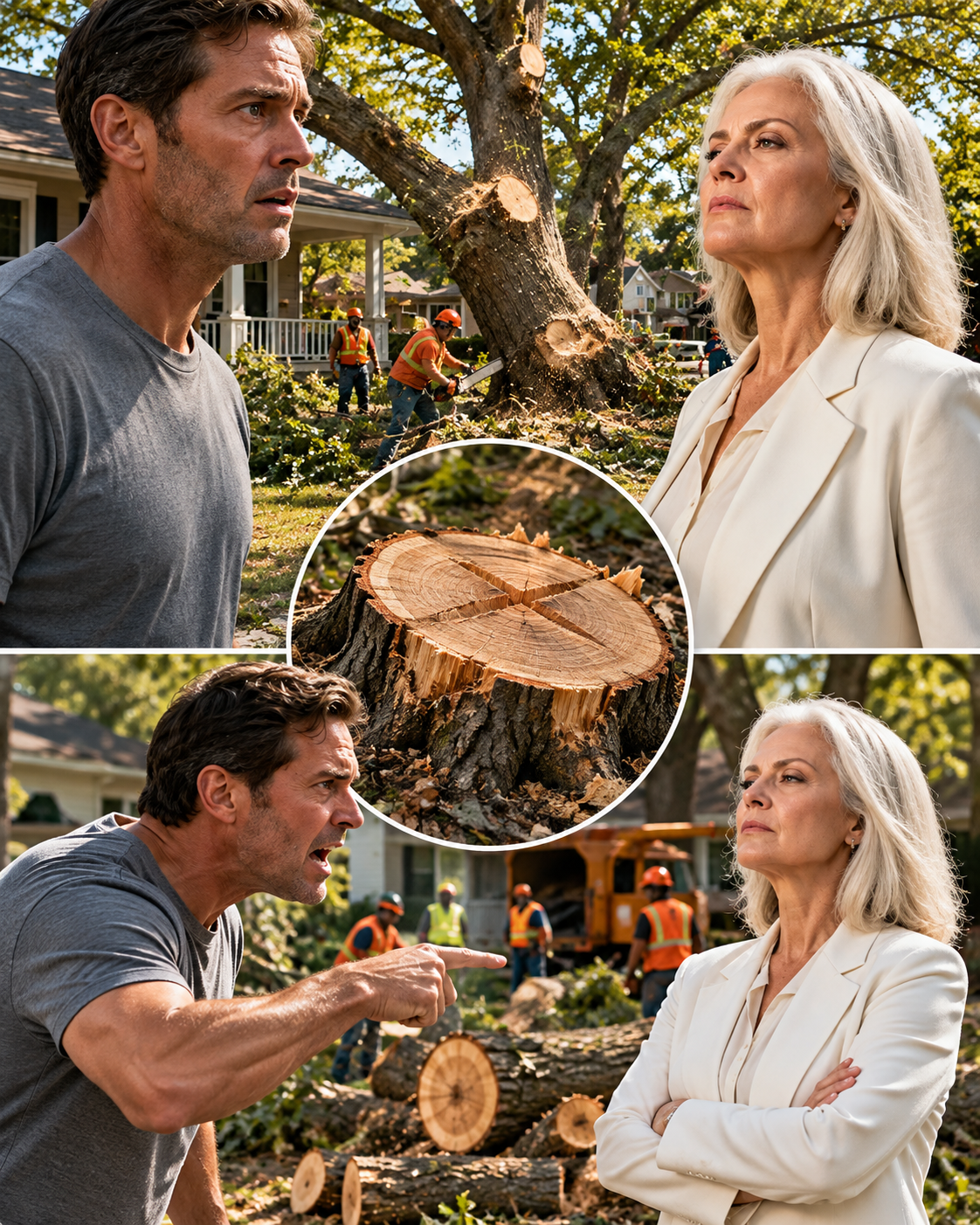
On a quiet Monday morning, Daniel Whitmore heard a chainsaw and ran outside
Part 2: Linda’s rulebook turns neighborhood disagreements into a personal campaign
Daniel’s return to Hollow Creek had felt like a homecoming rather than an investment decision, though real estate had made him wealthy. The house belonged to his family long before he inherited it, a single-story place with faded shutters and a porch that creaked at the same familiar spots. Behind it, the two white oaks rose above the roof, their wide branches holding the afternoon light over nearly half the yard. They had survived storms, recessions, and the passing of three generations, becoming part of the family in a way that deeds and photographs could never fully describe. To Daniel, the trees were not landscaping; they were the closest thing he had to a living conversation with his grandfather.
He had no interest in neighborhood politics when he moved back, but Linda Sinclair made it difficult to avoid them. For nearly six years, she had served as president of the homeowners association, treating its rules as both law and personal command. She could recite obscure bylaws about fence heights, mailbox colors, and lawn edges, often quoting them before anyone had asked. Her heels clicked down the sidewalk with the certainty of someone who expected doors to open before she reached them. Residents learned that even a small disagreement could earn them a warning letter signed in her precise handwriting.
Daniel tried to treat her notices as minor irritations, a familiar cost of living in an organized community. A fine arrived because autumn leaves had collected along his fence, though other yards held more leaves and drew no complaints. Another letter demanded that he repaint a section of fence that looked no worse than the neighbors’ fences. He paid little attention to either dispute, choosing to repaint and move on rather than waste his time over small amounts. But when Linda demanded that he cut the oak canopies nearly in half, he understood that the matter had changed.
Her letter claimed the trees cast excessive shade across the street and harmed the association’s landscaping standards. It threatened escalating weekly fines unless Daniel completed the work to Linda’s satisfaction. He read it twice, then responded through the official appeal process with county zoning records, heritage-tree certifications, and historical documents confirming the oaks’ age. He expected the material to settle the issue, since the trees were protected and the association had no authority to destroy them. Linda treated his thorough response as a challenge to her command.
Behind closed doors, she began telling board members that the trees were dangerous. She blamed their roots for damage that no inspector had documented and described falling acorns as a threat to the sidewalks. She spoke with enough confidence that some board members accepted her claims without asking for proof. Yet her goal had been clear from the beginning: she wanted those trees gone, and she had no intention of waiting for an appeal. Daniel, who had spent years learning to distinguish a bad deal from a temporary setback, recognized that the dispute had become personal.
On the morning of the removal, the crew had arrived before the required notice period expired. Daniel pleaded with the foreman and called county officials, but the saws kept running while his calls waited in queues. The first branch fell before anyone could explain who had approved the work, and the second tree followed before the hour was over. When Linda dismissed his grief and promised the yard would look better with new landscaping, Daniel did not shout. He looked at the torn ground, at the initials Ethan had carved somewhere among the branches, and understood that a fight had begun whether he wanted one or not.
Part 3: The fallen trees become evidence, and the neighborhood begins speaking
For several days after the destruction, Daniel said almost nothing about what had happened. He canceled meetings, left calls unanswered, and refused the association’s vague offers of landscaping credits. None of those gestures could return the shade, the swing, or the years contained in the trees’ rings. The empty space in the yard seemed larger each morning, especially when the sun crossed it without interruption. Daniel felt the loss as grief, but he decided not to let grief make his decisions for him.
He began with the cameras around his house, watching the footage until every minute of the removal had been recorded in his mind. The timestamps showed the crew arriving before the required waiting period had ended. A neighbor soon offered doorbell footage that captured Linda personally directing the workers toward specific limbs. Her voice came through clearly, confident and impatient, as she urged them to continue. The video left little room for the explanation that the crew had simply misunderstood the order.
Daniel then requested the association’s correspondence with the tree company under the same disclosure rules Linda often quoted to residents. The emails included a message she had sent nearly two weeks before the cutting began. She had told the contractor to proceed without waiting for Daniel’s appeal to conclude. The contractor had apparently asked whether all approvals were in place, and Linda had assured him the paperwork could be handled afterward. Each new document made the removal look less like a rushed mistake and more like a decision made in advance.
The most revealing evidence came from an employee in the association’s management office. Disturbed by what she had witnessed, the employee quietly sent Daniel internal meeting minutes that were never distributed to residents. The notes recorded Linda telling the board to move ahead immediately and deal with any lawsuit later. That line changed how Daniel understood the entire incident. Linda had known there could be consequences, yet she believed the consequences would be manageable and that Daniel would never make the effort to pursue them.
Meanwhile, word spread through Hollow Creek, and neighbors began appearing at Daniel’s fence. Some apologized for assuming the removal had been properly approved, while others admitted they had doubted Linda’s decisions for years but stayed silent. An elderly neighbor recalled the oaks when they were saplings, barely taller than she was, and cried as she spoke about them. Their support did not bring the trees back, but it gave Daniel something useful: witnesses who knew the difference between a community decision and one person’s command. It also revealed how long Linda had been allowed to act without serious scrutiny.
Daniel’s lawyers began assembling a civil case for trespass, property destruction, and violations of the association’s own procedures. Arborists came to inspect the remaining roots, photograph the site, and calculate the ecological and historical value of what had been lost. Their estimate climbed past one million dollars, a figure that included the trees’ environmental contribution and their documented heritage status. Daniel studied the report in silence, aware that no payment could replace the century the trees had taken to grow. He had enough evidence to file immediately, but he asked his attorneys to wait while he considered the larger consequences.
Part 4: A hidden loan gives Daniel unexpected leverage over Linda’s headquarters
Before returning to Hollow Creek, Daniel had spent two decades building a quiet real estate business. He had learned to read the documents that most people skimmed, to recognize a distressed asset before its value became obvious, and to wait patiently when other investors rushed. One of his earlier investments involved Crestwood Business Park, a mid-sized office complex that had struggled after several major tenants left. A bank, tired of managing the risk, sold its troubled mortgage to a private investment group. Daniel owned that group through a holding company whose name rarely appeared in everyday business conversations.
The complex eventually stabilized and began attracting law firms, insurance agencies, and local organizations seeking affordable space outside downtown. Among the tenants was the Hollow Creek Homeowners Association, which rented a modest second-floor suite with frosted glass doors and a small waiting room. Linda had never wondered who held the building’s mortgage or who stood behind its financial structure. To her, the association’s office was simply another monthly expense, like printer paper or landscaping contracts. She had not realized that the quiet homeowner she treated as an inconvenience was also the principal behind the creditor on the building.
Daniel learned that the association had accumulated unresolved obligations connected to the property. Late payments and mismanaged expenses had left a balance that the board had never adequately addressed. Those issues had existed before the oaks were cut, and Daniel had not created them for the sake of revenge. Still, he understood that the association’s financial condition might expose a pattern of behavior that residents had never seen. He instructed his legal and investment teams to examine the obligations carefully and document every step.
As Daniel worked, Linda’s behavior grew more aggressive rather than less. She began issuing fines for the stumps, calling the remains an eyesore, and insisting that Daniel pay for their removal and replacement landscaping. She also circulated stories that he had violated multiple regulations and was refusing to cooperate with the association. Her threats included placing a lien on his property if he continued to ignore her demands. Daniel did not respond publicly, but his attorneys added every notice and threat to the growing record.
The association’s management office began receiving formal letters about the outstanding obligations at Crestwood. The first notice looked ordinary enough to be set aside among invoices and routine mail. Linda glanced at it and assumed it came from some generic financial entity, never bothering to ask what the terms required. Three days later, a certified courier delivered a second notice with court documents initiating foreclosure proceedings tied to the unpaid obligations. The office staff scrambled to learn who held the mortgage and why the process had suddenly moved forward.
When the answer came back, Linda read Daniel’s name more than once. She first assumed it had to be a clerical error, because the quiet man from the neighborhood could not possibly control the debt now threatening the association’s office. But public filings confirmed the connection. The man she had treated as powerless had been the building’s creditor all along. Her authority had rested for years in a room whose future she had never bothered to understand.
Part 5: Missing funds and false minutes expose a much deeper association scandal
The foreclosure notice sent the board into a panic, and members began demanding answers Linda could not provide. They wanted to know why the association’s obligations had been ignored, why the trees had been removed without a vote, and whether the office would soon be lost. At first, Linda called the legal action a misunderstanding and promised to resolve it. Yet the more the board examined its records, the more they found discrepancies unrelated to Daniel’s mortgage. The tree dispute had opened a door into years of unchecked spending.
One board member compared vendor authorizations against meeting records and noticed that signatures did not match the listed approvers. Reserve funds intended for community infrastructure repairs had been recorded as administrative expenses without clear documentation. Several large invoices carried Linda’s signature alone, even though the bylaws required approval from more than one officer above a certain amount. The tree removal had never received a proper board vote. Linda had approved the work herself and paid for it with association funds.
Then the board discovered that the minutes claiming collective approval had been created after the removal. Their dates and wording did not match other records, and the employee who had sent Daniel the original notes confirmed that the official version had been altered. The problem was no longer simply a ruthless president making an unauthorized decision. The records suggested that Linda had used the association’s authority and money as if both belonged to her personally. Residents who had once avoided meetings suddenly wanted to know what else had been hidden.
An emergency meeting filled the association’s room beyond capacity. Residents crowded into folding chairs and lined the walls, carrying copies of notices, invoices, and questions they had waited years to ask. Linda stood at the front, straightening her papers and trying to maintain the composure that had served her for six years. But each time she promised that she would handle the matter, another resident asked for a specific record or a clear explanation. The crowd no longer accepted confidence as proof.
Board members who had supported her began distancing themselves as they realized the consequences could fall on everyone. Linda tried to blame the contractor for the tree removal and the management staff for the financial confusion. But the email trail, signed work orders, and fabricated minutes pointed directly back to her. Daniel sat through the meeting without interrupting, watching residents reclaim a space they had once left entirely under her control. By the end, Linda stood alone in front of a room that had once obeyed her.
The association launched an independent review and suspended Linda’s authority while the records were examined. Daniel’s attorneys filed the case over the oaks, supported by video, witness testimony, tree valuations, and the association’s own records. His investment company continued the foreclosure process based on the association’s unresolved obligations, following the terms attached to the debt. The two matters moved along separate legal tracks, though they converged in the same public crisis. Linda could no longer wave away either the trees or the money.
Part 6: In court, witnesses describe the morning the oaks were destroyed
The courtroom was crowded on the day the case reached a hearing. Residents of Hollow Creek came to watch, some hoping for accountability and others still uncertain about what the evidence would show. Daniel arrived with his lawyers and the arborists who had assessed the trees. Linda sat with her own legal team, keeping her eyes on the table as the proceedings began. The judge asked both sides to present their evidence in order.
The arborists testified first, explaining how the oaks had supported the soil, stored carbon, shaded the property, and contributed to the neighborhood’s value. Their calculations could estimate some of those losses, but they emphasized that no formula could make a century-old tree grow back overnight. They described the county documents that classified both oaks as protected heritage trees. The testimony was calm and technical, yet it made the loss feel larger with every detail. Daniel listened as strangers put precise language to a grief he had struggled to explain.
The contractor then admitted that Linda had personally directed the crew to begin work, despite his concerns about whether the required approvals were complete. She had told him the association would handle any paperwork later. An employee from the association confirmed that Linda had said the work should proceed even if Daniel tried to sue. Neighbors described watching Daniel beg the crew to stop as the trees came down. Video footage showed Linda pointing toward the branches while the saws ran.
The association’s attorneys tried to shift responsibility to the contractor, suggesting that the crew had exceeded the requested scope. But the contractor’s testimony and Linda’s own instructions undermined that argument. Daniel spoke briefly about the morning of the removal and what the trees had meant to his family. He did not raise his voice or try to make the courtroom feel sorry for him. He answered each question honestly, then let the documents and witnesses carry the rest of the case.
The judge found the homeowners association liable for the intentional destruction of protected heritage trees. The ruling ordered substantial damages to address the ecological and historical loss. It also found Linda personally responsible for acting outside the scope of properly authorized association business. The broader membership, which had not approved the removal, would not be required to carry the full weight of her actions. For the first time since the chainsaws started, Daniel felt that someone in authority had acknowledged what had actually happened.
The financial investigation continued alongside the court case. Auditors reviewed the reserve accounts, questioned the vendor payments, and compared board approvals against the altered minutes. Linda resigned before the inquiry concluded, but resignation did not erase the records. The association brought its findings to the appropriate authorities, and Linda faced separate consequences for the financial misconduct. Daniel remained focused on the trees, though he understood that the destruction had exposed a much wider failure of oversight.
Part 7: Linda leaves the office she thought placed her beyond consequences
While the court considered the tree case, the foreclosure proceedings at Crestwood Business Park continued under their own timetable. The association’s unresolved obligations and entangled finances left few realistic ways to preserve its lease. Daniel’s company issued formal notice that all tenants would need to renegotiate their arrangements or leave within a transition period. The process followed the original loan terms and the legal steps already underway. There was no secret trap waiting behind the paperwork; the association’s financial records and missed obligations had brought it to this point.
For the residents, the pending move was another blow after the revelations about the association’s finances. They had to decide how to maintain services, keep records accessible, and conduct an election while the old board was under investigation. Several residents volunteered to help, and the management company provided copies of the books for an independent review. The community held a special election and chose new leaders who promised regular financial reports and open meetings. Their first task was to rebuild trust among people who had learned how easily silence could be mistaken for consent.
Linda’s departure from the Crestwood office became a neighborhood story, though it was not the spectacle she might once have imagined. She carried a cardboard box filled with papers and personal belongings through the lobby, her heels no longer clicking with the certainty of someone who controlled the room. Daniel was there because his company was overseeing the building’s transition to its next phase of tenants. They met eyes for a moment in the parking lot. He said nothing, and she looked away first.
Daniel did not celebrate her humiliation, nor did he gather friends to mark the moment. He understood that seeing Linda lose her office did not restore his grandfather’s trees or recover the mornings Ethan had spent beneath them. The legal judgment mattered because it established responsibility, not because it offered a satisfying reversal. For years, Linda had acted as if authority meant she could do whatever she wished. Now the association and the court had made clear that power came with limits.
The residents who had once stayed quiet came to Daniel and apologized on behalf of the neighborhood. They admitted they had let Linda’s position intimidate them and had confused keeping the peace with doing what was right. Daniel accepted their words without asking them to feel guilty forever. He told them the community still had a chance to make better decisions from that day forward. What mattered now was building rules and habits that no single person could quietly bend.
The new board rewrote its financial procedures, required multiple approvals for significant expenses, and made meeting records available to residents. It created a process for appeals that allowed homeowners to be heard before any irreversible action took place. A portion of the damages funded a county conservation program for heritage trees at risk of removal. Another portion helped plant new oaks throughout Hollow Creek and expand green space in a nearby public park. Daniel wanted the money to become something the neighborhood could live under, rather than a reminder of what had been taken.
Part 8: A young oak takes root where three generations once found shade
Several months after the court’s decision, Daniel returned to the backyard with Ethan on a quiet Saturday morning. The ground still bore traces of the old root systems, though grass had begun to grow over the disturbed earth. The place where the canopies had once met above them was open to the sky. Ethan carried a white oak sapling wrapped in burlap, its thin trunk scarcely thicker than a broomstick. Daniel carried a shovel and a watering can.
They chose the spot where the taller tree had stood and began to dig. Ethan asked whether the young tree would ever become as large as the old oaks. Daniel said it would take patience, rain, sunlight, and care, and that neither of them might live to see it reach the same size. The answer made Ethan quiet for a moment. Then he placed his hands in the soil and helped pack the earth around the small roots. The sapling leaned slightly in the breeze but held its ground.
Daniel told his son that a tree could take hundreds of years to grow tall enough to shelter a family. It could take only one person, acting without thought or restraint, to destroy it in a morning. But the lesson was not that they should spend their lives waiting for revenge. It was that people needed to protect what could not be replaced and to speak when someone used authority carelessly. Ethan listened, looking from the young tree to the open patch of sky above it.
The damages had helped establish a heritage-tree fund, supported new plantings, and paid for a public park improvement. Children who would never know Daniel’s family story would have more shade and room to play. In Hollow Creek, residents began meeting regularly and asking questions about decisions that affected their homes. The new board was not perfect, but its members understood that trust required openness and shared responsibility. Gradually, the neighborhood learned to see participation as a form of care.
Daniel still missed the old trees. Sometimes he caught himself glancing toward their former branches when he walked through the yard, expecting to see the familiar shadows shifting over the lawn. He had kept a small piece of the fallen wood, not as a trophy but as a reminder of the price of indifference. Ethan’s initials had not survived in a form anyone could recognize, yet his son had left a new mark by helping plant the sapling. The family’s story had not ended with the cut trunks.
As afternoon light stretched across the fresh soil, Daniel turned on the hose and watered the young oak. The water disappeared beneath the surface, reaching roots too new to hold the ground firmly yet. The leaves trembled, then steadied as the breeze passed. Someday, another child might swing from a branch there without knowing the full history of the yard. Daniel hoped that child would inherit a neighborhood where no one person could decide alone what everyone else must lose.
Part 9: The community chooses accountability, and the family begins again
The following spring, the new board invited residents to a gathering in the park. They planted young trees along the walking path, each one labeled with a small plaque explaining the conservation fund that had helped make the planting possible. Daniel attended with Ethan, though he stayed near the back while neighbors shared stories about the old oaks. Some remembered playing beneath them; others had never understood their age until the court case brought the records to light. The gathering was less a ceremony than a promise to pay closer attention.
The association’s finances were now reviewed by an independent accountant, and residents received clear reports about spending and reserves. Meetings were recorded, and board members had to disclose conflicts before voting on contracts. Those rules did not guarantee that every future leader would be wise or fair. They did make it harder for one person to act without leaving a trace. Hollow Creek had learned that oversight mattered most before a crisis, when it could still prevent harm.
Linda’s case continued in the public record, separate from Daniel’s civil suit. The investigation into the altered minutes and unauthorized spending took months, and the consequences were not decided by neighborhood gossip or Daniel’s investment company. That distinction mattered to him. He had sought accountability for the trees and the unauthorized use of association funds, not the power to dictate every part of Linda’s future. The legal process would determine what responsibility she owed under the law.
The Crestwood office eventually filled with new tenants, and the association moved into a smaller community space near the park. Residents chose the new location for its accessibility, not for the prestige of a private suite. It had a room large enough for meetings and windows that looked out toward the trees the community was planting. The association’s name appeared on a simple sign beside the entrance. No one needed to wonder who owned the building for the board to do its work.
Ethan’s oak grew slowly through its first seasons. Daniel checked it after storms and watered it during dry weeks, while Ethan took pride in noticing each new leaf. The sapling was fragile, and there were moments when Daniel feared the roots would not take. But the soil held, the branches strengthened, and the leaves returned after winter. Each year, the small tree grew a little taller, although the old oaks remained beyond comparison.
Years later, Ethan would bring his own child to the backyard and show them the young oak. He would tell the story of the trees his great-great-grandfather planted, the president who ordered them cut, and the neighbors who eventually spoke up. The story would include the courtroom and the financial records, but it would end with the sapling. Daniel hoped the child would understand that the point was not to admire a clever victory. It was to remember that communities survive when people protect one another’s rights and take responsibility for what they allow.
When Daniel stood beneath the young oak, its shade still too small to cover more than a patch of ground, he no longer saw only what had been lost. He saw the work of rebuilding, the neighbors who had changed, and the child who had learned to plant something he might never see fully grown. The past remained present in the rings of the old trunks and in the open space above the yard. But it no longer had the final say. Around the sapling, new roots reached into the earth, and the family’s history continued.
Ending—Some things take a century to grow and a moment to destroy, but justice can plant what arrogance tried to erase.
✓ Lynn R. Adams
Part 2: Linda’s rulebook turns neighborhood disagreements into a personal campaign Daniel’s return to Hollow Creek had felt like a homecoming rather than an investment decision, though real estate ha…