Nobody at Saint Matthew’s Academy knew the quiet father in the faded gray SUV
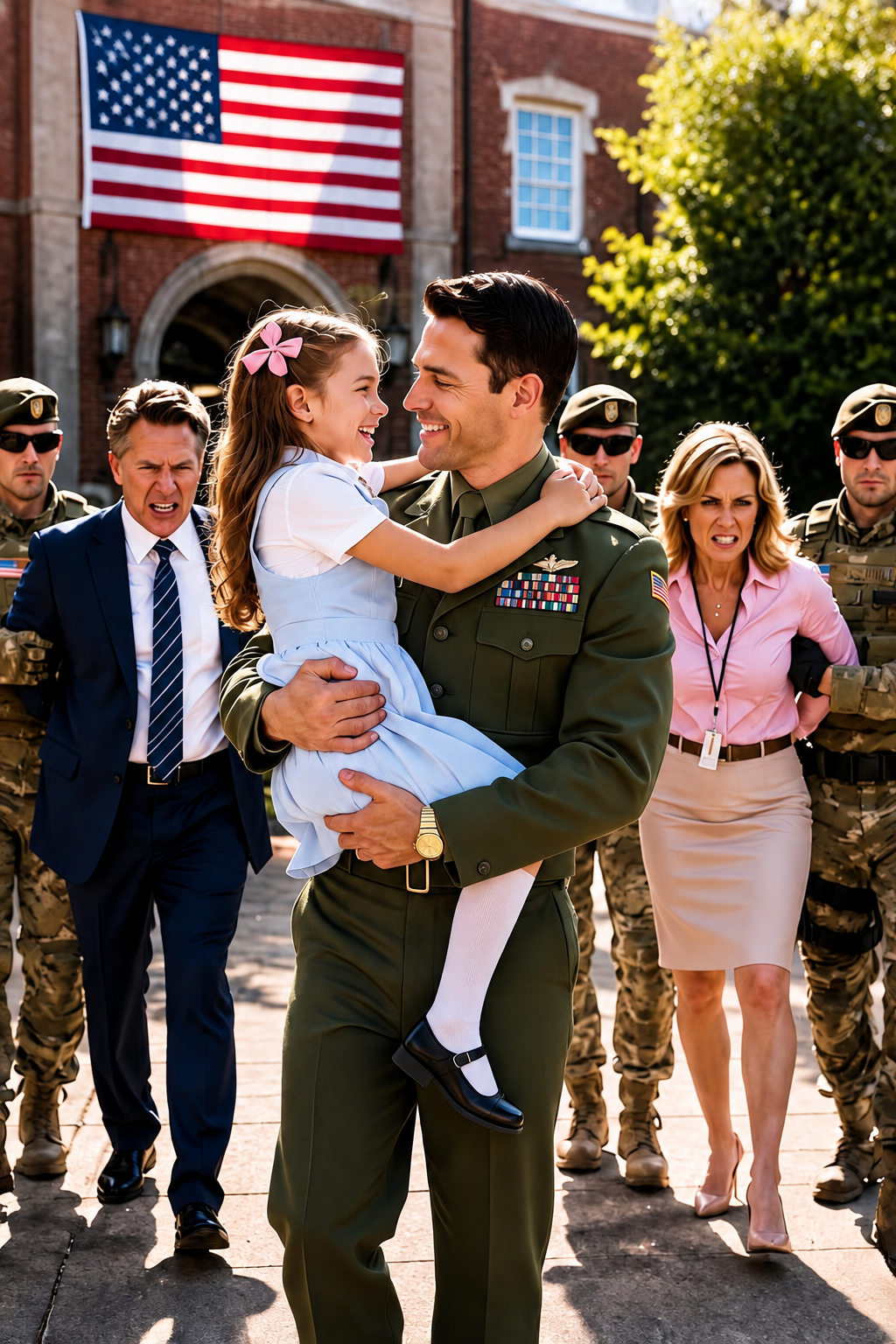
Part 2: Emily’s forbidden discovery revealed a child erased by the school.
Emily told investigators she had gone behind the auditorium searching for a missing pencil case when she noticed a service door standing open and heard crying beneath the stage, so she followed a narrow staircase into a basement filled with old scenery, broken chairs, and storage boxes. In the far corner she found a thin boy wearing a blue sweater, and although he looked older than her, he seemed terrified of footsteps upstairs and begged Emily not to tell Mrs. Gable she had found him. The detail Emily remembered most clearly was a silver bracelet around his wrist engraved with the number 472, and when she described it in Halloway’s office, the principal instinctively glanced toward a locked filing cabinet behind his desk. I had spent decades watching people during interrogations, negotiations, and battlefield briefings, and fear has a peculiar habit of directing a person’s eyes toward whatever they most desperately want protected. I told Halloway not to touch the cabinet, called my attorney Daniel Reeves, and within minutes local police and state child welfare investigator Marissa Cole were heading toward Saint Matthew’s.
Halloway ordered campus security chief Miguel Torres to remove me, but Torres instead produced copied surveillance footage showing Mrs. Gable leading Emily into the equipment room, shutting the door, and locking it from outside at that afternoon. Halloway demanded the recording, Torres refused, and when the principal shouted that Torres worked for him, the security chief answered, “I work for the board, and right now I work for that child,” which was the first moment I saw genuine fear replace arrogance in Halloway’s face. Marissa interviewed Emily in the nurse’s office, where my daughter described the hidden boy again: blue sweater, pale face, dark hair, silver bracelet, number 472. The school nurse dropped her pen and whispered, “Lucas Brennan,” then explained that Lucas had supposedly transferred out of Saint Matthew’s eleven months earlier and that staff had been instructed not to contact his family because they had moved overseas. Before anyone could ask another question, the fire alarm screamed through the building and smoke began pouring from beneath the auditorium.
Firefighters later determined the blaze had been deliberately started in the basement storage area, and during the evacuation Mrs. Gable disappeared along with part of Marissa’s evidence kit. Emily and I were standing behind an ambulance when she suddenly pointed toward the rear parking lot and screamed, “That’s him,” and I saw Mrs. Gable driving a gray sedan toward the gate with a frightened boy in a blue sweater beside her. Police vehicles blocked the exit before she could escape, officers pulled her from the car, and the passenger door slowly opened. A painfully thin child stepped onto the pavement wearing the silver bracelet Emily had described, and when Marissa approached him and said his name, Lucas Brennan ignored her completely. He looked through the crowd until his eyes found mine, and then he whispered two words that turned every head in the parking lot: “General Carter.”
I had never met that boy, but Lucas began crying as if he had spent years waiting for me, and from beneath his sweater he pulled a folded photograph whose edges had been worn soft by repeated handling. The picture showed Saint Matthew’s auditorium more than a decade earlier, with Halloway standing beside my wife Sarah while she held an infant wrapped in a hospital blanket. My wife had supposedly died three years earlier, and yet Lucas told me “Mrs. Carter” had given him the photograph shortly before she disappeared and promised that someday I would come for him. On the back was handwriting I would have recognized after a hundred years: Sarah’s. The sentence said, “John must never discover Lucas is our son.”
I read those words again and again while Emily held my hand, because Lucas looked about eleven, his gray eyes looked disturbingly like mine, and suddenly seventeen years of marriage seemed filled with rooms I had never entered. Yet the dates did not make sense, Sarah had never mentioned another pregnancy, and something about the photograph felt less like a confession than a message designed for someone else to find. Lucas was taken to a child advocacy center, where doctors documented malnutrition, old restraint injuries, and severe anxiety, while investigators discovered that he had spent months being moved among buildings connected to Saint Matthew’s. When asked why anyone would hide him, Lucas gave an answer that made the photograph almost irrelevant. “Because I remember the night Mrs. Carter was supposed to die.”
Part 3: My dead wife’s secret led directly into my own family.
Lucas said Sarah had planned to take him away from Saint Matthew’s shortly before her reported death, but someone stopped her because Lucas remembered seeing something involving a man Sarah called “the Architect.” While investigators worked through his fragmented memories, Daniel obtained financial records from Halloway’s office showing that Saint Matthew’s had received monthly payments for eleven years from an obscure corporation named Gray Meridian Holdings. The authorized representative on several transfers was Colonel Thomas Carter—my older brother, the man who had stood beside me at Sarah’s funeral, carried Emily when I could barely stand, and helped me lower what I believed was my wife’s coffin into the ground. I called him immediately, asked what he knew about Lucas Brennan, and heard the smallest hesitation before he denied knowing anything. When I mentioned Gray Meridian, Thomas disconnected the call.
Seconds later an anonymous message appeared on my phone containing four words—YOUR WIFE IS ALIVE—and a photograph taken only days earlier showed Sarah standing beside a window holding a current newspaper while Thomas stood behind her. The next morning I was ordered to Fort Belvoir, where Lieutenant General Marcus Vale informed me that I was temporarily relieved of command for improperly involving military resources in a civilian school dispute. Thomas sat beside him, avoiding my eyes, and when I placed Sarah’s photograph on the conference table, Vale dismissed it as fabricated before anyone had examined it. That mistake told me more than any confession could have because innocent men investigate impossible evidence while guilty men explain it away. I asked about Gray Meridian, Vale glanced at Thomas, and for the first time I understood that the threat surrounding my daughter had reached directly into the institution I had trusted most of my adult life.
Thomas followed me into the corridor after I walked out, and there he finally admitted that Sarah had discovered missing military procurement money flowing through charities and private schools controlled by Vale’s network. Thomas claimed he initially believed the transfers supported classified intelligence operations, then realized Gray Meridian was laundering stolen funds while gathering private information about senior military and government families through schools their children attended. By the time he understood the full operation, Vale possessed enough evidence of Thomas’s involvement to destroy him, and Thomas chose silence because he convinced himself silence was protecting us. Sarah’s death, he said, had actually been a protective disappearance intended to keep her away from Vale. I stared at my brother and told him that cowardice becomes especially dangerous when people rename it protection.
Back at the advocacy center, Lucas drew a large house beside a river and called it Bellweather House, a property investigators discovered belonged to Marcus Vale’s family. Meanwhile technicians examined the threatening note Emily had received and found impressions from another message written on the sheet above it: EMILY, FIND LUCAS. TRUST THE WOMAN WITH THE RED UMBRELLA. Emily remembered a woman carrying a red umbrella who had followed us through a train station weeks earlier and deliberately dropped a brass key near her backpack, which my daughter had quietly kept because she thought returning it someday would be “the responsible thing.” The key opened a locker at Union Station containing passports, financial ledgers, encrypted files, and a handwritten letter from Sarah. The first sentence said, “Lucas is not our son,” and the last said, “John, come to Bellweather House alone.”
I went shortly before midnight after giving Daniel copies of everything and arranging for the evidence to be automatically released if I failed to check in by sunrise. Bellweather House overlooked the Potomac from behind thick trees, and inside I discovered surveillance monitors showing Saint Matthew’s classrooms, hallways, the auditorium, and even the equipment room where Emily had been locked. Files categorized children according to their parents’ careers, marriages, debts, weaknesses, ambitions, and psychological vulnerabilities, and Emily’s folder contained a red label reading HIGH-VALUE SUBJECT—FATHER RESISTANT TO EXTERNAL INFLUENCE. The school had never merely been laundering money. It had been studying families, and children were the pressure points.
Then a floorboard creaked behind me.
Sarah stood in the doorway.
Part 4: I found my dead wife and learned our son survived.
Three years of grief collapsed into one impossible second as Sarah whispered my name, and although part of me wanted explanations before anything else, my body moved before my anger could stop it. I crossed the room and held the woman I had buried, and she held me back while repeating that she was sorry, until the memory of Emily standing beside an empty grave finally made me pull away. Sarah explained that she had discovered Gray Meridian while auditing a charitable foundation tied to defense contractors and learned that Vale’s network did more than steal procurement money. It gathered intelligence through elite schools, profiled powerful parents through their children, manufactured scandals when necessary, and used vulnerable families as leverage against judges, officers, contractors, politicians, and investigators. Lucas’s presumed mother, Megan Brennan, had uncovered part of the operation and died in a staged accident after Lucas witnessed enough to recognize Vale.
Sarah had hidden Lucas and deliberately created the false suggestion that he might be our son because she believed Vale would hesitate to kill a child potentially connected to a three-star general. When I asked why she had allowed Emily and me to mourn her for three years, Sarah said Vale had threatened our daughter and convinced her that contacting us would trigger retaliation. I wanted to understand, but understanding was not forgiveness, and I told her she had stolen years from Emily that no explanation could return. Then I asked the question I had avoided since seeing Lucas’s photograph: if Lucas was not ours, why had she written about “our son”? Sarah became completely still. She opened a locked file and placed a photograph of a teenage boy in front of me.
Before Emily was born, Sarah had delivered our first child prematurely while I was deployed overseas, and I had been told our son died only hours after birth. I returned home to a tiny grave, stood beside Sarah while she wept, and carried that loss for sixteen years without questioning the hospital records. Sarah told me the baby had survived. Marcus Vale had arranged for him to be removed from the hospital and raised under another identity as Ethan Vale, the publicly adopted nephew he frequently presented at military events. I had met Ethan twice. I had shaken my own son’s hand without knowing who he was.
Footsteps sounded upstairs before I could process it, and Thomas entered the basement with his hands raised while Vale followed behind him holding a pistol. Vale ordered Sarah and me against the wall and laughed when I told him copies of the files had already been distributed, insisting that documents did not destroy institutions because institutions knew how to survive scandals. “Documents don’t,” I told him. “People do.” When Vale aimed at Sarah, Thomas stepped between them, and Vale shot my brother through the chest.
I caught Thomas as he collapsed, but before Vale could fire again, federal agents flooded the basement because Daniel had used the evidence I sent him to obtain emergency warrants while I traveled to Bellweather House. Vale was arrested, Sarah entered protective custody, and surgeons managed to save Thomas. For one hour I believed the nightmare had finally reached its end. Then Marissa called and told me Emily and Lucas had disappeared from the advocacy center.
Security footage showed they had not been dragged away.
They had voluntarily left with a sixteen-year-old boy.
Ethan Vale.
Part 5: My stolen son had been raised to believe I abandoned him.
Ethan sent Sarah a message instructing both of us to enter the Saint Matthew’s auditorium alone at sunrise, and when we arrived, he stood beneath the dim emergency lights while Emily and Lucas waited several yards behind him. They were frightened but unharmed, and seeing Ethan clearly for the first time after learning the truth felt like looking at pieces of Sarah, my father, and myself arranged into a stranger. I told him to let the children go, but he demanded to know why I had never searched for him. When I said I believed he had died as a newborn, Ethan answered, “That’s exactly what General Vale said you would claim.”
Sarah stepped toward him and called him Ethan, but he snapped that General Vale was his father because Vale had raised him, educated him, protected him, and given him everything. “Everything except the truth,” I said, and his expression changed because the sentence reached somewhere anger could not protect. Sarah placed the hospital bracelet she had secretly preserved on the stage, its faded letters reading BABY CARTER, and told Ethan she had searched for him for years before Vale convinced her that exposing the kidnapping would destroy our entire family. Vale had told Ethan she surrendered him willingly, told Thomas cooperation protected everyone, and told Sarah disappearance protected Emily. Different lies, same weapon: fear.
Emily suddenly stood and told Ethan that if he truly wanted the truth, he could not demand it while holding people somewhere against their will because that was exactly what Halloway had done to her. My daughter was eight years old and standing in front of a traumatized teenager who had kidnapped her, yet somehow she understood what the adults in that room had forgotten: power without consent was merely another form of imprisonment. Ethan looked at her, then at Lucas, and something in his posture softened. Before he could respond, Thomas entered the auditorium pale, bandaged, and barely able to stand. He confessed that sixteen years earlier he had personally carried Ethan from the hospital after Vale falsely told him the transfer was part of a classified protective operation.
Thomas then played recordings copied from Vale’s private archive, and Vale’s own voice filled the auditorium: “The Carter boy remains effective leverage,” followed by instructions to redirect Ethan’s attachment toward Vale and to use Emily if I ever became uncontrollable. Ethan’s face went blank because in less than a minute his entire childhood had been transformed from a family story into an operational plan. I approached him slowly and told him he did not have to love us, forgive us, live with us, or call me Dad. He only had to make the next decision without Marcus Vale making it for him. After a long silence, Ethan looked toward Emily and Lucas and whispered, “Take them home.”
Metal shutters slammed over the auditorium doors before anyone could move, and chemical smoke began pouring through the ventilation system while Halloway’s voice crackled from the projection booth. He had escaped the first wave of arrests and returned to destroy what remained, still convinced the frightened parent he once threatened could be forced into submission. Lucas remembered a maintenance passage beneath the stage from the months he had been hidden there, and we forced open the hatch while smoke thickened around us. Emily crawled first, followed by Lucas, Sarah, and Ethan, but Thomas remained behind to operate the manual release controlling the tunnel gate.
I told him he could still escape, but Thomas shook his head and said he had spent years allowing other people to pay for choices he was too afraid to face. “You don’t fix that by dying,” I told him, and he answered that perhaps he could begin fixing it by making sure Ethan lived. The gate descended between us as Thomas handed me Vale’s recorder, and emergency teams later found him beneath collapsed machinery, barely alive but breathing. Halloway was arrested in the projection booth, and investigators recovered files documenting altered adoptions, falsified hospital records, missing children, and decades of surveillance. Among the photographs was one showing Megan Brennan beside Sarah and another woman holding a red umbrella.
Sarah stared at the picture.
“That’s Claire,” she whispered.
Her sister.
A woman she had believed dead for twenty years.
Part 6: The woman with the red umbrella revealed the final betrayal.
Claire surrendered herself to federal investigators three days later carrying boxes of records she had protected through two decades of false identities, and when Sarah saw the sister she had mourned since college, neither woman managed a word before collapsing into each other’s arms. Claire had investigated Gray Meridian with Megan Brennan years earlier and had been forced underground after Vale discovered how close they were to exposing him. She was the woman who had followed Emily, dropped the brass key, and trusted an eight-year-old to carry the one piece of evidence adults around her would never suspect. When I asked why she had placed that responsibility on my daughter, Claire gave an answer I never forgot. “Because Emily was the only person Gray Meridian underestimated completely.”
Everyone had underestimated her: Mrs. Gable believed dyslexia meant stupidity, Halloway believed fear meant obedience, and Vale believed children were useful only as leverage against adults. Emily had defeated all three assumptions simply by paying attention to things everyone else ignored. Claire’s records led to indictments across several states involving kidnapping, obstruction, unlawful surveillance, fraud, conspiracy, and financial crimes, while Mrs. Gable eventually admitted she had locked Emily away under Halloway’s orders because Emily’s questions about Lucas had become dangerous. She had known Lucas was hidden beneath the auditorium, delivered food to him, helped move him between properties, and still described herself as someone who was “only following instructions.” The prosecutors were not impressed.
Halloway attempted to portray himself as another victim of Vale until recordings revealed that he had personally selected vulnerable students, designed intimidation tactics, and threatened parents who challenged the school. Saint Matthew’s closed, its board established a compensation fund, and dozens of families filed lawsuits. I refused every settlement requiring confidentiality because I would not allow Emily’s suffering to become another secret purchased by an institution. The Army reversed my suspension and offered to restore my command. I declined.
For the first time since I was twenty-one, I understood that service and rank were not the same thing, and I wanted to spend whatever years remained serving the people whose voices powerful institutions found easiest to ignore. I retired quietly, with Emily wearing a blue dress, Sarah and Ethan standing together, Lucas sitting beside Claire, and Thomas watching through a secure medical connection while awaiting trial. When the folded flag was placed in my hands, Emily whispered, “Are you still General Dad?” I told her unfortunately yes, and her laugh was the first sound I had heard in months that did not carry an echo of that locked storage room.
Then DNA testing delivered one final shock.
Lucas was not Megan Brennan’s biological child.
Claire was his mother, and she had given birth during a period of captivity so traumatic that portions of her memory had disappeared; Vale’s doctors told her the infant died, then secretly placed him with Megan. The report identifying Lucas’s biological father was even harder to read. Thomas Carter.
My brother eventually admitted that he and Claire had been secretly involved while investigating procurement irregularities, and when Vale discovered the pregnancy, Lucas became the perfect weapon for controlling Thomas. Thomas spent years telling himself cooperation kept his son alive, yet the same cooperation ultimately financed the system that imprisoned Lucas. When Lucas finally agreed to meet him, their first conversation lasted seven minutes, the second eighteen, and neither ended with forgiveness. But Lucas returned the following Sunday.
Sometimes healing was not forgiveness.
Sometimes it was simply choosing to return.
Part 7: Emily transformed the room designed to make her feel powerless.
One year after Saint Matthew’s closed, survivors, military families, educators, and local donors reopened part of the property as a nonprofit school specializing in children with learning differences and trauma histories. Sarah wanted the equipment room demolished, but Emily refused because she said destroying it would make it too easy for future adults to pretend nothing happened there. Instead, the heavy door was removed, one concrete wall was replaced with glass, warm lamps and books filled the space, and colorful cushions covered the floor. Emily named it the Open Door Room. The basement chamber where Lucas had been hidden became a library.
Lucas chose its first book, Ethan designed the school’s computer lab, Claire created a scholarship in Megan Brennan’s name, and Sarah returned to forensic accounting to help nonprofits identify financial corruption before money became institutional control. I began teaching leadership workshops for educators, veterans, and public administrators, and my first lesson never changed: authority is not measured by how quickly frightened people obey you. It is measured by whether vulnerable people become safer when you enter the room. That was a lesson three stars had never taught me as clearly as one terrified eight-year-old had.
When Emily turned eleven, she asked to watch the original video from the afternoon I found her, and although I warned her she did not owe that memory anything, she said she wanted to see who she had been. We watched tiny Emily standing beside Mrs. Gable with tears on her face, watched Halloway threaten her future, and watched her younger self struggle to explain that she had not been reading slowly on purpose. When the recording ended, Emily remained silent for almost a minute. Then she said, “I believed her.”
I asked what she meant.
“I believed Mrs. Gable when she said I was slow.”
I told Emily she had never been slow, and she nodded because she already understood what I was trying to say. “I read differently,” she replied, “and because I notice things differently, I heard Lucas when everybody else missed him.” A smile slowly appeared on her face. “Maybe being different helped.”
“Maybe,” I said, pulling her against me, “it saved lives.”
Ethan’s return to our family was slower and more painful because sixteen years of manipulation could not be erased by a DNA report. For months he called me John, occasionally General, and never Dad, and I never asked him to change that because love demanded freely was simply another kind of control. Then one morning he walked into the kitchen, asked, “Dad, have you seen my keys?” and immediately froze. I froze too.
Sarah began crying into her coffee.
Emily rolled her eyes.
“Everybody is making this weird.”
Ethan laughed, and somehow that laugh did what years of evidence could not: it made the house feel like a family home rather than a recovery site.
Thomas eventually pleaded guilty and refused to minimize his crimes, admitting his role in Ethan’s abduction, the concealment of evidence, and the financing that helped keep Lucas imprisoned. At sentencing he told Lucas that fear of losing him had become the excuse Thomas used to participate in stealing his childhood. He did not ask for forgiveness. Afterward Lucas asked me whether I hated my brother.
“Sometimes,” I answered.
“Can you love somebody you hate sometimes?”
“That sounds complicated.”
“Family usually is.”
Emily overheard us and announced that she personally was not complicated.
Lucas laughed.
“You are the most complicated person here.”
She threw a pillow at him, Ethan joined the fight, and within seconds the children were yelling and laughing like siblings instead of witnesses in somebody else’s criminal case.
That sound mattered more to me than every guilty verdict combined.
Part 8: They believed power came from rank; Emily proved it came from truth.
Five years after I opened the storage-room door, thirteen-year-old Emily stood on the rebuilt auditorium stage before hundreds of students, parents, teachers, veterans, survivors, and investigators. She still read more slowly than some classmates, and sometimes she paused in the middle of long words before starting again, but nobody hurried her anymore. “My teacher once told me I was too slow to understand,” she began, and the auditorium became completely silent. “She was partly right. I was slow to understand why adults who were supposed to protect children sometimes used fear instead.”
Emily looked toward the glass walls of the Open Door Room and said she had eventually learned something those adults never understood: frightening another person did not make someone powerful; it merely proved they needed fear because they had nothing better. Then she looked directly at me and said that when she was eight, she believed I saved her because I was an Army general. “But Dad never brought soldiers to scare my teacher,” she said, drawing nervous laughter from the audience. “He listened to me. He believed me. He saved the evidence. And when important people told him to stop, he kept telling the truth.”
She pointed toward Lucas, Ethan, Sarah, and Claire, explaining that each of them eventually did the same thing, and even Thomas finally stopped hiding behind excuses and told the truth about what he had done. “That’s what changed everything,” Emily said. “Not rank. Not money. Not fear. People deciding that the truth mattered more than protecting themselves.” The audience rose in applause.
I stayed seated.
I was crying too hard to stand.
Afterward Emily ran toward me and asked whether her speech had been okay, and I hugged her and told her she had commanded a room better than most generals I had ever known. She immediately asked whether that meant she outranked me. I told her apparently it did.
Outside, children crossed the courtyard where police cars had once trapped Mrs. Gable’s fleeing sedan, and families walked through doors deliberately designed never to lock during operating hours. Beneath the old oak tree stood a small plaque containing no military ranks, donors, politicians, or administrators. Emily had chosen the inscription herself: Every child deserves to be believed before they learn to be afraid.
Vale would spend the rest of his life answering for the machine he built, Halloway would never control another school, Mrs. Gable lost the authority she once used as a weapon, and Thomas remained incarcerated for crimes he finally stopped pretending were acts of protection. Those consequences mattered, but punishment was never the ending I remembered most. What I remembered was the afternoon Emily voluntarily entered the Open Door Room for the first time after its renovation, stood where I had once found her crying in darkness, picked up a book, and told me to sit down because she wanted to read to me.
She struggled with several words.
She paused.
She started again.
Nobody hurried her.
Nobody laughed.
Nobody called her slow.
When she finished the page, Lucas applauded theatrically from the doorway, Emily threw a cushion at him, Ethan joined the attack, Sarah laughed until she had tears in her eyes, and Claire arrived carrying snacks. I stood in the same room where my daughter had once believed nobody would come for her and finally understood something Halloway never had. My rank had not destroyed his world.
An eight-year-old girl with dyslexia had heard another child crying beneath a stage when adults had trained themselves not to hear anything inconvenient. She remembered the number on his bracelet, protected a mysterious key, told the truth after adults threatened her future, and refused to accept their definition of what her mind could do. I had commanded thousands of soldiers, made decisions under fire, and entered rooms where national security depended on what happened next, yet the bravest Carter I ever knew remained the little girl who sat among gym mats in complete darkness and kept listening because somewhere nearby another child needed help.
Years later, people occasionally recognized me during school events and whispered, “That’s General Carter,” which irritated Emily tremendously because she would immediately correct them: “He’s retired.” Then she usually added, “And I outrank him.”
She was right.
On the fifth anniversary of the Open Door School, our family gathered beneath the oak tree with a wooden memory box. Lucas placed his silver bracelet inside, Ethan added the Vale family crest he no longer wanted, Sarah contributed the false death certificate that had erased three years of her life, Claire added the red umbrella keychain she carried while living underground, and Emily placed the brass Union Station key inside last. She asked whether we were going to bury the box.
“No,” I said.
“Because surviving something doesn’t mean pretending it never happened.”
Emily considered that and closed the lid.
We placed the box inside the school archive instead.
Truth had already spent enough time underground.
That evening Sarah and I sat outside watching the children race across the lawn while Ethan accused Lucas of cheating, Lucas insisted Emily kept changing the rules, and Emily loudly explained that changing the rules was allowed because she had invented the game. For decades, Gray Meridian had survived because powerful men believed secrecy was strength. They stole children, manufactured deaths, destroyed records, corrupted institutions, threatened careers, and locked frightened people behind doors until silence became easier than resistance.
They almost succeeded.
Their entire system collapsed because one eight-year-old girl refused to forget the sound of a boy crying beneath a stage.
Sarah rested her head against my shoulder and asked whether I still thought about the afternoon I opened that equipment-room door.
“Every day.”
“What part?”
“The moment I saw Emily.”
Sarah waited.
“I thought I was rescuing her.”
“You were.”
I watched our daughter grab Lucas by the arm and drag him toward the library while Ethan followed behind them.
“No,” I said quietly.
Sarah looked at me.
“I think she was opening the door for all of us.”
The sun disappeared behind the school roof, and lights came on beyond the glass walls where concrete and locked doors had once hidden frightened children. Every hallway remained visible. Every classroom remained open. Every child inside knew that struggling did not make them weak, being different did not make them defective, and speaking the truth did not require permission from someone more powerful.
My entire career had taught me how to command.
My daughter taught me something harder.
How to listen.
And after everything our family survived, that was the only kind of power I ever wanted again.
✓ Lynn R. Adams
Part 2: Emily’s forbidden discovery revealed a child erased by the school. Emily told investigators she had gone behind the auditorium searching for a missing pencil case when she noticed a service d…