No one wanted to fight for the paralyzed soldier in room 318, until a quiet nurse noticed the tiny pattern
IF FACEBOOK BROUGHT YOU HERE, HERE’S THE CONTINUATION YOU’VE BEEN WAITING FOR. ENJOY! 👇 The surgery lasted four hours and nineteen minutes. Dr. Kim decompressed the collection and relieved the pressure on Tobias’s spinal cord. She also found signs of an inflammatory process that did not fit the usual post-traumatic picture, so she took samples and waited for further results.
At two in the morning, while Ingrid waited in the surgical corridor, Colonel David Strang arrived through the service entrance with a younger officer and a folder under his arm. He was fifty, broad-shouldered, close-cropped gray hair, and carried the calm of someone accustomed to arriving in the middle of a crisis. He recognized Ingrid before she recognized him. “Solberg,” he said, then quietly used her old call sign: “Compass.”
Strang told her the military had been monitoring Tobias’s care file for two months because of concerns about his prognosis and Dr. Ashby’s research interests. Lars had discovered a signed consent form dated three weeks earlier, enrolling Tobias in a neural implant clinical trial run by Cortex Biomedical, a private company with federal rehabilitation contracts. The signature was supposedly Tobias’s, although he had been unable to hold a pen for fourteen months.
“He needed him non-responsive,” Ingrid said. Strang explained that Cortex wanted a high-profile candidate: a decorated veteran with a catastrophic injury, whose case could support grant applications. He also told her Tobias had been exposed to a neurotoxic compound during the Glass Field extraction. Its delayed inflammatory effects might have contributed to the spinal cord problem. The hospital should have been told. Strang did not make excuses.
Then he told Ingrid that Marco had been with Tobias at the end. He had wondered whether she ever learned that. Strang placed an envelope on the ledge beside her. Her name was written on it in Marco’s familiar, slightly oversized handwriting. Marco had given it to Tobias after Ingrid left the service and asked him to get it to her. Tobias had kept it until he could no longer hold anything.
Ingrid opened it alone in a supply room at a.m. Marco had written four sentences: “Compass, stop carrying me like I was cargo that fell. You kept me alive all the way home. That’s the whole job. The rest wasn’t yours to fix. M.” She read it twice, then sat on the floor with her back against the shelving and cried in a way she had not allowed herself to cry since the aircraft.
Dr. Kim found her in the corridor shortly before four. Tobias was in ICU. The cord had been compressed, not destroyed; some pathways were preserved. There were no promises, but there was room for hope. Ingrid asked how much room. Kim answered, “Enough.”
At six, Ashby arrived at the ICU and found Colonel Strang, two military police officers, and a hospital administrator waiting near the nursing station. An overnight pharmacy audit had found four unaccounted vials of sedative. Hallway footage showed Ashby entering room 318 after midnight on two separate nights, with no corresponding chart entries. The clinical trial consent had been flagged as fraudulent. Ashby called it a misunderstanding, but no one agreed. He was escorted from the building at .
Ingrid did not see him leave. She was sitting beside Tobias when he began to surface from surgery. His eyes found her first. “Shepherd,” she said quietly, using his call sign for the first time. His breathing tube was out, and his voice was thin and rough. “Compass,” he managed. She told him he was in ICU, the surgery was over, and the pressure had been relieved. His right hand moved a fraction. “Marco,” he said. Ingrid nodded. “I got the note.”
Part 3 Tobias’s wife, Clarice, had driven from Kingston through the night after the hospital called. She had waited in the family room for four hours, preparing herself for the worst. When she entered the ICU, she moved carefully, as if she were afraid to believe the call had not brought the news she feared. She sat beside her husband, took his hand, and said his name. For a long while, that was all either of them needed.
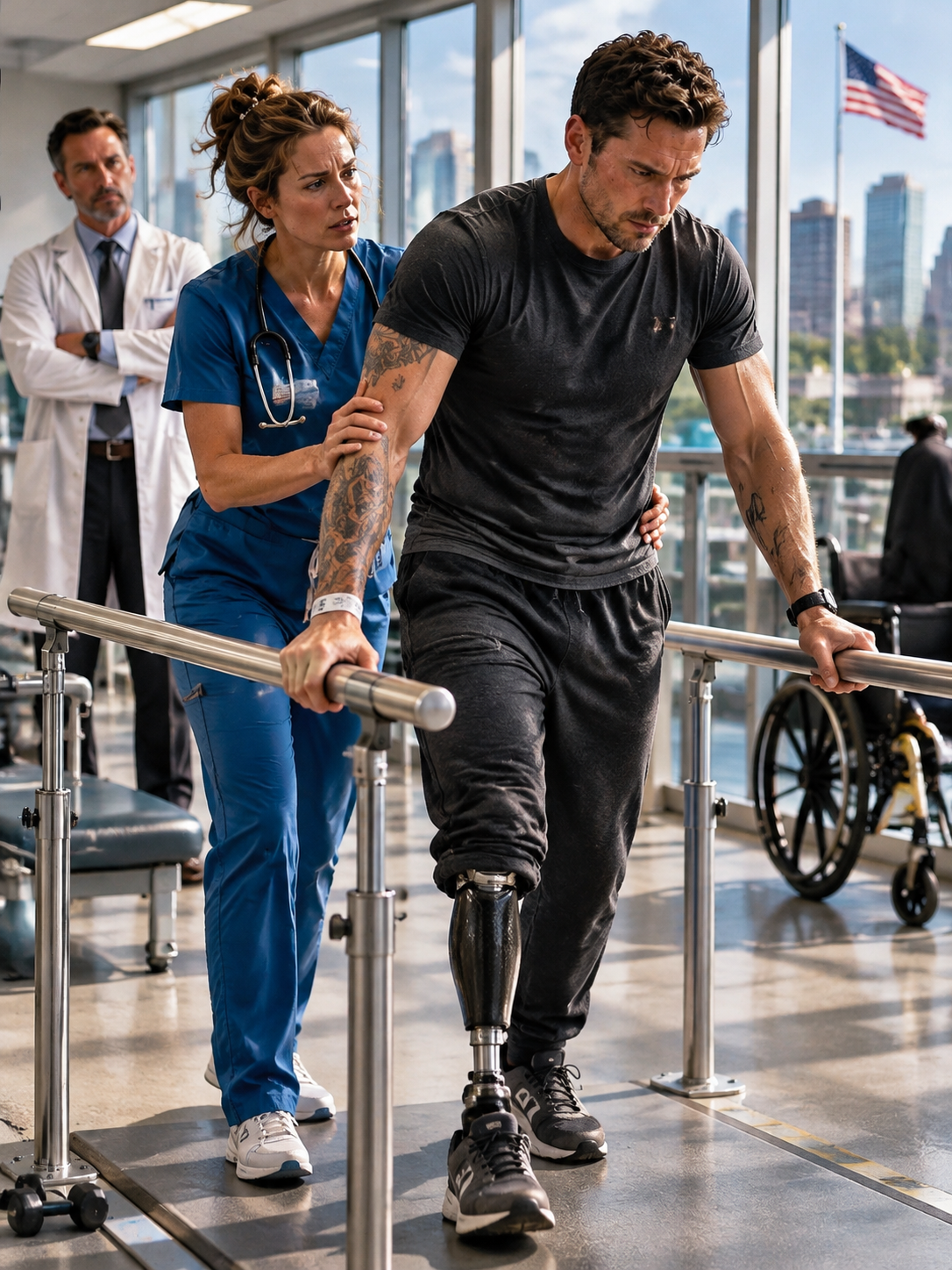
Three weeks later, on a Tuesday morning in March, Tobias stood for eight seconds between parallel bars in the rehabilitation gym. His knees shook. Clarice stood at the far end with both hands over her mouth, unable to make a sound. Ingrid waited beside the physiotherapist and watched the monitors. Then Tobias sat back down carefully, with help.
“I stood,” he said. His voice was stronger each day, though still rough and effortful. “You stood,” Ingrid answered. He looked at her with something close to pride and something more private. “Compass,” he said. “I’m here, Shepherd.” He reminded her that on the ridgeline he had kept tapping even though he did not know if anyone was listening. “I was always listening,” she told him.
Final Cortex Biomedical lost its federal contract that month, and Ashby’s research affiliation went under full review. The hospital ethics board received the fraudulent consent documentation. Lars was asked to present his chart addenda to the hospital board. He did so calmly, with the same careful notes he had kept from the beginning.
The hospital introduced a new review protocol: every veteran admitted with a catastrophic neurological injury would receive an independent second opinion before any prognosis became final. Lars suggested naming it the Shepherd Protocol. When Colonel Strang found Ingrid in the corridor after the announcement, he handed her a thin official folder. The relevant portions of her service record had been cleared for release. “You don’t have to be invisible here anymore,” he told her.
Ingrid became the clinical lead for the new veteran neurological review program. She still wore the same blue scrubs, faded unevenly at the elbows, and kept Marco’s note folded in her locker. On difficult days, when it seemed easier to stay quiet because the room expected it, she opened the note and read it again. She had learned the difference between choosing silence and being swallowed by it.
On a Sunday afternoon in early summer, Tobias walked across the rehabilitation courtyard and sat beside her on a bench. They watched the light move across the parking lot and the distant Ottawa rooftops. He told her that on the ridgeline, after his radio failed, he had thought there was only one person in the world who might hear his signal. Either she would, or she wouldn’t. He kept tapping anyway.
“You can’t stop tapping just because you’re not sure anyone’s listening,” he said. Ingrid looked at the light on the pavement. “I heard you,” she answered. He nodded, as if something had finally settled into place. “I know,” he said. “You showed up.”
A small brass plaque was eventually installed beside the ICU entrance at Gatineau Veterans Medical Center. Donated by the veterans on the ward, it read: “The Shepherd Protocol. No veteran should be silenced simply because no one has learned to listen.” Ingrid walked past it every morning on her way to the ward. She never needed to stop and read it. She already knew what it said.
THE END. I’ve shared the complete story, and I truly hope it touched your heart. If this story moved you, please , like, and share the post. Thank you for reading! ❤️
✓ Lynn R. Adams
IF FACEBOOK BROUGHT YOU HERE, HERE’S THE CONTINUATION YOU’VE BEEN WAITING FOR. ENJOY! 👇 The surgery lasted four hours and nineteen minutes. Dr. Kim decompressed the collection and relieved the pressu…