Nine dump trucks were lined up on Palmer Chadwick’s road when he arrived
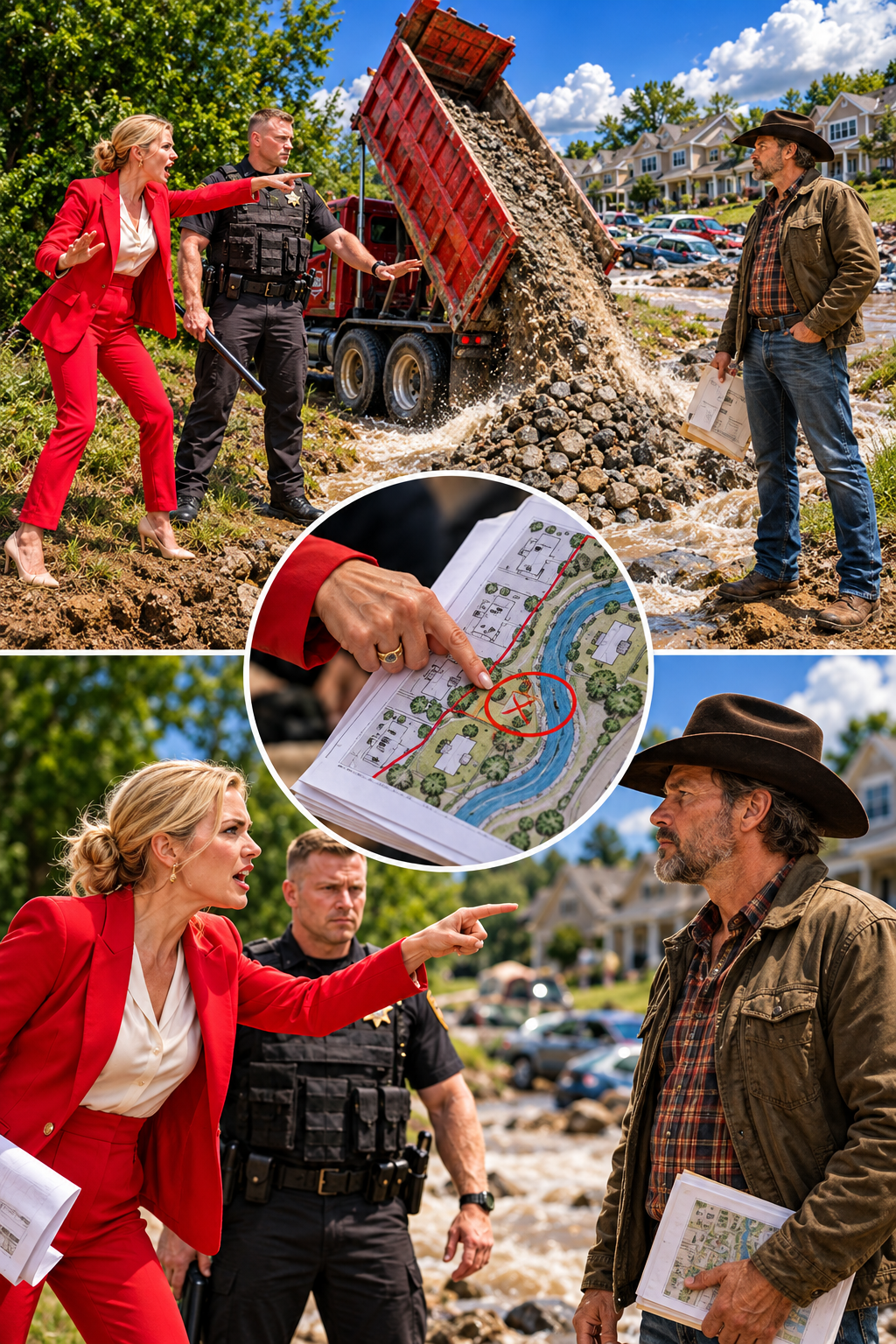
Part 2: She called our creek a ditch and claimed ownership publicly
When a hillside is paved with roofs, driveways, and roads, rainwater cannot soak in as it once did. Stonebrier’s developer had built a pond to hold the runoff and installed one outlet pipe to carry it away. That pipe ended at my creek. Water from 196 homes flowed into the pond, through the pipe, into my channel, and downstream. The arrangement served their neighborhood, but the land and waterway were mine.
I was never a Stonebrier resident. My property was not in its plat, never annexed, never dedicated, and never included in the association. I paid no dues and received no newsletter. At a county open house four years before the trucks came, I saw a glossy map labeling my creek “Common Greenway Ditch A.” I assumed someone in a design office had made a sloppy mistake with a highlighter. That was my first error, and it would cost me weeks.
Karen was in her third year as HOA president. She ran meetings with agendas, recruited two board members who agreed with her, and had a treasurer named Neville Ashcraft who read whatever she handed him as though it were scripture. Her big project that spring was Phase Two of the Stonebrier Greenway: a paved walking loop and two pickleball courts. It was the kind of improvement that photographed well and could get a president reelected without a challenger.
Phase Two needed four flat acres. There was exactly one undeveloped stretch of flat land near the subdivision: the bottomland my creek ran through. Karen visited me three times in January and February. The first visit was pleasant. The second included Ashcraft and a rendering of the proposed greenway. By the third, her tone had hardened into the confidence of someone who believed the decision had already been made.
I told her no each time, but I offered a compromise. I proposed a sixteen-foot walking easement along the east bank, with no motorized vehicles and the channel left untouched. I would have signed it that afternoon. Karen studied my offer as if I had asked her to pay for her own driveway. “The association doesn’t buy what the association already owns,” she said. I wrote the sentence on the back of a feed receipt because the certainty bothered me more than her rudeness.
On March 20, a paper was zip-tied to my front gate: a common-area improvement notice, identifying the channel as a drainage ditch and setting April 2 as the fill-and-grade start date. There was no place for me to object, just a date. On March 26, I sent Karen a certified letter stating that the channel lay on my deeded land and that I had not consented. I noted my state water right and added one plain sentence: If you fill that channel, the water from your subdivision has nowhere to go but back into your subdivision.
The green return-receipt card came back on March 30, bearing Karen’s signature, slanted hard to the right. I filed it beside the nursery invoices and assumed she would stop the work. Who reads a warning, signs for it, and proceeds anyway? At on April 1, I heard air brakes on Bell Hollow Road. I lay awake listening to trucks gather in the dark and kept turning over two sentences that would not fit together: she had my letter in her hand, and she had scheduled the fill.
Part 3: I found the permit, but lost my water rights anyway
The next evening, I walked into the Stonebrier clubhouse with a Manila folder and no lawyer. I had pulled my deed that morning, instrument number 1998-02214, recorded in Nettleton County. I had also obtained the recorded subdivision plat, the map that showed in permanent ink what land belonged to the association. I placed both documents in front of Karen and traced the boundary slowly with my finger.
“Your common area stops here,” I said. “The channel is 130 feet south of that line. It’s not in your plat. It never was.” A woman at the far end of the table leaned closer to see. Ashcraft did not look up; he stared at a blank legal pad. Then he cleared his throat and read the sentence he had clearly been given: “This is a matter the board has already addressed.”
“Addressed when?” I asked. He said, “Prior to commencement,” and offered nothing more. Karen leaned back. “For twenty years, that ditch has carried this community’s drainage. Twenty years of use beats one piece of paper. It’s called a prescriptive right. Look it up.” She said it with the confidence of someone who had read just enough online to find the answer she liked. Three people nodded.
Being right in a room where truth is not the currency is a frightening thing. I hired Ivor Blanchard, a surveyor, to restake the creek. His crew marked 640 feet with pink ribbon at fifty-foot intervals and drove capped boundary pins flush with the ground. It took most of a day and cost $3,200 I did not have loose. I returned at five that afternoon and found every stake removed, neatly piled beside Bell Hollow Road, the ribbon wound around the bundle.
I photographed the pile from four angles. Then I stood in the road with my hands on my head, trying to calm down before I did something that would end with me in the back of a patrol car. The next morning, a woman wearing a Highfield Community Management polo handed me an envelope without meeting my eyes. It was a notice of trespass barring me from the construction zone on my own parcel. Entry, it said, would be reported to the sheriff.
The rest arrived by mail over four days. There was a $500 fine for interfering with association personnel and contractors, then a $150 daily fine dating back to April 2, whether or not I returned to the creek. The association’s law firm warned that public statements questioning its rights in “Ditch A” might constitute slander of title. I called the county and spent two days finding the right office. Code enforcement listened, typed, and told me it was a civil dispute between private parties.
“There’s a state water right on that channel,” I said. “Then that’s a state matter, sir. We don’t referee boundary fights.” I sat in my truck outside the county building for a long time. Forty thousand seedlings were drinking from my storage tank, while the pump ran longer each day. I had been told that the destruction of my water was a disagreement between neighbors.
On April 7, a woman named Ma Kirkindall called from an unfamiliar number. She was on the board, older, and careful in the way people become when they are alone with a closed door. “I want you to know not everyone up here is comfortable with this,” she said. “Somebody warned us about exactly this some time ago.” When I asked who and what she meant, her voice tightened. “I’ve said more than I should. Please don’t call this number back.” Then the line went dead.
Part 4: The flood made her neighbors question everything she said then
The following morning, contractor Garvin Ruddock’s crew returned to finish the job. They smoothed the fill, rolled it until the greenhouse glass buzzed a quarter mile away, and drove orange-capped trail stakes down the middle of the buried creek. That night Karen posted photographs in the neighborhood group: “Phase Two is underway. Thank you all for your patience.” The comments asked about lighting and benches. No one asked where the water would go.
I walked my lower field after dark with a flashlight. No rain had fallen in nine days, but the grass near the bottom was soaked. When I pressed my boot into the ground, water rose around it. The spring at the top of my property was still running. The creek had not vanished; it had been blocked. Water was searching for a new route, and the only high ground within a mile belonged to Stonebrier.
I went back to the plat and noticed a line of small print along its margin that I had skimmed twice: “Drainage and outfall, see Instrument No. 2003-05412.” I did not yet know what that agreement said. On April 14, an ordinary spring rain dropped 1.9 inches over five hours. The retention pond filled in forty minutes, according to Birdie Longacre, who lived near the low end of Stonebrier Circle and had once bought three river birches from me.
Birdie watched the water rise to the pond’s outlet structure and stop. Then the level climbed over the lip because there was nowhere to discharge. My creek lay beneath 2,400 cubic yards of rock. By eleven that night, water crossed the curb on Bell Hollow Court. Before midnight, it had reached Stonebrier Circle, carrying mulch and a recycling bin sideways down the road.
Twenty-two lots took water in their yards. Nine houses flooded in their basements, and cars sat in driveways with water above their hubs. At two in the morning, I stood at my north fence in a rain jacket, watching the flow. I was scared, not triumphant. Water had found the low west edge of the pad and begun cutting through it, making a gravelly hiss as it dragged stone downstream.
If the pad failed all at once, the water behind it could surge toward the lower properties on my side. I called 911 and reported an obstructed drainage outfall above an occupied subdivision, with active erosion on the fill. The dispatcher was kind and said a deputy would come by. I called the county emergency line and left the same message. Then I stood in the rain until four, watching a hole cut into the fill I had been ordered not to touch.
By morning, Karen was telling residents that the downstream owner had blocked the channel to retaliate against the trail project. “What’s me?” I asked Birdie, who called sounding embarrassed. Two men came down my driveway at , one recording on his phone, and accused me of causing the flood. I did not argue. I led them up my property to the pad, where they saw the gray rock and the raw gully for themselves.
“Where’s the creek?” the younger one asked. It was not really a question. “Under that,” I said. “Your association put it there. Nine trucks. April second.” Neither man spoke for a while. The older one finally said, “Nobody told us that.” They walked back down my driveway much more slowly than they had come up.
Part 5: An old engineering letter exposed their warning before disaster struck
That afternoon, I drove to Cranmore Abstract and Title and asked for the recorded agreement listed on the plat. The clerk, Rosalind, found it in the county index and printed a certified copy. The document was signed in 2003 by the original Stonebrier developer and my father. It granted the subdivision a permanent drainage outfall across parcel 22-064. In return, the association agreed to keep the channel clear and unobstructed.
The language was direct. The channel was identified as the sole permitted outfall for Stonebrier’s stormwater system, and the obligation to preserve it was described as perpetual and non-terminable. I read the pages twice in my truck. The agreement did not answer every legal question, and it did not immediately restore the creek. But it proved that the association had acknowledged the waterway and relied on it for years.
I hired a lawyer named Amber Doyle. She sent a formal demand that the association remove the fill and restore the channel, and she asked the county to suspend its fines against me. The association answered through its attorneys, claiming the channel was an artificial farm ditch and therefore not protected as a natural watercourse. Karen said I had built a dam years earlier that restricted the flow. That part was true: my grandfather’s stone ford had a small weir built into it.
The association’s lawyer argued that the weir obstructed the channel, even though it had stood there since 1938. The county scheduled a ten-day compliance notice, and state officials temporarily suspended my water diversion right while they investigated the alleged obstruction. I had to shut off the intake. On paper, that was one sentence. On the ground, it meant 40,000 seedlings with only a few days of stored water.
I let the sod fields go first. By the third day, the redbud leaves were curling inward, a sign the plants had stopped growing and begun trying to survive. The association recorded a lien against my parcel for $28,600 in daily fines, the interference fee, and the engineering report it had commissioned to blame me. My bank froze my equipment line. Two commercial sod orders were canceled after word spread that my nursery had a code violation and a suspended water right.
I sat down with Averil Dowey and Ru Ellenwood, who had worked my spring seasons for six years, and told them I had no work for them until the dispute cleared. Ru cried. Averil shook my hand and said he would come back when I called. On May 2, I took the certified agreement to the county permits office and finally got fifteen minutes with an official. He read it fairly, then slid it back across the counter.
“This is a private contract between the association and your father,” he said. “That’s a civil matter. You’d file in circuit court.” He was not corrupt or lazy; he was simply the wrong official for the problem I had. That night, Karen’s newsletter said the cause of the drainage issue had been identified and addressed by the proper authorities. I stood in a dark greenhouse, listening to 40,000 silent pots, and noticed the routing stamp on my returned file.
Part 6: A second storm tested whether truth would arrive before disaster
The routing stamp pointed me toward stormwater, not code enforcement, boundaries, or private disputes. Stonebrier discharged under a municipal stormwater permit, and a subdivision that size had to name its outfalls. A permit came with conditions, and the destruction of the outfall named in it could threaten the whole authorization. I had been arguing about who owned a ditch. The deeper question was whether Stonebrier still had a legal right to discharge water at all.
At one in the morning, I took a pry bar and sledgehammer down to the old ford. The compliance notice gave me ten days, and I used the ninth. I dismantled my father’s weir block by block, working beneath a portable light and recording the entire process on a timestamped video. I tore the web of my left hand, but kept going until the channel was clear.
At dawn, I photographed the open creek from six angles and wrote a compliance affidavit in my truck. By ten, Amber had the video and the paperwork. I then filed a formal complaint with the county stormwater administrator, Winifred Stag, alleging obstruction of a permitted outfall and false reporting. I attached the recorded drainage agreement, photographs of the flood, and the green receipt showing Karen had signed for my warning letter.
Winifred called me on May 8. She had opened a file and asked whether any structure on my property still obstructed the channel. I told her I had removed the weir on May 4, and the county had the video and affidavit. After a pause, she said that helped. I asked how long the review would take. She said it depended on what the file contained.
I submitted a public-records request for Stonebrier’s complete stormwater compliance file, all years and correspondence. It cost $110 and took nine days. On May 17, I picked up a banker’s box and began reading in my kitchen. About two hundred pages in, I found a letter dated September 11, 2019, from Ryder and Fitch Engineering to the Stonebrier board.
The board had commissioned its own drainage assessment. Its engineers stated that the channel across parcel 22-064 was the community’s sole permitted outfall. The old agricultural tile line, which Karen had promised neighbors was a backup, had collapsed during utility work in 2011 and carried no flow. The report warned: “Under no circumstances should the channel be narrowed, filled, or obstructed. The community has no alternative discharge.”
Four pages later, the October 9, 2019, board minutes recorded a discussion of the report and possible negotiation of an outfall easement with my family. Karen had moved to table it as premature and defer communication with the adjoining owner. The motion passed four to two. She had known in writing, with an engineer’s assessment, and had put the warning away.
Part 7: The neighbors opened their homes after Karen’s plan collapsed
I called Ma Kirkindall back, though she had told me not to. She answered on the second ring. “You found it,” she said. I told her I had the October minutes. “I was one of the two,” she said, her voice thinning. She had kept an original printout after the board collected its copies. She had thought about the letter every night since the creek went under, and she agreed to tell the county what she knew.
There was another document in the box: an annual stormwater certification filed April 22, twenty days after the fill was installed. The form certified that every permitted outfall was clear, unobstructed, and functioning as designed. Karen had signed it under penalty of perjury while residents were still pumping water from their basements. The county contacted Ruddock, the contractor, and found no grading permits for the work.
Facing an unpermitted-work violation, Ruddock handed over his file. The association’s work order instructed him to “fill and grade the channel” from station zero to 640. Karen had written, in the same right-slanting handwriting as the receipt card: “Take it to grade. Don’t call the county.” For the first time since April 2, I thought the case might turn in our favor.
It did not turn quietly. On May 18, Ruddock’s trucks returned and raised the pad another three feet, armoring its west face with riprap the size of microwaves. The gully left by the April flood disappeared beneath the stone. Karen filed an emergency variance application asking the county to classify the channel as an artificial farm ditch, not a natural watercourse. If she won, the fill could become permanent.
She also imposed a $1,200 emergency assessment on every household to fund the association’s legal defense. Many residents had been flooded once, blamed me for it, and were now being asked to pay to continue arguing. Birdie told me the neighborhood comment thread grew to four hundred posts before someone shut it down. I spent two days building my rebuttal from county aerial photographs, spring-flow records, my state water right, and the association’s own 2003 agreement calling the creek a channel and outfall.
The variance hearing was set for May 24. On May 21, forecasts began warning of a major storm expected two days before the hearing. I called Winifred’s office and said the outfall was still blocked, the pad had been raised, and four to six inches of rain were expected. Her assistant put me on hold, then returned to say the matter would be addressed at the hearing. The pad sat three feet higher than before, gray and flat, with stone banked along its west side. Behind it, 196 homes turned on their porch lights.
The rain began on May 22 at 10:03 in the morning. I had barely slept since the fill was raised, and I watched the radar as red bands crossed the county. By late afternoon, more than four and a half inches had fallen. At a.m., I called the emergency line for the fourth time, reporting an obstructed outfall and a full retention pond above occupied homes. Then I called Ma. “Wake the circle,” she said. “Tell them to move their cars uphill and get things off their basement floors. Don’t wait for Karen.”
Part 8: We rebuilt the crossing and learned what water remembers together
At a.m., I heard the pond overflow. It was a broad roar, with no outlet sound because the outlet was buried. The pad held, so the water went backward through the storm drains into the streets it had just left. Birdie later told me a manhole cover jumped from Stonebrier Circle and landed in a yard. By six, water had reached 168 of the 196 houses, filling ground floors, garages, and finished basements.
I cut the chain on my north pasture gate and opened the field. Forty-some vehicles drove into the hayfield. A woman arrived with two dogs and a rabbit in a laundry basket. Someone’s ninety-year-old mother sat in my seed office beneath a borrowed blanket. My wife, Odette, made coffee in the potting shed for four hours straight. The two men who had accused me in April stood soaked in my greenhouse at seven. “Don’t,” I told them. “There’s coffee in the shed.”
Nobody was hurt. The pad held against the flow because Karen had armored it days earlier. The water cut at the west edge again, but the riprap prevented a breach that might have released the whole pond at once. At nine, Winifred arrived with county engineer Ephraim Gallatin, a quiet man who had spent thirty years studying drainage. They came through my property because both subdivision entrances were under water.
Karen walked down the hill in rubber boots, with Ashcraft carrying an umbrella over a folder. She began before Gallatin finished writing the date on his form. “This is an act of God. We had a four-inch rain event. The downstream owner has restricted this channel for years.” Gallatin asked how I had restricted it. I handed Winifred the tablet, and the video showed me removing my grandfather’s weir, block by block, with the timestamp visible.
“Your county file confirms it,” Winifred said. “There is nothing downstream of this fill.” Karen shifted to her other claim: the channel was an artificial farm ditch. Gallatin pulled out the 2003 agreement and read its terms aloud on the pad in the rain. It named the creek the sole permitted outfall and imposed a perpetual, non-terminable duty to keep it clear.
Winifred laid the annual certification on the hood of the county truck. “This form, filed April 22, certifies all permitted outfalls were clear and unobstructed. It bears your signature.” Karen said she had not known the work would flood the homes. Then Ma came down the hill carrying her copy of the 2019 engineering report. She told the county that the board had been warned the creek was the only outfall and had voted to table the report.
I handed Winifred the green certified-mail card showing Karen had received my March 26 warning three days before the trucks arrived. Ruddock produced the work order with Karen’s note telling him to fill the channel and not call the county. Gallatin looked at her. “God didn’t sign the work order,” he said. The county suspended Stonebrier’s discharge authorization, ordered the fill removed under state supervision at the association’s expense, denied the emergency variance, and referred the false certification for review.
Karen walked back through her neighborhood while residents stood in ankle-deep water. Nobody shouted. Nobody had to. The silence around her was louder than any accusation. On June 4, a state-supervised restoration crew began removing the 2,400 cubic yards of rock. It took nine days. When the final load came out, the spring water ran the length of my property again for the first time in sixty-eight days.
The code violation against me was dismissed, my water right reinstated, and the lien released. The $28,600 the association had charged me was refunded with interest. I saved about 11,000 seedlings; the rest went to the burn pile. The smell of them burning is something paper compensation cannot fix. The association’s insurer declined to defend Karen personally, the contractor lost his license for a year, and the $1,200 assessment was rescinded before residents paid it.
The recall vote was held in a field beside the clubhouse because the building was still stripped to its studs. Karen did not attend. The vote was 158 to 24, and Ashcraft resigned the same week. The new board came to me in August with an attorney and no rendering. They acknowledged the 2003 agreement and asked for access to inspect their outfall. I proposed an annual access fee and a defined path along the east bank, with one condition: no one entered the channel without telling me first. They accepted in four minutes.
The county needed to pump standing water out of the low end of the subdivision for three weeks, and the discharge line had to cross my hayfield. They asked permission, and I said yes without charging them. I will be honest: it was not nobility. The pumps ran day and night through my pasture, and it was the most satisfying sound of my adult life. Later that month, my ten-year-old son, Beckett, and I began gathering my grandfather’s stones from downstream. Four Saturdays later, we rebuilt the ford.
When we set the last stone, the water passed over it and dropped through the gaps with its familiar low, knocking chuckle. Beckett stood with his hands in the creek. “Is it the same water?” he asked. “It’s the same creek,” I said. “That’s the part Karen never understood.” You can bury a channel under 2,400 yards of rock, hold a ribbon cutting, and sign a certification saying everything is fine. Water does not argue. It waits, then goes where it was always going. The only thing we get to choose is where we stand when it comes back.
✓ Lynn R. Adams
Part 2: She called our creek a ditch and claimed ownership publicly When a hillside is paved with roofs, driveways, and roads, rainwater cannot soak in as it once did. Stonebrier’s developer had buil…