My stepmother claimed I stole her $30,000…
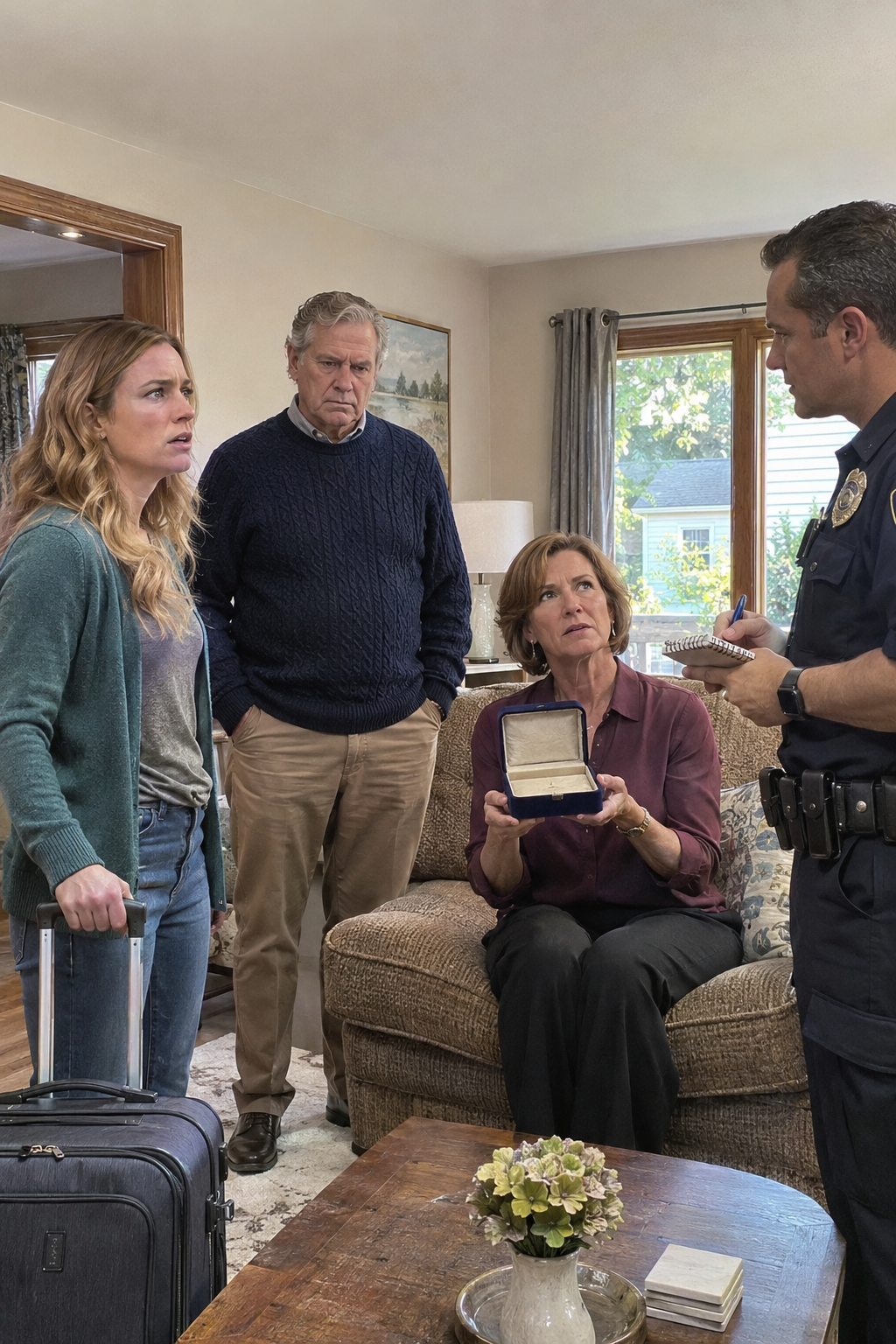
My stepmother claimed I stole her $30,000 diamonds, and my father called the police without asking what happened. I thought being thrown out was the worst part, until I noticed a date in an old auction catalog….
I was thirty-four when my father called the police on me. My stepmother, Celeste, sat on their living room couch holding an empty blue velvet jewelry box, and my father, Grant Kessler, stood beside her. She said her mother’s diamond necklace and matching earrings had disappeared. He told Officer Pike, “Mara was the only person here.” He said it before asking me whether I had touched the jewelry.
Eight days earlier, I’d moved into their guest room because a pipe had burst behind the kitchen wall of my apartment in Duluth, Minnesota. The cabinets and living room floor were soaked. Repairs were supposed to take three weeks, possibly longer, and my renter’s insurance covered only part of the temporary expenses. Dad had offered the room himself. “Why waste money on a hotel?” he’d said.
I worked handling freight claims for a logistics company near Duluth Harbor. I had my own place, paid my own bills, and planned to be out as soon as my apartment was livable. Celeste had made it clear she didn’t love having me there. She’d married Dad seven years earlier, after my parents divorced when I was twenty-one. Mom lived in Oregon. Dad had retired the previous spring from a marine equipment supplier, and our relationship had become strained since then.
Whenever Celeste made a cutting remark, Dad told me, “Don’t mind her. She means well.” I wanted to believe him because I remembered the man who drove me to science competitions before dawn. For years I had been trying to find my way back to that father. I didn’t know that an ordinary request for a socket set would put that hope to the test.
The afternoon before Celeste reported the diamonds missing, Dad was repairing a loose railing on the back steps. He asked me to get his red tool case from the upstairs closet in their bedroom. Celeste was at work. I walked in, opened the closet, picked up the case, and left. The whole trip took maybe ninety seconds. I never opened a drawer or touched her dresser.
Then Celeste announced the jewelry was gone. She told Officer Pike that the necklace and earrings were separately listed on their homeowner’s insurance for $30,000. She said they had been a gift from her mother. Dad nodded along. I explained why I’d entered their bedroom, but he wouldn’t look at me. When the officer asked whether I’d seen the jewelry box, I said I’d noticed it on the dresser, where Celeste had kept it for years.
“Then how would you know where it was?” she asked, sounding wounded. That question made me feel as if every ordinary thing I knew about their house could be used against me. At work, I compared photographs, delivery records, and dates before approving a claim. I noticed details because missing one could cost someone money. In that living room, the same habit suddenly made me seem suspicious.
Officer Pike asked whether I would voluntarily show him my suitcase and work bags. I agreed. When Celeste stepped toward my belongings, I asked her not to touch them, and Pike kept her back. He found no diamonds. He explained he would document the report and that there might be follow-up questions. He did not arrest me. Celeste looked more disappointed than relieved.
Dad followed Pike onto the porch and asked for the report number. Then he came back and told me to leave that night because Celeste “didn’t feel safe.” My suitcase was still in the guest room. I asked, “Dad, you know me.” He offered no answer, no help carrying my things, and no suggestion about where I should sleep. As I reached the door, Celeste asked whether he’d gotten the report number because the insurance company would need it.
I called my friend Jody Fenwick from the driveway. She managed the evening shift at a hotel, and when I told her what had happened, she said I could use her foldout couch. She left the porch light on. The next morning, Dad sent a message: “If you return what you took, we can deal with this privately.” I stared at it over cold coffee, knowing another denial would become another argument about why Celeste would supposedly lie.
Instead, I opened my laptop and made a timeline, the way I did at work. I recorded when I’d moved in, when I’d collected the tools, when Celeste said the jewelry vanished, and what everyone told Pike. I saved Dad’s message with its date. Using the contact information from the police report, I submitted a short statement denying the theft. I did not accuse Celeste of anything I couldn’t prove.
By Sunday, the story was spreading through the family. My aunt called to ask whether I’d been arrested. Celeste had told people the police came and I left the house, leaving them to reach their own conclusions. A family dinner invitation vanished from my calendar. Dad kept insisting I make things easier by telling the truth. I wrote, “I did not take the jewelry. Please stop telling people I did.” His answer was to ask me to help them understand what happened.
Three nights before the accusation, Celeste had shown us an old photo album. One Christmas picture showed her wearing the necklace and earrings with a green dress. The right earring tilted slightly inward. I remembered that detail because the previous February I had booked a jewelry repair for a bent prong on that earring; Celeste disliked making online appointments. When I leaned toward the picture, she’d closed the album quickly and asked whether I still had the photo on my phone.
At Jody’s kitchen table, I found the Christmas picture and searched my email. The repair request was there, describing the older cluster-style setting and the loose prong. I’d forwarded it to Celeste, who’d replied, “Thanks.” I saved both the photograph and the repair description. They didn’t prove I was innocent, but they were a better record of the jewelry than anyone’s memory.
Dad called to say Celeste was preparing an insurance claim and needed the police report number. I asked what would happen if the diamonds hadn’t been stolen. “Then where are they?” he demanded. I couldn’t answer. I knew only that Celeste had talked about insurance before the officer even left their driveway. Her eagerness to complete the paperwork bothered me, but suspicion wasn’t evidence.
I searched online for jewelry resembling the cluster setting in the repair email. Retail pictures weren’t useful, so I tried public auction catalogs in Minnesota and Wisconsin. For two evenings I found almost-matches: wrong earrings, newer settings, unfamiliar prongs. On the third evening, I opened an archived September sale from a Twin Cities auction house and worked my way through pages of estate jewelry.
Near the end was a necklace-and-earrings set with the same arrangement of stones. In the auction photographs, the right earring leaned inward, and one repaired prong looked thicker than the others. I put the auction image beside my Christmas photo. The lighting was different, but the setting matched in details that made my stomach tighten. I clicked on the lot information and saw that the set had been sold.
The auction date was September 3. Celeste had reported her diamonds stolen on September 26, twenty-three days later. I saved the catalog page, the lot number, and the images, then wrote myself a warning: “Similar appearance does not establish that this is the same set.” I needed someone who could check what I couldn’t. And I knew I couldn’t bring that question to my father first. Part 2…..
I called the auction house the following morning. A woman named Talia Norwood confirmed the public description and the September 3 sale date. When I asked who had consigned the set, she explained that private client records couldn’t be released to me. She did, however, tell me how a law enforcement investigator could make a proper request. I thanked her and hung up without learning the seller’s name.
I contacted Officer Pike through the department’s designated process. I sent the archived photographs, lot number, Christmas picture, and jeweler’s repair email. In my note, I explained exactly which details seemed to match and made clear that I could not independently establish they were the same diamonds. The department confirmed receipt. I didn’t warn Dad or Celeste, because I wanted investigators to verify the records without anyone arguing about them beforehand.
Two days later Dad called. Celeste wanted to know whether I’d “found anything.” I told him I’d submitted my statement and was cooperating with the police. He asked why I wouldn’t say what I was doing. “Because you still treat me as guilty,” I said. I repeated that I hadn’t taken the jewelry, and he ended the call. I stayed at Jody’s while the apartment repairs continued and tried to keep showing up for work as though everything were normal.
A week later he invited me to a diner near the highway, saying he wanted to speak without Celeste. I went hoping he had finally begun to question her story. Instead, he slid a typed paper across the table. It said I acknowledged taking the jewelry, would arrange to repay its stated value, and understood that Celeste would consider telling police the family had resolved the matter. It wasn’t a court document. It had a space for my signature.
“You want me to sign a confession?” I asked. Dad called it taking responsibility. He said Celeste was under tremendous stress and he wanted the situation over. I reminded him that he’d thrown me out and I was paying for somewhere to stay. When I pointed out that the paper described a theft I had not committed, his main concern was that people in the diner might overhear us.
Then I asked, “Have you asked Celeste where the diamonds were on September 3?” His spoon stopped. I explained that I’d found a matching set in an auction archive and had given the information to the investigator. Dad said matching did not mean identical. I agreed, because that was the reason the records needed checking. He said I should have come to him first. I asked why, when he’d refused to listen to me from the beginning.
He pushed the paper toward me again and asked me to think about what I was doing to the family. I asked to keep it, and he nodded, apparently thinking I might reconsider. I folded it, put it in my bag, and said I would not sign. Outside, I sat in my car until I could steady myself enough to drive. I photographed the document, preserved the original, and informed Pike that Dad had asked for my signature on an acknowledgment of theft. I offered a copy for the record.
There was no instant solution. In late October, Pike asked me to visit the station and explain where the photos and repair description had come from. He asked whether I’d handled the jewelry and what the auction house had told me. I answered every question. He said they were checking the provenance and timeline. He would not tell me whether they had identified Celeste’s set, and I understood why the verification took time.
In early November, he called me back. He placed the public auction listing and my repair email in front of us and said the department had checked the transaction records with the auction house. The records established that the jewelry had been consigned before September 26, the reported date of the theft. He could not release the seller’s private documents or name the people who had supplied information.
“Does that mean you know I didn’t take it from their bedroom that week?” I asked. Pike said the verified timeline did not support the accusation and they were no longer pursuing me as responsible for the reported theft. Other aspects remained under review. He didn’t promise an arrest or a final outcome for Celeste. I asked how to request the portions of the incident report that could be released, and he explained the process.
I called Jody from the parking lot. “They checked the records,” I told her. “They’re not pursuing me.” She was thrilled, then quiet when she realized I wasn’t celebrating. The verification mattered. But my father had accused me, forced me out, and put a false confession in front of me long before anyone contacted the auction house. A factual correction couldn’t undo those choices.
Dad called after the homeowner’s insurer questioned the claim documents. He said they had been told the jewelry was sold before Celeste reported it missing. “That’s what I tried to tell you,” I answered. He had begun learning why she’d concealed the sale, and this time he didn’t hang up when I asked questions.
Part 3 Celeste had once operated a small gift and home-decor shop that closed two years earlier. She’d told Dad all the suppliers had been paid. In fact, she’d accumulated about $28,000 in overdue balances on personal credit she used to keep the shop going. Collection notices had arrived disguised, in her telling, as routine tax mail. When Dad asked for the closing paperwork while reviewing their budget and why their savings weren’t growing, she kept promising to find it.
She had consigned the diamond set in August and received the auction proceeds in September, using the money to pay part of those debts. It still wasn’t enough. Dad had noticed the empty jewelry box the night before she accused me. She first claimed the set was being cleaned. When he asked for the jeweler’s name so he could call, she switched to saying it must have been stolen. I had entered their bedroom for the socket set, giving her a convenient suspect.
Celeste had insisted that the set remain separately scheduled under their homeowner’s policy at a stated value of $30,000. After Pike’s visit, she pushed Dad to report it to the insurer. She supplied a description and a loss date; Dad submitted the claim online as the policyholder even though he had never witnessed a theft. The insurer hadn’t paid anything. A payment could have hidden the missing jewelry and helped satisfy the creditors, but the transaction dates were now under scrutiny.
“I signed the submission,” Dad admitted. “I believed her.” I reminded him that he had signed a claim about something he had not seen, just as he had called police without checking my account. He said he hadn’t known about the old debts. I believed that. I hadn’t accused him of arranging the sale. But being deceived by Celeste was not the same thing as having no responsibility for what he did to me.
The insurer placed the claim under review, and Dad told me it would not be paid based on the information submitted. He wanted to see me. Before I agreed, Celeste sent her first email since the accusation. She called the auction sale a private financial matter and said Dad had misunderstood what she meant by “missing.” Then she asked me to stop sharing information with the insurer. There was no apology, and she did not retract her accusation.
I saved the email and sent it to Pike through the same official channel, presenting it simply as her statement. I replied once: “You accused me of stealing property you had already sold. Correct that accusation with the police and with everyone you told.” She didn’t respond. I decided to meet Dad in a public park overlooking the water, on a bench near the parking lot where I could leave whenever I wanted.
He arrived wearing the jacket he’d worn to my college graduation, far too thin for the cold wind. He told me Celeste was staying with her sister while they lived apart. He repeated that he hadn’t known about the debt and said he’d been trying to protect his wife. “From me?” I asked. He admitted he’d wondered whether I’d taken the diamonds and was too frightened to admit it, even after I’d denied it again and again.
I reminded him of the police call, the suitcase, and the diner paper. He finally admitted he should never have asked me to sign it. Then he said something I believed was the truth: “I was afraid of losing my marriage.” I looked at him and answered, “So you were willing to lose me.” He grew quiet. When he reached for my hand, I put it in my coat pocket.
I told him I would not change what I had told investigators or the insurer, ask police to disregard verified records, or move back into his house. I also wanted him to correct the accusation with the people who’d heard it. In writing. I had already drafted a message stating only what the investigator had confirmed, without anyone’s private records. I was sending it to our relatives that night whether Dad helped or not.
“You’d send it to Aunt Denise?” he asked. “She asked whether I’d been arrested,” I said. “You let her believe that was possible.” He showed me another message from Celeste telling him the insurance matter was private and that I should stop talking about the jewelry. She’d sent me essentially the same request. I asked him to stop making me carry her version of events.
He opened the family message thread, the same one where he’d told me to return the diamonds. After a long hesitation, he typed that the accusation against me had been false, the jewelry had been sold before it was reported missing, and he had been wrong to believe I stole it. He said he’d send the correction. “You can send it now,” I told him. He pressed send while I was sitting there.
The message appeared on my phone, where Celeste and the relatives who’d seen the accusation could read it. I stood and told Dad I didn’t want contact. When he asked for how long, I said I didn’t know, and that I couldn’t promise there would be a later. He called my name as I walked toward my car. I didn’t turn around. I saved the message before driving away.
That evening Aunt Denise admitted in the thread that she’d told two relatives I’d run away after being caught. I asked her to correct the story with those same people. She did call them, and one later contacted me to acknowledge the mistake. Another cousin said we’d all been under stress and should move on. I let that message sit unanswered. I wasn’t going to argue with someone who thought embarrassment and a false theft accusation were equal inconveniences.
Final The following week I received the releasable portion of the incident record I’d requested. It reflected the updated information and that the alleged theft was no longer being pursued against me. It was not a court judgment or an expungement, and I never represented it as one. I kept it with the auction photographs, the repair email, and my timeline. At least the version of events being passed around the family was no longer going unanswered.
The insurer later denied the theft claim after reviewing the sale and reported-loss dates. Dad forwarded only the conclusion of the denial, not the private claim file, and I didn’t respond. The insurer told me separately that it needed nothing further from me. I never learned whether it referred anything for additional investigation, and I never claimed Celeste had been convicted of a crime. What I did know was that the $30,000 payout she’d expected was not coming.
The proceeds from the auction were already spent on part of her old shop’s bills. Creditors still wanted payment. Dad stopped using the shared household account to pay debts in Celeste’s name and refused to sign the consolidation loan she wanted, though he still had to deal with any obligations that were legally his. They remained apart while working through their finances, and Celeste stayed with her sister. Her sister received Dad’s correction, just as the rest of the family had.
Celeste eventually replied in the group thread that she had been confused about dates and wanted everyone to stop discussing her finances. Aunt Denise asked one plain question: “You told us Mara stole from you. Did she?” Celeste never answered it. When she later asked relatives for help with the bills, her sister said she’d discuss a repayment plan, not simply hand over cash. I saved those messages and stopped reading the thread.
In early December, my apartment was ready. The kitchen cabinets were new, and the floor still smelled of finish. I made pasta in a pot that had survived the leak and ate it sitting on the floor because my table was in storage. Jody came by with salad and hot chocolate. She looked around and said, “This place needs a rug.” “But the walls are dry,” I told her. We ended up talking about her hotel guests and the snow forecast.
As Jody put on her coat, she asked how things were going with Dad. “They’re not,” I said. She nodded and didn’t try to talk me into forgiving him. After she left, I found a long message from Grant saying he was sorry, that Celeste had deceived him, and that he hoped we could someday sit down as a family again. He still spent more words explaining why he’d believed her than describing what he’d chosen to do to me.
I read it once and didn’t reply. I muted the conversation, then blocked his number. The next morning a small package arrived: a replacement lamp I’d ordered before all this happened, when I thought I’d be home by October. The delivery driver asked for my signature. I checked the label, my name, my address, and the apartment number before signing. Inside, I recycled the packaging, set my keys in their ceramic tray, plugged in the lamp beside my couch, and turned on the light.
THE END. I’ve shared the complete story, and I truly hope it touched your heart. If this story moved you, please , like, and share the post. Thank you for reading! ❤️
✓ Lynn R. Adams
My stepmother claimed I stole her $30,000 diamonds, and my father called the police without asking what happened. I thought being thrown out was the worst part, until I noticed a date in an old auctio…