My son took my house, my truck, and the keys while I stood in the kitchen where my wife and I had spent thirty years, then told me it was only fair. At eighty, I took one bag into a Michigan winter and headed for an abandoned lumber camp, never imagining what I would find beneath its old kitchen floor…
My son took my house, my truck, and the keys while I stood in the kitchen where my wife and I had spent thirty years, then told me it was only fair. At eighty, I took one bag into a Michigan winter and headed for an abandoned lumber camp, never imagining what I would find beneath its old kitchen floor…
The morning my son put me out of my house, he was showing strangers how to use my stove. I was eighty years old, standing in the kitchen in Escanaba, Michigan, while Jim explained that the front burner ran hotter than the others. The young couple nodded, already picturing where their things would go, and I could smell lemon cleaner that Helen had never used.
Helen had been gone for years, but her good plates were still behind the glass cupboard doors. Three orange pill bottles stood on the windowsill where she’d lined them up during her last winter, and a white mug with a cartoon moose hung where my old brown mug belonged. When the woman asked whether the plates stayed, Jim answered, “Everything stays. It’s furnished.”
After the couple went outside, Jim held out his hand. “House key, Dad.” I worked it loose from the ring with my thumbnail, but he wasn’t finished: he wanted the truck key and the garage key, too. The truck and house were in his name because I’d signed them over after a fall, when he said it would save trouble later.
“Later?” I asked him. “I’m still here, Jim.” He talked about the taxes, the roof, and the furnace, and said renting the place was the only sensible thing. “It’s only fair,” he told me, as if those three words could explain why his father no longer had a bed there.
I asked where he expected me to go. Jim glanced at the window and mentioned a senior place on the north side, though he knew there was a waiting list. “You’ll land on your feet,” he said, then reminded me that the lease had already been signed.
I filled one canvas bag with socks, my medicine, a razor, a wool shirt, a folding knife, and a photograph of Helen on the beach at Marquette with the wind blowing her hair. I had two twenty-dollar bills in my wallet and a bank card; my next pension check wasn’t due until February 3. Jim drove me to the bus depot in the truck that had been mine, kept its engine running at the curb, and said to call once I got settled.
The radio was reporting farm prices. I closed the passenger door gently, set my bag on the salted sidewalk, and watched him drive away without looking in the mirror. Inside the depot, I sat under the schedule board and tried to picture myself waiting at that senior home with a clipboard in my lap.
Instead, I remembered a cookhouse north of the Seney Swamp, near Tamarack Creek, and a Swedish cook named Arvid Lindquist who could feed forty lumbermen without ever raising his voice much above a growl. Forty years earlier, when the paper mill laid me off, I’d spent a winter there peeling potatoes and washing pots. I was forty then, with Helen and twelve-year-old Jim waiting at home, and Arvid had made me promise to return the following winter.
The mill called me back, and one winter turned into forty. Yet I could still picture Arvid’s enormous black range and hear him saying, “Frankie, the potatoes don’t peel themselves.” I went to the ticket window, bought a ride north toward the Lake Superior shore with my bank card, and kept those two twenties folded in my shirt pocket.
The bus left me at a crossroads store with one gas pump and a sign advertising bait and propane. Behind the counter sat a woman about sixty with glasses on a beaded chain and a crossword puzzle open. I bought flour, lard, coffee, matches, fishing line, hooks, and salt; the total was $38.60.
“Where are you headed with all that, hon?” she asked. When I said the old Tamarack Creek camp, she put her pencil down and told me nobody had lived there since Arvid died eight years earlier. Her name was Marlene, and instead of arguing with me she went into the back room and brought out a child’s red plastic sled for my groceries.
“The county plows to the bridge,” she said. “It’s two miles after that.” She told me to bring the sled back in spring, then added that if she found out I’d frozen to death, she’d be mighty upset.
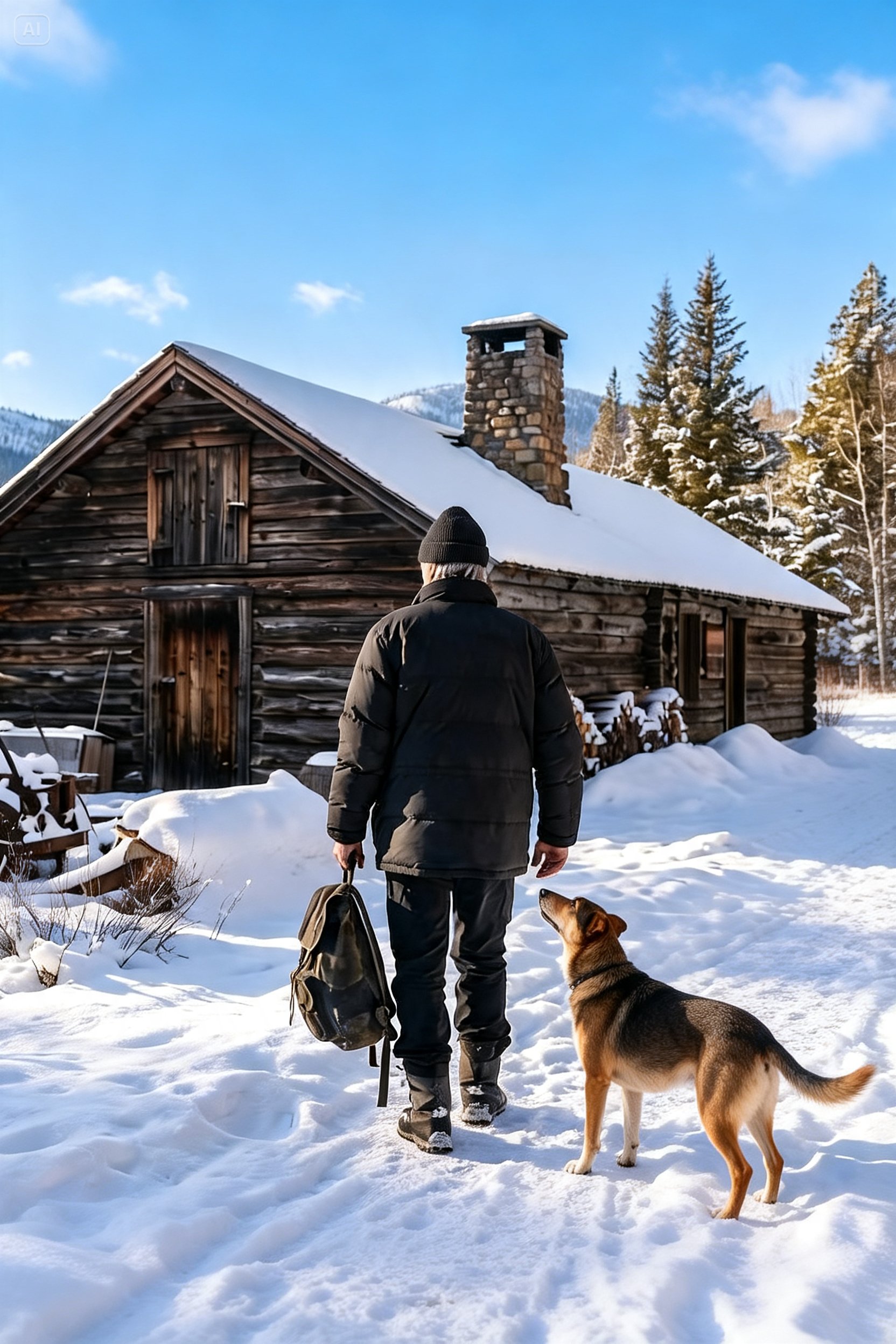
I pulled that sled down the road with my bad knee aching, then pushed through drifts up to my knees along the old two-track. By the time I reached the clearing, my mustache had frozen and I was stopping every few steps to breathe. There stood the cookhouse, dark logs beneath a snowy cedar-shake roof, with its fieldstone chimney rising among pines and birches.
I expected broken windows and a collapsed door, but the panes were whole, the roof was sound, and somebody had stacked dry firewood higher than a man beneath the overhang. Whoever cared for that place hadn’t been there that day, but he hadn’t abandoned it either. The door opened on a wooden latch, and I stepped into a room as cold and dry as a cellar.
The long tables still stood where the loggers had eaten, benches pushed underneath. At the far end sat the six-lid iron range with two ovens, resting on its old fieldstone base. I touched the stove and whispered, “Well, hello,” then opened the damper, laid birch bark beneath kindling, and lit one match the way Arvid had taught me.
When the iron began to tick with warmth, my hands shook for reasons that had nothing to do with the cold. Behind the kitchen I found Arvid’s little sleeping room, a low bunk, a cedar chest, and three clean wool blankets smelling faintly of cedar. I heated coffee, ate a little bread with lard and salt, banked the fire with oak, and slept in my clothes beneath all three blankets.
Sometime after three in the morning, my hand slipped over the edge of the bunk and touched the stone floor. It was warm, though the fire had burned low, and the warmth ran in a narrow line from the kitchen wall toward the window. I followed it with my palm, feeling cooler stone on both sides, and said into the darkness, “Somebody built you that way.”
In daylight I took the stove poker and tapped across the broad stone hearth. Most of the stones answered with a dull, solid thud; one long slab close to the range sounded hollow and rocked under my hand. I found a pry bar in the wood box, eased the stone up inch by inch, and lifted it aside.
Warm air rose against my face from a brick chamber beneath the floor. A narrow brick channel ran away toward Arvid’s sleeping room, carrying heat from the range under the stone where I’d slept. But somebody had placed something else inside that warm, dry space: a bundle wrapped in oilcloth and tied with ordinary kitchen twine.
My fingers had stiffened by then, so it took a while to loosen the knot. Inside lay a small black-covered cook’s notebook with my name written in Arvid’s square pencil lettering, and beneath it a dark-green iron cash box with a locked lid. I opened the notebook and read the words Arvid had left on its cover: “For Frankie when he comes back for the winter.” Part 2…..
I sat down on the bench nearest the stove and held the notebook in both hands. Arvid’s handwriting was the same big, square pencil script he’d used for the weekly menus, and for a moment I could almost hear him telling me not to rush. Under the notebook, the green cash box felt surprisingly light when I picked it up, and nothing inside rattled like coins.
The first pages were familiar enough: how much flour had once been kept in the cellar, and Arvid’s measurements for bread, pea soup, and fish chowder. Then I found the entry written when the timber company closed the camp almost thirty years before. Arvid said he’d bought the cookhouse and forty surrounding acres with his savings because somebody ought to keep the stove going.
“If you’re reading this, you came back like you said,” he’d written. “Good. The coffee is in the blue can. Read slow.” I laughed at that last part, because he used to say a man who rushed a recipe would turn cake into soup.
The next entries explained the warm floor. Arvid had rebuilt a branch of the stove flue with brick so it ran beneath his sleeping room before joining the chimney, and the stone held the heat until morning. He warned me never to close the damper all the way, no matter how cold the night became, because smoke could back up into the room and kill a sleeping man.
He’d left instructions for the second door into the woodpile, the ash barrel, the ice auger, and the fishing holes near the big rock on the lake. Fish in the morning and come home before the light faded, he said; old men got into trouble on the ice late in the day. Even after all those years, Arvid was still looking out for a helper who’d broken his promise.
Another entry mentioned Tommy Lahti, the boy who used to haul water and sweep the dining room. Arvid said Tommy checked the cedar shakes each fall, stacked the firewood, and had the other key. I remembered a fourteen-year-old with a stubborn cowlick who’d cried when the men teased him about his boots, and I wondered what had become of him.
On the notebook’s last page, in a shakier hand, Arvid had written that whatever was in the box belonged to me, and he’d locked it so nobody else could get there first. “Ask Tommy,” was all he added. I could have broken the lock with the pry bar, but it didn’t seem right to ignore the one clear thing Arvid had asked of me.
So I wrapped the box again, lowered it into its warm chamber, and fitted the hearthstone over it. I put the notebook beside Helen’s photograph above the bunk, where I could reach both in the evening. For the first time since Jim had taken my keys, I felt I could decide what happened next.
I thought of the winter Jim was twelve, when I called him from the crossroads phone every Sunday. He would tell me about hockey, and I’d ask about school, and after I came home in the spring neither of us talked much about the camp. I’d always figured there would be time, until there wasn’t.
I made a little inventory in my address book: dry wood, ten pounds of flour, medicine, fish if the lake was kind, and a pension check due February 3. The hand auger in the shed was rusted, but I greased it with lard and worked its crank loose. I repeated Arvid’s instructions aloud before I walked out to the ice: morning only, and back before dark.
Near the gray boulder at the far shore, I drilled slowly, stopping whenever my knee or lungs demanded it. When black water finally reached the hole, I sat on an overturned bucket with my heart pounding and lowered a baited line. I caught five perch that morning and fried them in lard, standing beside the hot front lid of the range the way I had forty years before.
The days began to have a pattern. I’d wake when the floor cooled around five, build the fire, drink some coffee, split a little wood, and fish if conditions were safe. In the afternoons I baked, and though the first loaf was hard and flat, the fourth tasted almost like Arvid’s.
On February 3, I hauled the red sled back to the crossroads for supplies after my pension arrived. Marlene nearly came around the counter to hug me because I’d returned alive, and she refused the two dollars I offered for the sled. She gave me a scrap of paper instead, saying I could buy groceries on credit between checks if I needed to.
I asked whether she knew Tommy Lahti, who would be past fifty now. She remembered families by that name upriver but didn’t know where he’d gone. Before leaving, I called Jim on the wall phone beside the bait cooler and got his recorded voice telling callers he was busy making something happen.
“It’s Dad,” I said after the beep. “I’m up north. I’ve got a roof and a stove, and I’m fine. You don’t need to worry.” I held the receiver a few seconds longer, but there was nothing more I could say to a recording.
Marlene guessed I’d been speaking to my boy and said sons eventually called back. “Eventually is a long word,” I told her, and pulled my hat down before heading home. I don’t think I was angry anymore; I was mostly tired of making excuses for the silence.
At night I kept reading. Between recipes were entries from twenty-two Decembers, each one noting the stove, the roof, and whether I had returned. “No Frankie. Maybe next year,” he wrote again and again, until his handwriting grew large and uneven and the last entry said he was tired.
I put my thumb against that page and tried to explain myself to a man who was no longer there. The mill called me back, Helen had been ill, Jim needed braces, and one year had followed another without anybody planning for forty of them to pass. There was no answer, only the gentle ticking of the range and the floor warming beneath my boots.
By the second week of February, mornings fell to twenty and twenty-five below zero. I counted each armload of wood in pencil on the wall and watched the blue heart pills more closely than I watched the flour. The pharmacy had given me only a partial refill while waiting on my doctor’s office, and one Sunday I counted twenty-two pills left.
The storm arrived February 14. I’d known it was coming from the nickel-colored sky and the strange stillness over the lake, so I carried in extra wood, filled pots with snow to melt, and brought the fishing gear indoors. By three that afternoon, wind was rattling the logs and pushing powdery snow through the doorframe.
Part 3 The first night the building held. The next day, the drift beneath the woodshed overhang reached halfway up the stacked wood, and every trip to dig out another armload made my knee stiffen. I had only about two days’ fuel inside, three loaves’ worth of flour, and ten blue pills, with no sensible way to reach the road.
During the second night, gusts blew down the chimney and the bunk room stayed painfully cold. I lay there listening to the fire strain and thinking of all the heat going up the flue. Against every warning in Arvid’s notebook, I got up at midnight and pushed the damper completely shut, promising myself it would be only for an hour.
I woke with a pounding head, a sick stomach, and the room spinning around me. The thin smell of smoke told me enough, even before I remembered Arvid’s warning. I couldn’t stand steadily, so I crawled to the stove, opened the damper again, and dragged myself the length of the dining room to lift the outside latch.
The wind tore the door out of my hand. I lay near the threshold in blowing snow, taking in the cold air, then pulled a bench close enough to sit beside the open doorway wrapped in a blanket. I stayed there through the night while the fire burned through the wood I’d worked so hard to gather.
By morning the dining room floor was streaked with snow, the indoor wood was gone, and my knee had locked so badly that pain shot into my hip whenever I moved. I’d survived my own foolish mistake, but I had left myself in a worse position than before. The hearthstone beneath Arvid’s bunk was cold for the first time since I’d arrived.
I went into the woodshed with a coal shovel, put my weight on the better leg, and dug through the drift a scoop at a time. Four armloads were enough to coax the range back to life, but afterward my hands shook too badly to cut the bread I’d baked from the last flour. I was sitting at the long table when I heard two engines outside.
At first I thought the sound came from the chimney, but then somebody pounded on the door. Two men in snowmobile suits stood there, faces red with cold and helmets coated in white. The older one introduced himself as Dale, about sixty, and the younger as his son Kyle, about thirty; they’d come from Saginaw and lost the trail the previous afternoon.
“We saw your smoke,” Dale told me, and I could hear how relieved he was. I let them inside, and Kyle noticed the snow on my floor, the empty space where the wood had been, and the way I held myself upright against the doorframe. I admitted I’d closed the stove damper when I knew better.
When I explained where the woodpile was buried, Kyle put his gloves straight back on. He spent hours clearing the drift, hauling in logs, and splitting the big rounds, while Dale shoveled snow out of the dining hall. Each time I tried to help, Dale pointed me back to the bench and told me to stay there.
I did the one useful thing they would allow. I soaked the dried peas I’d been saving, added salt pork to the kettle, and made Arvid’s soup, while the room slowly filled with warmth and the smell of wet wool. That evening, the three of us sat at the old table eating from bowls in the lamplight as the storm eased outside.
Dale wanted to know where I’d learned to cook like that. I told him about Arvid and the forty men who’d once filled those benches, and that I’d only been the helper. When Kyle asked why an eighty-year-old man lived out there alone, I said, “My son needed the house,” and left it there.
They slept on the benches in their snowmobile suits. In the morning Kyle split more wood before leaving, and Dale set out a can of kerosene and a bag of coffee from his sled. He said I’d saved their lives with the smoke from my chimney; I told him they’d kept me from freezing while trying to reach my wood.
Dale asked whether there was anyone to call. I told him about Marlene at the crossroads store, and asked only that he let her know I was all right and needed flour. I watched them ride away beneath a clear blue sky, then crossed out the old inventory on the wall and wrote a new one: wood for five days, no flour, eight pills.
Marlene arrived on Monday, riding the last stretch behind a neighbor kid on his snowmobile, with a box of groceries in her lap. She’d met Dale and Kyle at the store and wasn’t pleased to learn from strangers that I was low on food. She set out flour, lard, and oranges and told me I was going to eat every one of them.
When she noticed the heart pills, she took the bottle to arrange my refill through the pharmacy and promised the neighbor kid would bring it back. Then she looked at the old crew photographs on the wall and told me her own father had eaten there in the sixties. He’d said Arvid made the best bread on the whole shore.
“He did,” I said. “He still does. I’ve got his book.” By Wednesday the medicine was back, and after the wind settled I began fishing again, taking care to come home before dark and never closing that damper all the way. Every night I set it halfway and said, “Half, Arvid,” as seriously as if he were standing beside me.
March brought longer days and dripping snow along the south side of the roof. On March 3, I went toward the crossroads with the red sled, walking slowly because my knee still bothered me. A county snowplow thundered past on the road, then stopped about fifty yards ahead with its orange warning light turning.
The driver stepped down from the cab, a broad man with a gray beard and a stocking cap. He squinted toward me and shouted, “Frankie Dombrowski?” No one alive had called me Frankie in decades, and for a second I couldn’t think what to say.
He hurried toward me, pulled off his cap, and there was the same stubborn cowlick I’d known on a skinny fourteen-year-old boy. “Tommy,” I said, and his face changed as though he were looking at a ghost. He put both arms around me and asked where I’d been all these years.
Tommy Lahti had been plowing the other end of the county, and that day he’d been given another man’s run because Pete had broken his wrist. He said if he’d known I was at the camp in January, he would have come at once. When I told him I’d found Arvid’s notebook, he stopped and said, almost to himself, “You read the book.”
Part 4 We sat in the warm cab while Tommy poured coffee from his thermos. He told me Arvid had stayed at the cookhouse for twenty-two winters after buying it, feeding a few fishermen each summer and keeping the stove ready each fall. Arvid talked about me constantly, Tommy said, and would ask every year whether this might be the winter Frankie came back.
Eight years earlier, Arvid had been taken sick to a hospital in Marquette. Tommy visited him there, and Arvid gave him an envelope to cover the taxes, along with a promise to keep the roof sound and wood stacked until I returned. The money had run out three years earlier, but Tommy had paid the taxes himself and kept up the work.
“Why?” I asked, although I already knew part of the answer. Tommy stared out through the windshield and said, “You keep your promises to a guy like that.” I held the thermos cup for a long time without drinking from it.
Then I asked about the other key. Tommy worked a little brass key with a square head off his crowded key ring and held it out, saying he’d carried it for eight years without knowing what it opened. Arvid had told him he’d know when the time came.
We didn’t go to the store that day. Tommy turned the plow around, cleared the two-track to the cookhouse, and helped me lift the loose hearthstone. We took the oilcloth bundle out of its brick chamber and placed the green iron box on a bench beside the stove.
I asked Tommy to turn the key because he’d kept it so faithfully. The lock gave a small dry click, and he opened the lid, then stepped back so I could look. There was no money inside, only a photograph, a long envelope, and a folded page from a notebook.
The photograph showed the old logging crew standing in snow outside the cookhouse, Arvid in his apron with a hand on my shoulder, and a skinny boy with a cowlick in front. Tommy stared at his younger self, almost unable to speak. I could see my own forty-year-old face laughing at something beyond the photographer.
Inside the envelope were papers prepared by a law office in Marquette. I read them once and then read them again: Arvid’s will left the cookhouse and all forty acres to me, Frank Dombrowski, provided I could be found within ten years of his death. Otherwise, the property was to go to the county for a public campground.
There were witnesses’ signatures, including that of Tommy’s father, Eino Lahti. Tommy counted the years and realized Arvid had died eight years before, leaving only two years before the alternate provision would matter. Neither of us pretended that meant a court had already given me the place; there was still a legal process ahead.
The folded paper was in Arvid’s own handwriting. I read the opening lines, felt my throat close, and folded it against my chest before Tommy could see the rest. When he asked what it said, I told him I’d read it aloud later, slowly, the way Arvid wanted.
The next morning Tommy drove me to the county building in his old blue pickup. I wore a clean wool shirt and carried the green box on my knees; at the probate counter, a clerk recognized the parcel and said taxes had been paid for years, though no estate case had been opened. She took our papers to review and returned with copies and instructions for filing the will and giving notice to possible claimants.
She was careful to say a judge would decide, not the clerk behind the counter. I was grateful for that plain explanation, because I’d had enough of people telling me what belonged to whom before anybody had really looked. We filed what was required and went back to the camp while the court process moved along.
Marlene told practically everyone at the crossroads, and before long Dale and Kyle knew, too. A brief notice appeared in the county newspaper naming Arvid, me, and the forty acres. I missed the notice itself because I was out on the frozen lake hauling a big pike through a fishing hole and laughing like a boy over its size.
Jim called the store on a Tuesday after his Aunt Carol saw the notice. Marlene had a neighbor kid bring me down on a snowmobile to speak to him, and his first question was about the land. “Dad, what’s this about forty acres?” he demanded, asking what I had done.
“Hello, Jim,” I said. “I’m fine. Thanks for asking.” I reminded him of the voicemail I’d left in February, and he admitted he’d heard it but had been busy dealing with a problem with his tenants’ water heater.
I told him the cookhouse was the place I’d worked the winter he was twelve, the place he’d never asked about. When he said he was asking now, I invited him to come on a Saturday at noon to see it for himself. After I hung up, Marlene offered to be there, and I told her I’d been thinking of bringing back Arvid’s tradition of feeding the county road crew at the end of plowing season.
“I’ll bring pie,” she said. I invited Tommy and the drivers, and word reached Dale and Kyle as well. I wanted people to hear the old room full of voices again, whether Jim understood why or not.
April arrived wet and gray, and the snow disappeared into muddy ruts. Tommy laid planks across the worst stretches of the road, while I stopped going onto the ice when it softened at the edges. My knee gradually improved, and I found myself splitting wood in my shirt sleeves with geese passing high overhead.
On the second Saturday in April, Jim’s truck came up the muddy two-track and stopped in the clearing. He sat with the engine running before climbing out in his good wool coat and city shoes, which sank nearly to the laces. He looked at the high woodpile, the chimney smoke, and me, then said I looked better than when I’d lived at home.
“I eat better,” I answered, and invited him inside to wipe his feet. I’d laid out twelve chipped white enamel bowls with blue rims and warmed four loaves of bread under a towel. Jim looked down the long table and asked who all the places were for; I told him some friends and the road crew were coming, but that we had a little time to talk first.
He took an envelope from his coat and neatly lined it up with the table edge. One paper would give him power of attorney to manage my affairs, and another described a timber outfit willing to pay $90,000 for the standing pine. Jim said I was too old to manage a place like this and that with the money I could afford a proper home in town.
Part 5 “Who would hold the money?” I asked. He glanced down and said he’d hold it for me, as my agent under the paperwork. I looked at his squared-up pages and remembered our kitchen in Escanaba, then heard engines arriving outside and told him we’d eat first.
Tommy entered with two of Marlene’s pies, followed by Pete with his wrist in a cast, Walt, Rita, and the other county drivers. Marlene brought coleslaw, and Dale and Kyle came all the way from Saginaw with oranges and root beer. The room filled with wet coats and voices, and it sounded so much like the old camp at dinnertime that I stood still a moment with the ladle in my hand.
I introduced Jim to Tommy, who’d kept the roof sound and the taxes paid, and to Marlene, who’d sold me food on credit. I introduced Dale and Kyle as the men who’d found me after the February storm and dug out my woodpile. Jim shook their hands with the polite smile I’d seen him use on new tenants.
I ladled pea soup into the old bowls and cut Arvid’s bread as Kyle carried plates down the table. Walt, one of the older drivers, took a mouthful and set down his spoon in surprise: he remembered that exact soup from when Arvid fed the road crew years ago. “His recipe,” I told him. “I’m just the helper.”
When Marlene began cutting pie, Jim decided it was time to discuss the papers in front of everybody. He pushed the power of attorney and the timber offer toward me and explained, in a voice loud enough for the room, that he was trying to make sure I was taken care of. Tommy put down his fork, and Marlene’s pie knife stopped moving.
I reached into my wool shirt pocket for the folded page we’d found in the green box. Until then I’d kept Arvid’s final letter to myself, but I thought this was the right table at which to read it. I laid it flat, put on my glasses, and asked everyone to listen while I read slowly.
Arvid wrote that he remembered how I’d peeled potatoes like the job mattered and stayed after supper to wash the pots without being asked. He said a man who kept a stove for others deserved a stove of his own, and that he’d made the floor warm so an old man could sleep. He told me not to sell the pine to the first man with a saw because the trees protected the building from the wind.
His last instruction was simple: keep the stove going for whoever came in cold off the road. That was the rent he wanted, the only rent. When I finished, I folded the page and looked at my son, while the others sat quietly with their hands around their bowls.
“Jim,” I said, “the house in Escanaba is yours. I signed it over, and I’m not taking it back.” I told him I hoped the tenants would look after Helen’s plates, then straightened his two papers and slid them back toward his bowl.
“But this place isn’t for sale or rent,” I told him. “I’ve already been given my terms for keeping it.” He said he’d only been trying to help, and I said I understood that he’d been trying in his own way.
Jim stared at his hands while chairs scraped around us. In a low voice he said he’d called the senior place after my February message and learned I’d never checked in, and he’d feared I had gone somewhere and died. He admitted he hadn’t come looking, even then.
“You came now,” I said, and he knew I meant the news about the pine. I wasn’t going to make him say it in front of everybody. Instead I filled a clean bowl with the thick soup left at the bottom of the kettle, cut him the heel of the last loaf, and set them down in front of him.
“Eat,” I said. “You drove three hours through the mud. Nobody leaves this table hungry.” He ate quietly, dipping his bread into the bowl the way he’d done when he was little, while the conversation started up again around us.
Afterward Jim asked why I’d never told him about the camp. I told him he hadn’t asked, not once, and that I would have told him everything if he had. He put the unsigned papers away, thanked the others for the meal, and shook their hands at the door.
I watched him drive into the pines. At the turn he stopped, leaned out of the truck window, and lifted one hand; I lifted mine back, and then he was gone. Marlene came to stand beside me and asked if I was all right, and I asked whether there was any pie left.
“There’s always pie left,” she said. “That’s the whole point of pie.” It wasn’t forgiveness all at once, or a promise that Jim would become a different man. It was supper finished, the papers taken home unsigned, and a son who had finally looked back.
Final The court’s letter reached Marlene’s store near the end of April. Nobody had appeared to challenge the will, and after the judge reviewed the matter, the cookhouse and forty acres were legally mine. I read the decision twice at the long table before placing it with the photograph and Arvid’s papers in the green box beneath the hearthstone.
On the last day of April the lake ice began breaking apart, and by morning dark water showed between gray drifting slabs. I stood by the big rock with my coffee and listened to the loons calling across the lake. When I went back inside, I opened Arvid’s notebook at the first blank page after his final December entry.
I took the stub of pencil from the shelf and wrote, “April. Stove is good. Roof is good. Frankie came.” I stared at the words a long while before turning the page and writing instructions for whoever came after me: the half-open damper, the bread and soup recipes, the second woodshed door, and the warning about getting off the ice before dark.
I also wrote what I wanted for the place when I was gone. The land and building should serve as a county campground, in keeping with Arvid’s wish, but Tommy should keep his key and care for the stove as long as he wanted. The rule would remain the same: feed whoever came in cold from the road.
Tommy and Marlene witnessed what I’d written, and the following week Tommy drove me to a lawyer in Marquette to have my wishes put into proper legal form. When we returned, I offered Tommy the little brass key he’d carried for Arvid. He tried to tell me it was mine now, but I asked him to carry it a while longer, because he would know when it was needed.
He worked the key back onto his ring between the county garage key and his own front-door key. After that, drivers began stopping at the cookhouse for coffee or soup when their routes took them nearby. Rita brought books, Pete brought an old radio, Marlene worked her crossword at my table on Sundays, and Kyle mailed a postcard from Saginaw promising to come back for fishing season.
Jim called the store once in May. He told Marlene the tenants had planted tomatoes in Helen’s old garden bed beside the garage and that the shoots were coming up fine. I listened to her repeat the message twice, then pulled the empty red sled home behind me through the pines, because Marlene and I had agreed I might as well keep it.
Toward the end of May, a cold wind came in off Lake Superior. I built up the fire with birch, set an oak log at the back, and left the damper halfway open, exactly as Arvid had taught me. I set my boots beside the stove, lay down beneath the gray, red, and green wool blankets, and rested my hand on the stone floor.
It was warm, like bread cooling after it came out of the oven, and I knew it would stay that way until five. Out beyond the pines a loon called once, then fell silent. I closed my eyes in the cookhouse I’d finally returned to, with the stove going for whoever might need it next.
THE END. I’ve shared the complete story, and I truly hope it touched your heart. If this story moved you, please , like, and share the post. Thank you for reading! ❤️
✓ Lynn R. Adams
My son took my house, my truck, and the keys while I stood in the kitchen where my wife and I had spent thirty years, then told me it was only fair. At eighty, I took one bag into a Michigan winter an…