My son promised to pick me up from a roadside motel after the furnace in my house was repaired
Part 2: A missing wallet exposed the shocking conspiracy against my home
The young man behind the motel counter looked barely old enough to buy a drink. His name tag said Tyler, and he wore the exhausted expression of someone who had already dealt with too many difficult guests that morning. I explained that my room telephone wasn’t working and that I needed to make an urgent call. He apologized and said the lobby telephone was available only for local calls. When I asked for the police department’s non-emergency number, his expression changed.
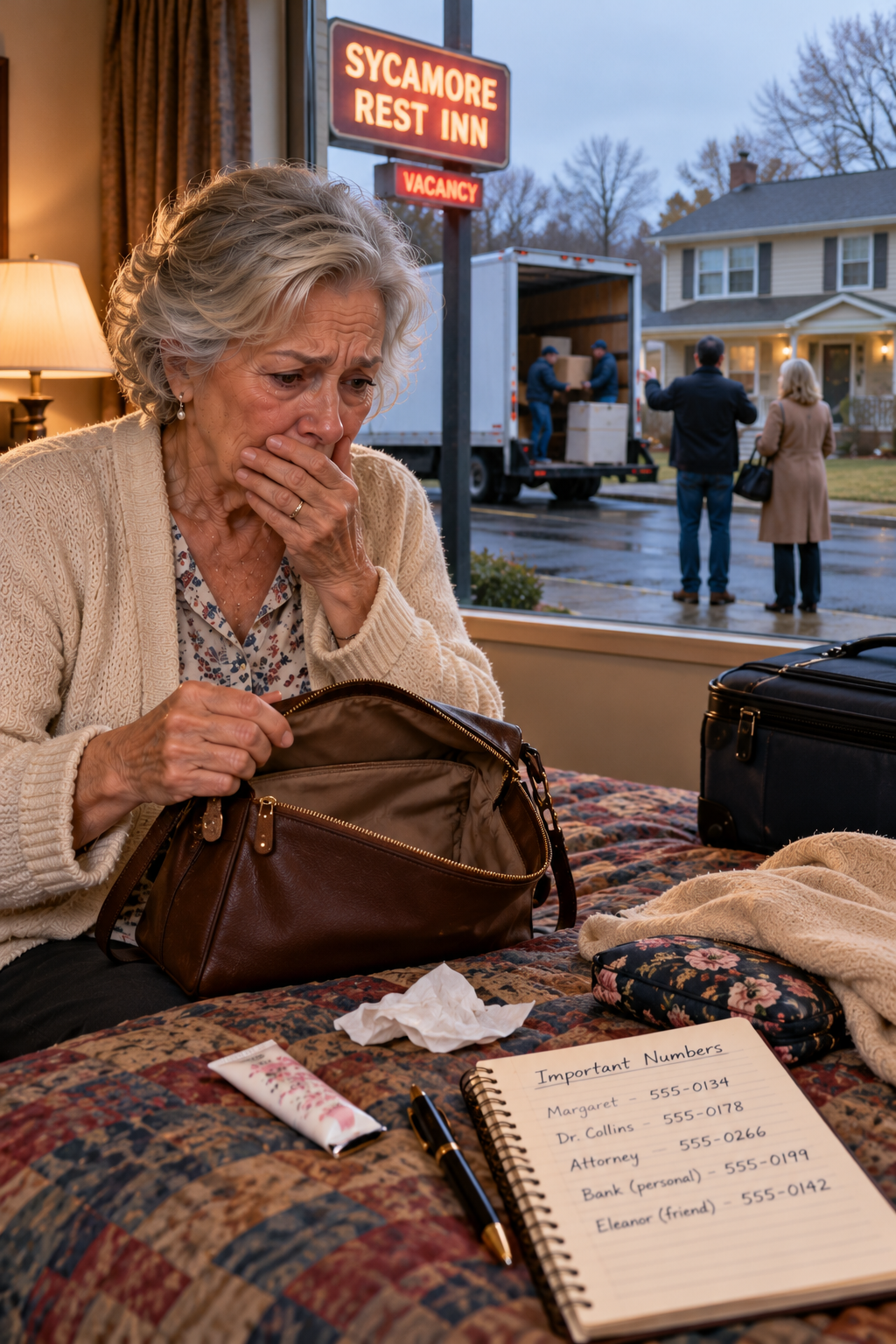
“Are you in some kind of trouble, ma’am?” he asked. I considered telling him everything, but I wasn’t ready to explain that my own son might have stolen my identification and abandoned me. Instead, I told him I needed to contact a neighbor because I couldn’t reach my family. He tried the telephone in my room, confirmed that it wasn’t functioning, and offered me his personal cellphone. I thanked him, opened my notebook, and dialed a number I had known for more than twenty years.
Ruthanne answered on the second ring. She lived across the street from me and had been my closest friend since the year her husband retired from the fire department. Before retirement, she had worked as a paralegal for nearly three decades, and she possessed the rare ability to recognize trouble without becoming overwhelmed by it. I told her where I was and asked her not to contact Warren. There was a pause before she asked what had happened.
I explained the supposed furnace failure, the motel, the dead telephone, and the missing wallet. Ruthanne listened without interrupting, which frightened me more than any expression of alarm would have. When I finished, she said something that made my stomach turn. “Cecilia, there’s a moving truck outside your house right now.” I gripped the counter so tightly that my knuckles turned white.
She described two men carrying furniture through my front door while another person photographed the living room. A white van with the name of a home-staging company was parked beside the truck, and Claudette’s car had been there earlier. Ruthanne had assumed I was preparing to sell the house, although she found it strange that I hadn’t mentioned anything. When she saw the moving crew remove the old floor lamp from my living room, she began to suspect something was wrong. She promised to collect me immediately and told me not to speak with Warren until we understood what was happening.
Nineteen minutes later, Ruthanne entered the motel room carrying a thermos of coffee and the kind of expression that could frighten a dishonest politician. She hugged me once, then examined the room and asked me to repeat the events in chronological order. I told her everything, including Warren’s recent interest in my financial documents and Claudette’s repeated suggestions that I sell the house. Ruthanne took notes in a small legal pad, occasionally asking questions about dates and conversations. When I finished, she closed the notebook and announced that we were going to the police.
The officer who interviewed us was polite but cautious. He asked whether I might have misplaced my wallet and whether I had authorized my son to arrange a move. I explained that I had owned my house for thirty-one years and had never agreed to sell or transfer it. I also told him that my son had placed me in a motel under a false explanation while people were removing belongings from my property. Ruthanne confirmed the moving truck and provided the name of the staging company.
The officer took a formal report and gave me a case number. He explained that investigators would need to establish what documents had been signed and whether any unauthorized financial transactions had occurred. I understood that the situation might involve both criminal conduct and civil property issues, but I was grateful to have an official record. The report number felt like the first solid thing I had held since discovering my missing wallet. I wrote it carefully in my notebook.
Our next stop was the bank. I had maintained my primary accounts at the same branch for almost twenty years, and the manager, Teresa Collins, knew me by name. When I explained that my identification had been stolen, she arranged alternative verification procedures and invited Ruthanne to sit beside me. I asked Teresa to review any recent changes to my accounts. She studied the computer screen, and the color gradually drained from her face.
“Mrs. Marsh,” she said quietly, “a power of attorney was submitted four days ago.” She explained that the document appeared to grant Warren broad authority over my financial affairs. According to the bank’s records, a substantial transfer had already been initiated using that authority. I felt the room tilt beneath me, although I remained seated and kept my hands folded in my lap. I asked her to print a copy of the document.
The signature at the bottom was supposed to be mine. I had signed my name thousands of times, and I knew every peculiar curve of the letters. The capital C in Cecilia never formed a complete loop, and the final stroke of Marsh always slanted downward. On the document Teresa handed me, the C was closed and the final letters sat perfectly straight. Someone had copied my name, but they had not copied my handwriting.
“That is not my signature,” I said. Teresa looked at the police report number Ruthanne had placed on the desk, then excused herself to contact the bank’s fraud department. I stared at the paper while a terrible thought settled into place. Warren and Claudette had not simply planned to sell my house without consulting me. They had prepared documents to make it appear that I had voluntarily surrendered control of my entire financial life.
Part 3: My secret savings account became the weapon they never expected
Teresa returned with a compliance officer and asked me to describe every circumstance surrounding the suspicious power of attorney. I explained that I had not signed any new financial documents, had not appointed Warren as my agent, and had never authorized the transfer shown on the account history. The compliance officer took copies of my police report and began the bank’s formal fraud-review process. Additional transactions were flagged for investigation, and restrictions were placed on further activity while the disputed authority was examined. Teresa warned that recovering the transferred money could take time and might require cooperation from several institutions.
I asked how much remained in my primary accounts. When she showed me the balance, I felt a sharp ache beneath my ribs. Years of careful saving had been reduced to a fraction of what should have been there. I thought about Gerald working overtime at the factory, about the vacations we postponed, and about the evenings I spent balancing our household budget at the kitchen table. Warren had treated that money as though it were an emergency fund reserved for his own mistakes.
Teresa asked whether I had access to any other resources. For the first time that morning, I allowed myself a small smile. Thirty years earlier, my mother had left me a modest inheritance, and I had placed it in an account at a local credit union. I had continued adding small amounts whenever possible, regarding the money as a reserve for unexpected emergencies. Gerald knew the account existed, but we rarely discussed it, and Warren had never been given access.
The account was not a fortune, but it was enough to provide security while the investigation proceeded. Ruthanne drove me to the credit union, where I confirmed the balance and arranged temporary access to funds. I also reported the stolen identification and asked about additional account protections. The manager helped me review my contact information and establish safeguards against unauthorized changes. For the first time that day, I felt that my future was not entirely dependent on the outcome of the fraud investigation.
Our final appointment was with Adele Fontaine, an attorney Ruthanne had known professionally for years. Adele’s office occupied the second floor of an old downtown building above a dry cleaner, and her waiting room smelled faintly of coffee and paper. She greeted us with the direct manner of someone accustomed to difficult situations. I described the motel, the missing wallet, the moving truck, and the forged power of attorney. Adele listened carefully, writing notes on a yellow legal pad.
When I finished, she asked whether I had ever authorized Warren to sell or transfer the property. I told her absolutely not and produced a copy of my deed from the documents stored in my notebook. She explained that the suspicious financial instrument, unauthorized transfer, and attempted property transaction raised serious legal concerns requiring immediate action. She would examine the relevant records, contact the appropriate authorities, and seek emergency relief to prevent further changes to the property. I told her that my priority was to recover my home and protect whatever assets remained.
Adele asked whether there was any chance the furnace had genuinely failed. I explained that I had noticed no problem before leaving and that Warren had never shown me a repair estimate or service appointment. She suggested contacting the heating company that normally maintained my system. Ruthanne called from the hallway and returned with the answer we expected. No service request had been made, and no technician was scheduled to visit my address.
The deception was now unmistakable. Warren and Claudette had invented a household emergency to remove me from the property while they attempted to take control of it. I struggled to understand how my son could participate in something so cruel. I remembered him as a frightened child running into my arms during thunderstorms and as a young man calling home when his first marriage collapsed. I had comforted him through every major disappointment of his life, and now he had decided that my security was an acceptable sacrifice for his own needs.
Adele asked whether I wanted to proceed even if the investigation resulted in criminal charges against my son. I thought about the question for a long moment. I did not want Warren imprisoned, humiliated, or destroyed, but I could not pretend that what happened was a harmless family disagreement. He had taken my identification, misrepresented my wishes, and attempted to strip me of property I had spent decades maintaining. I told Adele to take whatever lawful steps were necessary to protect me and preserve the evidence.
That evening, Ruthanne insisted that I stay in her guest bedroom. She made chicken soup, placed clean towels in the bathroom, and handed me a pair of slippers without asking whether I needed them. I sat on the edge of the bed and finally allowed myself to cry. I wasn’t crying over the money or even the house. I was grieving the son I believed I had raised.
After several minutes, I washed my face and went downstairs. Ruthanne was sitting at the kitchen table with two cups of tea, reviewing the notes she had taken throughout the day. She looked up and asked whether I wanted to talk. I told her I wanted to make a plan for the morning. She smiled, pushed the legal pad toward me, and said, “That’s exactly what I hoped you’d say.”
Part 4: The forged signature triggered a legal battle for my house
By the following morning, Adele had begun preparing an emergency court application to protect my property. She obtained the relevant ownership records and contacted the real estate agency connected to the staging company. The house had been prepared for listing, and documents suggested that Warren intended to proceed as though he possessed legal authority to act on my behalf. Adele notified the agency that I disputed that authority and that the matter was under investigation. She also sought court orders to prevent any sale or transfer while the dispute was resolved.
I accompanied Ruthanne to the county recorder’s office, where we requested certified copies of the property records. The clerk confirmed that the deed remained in my name, although documents connected to a proposed transfer had been submitted for review. Adele examined the paperwork and immediately questioned the notarial information attached to the power of attorney. The name belonged to Patricia Neil, a notary whose commission had reportedly been suspended more than a year earlier. That discovery raised additional questions about how the document had been prepared and who had participated in its creation.
The investigation expanded quickly. Detectives interviewed bank employees, requested transaction records, and contacted the people involved in preparing the property for sale. Ruthanne provided a statement describing the moving truck and the activity she observed at my house. Tyler, the motel clerk, confirmed that I had been left there and that my room telephone was not functioning when I requested assistance. Every detail helped establish a timeline of what Warren and Claudette had done.
Adele explained that proving fraud required more than demonstrating that the documents looked suspicious. Investigators needed evidence connecting the people involved to the disputed signatures, transactions, and property arrangements. She warned me that the process could become complicated and emotionally exhausting. I understood, but I had no intention of abandoning it simply because the people responsible were related to me. My son had relied on my reluctance to create conflict, and I was no longer willing to let that reluctance endanger my future.
Two days later, Ruthanne drove me past my house. A lockbox hung from the front door, and a staging company’s van was parked in the driveway. Through the living room window, I could see that the furniture had been rearranged and several familiar objects were missing. The azaleas I planted after Gerald died were blooming beside the front steps, indifferent to the strangers moving through the rooms. I felt a wave of grief so intense that I had to look away.
Ruthanne asked whether I wanted to stop. I told her not yet, because Adele had advised me to avoid confrontation while the emergency application was pending. We sat across the street for several minutes, watching a worker carry a box toward the garage. I recognized the box immediately because Gerald had labeled it during our last move. It contained photographs from our early marriage, including the only surviving pictures of our first apartment.
I pressed my hands together to keep them from trembling. The people inside my house were treating decades of memories as clutter to be removed before prospective buyers arrived. They had no idea what those objects meant to me or how much of my life was contained within those walls. I wanted to march across the street and demand that everyone leave. Instead, I asked Ruthanne to drive us back to Adele’s office.
That afternoon, Adele called with encouraging news. The court had granted temporary relief preventing further transfer activity while the matter proceeded. The real estate agency had been formally notified, and the listing process was suspended. The bank continued reviewing the disputed financial transactions, and investigators were examining the authenticity of the power of attorney. I knew the battle was far from over, but for the first time since the motel, I felt the situation moving in the right direction.
Three days later, Warren called from an unfamiliar number. I recognized his voice immediately, although it sounded weaker than I remembered. He asked whether I was safe and said he had been trying to reach me. I almost laughed at the absurdity of the question. The man who had abandoned me without identification or reliable communication was suddenly concerned about my well-being.
I told him I was safe and that my attorney was handling the situation. He began speaking rapidly, explaining that he and Claudette had been under tremendous financial pressure. Their business was struggling, medical expenses had accumulated, and a second mortgage had become difficult to manage. He said they had convinced themselves that selling my house would solve everything temporarily. He insisted that he never intended to leave me without a home.
I asked whether he had forged my signature. The silence lasted so long that I thought the call had disconnected. Then he whispered that he had signed the document because Claudette said it was the only way to move forward quickly. I asked whether he had taken my wallet. He admitted that he had removed it from my purse because he feared I would interfere with the arrangements.
“Interfere?” I repeated. “Warren, it was my house, my money, and my life.” He began crying, telling me he had panicked and believed he could fix everything before I discovered what happened. I reminded him that he could have asked for help instead of stealing from me. Then I told him that any further communication needed to go through Adele.
Before I ended the call, Warren asked whether I still loved him. The question broke my heart because the answer was complicated. I loved the child I had raised and the man I remembered, but I no longer trusted the person who had placed me in that motel. I told him that love did not erase responsibility. Then I hung up and sat quietly while Ruthanne placed a cup of tea beside me.
Part 5: My son’s confession exposed the desperation behind his betrayal
Warren’s confession did not make me feel victorious. Instead, it left me with a strange mixture of sorrow, anger, and exhaustion that followed me through the next several days. I kept remembering the boy who brought injured birds into the kitchen and begged Gerald to help them. I remembered the teenager who worked weekends to buy his first car and the young father who cried when he held his daughter for the first time. Somewhere along the way, that boy had become a man who believed his mother’s property was available to solve his financial problems.
Adele advised me not to discuss the case directly with Warren or Claudette while the investigation continued. She explained that statements made during emotional conversations could complicate legal proceedings or create confusion about what had been admitted. I followed her advice, although ignoring my son’s calls was one of the hardest things I had ever done. Each time his name appeared on my screen, I felt the old instinct to answer and make everything better. Then I remembered waking in Room 114 without my wallet.
The detective assigned to the case contacted me several days later. He explained that investigators had obtained additional records connecting the disputed power of attorney to the attempted financial and property transactions. Claudette had retained separate legal counsel, and Warren had agreed to provide information through his attorney. The detective could not predict the final outcome, but he said the evidence warranted continued investigation. I thanked him and wrote down the details in my notebook.
Meanwhile, Adele worked to restore my access to the house. The temporary court orders prevented further property transactions, but practical arrangements were still necessary before I could return safely. The staging company needed to remove its equipment, the lockbox had to be taken down, and the locks required inspection. Adele coordinated with the relevant parties to ensure that my return would not create another confrontation. I waited impatiently, counting the days until I could sleep in my own bed again.
During that waiting period, Eleanor Whitcomb arrived from Vermont. She had been my college roommate more than forty years earlier and remained one of the few people who knew me before I became Gerald’s wife or Warren’s mother. Years ago, I had named her as my agent under a properly executed durable power of attorney, intended to be used only if necessary under its terms. She had never needed to act in that capacity, but the document remained part of my estate planning records. When I told her what happened, she booked a flight without asking whether I wanted company.
Eleanor entered Ruthanne’s kitchen carrying a suitcase, a folder of documents, and a bag of coffee from her favorite shop. She hugged me tightly, then held me at arm’s length and examined my face. “You should have called sooner,” she said, sounding exactly as she had when we were twenty. I told her I hadn’t wanted to involve anyone until I understood the situation. She shook her head and reminded me that friendship was not something I had to earn by handling every problem alone.
We spent the afternoon reviewing documents with Adele. Eleanor provided copies of the existing estate planning records, and Adele explained how they differed from the suspicious document Warren had submitted. The contrast strengthened my understanding of the case and helped establish that I had already made deliberate choices about whom I trusted with important responsibilities. We also discussed updating account security and ensuring that future changes required appropriate verification. I left the meeting feeling better prepared than I had been at any point since the betrayal began.
That evening, Ruthanne prepared dinner for the three of us. We sat around her kitchen table sharing memories from college, laughing about old friends, and recalling the ridiculous things we once considered important. For a few hours, the legal case faded into the background. I realized that Warren and Claudette had underestimated more than my ability to manage paperwork. They had underestimated the relationships I had built over a lifetime.
The following morning, Adele called with the news I had been waiting for. The necessary arrangements had been completed, and I could return to my house that afternoon. Ruthanne insisted on driving, while Eleanor accompanied us with a small bag of groceries and cleaning supplies. As we turned onto Maple Grove Lane, I saw the familiar oak tree rising above the roof. My heart began beating faster.
The lockbox was gone. The staging company’s van had disappeared, and the driveway stood empty beneath the afternoon sun. I walked up the front path, noticing the weeds between the stones Gerald and I had laid together. My original key still worked in the deadbolt, although the interior hardware had been changed. With assistance from the people coordinating my return, I entered the house that had been taken from me.
The air smelled artificial, filled with the sweet fragrance of plug-in air fresheners. Furniture had been moved, pictures removed, and decorative objects placed where our family belongings once stood. I walked through the rooms slowly, recognizing the familiar walls beneath the unfamiliar arrangement. The kitchen was still painted pale yellow, and the floorboards creaked in the same places they always had. I placed my hand against the counter and whispered, “I’m home.”
Part 6: I reclaimed my house but lost the son I trusted
Returning home was not the triumphant moment I had imagined. I was relieved to stand inside my own kitchen, but every room contained evidence of how casually my son and daughter-in-law had treated my life. The living room looked like a furniture showroom, with neutral cushions and decorative books arranged to impress strangers. The family photographs had disappeared from the mantel, and Gerald’s favorite floor lamp was missing. I felt as though someone had erased our history and replaced it with a version designed to sell.
Ruthanne helped me search the garage, where we discovered several boxes containing my belongings. Gerald’s coin collection was packed beside old photo albums, and my mother’s handmade quilt had been folded into a plastic storage bin. The floor lamp had been dismantled, but fortunately none of its pieces appeared damaged. We carried the boxes inside and began restoring the rooms one item at a time. I insisted on placing the quilt across the back of the sofa myself.
Eleanor opened windows while Ruthanne collected the artificial air fresheners. Fresh air moved through the house, carrying the scent of damp earth and blooming azaleas. I found the framed photograph of Gerald and me at a friend’s wedding in 1989 and returned it to the side table. In the picture, we were laughing at something outside the frame, completely unaware of the difficulties that lay ahead. I touched the glass and felt a sudden ache for the husband who would have been furious to know what our son had done.
By evening, the living room looked familiar again. We had not restored everything, but the important pieces were back in place. Ruthanne prepared sandwiches, Eleanor made tea, and we sat together beneath the soft glow of Gerald’s repaired lamp. I thanked them both for helping me reclaim a home I had nearly lost. Neither woman accepted the thanks easily, insisting that I would have done the same for them.
After they left, I walked through the house alone. I checked the bedrooms, opened the hall closet, and stood for a long time in the doorway of Gerald’s old workshop. His tools remained neatly arranged above the workbench, exactly as he had left them. I remembered how he used to whistle while repairing household appliances and how he always claimed that nothing was truly broken until he had taken it apart twice. I wished desperately that he were there to tell me what to do about Warren.
That night, my phone rang several times. Warren’s number appeared on the screen, but I allowed the calls to go unanswered. Adele had advised me to preserve communications and avoid direct discussions while the case remained active. I followed her instructions, although each unanswered call felt like another small fracture in our relationship. Eventually, I turned off the phone and sat beside the window until the street grew quiet.
There is a particular kind of loneliness that comes from loving someone you can no longer trust. The love does not disappear simply because the person has done something terrible. Instead, it becomes tangled with memories, disappointment, and the painful knowledge that the relationship can never return to its previous innocence. I knew Warren had once loved me without calculation, but I also knew he had recently looked at my home and seen a financial opportunity. That realization hurt more deeply than the missing money.
Two weeks later, a letter arrived in the mail. The envelope carried Warren’s familiar handwriting, slightly oversized and uneven along the lines. I placed it on the kitchen table and stared at it for several minutes before opening it. Inside were three pages written in blue ink, filled with apologies and explanations. He admitted that he had convinced himself he was protecting me when he was actually protecting his own pride.
He wrote about the business debts, Claudette’s medical expenses, and the pressure of maintaining a lifestyle they could no longer afford. He admitted that Claudette had proposed using my property to solve their problems, but he accepted responsibility for agreeing to the plan. He said he had been too ashamed to ask me for help because he feared I would see him as a failure. Instead, he had chosen a course of action that made him responsible for something far worse.
One sentence stayed with me long after I finished reading. “I thought you were becoming too old to understand what was happening, but I was the one who couldn’t see clearly.” I read those words several times, remembering every occasion when Warren had dismissed my opinions or suggested that I was becoming forgetful. His letter acknowledged that he had mistaken my quiet nature for weakness. I folded the pages carefully and placed them in the drawer with my important papers.
I did not forgive him that day. I did not tear up the letter or call him to say everything would be all right. I understood that genuine remorse mattered, but it did not erase the damage caused by deliberate deception. Warren would have to face the consequences of his actions, and I would need time to decide whether our relationship could ever be repaired. For the first time in my life, I allowed myself to love my son without taking responsibility for saving him.
Part 7: The courtroom finally heard what my family tried to silence
The legal proceedings continued for several months. Investigators reviewed financial records, questioned witnesses, and examined the documents used to support the attempted property transaction. The disputed power of attorney became central to the case, particularly because the notarial information raised serious questions about its validity. Warren and Claudette each retained counsel, and their attorneys negotiated with prosecutors as the evidence developed. I attended meetings when necessary, but I refused to let the case consume every hour of my life.
Adele kept me informed about developments and explained the possible outcomes without making promises. She emphasized that criminal charges and restitution decisions were controlled by the appropriate legal authorities, not by my personal feelings toward Warren. I appreciated her honesty because I had no desire to turn the proceedings into a family revenge campaign. My goal was to establish what happened, recover what could be recovered, and prevent similar harm from occurring again. I wanted the record to reflect that I had never voluntarily surrendered my property or financial independence.
Eventually, Claudette entered an agreement that required cooperation with the investigation. Warren accepted responsibility through a negotiated resolution involving a reduced charge, restitution obligations, and court-imposed conditions. The outcome did not erase what happened, but it created a formal acknowledgment of wrongdoing and a process for addressing the financial damage. I had complicated feelings about the fact that Warren would not serve a prison sentence. Part of me was relieved, while another part wondered whether the consequences were sufficient.
Before sentencing, the prosecutor asked whether I wanted to submit a victim-impact statement. I agreed immediately because I believed the court needed to understand that the harm extended far beyond money. I spent several evenings drafting the statement at my kitchen table, choosing each word carefully. I described the motel room, the missing identification, and the discovery that strangers were preparing my house for sale. Then I explained what it felt like to realize that my own son had deliberately removed me from the life I had built.
On the day of the hearing, Ruthanne sat beside me while Eleanor waited in the row behind us. Warren was seated with his attorney, looking older and more exhausted than I remembered. Claudette sat several seats away, her expression carefully controlled. I avoided looking at either of them until the judge invited me to speak. Then I stood, unfolded my statement, and began reading.
I told the court that I was sixty-eight years old and fully capable of managing my own affairs. I explained that I had maintained my home, paid my bills, and made independent decisions for decades. I had not requested assistance with selling my property or transferring control of my accounts. The people responsible had acted because they believed my age made me easier to manipulate. I wanted that assumption placed clearly on the record.
I described the emotional consequences of waking in a motel without my wallet and discovering that my son had arranged to remove my belongings. I explained that financial loss could sometimes be repaired, but trust was far more difficult to restore. I spoke about the fear of being treated as an inconvenience by the people who were supposed to care about me. Most importantly, I asked the court to recognize that older adults were entitled to the same autonomy and dignity as everyone else. I finished by saying that I intended to spend the rest of my life making sure my voice was heard.
The courtroom remained quiet when I sat down. Ruthanne squeezed my hand, and Eleanor nodded from behind us. I looked toward Warren and saw tears running down his face. For a moment, I remembered the little boy who used to run to me after scraping his knees. Then I reminded myself that the man sitting across the courtroom had made choices for which he was responsible.
The judge acknowledged my statement before addressing the defendants. The court imposed the agreed conditions, including restitution and compliance requirements, and made clear that the conduct involved serious violations of trust. I listened carefully, feeling neither triumph nor satisfaction. The outcome was necessary, but it could not restore the innocence of my relationship with Warren. It could only establish boundaries and consequences where none had existed before.
After the hearing, Warren approached me in the hallway with his attorney nearby. He asked whether he could say something, and I agreed to listen briefly. He apologized again, this time without mentioning Claudette, the business, or the pressures that had influenced his decisions. He said he understood that he had betrayed me and that he would respect whatever boundaries I established. I thanked him for acknowledging the truth but told him I was not ready to discuss reconciliation.
He nodded and stepped away. I watched him walk down the hallway, feeling the familiar ache of loving someone who had caused profound harm. Ruthanne asked whether I wanted to go home, and I said yes. We stopped at a bakery on the way and bought two slices of lemon cake. That evening, we ate them on my back porch while the sun disappeared behind Gerald’s oak tree.
Part 8: One year later, the woman they underestimated stood stronger than ever
Spring arrived with warm rain and the smell of fresh soil. I ordered new azalea bushes for the back fence, choosing a variety Gerald and I had once admired at a botanical garden. Ruthanne helped me dig the planting holes, although she complained loudly about the condition of her knees. We worked slowly, taking breaks whenever we needed them and laughing at our determination to finish the project without hiring anyone. By late afternoon, the bushes were planted, and the garden looked more alive than it had in years.
Eleanor visited from Vermont that weekend. We spent hours on the back porch drinking coffee, discussing books, and remembering people we had known when we were young. She asked whether I had considered moving somewhere smaller after everything that happened. I told her I might eventually make that decision, but it would be mine to make when the time was right. For now, I wanted to remain in the house Gerald and I had built into a home.
My daughter, Cheryl, visited in April with her nineteen-year-old daughter, Madison. Madison had inherited her grandfather’s curiosity and spent an entire afternoon examining the old photographs stored in the hallway closet. She found a picture of Gerald and me taken in 1971, when we were young and convinced that life would unfold exactly as we planned. She asked whether we had been happy, and I told her we had been happy most of the time. I explained that a good marriage was not a life without difficulty but a partnership in which neither person had to face difficulty alone.
Later, Madison asked whether I was truly all right after everything Warren had done. I considered the question carefully because I did not want to offer a comforting answer that wasn’t true. I told her that I still experienced sadness and anger, especially when memories of her uncle reminded me of the son I had once trusted. But I also told her that I felt safe in my own home and proud of the decisions I had made. I had discovered that being hurt did not mean being defeated.
The financial recovery process continued, and restitution payments began according to the court’s requirements. Not every dollar returned immediately, and some losses required additional administrative work. But the money remaining in my accounts was protected, my credit union savings remained untouched, and the title to my house was secure. Adele helped me review my estate documents and update safeguards against unauthorized transactions. I also arranged for regular financial reviews so that any future irregularities would be detected quickly.
Warren continued sending occasional letters. I read them when I felt ready, sometimes waiting several weeks before opening an envelope. He wrote about attending counseling, rebuilding his finances, and learning to accept responsibility without blaming other people. I appreciated the effort, but I did not confuse improvement with restored trust. Forgiveness, if it came, would have to develop naturally rather than through pressure or guilt.
Claudette never contacted me directly again. I heard through family members that she and Warren were living separately while they attempted to resolve their financial and marital problems. I did not celebrate their difficulties because I understood how painful broken relationships could be. But I also refused to accept responsibility for the consequences of choices they had made. Their future belonged to them, just as mine belonged to me.
That summer, a woman named Margaret Ellis wrote to me after reading a short article about the case in the local newspaper. Her mother had experienced a similar betrayal, but the family had discovered the problem too late to prevent serious financial loss. Margaret thanked me for speaking publicly about what happened and said my statement had encouraged her to help other older adults review their legal documents. I wrote back, and we began exchanging letters. Eventually, she visited my home, and we spent an afternoon discussing practical ways families could protect vulnerable relatives without stripping them of independence.
Those conversations inspired me to volunteer with a local senior resource organization. I did not pretend to be an attorney or financial expert, but I could share my experience and encourage people to seek qualified advice. I spoke about maintaining accurate records, understanding account permissions, and choosing trustworthy people for important legal responsibilities. I also emphasized the value of friendships and community relationships that existed outside immediate family. My little notebook had helped save me because it contained the names and numbers of people who would answer when I called.
By autumn, the garden was thriving. The azaleas had established themselves along the fence, and the oak tree Gerald planted cast long shadows across the lawn. I had repaired the leaking kitchen faucet, replaced a damaged section of the roof, and reorganized the garage after the staging company removed my belongings. These were ordinary household tasks, but completing them gave me enormous satisfaction. Each small repair reminded me that the house remained mine to care for and enjoy.
One evening in October, I sat on the back porch with a cup of tea and watched leaves drift across the grass. The air was cool enough for a sweater, and the neighborhood was quiet except for distant children playing. I thought about the motel room, the flickering orange sign, and the terrible moment when I discovered my missing wallet. I remembered the fear, the anger, and the certainty that someone had decided I no longer mattered. Then I looked around at the home I had reclaimed and felt something stronger than relief.
I felt pride.
Not because I had defeated my son or punished Claudette, but because I had refused to accept the role they assigned me. They expected an older woman who would become confused, frightened, and dependent when her identification and money disappeared. Instead, they encountered someone who knew her rights, kept careful records, and had spent decades building relationships with people she trusted. My strength had not appeared suddenly during the crisis. It had been developing quietly through every ordinary decision I made throughout my life.
I still loved Warren, although that love now existed beside disappointment and caution. Perhaps one day we would sit together and speak honestly about the years before the betrayal. Perhaps we would rebuild a relationship that acknowledged the damage without pretending it never happened. I did not know, and for once I was comfortable allowing the future to remain uncertain. I had learned that I could love my family without surrendering control of my life.
As the sun disappeared behind the oak tree, I went inside and placed my teacup in the sink. My notebook rested on the kitchen counter, its pages filled with telephone numbers, appointments, and reminders. I picked it up and added one final sentence beneath the day’s notes. “Never mistake silence for surrender.”
Then I closed the notebook, turned off the kitchen light, and locked the front door of the house that was still mine.
✓ Lynn R. Adams
Part 2: A missing wallet exposed the shocking conspiracy against my home The young man behind the motel counter looked barely old enough to buy a drink. His name tag said Tyler, and he wore the exhau…