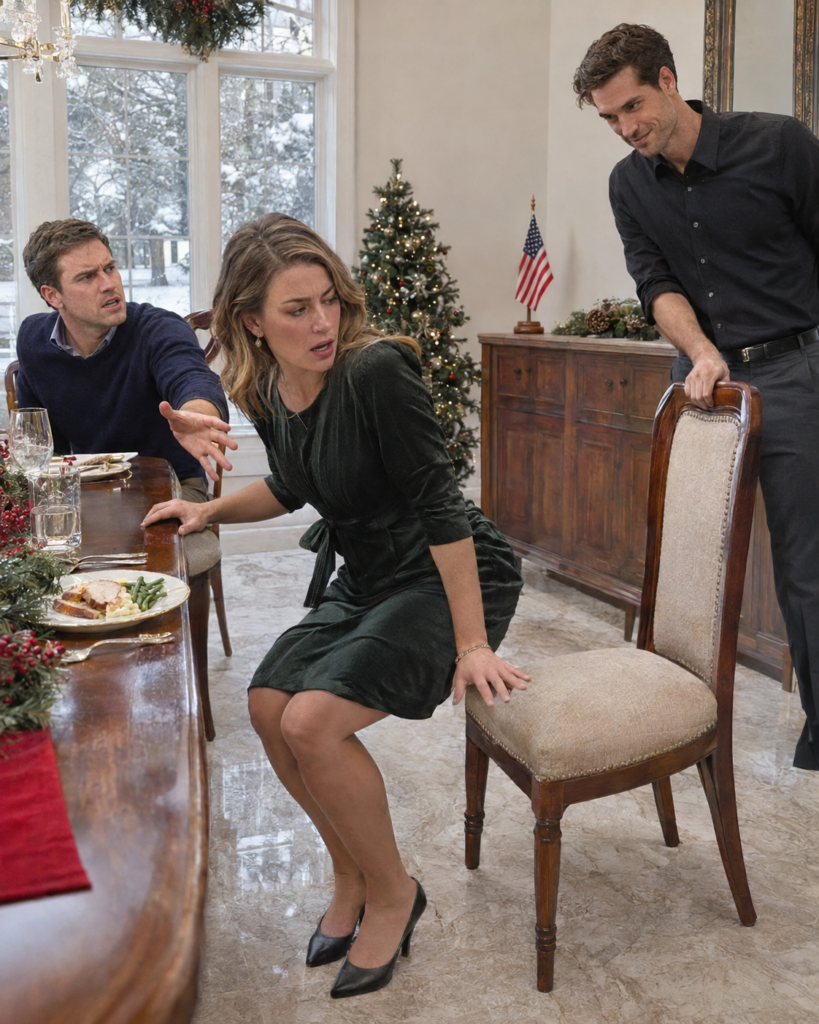
My sister’s fiancé pulled my chair out from under me at Christmas dinner, and I hit the marble floor hard enough to break my elbow. Instead of helping, my mother laughed, my sister clapped, and Hunter joked that I was too heavy for the chair. I couldn’t lift my right arm. When my husband demanded an apology, Hunter laughed at him, too. Then Ethan, the quietest man I’d ever known, grabbed Hunter by the neck and slammed him against the wall. But somehow, my family ended up demanding that I apologize.
My Sister’s Fiancé Broke My Elbow at Christmas. At New Year’s Brunch, I Saw His Foot Move Again.
The chair shifted sideways just as my sister started to sit.
“Kelsey, stop!” I shouted.
She caught the edge of the table and straightened her knees. The chair scraped against the floor behind her, and one of the champagne glasses rattled against its neighbor. Hunter Lockridge was still standing beside it, his polished shoe hooked around the back leg.
For a moment, nobody laughed.
We were at the country club where Hunter’s family was hosting a New Year’s Day brunch. My husband, Ethan, and I had come to deliver twelve paid-for centerpieces, a floral arch, and a welcome arrangement through my shop, Petal and Pine. My right elbow was in a cast. Seven days earlier, at my parents’ Christmas dinner, Hunter had pulled my chair away while I was sitting down. I’d struck the marble floor with my elbow and hit my head against the table leg. He’d laughed while I lay there trying to move an arm that would not support me.
Now he had been reenacting that fall for his friends. When Kelsey moved toward a chair, he decided to demonstrate his favorite joke again, this time on the woman he was supposed to marry.
“What are you doing?” Kelsey asked him.
Hunter moved his foot away. “Relax. I wasn’t going to let you fall.”
“You moved the chair.”
“An inch. I was showing them what happened.” He looked at the friends who had been laughing moments earlier. “Come on. You saw it.”
No one answered. A man holding a coffee cup stared at the floor. One of the club servers stepped closer and asked whether Kelsey was all right. She said she was, but she remained standing with both hands on the table.
I felt Ethan turn beside me. He had been holding the empty crate we’d used to carry the centerpieces. His hands tightened around the handles, then he set it down gently. I knew what he was remembering. At Christmas, he had grabbed Hunter by the neck and shoved him against the dining-room wall when Hunter refused to apologize for hurting me. Ethan had released him the instant I called out for help, but the sight of my quiet husband losing control had frightened me almost as much as the fall.
This time he stayed beside me.
“Kelsey,” I said, “look at where his foot was.”
She did. Her eyes went from the chair leg to Hunter’s shoe, then to the cast on my arm. The color drained from her face. I’d spent the previous week trying to explain that my fall hadn’t been an accident. She had been at the table when it happened. She had clapped while everyone laughed. But I had never seen her look at Hunter quite the way she looked at him then.
“That isn’t funny,” she said.
“It wasn’t meant for you,” Hunter replied. “It was a demonstration.”
“A demonstration of what?”
He opened his mouth. He’d been quick with jokes all morning, but he couldn’t find one that answered her. His mother came over and asked why everyone was standing around. Kelsey told her what he’d done. Mrs. Lockridge looked from the chair to her son, then said perhaps everyone should get a drink and let the staff finish preparing the room.
I could have reminded her that she’d laughed when I hit the floor at Christmas. I didn’t. The change in the room was already plain. Hunter’s friends were no longer looking at me for entertainment. They were looking at him.
The club manager approached and asked if there was a problem with the furniture. I told him no chair was defective. I said Hunter had moved one while somebody was sitting down, and that the same action had put me in the emergency room the previous week. The manager glanced at my cast. He asked Hunter to stop interfering with the seating and checked that Kelsey was unhurt. It was a practical response, not a public trial, and I was grateful for it.
Hunter gave a short, irritated laugh. “You two are really going to turn my family’s brunch into a complaint about a chair?”
“We came to deliver flowers,” I said. “The arrangements are finished. We’re leaving.”
“Good. Maybe next time you can leave the drama at home.”
Ethan lifted our equipment crate without answering. We had photographed the completed setup for the shop’s records and checked it with the event coordinator. The flowers were beautiful, exactly what Hunter’s mother had ordered and paid for months before anyone knew how Christmas would end. I was proud that my anger hadn’t made me break my promise to a customer.
Kelsey followed us toward the hall.
“Jade, wait.”
I stopped. She looked miserable. Beyond her shoulder, Hunter was explaining something to a group near the bar, his hands moving as he talked. I could hear him use the word overreaction.
“Were you really going to hurt me?” Kelsey asked. She sounded as though she already knew the answer and hated herself for needing to ask it.
“No,” I told her. “I shouted because I saw the chair move. That’s all I know.”
She rubbed her hands together. “When he pulled yours, I thought it was just a stupid joke that went wrong. I didn’t think he would do it again.”
“Neither did I.”
“He knew you were hurt.”
She looked back at the room. Her engagement ring flashed under the hallway lights. “I don’t want to go home with him right now.”
Ethan and I had deliveries waiting at the shop. I couldn’t offer to spend the whole day sorting out her relationship, and I wasn’t ready to pretend we’d made up. But I could wait while she arranged a ride. I said so. She took out her phone, ordered a car, and stood with us near the front windows until it arrived.
Before she left, she said, “I’m sorry I laughed on Christmas.”
The words surprised me. They weren’t enough to put my elbow back together, and she knew it. I thanked her for saying them. Then she walked out into the cold January afternoon without going back for Hunter.
I watched her car pull away. Ethan stood beside me, still holding the crate. We didn’t discuss whether Kelsey would marry Hunter, whether his friends believed him, or what his parents would say. We had no way to know. The immediate fact was that a second person had nearly fallen because Hunter wanted an audience.
“Are you okay?” Ethan asked.
I nodded, then realized my left hand was trembling. “I will be. Let’s go home.”
My name is Jade Brightwell. I’m thirty-one years old, and Petal and Pine is the flower shop I built after years of working for other florists. My days normally involve wedding consultations, delivery schedules, buckets of water, and an extraordinary amount of sweeping. I love the work. I also know that when you own a small business, a few missed orders can turn a good month into a very difficult one.
Ethan is a structural engineer. We’d been married six years, and until Christmas I’d never heard him raise his voice. He is patient by habit, the sort of man who can spend half an hour explaining why a shelf is crooked without once making the person who installed it feel foolish. We are not people who spend our holidays looking for a fight.
We had gone to my parents’ house in Minneapolis on Christmas Day because I wanted one pleasant family meal. I’d baked my grandmother’s cranberry bread that morning. It smelled of orange peel and butter, and I carried it into the house still warm under a clean towel. I hoped the bread might give my mother and me something easy to talk about while we waited for dinner.
My younger sister, Kelsey, had always been my mother’s favorite. It wasn’t a secret, though everyone pretended it was. When we were children, Kelsey’s achievements seemed to fill the whole house, while mine were treated as ordinary. I had learned to do well without expecting much celebration. I wasn’t angry every time my sister got attention. I was tired of how often I was expected to make room for her.
Hunter made that arrangement worse. He sold luxury homes and liked everyone to know how successful he was. He called me “the flower lady,” asked whether I’d brought weeds for the table, and suggested I handle Kelsey’s wedding flowers as a charitable favor. I told him Petal and Pine was a business, not a hobby. He smiled as though I’d misunderstood a compliment.
Ethan started to answer him, but I touched my husband’s wrist. I wanted to get through Christmas without making my parents choose sides. That was the mistake I had been making for years: assuming that if I absorbed the small humiliations, the big ones might never come.
At lunch, Dad rose to offer a toast to family. Everyone stood. We raised our glasses, then began to sit. I was lowering myself into my chair when Hunter reached behind me and pulled it away.
I fell backward and sideways. My right elbow hit the marble first, and my head struck a table leg. I remember the hard sound of the impact and the immediate pain shooting through my arm. For a second I couldn’t get enough air to tell anyone what had happened.
Then I heard laughter.
Hunter’s parents laughed. Kelsey clapped. My mother laughed so hard her eyes watered. Hunter announced that I was too heavy for the chair and grinned at his own joke. I tried to push myself upright and couldn’t. The arm beneath me would not take my weight.
“Something’s wrong with my arm,” I said.
Mom told me not to be dramatic. She was still smiling. Dad stood near his chair, silent, looking between me and the others. I wanted someone to kneel beside me. Instead, I heard Hunter make another joke about my weight.
Ethan stood up. He demanded an apology. Hunter refused and challenged him, laughing at my husband as well. Before I could speak, Ethan crossed the room, caught Hunter by the neck, and shoved him against the wall. Hunter’s expensive suit tore down the back. The sound of ripping fabric finally silenced the table.
I was frightened. I needed medical help, not another person getting hurt.
“Ethan, please. My arm.”
He let go immediately and came back to me. His face changed when he saw I couldn’t lift my elbow. He crouched, asked where it hurt, and helped me move carefully. He didn’t try to straighten my arm. Hunter demanded an apology from both of us, as though his torn suit were the only damage anyone had suffered.
Kelsey said I’d ruined Christmas. Mom suggested we apologize so the family could finish dinner. I was the one who’d fallen, the one crying from pain, yet they expected me to restore the peace.
Ethan helped me to my feet. I was dizzy and holding my right arm against my body. He told my parents we were leaving for the emergency room. My mother warned me that if I walked out, I shouldn’t come back.
“Okay,” I said.
I didn’t argue. I couldn’t have managed a longer sentence. I wanted to get somewhere that people would take me seriously when I told them I was hurt.
At the emergency department, a nurse helped me settle into a chair and asked about the fall, including the blow to my head. A doctor examined me and sent me for X-rays. Ethan sat beside me through the waiting, his hands folded so tightly I could see the pressure marks on his fingers. He was quiet until the doctor returned with the images.
My elbow was fractured. I would need a cast for six weeks, follow-up appointments, and care as the swelling and pain changed. The doctor also gave us instructions about symptoms to watch for after the head strike. It was the sort of conversation I normally listened to carefully. That afternoon I had to ask Ethan to repeat parts of it once we were alone.
“Six weeks?” I said.
I wasn’t worried about missing tennis or a holiday trip. I was thinking about flower shears, ribbon, wire cutters, boxes, buckets, the steering wheel of our delivery van, and the orders waiting at Petal and Pine. My right hand was the one I used for nearly everything. I could still work, perhaps, but not the way I had the day before.
Ethan touched my uninjured hand. “We’ll figure the shop out,” he said.
At about four o’clock, Dad appeared in the emergency department with my coat folded over one arm and a shopping bag containing the Christmas gifts we’d left behind. He stopped at the sight of the cast. For a moment he looked much older than he had that morning.
“I should have helped you,” he said. “I saw you on the floor, and I did nothing.”
I didn’t know what to say. I had spent much of my life defending Dad by telling myself he hated arguments and didn’t know how to interrupt Mom. But he’d been the adult at that table, and he’d watched his daughter get hurt while people laughed.
He sat beside me and said he’d asked the guests to leave after we drove away. He’d also told my mother that he would not make the next payment toward Kelsey’s wedding while everyone was pretending Hunter’s conduct had been harmless.
“I don’t want money to be the only reason you take my side,” I told him.
“It isn’t,” Dad said. “But I can’t keep paying for something I’m not willing to defend.”
He had tears in his eyes. I hadn’t seen that often, and it made me want to comfort him. I didn’t. I squeezed his hand and let him be the person who was sorry for a change.
That evening Ethan and I ate soup at our kitchen counter because I couldn’t bear to sit at the dining table. He helped me take off my coat and arranged pillows so I could sleep with my arm supported. When he thought I was comfortable, he sat down across from me.
“I shouldn’t have grabbed Hunter,” he said.
I looked at him. “I know why you did.”
“That doesn’t make it a good decision. I saw you on the floor, and I heard him laugh. I stopped thinking.”
“When I called you, you came back.”
“Because you needed me. I should have seen that sooner.”
We talked for a long time. Ethan did not pretend he’d been justified in putting his hands on Hunter merely because Hunter had done something cruel first. He was prepared to tell the truth if anyone asked about the confrontation. I told him that the image of him pressing Hunter into the wall had scared me, and he apologized for that too.
There was something reassuring about his willingness to own the part he’d gotten wrong. I wished the people who had pulled away the chair could have managed a fraction of the same honesty.
The first message from Hunter came the following morning. He wrote that Ethan was lucky he hadn’t pressed charges and that my husband should replace his torn suit. There was nothing about my elbow. I saved the message without answering. Ethan read it, went still for a moment, and put the phone back on the counter.
Kelsey sent a separate message removing me as her maid of honor. She said it was too awkward after what had happened and that she couldn’t risk any more trouble around wedding events. I wanted to ask whether she had considered that I might not be able to carry a bouquet in a cast, much less stand beside her at a ceremony. Instead, I wrote that I understood she had made a decision.
Mom called later that day. “I’ll forgive you if you apologize,” she said.
“For what?”
“For leaving and letting Ethan embarrass Hunter. You know he was joking.”
I looked down at the cast covering my right arm. “Mom, the X-rays showed a broken bone.”
“Nobody meant for you to get hurt.”
“Hunter meant to move the chair.”
She said I was twisting things and that Christmas had been difficult for everyone. I ended the call before we could go around the same argument again.
That evening, I opened a message to her and began typing an apology. I’d done it before, after birthdays when I supposedly took the attention away from Kelsey, after family dinners when I failed to laugh at a joke, after disagreements I couldn’t remember starting. I knew exactly which sentences would make my mother speak warmly to me again.
Ethan came into the room and saw me looking at the screen. He didn’t tell me what to write. He simply said, “Hunter pulled your chair away on purpose. You don’t have to apologize for getting hurt.”
I read what I’d typed, deleted it, and put down the phone. The silence afterward was uncomfortable. It was also the first time I could remember not rushing to fill it.
Petal and Pine opened the day after Christmas with a calendar full of orders and one owner who couldn’t use her right arm. I stood behind the worktable trying to fasten a ribbon around a vase and discovered how much a simple knot required both hands. I could still choose flowers, talk to customers, sketch arrangements, and handle the books. I couldn’t work wire into a heavy arch or lift a water-filled bucket safely.
Ethan rearranged his schedule as much as he could without neglecting his engineering work. He wrapped bouquets at night and made deliveries when he was free. He was terrible at choosing ribbon lengths at first, but good at following a written plan. When I drew a simple diagram of a centerpiece, he could copy the structure and ask sensible questions. We also paid for extra hands when a job required more than the two of us could manage.
The added help cost money. So did my medical care. There were insurance charges, follow-up appointments, and orders I could no longer accept. Nothing catastrophic happened overnight, but by the end of the week the figures on my desk were more worrying than I’d expected. We had savings for emergencies. I resented that this was how we were using them.
On December thirtieth, I found the Lockridge family’s New Year’s brunch order in our event schedule. Twelve centerpieces, a large floral arch, and a welcome arrangement. Hunter’s mother had placed the order months earlier and paid in full. We had confirmed the designs and purchased the materials. The job would take most of a day, and walking away would mean wasting work we’d already paid for.
Ethan asked whether I wanted to cancel it.
“No,” I said after looking over the order. “They paid for flowers, and I’m going to deliver flowers.”
He looked at the cast. “Then we’ll do it carefully.”
We spent the next day preparing the arrangements. I chose cream roses, winter greenery, and muted gold accents to match the family’s request. Ethan and I checked every fastening on the floral arch before loading it, and we made two trips with the crates rather than trying to lift everything at once. I was tired before we started driving on New Year’s morning, but I knew the work was good.
I hadn’t expected Hunter to arrive while we were finishing. I certainly hadn’t expected him to call over his friends and act out the moment I broke my elbow. Yet there he was, laughing at my fall while I stood a few feet away in a cast. And when he hooked his foot around Kelsey’s chair, I finally understood that Hunter hadn’t spent the week regretting what he’d done.
He’d spent it practicing how to make the story entertaining for other people.
Back at Petal and Pine, we unloaded the empty crates in silence. I changed out of my good coat and sank into the little chair behind the counter. I had stood longer than my arm and the rest of my body were ready for. Ethan brought me water and checked the day’s remaining deliveries. He did not ask whether he should go back to the club and confront Hunter. He knew I would say no.
“I wanted to grab him again,” Ethan admitted after a while.
“I saw your hands.”
“Then I remembered you were the one standing there with a broken elbow.”
“That’s what I needed you to remember.”
He nodded. He went back to sorting the delivery slips, and I felt relieved that there was nothing more to say. We were learning something unpleasant about ourselves too: anger could be understandable without being useful. Ethan had a right to be furious. I needed him beside me, not in another confrontation that might take him away when I was counting on him most.
That evening, Kelsey called from a friend’s apartment. She said Hunter had sent her several messages telling her she had embarrassed him in front of his clients and friends. He maintained he’d only been demonstrating a joke, that he’d never meant for her to fall, and that I had deliberately caused trouble by yelling.
“What did you tell him?” I asked.
“I told him I needed time.”
“And what did he say?”
“That I’m making him look bad.”
She was quiet for a moment. Then she asked, “When he pulled your chair at Christmas, did you really think he was going to do it before he moved?”
“No. I was just sitting down. I didn’t know he was behind me until I fell.”
“And Mom laughed.”
“I laughed too.”
I closed my eyes. Hearing her say it plainly hurt more than I’d expected. “You did.”
Kelsey began crying. She said she’d always thought Hunter could be obnoxious, especially when he wanted attention, but she’d convinced herself his behavior was mostly harmless. He was generous when he felt admired. He planned extravagant evenings, remembered which restaurants she liked, and talked about the house they would buy after the wedding. When he mocked someone, she laughed because that seemed easier than being the person he turned on next.
“That’s an explanation,” I said gently. “It doesn’t make it okay.”
She asked whether I would forgive her. I told her I wanted to, but I wasn’t ready to pretend that a week of pain and humiliation had been erased by one frightening moment at the club. We could talk and see what she did next. She didn’t demand more from me. That helped.
The following day Mom called. She had heard Kelsey had left the brunch separately and was refusing to spend the night at Hunter’s apartment. She wanted me to call my sister and persuade her not to throw away a good relationship over an unfortunate joke.
“Did Kelsey tell you what he did with the chair?” I asked.
“She said he was teasing her.”
“She had to grab the table to keep from falling. I watched him pull it.”
Mom sighed. “You and your sister are both so upset right now. Somebody needs to be sensible.”
“I was sensible when I delivered the flowers I’d been paid to provide. I don’t have to tell Kelsey how to feel about the man she’s planning to marry.”
“I thought you’d want to help her.”
“I do. Helping her doesn’t mean talking her out of something she saw with her own eyes.”
Mom changed the subject to the wedding deposit Dad had stopped paying. She complained that he was embarrassing the family and putting Kelsey in a difficult position. I said Dad was responsible for his own money and that the wedding arrangements belonged to Kelsey and Hunter. I was not the person who could solve them by apologizing.
After I hung up, I wondered whether my mother had called me because she couldn’t bear the idea of Kelsey being disappointed. She had never called that quickly when I was the disappointed child. I was still angry about it, but I no longer felt obliged to rearrange everything so she would be comfortable.
Ethan and I spoke with an attorney about the chair incident and Hunter’s threat. We wanted to understand the options before responding to anything. We gave a factual account of Christmas, including Ethan grabbing Hunter and the damage to his suit. We also described the New Year’s incident and identified people who had been nearby. The attorney made no promise about what police or a court would do. He told us to preserve the hospital records, messages, receipts, and our own notes, and to avoid contacting Hunter in anger.
That suited me. I didn’t want the rest of my winter consumed by threatening messages. But I did want to keep a record of what had happened, particularly because my business was absorbing costs from an injury that someone else had deliberately caused. I began a separate folder for medical bills, lost workdays, extra help, and the orders I’d had to turn down. Recording the numbers was the one practical thing I could do while I waited for my arm to heal.
Hunter did not file a complaint against Ethan while we were dealing with the matter. I knew that did not erase what Ethan had done, and neither did he. We did not use his confrontation as an excuse for Hunter’s behavior, or Hunter’s behavior as an excuse for Ethan’s. Both had happened. It was possible to tell the truth about both.
The Lockridge brunch ended, at least as far as my flower shop was concerned. The event coordinator confirmed that our arrangements had been installed as ordered. I issued the final paid receipt and closed the file. I did not write a public post about the family or invite customers to take sides. Petal and Pine had survived on reliable work and word of mouth, and I intended to keep it that way.
Two Sundays after New Year’s, Kelsey came to the shop near closing time. She had called first, which was a relief. I had been turning away unexpected visitors because I couldn’t always stop in the middle of an order. The day was quiet, and Ethan was out making the last delivery, so I offered her a chair near the front window and made us tea.
She watched me work with my left hand while we talked. I could choose a rose, strip a damaged leaf, and arrange stems in a vase, but I still needed help with wrapping and cutting. Kelsey asked whether I would be able to use my right arm normally again. I told her the doctor expected improvement but that healing was taking patience. I had a follow-up scheduled, and I wasn’t going to rush back to lifting heavy buckets because I was embarrassed to need assistance.
“I keep thinking about you on the floor,” she said.
She turned the paper cup slowly between her hands. “I should have helped you. I could see you were hurt, and I clapped.”
I didn’t offer her an easy way around it. “That was what stayed with me after the pain medicine wore off. I knew Hunter liked humiliating people. I didn’t think my sister would enjoy watching him humiliate me.”
“I wasn’t thinking. Everyone was laughing, and I went along with it.”
“You made a choice.”
Her eyes filled, but she kept looking at me. Kelsey said she had told Hunter to stop calling the fall a joke. He had refused. Instead, he brought up Ethan’s reaction whenever she asked about my injury. She agreed that Ethan shouldn’t have grabbed him, but she couldn’t accept that one wrong act made the other disappear.
“He keeps saying he had no idea you would get hurt,” Kelsey told me. “But he knew exactly what moving a chair does. He tried it on me after seeing your cast.”
I took a breath. “What are you going to do?”
“I don’t know yet.”
I didn’t tell her to leave him. I’d spent too many years having other people make decisions for me, and I was not going to turn around and make hers. I did tell her that she could take time, ask hard questions, and refuse to be hurried because a wedding date or deposit was on the calendar. She nodded, then asked whether I hated her.
“No,” I said. “I love you. I’m angry with you. Those are both true.”
Her face crumpled. She cried quietly while I sat beside her. I couldn’t put my right arm around her, so I rested my left hand on her shoulder. I didn’t promise that everything would be as it had been. I didn’t want things to go back to the way they’d been.
The next week Dad came by Petal and Pine with a small lunch for Ethan and me. He had learned our busiest hours and waited until the morning orders were finished. He asked if I needed anything picked up from the wholesaler and accepted my answer when I said I had it covered. It was a small courtesy, but I noticed. Dad had spent years assuming I was the daughter who could always manage, the one who wouldn’t make a fuss if people forgot her needs.
While Ethan went to the back to put away supplies, Dad told me Kelsey had asked him to keep the wedding money on hold. She had also canceled a meeting with the venue and told her parents she would not choose a new date until she understood what she wanted. Mom was upset and kept insisting this was an overreaction to an embarrassing incident.
“What did you say?” I asked.
“I told her that Kelsey saw what happened at the club. She has a right to decide what it means.”
I studied my father. “You didn’t say that at Christmas.”
“No. I should have.”
He looked at the cast, then at the flowers laid out on the table. “I let your mother decide which things deserved attention for too long. You seemed strong enough to take care of yourself, so I let you. That wasn’t fair.”
I appreciated the honesty, although I knew one conversation wouldn’t change thirty years of family habits. Dad had always loved me. He had also stayed quiet when loving me required him to disappoint someone else. I told him I needed him to keep speaking when it was difficult, not just when Kelsey was out of the room and Mom wasn’t listening.
He nodded. “I’m trying.”
For several weeks, that was how things stood. Kelsey remained apart from Hunter and took time to think. Dad did not restart his wedding payments. Mom called Kelsey often and spoke to me only occasionally. When she did call, I kept the conversations short if they turned into requests that I smooth things over. She stopped telling me that she would forgive me if I apologized, though she had not yet apologized herself.
I had other concerns. The cast made my arm itch, and on bad evenings my elbow ached until I could think about little else. Valentine’s Day orders were beginning to appear in the shop schedule. Ethan had become good at assembling a sturdy arrangement, but he still looked at me for the choices that made a bouquet feel balanced. I knew we were going to need extra help through the holiday rush, so we budgeted for it rather than pretending I could do everything.
One afternoon, Mom came into the shop while Ethan was out. I was working on an arrangement of pink and white flowers, and she stood by the counter looking uncomfortable. She had never been particularly interested in Petal and Pine except when she wanted something for a relative’s birthday. This time she carried nothing and asked whether we could talk.
“I heard you and Kelsey are speaking again,” she began.
“She told me she may end the engagement. Hunter’s family is very upset.”
“I imagine they are.”
“Your father has made the whole situation worse by refusing to pay another deposit.”
I put down the stem I’d been holding. “Mom, I don’t control Dad’s checkbook. I don’t control Kelsey’s engagement. I’m not asking either of them to do anything.”
She looked at my arm and frowned. “I suppose I should have checked on you more after Christmas.”
I waited. It sounded close to an apology, but she’d stopped just short of one.
“You laughed while I was on the floor,” I said. “When I told you something was wrong, you said I was being dramatic. I needed a doctor, and you wanted me to apologize so everyone could finish dinner.”
Mom began to say she hadn’t understood how badly I was hurt. I told her that was precisely why she should have stopped laughing long enough to ask. Her face reddened. For a moment I thought she’d walk out, as she had done when I challenged her as a teenager.
Instead, she pulled a chair away from the consultation table and sat down.
“I was wrong,” she said after a long silence. “I should have helped you. And I shouldn’t have laughed.”
I felt my throat tighten. I’d wanted those words for weeks. Still, I knew my mother had a habit of apologizing for one moment while leaving the larger pattern untouched. I thanked her, then told her something she’d never liked hearing: I could love Kelsey without being treated as less important than she was.
Mom looked at the flower stems laid out before me. She didn’t argue. “I don’t know how to fix all of that,” she said.
“Neither do I. But you can stop asking me to take the blame whenever someone else behaves badly.”
She nodded. We talked a little longer, not about Hunter or the wedding, but about my shop and the trouble I was having with certain tasks. Before she left, she offered to bring dinner for Ethan and me later that week. I told her we already had meals planned, but I’d let her know if we needed anything. She accepted that without looking offended.
At my six-week follow-up, the cast came off. I had imagined I would feel free the moment it was removed. Instead, my elbow was stiff, my arm looked thinner than I remembered, and everyday movements felt uncertain. The doctor explained that recovery would continue after the bone had healed enough for the cast to come off. I had exercises to do and limits to respect. I couldn’t simply go home and pick up a heavy arrangement because I missed working with both hands.
Ethan drove me back to the shop. I stood behind the counter trying to bend my elbow through its comfortable range while he opened a box of fresh flowers. He watched without hovering, which I appreciated. We had learned how to ask for help without making either of us feel helpless.
“I’ll be wrapping the bouquets again soon,” I told him.
“Good,” he said. “Because your ribbon corners look better than mine.”
He was right. His bouquets had improved, but his ribbons still had a habit of curling in the wrong direction. I laughed, then rested my arm on the counter when it began to ache.
In February, Kelsey told me she had ended her engagement. She came to the shop after speaking with Hunter and his parents, her face pale from crying. She wasn’t wearing the ring. She said she had tried more than once to discuss the chair incidents without an audience, hoping Hunter would at least acknowledge that the jokes had been cruel and dangerous. He continued to say nobody should take them seriously. When she told him she needed him to apologize to me, he insisted I owed his family an apology for the scene at Christmas and Ethan’s conduct.
“He wanted me to promise we would never talk about it again,” she said. “But I kept thinking about your arm. And how he looked at me when he thought I’d laugh.”
I let her talk. She had spent months planning a wedding and imagining a future with Hunter. Giving that up was painful even if she had good reasons. I didn’t tell her she should be glad or that I’d known all along. She needed room to grieve the relationship she thought she’d had.
“I canceled the venue,” she said. “Some of the deposits are gone. Dad told me not to worry about the money he’d already contributed, but I told him I’m going to figure out which costs I can repay over time.”
“That’s between you and Dad,” I said. “I’m sorry this hurts.”
She looked around the shop and gave a weak smile. “I suppose I won’t need you to donate the wedding flowers now.”
“I wasn’t going to donate them.”
She laughed softly, then became serious. “I know. I should never have acted as though your work was free because we’re sisters.”
I put my hand over hers. We were still learning how to be honest with one another without making the truth into a fight. It was slower than I expected, and worth more than a perfect apology spoken once.
Meanwhile, the attorney we’d consulted helped us communicate about the costs of my injury. We had medical records, a clear account of the deliberate chair movement at Christmas, and witnesses who had been present. We did not have a guarantee of what any legal proceeding would produce, particularly with Ethan’s conduct part of the same afternoon. We were honest about all of it. The attorney sent a carefully documented request for compensation for expenses caused by the fall, and Hunter responded through counsel rather than contacting us directly.
There was no sudden court victory. The first response disputed responsibility and pointed again to Ethan’s torn suit. Our attorney explained the options and costs of continuing. We considered them, asked questions, and decided what we were willing to spend our time pursuing. After further exchanges, a limited civil settlement was proposed. It covered much of the out-of-pocket medical expense, though not all the extra business costs or the work I had lost. It did not require anyone to call Hunter’s behavior a harmless joke, nor did it announce him guilty of a crime.
I read the agreement slowly with Ethan and our attorney. The settlement resolved the civil claims we were discussing, including the dispute over the torn suit. It was not the apology I had once wanted from Hunter, and it could not restore the Christmas I’d lost. But it was a practical end to a costly argument, reached without pretending that nobody had been hurt. We signed when we understood the terms. We paid the remaining expenses from our own savings and closed the folder.
Hunter never came to Petal and Pine again. I heard very little about him after Kelsey ended the engagement, and I asked relatives not to bring me updates unless there was a genuine reason. I had no interest in following the fortunes of his real-estate business or discovering whether his friends still laughed at his jokes. He had already taken more time from my life than I wanted to give him.
The family changed in smaller, less dramatic ways. Dad continued visiting the shop and calling to ask how my recovery was going. Mom stopped demanding an apology for Christmas and began inviting Ethan and me to ordinary lunches without Hunter’s name attached. I wasn’t ready to sit at her marble dining table again, so I said no the first few times. She was disappointed but accepted it. Once, she came to our house with my grandmother’s cranberry bread and stayed for coffee. We talked about flowers and the weather, then about how we might handle family holidays differently. It was awkward, but we were both trying.
Kelsey and I began having lunch every couple of weeks. Sometimes we talked about what had happened; more often we talked about her work, my shop, and the kind of sisterhood we had missed while we were busy trying to fit our mother’s expectations. She did not ask me to say the past was forgotten. I didn’t ask her to keep apologizing forever. She listened when I told her something hurt, and I learned to believe that she meant it when she asked how I was doing.
By early spring, I could do more of the work I loved. My arm tired quickly, and I still had to be sensible about heavy lifting, but the small movements returned first. I could strip leaves, turn a vase, choose the angle of a stem, and tie a ribbon without waiting for someone else’s hands. Ethan still helped with deliveries, though he was back to spending most of his days on engineering projects. We hired extra help when the orders demanded it, just as we should have done sooner.
One Saturday afternoon, Kelsey came by to pick up flowers she’d ordered for Dad’s birthday. She had placed the order through the shop like any other customer, paid for it, and asked me to choose what I thought he’d like. I selected white lilies, blue delphinium, and a little greenery, then arranged them while she browsed the plants near the window.
When I finished, I reached for a length of dark blue ribbon. My right elbow bent slowly, but my hand held steady. I wrapped the ribbon around the stems, made two neat loops, and tightened the knot. It wasn’t a complicated task. A year earlier I wouldn’t have noticed doing it. That afternoon I looked at the finished bow for a moment before sliding the flowers into their paper sleeve.
Kelsey came back to the counter. “Those are beautiful, Jade.”
“I hope Dad likes them.”
She lifted the bouquet carefully, asked whether I wanted help carrying anything out to the van, and accepted my answer when I said everything was already done. At the door she turned to wave. I waved back with my right hand.
After she left, I picked up my shears and went back to the worktable. There was another order to finish before closing, and this one I could make myself.
✓ Lynn R. Adams
My Sister’s Fiancé Broke My Elbow at Christmas. At New Year’s Brunch, I Saw His Foot Move Again. The chair shifted sideways just as my sister started to sit. “Kelsey, stop!” I shouted. She caught t…