My Sister Gave Me a DNA Test at Dinner to Erase Me—Then Our Father’s Will Exposed Who the Real Outsider Was
My Sister Gave Me a DNA Test at Dinner to Erase Me—Then Our Father’s Will Exposed Who the Real Outsider Was
Part 1: The Birthday Gift That Was Never Meant to Be Kind
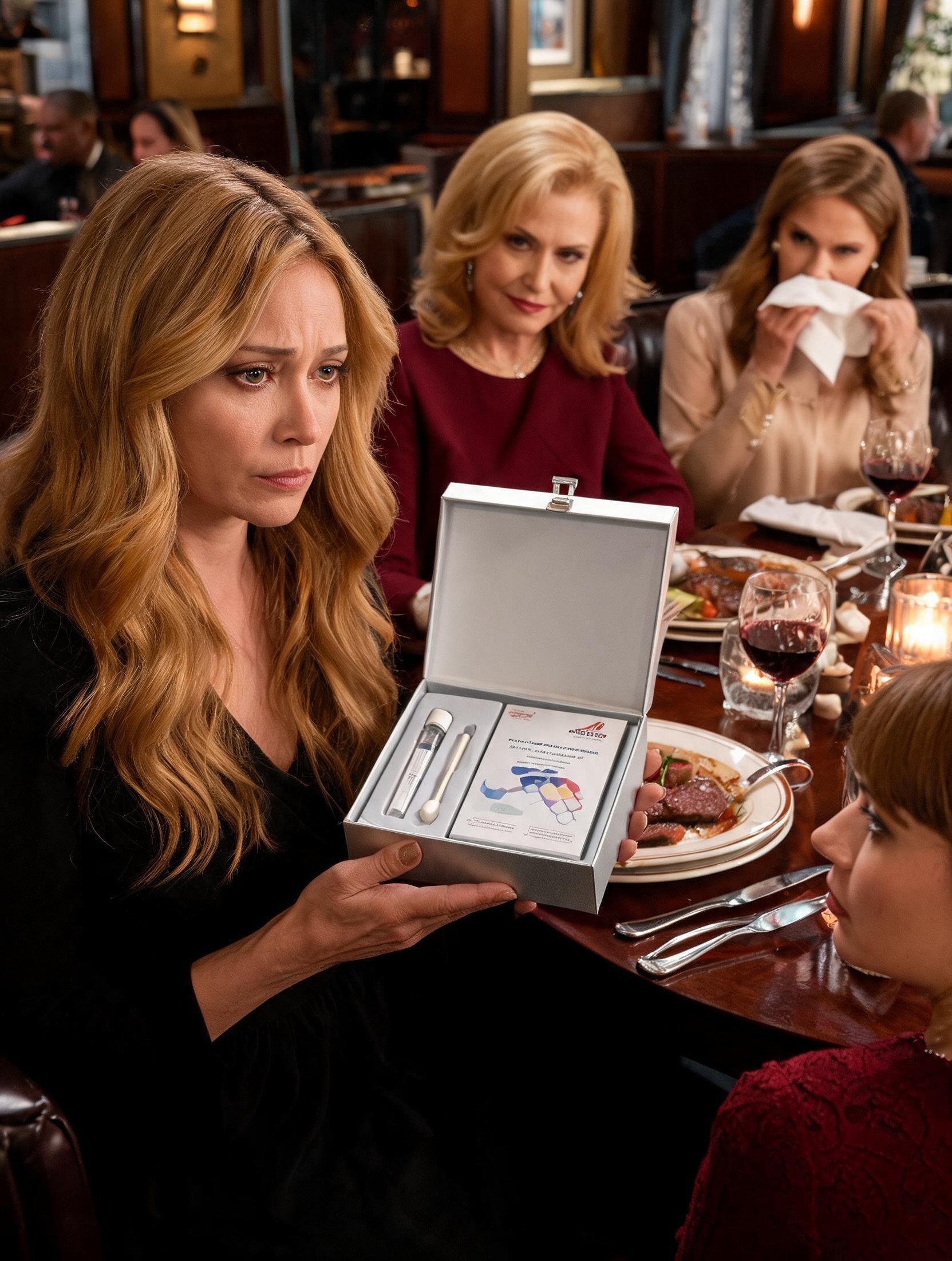
My sister gave me a DNA test for my thirty-sixth birthday and told me, in front of our mother, that it might finally prove why our father had never loved me. Mom didn’t defend me; she lowered her wineglass and hid a smile behind her napkin. I looked at the white plastic tube resting inside its silver box and realized they hadn’t brought me to Charlotte’s most expensive steakhouse to celebrate me. They had brought me there to watch something inside me break. I closed the lid, placed the box beside my plate, and asked the waiter for coffee.
Sloan Brennan’s smile tightened because crying had always been the part she enjoyed most. “Aren’t you curious, Callie?” she asked, tapping one polished red nail against her glass. “You’ve spent your whole life wondering why you never fit in.” Our mother, Diane, stared at the candle between us instead of at me. I stirred cream into my coffee until the surface became perfectly still.
I did not ask why Sloan had ordered the kit three weeks earlier. I did not ask why Mom looked frightened instead of surprised. I did not ask why my dead father’s estate attorney had postponed the reading of his will twice during the previous month. I did not ask why Sloan had suddenly become interested in whether the word “children” meant biological children. I did not ask, because the questions were already answering themselves.
That was the strange thing about humiliation when you finally stopped needing the people humiliating you to love you. It became information. Every smirk became information, every nervous glance became information, every carefully staged insult became information, and Sloan had just given me more information than she understood. She thought she had handed me proof that I didn’t belong. What she had really handed me was a map.
Sloan and I grew up outside Pittsburgh in a brick colonial with white shutters, trimmed hedges, and neighbors who thought the Brennans were the kind of family Christmas cards were invented for. Dad, Gerald Brennan, had built Brennan Freight from six aging trucks into a regional company whose blue trailers crossed Pennsylvania, Ohio, West Virginia, and North Carolina every day. Mom chaired committees, hosted fundraisers, and never appeared in public without lipstick. Sloan was two years older, blond, loud, funny, reckless, and worshiped. I was dark-haired, quiet, useful, and easy to overlook.
When I was seven, I asked for chocolate cake for my birthday because chocolate was my favorite thing in the world. Mom brought out a lemon cake because Sloan preferred lemon and told me not to be ungrateful when I whispered that she had forgotten. At seventeen, Sloan wrapped Dad’s Mercedes around a mailbox after drinking at a party, and our parents spent the entire night calling attorneys. At eighteen, I graduated valedictorian, but neither of them came because Sloan had called from her boyfriend’s lake house claiming she had a migraine and needed someone to drive her home. I gave my speech while staring at two empty seats I had saved in the second row.
I learned to survive quietly after that. I worked nights in college, ate noodles when money was tight, built a career in commercial risk management, and eventually moved to Charlotte because distance made family easier to love in small doses. Sloan tried three businesses with our parents’ money, abandoned all three, and called the losses “investments in herself.” Dad complained, Mom defended her, and Sloan always landed softly. I stopped expecting fairness and became very good at not needing rescue.
Then Dad died from what everyone called a sudden heart attack ninety days before my birthday. Sloan cried loudly at the funeral, but three days later she was asking Dad’s attorney, Warren Whitfield, about property values, business shares, and when exactly beneficiaries could take control. Mom started talking about a Mediterranean cruise before Dad’s headstone had even arrived. I told myself grief made people strange. Then Sloan handed me the DNA kit.
In my driveway after dinner, I sat behind the wheel without turning on the engine. The silver box rested on the passenger seat, illuminated by the yellow porch light, and Sloan’s words repeated in my mind: Maybe this will explain why you were always somebody else’s mistake. She had spent money, planned the timing, chosen a public place, and made sure Mom was there. Sloan never worked that hard for a joke. Whatever she believed the test would prove, she needed it before the will was read.
The next morning I called my office and took a personal day. I waited until Sloan posted a picture from her Pilates studio and Mom texted our family chat about grocery shopping, then drove to the house where I had grown up. My old brass key still opened the side door. Dad’s study smelled exactly as I remembered it—cedar shelves, stale pipe tobacco he had stopped smoking years ago, and paper warmed by sunlight. I locked the door behind me and began searching.
My file was in the bottom drawer of his cabinet. Birth certificate, vaccination records, school transcripts, tax documents, nothing sentimental. Sloan’s file contained hospital bracelets, childhood drawings, ballet programs, birthday cards, and a lock of blond baby hair tied with faded pink ribbon. I stared at the difference for several seconds, then put everything back precisely where I had found it. Anger could wait; evidence mattered more.
On the top shelf of the study closet, behind old accounting ledgers, I found a shoebox labeled 1990–1991. Most of the photographs inside showed Sloan as a toddler, Dad beside a new truck, Mom at company dinners, and relatives whose names I barely remembered. Near the bottom was a photograph of a newborn wrapped in a striped hospital blanket. The baby had a tiny heart-shaped birthmark behind her right ear, the same mark I had hidden under my hair for thirty-six years. But Gerald Brennan was not the man holding her.
The stranger was tall, dark-haired, and young enough to look almost frightened. His tie hung loose, one sleeve was rolled up, and he was staring at the baby with an expression I had spent my childhood waiting to see on my father’s face. I turned the photograph over. Three words had been written in Mom’s blue ink. Forgive me, Martin.
Then the front door slammed downstairs. Footsteps crossed the marble foyer, moved through the kitchen, and started climbing toward the second floor. I slipped the photograph into the inner pocket of my jacket and closed the closet. The study doorknob turned once, then stopped against the lock. Sloan’s voice came softly through the wood.
“Looking for something that belongs to you, little sister?”
Part 2: A Dead Man’s Photograph Opens a Thirty-Six-Year-Old Door
I opened the door because hiding would give Sloan exactly what she wanted. She stood in the hallway wearing black leggings, oversized sunglasses, and the expression of someone who had expected to catch an animal in a trap. “Snooping for the will?” she asked. I stepped around her and reached the staircase before answering. “No, Sloan, I think I already found something more useful.”
Her face changed for less than a second. It was enough. She followed me downstairs, asking what I meant, but I kept walking until I reached my car. “Don’t forget the test,” she called from the doorway. “Whitfield reads the will at the end of the month, and certain people may need proof of who they really are.”
I stopped with one hand on the driver’s door. “You’ve already spoken to Whitfield about me.” Sloan didn’t answer, which was an answer. I got into the car and drove away without showing her the photograph. Two streets later, I pulled into a grocery store parking lot and finally allowed myself to look at the stranger again.
Martin. I searched the name with every combination I could think of: Martin, Pittsburgh, Brennan Freight, Gerald Brennan, Diane Brennan, 1990. After forty minutes, an old scanned business article appeared from a regional trade publication. Brennan Freight had nearly collapsed during a fuel-price crisis the year I was born, but an unnamed private investor had saved the company with an emergency capital injection. The amount was two million dollars.
Two million dollars in 1990 was not a favor between friends. I kept digging. A later article identified the investor as Martin Ellis, founder of Ellis Lumber and Supply, a privately held chain that had expanded across Pennsylvania and Ohio. Modern photographs showed Martin in his seventies, silver-haired and broad-shouldered. The jaw was mine, the eyebrows were mine, and the small crease in his chin was one I saw every morning in my bathroom mirror.
I bought the fastest DNA processing the company offered. I swabbed my cheek in the parking lot, sealed the tube Sloan had so generously provided, and mailed it before I could talk myself out of knowing. Then I drove home, photographed the hospital picture front and back, and locked the original in the fireproof box where I kept my passport. That evening Sloan texted me a champagne emoji followed by one sentence. Hope you enjoy meeting the real you.
The results arrived thirteen days later at a.m. I opened them at my kitchen counter while coffee dripped into the pot. There were no meaningful Brennan matches. At the top of the page, under Parent/Child Relationship—49.8% Shared DNA, appeared a name I already expected. Martin Ellis.
I didn’t call Sloan. I didn’t call Mom. I called Evan Cole, an estate litigator whose reputation in Charlotte could be summarized by the number of wealthy families who hated seeing his name on opposing counsel. I gave him the photograph, the DNA report, the business article, and Sloan’s messages. He read everything twice before asking whether anyone in my family knew I had contacted him.
“Keep it that way.”
That afternoon I drove to Mom’s house while Sloan’s SUV was gone. Diane was in the sunroom repotting orchids, her gardening gloves stained dark with soil. I placed the DNA report and the photograph on the glass table between us. The orchid slipped from her hands and spilled bark across the floor. She didn’t ask who Martin was.
“How long?” I said.
Mom sat slowly. “Before you were born.”
“How long did Sloan know?”
Her mouth trembled. “Since she was seventeen.”
The story came out in pieces because cowards rarely tell the truth in straight lines. Mom had met Martin through a charity board while Dad was traveling constantly to save Brennan Freight. She said the affair was brief, that she had planned to leave Gerald, that she loved Martin, and that everything changed when she discovered she was pregnant. Gerald learned the truth before my second birthday.
“What did he do?”
Mom stared toward the garden. “He stayed.”
“That isn’t what I asked.”
Her eyes filled. “He was going to lose the company, Callie. Martin offered money, Gerald accepted it, and Martin agreed to stay away.”
The room went silent except for the refrigerator humming in the kitchen. Suddenly my childhood rearranged itself into something uglier and clearer. Gerald had known I wasn’t his, accepted Martin’s money, raised me under his roof, and treated me like a debt that breathed. Mom had protected the arrangement because it protected her marriage and status. I had spent decades trying to earn affection from adults who had turned my existence into a contract.
Then I asked the question that mattered most. “Why has Sloan been blackmailing you?” Mom’s head jerked toward me. I knew before she answered. Seventeen-year-old Sloan had found one of Martin’s old letters, threatened to tell Gerald, and spent nineteen years using the secret whenever she wanted money, rent, another car, another business, another bailout. Mom had never realized Gerald already knew.
A slow clap came from the hallway. Sloan leaned against the doorway in a cream silk robe, her expression almost amused. “I wondered how long it would take you.” Mom shot to her feet and asked how long Sloan had been standing there. “Long enough.”
I looked at my sister. “You knew Dad knew.”
She didn’t respond immediately. Instead, she walked to the counter, poured sparkling water into a glass, and watched the bubbles rise. “Gerald wasn’t stupid.”
“You blackmailed Mom for nineteen years over a secret you knew wasn’t a secret.”
Sloan shrugged. “She paid.”
Mom made a wounded sound. Sloan barely glanced at her.
“Why the DNA test?” I asked.
This time Sloan smiled. “Because Dad’s will says his estate goes to his children.”
Evan had warned me not to reveal what I knew, so I gave her nothing. “And you think DNA decides that?”
“I think lawyers decide that, and mine is very expensive.”
I stood and picked up my copy of the report. “Then bring him.”
Her confidence flickered again. “You won’t walk away with anything, Callie.”
“I spent thirty-six years walking away with nothing.”
That night, Evan called after researching Gerald’s corporate records. The two-million-dollar investment from Martin Ellis had not been a conventional loan. It had been converted into shares, then quietly purchased back over twelve years through a series of agreements that had never been discussed inside our family. More importantly, Gerald had rewritten his will eleven months earlier, after suffering what everyone thought was his first cardiac scare. Evan had obtained the probate filing date, but the document itself remained sealed until the reading.
“Do not assume Sloan knows what’s in it,” Evan said.
“She seems very sure.”
“People who are sure usually don’t stage DNA tests at birthday dinners.”
I almost smiled. Then he went quiet.
“There’s something else.”
“Three months before your father died, Gerald hired a private investigator.”
Part 3: My Sister Came to the Will Reading Ready to Win
Whitfield & Associates occupied the twenty-second floor of a glass tower overlooking uptown Charlotte. Sloan arrived fifteen minutes late in a black Bentley I knew she didn’t own, wearing oversized sunglasses and a cream designer suit. Mom came separately, looking ten years older than she had at my birthday dinner. Evan sat beside me with one yellow legal pad and no visible emotion.
Warren Whitfield was seventy-three, silver-haired, narrow-faced, and so calm that Sloan seemed to dislike him immediately. He explained the usual probate language, identified the witnesses, and began reading Gerald Brennan’s final instructions. Mom received lifetime use of the family home and a monthly stipend of thirty-five hundred dollars from a protected trust. Sloan interrupted before he finished.
Whitfield looked over his glasses. “Yes.”
“Why not the full account?”
“Your father had concerns regarding financial management.”
Sloan’s jaw tightened. Mom stared at her hands.
Then Whitfield turned a page. “To my daughter, Sloan Marie Brennan, I leave twenty-five thousand dollars.”
Sloan laughed because she thought she had misheard. When no one joined her, she removed her sunglasses. “Twenty-five thousand?”
“My handbags cost more than that.”
Whitfield continued. “To Caroline Diane Brennan, whom I raised as my daughter, I leave the remainder of my estate, including sixty-eight percent controlling interest in Brennan Freight Holdings, all unallocated investment accounts, and the remaining liquid assets after taxes and specified charitable distributions.”
For the first time in my life, Sloan had absolutely nothing to say. The silence around the conference table felt physical. Mom covered her mouth. Evan wrote one word on his legal pad and turned it toward me.
Sloan suddenly reached into her purse and slapped several pages onto the table. “She isn’t his daughter.” My DNA report. She had somehow obtained a copy, probably through Mom or by accessing the account linked to the kit she purchased. “Gerald Brennan is not her biological father, and the will specifically refers to children.”
Whitfield looked almost tired. “Ms. Brennan, your father anticipated this.”
He opened a sealed envelope. “Gerald left a personal statement to be read if Caroline’s biological parentage was challenged.”
My heart started pounding, but I kept my hands flat on the table.
Whitfield read Dad’s words slowly.
I have known since Caroline was two years old that I was not her biological father. I agreed to raise her and accepted financial assistance from her biological father during a period when Brennan Freight might otherwise have failed. I was not always kind to Caroline, and history will not improve me by pretending otherwise. I resented circumstances she did not create, and she paid for an adult decision before she was old enough to understand it.
My vision blurred. I blinked until the room sharpened again.
Whitfield continued.
But I watched both of my daughters become adults. One learned responsibility without being given security. The other was given security and learned to expect rescue. Blood may determine biology, but it does not determine character, loyalty, or succession. Caroline protected this family’s name more faithfully than anyone who carried my blood.
Sloan shoved her chair backward. “He was sick.”
Whitfield didn’t react. “He passed two independent competency evaluations within sixty days of signing this document.”
“I’ll contest it.”
“I’ll freeze everything for years.”
“You may attempt that too.”
Whitfield reached beneath his folder and placed a black binder on the table. Sloan stopped moving.
“Your father expected that response.”
The private investigator Gerald had hired was named Frank Rourke, a retired state investigator who specialized in elder financial abuse. Dad had originally hired him because money was disappearing from family accounts. According to Rourke’s report, Dad had briefly suspected me because I managed commercial risk for a living and understood financial systems. Rourke cleared me in forty-eight hours.
Then he investigated Sloan.
There were bank statements showing withdrawals from Mom’s personal savings. There were payments to luxury resorts, designer stores, short-term lenders, and multiple online gambling platforms. There were emails between Sloan and an attorney discussing what evidence would be required to have an elderly parent declared incompetent. There was even a draft petition identifying Sloan as the proposed financial guardian.
Mom looked across the table. “You were going to take control of your father’s money?”
Sloan’s face hardened. “He wasn’t well.”
“He was running a company.”
“He was old.”
Whitfield pressed a button on a small recorder.
Sloan’s voice filled the conference room.
Once Dad’s gone, Mom will do whatever I tell her. If she becomes difficult, I’ll find somewhere cheap with good brochures and move her there. Callie won’t get anything because she isn’t really family anyway. I just need the old man to stop changing things.
Mom’s face collapsed.
“You were going to put me in a home?”
Sloan stared at the recorder as if she wanted to smash it.
“I was venting.”
Whitfield closed the binder. “Gerald heard that recording three months before he died.”
Evan finally spoke. “There is also a no-contest clause.”
Sloan turned toward him.
“If you challenge the will unsuccessfully, you forfeit the twenty-five thousand and become personally responsible for debts the estate has agreed to forgive.”
“What debts?”
Evan slid a page toward her.
One hundred forty-two thousand dollars.
Sloan stared at the number. Her lower lip moved once before she caught herself. “That’s not real.”
“You signed the loan acknowledgments.”
“They were family loans.”
“Correct,” Evan said. “Which makes them enforceable.”
Sloan looked at Mom. “Tell them this is insane.”
Mom said nothing.
Still nothing.
Sloan’s voice rose. “After everything I’ve done for you?”
Mom finally looked up. “You mean everything I did for you.”
It was the first time I had ever watched our mother refuse her.
Whitfield placed a waiver beside Sloan and handed her a pen. “You have seventy-two hours to consult independent counsel.”
Sloan’s eyes landed on me.
“You think you won.”
“You always wanted Dad to choose you.”
“You wanted me to lose.”
I held her stare. “I wanted you to stop deciding what everyone else was allowed to have.”
Her eyes filled, but there was more fury than grief in them. “You’re still not a Brennan.”
I looked at the share documents lying in front of me.
“Apparently that wasn’t a requirement.”
Sloan stormed out without signing. Mom remained seated, staring at the recorder like it had opened a grave in the middle of the conference table. Whitfield asked whether I wanted to continue with the transfer documents. I said yes. My hands were steady again.
Halfway through the paperwork, Evan received a text. He read it, frowned, and handed me his phone beneath the table. His investigator had checked Martin Ellis.
Martin had died eighteen months earlier.
For a moment, losing a father I had never met hurt more than inheriting from the one who had raised me. Then I noticed the second line.
Martin Ellis had left instructions specifically for me.
Part 4: The Father I Never Met Had Been Waiting for Me
Martin’s attorney worked from a small brick office outside Asheville, three hours west of Charlotte. I drove there alone two days after the will reading, following Interstate 40 until buildings gave way to green ridges and October leaves. The attorney, Margaret Holloway, was in her seventies, wore no makeup, and greeted me as though she had already known me for years. When I said my name, her eyes softened.
“You have his chin.”
No one had ever said anything that simple and made me want to cry.
Margaret brought me into a private room where a wooden box waited on the table. Martin Ellis had known where I lived, where I went to college, when I married briefly in my twenties, when I divorced, when I moved to Charlotte, and when I received my first major promotion. He had obeyed the agreement with Gerald and never contacted me. But he had kept newspaper clippings, company newsletters, old graduation announcements, and photographs purchased from school archives.
“He watched you from a distance,” Margaret said.
“That doesn’t sound much better than leaving.”
“No,” she said softly. “It doesn’t.”
I appreciated her honesty.
Inside the box was a leather journal, a brass compass, and documents establishing a private trust in my name. The amount was large enough that I stopped reading and started again. Martin had left me seventeen million dollars through a structure designed to keep my existence separate from his public estate. Money I had never asked for from a man I would never meet.
Then I found the letter.
My dearest Caroline,
If you are reading this, then Gerald kept his promise or broke it too late for either of us to repair what we did. I told myself staying away protected you from scandal, lawsuits, and two powerful men fighting over a child who deserved peace. That explanation grew more convenient every year. The truth is that I was afraid.
I stopped reading and looked out the window.
Margaret waited.
I continued.
I loved your mother, but loving her did not excuse the choices we made. Gerald was furious when he learned you were mine, but his company was collapsing and hundreds of employees depended on it. I offered capital, he offered stability, and both of us pretended a financial agreement could solve a human problem. I regret every birthday I missed.
My throat tightened.
I kept going.
I knew about your graduation. I knew Gerald left to help Sloan instead. I almost broke our agreement that day. I drove to your school and sat in a borrowed car across from the football field because I wanted to hear your speech.
“What school?” I asked Margaret.
She named it.
I remembered a dark sedan parked beyond the fence.
For thirty-six years, I had believed nobody came.
Someone had.
Not close enough.
Not bravely enough.
But someone had.
I pressed the heel of my hand against my eyes and waited until I could see again. The next pages contained apologies without excuses, memories from before my birth, and descriptions of things Martin wished he had done differently. Near the end he wrote one sentence twice. Do not inherit our cowardice.
I closed the journal.
Margaret pushed a second envelope toward me.
“This was not part of your trust.”
“What is it?”
“Martin told me to give it to you only if Gerald died before Diane.”
The temperature in the room seemed to change.
I opened it.
Inside was a photocopy of a handwritten note from Gerald dated six months before his death. Martin, we made one bad bargain and spent thirty years pretending it was honorable. Sloan knows more than I thought, and money is disappearing again. If anything happens to me before I finish fixing this, make sure Caroline learns where the original agreements are stored.
My pulse accelerated.
“Did Martin receive this?”
“What original agreements?”
Margaret shook her head. “He never told me.”
“Did he respond?”
“He tried.”
She opened a file and produced a courier receipt. Martin had sent Gerald a package four months before Dad died. It was delivered directly to Brennan Freight headquarters and signed for by someone whose last name I recognized immediately.
I photographed everything and called Evan from the parking lot. He told me not to confront her. Brennan Freight’s headquarters had archived security footage, executive access records, and document logs going back several years. As controlling shareholder, I now had authority to preserve them.
I sent one email.
Do not delete, destroy, alter, or remove any physical or electronic records until further notice.
Twenty-three minutes later, our chief information officer called me.
“Caroline, we may have a problem.”
“What kind?”
“Someone accessed Gerald’s executive archive the night he died.”
I pulled onto the shoulder.
“I’m still checking.”
“Don’t call anyone else.”
“There’s more.”
“The archive contains a locked digital folder Gerald created himself.”
“What’s it called?”
The CIO hesitated.
“Ellis Agreement.”
I arrived at headquarters shortly after dark. The building was mostly empty, but Evan met me in the lobby with two forensic technicians. We entered Dad’s old office together. Everything was exactly as he had left it—the heavy walnut desk, framed photographs of company trucks, awards, maps, and one family portrait where Sloan stood beside him while I occupied the far edge.
The technicians opened the encrypted folder.
Inside were scans of the original deal between Gerald and Martin, letters between them, bank records, and private memos spanning three decades. Gerald had documented almost everything. Martin’s investment had saved Brennan Freight, but there was no clause requiring him to surrender parental rights. There was only a personal promise not to interfere unless Gerald endangered me.
Then we found Gerald’s final memo.
Dated eleven days before his death.
Sloan has discovered the Ellis correspondence and believes she can use Caroline’s parentage to remove her from succession. She does not know I changed the will. She has also been pressuring Diane for access to medication and financial documents. I no longer believe this is merely greed.
I read the final line twice.
If my death appears sudden, do not assume it was natural.
Part 5: The Last Secret Was Hidden Inside My Father’s Death
Evan took the keyboard away from me before I could continue clicking. “We preserve everything before we read another word.” He called a forensic firm, then contacted an attorney who handled criminal referrals involving corporate estates. I sat in Dad’s chair while strangers copied files around me. The room where I had once waited as a child for him to notice me had become a crime scene without yellow tape.
I wanted to call Sloan. I wanted to hear her voice and measure whether fear had entered it yet. I wanted to drive to Mom’s house and demand every bottle, every receipt, every memory from Dad’s final week. Instead, I did what anger had never taught Sloan to do. I waited until we had facts.
Dad had collapsed at home on a Sunday night. Mom had been upstairs showering. Sloan had been visiting that afternoon but claimed she left shortly after dinner. The county medical examiner never ordered a full toxicology panel because Dad was sixty-nine, had documented cardiac disease, and his death appeared consistent with a heart attack.
The digital access logs changed that story.
At 11:47 p.m., approximately two hours after Dad was pronounced dead, someone used Sloan’s executive credentials to enter his office remotely. The session lasted forty-one minutes. Files were opened, copied, and several were marked for deletion. Automatic backups preserved them.
Then the forensic team recovered something else.
An email Gerald had scheduled to send to Whitfield the morning after his death.
Warren, I am meeting Sloan tonight about the missing funds. If she refuses repayment, I intend to remove her from every corporate role Monday morning. I have also told Diane to stop giving her money. Caroline does not know any of this, and I prefer she remain uninvolved until the documents are secured.
Sloan had not mentioned meeting Dad that night.
When I showed her the email the next morning, all the color disappeared from her face.
“She came back.”
“What time?”
“After eight.”
“You told everyone she left after dinner.”
Mom’s hands began shaking.
“Dad called her.”
I stayed silent.
Mom looked toward the kitchen doorway as if she could still see them there.
“They argued in his study. Gerald said he knew about the gambling. Sloan said he couldn’t cut her off because she had protected this family longer than anyone understood. He told her she had protected nothing.”
“What happened next?”
“I went upstairs.”
“Because Gerald told me to.”
Her eyes filled.
“He said, ‘For once, Diane, let me handle our daughter.’”
I asked when she came back downstairs.
“After I heard something fall.”
Dad had been on the floor beside his desk. Sloan was kneeling near him. Mom said Sloan was crying and telling her to call 911. Paramedics arrived within nine minutes, but Dad never regained consciousness.
“Did Sloan touch his medication?”
“I don’t know.”
Mom closed her eyes.
“He took a pill every night.”
“Which pill?”
“Heart medication.”
“Who filled his pill organizer?”
She started crying before she answered.
“Sloan had started doing it.”
That was enough for Evan to contact authorities.
It was not proof of murder. It was not proof of poisoning. It was enough to reopen questions everyone had accepted too quickly.
Detectives arrived at Mom’s house that afternoon and collected Dad’s remaining medications, the pill organizer stored in a bathroom cabinet, pharmacy records, and security-system logs. I stayed out of their way. Sloan called me six times during the search.
I ignored all six.
Her seventh call came from a different number.
I answered.
“You’re destroying this family,” she said.
“You sent police to Mom’s house.”
“They’re detectives.”
“Same difference.”
She laughed once, but there was no humor in it. “You’ve become very confident since Dad handed you his money.”
“This isn’t about money anymore.”
That was the first moment I knew she understood exactly what I meant.
“You should be careful,” she said.
“Is that advice?”
“It’s reality.”
Then she hung up.
Two days later, Sloan signed the inheritance waiver through her attorney. She accepted the twenty-five thousand dollars, relinquished her right to contest Gerald’s will, and agreed to resign from every Brennan Freight position. Her attorney also requested that all further communication go through his office. Sloan disappeared from Mom’s house that night.
No one knew where she went.
The toxicology work took longer than anyone wanted. Gerald had been embalmed, but preserved hospital blood samples still existed because the emergency department had drawn labs during resuscitation. Investigators obtained them. Evan warned me not to expect dramatic answers.
While we waited, I went to work.
Brennan Freight had nearly nine hundred employees. Most of them didn’t care who my biological father was. They cared whether paychecks cleared, whether trucks were maintained, whether routes remained profitable, and whether a woman who had never run a trucking company could keep one alive.
So I learned.
I sat with dispatchers at four in the morning. I rode with a veteran driver named Luis from Charlotte to Knoxville and back. I listened to mechanics explain why Dad had delayed replacing twelve aging tractors. I read contracts until midnight.
Three weeks later, the board voted unanimously to confirm me as executive chair.
Sloan would have called that revenge.
It was work.
Mom and I began seeing each other once a week. I paid off the remaining mortgage as Dad’s trust permitted, but I placed safeguards around her monthly stipend. Sloan could not borrow against it, access it, or move back into the house without triggering a financial review.
“You don’t trust me,” Mom said.
She nodded because, for once, she understood that forgiveness and access were not the same thing.
Martin’s trust transferred quietly. I used part of it to create scholarships for teenagers aging out of foster care and young adults paying their own way through community college. I named the program North Star because of the brass compass Martin had left me. The compass sat on my desk beside Gerald’s final memo.
Two fathers.
Two flawed men.
Two different kinds of absence.
Neither story erased the other.
Six weeks after Dad’s case was reopened, Detective Maya Bennett called me to the police station. Evan came with me. Bennett placed a laboratory report on the table but did not immediately explain it.
“Your father’s hospital blood sample contained a medication that was not listed in his active prescriptions.”
My stomach tightened.
“What medication?”
“A potent sedative.”
“Could the hospital have given it?”
Evan leaned forward.
“Not by itself.”
Bennett turned another page.
“In someone with Gerald’s cardiac condition, combined with his prescribed medication, it could significantly increase the risk of arrhythmia, loss of consciousness, and cardiac arrest.”
I heard Sloan’s voice from my birthday dinner.
Maybe this will finally explain why you were always somebody else’s mistake.
“Was it in his pill organizer?”
Bennett didn’t answer immediately.
“One capsule contained residue consistent with the same drug.”
Evan asked the next question.
“Fingerprints?”
Bennett looked directly at me.
“Your mother’s.”
The room tilted.
I stared at her.
“That doesn’t make sense.”
“It means Diane Brennan handled the capsule or container at some point. It does not prove she knew what was inside.”
I remembered Mom saying Sloan had started filling Dad’s medications.
I remembered nineteen years of blackmail.
I remembered her silence at the birthday dinner.
Bennett closed the report.
“There’s something else.”
Of course there was.
“There usually is,” Evan murmured.
The detective slid a photograph across the table.
It showed a small storage unit outside Charlotte. Detectives had found it after tracing a recurring payment from an account Sloan controlled. Inside were boxes of old Brennan records, jewelry that had belonged to Dad, copies of Martin’s letters, financial documents, prescription bottles, and one locked metal case.
“What was in the case?” I asked.
Bennett placed a clear evidence bag on the table.
Inside was a flash drive.
“We haven’t finished processing it,” she said. “But the first folder contains video files recorded inside your father’s study.”
My mouth went dry.
“Hidden camera.”
“Dad installed it?”
“We don’t think so.”
“Then who did?”
Bennett looked at me for several seconds.
“The account used to purchase the camera wasn’t Sloan’s.”
I already knew what she was going to say before she said it.
“It belonged to your mother.”
That evening, I drove to the Brennan house alone.
Mom had stopped answering her phone three hours earlier.
The front door was unlocked.
Her car was still in the driveway.
The kitchen lights were on, two cups of coffee sat on the table, and one chair had been pushed backward so hard it had fallen onto the tile.
I walked through the dining room.
The house answered with the soft ticking of the grandfather clock.
On Dad’s study desk, the North Star Foundation announcement I had mailed her that morning had been torn in half.
Beside it sat Martin’s original photograph of him holding me as a newborn.
I had locked that photograph in my own fireproof box in Charlotte.
Someone had taken it from my house.
My phone vibrated.
Unknown number.
One new message.
You inherited Gerald’s company.
You inherited Martin’s money.
But you still don’t know what either man was paying to keep hidden.
A second message appeared before I could breathe.
Check the date on the back of the photograph.
I turned it over.
Beneath Mom’s faded words—Forgive me, Martin—someone had written a second date in black ink.
It was six months before I was born.
Under the date was one sentence.
Caroline was never the first child.
Upstairs, a floorboard creaked.
I looked toward the dark staircase.
Then someone whispered my name.
✓ Lynn R. Adams
My Sister Gave Me a DNA Test at Dinner to Erase Me—Then Our Father’s Will Exposed Who the Real Outsider Was Part 1: The Birthday Gift That Was Never Meant to Be Kind My sister gave me a DNA test for…