My seventy-four-year-old father was standing beside the pear trees my mother
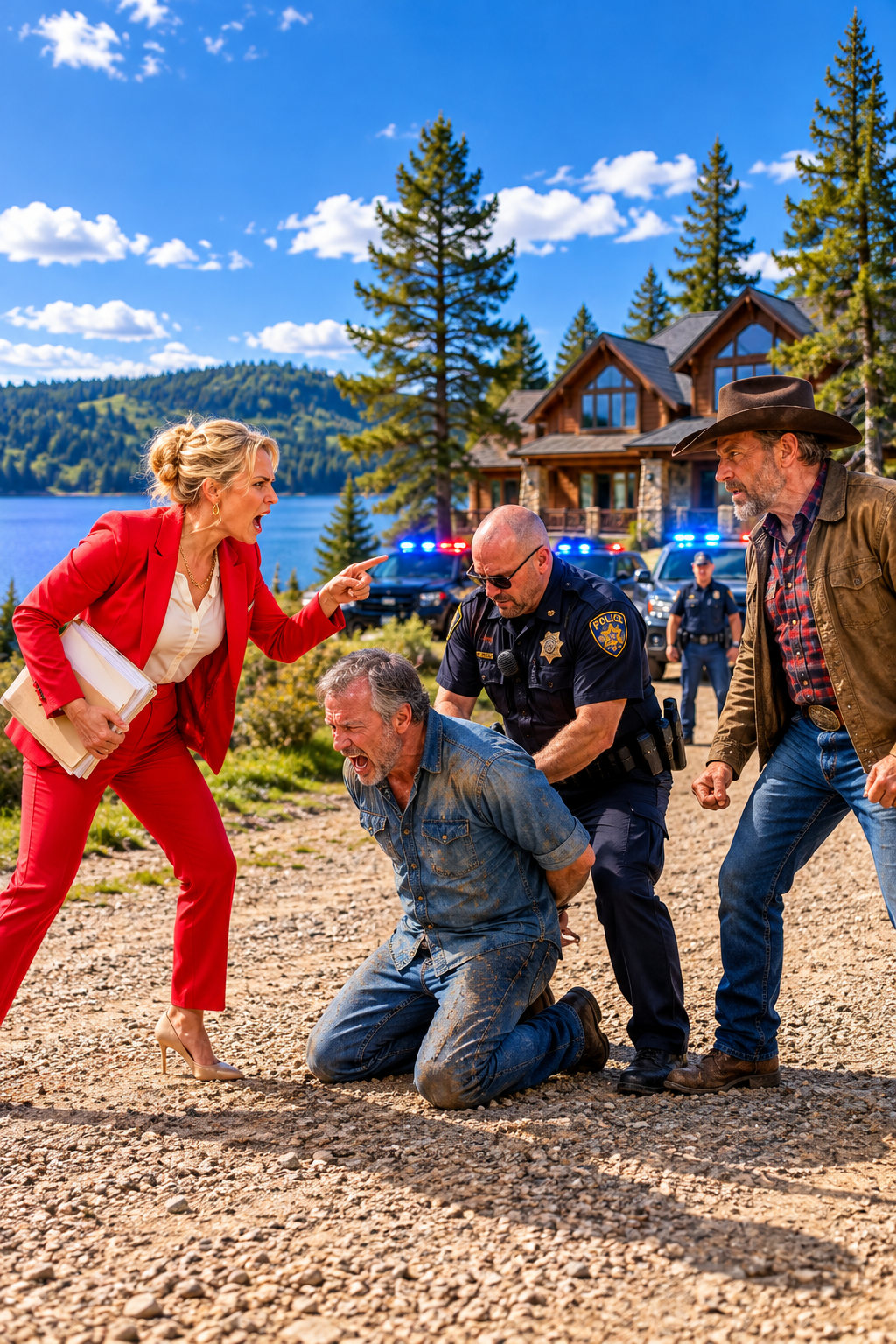
Part 2: The HOA claimed my father had joined without his knowledge
Dad told me they had charged him with criminal trespass and resisting. He tried to laugh, but the sound didn’t reach his eyes. Halfway home, he asked me not to tell my sister. The house smelled of motor oil and coffee, exactly as it always had. When I asked how long this had been happening, he nodded toward the kitchen and said, “Third drawer down.”
The drawer stuck because it was packed with HOA letters. I pulled out stacks of notices, some still sealed, citing an unapproved machine shed, unapproved fruit trees, an improper gravel drive, and improper vehicle storage. Every letter carried a fine, sometimes $150 per day, for things my father had built or maintained long before Karen had become HOA president. Dad said he ignored the letters because he didn’t belong to the association and had never agreed to its authority. I kept digging until I found the total: $18,400 in assessments.
Beneath those notices was a heavier sheet: a $31,200 lien recorded against my father’s parcel by Barrow Glenn Estates. A form letter underneath claimed the land had been member property since 2019. I read that sentence three times. My father had lived there for sixty-three years without joining a single organization, and now a county record said he belonged to an HOA he had never contacted. Something in the public record had changed while he was still living in his own home.
That evening, I walked the fence line, and two neighbors found reasons to speak with me. Karen had been president for three terms, they said, and the board usually voted the way she pointed. She had a private security contractor, Iron Veil, with two trucks that patrolled the neighborhood at night under amber lights. “You get on her list, you stay on it,” one neighbor warned. Another said a stranger with a clipboard had been taking pictures of Dad’s house the morning the deputy arrested him.
Karen called me at nine that night, not from the HOA office but from her own phone. Her voice was soft, measured, almost sympathetic. She said she had been worried about my father for a long time and that he was confused, forgetting things, wandering into common areas, and arguing with people who were only trying to help. Then she suggested the association could buy his land for a fair price and close quickly. “He can be somewhere with people who look after him,” she said.
I asked where the HOA got authority over Dad’s parcel. Karen said he signed a joiner in 2019 and that it was recorded, so the matter wasn’t debatable. Dad stood in the kitchen doorway and heard her say it. He gripped the frame with shaking fingers and told me he had never signed anything the HOA put in front of him. I believed him. The problem was that I was a federal agent working financial-crime cases, and for four months I had been investigating a fund buying HOA liens across the state.
Part 3: The county plat proved his land was never included
The county recorder’s office opened at , and I was there at . A clerk brought out the original plat book and turned it to the 1998 development map. Barrow Glenn Estates was drawn as 190 numbered lots around a loop road. In the middle of those lots sat a separate rectangle, outlined heavily and marked with three words: “Not a part.” My father’s three-point-two acres had been excluded on the developer’s own map.
I requested the declaration, the founding document that listed every parcel subject to the association. Exhibit A named lots one through 190. Dad’s land wasn’t a numbered lot, a footnote, or a later addition. It simply wasn’t there. The original developers had known they could not take it and had built around it. I paid twelve dollars for certified copies of both records. The clerk slid them across the counter in a manila envelope and mentioned I was the second person that month to ask about that parcel.
I asked who had been there first. The clerk said he couldn’t tell me, but the person had paid cash. I thought again of the stranger with the clipboard and added the detail to my notes. That Tuesday, I attended the HOA board meeting at the clubhouse. Forty residents sat in folding chairs beneath a projector fan that ground overhead. Karen sat at the front beside board members Cranfield, Ainsworth, and Hallagan, arranged like a panel at a hearing.
During open forum, I introduced myself and walked the envelope to the front table. I showed the certified plat and the declaration. “My father’s land is marked ‘Not a part,’” I said. “It’s never been in this association.” Karen didn’t look at the records. She let the silence hang for a beat, then reached into a folder and held up a single page with a notary seal and my father’s name in blue ink.
“This is a recorded annexation agreement,” she said. “Executed by Arless Fairbanks, notarized and filed with the county in March 2019.” Someone in the third row clapped, then a dozen more joined in. The room filled with applause for the document that contradicted the two certified records in my hand. An older neighbor, Delbert Yansy, stood and said Dad had never joined anything in the nineteen years he had known him. Karen cut him off and told the note taker to record him as disruptive.
I went home and told Dad the meeting hadn’t gone the way I hoped. “It never does,” he said, and went to bed. At six the next morning, Iron Veil drove the loop twice. Before seven, an HOA maintenance truck backed into Dad’s driveway. Two men in polo shirts began wrapping a chain around the cedar post at the end of the drive, the one he had carved himself. Their work order called for removing unapproved signage and vegetation encroaching on the setback.
Part 4: The pear trees fell after Karen ignored the survey
I came outside with my coffee still in hand and told the maintenance crew the cedar post stood on my father’s private property. The older worker kept working and handed me a sheet signed the night before. Then I heard a chainsaw start. There were eleven pear trees in the row, planted by my mother the spring I was born. By the time I reached the shed, four of them had been cut down to stumps, their sap running into the gravel.
Dad came outside in his undershirt. He didn’t yell or threaten the men; he walked straight toward the chainsaw. I caught him from behind and held both his arms. “Let go, Porter,” he said. “Those are your mother’s trees,” I answered. He fought me for four seconds, longer than a seventy-four-year-old with bad hands should have had to fight anyone, then stopped and stood in his driveway breathing hard while the crew finished.
That was the hardest thing I did all week. If Dad had touched the worker, Karen could have had a second arrest and a “violent old man” on record. She was always building a file. The truck left at with the cedar post lying sideways in the bed. That afternoon, a certified letter arrived addressed to me at Dad’s house, which told me Karen had been tracking who was staying there.
The letter said that because of the $31,200 lien and lack of a payment plan, the association would initiate foreclosure proceedings against the parcel. I sat with it for a long time, then went to the file cabinet in the machine shed. I found an eight-page contract Dad had signed in 2011 when he sold his half of the repair shop. I placed it beside the annexation agreement, moved the desk lamp close, and held both pages up to the light. The signatures weren’t merely similar; they were identical.
The angle of the A matched. The two L’s ran together at exactly the same point, and the downstroke of the F contained the same tiny skip. That mark came from a rough patch on the paper in 2011. It had somehow appeared in the 2019 signature too. I asked Dad to sign a blank sheet. He sat down and steadied his right hand with his left, then wrote his name in eleven seconds. The A was square, the letters separated, and the final stroke trembled.
“That’s not mine,” he said, looking from his signature to the recorded agreement. “I can’t write like that anymore. I haven’t been able to since 2016.” I knew he was right; I had filled out his Medicare forms. Someone had reproduced an older version of his signature. The notary on the annexation was Cecile Hartnett, a staff member at Pilgrim Trust Abstract, the management company that handled the HOA’s books. That didn’t prove the forgery by itself, but it meant the notary worked for the association whose document she had stamped.
Part 5: A multimillion-dollar deadline explained the pressure
I searched every annexation instrument Barrow Glenn had recorded since 2015. There were four: Dad’s parcel in March 2019 and three more holdouts, all excluded from the 1998 plat. One belonged to a widow named Winona Stackhouse, another was a strip of pasture with a wellhouse, and the third was a small parcel near the north edge. All had supposedly joined between 2019 and 2020, though none of the owners remembered doing so. That was when the shape of the case changed.
I opened the federal file I had been working on for four months. The investment fund in that investigation bought HOA liens across the state at a discount, waiting for homeowners to fall behind. I searched the list of associations selling liens and found Barrow Glenn Estates with twenty-two assignments since 2019. My father’s neighborhood had been in the file on my screen since April. I had never looked at the name because it had been one line among thousands.
Then I searched the county’s commercial filings. Barrow Glenn had an option agreement with Haven Ridge Property Group, a developer based in the state capital. The association would receive $2.4 million if it delivered a contiguous, clear-title assemblage covering the north quarter of the loop and every excluded parcel inside it. The deadline was September 30. I thought of the stranger with the clipboard taking pictures of Dad’s house while the deputy arrested him. He had not been a gawker; he had been on a site visit.
The detail about clearing the driveway before ten suddenly made sense. Karen had scheduled the arrest and the appraisal in the same window. I had four documents in front of me: a likely forged joiner, a notary employed by the management company, three other excluded parcels, and a multimillion-dollar deadline. I had a case. Then, ninety seconds later, I realized I couldn’t work it.
My father was the victim, and I was a supervisory federal agent on the squad that owned the broader financial investigation. Every record I had pulled could look like an agent working a case about his own family. I sat awake until two in the morning, weighing the option of continuing quietly and handing everything over later. Instead, I called my assistant special agent in charge and reported the conflict myself. Six days later, Karen’s attorney filed a fourteen-page complaint with my agency’s professional-responsibility office, the U.S. attorney, the sheriff, and even the neighborhood newsletter.
The complaint said I had used my federal position and federal databases to intimidate a volunteer HOA board on my father’s behalf. Every fact in it was accurate, which made it effective. The newsletter printed the story on glossy paper, and by Thursday, the narrative had flipped: the federal agent was abusing his power, while Karen was protecting the community. An inspector interviewed me for five hours, then placed me on administrative suspension pending review. I put my credentials and weapon in a lockbox, signed the form, and listened while Hugh told me I could not access, discuss, or receive information about my father’s arrest or the civil-rights case.
Part 6: I lost my badge while the foreclosure date moved closer
The deputy’s arrest case went to another squad, and I was barred from even riding the elevator to the agents handling it. That was the day the thing I was best at became the thing I was forbidden to do for the person I loved most. Dad and I went to court for the lien. Karen’s lawyer didn’t argue that the annexation was authentic; he argued it was recorded and facially valid, and that a summary hearing could not declare it a forgery based only on a son’s belief about his father’s handwriting.
He was right about the law. The judge said a quiet-title action could take eight to fourteen months and denied our motion to stay the lien. Karen’s attorney then announced that the foreclosure sale was scheduled in twenty-one days, at ten in the morning. Three-point-two acres, a farmhouse, a machine shed, and the pear trees would be auctioned on the courthouse steps. Dad looked out the window during the drive home and didn’t speak.
The county attorney amended Dad’s charges to include obstruction based on a supplemental report filed eleven days after the arrest. Dad had to check in every Tuesday at nine. For two weeks, he stood at the end of the pear row every afternoon, looking at the four stumps. Then one day he didn’t. He began sitting in the machine shed with the radio off. On Sunday, he told me he sometimes wished he had signed the agreement, because it would be easier to be a fool than to be robbed.
I couldn’t investigate the case, query databases, or contact my former squad. Everything I had already collected was potentially tainted by the fact I had gathered it. But I was also a witness, the son of the victim, and the person on a video call when the arrest happened. None of that required a badge. I wrote a sworn affidavit describing everything I had seen and every public record I had obtained, attaching the certified plat, original declaration, signature examples, and Haven Ridge option agreement.
I drove it to the U.S. attorney’s office and handed it to Assistant U.S. Attorney Imogen Blackwood with Agent Winterborn present. I said on the record that I was not asking to work the case; I wanted to be interviewed as a witness. Blackwood read the filing, then stopped at the schedule of lien assignments. She asked when the federal investigation had opened. “February,” I said. She looked up: four months before the arrest and the HOA dispute.
That timing changed one thing: Karen could no longer claim I had started using my badge only after she targeted my father. Blackwood asked Dad to come in the following Monday, then told me not to call her; she would call me. Sixteen days later, grand-jury subpoenas went to Pilgrim Trust Abstract and Iron Veil. I was in the building as a family member, sitting against the wall with my mouth shut, while the agents reviewed the records.
Part 7: The investigation uncovered a forged stamp and a paid deputy
One subpoenaed document was an outside-counsel advisory letter from November 2018, four months before the joiner was recorded. It told the board that the four excluded parcels could not be annexed unless each owner voluntarily signed and recorded an agreement. The letter said the association had no way to compel them. In the upper-right corner, someone had written “KT 11/26/18” in blue ink. Dad had never seen the letter, but Karen had been told exactly what was required.
Cecile Hartnett came in with her own lawyer. She had worked as a notary for nineteen years, eleven at Pilgrim Trust. She testified that between 2019 and 2021, Karen repeatedly brought her documents and asked her to stamp signatures she had not witnessed. Cecile had never met my father. When asked why she did it, she paused and said, “Because she was the client, and I liked my job.” She signed a cooperation agreement that afternoon.
Iron Veil’s duty logs revealed another piece. Deputy Gus Threadgill had been working a special detail on the morning of Dad’s arrest. The off-duty employment records showed he was on the HOA payroll at ninety dollars an hour, with a four-hour minimum. He had not been dispatched; the association had hired him directly. At that morning, Karen’s cell number called his. It meant the man who cuffed my father had been paid by the woman who ordered the arrest.
The investigation split cleanly. I remained barred from the civil-rights matter involving Threadgill, but the broader financial-fraud case predated the dispute and belonged to my squad before Karen knew my name. My conflict review allowed me back on that financial investigation only, with strict limits. Hugh returned my credentials in a parking garage and held on to them a second longer than necessary. “Financial only,” he warned. “Ask one question about your father’s arrest, and I take these back.”
Karen called a special meeting seven days before the sale. In front of ninety residents, she said the association was under attack by a federal agent with a personal grudge. She proposed retroactively ratifying every board action since 2018: every notice, fine, lien, and recorded instrument. Cranfield seconded the motion, and Ainsworth and Halligan raised their hands. It passed on a voice vote. Delbert called me afterward and said she had made everyone sign the check.
Two days later, Karen moved nineteen boxes of HOA records from the clubhouse into her garage, announcing that the files would be safer at her home during the litigation. I did not go looking for them. I was working the financial case when I found a $41 charge from Meridian Stamp and Engraving, dated six weeks before the 2019 joiner. The shop sold custom pre-inked signature stamps made from customer-provided samples. The purchase had been charged to the HOA and shipped to a residence on Catillian Court—Karen’s address.
Part 8: The search warrant arrived hours before the scheduled sale
Meridian still had its order records and saved artwork file. The order was for one pre-inked signature stamp, black housing, made from a scan of my father’s 2011 signature. It had been mailed to Karen’s house. The evidence was no longer about handwriting resemblance; it was a physical device, and the order showed exactly where it went. The stamp was small enough to fit in a desk drawer, but it could have taken away everything my father owned.
Blackwood took the records to a magistrate that evening and requested a warrant for Karen’s home. The items sought were the stamp bearing Dad’s name and the nineteen boxes of HOA records she had moved into her garage. Judge Everline Prather signed the warrant at p.m. The foreclosure sale was set for ten the next morning. We planned to execute the warrant at six.
I attended the briefing in a gravel lot behind a Baptist church, half a mile outside the neighborhood gate. Six vehicles, fourteen agents, two evidence technicians, and a photographer gathered around the lead SUV while I read the operations plan by flashlight. The garage was the priority. We would knock, announce, and give Karen time to answer. Before we moved out, I said the part that needed to be on the record: my father was the victim, I was assigned to the financial case only, and Agent Doss would log every item. I would not touch a box.
At , the vehicles entered Barrow Glenn without lights or sirens. At , they reached Catillian Court and spread into position around Karen’s house. The convoy became a perimeter: one car at the cul-de-sac, another at the entrance, agents down both side yards. Porch lights came on across the court, then kitchen windows and garage lights. Neighbors stepped outside in bathrobes with phones raised.
Karen opened her door four inches on the chain and immediately complained that the vehicles were not approved for the private community. Agents asked her to unchain the door. She said she was the board. When she stepped onto the porch, she saw me at the bottom of the stairs holding the warrant. It took two seconds for her to recognize me, and I watched her calculate the driveway, the phone on the gravel, and the arrest she had ordered.
I read the warrant aloud. Karen said my father had signed the agreement, it had been witnessed and notarized, and the county had recorded it. I told her Cecile Hartnett had testified to a grand jury that she stamped signatures she never witnessed at Karen’s direction. “That’s her word,” Karen replied. “Yes,” I said. Agents entered the house, and Karen turned back toward me, insisting she had nothing to do with the deputy’s arrest and had only called about a trespasser.
Part 9: The stamp proved the signature was a deliberate forgery
Agent Doss came around the side of the house with an evidence bin. She asked Karen if the phone in it was hers; the device was listed on the warrant. Karen began to protest, then stopped when Doss said the seizure was authorized. Twelve days later, investigators recovered a message to Deputy Threadgill’s personal number, sent at on the morning of the arrest: “Here now, bring cuffs. Make it look official. Neighbors are watching.”
At the time, all I saw was Karen standing on her porch with nothing in her hands. An agent emerged from the front door carrying a clear evidence bag. Inside was a small black stamp with a curved handle, about the size of a deck of cards. It had been found in the second desk drawer in Karen’s bedroom, beneath a checkbook. I did not take it. I watched Doss lay a sheet of paper on a car hood and press the stamp down.
The sound was a small, dry thump. When Doss lifted the stamp, my father’s name sat on the page in crisp black ink. The A leaned at the same angle as the recorded joiner; the two L’s ran together; the tiny skip in the F appeared exactly where it had in the 2011 signature. Fourteen agents, Karen, and a dozen neighbors stood in a silence broken only by a sprinkler ticking water across a lawn. “That’s not—” Karen began, then stopped.
The garage door opened, revealing nineteen boxes stacked three high. The files included board minutes, correspondence, the 2018 legal advisory letter with Karen’s initials, and records on three other excluded parcels. She had moved everything to her home eight days earlier, after announcing it publicly at a meeting. Agents walked her down her own front steps past the mailbox and flag bracket in front of the neighbors who had once received her violation notices. I signed my name on the seizure log for one signature stamp and handed the pen back to Doss.
At that morning, a clerk on the courthouse steps read a list of properties and reached my father’s parcel. The foreclosure sale had been withdrawn at the request of the United States attorney. That was all: eleven words. I wasn’t there; Blackwood called me with the news. Eleven weeks later, the quiet-title action voided the 2019 joiner as a forged instrument, removed the $31,200 lien, and found the $18,400 in assessments had been levied without authority.
The court restored Dad’s parcel to its status on the 1998 plat: three-point-two acres, not a part. The criminal trespass, resisting, and obstruction charges against him were dismissed, and his record was expunged. He no longer had to check in every Tuesday. The marks on his wrists faded long before the ruling; no order could make him forget the cuffs. The association’s foreclosure scheme failed, and the $2.4 million development option expired without a clear-title assemblage.
Part 10: My father carved his name back into the cedar post
Karen was indicted on eleven counts, including wire fraud, aggravated identity theft, forgery of a recorded instrument, and deprivation of rights under color of law. The last charge grew from the message asking Threadgill to make the arrest look official. The board removed her the following Tuesday, then all three members who had ratified her actions were gone within six weeks. Threadgill surrendered his peace-officer certification rather than face a review board. Iron Veil lost its contracts in three counties, and Haven Ridge terminated its option in October.
The other excluded owners got their land back. Winona Stackhouse learned that her parcel had been annexed without her knowledge, and two more households discovered the same pattern. The HOA had spent member money pursuing liens and legal fees, while residents believed the association was enforcing ordinary rules. The development deal never closed, and nobody in Barrow Glenn saw a dollar of the promised $2.4 million. In the spring, Karen’s house on Catillian Court went on the market.
The neighborhood changed in ways no court order could require. People who had once watched from their windows started speaking at meetings. Delbert Yansy called one Saturday and asked whether Dad would be home. He arrived with four men, a post-hole digger, and a cedar post he had cut and planed himself. Two of them had stood in the road the morning Dad was arrested. Neither apologized, and neither did I ask them to.
They set the post in the old hole, checked it with a level, and packed gravel around the base. Dad took his chisel and carved the name himself, working slowly because his hands were weak. “Fairbanks, 1962,” he cut into the wood. The letters came out crooked, deeper on the left than the right. Dad looked at them and said that was fine; the first post had been crooked too.
Then he planted four pear trees where the stumps had been. He tamped down the last one and said, without looking up, “I won’t see these bare.” I told him that was all right; my mother hadn’t seen the first ones bare either. We stood there quietly as the late light moved across the yard. His land was his again, not because Karen had changed her mind, but because the law had finally caught up with what had been true all along.
That June, Dad decided to put the parcel in both our names. I argued with him for a month and lost. We signed the transfer paperwork at the kitchen table. He steadied his right hand by pressing his left palm flat to the page and wrote his name in eleven seconds. The A was square, the L’s stood apart, and the last letter trailed into the tremor he had lived with since 2016.
He studied the signature and called it ugly. “It’s yours,” I told him. He capped the pen and set it down. We walked outside and sat on the step while water ran slowly along the row of new pear trees. Behind us, the cedar post stood at the end of the drive with his name cut into it by his own hand. This time, no one could claim he had signed anything else.
✓ Lynn R. Adams
Part 2: The HOA claimed my father had joined without his knowledge Dad told me they had charged him with criminal trespass and resisting. He tried to laugh, but the sound didn’t reach his eyes. Halfw…