My retired military dog led me off a Blue Ridge trail to a deputy who’d been missing for two days, and when her chief promised to send help, I gave him our exact location. Then she opened her eyes,
My retired military dog led me off a Blue Ridge trail to a deputy who’d been missing for two days, and when her chief promised to send help, I gave him our exact location. Then she opened her eyes, saw the radio clipped to my vest, and used what little strength she had left to grab my wrist…
Zephyr stopped walking before I did. I took two more steps before I realized I could hear my own boots on the wet pine needles and had stopped hearing his paws. When I turned, all four feet were planted, and he was staring into the mountain laurel.
I’d worked with military dogs for seven years, and I knew the difference between a dog who’d caught the smell of a deer and a dog who needed me to pay attention. Zephyr looked straight at me. I stopped fiddling with the strap on my pack and listened.
Thunder was coming in from the west. I was four days into my leave, hiking in the Blue Ridge Mountains of western North Carolina while my Navy unit rotated back stateside. I’d planned a six-day loop with a tarp to sleep under, a small fire to cook over, and nobody expecting me to have an answer for anything.
I hadn’t put it to anybody quite like that. When people asked what I was doing on leave, I told them I was taking the dog hiking. That sounded ordinary enough, and after the deployment we’d just finished, I’d started to miss ordinary things.
I’d adopted Zephyr three months earlier through a military working dog retirement program. He was an eight-year-old German Shepherd with amber eyes and a surgical scar across his left hip. I’d read about the deployment where he got it in his transfer papers. I’d never found much reason to talk about it.
“What is it, boy?” I kept my voice low. He turned and walked into the laurel, the wet leaves closing behind his shoulders. I gave him about two seconds before I went after him.
The thicket was thick enough that I had to raise both forearms to keep the branches out of my eyes. Somewhere ahead, Zephyr barked once. I pushed through the last of the brush and found myself on a limestone ledge above a steep drop to a creek bed full of flood debris.
Zephyr had his nose against the cliff. At first I took the dark line in front of him for a shadow, but when I got closer I could feel air coming through it. Behind some dead ferns was an opening in the limestone, eighteen inches across at most.
He went through before I could say anything. We had less than an hour of daylight, and the storm was making that estimate look generous. I turned sideways, tugged my pack through after me, and stood still until I could make out the chamber.
It was about thirty feet across, with a high ceiling that caught what little light came through the opening. Zephyr barked again from the far end. I took the flashlight out of my chest pocket, found the wall with the beam, and lowered it to the floor.
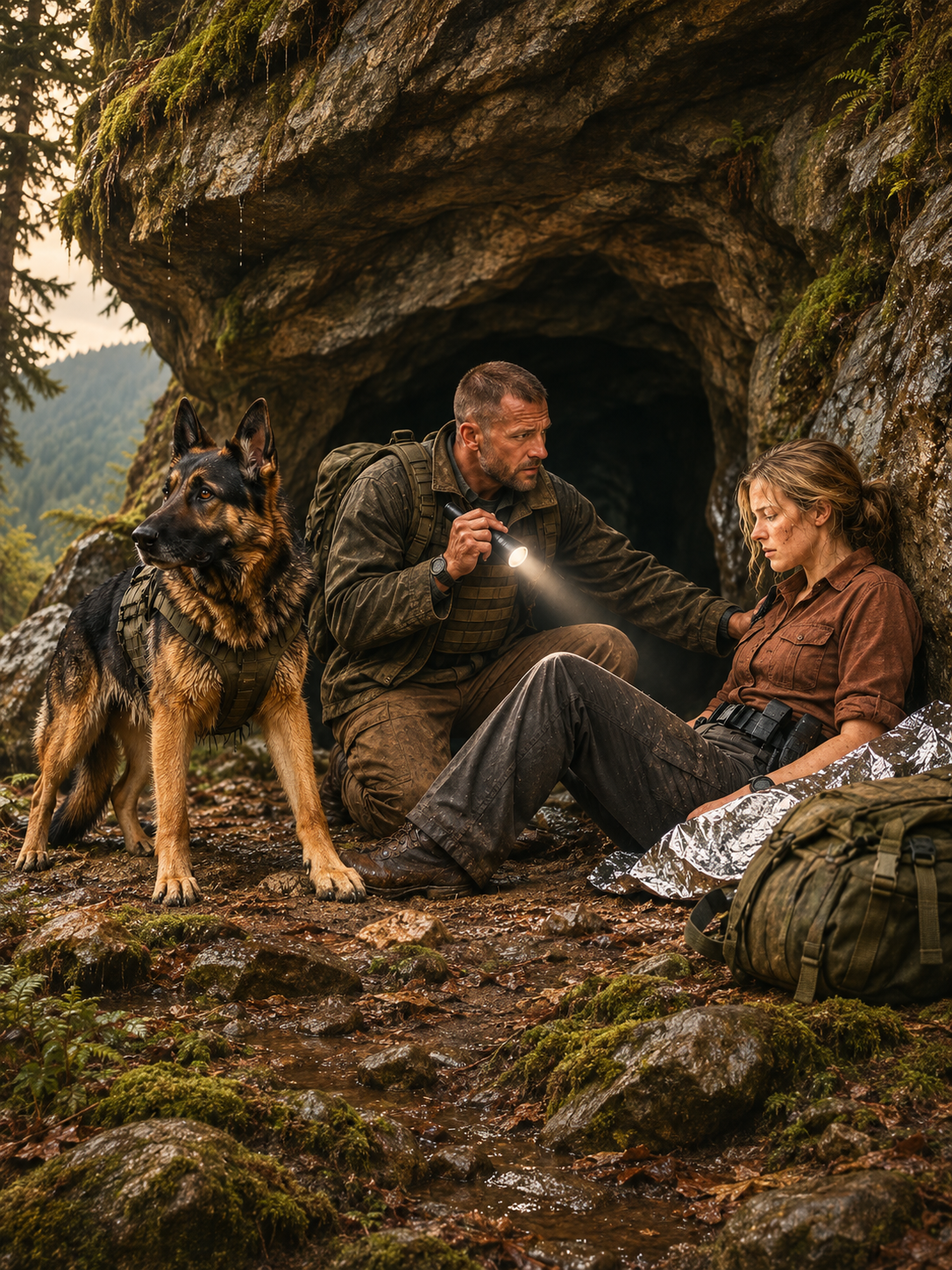
A woman was lying on her side with her knees drawn up and her right arm tucked beneath her cheek. I crossed the chamber and knelt beside her. Her tan sheriff’s deputy uniform was muddy and torn at the left shoulder, and the name tag still pinned to her vest said Crawford.
I put two fingers to her neck. Her pulse was faint and uneven, and I kept my hand still long enough to feel it again. Beside me, Zephyr lowered himself onto the limestone and pressed his warm flank against the backs of her knees.
I carried a trauma kit even when I went hiking. It was one of those habits I’d brought home, like sitting where I could see the door at a restaurant. I got a dressing on her shoulder and unfolded the silver emergency blanket over her. It made more noise than anything else in that cave had so far.
Then the rain hit. It sounded like somebody pouring gravel against the cliff, and the gap we’d come through filled with the noise of running water. I checked Crawford’s pulse again and took out my phone. I’d gone up there partly because I knew I wouldn’t get a signal, and I stood there a second waiting for one anyway.
I found a county-issued handheld radio under a torn flap on her belt. The casing felt solid, and when I turned it on I heard static. I kept the volume low, pressed the button, and asked for Harker County sheriff’s dispatch.
A woman from Emergency Communications came back and asked me to identify myself. I told her my name was Crew, that I was active-duty Navy, and that I was in a cave on the north face of Ridgeline Trail, about four miles past the Kettle Falls trailhead. I had an unconscious deputy with a gunshot wound to the left shoulder, and she needed a surgical team.
Then an older man came on. He introduced himself as Chief Deputy Alderman and asked whether I was with Deputy Crawford. He said they’d had search teams out for her for two days.
“She’s alive,” I told him. I could still hear water running down outside, and I told him the storm was going to make the access roads harder to use. He said he was putting a response team together and asked for my exact coordinates.
I read them off my watch and listened while he confirmed he had them. He told me to keep her still and said he expected to have people there in about twenty-five minutes. “You did good, son,” he said.
I clipped the radio to my vest. For the first time since I’d found her, I could picture handing her over to somebody who could get her to an operating room. I looked down at Zephyr, expecting him to be watching her.
Both his ears were forward, aimed at the entrance. His mouth had closed, and his breathing had changed. I’d seen him do that often enough to know he was listening to something I hadn’t heard yet.
At the opening I could just make out engines underneath the rain. There was more than one, and the sound was coming from the north slope. I’d expected anyone sent in by dispatch to come up from the access roads on the south side. Through the gap I couldn’t see any headlights.
When I got back to Crawford, her eyes were open. She looked straight up at me from under the silver blanket. “You found me,” she said.
“My dog found you.” She turned her head enough to see Zephyr, and he met her gaze without moving. For a few seconds I thought she might ask for water, or ask how long she’d been there.
“Who did you call?” she asked. I said dispatch had put me through to Chief Deputy Alderman. Before I could tell her what he’d promised, her right hand came out from under the blanket and closed around my wrist.
“Do not trust Alderman,” she whispered. Her fingers barely had the strength to stay there. I looked down at the radio, thinking of how carefully I’d read him every digit on my watch. Part 2…..
IF FACEBOOK BROUGHT YOU HERE, HERE’S THE CONTINUATION YOU’VE BEEN WAITING FOR. ENJOY! 👇 I bent closer so she wouldn’t have to raise her voice. She’d spent six weeks looking into what appeared to be an illegal timber operation. The trucks really did haul timber, but she said they were moving fentanyl across three state lines in those loads.
On her own time, she’d followed a truck to a processing facility about twenty miles east of Ridgeline. She had a camera with her and got photographs. Someone spotted her there.
Three days earlier, at two in the morning, two men had followed her patrol vehicle off the main highway. She recognized one of them as a Harker County deputy. She went into the mountains because she knew that ground better than the people coming after her.
“Alderman set it up,” she said. He’d been running interference for the operation for two years, she told me. Once she recognized the deputy following her, she’d known what calling it in would mean.
I checked my watch. Fourteen minutes had passed since I’d given Alderman the coordinates. I asked how many people he might send.
“Four to six, probably. He won’t come himself.” She looked past me at the entrance. “They’ll be armed.”
I shut off the radio and helped her move a few feet, where she could brace her back against the limestone. She pushed with her right arm when I asked her to. Zephyr settled alongside her again, and I switched off the flashlight.
We waited in the dark while the engines came closer and then went quiet. For a while all I could hear was rain. Then something brushed the stone at the entrance.
Two men came through. The struggle was short, and when it was over, both men were restrained on the cave floor. I could hear at least two more voices outside, low and close enough that I knew we couldn’t leave the way I’d come in.
“There’s a fissure behind the far pillar,” Crawford said from the wall. She’d found it when she first came into the cave. She thought it would take us through to the south face if we could fit.
She got up using the wall and her right arm. When she swayed, I let her lean on me, and Zephyr went ahead. At the far end of the chamber, he lowered himself and disappeared through a crack I would’ve walked past if she hadn’t pointed me toward it.
Crawford looked at the opening and then down at her shoulder. She went first, inching sideways until I couldn’t see her. I passed the packs through after her and followed, listening for Zephyr on the other side.
It was still raining on the south face, but there was a little gray showing through the clouds to the east. I took the satellite communicator I carried out of my jacket and sent a message requesting federal help. I included our coordinates and told them I was with a wounded deputy and that armed men tied to local law enforcement were pursuing us.
Crawford had her good hand flat against a pine tree, holding herself upright. Rain was running down her face. I said, “Good,” and she took a breath before answering. “Don’t compliment me yet.”
We headed south along the cliff with Zephyr out in front. Crawford stumbled twice and caught herself both times. I kept my hand near her elbow and let her set the pace.
We’d gone about a mile when Zephyr stopped again. He lifted his nose and his tail moved once. A moment later I heard rotors coming from the south.
A dark green helicopter cleared the ridge and landed on a rocky shelf about two hundred yards from us. I could see the federal markings on the tail. Four people got out, and two came toward Crawford with a medical kit while the other two headed north toward the cave.
I stepped back so the medics could work. Crawford kept watching the northern tree line until Zephyr sat beside her and leaned against her knee. She put her hand on his head and left it there.
Final By the time a federal agent came over with a recorder, the rain had thinned to mist. I gave him the names, the coordinates, the time of the call, and the channel the county radio had been on. I told him what Alderman had said and where we’d left the two men in the cave.
He nodded toward Zephyr. “The dog led you there?” I told him he did. Zephyr looked back at the agent with the same steady gaze he’d given me on the trail.
When I went back to Crawford, the medics had her on a stretcher with an IV in. She turned her head at the sound of my boots on the rock. “They got Alderman,” she said. “He was still at the staging area.”
She took a moment to let that settle. He’d stayed put because he thought the men he’d sent would take care of it, she said. Now she could look toward the trees without having to decide where to run next.
“Your dog saved my life,” she said. I told her Zephyr would probably give her some credit for finding her own way into that mountain. She reached out, and he put his nose against her hand and held it there until the medics were ready to lift the stretcher.
The helicopter took her south to the regional trauma center. I waited until the sound of the rotors was gone, then put my hand on the back of Zephyr’s neck. “Okay,” I said. “Let’s go find the trail.”
Six weeks later, I was at a farmers market in Asheville, near the coffee stand, when Crawford walked up with her left arm in a sling and some papers tucked under her right arm. The surgery had gone well, and she’d been cleared for light duty the week before. She still had another four months of physical therapy ahead of her.
A federal indictment had been handed down against Alderman and seven associates. Crawford could’ve opened with that, or with how her shoulder was doing. Instead she stood beside Zephyr and waited for him to turn his head. He did, and his tail moved once.
“How’s he doing?” she asked, scratching behind his ears. I said he was fine and asked how she was doing. “Better every day,” she said, and handed me the papers.
They were Zephyr’s service record and a commendation. She said there was no medal they could give a retired dog, so they’d written him a letter. A federal field supervisor had put down in plain language that Zephyr’s alert on Ridgeline Trail had set in motion the rescue of a deputy and helped disrupt a criminal network.
I folded the papers and put them in my jacket pocket. “He won’t be impressed,” I said. Crawford looked down at him. “I know. That’s why I liked the idea.”
We stood there with our coffee while people went past carrying bags of produce. A terrier at the next booth was doing its best to get Zephyr’s attention. Zephyr leaned against Crawford’s leg, and when she put her hand on his head, he stayed right where he was.
THE END. I’ve shared the complete story, and I truly hope it touched your heart. If this story moved you, please , like, and share the post. Thank you for reading! ❤️
✓ Lynn R. Adams
My retired military dog led me off a Blue Ridge trail to a deputy who’d been missing for two days, and when her chief promised to send help, I gave him our exact location. Then she opened her eyes, sa…