My mother wore her motorcycle vest
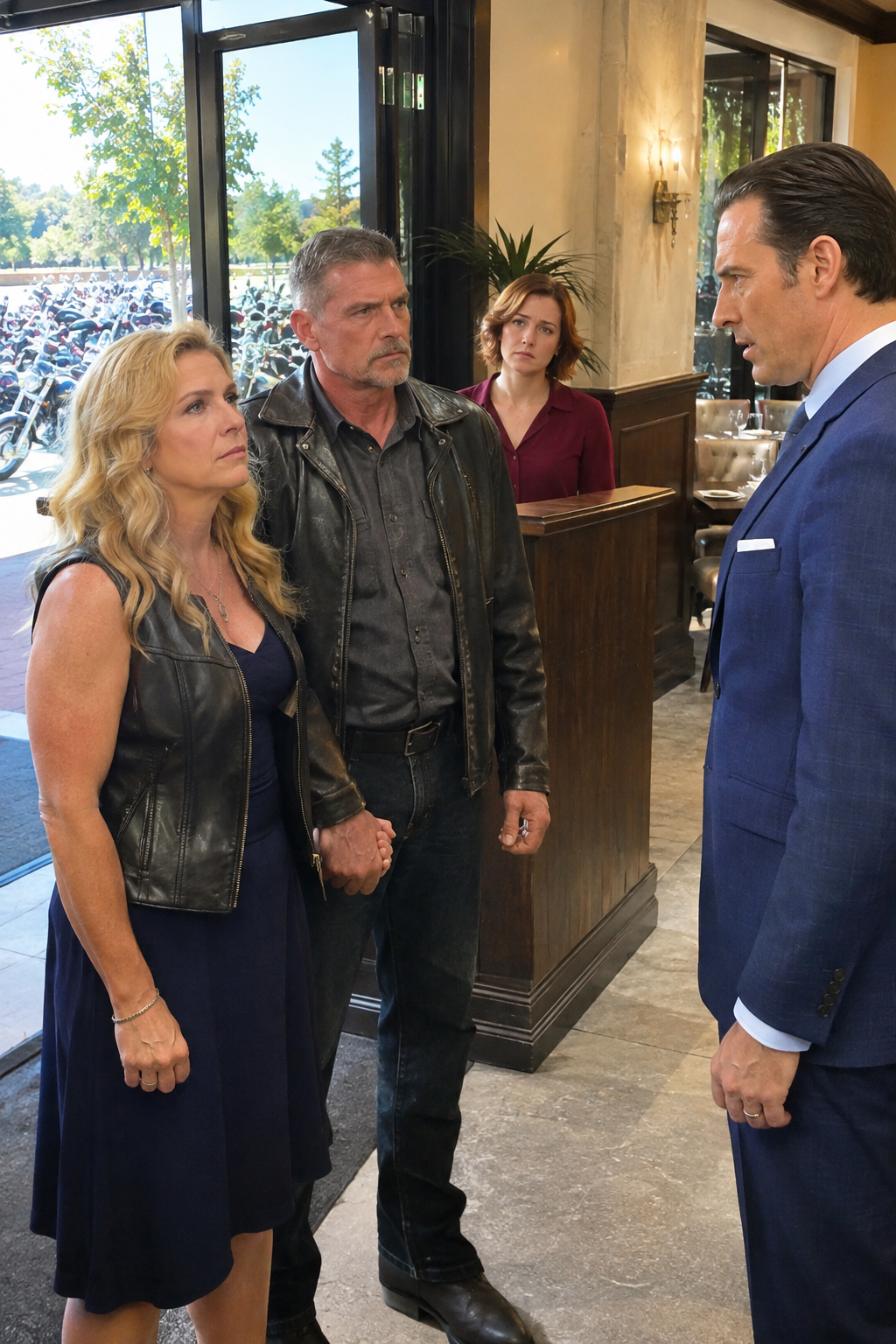
My mother wore her motorcycle vest to celebrate thirty years of marriage, but the manager of our town’s nicest restaurant called her trash and ordered her out; twenty minutes after she called my father, the windows began to shake…
My mother, Sarah Mitchell, never cared much for fancy places. She liked clean sheets, good coffee, and people who meant what they said. But for her thirtieth wedding anniversary, my father, Marcus, had promised her dinner at Belmont’s, the nicest restaurant in Riverside, the Northern California town where they had lived for fifteen years.
I can still hear Mom telling me about that evening. She had put on her favorite navy-blue dress and checked the mirror twice, not because she was vain, but because after three decades of marriage, an evening when neither of them had to cook felt like something worth dressing for. Over the dress, she slipped on her leather motorcycle vest.
The vest carried the Hells Angels patch on the back and the familiar “Property of Reaper” patch on the front, Reaper being Dad’s riding name. There were pins from charity rides and other gatherings. Mom understood that people had strong opinions about those patches, but they were part of the life she and Dad had built together, and she wasn’t going to hide them for dinner.
Dad was finishing a shift at his auto shop, so Mom went ahead. Their reservation was for two at six-thirty, but she arrived around six. She thought she might have a quiet drink while she waited, and she had already decided she was ordering dessert whether Dad complained about the prices or not.
The young hostess, Emily, greeted her with a smile. “Good evening. Do you have a reservation?” Mom gave the name Mitchell, and Emily found it right away. She was about to suggest the bar when a man in an expensive suit came toward them from the dining room.
His name was Richard Vaughn, Belmont’s manager. Mom remembered his gaze going straight to the leather vest, then stopping on the patch as though he had found something filthy on his floor. “What is that doing in here?” he asked, loud enough for people at the nearest tables to hear.
Mom thought at first he was asking about the vest itself. “It’s my husband’s motorcycle club,” she said. “We have a reservation.” Richard told her the restaurant had standards, that gang symbols weren’t welcome, and that they did not serve bikers.
She tried not to make a scene. “It’s our anniversary,” she told him. “My husband will be here in a few minutes. We only came for dinner.” Richard didn’t ask whether she planned to cause trouble or whether she’d bothered anyone. He simply told her to leave before he called the police.
Emily shifted behind the hostess stand, plainly uncomfortable, but Richard cut off her attempt to speak. Diners began looking up from their meals. Mom said that being watched was almost worse than being turned away, because each glance made her feel as though she had to defend the person she had been her whole life.
She was a registered nurse who had spent thirty-two years caring for people, often when they were frightened or in pain. She volunteered at the VA hospital every weekend she could. The year before, she’d helped organize a motorcycle charity ride that raised $50,000 for children’s cancer research. None of that came to mind as a speech she wanted to deliver; she simply wanted the man to stop talking down to her.
“My husband is a decorated veteran,” she said quietly. Richard replied that he didn’t care who her husband was. Then he called her trash, told her people like her brought down the place, and ordered her out again.
Mom was not a woman who cried easily in public. I had seen her come home from long nursing shifts, sit at the kitchen table with sore feet, and still ask how everyone else was doing. But she told me that walking past those occupied tables, with strangers watching her leave, made her face burn so badly she could hardly see where she was going.
She reached her car, shut the door, and sat with both hands on the steering wheel. Her anniversary dress felt suddenly foolish. She pulled out her phone and called Dad, who was still on the road and thought she was already inside waiting for him.
“Hey, baby,” he said. “I’m about ten minutes out. You get our table?” Mom tried to answer normally, but her voice broke. “They kicked me out, Marcus. He saw my vest. He called me trash, right in front of everybody.”
Dad went quiet for a moment. He asked where she was, and she said she was still in the parking lot. “Stay there,” he told her. “I’m coming.” He wasn’t shouting. Mom said that somehow his quiet voice made her feel less alone than any angry promise would have.
What she didn’t know was that Dad made another call as soon as they hung up. In his riding group he was Reaper, and he told the brothers exactly what had happened at Belmont’s. He asked anyone nearby to come in the next twenty minutes, not to start a fight, but to stand beside a woman who had been humiliated for the vest she wore.
The message moved through three chapters within fifty miles. Men who had planned to eat at home or work on their bikes changed course. Dad didn’t tell Mom he’d called them; he just hurried to the restaurant, arriving about twelve minutes after her call, parked his Harley, and went straight to her car.
Mom was still sitting inside, trying to get herself together. Dad opened her door and crouched so they were looking at each other. He reminded her of the patients she’d cared for, the veterans she’d spent weekends helping, and all the times she’d been the person other people leaned on.
“You don’t have to prove your worth to him,” he said. Mom asked whether they could simply go somewhere else. Dad looked toward the restaurant and said he wanted to walk back in with her, but that she wouldn’t have to do it by herself.
That was when she first heard the engines. At a distance, she thought it might be a few bikes passing on Main Street. Then the sound grew until she could feel it through the seat of the car. Motorcycles turned into the lot from one direction, then another, their riders pulling into rows and shutting off engines.
There were fifty, then a hundred, then so many she stopped counting. Men in weathered leather and familiar patches dismounted, greeted one another, and looked toward Dad and Mom. They hadn’t come because they expected free food or a show. They had answered a call from someone they considered family.
By the time the last motorcycles arrived, the count had reached three hundred, with overflow along the street. Dad offered Mom his hand. She stared at all those people, then at the restaurant where, minutes earlier, she had been made to feel she didn’t belong.
Inside Belmont’s, Richard heard the low thunder and went to the window. Mom saw his expression change when he realized the motorcycles were not passing through town. Three hundred riders had come to the restaurant he managed, and Dad was walking toward its front door with Mom beside him. Part 2…..
IF FACEBOOK BROUGHT YOU HERE, HERE’S THE CONTINUATION YOU’VE BEEN WAITING FOR. ENJOY! 👇 Dad opened the restaurant door first, with Mom close beside him. The riders followed without shouting or shoving, although a crowd that size was unsettling enough on its own. The ones who couldn’t fit safely inside remained outside, and the men who entered lined the available space near the bar and dining room while the customers stopped eating and watched.
Richard stood near the hostess stand, his face drained of color. Dad walked up to him and said, “You called my wife trash because of a vest. You never asked her name beyond the reservation, never asked what kind of person she was.” Richard began explaining the restaurant’s policies, but Dad asked him to listen before answering.
Mom told me later that she almost pulled Dad away. The point had been made as soon as the motorcycles arrived, and she hated that the people having dinner were now afraid. But Dad kept his voice even and said nobody was there to damage the restaurant or hurt anyone. He wanted Richard to understand whom he’d thrown out.
He told the room about Mom’s thirty-two years as a registered nurse, her weekend work with veterans, and the $50,000 charity ride she’d organized for children with cancer. One of the brothers had brought a small projector, and photographs appeared against a clear section of wall: Mom in scrubs, Mom beside patients and charity volunteers, Mom receiving a community service award from the mayor. She covered her mouth when she recognized the photographs.
Richard stared at the images. “I didn’t know,” he said. Dad answered, “You didn’t ask.” That was the sentence Mom remembered most clearly, because it was quieter than anything else said that night and harder to argue with.
Dad spoke about the other riders too. They were men he knew as veterans, business owners, teachers, fathers, and volunteers, each with his own history and faults. He wasn’t asking the restaurant to approve of everything associated with their club; he was asking Richard not to decide what Mom deserved from one look at her clothing.
Preacher, an older rider who had served forty years as a pastor, stepped forward and spoke about finding a family in the club when his relatives had turned away. A firefighter described twenty years on the job. A high school history teacher talked about mentoring teenagers with other riders. Different men, different lives, all of them uncomfortable at being reduced to a single patch.
One rider everyone called Tank was standing near the dining room entrance. He was huge, sixty-five, and covered in tattoos, which made several diners keep watching him. He said very little, but when a server needed room to pass with a tray, he moved aside and held the door, an ordinary gesture that Mom noticed because the room had been so tense.
Dad turned back to Richard. “My wife deserves an apology, and she deserves to decide for herself whether to accept it.” Richard looked directly at Mom and admitted that he’d judged her unfairly. He apologized for the names he’d used and for humiliating her in front of his customers.
Mom nodded, but she didn’t rush to reassure him. “I came here to have dinner with my husband,” she said. “I didn’t come here to explain my life to a stranger.” The words were plain, and that was why Dad said he was proud of her.
Tank wondered aloud whether they could finally eat. Dad laughed for the first time since arriving and asked who was hungry. Richard looked around at the crowd, then toward the kitchen, knowing there was no way his regular staff could serve three hundred unexpected customers at once.
The riders took available seats, and the rest waited or rotated through as tables opened. Extra kitchen staff were called in, and what should have been a quiet anniversary dinner stretched into a busy three-hour service. The people who worked there did not have an easy evening, but the riders waited, ordered politely, and left generous tips.
A woman at a nearby table approached Tank before she left. She admitted she’d been afraid when she saw him come through the door, then said he reminded her of her late husband, a Marine. Tank thanked her so softly that Mom nearly missed it, and the woman gave him a quick hug.
Another customer asked Mom about nursing because her daughter wanted to enter the profession. Mom offered to talk with the girl about what the job was really like and whether a shadowing opportunity might be possible. Near the bar, a businessman discovered that a rider named Wrench owned a construction company, and they exchanged cards over an ordinary conversation about work.
Richard moved from table to table apologizing. Some people accepted it, and others were still angry, particularly the ones whose meals had been interrupted. Mom didn’t pretend the evening had been comfortable for everybody; she said that learning to see people differently was rarely as tidy as the speeches people made afterward.
Tank asked Richard what he planned to do the next time someone walked in wearing motorcycle leather. Richard said he wanted to put an “All are welcome” sign in the window and make sure the staff meant it. Dad told him a sign mattered only if the people working behind it behaved differently.
By ten o’clock, riders were settling their bills and thanking the cooks and servers. The wait staff later said the tips were more than they’d made on any previous evening. Mom and Dad left last, after finally eating the anniversary meal they’d originally reserved for two.
At the door, Richard apologized once more, without making excuses. He told Mom that he was ashamed of what he’d said and grateful nobody had been hurt. Dad studied him for a moment and said, “People can change. What matters is what you do after tonight.”
The riders gathered outside, started their motorcycles, and headed through Riverside in formation before ending the evening at the VFW hall. People came out to watch the procession. Mom said the sound still made her jump, but this time she wasn’t sitting in her car feeling alone.
At the hall, Preacher raised a glass to Mom and to the people who had shown up for her. She stood and thanked the brothers, then surprised them by saying the part she respected most was that the night had ended without anyone being struck or the restaurant being damaged. “You could have made this about anger,” she told them. “Instead, you made me feel that I mattered.”
In the weeks that followed, Richard put up the promised sign. He spoke with his employees about treating people respectfully, and Belmont’s gradually became a gathering place for veterans and riders as well as the customers it had always served. Business improved as people heard what had happened, though Mom was more interested in whether the door stayed open to the next person who looked different.
Richard asked to sponsor the next charity ride, and Dad agreed after seeing that the restaurant’s welcome wasn’t just for show. Belmont’s began catering the annual event, which raised money for veterans’ causes. Mom said it was strange, at first, seeing the man who’d insulted her helping carry trays for the same people he’d wanted out of his dining room.
A year after the incident, Richard appeared at the ride in a shirt that said “Biker Supporter.” He told the crowd how he had mistreated Mom and how deeply he’d regretted it. That year the event raised a record $120,000, with Belmont’s making the largest single donation.
Footage of hundreds of motorcycles arriving at the restaurant traveled far beyond Riverside. News reports repeated the story, and millions watched the video. Mom received messages from riders who had been turned away elsewhere, but she also heard from people who admitted they’d never spoken to a biker before seeing what happened at Belmont’s.
When Mom and Dad celebrated thirty-five years of marriage, they went back to Belmont’s. Richard served them at the table they’d once been denied, and a dozen brothers joined them. Dad teased that they never managed to have a quiet anniversary anymore, and Richard laughed along with everyone else.
Five more years brought more attention than Mom had ever imagined. At a national motorcycle rights convention in Las Vegas, ten years after that first dinner, she stood before about five thousand people. She was sixty-two, wearing the same vest, and Dad watched from the front row with a face I knew well: the look he got when he was proud but didn’t want to make a fuss.
Part 3 She spoke about working with legislators in twelve states, helping organize more than two hundred charity rides, and raising millions for veterans, children’s hospitals, and disaster relief. The numbers mattered, but she kept coming back to the people who had come to her after events because they needed a friend, a hospital contact, or help getting through one more difficult week.
Not every message was kind. Mom received hate mail and threats from people who disliked motorcycle clubs or believed she was excusing every bad thing any member had ever done. She wasn’t. She told us that loving people didn’t require pretending they were perfect, and fighting prejudice didn’t require closing your eyes to real wrongdoing.
Richard, meanwhile, opened two more restaurants with the same welcome policy. He offered his dining rooms for veterans’ support meetings and went to speak with business owners who were considering blanket bans on motorcycle-club clothing. Some listened to him; others didn’t. He kept going anyway, which was one reason Mom eventually called him a friend.
The largest new challenge involved a chain called Henderson’s Steakhouse. Its corporate rule banned gang colors or insignia, and riders had been refused service at seventeen locations across six states. Club members believed the rule was being applied to them as a group, regardless of their conduct, and asked Dad to help plan a response.
Dad proposed a coordinated, peaceful demonstration at Henderson’s restaurants around the country. Mom worried that all it would take was one angry person and one foolish shove for years of work to be lost. He listened, and the plan included clear instructions: no threats, no aggression, no drinking beforehand, and no blocking doors or access for other customers.
The news coverage before the protest was rough. Some reports called it a nationwide intimidation campaign, and Mom understood why a sudden group of motorcycles could look frightening. She insisted the brothers needed to behave in a way that made their actual intentions clear even to people who disagreed with them.
On the appointed Saturday, Dad and Mom arrived at their local Henderson’s with fifty riders. Richard came along to stand with them. Similar gatherings took place at roughly four hundred restaurants, involving around four thousand riders in all, though the groups at individual locations varied in size.
Small groups went inside, requested tables, and were refused because of their insignia. Outside, the riders kept to spaces where customers could still pass, sat quietly, and waited. Some people turned away from the restaurants after seeing the demonstration, while others stopped to ask what was happening.
The first location to change course was in Texas, where a manager called the company’s office and then invited riders in. By noon, twelve restaurants had decided to serve them. By evening, forty-seven had done so, and the company’s leadership announced that it would review the policy after the weekend.
Some riders maintained peaceful vigils while others went home and returned in shifts. On Monday, Henderson’s announced that it was rescinding the ban on motorcycle-club insignia and apologized for the offense it had caused. Mom saved the announcement, but she reminded Dad that a policy change on paper was only the beginning of treating customers fairly.
The result drew national attention and criticism as well as praise. A leader from a veterans’ organization went on television and called the riders criminals, a remark that hurt Dad especially badly. He had served twenty-two years in the Marine Corps, including two tours in Iraq, and he knew what it felt like to come home carrying things he struggled to explain.
Dad accepted an interview and spoke about his PTSD and the support he’d found among his riding brothers. When asked about criminal records held by some members, he didn’t pretend there had never been trouble. He said people should answer for what they did, but that those who had served their time and changed deserved the chance to do good.
I watched that interview with Mom. She sat forward whenever Dad spoke about coming home, as if she still wanted to protect the younger man he had been. The clip spread widely, and some veterans’ groups that had criticized the club reached out to discuss helping people who had served.
Mom turned those conversations into a program called Vets Ride. The idea was straightforward: connect veterans who rode motorcycles, or felt comfortable around riders, with peers who could help them navigate VA services and find housing and support. In its first year, the program helped three hundred veterans reach resources, secure assistance, or begin dealing with PTSD.
The program drew interest from the Department of Veterans Affairs, which offered a partnership and funding. The offer came with conditions, including keeping Hells Angels insignia from being prominent in promotional materials. Some members believed that agreeing meant hiding the very community that had made the project possible.
Mom took the concern seriously. At the club council, she said she understood why the patches mattered, but reminded everyone that the real purpose was helping veterans who might otherwise fall through the cracks. “They’ll know who helped them,” she said. “We don’t need to put our name across every page to do the work.”
Preacher, who was eighty-three by then, agreed. He had spent much of his life telling people that service meant giving something up when someone else needed it. The council voted to accept the conditions, and with the additional support Vets Ride expanded to serve about fifteen hundred veterans in its second year.
As the program grew, Mom was invited onto talk shows and published a book called Beyond the Leather: How Bikers Changed My Life and Changed America. She liked the speaking engagements that put her in a room with skeptical people, because a conversation could change more than a rehearsed argument. Still, the attention brought a steady stream of ugly messages to our family.
One morning someone had spray-painted a slur on the garage at Mom and Dad’s home. Dad was furious, and several riders wanted to go looking for the people responsible. Mom stood in the driveway, staring at the damage, then made herself pick up the phone and report it to police instead.
She photographed the vandalism and kept the threatening messages. Investigators eventually identified three young men influenced by hostile online forums, and they faced felony charges. Mom went to court not to deny the harm they’d done, but to ask whether accountability might include learning about the people they had targeted.
At sentencing, she proposed supervised community service and education rather than simply sending them to prison. The judge agreed to an arrangement that included two hundred hours helping with the veteran-support program. For six months, those three young men worked alongside people they had previously dismissed as dangerous strangers.
At first they barely spoke. They swept floors, carried supplies, and watched the work without trusting anyone. Over time they met veterans who needed help, heard stories about war and homelessness, and saw riders giving their free hours to people who had nothing to offer in return.
One of the men was Connor, twenty-two years old. At the end of his service he stood in front of Mom and admitted he’d believed things about her that weren’t true. She accepted his apology, but she also told him that making things right meant deciding how he would treat the next group of people he didn’t understand.
Final Connor eventually began speaking to students about prejudice and the way his views had changed. His experience became part of a documentary called From Hate to Understanding: The Sarah Mitchell Story, which received awards and was used in training programs. Mom liked that the film included how frightened and angry she’d been, because she didn’t want compassion mistaken for never feeling anger.
By the twelfth year after Belmont’s, she saw more businesses opening their doors to riders and some police departments engaging with local clubs as community groups. None of it erased the arguments or the legitimate concerns people raised about individual conduct. But she believed there was more room than before to judge a person by what that person actually did.
Fifteen years after that anniversary dinner, Richard organized a gathering at Belmont’s. Three hundred brothers came, along with staff members who remembered the first night, community volunteers, veterans helped through the programs, and Connor, who by then worked as a youth counselor. The room felt different from the time when everyone had gone silent at the sight of motorcycle leather.
Dad stood before the crowd and admitted that, when he’d made the call years earlier, all he had wanted was for Mom not to feel alone. He hadn’t imagined books, programs, arguments over policy, or relationships that would last decades. “Sarah was the one who kept asking what good we could do after people stopped being angry,” he said.
Mom spoke next. She told everyone that she could still remember the exact moment Richard called her trash, and that she never wanted someone else to have to swallow that kind of shame at a restaurant door. But she also looked at Richard, now her friend, and said the deepest change that night hadn’t been his fear of the motorcycles; it had been his willingness to admit that he’d been wrong.
Richard stood with his hands clasped in front of him. He said he could never undo the way he’d treated her, but that he could keep choosing differently for the rest of his life. Mom went over and embraced him, and Dad gave him the sort of firm handshake that needed no speech.
Afterward, Mom and Dad stepped out into a parking lot filled with motorcycles. For a few minutes they stood alone, away from the music and the conversations inside. Mom asked him, “We did some good, didn’t we?” Dad put an arm around her and said they had, though he still wished her first anniversary dinner at Belmont’s had simply been a nice one.
The years that followed weren’t easy. Mom kept speaking, mentoring younger advocates, and helping people find support as long as she could, but her health began to fail. At seventy-eight she learned that she had terminal cancer, and the doctors told the family she might have about six months.
I remember how carefully she folded the paper from that appointment before setting it on the kitchen table. Dad reached for her hand, and neither of them pretended there was some perfect thing to say. She asked us to keep the veteran program going and not turn her illness into an excuse to stop living while she still had time.
When riders around the country heard the news, they organized one last tribute called Sarah’s Ride. More than three thousand bikers traveled to Riverside, where the route passed Belmont’s, the VA hospital where she’d volunteered, and the community center where she’d spent so many hours with veterans. The procession lasted about three hours.
Mom was too weak to ride, so Dad brought a chair onto the porch and stood close beside her. I watched her follow the motorcycles with her eyes, lifting one hand as each long wave of riders came past. Dad leaned down and told her they had come because of what she’d meant to them.
“We changed each other,” she answered. She said it the way she used to tell us to bring a sweater or call when we got home, with no grand performance. She lived two more weeks, surrounded by Dad, her children, and riders who took turns sitting quietly with the family.
At her funeral, three thousand bikers formed an honor guard. Preacher, ninety-three by then, gave the eulogy and spoke about how Mom had married into the brotherhood but had become one of its most important teachers. He said she’d shown them that compassion without strength could be helpless, but strength without compassion could become cruelty.
When the engines started after the service, the sound seemed to fill the whole town. I thought of Mom in that car outside Belmont’s decades earlier, believing she was alone. The same sound that had frightened her at first had become part of how people said goodbye.
Dad spent the next five years trying to continue her work. He spoke at events when people invited him, mentored young riders, and asked practical questions about whether veterans were actually getting the support the programs promised. When he died at eighty-three, he was buried beside her. Their headstone read, “Marcus and Sarah Mitchell. They taught a nation about honor, dignity, and brotherhood.”
Richard lived to ninety-six. He never got comfortable describing himself as the man who had learned a lesson from three hundred bikers, but he kept telling it because he knew how easily someone else could repeat his mistake. Before he died, he said he’d spent his years trying to repay the kindness of the woman he’d humiliated and the husband who demanded that he see her as a person.
Belmont’s remained open decades after that evening. By its fiftieth anniversary of the incident, a plaque near the entrance told visitors that Sarah Mitchell had been turned away in 2025 because of her appearance and that hundreds of riders had peacefully come to stand with her. It ended with a promise that everyone was welcome.
People still gather there to remember my parents. Some arrive in leather, others in work shirts or Sunday clothes, and most have never met the couple whose names are on the plaque. When I hear the familiar rumble of motorcycles outside, I think less about the number three hundred than about one woman in a navy dress reaching for her husband’s hand after someone had tried to make her feel small.
My parents didn’t solve prejudice for everybody, and they never claimed they had. They showed us what could happen when anger was followed by responsibility, when an apology was followed by years of different choices, and when people who called themselves family showed up and then stayed to do the harder work. That’s the part of their anniversary story I carry with me.
THE END. I’ve shared the complete story, and I truly hope it touched your heart. If this story moved you, please , like, and share the post. Thank you for reading! ❤️
✓ Lynn R. Adams
My mother wore her motorcycle vest to celebrate thirty years of marriage, but the manager of our town’s nicest restaurant called her trash and ordered her out; twenty minutes after she called my fathe…