My mother called to tell me I wasn’t welcome at Christmas because, in her words, I had become
Part 2: I left Wall Street after one small act gave my life meaning
I had not always worked in the nonprofit world. Twenty years earlier, I had graduated from Wharton with an MBA in the top ten percent of my class, and several major firms competed to hire me. Goldman Sachs, Morgan Stanley, and McKinsey offered salaries that ranged from $180,000 to $220,000. I chose investment banking at Goldman, and my family celebrated as if I had won a championship. “Finally,” my mother said at graduation, “a child who’s making something of herself.”
My older brother, James, was already a marketing director at Procter & Gamble, earning a strong salary and building the kind of career our parents admired. Sarah was in medical school and on her way to becoming a pediatrician. I was the banker, the one with the largest salary, the sharpest title, and the most impressive office. For three years, I lived in Manhattan and worked eighty-hour weeks on deals worth billions. My apartment was beautiful, my clothes were expensive, and my evenings were spent at restaurants where a single entrée cost more than some people had for dinner in a week.
I wore Armani suits and carried a Prada bag to meetings, then returned to my apartment after midnight to finish the next day’s presentation. The work was not too hard for me; I had chosen a demanding field and could handle long hours. What began to trouble me was the emptiness behind the tasks. I helped billionaires become richer, prepared models that shifted figures across spreadsheets, and called the results “shareholder value.” One night, I would sit alone after another late shift and wonder whether any part of my work had made someone’s life better.
The moment that changed me came on an October Tuesday after a sixteen-hour day. I was walking toward the subway, exhausted and carrying a briefcase full of documents for a seven a.m. meeting. Near the station, I passed a man sleeping on cardboard, wearing a worn jacket and holding a sign that said he was a hungry veteran. I had seen him in that spot almost every day for six months. That night, I stopped walking.
I asked whether he had eaten, and he looked up at me with the wary surprise of someone who expected to be ignored. “No, ma’am,” he said. I bought two slices of pizza and a soda from a nearby place, which cost eight dollars. When I handed him the food, he began to cry and thanked me as if I had given him something priceless. I was no angel; earlier that day I had helped structure a pharmaceutical deal expected to raise drug prices by twenty-three percent. But that man had felt seen, if only for a few minutes.
On the subway ride home, I kept thinking about the difference between his tears and the money I had helped move that afternoon. The bank would earn millions in fees from the deal, and my bonus would be generous, but I could not remember anyone thanking me for a single presentation. Six months later, I left Goldman and joined a small nonprofit called Children’s Hope Foundation. It funded treatment for children whose families could not afford cancer care, heart surgery, or transplants. My salary fell to $52,000, and my parents reacted as though I had thrown away my future.
Part 3: My family saw a pay cut where I saw children’s lives
“You’re throwing away your career,” my father said when I told him I had accepted the nonprofit job. My mother asked whether I understood how embarrassing it was to earn a Wharton MBA and work for a charity. I explained that I would be helping children receive medical care their families could not afford. She replied that James was making real money and Sarah would be a doctor, while I had chosen “poverty wages.” I told her I was making enough. “Enough for what?” she asked, as if only a house and a large bank account could make a life secure.
I answered that I did not need a house simply because other people wanted one for me. My mother said everyone needed stability, and I told her I was choosing work that made me feel useful. “So you can feel good about yourself?” she asked. “Yes,” I said. She never understood that there was nothing selfish in wanting my work to matter. Over the next seventeen years, I did not spend my time regretting the choice.
When I joined the foundation, we had four employees, an $800,000 budget, and the capacity to help 127 children in a year. The organization operated in just three cities, and most days involved writing grant applications, talking with hospitals, and trying to stretch every dollar. We grew slowly through partnerships and hard work. I traveled to conferences, met with donors, negotiated with pharmaceutical companies, and sat with parents in hospital waiting rooms. When they worried about a bill, I promised we would work together to find an answer.
I also fought insurance companies when they denied treatments and hospital billing departments when the costs seemed impossible. Sometimes I spent whole afternoons reviewing medical records to determine whether we could cover one family’s needs without leaving another family behind. Those decisions were never easy. Every application represented a child, parents who were frightened, and a future that depended on resources we did not always have. I learned that good intentions alone were not enough; we had to build effective programs, track results, and persuade others to help us keep going.
Three years before the Christmas call, I became the foundation’s executive director. My salary was $140,000, which was comfortable but not Wall Street money. By then, Children’s Hope had become a national organization serving families in forty-seven states, with 143 employees and an annual budget of $68 million. The year before the gala, our funding helped more than 8,000 children receive lifesaving treatment. Those numbers were not a measure of my worth, but they showed what our team could accomplish when people believed in the mission.
Two years earlier, we had launched a partnership with six major children’s hospitals. The program helped identify complications earlier, lowered treatment costs by thirty-four percent, and improved outcomes for young patients. A peer-reviewed study of the work appeared in the New England Journal of Medicine. Then the Heartwell Foundation approached us about a major contribution to expand our program. We spent six months sharing our results, explaining the plan, and answering difficult questions from their team.
The final donation was $12.4 million, the largest single gift in Children’s Hope Foundation history. It would let us expand into twelve more cities, hire eighty-nine additional staff members, and reach 15,000 children each year. Our projections estimated that the expanded program could save 2,100 lives over five years. In October, when the donation came through, I was proud of our team and grateful to the donors who trusted us. A month later, my mother called our work “that nonprofit thing” and told me I had nothing to show for my life.
Part 4: I spent Christmas with children while my family celebrated without me
I did not tell my colleagues about the call. They assumed I would spend Christmas with family, and I could not bring myself to explain why I had been uninvited. For a while, I considered changing my mind and asking my mother to let me come anyway. Then I imagined sitting at the table while she compared James’s promotion, Sarah’s family, and my life as if it were a cautionary tale. I decided I would rather spend the holiday somewhere my presence might help.
On Christmas Day, I volunteered at a children’s hospital in Philadelphia. I played board games with children who could not go home and read stories to a seven-year-old recovering from a bone marrow transplant. Later, I sat with a newborn in the neonatal intensive care unit while his mother rested. No one asked what I earned, whether I had a husband, or whether I owned a house. They needed company, patience, and someone who would stay for a while. I went home that night tired, but more content than I had felt at many family dinners.
My apartment in Center City was small, with one bedroom and just enough space for the life I wanted. I made pasta, watched a movie, and went to bed around ten. My mother’s words returned now and then, especially the word “embarrassment.” I tried to imagine what she would say if she saw the children I had met that day. Then I looked at a photograph on my desk: eight-year-old Marcus, smiling with his family after receiving the heart transplant we had helped fund. I knew I was exactly where I wanted to be.
Early in December, the Children’s Hospital Network contacted us with news that Children’s Hope had been selected for its Humanitarian Impact Award. The annual gala would take place on January 24 at the Belleview Hotel. It would be a black-tie event with six hundred guests, a formal dinner, and an awards ceremony. My board chair, Margaret, called and told me I would accept the award. I said the accomplishment belonged to the whole organization, but she reminded me that leadership mattered too.
Margaret was eighty-three, a retired hospital chief executive who had no patience for false modesty. She said I had helped build an $800,000 operation into a $68 million national foundation, secured its largest gift, and led programs that changed lives. “Accept the damn award,” she said. I laughed and agreed. She told me I could bring a guest, but I had been single for four years, and my last relationship had ended partly because my partner felt I cared more about other people’s children than about building a life with him. “I’ll come alone,” I told her.
On the day of the gala, I finished reports in the morning and went home to get ready at three. I wore a simple navy dress I had bought on sale for $200, pearl earrings, and a silver necklace my grandmother had given me. Looking in the mirror, I remembered my mother’s list: forty-two, unmarried, no children, nonprofit job. I reminded myself that I was going to be honored for seventeen years of work that mattered. The thought did not erase the old hurt, but it helped me stand a little straighter.
I reached the Belleview at and found a ballroom filled with crystal chandeliers, ivory tablecloths, and carefully arranged place cards. My seat was at table five, near the front with board members and award recipients. Margaret stood when I arrived and told me I looked beautiful. As the other guests settled, I looked around the room and saw hospital leaders, major donors, foundation directors, and journalists. Then, in the back section, I spotted a familiar burgundy dress—and the woman wearing it was my mother.
Part 5: The award announcement revealed the daughter my mother never knew
I stared at table nineteen, trying to understand what my mother was doing at an event she had never heard about from me. She sat beside a well-dressed woman I did not recognize, laughing as they spoke. Margaret saw my face change and asked whether I was all right. I told her my mother was there. She asked if I had invited her. I shook my head, and we both watched the host take the stage before either of us could ask another question.
He welcomed the guests and explained that dinner would be followed by the awards ceremony. I barely listened. During the meal, I moved food around my plate and pretended not to notice my mother talking across the room. Margaret kept asking whether I was ready to speak, and I kept insisting I was fine. She could see I was pale, but she did not press me. I tried to focus on the people at my table and the work we had come to celebrate.
The award ceremony began at eight. First, a Boston hospital received an award for innovation in pediatric care. Next, a research team from Johns Hopkins was honored for medical research. Each recipient thanked colleagues, families, and donors before returning to their seats. I listened to the applause and tried to slow my breathing. When the host announced the Humanitarian Impact Award, I felt my hands begin to shake beneath the table.
He explained that the award recognized an organization or individual who had made an extraordinary contribution to children facing medical challenges. This year’s recipient, he said, had transformed pediatric healthcare in ways many people did not fully understand. Seventeen years earlier, she had left a lucrative investment banking career to join a small nonprofit with four employees and a budget under a million dollars. I saw my mother glance toward the stage, still unaware of where the story was leading. Her friend leaned over and whispered something.
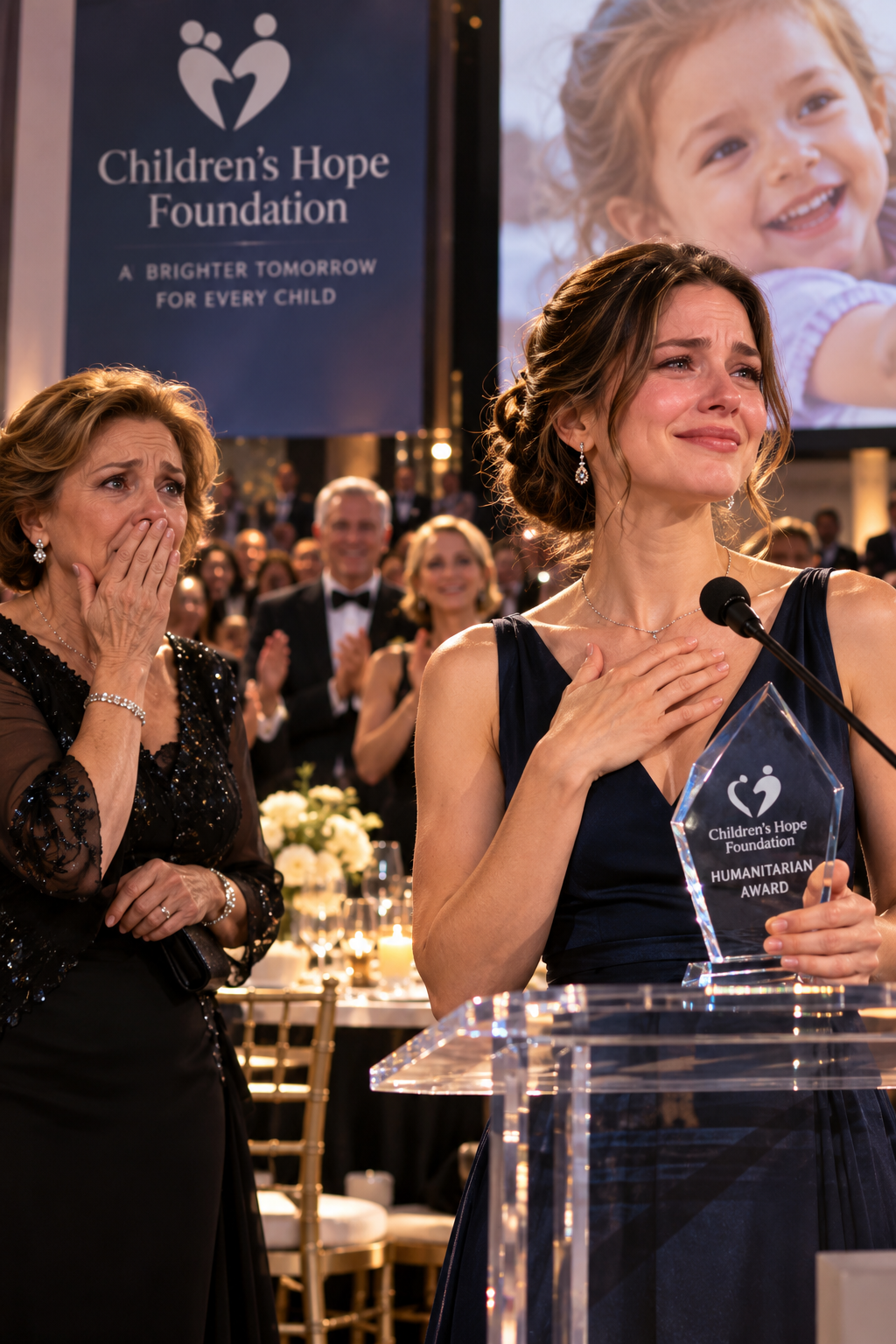
Under the recipient’s leadership, the host continued, the organization had grown into a national foundation operating in forty-seven states, with an annual budget of $68 million. Last year alone, it had helped fund lifesaving care for more than 8,000 children. The recipient had also secured a $12.4 million gift that would allow the foundation to expand its reach and serve 15,000 children annually. Behind the speaker, a screen lit up with a photograph of me. Beneath it appeared my name and title: Catherine Morrison, Executive Director, Children’s Hope Foundation.
The host went on to describe our hospital partnerships, the research published in a medical journal, and the lives saved through programs we had built. He invited everyone to welcome that year’s Humanitarian Impact Award recipient. The room erupted into applause, and the guests rose to their feet. I stood and walked toward the stage, trying not to look toward table nineteen. But as I passed, I saw my mother frozen in her chair, her face drained of color. Her friend touched her arm and whispered, and my mother looked directly at me.
The host handed me the award, a heavy crystal sculpture that caught the light from the chandeliers. He asked whether I would like to say a few words. I looked out at six hundred faces and, in particular, at my mother. “Seventeen years ago, I made a decision that confused a lot of people,” I began. I spoke about leaving banking, taking a pay cut, and giving up the apartment, expense account, and bonuses. A few people laughed gently, but my mother did not move.
Part 6: I told six hundred guests what success meant to me
“People asked me why,” I continued. “My family asked me why. Some of my colleagues thought I was making a terrible mistake.” I said that I had left because I had realized money was a tool, not a measure of a person’s value. Success was not defined by salary, title, or the size of a house. It was measured by the lives a person touched, the work they built, and the difference they made. As I spoke, I could see tears on my mother’s face.
I held up the award and told the room it belonged to the 8,247 children who had received care through our work. I spoke about Marcus, who had received a heart transplant at eight and was now a healthy fifth grader who wanted to become a doctor. I mentioned Sophia, who had beaten leukemia and recently started college, and James, who had survived a brain tumor and now helped other families navigate the medical system. My voice faltered when I thought of the parents who had sat beside their children, frightened and exhausted. They were not numbers to me; they were the reason I had stayed.
I thanked the 143 people who worked at Children’s Hope, along with the donors, hospital partners, and families who had trusted us. Then I looked toward table nineteen again. I said I did not have a large house, a corporate title, a husband, or children of my own. By some people’s standards, I might look unsuccessful. But I knew that I had spent seventeen years building something that saved lives and gave families hope during their hardest moments. “By the measure that matters to me,” I said, “I have a life I’m proud of.”
The ballroom rose again in a standing ovation. I stepped down from the stage and returned to table five, where Margaret hugged me. She told me the speech was perfect. I thanked her and noticed her glance toward my mother, who was still sitting quietly at the back. Margaret asked whether I planned to speak with her. I told her not here, not yet. I needed the moment to belong to the work and the people who had helped me build it.
The formal program ended at , and the room shifted into a busy reception. Hospital administrators wanted to discuss new partnerships, donors asked about the expansion, and journalists requested interviews. I stood surrounded by people who understood why our programs mattered. At 10:15, I saw my mother approaching slowly, with her friend a few steps behind her. The people around me sensed something private was happening and gave us room.
“Catherine,” my mother said, stopping a few feet away. “I didn’t know.” She looked toward the screen, where my photograph and the foundation’s name were still displayed. “You didn’t know what?” I asked. She said she had not understood the size of the foundation, the work, or what I had accomplished. I told her she had never asked. She replied that she thought I worked at a small charity, and that she had not realized I was leading the organization.
Her friend stepped forward and introduced herself as Susan Porter, a board member at Children’s Hospital. She explained that she had invited my mother to the gala after hearing she lived nearby, with no idea we were related. I thanked her for bringing her. Susan looked between us, offered us privacy, and walked away. My mother turned back to me. “I called you an embarrassment,” she said. “I uninvited you from Christmas, and I told you that you were a failure.” I told her I remembered every word.
Part 7: My mother apologized, but forgiveness would take more than one night
My mother began to cry and asked why she had believed the things she said. “Because I measured success by the wrong things,” she whispered. She admitted that she had compared my salary and title to James’s and Sarah’s, and had not tried to understand what I was building. I told her I had explained my work many times. She said she heard that I helped sick children but imagined I was a low-level employee filling out paperwork. “Would it have mattered?” I asked. “If I had told you I was the executive director, would you have respected me then?”
She did not answer. I told her that I had spent seventeen years being dismissed at family dinners, listening as James’s promotions and Sarah’s achievements were celebrated while my work was reduced to “that nonprofit thing.” I had felt like the disappointing middle child who could never meet the family’s idea of success. My mother said I was not a disappointment. I told her I knew that now, because the applause had made something clear—not because I needed six hundred people to tell me who I was, but because I had finally learned to believe it myself.
I asked her whether she understood my worth now. She said she did, and that she was sorry it had taken so long. I told her I was sorry too—not for my choices, but that she had missed seventeen years of my life while looking for a daughter who fit her expectations. When she asked if I could forgive her, I said perhaps, eventually, but not that night. I wanted to celebrate with the people who had believed in me from the beginning. I asked her to go home and think about why she had said those things and what she had failed to see.
She asked when she could see me again. I told her when she was ready to know the real me, not the version she wished I had become. I had chosen meaning over money, impact over image, and children’s lives over corporate prestige; I would choose the same life again. She nodded and started to leave, then turned back. “For what it’s worth, I’m proud of you,” she said. “I should have said that seventeen years ago.” I thanked her quietly, and she walked away.
Margaret came over and asked how I felt. “Tired,” I admitted. She asked if I wanted to leave, but I wanted to speak with the donors, colleagues, and partners who had come to support the foundation. We spent another hour discussing expansion plans and potential partnerships. I gave interviews to two journalists and exchanged contact information with hospital leaders. By the time I left at 11:30, my phone held seventeen messages: congratulations from board members, meeting requests from donors, interview requests from reporters, and a text from Sarah.
My sister had seen a video of my speech online. She wrote, “Why didn’t you tell us about any of this? I had no idea.” I did not call her that night. At home, I changed into pajamas and sat on the couch with the award on the coffee table. I looked again at Marcus’s photograph on my phone and thought about how happy he had looked after his transplant. That was success to me—not the approval of my family, but the life of a child who had been given another chance.
My mother called three days later and asked if we could talk. She said she had spent those days reading everything she could find about my work: the articles, interviews, medical study, and annual reports. She admitted she had thought nonprofit work was small, ineffective, and suited to people who could not succeed in the real world. “I was so wrong,” she said. “Yes,” I replied. She asked if she could visit the office, meet my team, and learn what we did.
I asked why she wanted to come now. Was it because she had seen me receive an award while six hundred people applauded? She said part of it was that, and she was ashamed to admit it. She also wanted to understand what mattered to me, and to stop making assumptions about my life. I told her the office was not a showpiece; it was a workplace full of grant applications, hospital bills, difficult decisions, and families asking for help. She said she wanted to see all of it. I agreed to let her visit the following Tuesday at ten.
Part 8: My mother learned what my work looked like beyond the applause
My mother arrived the following Tuesday at our office in a converted warehouse in South Philadelphia. The foundation occupied three floors, with open workspaces, conference rooms, and photographs of children we had helped. She stood in reception for a long moment, looking at the pictures. “Are these the children you’ve saved?” she asked. I told her they were some of them, and that thousands more had come through our programs. Then I showed her around.
We visited the program offices where caseworkers reviewed applications, the finance department that paid hospitals, and the donor relations team that maintained relationships with supporters. She met the communications staff who helped families tell their stories with dignity. At my office window, she looked at the files covering my desk and asked whether this was where I worked most days. I said yes, when I was not visiting hospitals or meeting donors. She picked up the photograph of Marcus and asked who he was.
I told her Marcus had received a heart transplant at eight, and that he was twelve now, healthy, and hoping to become a cardiologist. I kept photographs of many children because they reminded me why the work mattered. My mother set the photo down carefully and said she needed to tell me something. When I left Goldman, she thought I was making the biggest mistake of my life. She had believed I was throwing away my future, my potential, and my security. She had been angry with me. “I know,” I said.
“But I was wrong,” she continued. “You didn’t throw anything away. You built something extraordinary.” I asked why she had been so certain that my choices were wrong. She sat down and told me she had grown up poor, with a father who worked in a factory and a mother who cleaned houses. She wore hand-me-downs and remembered eating government cheese. When she married my father and later found stability, she wanted her children to have the security she never had. Money and status had become, to her, proof that we would be safe.
I told her I understood why she wanted that for us. But I had a good salary, an apartment, retirement savings, and a life I could afford. I was not struggling. She said I could have had more. “More what?” I asked. More money, she said. I told her I did not need a larger apartment if I would be alone in a job that meant nothing to me. I was safe in a life I had chosen, one that gave me purpose every day. She listened while I explained that children were alive because of decisions our team had made, and families had hope because of programs we had built.
My mother said not many people could say that about their work. I told her I had enough money, enough security, and meaning; that was everything I had wanted. She called me remarkable and apologized for taking forty-two years to see it. I reminded her that she had seen me clearly for the first twenty-five. It was the last seventeen that she had missed. If we wanted to repair our relationship, I said, she would need to ask about my life and listen without comparing me to James or Sarah.
She said she would try, and over the next six months, she did. She called most Sundays to ask about my week and listened when I talked about funding decisions, negotiations, and the children we had helped. In March, she attended a fundraising event and watched me speak. Afterward, she introduced herself to donors as my mother and said she was proud of my work. In April, she brought my father to the office and showed him the programs. He asked questions and seemed genuinely interested.
In May, Mom told James and Sarah about the award and showed them my speech. Sarah called, crying, and asked why I had never told them about the foundation’s growth. “You never asked,” I said. She admitted they should have. In June, the whole family came to our annual gala. My mother, father, James and his fiancée, Sarah and her husband, and the twins sat together at table seven. They applauded when I was introduced, and when I spoke, I saw them looking at me—not as the failure or embarrassment, but as myself.
Afterward, we went to dinner. James said he had no idea the foundation was so large or important. I told him I had tried to explain, but they had not been listening. Sarah said they were listening now, and I told her I appreciated that. My mother reached across the table and took my hand. She apologized again for the Christmas call and said she would regret those words for the rest of her life. When she asked if I could forgive her, I thought about the hurt and the past six months of effort. “Yes,” I said. My father squeezed her shoulder, and they told me how proud they were.
I believed them—not because their approval validated the choices I had already made, but because they were finally trying to understand me. I had spent seventeen years doing work that mattered before my family applauded it. The award did not make my life meaningful; the children, their families, and the people beside me had done that long before the ceremony. My mother’s apology could not erase the years she had missed, but it opened a door to something better. Success was never a salary, a title, a spouse, or a house. It was the lives we touched, the hope we gave, and the difference we chose to make.
✓ Lynn R. Adams
Part 2: I left Wall Street after one small act gave my life meaning I had not always worked in the nonprofit world. Twenty years earlier, I had graduated from Wharton with an MBA in the top ten perce…