My husband’s new ally slapped me in the design studio twenty minutes before our annual
IF FACEBOOK BROUGHT YOU HERE, HERE’S THE CONTINUATION YOU’VE BEEN WAITING FOR. ENJOY! 👇 A man stepped halfway into the restroom and stopped when he realized his mistake. “My apologies, wrong door,” he said, then noticed my cheek and my hands on the sink. Instead of asking for the story, he offered a doctor, security, or somewhere quiet; I chose somewhere quiet.
His name was Stellan Baird. He was about forty-four, quietly dressed, and had come to meet Garrison about a proposed Lakeshore co-development arrangement. I brought him to our second-floor conference room, whose badge-controlled lock I’d specified two years earlier for client confidentiality.
Stellan sat across from me while I made three calls. First, I reached my attorney and reported the signature and the slap. Next, I called Beth Orman, our head of operations, who told me Fleur had sent a revised event program that morning and claimed I’d approved it verbally.
“I waited for your written approval,” Beth said. “When it didn’t come, I printed the original.” Beth had worked with us since our second year and knew I didn’t authorize revisions that way. I thanked her and called the event coordinator to confirm the unapproved programs were being withdrawn.
After I hung up, Stellan placed a glass of still water near my hand. He remembered I’d said at an industry panel that carbonation made my hands unsteady before presentations. His attention startled me because it asked for nothing in return.
I asked what Garrison had promised him. Stellan said Garrison had described the Lakeshore Commission as a firm asset being restructured under new creative leadership. When Stellan asked to meet the founders before agreeing, Garrison spoke as though I was being transitioned out.
“I meant to meet you,” Stellan said. “That’s why I came tonight.” I thought of the three years I’d spent building the Lakeshore relationship and realized Garrison was arranging the project’s future without talking to its lead designer.
Seventeen minutes later, Garrison entered without knocking. He looked at my cheek and appeared genuinely surprised. When he came toward me, I raised my hand and told him to stop. “Fleur struck me,” I said. “She also accessed an email identity using my name and showed me a transfer agreement with a signature I didn’t make.”
I showed him the photos. He called the document a proposal, not an executed transaction. “You wouldn’t have signed voluntarily,” he said when I challenged the signature. “That’s precisely why the signature matters,” I replied; the distinction between proposing something and pretending I’d agreed was one our attorneys would have to address.
Garrison wanted us to present a united front for the clients. I told him there would be no such performance. The showcase belonged to the designers, artisans, and clients whose work was displayed downstairs, and I expected him to behave accordingly.
By six, I’d checked with three featured artisans that their signed agreements remained in force, notified the relevant forty-two guests that an unauthorized program had circulated, and made a second call to my attorney about the disputed transfer. I kept every description factual. No one needed a rumor when we already had documents to preserve.
Stellan stayed nearby, reading on his phone rather than asking me to entertain him. Later he brought cinnamon tea from the staff kitchen, with no caffeine or sweetener, because he also remembered that detail from my panel. When I asked why he was helping, he said the proposed business meeting appeared to have been arranged under false pretenses and someone had hit me; neither fact required him to look away from the other.
He’d visited four buildings I’d designed, he told me, and knew the difference between a space meant to impress and one meant to be lived in. I was too tired to answer elegantly, so I simply thanked him. Before going downstairs, I asked one thing: if Garrison used Stellan’s presence to validate the Lakeshore proposal, he should tell the truth about what had actually been discussed. He agreed.
Part 3 The showcase opened at . I changed into the charcoal wrap dress I’d packed that morning instead of the pale blush outfit Garrison’s stylist had suggested for a coordinated appearance. I wore the steel cuff earring my grandmother had given me when I graduated architecture school, engraved with the coordinates of the first building she’d ever entered through the front door rather than the service entrance.
Beth met me near the main gallery. The original programs were on the chairs; Fleur’s version had been removed. Security knew Fleur could attend as a public guest but no longer had access to our private floors.
Garrison found me beside the twelve-foot model of the Lakeshore public plaza, made from chipboard and wire after six months of my evenings. He complimented my dress. I asked whether Fleur was his partner, and his face tightened.
He accused me of refusing to delegate and pulling away from client meetings. I reminded him that he had given Fleur my office access and removed mine from the bid calendar first. When I asked whether he’d authorized the transfer signature or impersonation of my email, he didn’t answer.
Then I asked whether he’d promised Fleur my partnership interest. He looked out toward the lake and admitted he’d told her there would be a future for them after our separation. It wasn’t every truth I’d asked for, but it was the first one he’d offered plainly that evening.
Across the gallery, Stellan was listening to Wendell, the retired contractor who’d worked on three of our earliest projects. Wendell was telling the old story about me sourcing limestone from an Indiana salvage yard and making four trips in a rented van because the vehicle was smaller than I expected. Stellan looked almost delighted to learn it, and for the first time that day I smiled without forcing myself.
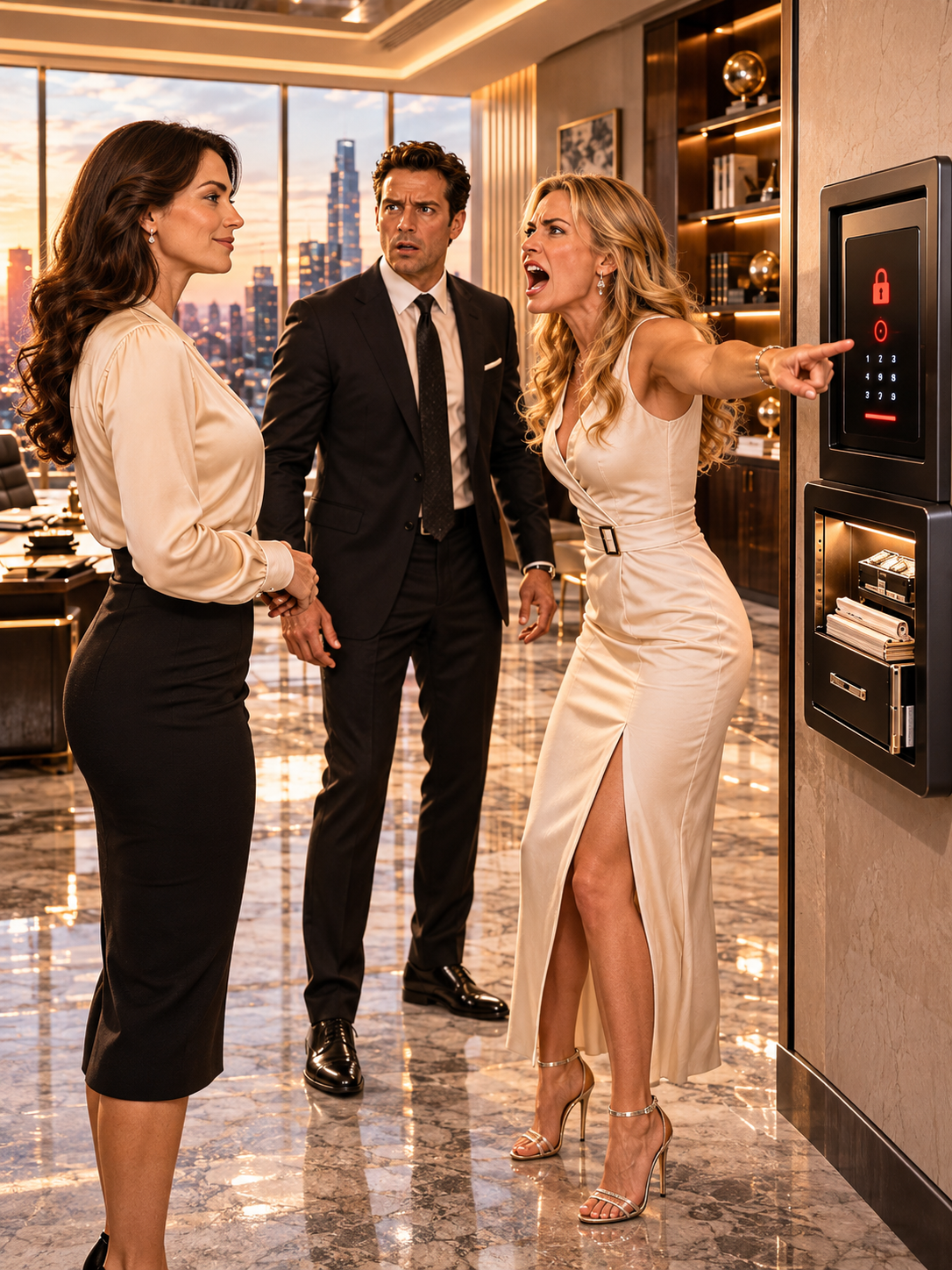
At , Garrison took the microphone. He spoke about growth, legacy, and creative evolution, phrases he could deliver beautifully when an audience was listening. Then he gestured to Fleur, standing near the platform in a white gown, and introduced her as the incoming creative director.
I crossed the gallery and approached the microphone. Garrison started to move into my path, saw the 112 people watching, and stepped aside. I did not raise my voice.
“Earlier today Fleur Donovan struck me in our private studio,” I said. “She also attempted to access our master client archive, and an unauthorized program was circulated identifying her as acting creative director while removing me from the founding partners section.” I showed the altered program and the photograph of the disputed transfer signature on the event screen.
“I didn’t approve that program, and I didn’t sign that transfer,” I said. “I have not agreed to give up my partnership interest.” I opened the leather folio containing our original founding agreement, still marked by my grandmother’s handwriting in the witness margin thirteen years earlier.
I explained that the original designs and confidential agreements were maintained in an archive with physical authorization controls, not because I wanted to hoard power but because the work deserved protection. The clients deserved to know who was responsible for it, and the staff deserved not to have their projects reassigned through an unapproved document.
Fleur stepped forward. “Garrison, tell them what you promised,” she said. She began saying he’d assured her the transfer was agreed, and Garrison cut her off. The room fell quiet enough that I could hear someone shifting a chair near the east wall.
I refused to let the entire showcase become an argument over our marriage. I told the guests that the designers and artisans had earned the right to celebrate what was on the walls, and that the partnership would be addressed through attorneys. “Tonight belongs to the people who built this work,” I said, and set down the microphone.
Wendell applauded first, then Beth, then the ceramicist whose installation filled the east wall. Others followed, but I paid less attention to the applause than to the junior designers standing near the exit. They looked relieved, and I understood how long they’d been carrying worries they couldn’t safely voice.
As Fleur moved away from the platform, I noticed a rose-gold chain at her collar. A compass pendant hung from it, the one I’d left in my office desk three months earlier and assumed had been lost during the rearrangement. I asked for it back, and she said Garrison had given it to her.
“It wasn’t his to give,” I said, holding out my hand. She removed the necklace and placed it in my palm. Garrison looked toward the window while I closed my fingers around it.
Part 4 The legal work took longer than the speech. Over three months and four formal sessions, the partnership was dissolved under negotiated terms. I kept the master archive, my founding design portfolio, the creative agreements, and the active commissions tied to my work, with client instructions and proper transfer arrangements handled through counsel.
Every client contacted about the transition confirmed that my designs were the reason they’d engaged the practice. Seven asked what I planned to do next. I told them I was creating Fairchild Studio, and I didn’t need to make promises beyond the work I knew I could deliver.
Garrison retained the registered business, its infrastructure, lease, and the relationships he’d cultivated separately. Those were real assets, but without the active creative work and long-standing staff, the firm was smaller than its name suggested. Beth resigned the morning after the showcase, and two junior designers joined my new practice within a month.
Fleur was terminated for cause over the unauthorized client communications, disputed legal document, and assault. A formal filing followed the physical incident; the insurer declined to cover the unauthorized transfer document. She faced proceedings and later worked at a small residential practice outside the professional circle she’d tried so hard to enter.
I didn’t celebrate any of it. I wanted the records corrected, my clients protected, and a workable separation, not an audience for someone else’s downfall. As soon as there was nothing more for me to do, I stopped tracking what Fleur and Garrison said about me.
Fairchild Studio opened on the top floor of a building I’d designed in 2016 for a hospitality client who’d become a friend. Wendell hand-lettered our small sign, and it hung a little crooked. I left it that way, partly because it was his gift and partly because the imperfection made the entrance feel like somewhere people worked rather than posed for photographs.
Stellan sent the Lakeshore documents two days after the showcase, saying they had always been intended for me to review without pressure. We answered each other’s design questions with professional precision. He never sent flowers, and he never behaved as if an invitation to collaborate entitled him to a place in my private life.
Six weeks later, we had dinner at a narrow Italian restaurant near the river. He noticed I’d changed outfits twice before arriving, although I hadn’t told him. When I admitted it, he said the one I’d chosen suited me; he didn’t know what the other choices were, and he was content with that information. I laughed so loudly a neighboring table glanced over.
We spent three hours discussing buildings, not my former partnership. I told him about a Copenhagen building that had changed how I understood thresholds and light, and how I’d once almost left architecture to design stage sets. I chose permanent buildings, I said, because I wanted to make things that stayed after an event ended.
Stellan told me his father had been a successful developer and largely absent from home. His mother spent years making that absence manageable for everyone else before leaving. She now ran a bookshop in Vermont, where she was particular about shelves and, according to her son, very happy.
At my car, he told me directly that he was attracted to me and had been since the industry panel in October, before he’d known about my marriage. He didn’t ask for an answer. “You’ve had enough people making decisions around you without telling you the truth,” he said.
I told him honesty was a good reason to speak, and drove home without promising anything. I was surprised by how peaceful it felt to have someone state his feelings without treating them as a debt I owed him.
Final Eight months after the showcase, the Lakeshore Commission broke ground. The contract named Fairchild Studio as lead designer and Baird Development as co-developer, with each side’s authority written plainly and a mutual exit clause if the collaboration stopped serving the work. I drafted that clause; Stellan read it without asking me to remove it.
At the center of the public plaza, I designed a reading terrace facing the water, with free seating and no requirement to buy anything. Cities, I’d written in the proposal, needed places where people could sit without explaining why they deserved to be there. Stellan approved the idea without requesting a revenue-producing substitute.
Two weeks later I found a pencil note he’d left on the drawing’s margin: “This is the best decision in the proposal.” I kept the note there through the rest of the project because it recognized the exact thing I’d wanted the space to give people.
The evening my divorce was finalized, I called him from the studio. “I want company tonight, not comfort,” I said. He arrived with Lebanese takeout, not flowers, and we ate with plastic forks on the floor among drawings and material samples.
I told him about a community library commission I’d lost in 2011 because the selection committee preferred a larger firm’s name. I’d parked beside the empty lot afterward and sat for an hour before remembering that losing a project didn’t mean losing my judgment. I had been holding on to that distinction ever since.
Stellan said he thought I was unusually intentional. “I’ve been mistaken for accommodating for a very long time,” I told him. “It isn’t the same thing.” He agreed, and neither of us tried to make the evening more solemn than it was.
Eventually his shoulder brushed mine. I turned toward him in the warm evening light that had made me choose this studio in the first place. I told him I understood what I wanted for the practice and for Lakeshore, but I couldn’t pretend to know exactly where a relationship with him would go.
“I’m not afraid to find out,” I said. He reached over and took my hand, gently and without rushing me. “That’s enough,” he answered.
Outside, Chicago carried on with its ordinary evening. My name was on the studio door, my work was in the drawings around us, and the decisions ahead would be mine to make. The woman who had slapped me had tried to tell me what I was worth; I had opened the archive, preserved the truth, and built the rest of my life from there.
THE END. I’ve shared the complete story, and I truly hope it touched your heart. If this story moved you, please , like, and share the post. Thank you for reading! ❤️
✓ Lynn R. Adams
IF FACEBOOK BROUGHT YOU HERE, HERE’S THE CONTINUATION YOU’VE BEEN WAITING FOR. ENJOY! 👇 A man stepped halfway into the restroom and stopped when he realized his mistake. “My apologies, wrong door,” h…