My husband watched his sister shove me down the Christmas stairs and told me I deserved it, but when I called the father I’d pushed away for two years, he arrived knowing far more than I expected…
My husband watched his sister shove me down the Christmas stairs and told me I deserved it, but when I called the father I’d pushed away for two years, he arrived knowing far more than I expected…
The first thing I felt was the cold edge of the bottom step against my cheek. The second was Kimber Stokes’s heel pinning my wrist to the floor while she laughed. I looked up at my husband, Jared, waiting for him to help me.
“You pushed her too hard, Kim,” he said, checking his watch. Then he looked down at me. “But Anukica, you deserved it. You embarrassed us in front of everybody.”
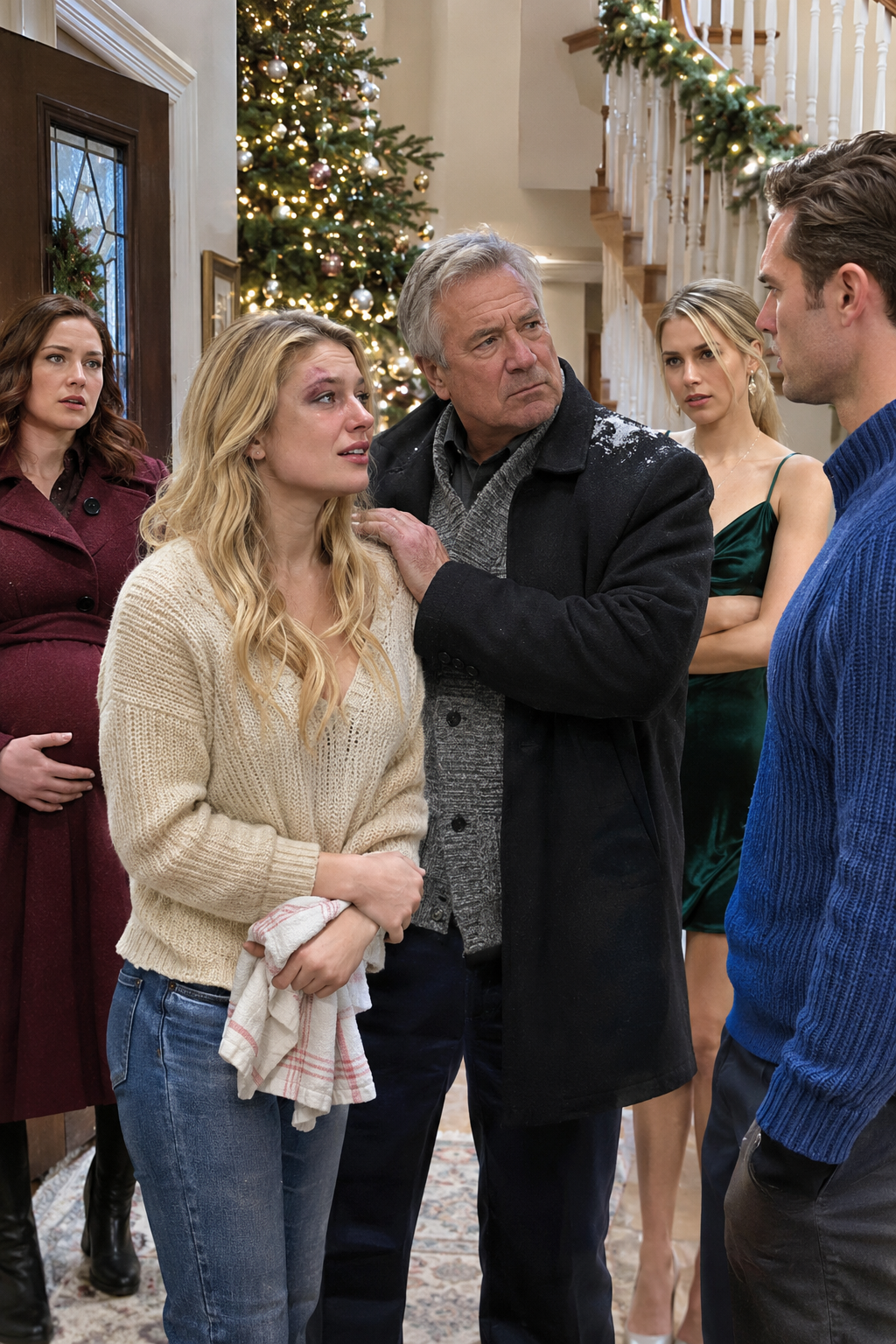
I was twenty-nine years old, lying beneath a staircase decorated with Christmas garland. My eyebrow was split, my wrist was swelling, and twenty relatives stood beneath a twelve-foot tree without moving toward me. My mother-in-law, Margene, stepped around my legs and worried aloud about blood on her rug.
I need to explain what happened before I landed there. I also need to tell you what I did wrong, because being hurt that night didn’t erase the lies I’d told during the years before it.
It was Christmas Eve at the Stokes family house. Margene lifted her bare hand while everyone was getting ready for dinner and announced that her diamond cluster ring, the one she’d worn every Christmas for thirty years, was missing. She said she’d removed it to wash the cranberry bowl.
Then she looked directly at me. “I haven’t touched your ring,” I said. “Nobody said you had, sweetheart,” she answered, leaving the accusation hanging between us and the eggnog glasses.
I’d been keeping the books at Stokes Hardware and Lumber for three years. Margene knew how easily a room full of relatives could turn “Annie handles the money” into “Annie must have taken it.” Nobody asked to search the kitchen or look beside the sink.
Kimber, Jared’s twenty-six-year-old sister, set down her drink. “Funny how things disappear when the help gets comfortable,” she said. I reminded her that I was her brother’s wife, not the hired help she’d decided I was.
She said Jared had lately looked like a man trapped in someone else’s marriage. I could have walked away. Instead, I asked Jared, loudly enough for everyone to hear, where the Stokes payroll money had gone in October.
His face changed before he could stop it. Kimber crossed the foyer, caught my arm, and pulled me toward the stairs. I thought she meant to throw me out the front door, but she turned me around and shoved.
My shoulder struck one step and my head struck another. My wrist folded beneath me at the landing. By the time I stopped moving, Kimber was standing over me and Jared was telling me I’d earned it.
Nobody called an ambulance. Margene turned the music back up, and Jared crouched beside me only to order me to apologize and smile through dinner. “I think my wrist is broken,” I whispered. “Then don’t use it,” he said, adding that the family would claim I’d been drinking and stumbled, although I never drank alcohol.
He asked the room who had seen Kimber push me. No one spoke. I got to my feet on the second try, and Kimber told me not to bleed on the guest towels.
I locked myself in the powder room and stared at my bruising face in the mirror. My phone had two bars of service. There was one number I remembered despite having removed it from my contacts two years earlier: my father’s.
Gunner Larson was sixty-one and had spent thirty-four years running Harbor County Credit Union. He wore a gray cardigan, remembered borrowers’ children by name, and could spot a dishonest balance sheet faster than most people could read a newspaper. He had never liked Jared.
When I brought Jared home at twenty-five, Dad listened to him for less than an hour. Afterward he said, “Annie, he doesn’t love you. He loves how you make him look.” I accused Dad of distrusting anyone he couldn’t foreclose on.
He came to our wedding anyway, stayed at the back, and left before the cake. During the next four years I let our calls get shorter until they stopped. Jared encouraged the distance, but I helped build it because admitting I was unhappy would mean admitting Dad might have been right. I even mailed cheerful holiday cards claiming the lumberyard was thriving.
Six years before I met Jared, his late father, Walt Stokes, had borrowed $640,000 from my father’s credit union to save the business. The building, inventory, land, and Stokes family home on Maple Court secured the loan. Honest quarterly reports and limits on personal withdrawals were part of the agreement.
I learned about the note during my second year as bookkeeper. When the business began missing its targets, Jared asked me to prepare cleaner reports for the lender. I knew whose signature was on the loan, and I still signed eleven quarterly certifications that concealed the real numbers.
I told myself I was protecting my husband and the employees. Mostly I was terrified of being the wife who had to admit her marriage and her husband’s business were failing. I had participated in something serious, and I knew it.
Inside that locked bathroom, I finally called Dad. He answered on the second ring, and the sound of him saying “Annie?” nearly undid me. I told him I’d fallen and needed help.
“Where are you?” he asked. When I said the Stokes house, he told me to stay somewhere safe and keep talking. I heard him get his boots, open his truck, and start the engine for the fifty-minute drive over icy roads.
I told him about Margene’s ring, Kimber’s shove, Jared’s words, and the relatives who had stood silent. Dad listened, then said, “Don’t argue with anyone. Don’t sign anything. Don’t talk about money tonight. First we get you out.”
Jared knocked at the bathroom door before Dad arrived. Back in the dining room, Margene demanded an apology, and Kimber reminded everyone that I controlled the payroll login. I looked at Jared and asked whether the October money had paid for trips to the Harrington resort with a woman named Bri.
I’d seen a message on his phone from someone saved as “B. Danvers, supplier.” Jared tried to interrupt me, but the doorbell rang. On the porch stood a woman in her early thirties, snow melting in her hair, one hand resting on her very pregnant belly.
“I’m Bri Danvers,” she said. “Jared told me to come at nine. I’m seven months pregnant, and he said he was finally going to tell his wife.” Jared moved toward the door, begging her to speak outside, while I stood beside the staircase holding my injured wrist in a dish towel.
Bri looked from Jared to my swollen face. “What happened to her?” she asked, just as headlights crossed the front windows and a truck door shut outside. My father came in wearing his old gray cardigan, snow on his shoulders, and put his coat around me before calling for medical help. When Margene declared it a family matter, he said quietly, “It is. My family.”
Then he looked at Jared. “My daughter isn’t staying here. And tomorrow at nine, I’ll be at the lumberyard.” He said it without raising his voice, and for the first time that Christmas Eve, Jared had nothing to say. Part 2…..
IF FACEBOOK BROUGHT YOU HERE, HERE’S THE CONTINUATION YOU’VE BEEN WAITING FOR. ENJOY! 👇 Jared found his voice when he saw my father reach for his phone. “Gunner, come on. This has gotten out of hand.” Dad asked whether anyone had already called an ambulance, then told the dispatcher I’d been pushed down the stairs and needed help for a head injury and a possibly broken wrist.
Margene said we were making a private embarrassment public. My father answered, “You had a house full of people who could have helped her privately.” Kimber looked away, and Bri backed out onto the porch as though she finally understood she had walked into something much worse than a family argument.
While we waited for the ambulance, Dad held my good hand and asked me to keep looking at him. I watched Jared try to collect his mother’s guests into a little circle near the dining room, rehearsing the word “accident” until it sounded almost natural.
At St. Brendan’s Hospital, the doctor confirmed my wrist was broken and stitched the cut above my eyebrow. When he asked what happened, I said I had been pushed. The doctor documented my account, and a deputy took my statement about Kimber and the people who had witnessed it.
Dad sat beside the bed beneath a humming fluorescent light. I’d spent years imagining what I would say if we ever sat together again, but all I could manage was, “I lied to you.” He waited without rushing me.
“I signed eleven false quarterly reports for Stokes Hardware,” I said. “Jared gave me the figures, and I knew they weren’t right. I sent them to your credit union anyway.” My father folded his hands and looked at the floor.
“I’ve known the reports were wrong for fourteen months,” he said. He had compared the smooth statements with underlying bank activity and seen the discrepancies. He’d suspected that Jared was using me, but he hadn’t known how much I was choosing to do myself.
“Why didn’t you say anything?” I asked. Dad’s mouth tightened. “Because I wanted you to come to me on your own. Because I was afraid that if I accused him, I’d lose you for good.” Then he said something I hadn’t expected: “I should have handled the loan sooner. Waiting didn’t protect you or the credit union.”
I told him about the payroll diversion in October, Jared’s personal withdrawals, and the trips to the Harrington resort. I explained the numbers I had altered, the figures Jared had supplied, and the originals that still existed in the business records. I also told him I’d seen Margene’s ring under a velvet tray in her jewelry box weeks earlier, though I couldn’t prove where it was that night.
Dad didn’t tell me it was all forgivable because I’d been frightened. He said we would need an independent lawyer and that I would have to give a truthful account to the credit union’s counsel, even if it exposed me to charges. I was relieved to hear him say it plainly; I had spent long enough pretending consequences belonged only to other people.
Just after two in the morning, Bri Danvers came to the hospital. She stood in the hallway holding an envelope against her coat, looking from my cast to my stitched eyebrow. “I didn’t know he was still living with you as your husband,” she said. “He told me you’d separated months ago.”
She was a sales representative for a flooring supplier. Jared had charmed her, told her I stole from his family, and shown her a bank statement with my name on it as supposed proof. He’d promised a future with her and their baby while claiming he couldn’t afford to leave the house until things were settled.
“The bank called me yesterday about an overdraft,” Bri said, opening the envelope. Jared had arranged an account in her name and used her signature on paperwork connected to it. She had discovered that money from the Stokes payroll was passing through the account, and she brought the statements she could obtain.
I stared at the papers, then at the woman whose baby was due in a few months. She wasn’t there to win an argument with me. She was trying to learn whether the father of her child had made her responsible for money she had never agreed to hide.
“I thought I was helping him get his life in order,” she said. I knew that sentence because I’d said versions of it to myself for years. “He made both of us believe we were the problem,” I told her, and we sat side by side while the vending machine hummed.
Bri agreed to give the records to investigators. Dad told her to keep her copies and to seek her own legal advice because the account carried her name. She thanked him, then asked me if the baby would always make me hate her.
I looked at her hand resting on her stomach. “I don’t know what I’ll feel tomorrow,” I admitted. “But I know Jared lied to you, and your child didn’t do anything wrong.” It was the most truthful thing I could offer.
At nine on Christmas morning, I went with Dad to Stokes Hardware and Lumber. The store was closed, but Dad still had a key Walt Stokes had given him years earlier. I sat with my arm in its fresh cast while Dad placed a written notice on the desk in the back office.
Margene, Jared, and Kimber had been waiting. Jared wore a pressed shirt, and Margene had a folder labeled with my married name. The folder was thick enough to show they’d prepared a case against me before asking whether I could even hold a pen.
Dad explained that the credit union had documented material misrepresentations in eleven financial certifications and personal withdrawals that appeared to violate the secured loan agreement. The notice demanded repayment under the note’s default provisions and referred the matter to the lender’s attorneys for the required process. He made clear that he would step aside from decisions involving his own daughter.
“Those reports have Anukica’s signature,” Jared said, smiling as though he’d found his way out. “Your precious daughter falsified them. She’s the one you should be after.” Dad nodded, and the smile slipped from Jared’s face.
“She signed them,” Dad said. “She’ll have to answer for it. She’s also given a full statement about who supplied the figures, who moved the money, and who told her what to conceal.” Then he set the actual bank records beside the reports I’d signed.
Margene pushed back her chair. “After everything Walt did for this place, you’re going to destroy his family on Christmas?” My father looked around the office, at the shelves of old invoices and the worn photograph of Walt above the desk. “The business was Walt’s work,” he said. “The false reporting was not.”
He explained that the building, inventory, land, and Maple Court home were all pledged as collateral. No one was being thrown into the street that morning, but the default could ultimately mean losing the business and the house through lawful enforcement. Kimber whispered, “Even our home?” Dad answered, “The agreement your father signed includes it.”
Then someone knocked at the office’s back door. Deputy Tolen, the officer who had taken my statement, stood there with Bri beside him and her envelope in hand. Jared looked at Bri, then at the papers, and understood that the account he’d hidden behind her name was no longer hidden.
Part 3 “Bri, what are you doing here?” Jared asked. His voice had changed from the confident one he’d used with his mother to the soft, persuasive voice he’d used on me in our bedroom. “Everything I did was for us.”
Bri shook her head. “You did it for yourself. You used my name, and you let me believe your wife was the one stealing.” She handed Deputy Tolen copies of the statements and asked that they be passed to the investigators reviewing the financial complaints.
Tolen was there because of the assault report and the risk of another confrontation, not to settle a bank debt. He asked Jared to keep his distance when Jared moved toward the papers. Bri stepped back, one hand resting protectively on her stomach.
Margene took over. “There is nothing here except a bitter wife who handled our books and wants to punish her husband.” She tapped the folder bearing my name. “We have all her signatures. Every last one.”
“So do I,” I said. My cast was heavy against the arm of the chair. “I signed reports that I knew were false. I won’t deny it to save myself, and I won’t let you use those signatures to pretend Jared never told me what to put in them.”
Jared stared at me as if my confession were a personal betrayal. For four years, he’d counted on my shame doing his work for him. I could feel that shame rising again, but I kept my hands still in my lap.
Margene turned to Dad. “Think about her reputation, Gunner. She could lose her work, her name, everything. Do you want the county reading about your daughter in a fraud case?” Dad looked at me instead of answering for me.
“Let them have the records,” I said. “I’ll answer for the reports I signed, and I’ll tell them exactly why I did it.” The words did not make me brave or innocent. They simply meant I was finally willing to face what I’d helped conceal.
Dad squeezed my uninjured hand. Margene looked at me for a long moment, then said, “You were the best bookkeeper this family ever had.” I thought of every neat quarterly report I’d mailed out, every time I’d made a failing business look healthy on paper.
“I was good at hiding things,” I said. “That’s different.” For once, I didn’t look to Jared to see whether he approved of my answer.
Tolen told the family that the assault investigation would continue and that the financial evidence would be reviewed by the appropriate investigators. No one was arrested in that office on the strength of a Christmas morning argument. But the documents went with Bri, and the credit union began the formal process that would eventually end the Stokes family’s control of the lumberyard.
I left with Dad after the meeting. As he drove, I watched the hardware store disappear in the rearview mirror and tried to remember the first time I’d been proud to work there. I could remember putting labels on shelves and learning customers’ names, but I couldn’t remember the last time I’d been happy to open its books.
Three days later, Kimber was standing at the end of Dad’s driveway. She wore a thin coat and had pulled her blond hair into a plain ponytail. Without the bright makeup and the laugh she’d used to cut people down, she looked exhausted.
Dad opened the door before I could. “You don’t have to speak to her,” he said. I looked at my cast and then at the woman who had caused it. “I know,” I answered, and went onto the porch.
“I went to the sheriff’s office this morning,” Kimber said. “I told them I pushed you. I told them Jared said you deserved it, and I told them nobody helped.” Her fingers kept worrying at one loose thread in her sleeve.
“Why now?” I asked. She looked beyond me toward the kitchen window. “Because I saw your face on the landing, and I remembered mine when Jared shoved me against the garage door four years ago.”
She told me he’d hurt her after she refused to lie for him about their father’s will. She hadn’t told me then because she’d convinced herself I was part of his schemes. Watching me keep the books for Jared had made it easier for her to call me an enemy than to admit how afraid she was of her own brother.
I remembered Kimber at nineteen, holding things together after Walt’s funeral while the older relatives made speeches. I’d seen how quickly that family asked young women to be useful and how rarely it offered them protection. That memory explained some things, but it didn’t excuse a broken wrist.
“You could have killed me,” I said. Kimber nodded. “I know. I’m not asking you to forgive me. I just didn’t want them telling the story as if you fell.” She stood in the cold and waited for something else from me.
I wanted to shout at her. Part of me wanted her to hurt the way I had. Instead, I said, “Tell the truth when they ask you again. Don’t change it to make yourself look better, and don’t expect me to protect you from the consequences.”
“I won’t,” she whispered. She walked down the driveway without asking to come inside. Dad stood next to me until she had rounded the corner, then took the dish towel from my hand because I had been twisting it so tightly with my good fingers.
“That couldn’t have been easy,” he said. “It wasn’t,” I told him. He made us coffee and let the subject rest, which was one of the kindest things he had done for me all week.
The investigations took time. I provided the original business records, explained every certification I had signed, and retained my own lawyer. Jared’s instructions, the bank transactions, and Bri’s account records told a story no single signature could explain away.
The prosecutor eventually filed charges against Jared for embezzlement, forgery, and conspiracy involving the financial institution. Kimber faced responsibility for the assault she had admitted. I was not exempt from the law just because I had decided, late in the day, to start telling the truth.
Final My attorney negotiated a resolution to my own case that reflected my cooperation but did not erase the false certifications. I pleaded to a misdemeanor, paid restitution, served probation, and was permanently barred from handling client funds. The bookkeeping career I’d built around being indispensable was over.
Jared’s case moved through the courts separately. He was convicted and sentenced, and at the hearing he turned in his seat to look at me. “You did this,” he mouthed, just as he had blamed me for everything on Christmas Eve.
I didn’t argue with him across the courtroom. When he passed close enough to hear me, I said, “I stopped covering for it.” The bailiff directed him forward, and that was the last conversation we had as husband and wife.
The credit union’s lawyers pursued the collateral according to the loan documents and the law. The lumberyard couldn’t survive its debt, and the Stokes family eventually lost the property, including the Maple Court house. I lost my home there, my car, my marriage, and the Stokes name I had once been so eager to wear.
Margene was not charged, but she couldn’t keep the life the business had paid for. The country club membership disappeared, followed by her church board seat and the invitations that had once filled her calendar. She rented a one-bedroom apartment on the edge of town and told anyone willing to listen that a bank had persecuted her son.
For a while, I was angry that she could tell her version without anybody correcting her. Then I realized I had spent years trying to control what people thought about my marriage, and the effort had cost me more than gossip ever could. I let her speak.
Kimber testified about the staircase without blaming me or minimizing what she’d done. She served a short sentence for the assault. When she was released, she wrote me a single-page letter with no excuses and no request that I answer.
I kept the letter in a drawer for six months. Eventually I wrote back one line: “I hope you’re well.” I wasn’t ready to call it forgiveness. I was learning that leaving a door unlocked did not mean I had to stand in its doorway.
Bri gave birth in March to a baby girl she named Hope, after a long-lost aunt rather than the virtue. She took responsibility for building a life for her daughter, and Jared agreed from jail not to be involved; any legal parental questions were handled separately. Bri and I began sending each other photographs on holidays.
I never expected to care about her child, but the first picture of that small face made the rivalry Jared had manufactured seem especially foolish. As the baby grew, she developed her mother’s chin. There was no reason to punish either of them for trusting the same dishonest man.
Spring brought an invitation from Dad to help at the credit union’s community outreach desk. I couldn’t handle accounts or client money, and I wasn’t deciding who received loans. Under supervision, I helped people understand application paperwork and organize information they chose to share.
One afternoon a young couple sat across from me, frightened by a notice they barely understood. They kept apologizing for the numbers on their forms. I slid the papers back toward them and said, “Start with the real figures. We can talk about your options from there.”
Dad heard me say it and glanced up from the next desk. Later he told me, “You understand how people talk themselves into hiding a bad month. That might help somebody tell the truth before it costs them everything.” I wanted him to be proud of me, but I was beginning to understand that pride couldn’t be my only reason to do right.
Exactly one year after that Christmas Eve, I drove to his house as snow gathered along the road. I knocked even though I had a key, and he answered in the same gray cardigan, a half-finished crossword tucked under his arm. “Annie,” he said, as if we’d seen each other only yesterday.
“Dad, I came to thank you,” I told him. He shook his head and said I had done the hard part. I followed him into the kitchen and watched him set out two cups, the same chipped mugs we’d used when I was a teenager.
“You didn’t rescue me from every consequence,” I said. “You helped me stop living a lie, even when telling the truth cost me.” He poured the coffee, pushed one cup toward me, and sat down without trying to improve what I’d said.
When I was twelve, he used to sit beside me at that table while I struggled through long division. That evening we sat together the same way, listening to the furnace click on and the snow brush the window. For the first time in years, silence didn’t feel like a verdict.
I still lived with what I’d signed and what I’d allowed. But I no longer confused love with loyalty to a lie, or justice with a result that spared me. I had lost the marriage I’d protected at any cost, and found my way back to a father who had left the kitchen light on.
THE END. I’ve shared the complete story, and I truly hope it touched your heart. If this story moved you, please , like, and share the post. Thank you for reading! ❤️
✓ Lynn R. Adams
My husband watched his sister shove me down the Christmas stairs and told me I deserved it, but when I called the father I’d pushed away for two years, he arrived knowing far more than I expected… Th…