My husband told twelve Christmas Eve guests that the holiday would be better without me, and his mother smiled as though she’d won—until I told her something that finally made that smile disappear…
My husband told twelve Christmas Eve guests that the holiday would be better without me, and his mother smiled as though she’d won—until I told her something that finally made that smile disappear…
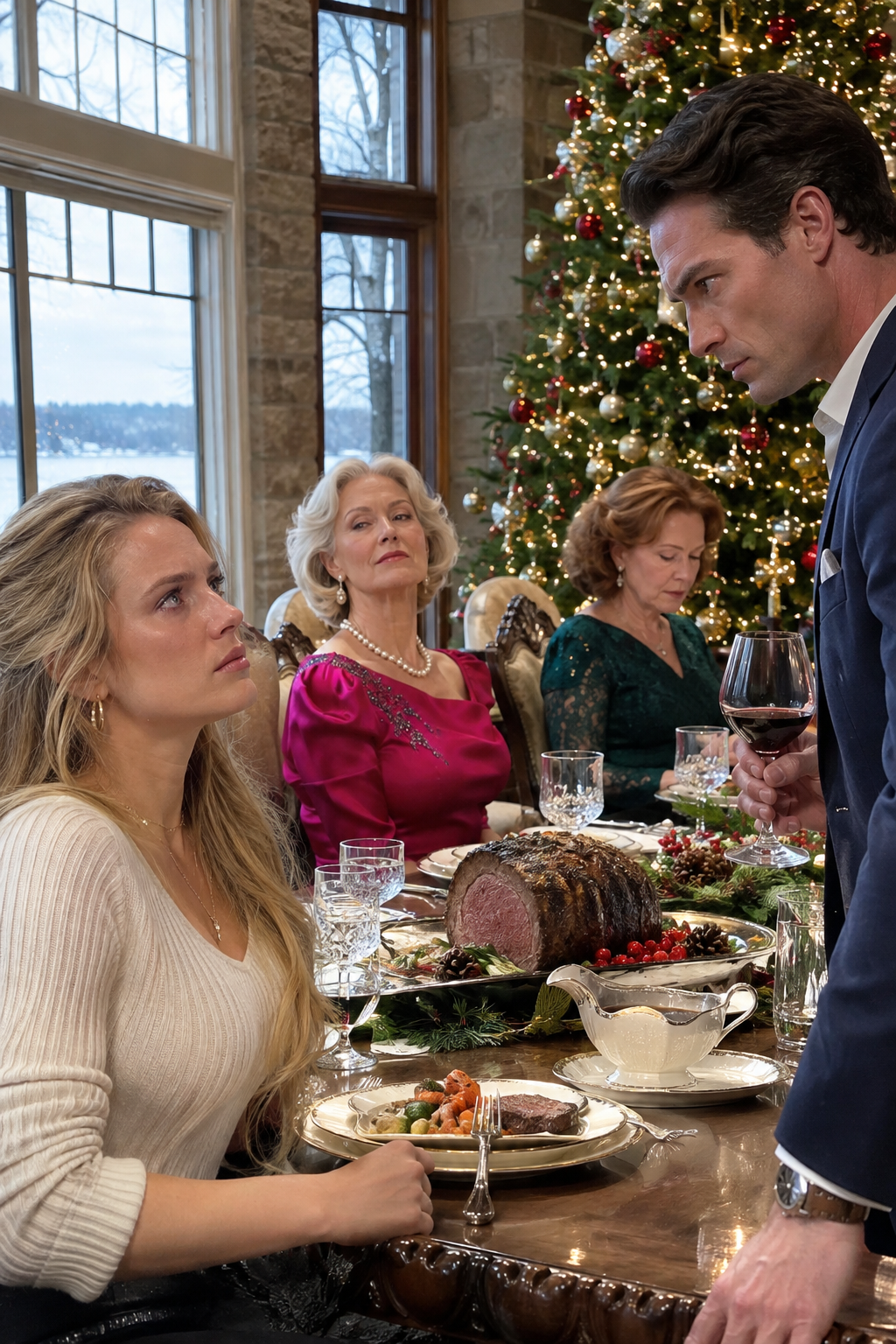
“Christmas is better without you, Katie.” My husband said it over the roast beef, with twelve people around our dining table and a glass of wine in his hand. For a moment, all I could hear was the little click of his mother setting down her fork.
“Say that again,” I said. Elliot Strand leaned back in his chair and repeated himself, adding that my sad face had spoiled the evening. His mother, Rosalie, gave a small laugh and observed that some guests didn’t know when to leave.
I set my napkin beside my plate. “Then you’ll love tomorrow,” I told him. Rosalie’s smile tightened, because unlike Elliot, she had a fair idea of what I meant.
I was thirty-one that Christmas Eve, and I’d been married to Elliot for six years. He had founded Strand Meridian, endowed hospital wings, and become the sort of wealthy Wisconsin businessman whose photograph appeared in airports. We lived in a stone house on Lake Geneva with eleven fireplaces, but most days I felt like a visitor who had overstayed her welcome.
I’d spent three weeks getting the house ready. I tied cedar garlands to the banisters, hung stockings, and decorated a twelve-foot Fraser fir with ornaments I’d collected slowly over the years. That dinner included Elliot’s aunt Corliss and uncle Dwayne, two board members and their wives, and Rosalie presiding over us in pearls.
Rosalie was sixty-one, silver-haired, beautifully dressed, and never needed to shout. “Katie made the gravy herself,” she’d announced earlier. “Isn’t that brave? Most women in her position let the staff do it.” I smiled the way I’d learned to smile whenever she made me feel small.
The argument began because I asked whether we might invite Elliot’s younger brother to Christmas. “Dash has been out for two years,” I said as I passed the gravy. “He’s working at a boat yard in Racine. He shouldn’t have to spend tonight alone.”
Every fork seemed to stop. Six years earlier, their father, Thaddeus Strand, had died when the family car went off County Road 50 and struck an oak tree. Twenty-three-year-old Dashiell had been found unconscious with a fractured skull, then pleaded guilty to vehicular homicide and served four years at Waupun.
Elliot never spoke about him. His brother had killed their father, he insisted, and that ended the conversation. But I’d visited Dash in prison without Elliot knowing, and I knew how much of that story was wrong.
“It’s Christmas,” I said. “He’s still your brother.” Elliot stood, his chair scraping the floor, and accused me of performing for the guests. He called me the tenderhearted nurse who thought one night in an emergency room qualified her to fix his family.
Then came the sentence about Christmas being better without me. Aunt Corliss looked down at her plate, and one board member stared toward the window. Rosalie watched me, perfectly still, as if she wanted to see whether I’d finally break.
The guests left early. Near eleven, I was in the kitchen scrubbing a clean pan when Elliot came in, loosening his tie. He didn’t apologize; he told me I’d embarrassed him, and I asked why hearing Dash’s name frightened him so much.
“Because I buried my father,” he said. “I don’t need you digging him up with your guilt.” He caught himself and changed “guilt” to “sympathy,” then told me his mother was right: I needed to fix people because I was broken.
He went upstairs, leaving me with the dish towel twisted tight in my hands. What Elliot called guilt was more than he knew. I had helped put an innocent man in prison, and the woman who’d begged me to do it had been sitting at our Christmas table.
Six years before, I was a twenty-five-year-old emergency room nurse at Lakeland Memorial, working the Christmas Eve night shift. At p.m., an ambulance brought in the victims of the crash: Thaddeus, already dead; Dash, unconscious and badly injured; and Rosalie, bleeding from her lip in a torn evening gown.
I was assigned to assess Rosalie. Her breath smelled unmistakably of bourbon, and she had a seat belt bruise running from her left shoulder to her right hip. There was also a deep mark across her chest consistent with striking the steering wheel, and I entered those observations in her chart.
She gripped my hand and begged me not to report that she’d been driving. Her husband was dead, she said, one son might die, and Elliot needed his mother. She promised Dash would get off lightly if the crash was treated as his mistake.
I should have called for help and left the chart alone. Instead, exhausted and frightened by the grief in front of me, I changed the steering wheel observation to a passenger-restraint description and removed the reference to alcohol. I told myself the police would uncover the truth without me.
They didn’t. Dash woke with no memory of the crash, and Rosalie told him he’d driven because his father had been drinking. With her account and the altered hospital record among the evidence, he believed he’d killed Thaddeus, pleaded guilty, and spent four years paying for something he hadn’t done.
I sat silent at the hearing. Three months later, Elliot approached me in a hospital cafeteria and asked me to dinner. I accepted, partly because I cared about him and partly because I thought staying near the family might give me a way to repair the damage I’d caused.
Six years passed while I kept promising myself I’d find the right moment. In prison I sent Dash small amounts for his commissary, visited him secretly, and mailed cards signed only “a friend.” None of it gave him back a single day.
That Christmas Eve, after Elliot went upstairs, I packed my nursing pins, my grandmother’s quilt, an old letter confessing what I’d done, and a few clothes. I left his jewelry and credit card behind. Then I removed the ornaments, stockings, wreaths, garlands, and gifts I’d bought, placing the things that were mine into my old Subaru.
I also boxed the framed photographs of Thaddeus I’d placed in the hallways; Dash had as much right to those pictures as Elliot did. I didn’t damage anything or take property that belonged to my husband. I left the heat running and set an envelope on the kitchen island marked, “Read this before you speak to your mother.”
Rosalie was waiting at the foot of the back stairs in a cream silk robe when I brought down my bag. “Going somewhere?” she asked. I told her I was going to see Dash, and she stepped in front of me with an almost patient expression.
She reminded me that changing medical records could cost me my license and my freedom. She’d known what I did all six years, she said, and Dash would never forgive the woman who let him plead guilty. I told her I understood, but I could no longer keep protecting her at his expense.
“You let your son believe he killed his father,” I said. Rosalie answered that Elliot had needed a mother and a good name, while Dash was the one who could survive prison. She said it so calmly that I finally understood she’d never regarded the two boys as equally worth saving.
“Move,” I told her. She asked what I’d do if she refused, and I said, “Tomorrow morning, your son wakes up in an empty house.” Her expression cracked for the first time in six years, and I walked around her, opened the front door, and stepped out into the snow. Part 2…..
IF FACEBOOK BROUGHT YOU HERE, HERE’S THE CONTINUATION YOU’VE BEEN WAITING FOR. ENJOY! 👇 Rosalie called after me that Elliot would never believe a word I said. I didn’t turn around, because the letter was already waiting on his kitchen island, and because I was finally prepared to tell the truth without knowing what it would cost me.
The drive toward Racine took about forty minutes through heavy snow. My Subaru was loaded with Christmas decorations and carefully wrapped gifts, and a little four-foot tree I’d bought separately stood secured in its bucket of damp soil. By in the morning, I was climbing the outside steps of Dash’s faded duplex, two blocks from Lake Michigan.
He opened the door only a few inches. At twenty-nine, he had Elliot’s jaw but none of his brother’s polished ease, and a scar ran into his hairline. When he recognized me, his first question was whether Elliot was all right.
“He’s fine,” I said, lifting the little tree. “I brought you a Christmas.” Dash looked at the tree, then at me, and let out a tired, disbelieving laugh before stepping aside.
His apartment was neat and nearly bare: a couch, a card table, a space heater, and one faded photograph of his father. I settled the tree into a corner and plugged in its lights. Dash sat slowly, looking from the little pool of light to the bags at my feet.
“Why are you doing this?” he asked. I sat across from him, placed my hands on my knees, and told him I needed to say something terrible all the way through. He nodded, though he couldn’t possibly have known what was coming.
I described the emergency room, his mother’s injured chest, the bourbon on her breath, and what she’d asked me to erase. I told him exactly what I changed in the chart and why I had kept quiet when he pleaded guilty. I didn’t ask him to comfort me while I said it.
At first he didn’t move. Then he covered his mouth and whispered that he had never remembered driving the car. His mother had told him his father was drinking, that he’d taken the wheel, and that the crash was his fault.
“I’ve lived with that every day,” he said. He told me he’d stopped drinking and gotten baptized in prison, trying to become a better man than the one he’d been told he was. At night, he had repeated his father’s name in his cell because he didn’t know what else to do.
I apologized, and he cut me off. “Don’t say sorry like it’s a coat you can hand me,” he said. Then, after a long pause, he admitted he didn’t think he could forgive me.
“I don’t expect you to,” I answered. The space heater clicked on, and we sat without speaking while the snowplow scraped along the street outside. His life had changed again, and I knew I had no right to tell him how to feel about it.
Eventually he asked about the monthly cards and money that had appeared on his prison account under the name “a friend.” I told him those had come from me. “Why?” he asked, and the only truthful answer I had was that I couldn’t bear doing absolutely nothing while continuing to do the one thing that mattered least: keeping quiet.
Then he asked why I’d married his brother. I told him I had loved Elliot, and that I thought part of me still did. But I’d also wanted to stay close to the family I’d hurt, hoping I could somehow repair it from inside their home, and that had been unfair to both brothers.
“What happens now?” Dash asked. I showed him the written account I’d prepared, with the date of the emergency shift, my supervisor’s name, and the physician who signed the chart. I told him the hospital should have an audit trail recording my original entry and the later edits.
I offered to speak to his attorney, the district attorney, or anyone else who needed to hear it. Dash looked at me and said I might lose my nursing career and go to prison myself. “I know,” I said, and for once that was not a reason to stop.
He found my grandmother’s quilt in the pile of things I’d brought. Around four in the morning, he laid it across the couch for me without a word and went to his bedroom. I was still awake for a long time, staring at the little tree I’d placed beside his father’s photograph.
At that Christmas morning, Elliot woke in our bed and reached across the cold sheets. He later told me he’d walked downstairs expecting coffee and a roaring fire, only to find the great room stripped of the decorations I’d spent weeks hanging. The tree was gone, and pale rectangles remained where the photographs of Thaddeus had been.
In the kitchen he opened my envelope. I had written that his father had been a passenger in Rosalie’s car, that I’d seen signs she’d driven after drinking, and that I’d changed her hospital record when she begged me to. I said Dash had gone to prison for her wrongdoing, that I had let it happen, and that I was going to tell the authorities.
I also wrote, “Ask your mother about bourbon.” Elliot told me later that he read the letter sitting on the kitchen floor, his back against the cabinets, unable to stop repeating the word “no.” Then an old memory came back so clearly that he went straight to his study.
A week after his father’s funeral, he’d retrieved a briefcase from his mother’s car at the impound lot. In the glove box he’d found a Lakeview Club cocktail napkin with a bar tab for three bourbons and a gin and tonic, timestamped p.m. and signed “R. Strand,” not “T. Strand.”
He’d understood what it might mean, then folded it away and told himself his father must have signed her name. For six years the napkin had sat in a drawer where he never needed to look at it. Now he took it out and walked to the guest suite in the east wing, where Rosalie was sleeping.
Part 3 His mother opened the door in her robe, silver hair brushed and lipstick already on. Elliot held up the napkin and asked whether she had been driving the night his father died. Rosalie immediately called me unstable and accused me of visiting Dash to destroy their family.
Elliot asked again. At last she said Thaddeus had been too drunk to stand and someone had to drive, as if that explained everything. When Elliot asked why she’d allowed Dash to take the blame, she said his brother had always been a screwup, while Elliot had a future to protect.
He told her to leave the house. She tried to argue that his father had built it, then laughed and warned that Elliot would come crawling back because he was nothing without her. He closed the door rather than answer.
At that morning, someone knocked on Dash’s door. I woke under my quilt to find Elliot on the landing, unshaven and wearing a wool coat over his robe, his shoes untied. He stared at his brother, trying to form the words he’d avoided for six years.
“I knew something was wrong,” Elliot finally said. He confessed that he’d found the bar tab after the funeral, put it in a drawer, and chosen not to pursue what it suggested. “I let you go to prison,” he told Dash, “and afterward I treated you like you were the one who’d betrayed us.”
Dash stood with a hand on the doorframe and didn’t rescue him from the silence. Elliot admitted he’d also punished me for bringing up his brother’s name, because each mention threatened the version of the past he’d depended on. Then he knelt on the snowy wooden porch and asked only whether Dash would let him begin again by standing at his door.
Dash looked down at him a long time. “It’s Christmas,” he finally said. “Get up before the neighbors think I’m running a cult.” He said Elliot could come in for his terrible pancakes, but there wouldn’t be any hugs yet, and he would leave again if Elliot ever treated him like the problem.
Elliot agreed. When he noticed me sitting on the couch, he said, “Katie, thank you.” I told him I was one of the reasons Dash had suffered, and I wouldn’t turn one confession into proof that I’d been brave all along.
He answered that I was also the reason the lie had finally stopped. We didn’t embrace or discuss our marriage. The three of us had too much to sort out for anyone to mistake a Christmas morning conversation for a fresh start.
On December 27, I sat with an attorney named Tegan Branvold and gave a sworn statement that took four hours. I went through my old shift, the chart changes, the sentencing, and the years of silence. Tegan made sure I understood that coming forward willingly would not erase my own responsibility.
On December 29, Dash’s lawyer moved to vacate his conviction. On January 4, the district attorney obtained the hospital’s record history, and the audit trail showed my original description of Rosalie’s injuries and the odor of alcohol. Forty minutes later, under my login, the record showed the altered description and the missing alcohol reference.
There it was in a form nobody had to take on faith. I’d typed the truth, then deliberately taken it back. Dash had finally been given something I should have provided six years earlier: an evidentiary basis for challenging the story he’d been made to believe.
In March, the state revoked my nursing license, and I faced a felony charge for falsifying records in a death investigation. Tegan negotiated a resolution that accounted for my voluntary confession and the pressure Rosalie had placed on me. I received two years of probation and a permanent bar from nursing in Wisconsin.
I stood in court and admitted what I’d done. I said I was sorry and wanted the record to reflect that Dashiell Strand had not caused his father’s death. It wasn’t a speech that could return his twenties to him, but for once I said everything where it could be heard.
In April, a judge vacated Dash’s conviction, and his record was expunged. I sat in the back row of the courtroom while the judge announced the decision. Dash turned, found me in the audience, and nodded once without smiling.
In May, Rosalie was charged over the fatal crash and the cover-up, including homicide by intoxicated use of a vehicle, obstruction, and conspiracy to falsify evidence. She hired expensive Chicago lawyers who told reporters she was a bereaved widow targeted by her vindictive daughter-in-law. But the original chart, the audit trail, the injury evidence, and the club tab could now be considered together.
Elliot testified against his own mother. He acknowledged finding the napkin years before and failing to act on what it suggested. Watching him say that out loud, I understood that guilt and responsibility weren’t mine alone, even if my actions had carried their own terrible consequences.
The jury deliberated for two days. Rosalie received six years at Tochita Correctional Institution, two years longer than the term Dash had served for her wrongdoing. The court recognized the lasting damage she’d inflicted by allowing her own son to be punished to protect herself.
Final I visited Rosalie once that fall. She sat behind the prison glass in a gray uniform, her silver hair thinner, and called me a martyr before I’d even settled into my chair. Then she told me Elliot had sold the lake house, moved to Racine, and chosen the brother who’d ruined him.
“You took my sons from me,” she said. I thought of Dash lying awake in a prison cell, certain he’d killed his father, and of Elliot carrying a folded napkin he couldn’t bear to read. “You chose which son to sacrifice,” I told her. “The other one finally went looking for him.”
She said she’d done it for her boys. I told her I believed she’d done it for the woman she wanted to remain in the mirror, and that both boys had paid the price. She set down the telephone and wouldn’t look at me again.
People have asked whether Elliot and I got back together after all that. We didn’t. He had humiliated me before our guests and turned away from his brother, while I’d falsified a record and watched an innocent man go to prison; neither of us could pretend those choices had never happened.
We signed the divorce papers in May. I kept my old Subaru and asked for none of Elliot’s money or the big house, and he didn’t press me. Whatever affection remained between us wasn’t enough to rebuild the marriage we had lived inside for six years.
I found work as a front desk coordinator at a free clinic in Kenosha and rented a one-bedroom apartment over a bakery. Every time I passed the clinic’s supply closet and saw the boxes of medical gloves, I remembered what it had felt like to belong in an emergency room. I missed nursing, and I understood why I couldn’t return to it.
Elliot stepped down as CEO of Strand Meridian. He put most of his Meridian shares into a trust supporting legal aid for people who had been pressured into guilty pleas, and moved into a rented duplex in Racine, three doors down from Dash. On Saturdays he went to the boat yard to help his brother sand hulls and do the unglamorous work that needed doing.
Dash didn’t forgive him all at once. They worked beside each other, argued sometimes, and learned when to stop talking. One October afternoon I saw them sitting on a bench by Lake Michigan, passing a thermos back and forth in the cold without the silence between them feeling like punishment.
The following Christmas Eve, a drugstore card arrived at my apartment. A cartoon snowman grinned on the front, and inside Dash had written in block letters, “Dinner at . Bring nothing. We have a tree.” I kept the card on the kitchen counter until it was time to leave.
I drove my Subaru back to Racine through the same winter snow. The duplex smelled of pine and something sweet that had spent too long in the oven, and the little four-foot tree I’d brought Dash the year before stood in the corner. He’d kept it alive in its pot and proudly told me it had grown an inch.
Elliot opened the door in a flannel shirt with flour on one sleeve. He said he was only responsible for the burned piecrust, not for the invitation, and I laughed before I could stop myself. “Merry Christmas, L,” I said, and he wished me the same.
Dash came from the kitchen holding a casserole dish. On the card table were three mismatched plates and three chairs, none of them grand enough to impress the people who used to dine at our lake house. “You’re letting the heat out,” he told me, so I stepped in and shut the door.
Before we ate, Dash raised his glass of cider. “To Dad,” he said, then added, “And to who we should’ve been better to.” Elliot repeated the toast, and I said, “To the truth. Even when it costs everything.”
A fourth chair stood empty, without a plate. Rosalie had sent Dash a card from prison, but he hadn’t opened it; it sat sealed beside his father’s photograph. That was his decision to make, and nobody at the table asked him to explain it.
I don’t think justice always looks like a courtroom or a sentence. Sometimes it looks like a small table, a ruined pie, and three people willing to acknowledge what they did without demanding forgiveness in return. I lost my career and my marriage, but I no longer have to look away from the truth when I meet my own eyes in the mirror.
THE END. I’ve shared the complete story, and I truly hope it touched your heart. If this story moved you, please , like, and share the post. Thank you for reading! ❤️
✓ Lynn R. Adams
My husband told twelve Christmas Eve guests that the holiday would be better without me, and his mother smiled as though she’d won—until I told her something that finally made that smile disappear… “…