My husband stood by while his deputy brother struck me and told me to apologize, never knowing my phone was connected to the brothers he’d kept away from me for seven years—and they were on their way…
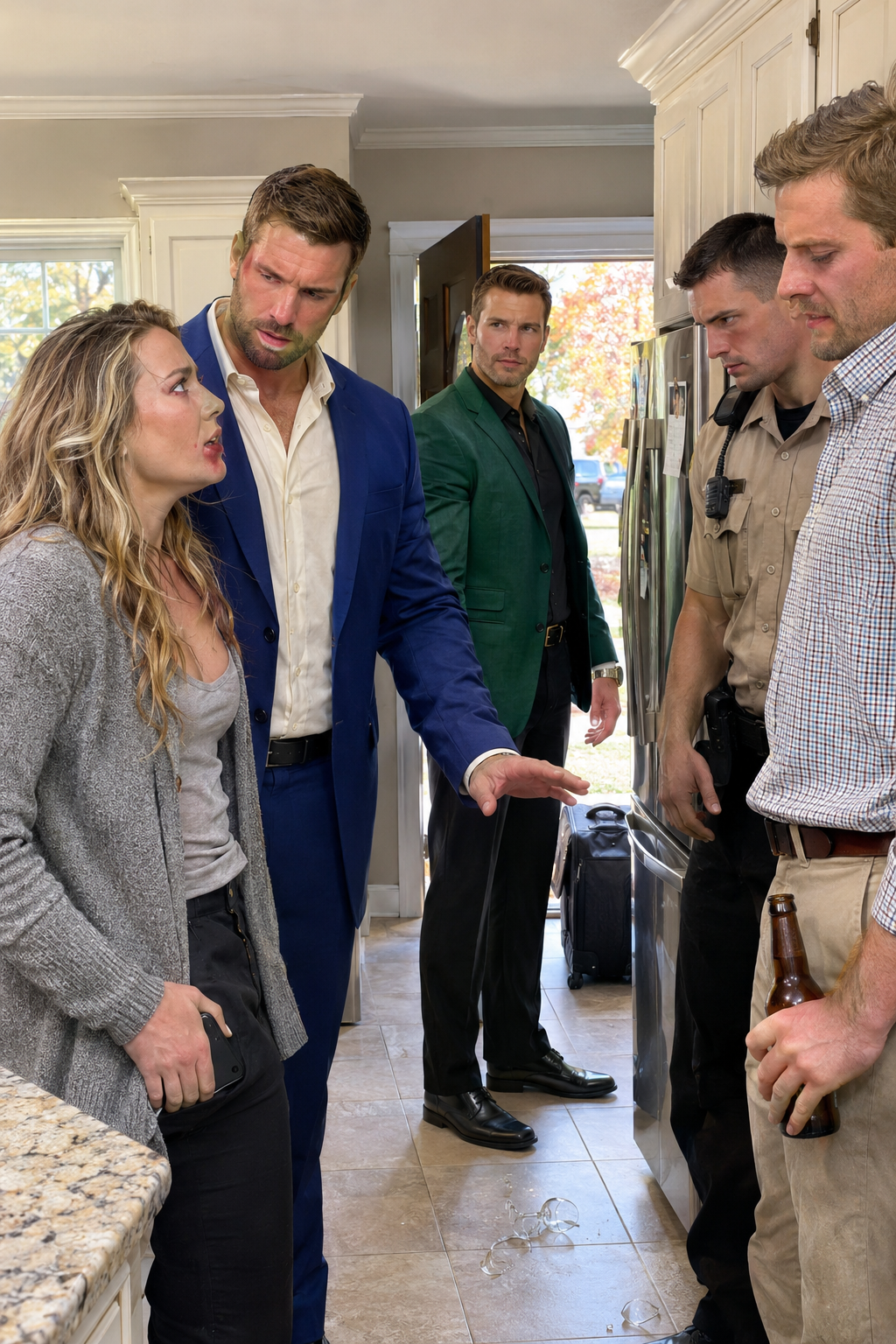
My husband stood by while his deputy brother struck me and told me to apologize, never knowing my phone was connected to the brothers he’d kept away from me for seven years—and they were on their way…
The first time Brock hit me that Saturday, my husband was standing ten feet away with a beer in his hand. By the second slap, Mitchell had checked his watch and told me to apologize. Neither man knew my phone was still connected to someone they thought I would never speak to again.
My name is Ray Ames. I was 31, a third-grade teacher in a quiet Ohio neighborhood, and I had spent seven years telling everybody I had a good marriage. I had gotten so practiced at saying it that sometimes I almost believed myself.
I need to tell you about the family I left behind, because I wasn’t innocent in that part of my story. Seven years earlier, my mother died in a hospice bed in Columbus. My older brothers, Shane and Brendan Halloran, were 29 and 27 then, trying to keep a freight business alive while paying toward her medical care.
They worked around the clock and came when they could. I sat with Mom through the hardest hours, listening to her breathing and holding her hand. I was exhausted, grieving, and furious that we couldn’t somehow give her more time.
At her funeral, I turned on both brothers in front of our relatives. “You paid for her death with money,” I told them, “and I paid for it with my life. You’re not my brothers anymore.” Shane went still, Brendan cried, and I walked out without taking back a word.
Mitchell had been my boyfriend for four months. In the car afterward, he put an arm around me and said, “You don’t need them, Rae. You’ve got me.” I wanted somebody to make the hurt feel simple, so I let him.
Mitchell taught high school history, coached football, and served as a church deacon. He helped neighbors carry groceries and never forgot a parent’s name. At home he measured my moods, corrected my memories, and made me grateful for whatever kindness he decided I’d earned.
His younger brother, Brock, was a county sheriff’s deputy who enjoyed making me the joke at family dinners. Once he gripped my wrist at a barbecue hard enough to leave marks; another time he shoved me into a doorframe. Mitchell called it roughhousing, and I learned how to change the subject before anyone asked questions.
Their father, Dale Ames, was a retired sheriff’s captain whose word still carried weight around town. Their mother, Sylvia, lived in the in-law suite above our garage. She flinched whenever a voice got sharp, though for years I mistook that for shyness.
That October Saturday began with an ordinary errand. I was looking in Mitchell’s closet for the spare key to our storage unit when my elbow knocked a shoebox from a high shelf. Envelopes spilled across the carpet, some yellowed, some still bright white.
Every one was addressed to me. I recognized Shane’s handwriting on some and Brendan’s on the others, and all had the same Seattle return address. Every envelope had been opened and carefully taped shut again.
I sat on the floor reading birthday wishes, Christmas cards, and letters asking me to call. “I don’t care what you said,” Brendan wrote in one. “You’re still my sister.” In another, Shane explained that the freight company was finally doing well, but he’d give anything just to hear my voice.
At the bottom lay a printed phone bill with calls from Seattle highlighted in yellow. Beside them, in Mitchell’s unmistakable neat handwriting, was one word: “blocked.” Seven years of silence hadn’t been what my brothers wanted; it was what my husband had arranged.
I called Mitchell at school, where he said he was in a meeting. When I asked why my brothers’ letters were hidden in his closet, his voice went flat. “They wanted your money,” he said. “I protected you. We’ll talk when I get home.”
I looked at the letters spread around my knees. My brothers had been trying to reach me while I had been telling people they had abandoned me. I couldn’t fix what I’d said at the funeral, but I could stop letting Mitchell speak for me.
I found Brendan’s old number, one I had never quite managed to delete. “It’s Ray,” I typed. “I found the letters. I was wrong, and I’m so sorry. Please call me.” Then I pulled a bag from the closet and began packing.
He called before I’d folded my second shirt. For a moment neither of us could manage a sentence, and then he said my name like he was afraid the call would disappear. I heard him shout to Shane that it was really me.
They were in Ohio for a Halloran Freight and Logistics warehouse opening in Dayton. Brendan asked for my address and told me they were about forty minutes away. “Stay on the phone,” he said. “Please, Rae. Just stay with us.”
I switched to speaker and tucked the phone into the pocket of my gray cardigan. My hands were shaking too badly to hold it while I packed. I could hear my brothers talking on the other end, their voices familiar and unfamiliar all at once.
Then the garage door rattled open. Mitchell came into the kitchen, with Brock behind him in his deputy uniform. Mitchell’s gaze landed on the travel bag beside the door, and the pleasant face he wore at school vanished.
“I’m leaving,” I told him. “You kept my brothers from me for seven years.” He said the letters meant nothing, that my brothers had been using me, but I had read enough to know he was lying.
Brock moved between me and the front door. He said I wasn’t going to walk out and embarrass his family, especially with his mother living under our roof and his father so respected in town. When I told him I’d speak the truth, he looked toward Mitchell as if waiting for permission.
Mitchell said nothing. Brock raised his hand and counted, “One.” The slap turned my head, and I stumbled against the counter with a sharp taste of blood in my mouth.
“Mitchell, stop him,” I said. My husband opened a beer and told me I was making things worse by yelling. When Brock said, “Two,” another blow left my ear ringing and a drinking glass shattered on the floor.
I kept looking at Mitchell, waiting for him to become the husband everyone admired. He finally met my eyes and said, “Just apologize and it ends, Ray.” His voice was so calm that I understood he wasn’t frightened or confused; he thought this was how things ought to work.
Brock grinned and demanded that I say I was sorry. I said no. He struck me again, then a fourth time, and I went down on my hands against the cold kitchen floor.
From inside my pocket I heard Brendan telling Shane to drive faster. My brothers had heard the voices, the blows, and my requests for help. I was too frightened to explain anything, but for the first time in years somebody knew what was happening in that house.
Brock pulled me upright by my hair. “Last one,” he said. “This one’s from Dad.” The fifth blow came just as the doorbell rang, followed by a crash as the front door slammed open against the wall.
I had remembered Shane and Brendan as young men in worn jackets, trying to launch a company from a rented garage. The men standing in my doorway were older: Shane, now 36, composed in a sharp suit, and Brendan, 34, towering behind him. They looked from my swollen face to Brock’s hand tangled in my hair.
Brendan crossed the kitchen and said, very quietly, “Let her go.” Brock released me. My little brother stepped between us, and for the first time that afternoon, the man with the badge moved backward instead of me. Part 2…..
IF FACEBOOK BROUGHT YOU HERE, HERE’S THE CONTINUATION YOU’VE BEEN WAITING FOR. ENJOY! 👇 Brendan took Brock by the uniform collar and pushed him back against the refrigerator. Magnets scattered across the floor, and Brock sputtered that he could have Brendan arrested for assaulting an officer. Shane entered behind them and said, “Call whoever you want,” in a voice so controlled it frightened Mitchell more than shouting would have.
I later learned that Halloran Freight and Logistics, the company my brothers had built from that rented garage, was worth a little over $2 billion. I had seen the name on trucks without letting myself think about the Halloran part. But there in my kitchen, their money didn’t matter nearly as much as the fact that they had come when I called.
Shane noticed the phone glowing in my cardigan pocket and helped me bring the call out into the open. Brendan had kept a recording at his end, and when Shane played it back, the kitchen filled with Brock counting, the sounds of the blows, and Mitchell’s voice telling me to apologize. Mitchell immediately protested that recording someone in his house had to be illegal.
“Ohio allows a participant to consent to recording a conversation,” Shane told him. “Rae was on that call.” He wasn’t pretending a recording by itself decided a criminal case, but he made it clear that no one would be able to pretend the afternoon had been a misunderstanding.
Brendan knelt in front of me, his eyes bright and his hands carefully at his sides. “Can I hug you?” he asked. I nodded, and when he put his arms around me, I apologized for the funeral until I couldn’t find any more words.
“I know,” he whispered. “You called. That’s what matters right now.” His shirt was damp against my cheek by the time I stepped back, and he didn’t seem to notice.
Brock tried to head toward the garage, calling his father and demanding help from the department. Brendan blocked his path, and Shane spoke briefly to Dale over the phone. “Your son assaulted my sister,” he said. “We’re calling the Ohio State Highway Patrol, and our attorney is being notified.”
Dale shouted loudly enough that I could hear him from the hallway. Shane ended the call without arguing. Brock sat on the floor rubbing his shoulder, his expression changing as he realized that his father’s name might not control what happened next.
Then Sylvia appeared on the stairs in her robe, holding the railing with both hands. She looked at my face, at Brock’s uniform, and at Mitchell standing by the sink. Brock told her to explain that this was nothing, that she knew how a man had to keep his household in order.
“Be quiet, Brock,” she said. Her voice shook, but she repeated it when he tried to interrupt. I’d lived near Sylvia for years and never heard her speak to her sons that way.
She told us she had watched from the stairs and heard me beg Mitchell for help. “Your father said those same words to me for forty years,” she told him. “Just apologize and it ends. I apologized every time.”
Mitchell told her to stop. Sylvia turned toward him and said he had watched his father hurt her, while Brock had learned to imitate him. “And I let both of you believe that was normal,” she said, looking down at her hands.
When Shane said the trooper was coming, Sylvia asked to give a statement as well. She wanted to tell investigators about the violence in her marriage, complaints involving Brock, and what she believed Dale had helped keep out of official view. The decision didn’t erase her years of silence, but I saw what it cost her to make it.
A state trooper named Sergeant Akoye arrived about nineteen minutes later. She was a woman around fifty who examined my injuries, photographed what she could see, and listened carefully to the recording. Brock was taken into custody after the initial investigation, protesting all the way through our hallway.
Mitchell told the sergeant he’d never touched me. Brendan, standing by the window, said, “That’s exactly it. You stood there.” Mitchell turned to me as if I might still help him explain it away.
“You kept my family from me,” I said. “You watched your brother hit me five times, and you told me to apologize.” I asked him which part of that was love, and he stared at the floor instead of answering.
Shane had also brought a folder documenting my brothers’ attempts to reach me. Among the records was doorbell footage from two Aprils earlier: Brendan on our front porch, holding a wrapped birthday gift while Mitchell spoke to him at the door. Brendan said he’d come by twice and had been told I didn’t want to see him.
I’d been home on the day captured by that camera, hanging laundry in the backyard. Mitchell hadn’t called me to the door. I could hardly bear to look at the image, knowing how close Brendan had been while I believed he had forgotten me.
Shane told Mitchell that the records and footage could be provided to investigators and attorneys if relevant. He didn’t promise that wealth would make everything right; he promised only that we wouldn’t have to take Mitchell’s version of events as the truth. Mitchell sat down hard in a kitchen chair.
That night I went with my brothers to a hotel in downtown Columbus, in a room overlooking the river. Brendan stayed until I fell asleep, and Shane made calls to make sure I had support and legal advice. When I woke around three, I found them both still in the sitting room.
“You don’t have to stay awake for me,” I said. Shane closed his laptop and moved over on the couch. “We stayed away because we thought you wanted us to,” he said. “We’re not doing that again.”
Part 3 In the weeks that followed, I learned how much patience it takes to let a case move through the system. Brock was charged in connection with the assault on me. His department suspended him, and investigators began examining how earlier complaints involving him had been handled.
One of those complaints concerned a woman named Cassie Rourke. Four years earlier, Cassie had accused Brock of throwing her against a wall, but the complaint had been closed quickly with Dale’s involvement. Shane helped arrange for Cassie, who was living in Arizona, to travel back and speak with investigators.
Cassie appeared at the courthouse during the proceedings. We didn’t know each other well enough for an embrace, but she held my gaze and gave me a small nod. I understood what that cost, especially after learning how long she’d lived with people dismissing her account.
Prosecutors added a count related to Cassie’s assault allegation after reviewing the available evidence. Brock’s badge was suspended soon after my report and ultimately revoked three months later. For once, his uniform couldn’t end the conversation before it began.
Sylvia gave investigators a detailed statement about her marriage to Dale, the complaints she knew about, and the influence he had exercised in the sheriff’s department. A state inquiry uncovered three more files that deserved scrutiny. Dale resigned from his boards, and after the reviews and administrative decisions, he lost his pension and the standing he’d spent decades building.
He wasn’t arrested. That distinction mattered to me, because I had spent so long living among people who treated their own version of events as a verdict. I wanted the record to say what had happened, no more and no less.
When Sylvia moved out of the apartment above our garage, she had one suitcase. She told me she was going to stay with her sister in Pennsylvania, and for the first time since 1981, she hoped to sleep without flinching at footsteps. “I’m not asking you to forgive me,” she said. “I’m going to try to do better with the time I have.”
I wasn’t ready to hug her. I held her hand for a moment, and she held mine back. That was all either of us could manage.
Brock pleaded not guilty and went to trial. On the second day, the prosecutor played the recording, and I watched the jurors react as the five blows sounded through the courtroom. Beneath the last one came Mitchell’s calm voice telling me to apologize.
Mitchell testified in the same gray suit he used to wear to church. He admitted that he had been there, that he had seen Brock strike me, and that he had done nothing to stop it. When the prosecutor asked why, he said he thought I’d apologize and the confrontation would be over because that was how things had worked in his childhood home.
His explanation didn’t soften the memory of him checking his watch. It did show how a cruel pattern can be handed down and then defended as though nobody ever had a choice. Sylvia had finally made a different choice; Mitchell still sounded surprised that he was being asked to account for his.
Brock was convicted of assault and sentenced to eighteen months in state prison, followed by probation, with his law-enforcement career at an end. The judge told him that a badge was supposed to be a promise of protection, not permission to intimidate. I listened without feeling the satisfaction I had imagined I would.
Mitchell wasn’t charged with a crime. The school board put him on leave when the recording and testimony became public, and his contract wasn’t renewed. His church asked him to step down as deacon, and families who’d trusted him to coach their sons began keeping their distance.
A football parent wrote to the local paper about how glad she was that her son had learned the truth before becoming too much like the man he’d admired. I didn’t put the clipping on my refrigerator. I was tired of living with Mitchell at the center of every room, even when he wasn’t there.
Final I signed the divorce papers on a Tuesday. I didn’t ask for money or try to keep the house; I wanted a place where the front door opening wouldn’t change the way I breathed. Later, sitting at Shane’s glass dining table in Seattle, I learned my brothers still had some anger to work through.
Brendan said they could use their business influence and the advertising space they controlled back in the county to make Mitchell’s life even harder. Shane didn’t interrupt him, and for a moment I pictured what it might feel like to say yes. I’d be lying if I said the temptation never crossed my mind.
But I thought about seven years of letting Mitchell decide who I could love and when I was allowed to be angry. “I don’t want to spend the next seven years deciding what he’s allowed to have,” I told them. “He lost his marriage, his position, and his family’s trust. He has to live with what he did.”
Brendan looked unhappy, but Shane nodded. “Then we stop,” he said. I hadn’t expected refusing revenge to feel like such a firm decision, but it was the first one in a long time that belonged entirely to me.
A month later, a four-page letter from Mitchell came through my divorce attorney. He wrote that he’d told himself he was afraid of Brock, but the harder truth was that he liked being the person I considered safe when someone else frightened me. He said he was in therapy and wasn’t asking for a reply.
I read it once by the mailbox and put it in a drawer. I didn’t answer that year, and I still don’t know whether I ever will. Knowing he could finally name what he’d done didn’t create an obligation for me to make him feel forgiven.
My brothers didn’t give me a new life out of their bank accounts. They gave me their time. Shane called every Sunday, and Brendan came from Seattle every few weeks to make terrible pancakes in my rented kitchen.
We opened the old shoebox together and read the letters one at a time. One of Brendan’s mentioned trying to learn to cook and how appalled Mom would have been by his efforts. We laughed until I had to put the paper down, and then we cried about everything she’d missed.
I apologized again for what I’d said at her funeral. I told them I had been grieving, but that didn’t excuse using them as a place to put my pain. Shane said they’d wished they’d found ways to be at hospice more often, and Brendan admitted he still wished he’d knocked harder when he came to my door.
For a while we just sat together. None of us could give back the years, and there was no single apology that made them disappear. But the silence between us no longer meant that someone was shutting us out.
A few months later, I returned to teaching third grade at a small school outside Seattle. I put a sign on my classroom bulletin board that says, “Kindness is not weakness.” When a girl named Emmy asked why, I told her I’d had to learn that lesson myself.
Every winter, Shane and Brendan show up for our school concert in their nice suits and sit in the back row, clapping louder than anybody. Other teachers sometimes ask who those important-looking men are. “They’re my brothers,” I say, and that’s the only introduction they need.
Last spring, Sylvia sent me a postcard from Pennsylvania with a plain red barn on the front. On the back she’d written six words: “I’m free. I hope you are.” I pinned it above my desk, not because everything between us was fixed, but because I knew exactly what she meant.
What stays with me most isn’t the sound of Brock’s hand. It’s Mitchell asking me to apologize while he watched, and Brendan’s voice coming through my pocket because he refused to hang up. Sometimes the deepest wound comes from the person who stands by, and sometimes the way out begins with calling someone you were sure you’d lost.
If somebody is telling you to stay quiet so the trouble will end, please remember that silence is not the price of love. And if there’s someone you owe an apology, don’t assume it’s too late to try. I let seven years go by before I made that call, but the people on the other end still answered.
THE END. I’ve shared the complete story, and I truly hope it touched your heart. If this story moved you, please , like, and share the post. Thank you for reading! ❤️
✓ Lynn R. Adams
My husband stood by while his deputy brother struck me and told me to apologize, never knowing my phone was connected to the brothers he’d kept away from me for seven years—and they were on their way……