My husband pushed me out of his truck on a Montana highway
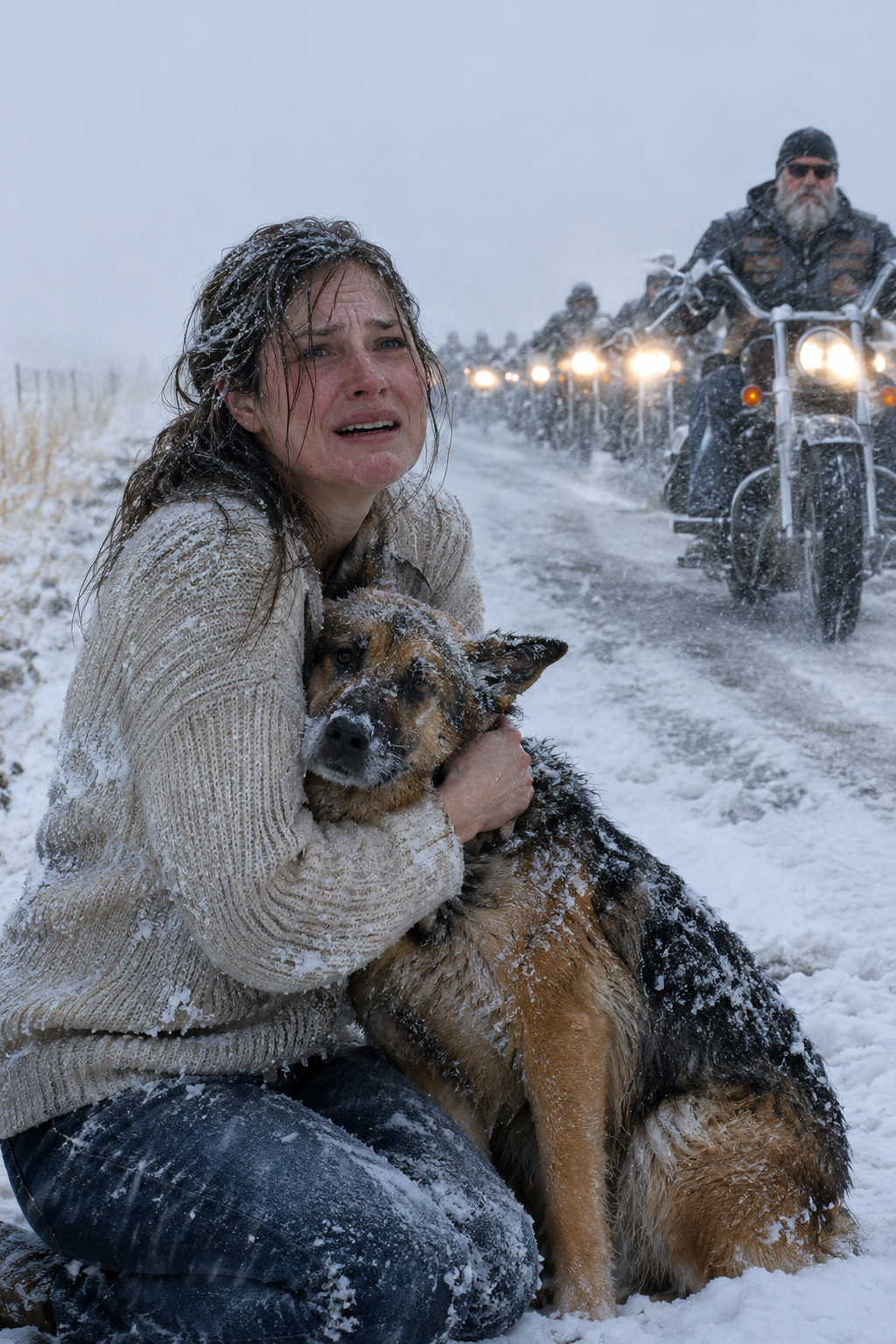
My husband pushed me out of his truck on a Montana highway in the middle of a January snowstorm because he was furious over a forty-dollar charge for our dog, and after his taillights disappeared, I kept listening for him to come back until a sound rose through the wind that I could hardly believe was real…
I remember the sound of Clint’s tires more clearly than the sound of my own voice. Snow sprayed across the shoulder as his green Ford pulled away, and I stood there in a sweater that wasn’t nearly warm enough, waiting for the brake lights to come on. My German shepherd, Bishop, pressed against my knee and watched the truck disappear with me.
My name is Marla Avery, and we were on our way home to Butte from my sister’s place in Deer Lodge. It was the middle of January, late enough in the afternoon for the sky to turn gray, and a storm was moving across that open stretch of Montana highway. I’d left my coat and purse in the truck, which meant my phone was gone too.
The argument had started with a credit card statement I’d set on the dashboard along with the rest of the mail. Clint noticed a forty-dollar charge for dog food and a visit to the vet for Bishop. I’d taken that shepherd in off the street two winters earlier, and he’d been my shadow ever since.
Clint had never liked him. He held up the statement and asked why I thought I could spend his money without permission, then started in on what I supposedly did all day. I watched the road through the windshield and tried to keep my answers short, because I’d learned that defending myself usually just made him louder.
This time, he brought up my father. Dad’s name was Ray Delgado, though almost everyone who knew him called him Big Ray, and Clint knew exactly how much it hurt when he talked about him. He called Dad a grease monkey who rode with criminals and said I’d come from nothing and would never amount to anything.
Dad had spent thirty years with a motorcycle club called the Iron Vigil. People who saw the patches sometimes crossed the street, but I knew the man who repaired broke riders’ bikes without charging them and helped organize a canned-food drive every Christmas. He cried openly at my high school graduation, then tried to pretend his eyes were watering from the wind.
His heart gave out in his sleep two years before that drive. Clint and I had married six months before Dad died, and although Dad never spoke against my husband, I remembered how quiet he’d become whenever Clint was around. Losing Dad had felt like losing the one person who could see me clearly without requiring an explanation.
When Clint started talking about Dad in the truck, something in me finally refused to keep listening. I said, ‘Pull over.’ I only meant that we needed a few minutes to cool down before we finished the drive, but Clint looked at me as though I’d challenged him in front of a crowd.
He steered onto the shoulder, leaned across me, and pushed open the passenger door. ‘Then get out,’ he said. I gave a disbelieving little laugh, certain he was trying to scare me, until he caught my arm and shoved me toward the opening.
I grabbed at the frame, but he pushed again and I landed on the frozen gravel. Bishop scrambled out of the back seat after me before I could call him. I got to my feet, hit the side window with my palm, and shouted for Clint to stop, but he drove away without opening the door again.
For a moment I truly believed he’d turn around. I looked at the bend in the road and tried to imagine his truck coming back through the snow, Clint saying he’d lost his temper and telling me to get in. Thirty seconds went by, then another minute, and the place where I’d last seen his lights stayed empty.
The wind came across the fields hard enough to sting my face. There were fence posts on either side of the road and almost nothing else I could make out through the thickening snow. I didn’t know if the next town was eight miles away or ten, but I knew I couldn’t walk that distance dressed as I was.
I started anyway, because standing still was worse. Bishop walked so close that his shoulder kept brushing my leg, and every few steps he leaned against me with his whole weight. His fur was collecting snow, and I kept rubbing his neck as if that could warm both of us.
My fingers stopped feeling like fingers. I tucked my hands under my arms, then pulled them out to steady myself whenever my shoes slid on the shoulder. I thought about the warm kitchen at my sister’s house, the mug I’d left by her sink, and how a perfectly ordinary afternoon had become something I might not survive.
I thought about Dad too. Every January the Iron Vigil took food, toys, and donations to shelters in Butte and Anaconda, no matter how miserable the weather got. Dad used to say that people who needed help in January didn’t get to skip January, so the rest of us shouldn’t either.
The snow grew thick enough to hide the nearest fence line. My legs felt strangely heavy, and I bent down to hold Bishop around the shoulders, pressing my face into his wet fur. I knew sitting in the snow would be dangerous, but for one awful second I wanted nothing more than to stop moving.
Then I heard something underneath the wind. At first it was a low vibration, too steady to be thunder, and I lifted my head because I could feel it almost as much as hear it. A line of lights was taking shape through the blowing snow behind us.
They weren’t the headlights of Clint’s truck. As they drew closer, I saw motorcycle after motorcycle, an entire procession moving cautiously along that icy two-lane road. I stood with one hand buried in Bishop’s collar, not trusting my eyes.
The lead rider slowed, and the others followed until forty motorcycles had stopped around us. Their engines settled into a deep, uneven rumble while the riders made room on the shoulder. For the first time since Clint left, I was standing among people who were paying attention to whether I was alive.
A broad man with a gray beard came toward me and stepped between me and the wind. He crouched rather than towering over me and asked if I could stand. I tried to explain, but my mouth wasn’t working properly, and all I could manage was a nod and the word ‘Husband’ as I pointed down the highway.
He raised one hand, and the riders behind him quieted their engines. ‘Get her warm,’ he said, and people moved immediately. A big rider they called Tiny took off his jacket, while two women came to my side with a thermal blanket and gentle questions about my hands and feet.
The gray-bearded man took off his leather vest, the one with the Iron Vigil colors on its back, and laid it over my shoulders. Another rider waited patiently until Bishop allowed himself to be lifted into the sidecar of an older motorcycle. Someone tucked a blanket around my dog, and only then did he stop trembling quite so hard.
They helped me onto a bike behind one of the women, making sure I was secure before anyone thought about moving. Warmth returned to my hands in sharp, painful prickles, and I looked down at the borrowed leather covering my sweater. The man who had given it to me was Dutch Kowalski, president of the Iron Vigil, though I hadn’t recognized him through the snow.
Dutch asked for my name, where I lived, and what had happened. I told him I was Marla Avery from Butte, and that Clint had put me out over an argument about Bishop and driven toward town. He listened without interrupting, then asked a question I hadn’t expected: ‘What’s your father’s name?’
‘Ray Delgado,’ I said. Tiny turned toward us, one of the women stopped adjusting my blanket, and Dutch’s face changed so suddenly that I forgot the cold for a moment. I had no idea then that he had known Dad for twenty-five years or had helped carry his casket, but I could see that the name meant something to every person standing near me. Part 2…..
Dutch rested one hand lightly against the side of the motorcycle. He said they’d get me somewhere warm and safe, then asked the others to take it slowly. I clung to the woman in front of me as we pulled back onto the road, with Bishop riding near the front in the sidecar.
We hadn’t gone far when Dutch signaled for everyone to stop beside an old grain elevator that broke some of the wind. He came back to speak to me where I sat under the blanket. ‘Your dad rode with us for thirty years,’ he said. ‘He led this run for a decade. I helped carry him to his grave.’
I hadn’t seen Dutch much since the funeral, and my thoughts were still slow from the cold. The idea that these riders had found me by chance on the same charity run Dad had once led was almost too much to take in. Dutch waited while I swallowed and tried to get myself together.
‘You’ve been riding with your dad’s people,’ he told me. ‘Now I need to ask where your husband was headed.’ Behind him, the motorcycles idled in the snow, and I understood that he wasn’t asking out of curiosity.
Clint had a habit of stopping at the Copper Spoon Diner on the edge of Butte whenever we came back from Deer Lodge. He liked a window seat, black coffee, and a slice of pie, and he almost never broke that routine. I told Dutch where to look, though the thought of seeing Clint again made my stomach tighten.
Two riders went ahead and reported back that Clint’s green Ford was in the diner lot. The Butte Insurance Group magnet was still on its door, and he’d parked across two spaces. I sat listening to that description and wondered how he could be ordering dessert while I was still shaking from what he’d done.
Before we moved again, a woman named Sheila asked to look at my hands and feet. She’d been a nurse for thirty years before retiring, and she checked carefully for signs of a cold injury instead of simply telling me I looked fine. She believed I would recover, but I still needed warmth and proper attention if anything worsened.
Then Dutch asked me what I wanted. Not what the club wanted, he said, and not what my father would have wanted, but what I needed to happen next. He said Dad had always believed that helping someone meant leaving them in charge of their own choices.
I looked at Bishop, curled beneath the blanket in the sidecar, and pictured myself beating on the truck window. I didn’t want anyone to hurt Clint. I wanted him to understand, even for one minute, what it was like to be stranded and frightened while the person you depended on simply drove away.
Dutch listened, then nodded. He told the riders plainly that nobody was to lay a hand on Clint. When we turned toward Butte, the engines stayed steady and the group moved with the caution that icy roads demanded.
By the time we reached the Copper Spoon, the storm had begun to ease and the light was fading. The riders spread out across the front of the diner, their headlights bright against the windows. Someone had filmed us passing a gas station, and people inside the diner put down their cups and turned to stare.
Clint was where I’d said he’d be, sitting beside the window with coffee, pie, and his phone. I watched him glance up, annoyed at first by the commotion outside. Then he saw me step down from the motorcycle in Dutch’s leather vest, with Bishop walking at my side.
Clint pushed back his chair so quickly that his coffee tipped over. He hurried through the diner door with both hands raised and began talking before he was even close to me. He said there’d been a misunderstanding, that I’d got out by myself, that he had meant to come back.
Dutch stood beside me and told the people gathering near the entrance what I’d reported: Clint had left his wife and her dog beside the highway in a whiteout, without a coat or phone. A waitress, a trucker, and two older men heard him. More people were watching from the windows, and I knew that by morning the story wouldn’t stay in that parking lot.
I let Clint finish. My hands were still aching, and Bishop kept leaning against my calf, but I managed to look straight at the man I’d been afraid of upsetting for ten years. ‘You weren’t coming back,’ I said. ‘You stopped for pie.’
Part 3 Nobody laughed. Clint opened his mouth and closed it, then tried again to say he hadn’t meant for any of this to happen. I told him that what happened on the highway wasn’t an accident and that he’d had chances to ask for help long before reaching the diner.
I told the people listening that my father was Big Ray Delgado, and that the riders standing behind me had gone out every January to bring supplies to people who needed them. Clint had spent years telling me Dad’s friends were nobodies. Yet those were the people who stopped, while my own husband had left me there.
Dutch didn’t threaten Clint or ask anybody to touch him. Tiny brought my purse from the truck and put it on the gravel so I could retrieve my phone. Seeing that worn bag again, with everything I’d been unable to reach inside it, made my knees feel unsteady.
Then two riders walked over to the Ford. One opened the hood and removed a small part, while the other left a note offering a tow and the return of the part in the morning. Dutch told Clint his truck wouldn’t be going anywhere that night and pointed out that there was a motel about a mile away.
I won’t pretend that tampering with his truck was the right way to handle things. In that moment, though, I recognized the awful comparison they were trying to make: Clint could go back into a heated diner or ask for help, choices he hadn’t left me on the highway. He looked from the truck to the riders, finally understanding that nobody was going to applaud what he’d done.
The trucker went back inside. The waitress folded her arms, and the two men on the steps turned away. Clint kept looking at me as though I might step in and tell everyone to forget the whole thing, but I didn’t.
Dutch walked with me toward the diner door, and Bishop followed close enough that his shoulder brushed my leg. I didn’t know how I would get home or what I would do the next morning. I only knew I wasn’t getting back into Clint’s truck.
The riders filled much of the back of the Copper Spoon, and Dutch paid for the food. Somebody found a warm place for Bishop to settle near my feet, and a waitress set down a plate in front of me before I’d even decided what I could eat. My hands were still stiff around the coffee mug.
Sheila sat beside me and talked about Dad. She remembered him riding for hours in the rain to deliver a rebuilt motorcycle to a widow who couldn’t afford the repair. She remembered the toy collections, the canned goods, and the way Dad talked about me when I wasn’t around to hear.
I found myself smiling at stories I hadn’t known. Every now and then a little detail would catch me off guard, like the way Dad tied a bow around that repaired bike, and I’d have to look down at my plate. Bishop lay across my shoes, warm and deeply asleep.
Near the end of the meal, Dutch pulled a chair across from me. He told me he needed his leather vest back because those colors belonged to the person who’d earned them. I understood, and I was already easing it from my shoulders when he reached into his bag.
He placed a small, worn support patch on the table. It had belonged to Dad, and Dutch had kept it since the funeral. ‘I was waiting for the right hands,’ he told me, and suddenly I could hardly hold the little piece of cloth steady.
He said the club owed my father more than it could repay and that I could call them any hour, on any road. I thought about Dad refusing payment for repairs and loading food into saddlebags in the cold. For once, I could see that his kindness had kept traveling after he was gone.
By the end of that evening, one of the women had given me the name of a Butte lawyer who handled family cases for people on tight budgets. I had my phone, my dog, and a way to ask for help without going through Clint. It wasn’t a finished plan, but it was enough to let me sleep.
Final Within a week I was sitting in that lawyer’s office, sorting through what was mine and what needed to be settled. Video from the diner confrontation had circulated, and the waitress and trucker wrote down what they’d heard Clint say outside. Those accounts didn’t erase what had happened to me, but they meant I didn’t have to rely only on his version of the story.
The divorce was resolved sooner than I’d feared. I kept the house that had come from my grandmother’s family, and Clint no longer lived there. His reputation at the insurance office suffered as people around Butte learned what had happened, and the last I heard he’d moved two states away.
None of that gave me back the hour I spent on the road. For a while I still reached for a coat whenever a draft came through a doorway, even indoors, and Bishop followed me from room to room as if he were checking that I hadn’t disappeared. But the house grew quieter in a good way, and I stopped listening for Clint’s truck in the driveway.
That spring I brought home another dog, and later I fostered a third through the winter and couldn’t bear to part with him. I began volunteering at the shelter in Butte where the Iron Vigil delivered supplies each January. It felt good to arrive with something to give, even if it was only a few hours of work and a bag of dog food.
When the next winter charity run came around, I was in the parking lot before dawn, helping pack canned food into saddlebags. I rode behind Sheila, while Bishop settled happily into a sidecar, ears back in the cold air. We followed the same road outside Butte where Clint had left us a year before.
I recognized the stretch by the fence posts. It looked ordinary now, just gravel and snow beside the highway, but I remembered kneeling there with my arms around Bishop and thinking I couldn’t take another step. Then I looked at the riders ahead and behind me and remembered Dad saying that people who needed help in January didn’t get to skip January.
I used to think Dad had left me alone when he died. On that ride I understood how much care he’d put into the world and how it had found its way back to me on a day I couldn’t save myself. What I wanted now was to keep passing it along, to Bishop, to the shelter, and to anybody I saw stranded on a cold road.
THE END. I’ve shared the complete story, and I truly hope it touched your heart. If this story moved you, please , like, and share the post. Thank you for reading! ❤️
✓ Lynn R. Adams
My husband pushed me out of his truck on a Montana highway in the middle of a January snowstorm because he was furious over a forty-dollar charge for our dog, and after his taillights disappeared, I k…