My Husband Got My Sister Pregnant During My IVF — My Mom Told Him To Use Our HSA Card
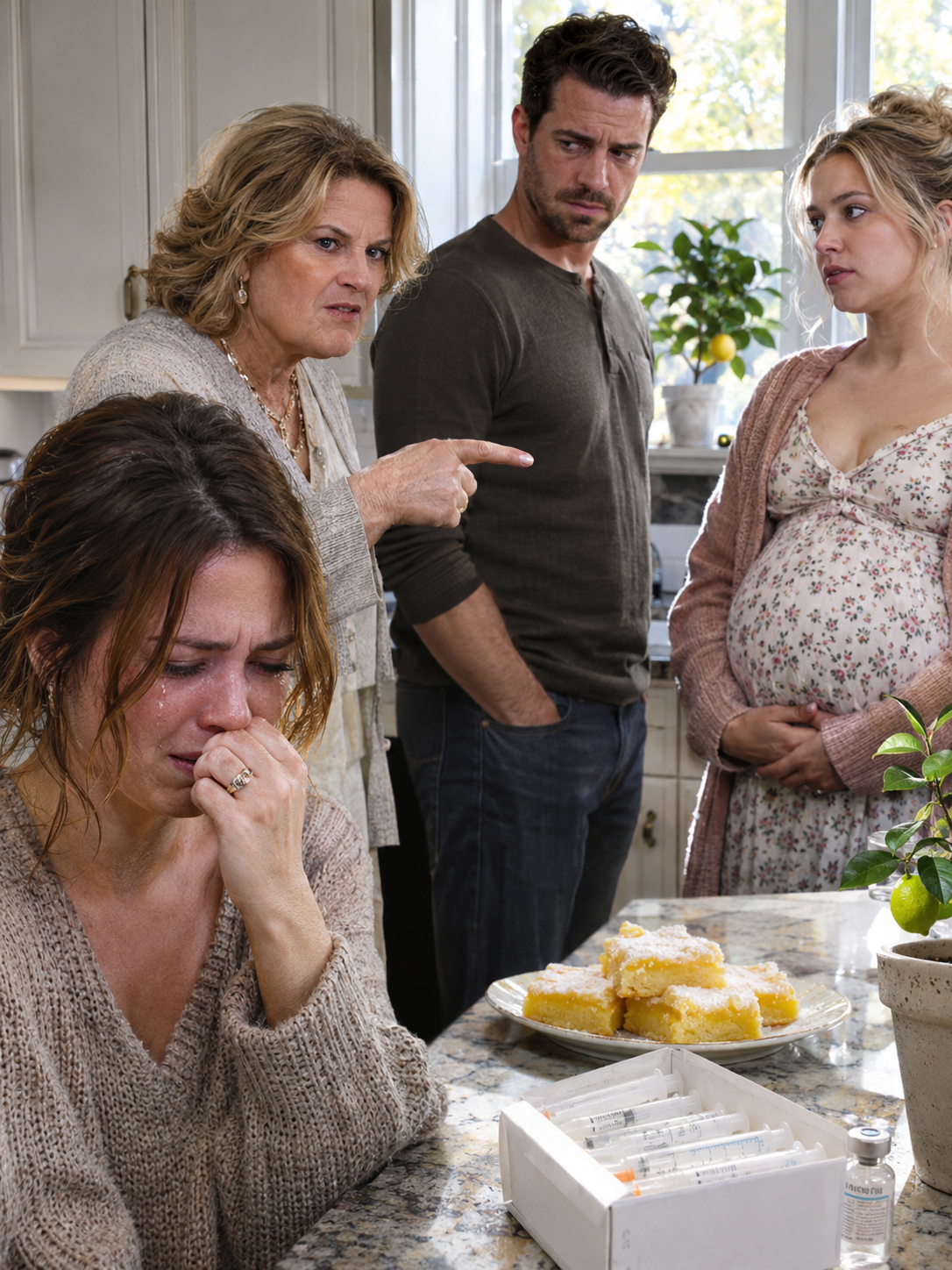
My husband got my younger sister pregnant while I was going through IVF, and my mother told me to be happy for them. I had already found her note telling him to use his health savings card for my sister’s care. Then, at my father’s birthday dinner, Mom placed Grandma’s silver pen on a $31,000 withdrawal form and asked me to sign…
Three days after my second embryo transfer failed, my mother came into my kitchen carrying lemon bars. She set them beside a box of progesterone syringes I hadn’t yet put away and said, “At least there’s going to be a baby in this family. Be happy for them, Noelle.” She’d known for nine weeks that my husband was the father.
I’m Noelle Calloway, and I was 36 that fall, living in Omaha’s Dundee neighborhood and working as an outpatient pharmacist at a hospital on the west side of town. I checked names, dates, and doses all day, never expecting to use that skill on my own marriage.
Rhett and I had tried to have a child for nearly three years before a specialist diagnosed diminished ovarian reserve. We started IVF two years before everything fell apart, putting money into a credit union account we called the Baby Fund. I’d arranged for withdrawals above $5,000 to require both signatures, because I wanted us to protect that money even from ourselves.
After our first embryo transfer, I bought a little Meyer lemon tree for the kitchen window. I told Rhett that by the time it grew lemons, we’d have a child to make lemonade with. That transfer failed, and he held me on the couch with a bag of chocolate pretzels, promising we still had one embryo, some savings, and time.
I had grown up being the dependable daughter. My parents, Bettina and Leland, raised my younger sister Paisley and me in a brick house in Benson, and somehow the rules always bent more easily for her. I worked a summer job to buy my prom dress; when she needed one, Mom took her to Kansas City and spent $400.
Our grandmother Opal was different. She taught me to make lemon bars with extra zest and a thin crust, and she promised me the old wooden rocking chair from her bedroom for my first baby’s nursery. She also owned a silver fountain pen engraved with her initials, the one she used to sign every birthday card. After she died, Mom kept it in her desk.
When I broke my arm at 12, seven-year-old Paisley slept on my bedroom floor for eleven nights, holding my good hand. That was the sister I remembered whenever she needed another favor.
I met Rhett Sorenson at a Fourth of July party when I was 28. He managed sales at a truck dealership on West Dodge Road, remembered the smallest things about me, and married me two years later in a Benson chapel. Paisley was my maid of honor, and my best friend Priya Natarajan gave a toast that made us all laugh.
By the second year of fertility treatment, our evenings revolved around injections at nine, test results, and clinic visits. Rhett used to hold an ice pack against my skin before each shot. Eventually, he stopped, around the same time Paisley began calling him whenever her car, her salon business, or her apartment needed rescuing.
Mom always asked me first. “Can Rhett go help her? You know how she gets.” I kept saying yes, even when his one-hour errands became three-hour absences. In May he started guarding his phone, and by June he had stopped coming to my ultrasounds, blaming staffing problems at the dealership.
When I asked what was happening, he said, “You’re spiraling, Noelle. Those hormones are making you see things.” Then I began smelling Paisley’s coconut keratin spray on his shirts. Rhett blamed a receptionist’s lotion, but when I took him lunch at work, the receptionist was an older man named Hank.
At Dad’s Labor Day cookout, Paisley suddenly refused the bratwurst she’d always liked, and Mom handed her ginger ale before she asked. Nobody explained it. I noticed.
Our second transfer was scheduled for late September, using the last frozen embryo from our first retrieval. The medications cost $4,100, but when I asked Rhett to pay with his work HSA card as we’d done before, he said the account held only $212 because of dental bills. I paid from my own savings and tried not to think about it.
Eleven days later, on a Monday, my blood test came back negative. I cried in my car in the hospital parking garage, then returned to work for six hours because patients still needed their prescriptions. The next morning, with my car in the shop, I borrowed Rhett’s truck while he drove a dealership demo.
Reaching into his console for my sunglasses, I found a white pharmacy bag from a chain store across the river in Council Bluffs. The prescription label faced upward: Paisley’s name, prenatal vitamins, and medication commonly used for pregnancy nausea. A stapled receipt showed payment with a card ending in 4417, the last four digits of Rhett’s HSA card.
Behind the receipt was a yellow sticky note in handwriting I’d known since childhood: “Use Rhett’s HSA card. It’s medical. Nobody checks. Love, Mom.” I sat in that truck with the engine off, reading it until the words stopped looking like words. Then I photographed the bag, the receipt, and the note and put everything exactly where I’d found it.
That night, I logged into the HSA portal using the password I’d set up when I handled our IVF claims. The balance really was $212. But there had been no dental work: eleven charges totaling $2,960 had gone to a women’s clinic, an ultrasound center, and a Council Bluffs pharmacy, starting nine weeks earlier.
On Wednesday, Rhett came home with takeout and a funny dealership story. I let him finish before setting my phone on the counter with the prescription-label photo open. “Is my sister pregnant?” I asked. His face drained of color, and eventually he admitted she was, and that the baby was his.
The affair had started in March. When I asked why he’d let me go through another transfer without telling me, he said, “Your mom thought if it worked, you’d have your own baby to focus on.” Mom had known since the end of July. She’d prayed over me at church and asked about my injections while protecting their secret.
I told Rhett to leave, and he packed a duffel bag. Before midnight, Paisley texted, “Please don’t hate me. Mom said you’d understand eventually. You always do.” I didn’t answer, and I didn’t tell any of them I knew about the HSA charges or Mom’s note.
Priya picked me up that night and drove me to an all-night diner on Dodge Street. She ate half the pancakes I couldn’t touch and asked what I planned to do. “Not yet,” I told her. “I need to see what they do when they think I don’t know everything.”
The next afternoon brought Mom and her lemon bars. When I pulled my hand away, she explained that Paisley had been scared and said she’d kept the secret to protect me during treatment. “You’ve always been the strong one,” she added, before inviting me to Dad’s sixty-fifth birthday dinner at a steakhouse on Center Street that Sunday.
I went. Paisley sat beside Rhett in a loose green dress, her belly beginning to show, while Dad studied his menu and Mom waited for our steaks. Then she announced that Paisley needed somewhere bigger than her studio apartment and Rhett’s commissions weren’t what they used to be.
She took a credit union withdrawal form from her purse and flattened it beside my plate. The amount was $31,000, drawn from the Baby Fund; Rhett had already signed, and my signature line was empty. Mom placed Grandma Opal’s silver fountain pen on top and said, “Sign it with Grandma’s pen. She’d want this.”
“That money was for our baby,” I said. Mom replied that I couldn’t use it right now anyway, and now there was a baby coming in April. Dad admitted he’d known about the pregnancy for two weeks but asked me not to make a scene on his birthday, while Rhett kept his arm around my crying sister.
I turned Grandma’s pen between my fingers and looked at the form. “What time Friday?” I asked. “Ten,” Mom said, smiling. “The credit union on 72nd Street. We can start healing.” I put the pen and paper in my purse, and nobody at that table noticed that I had never agreed to sign. Part 2…..
IF FACEBOOK BROUGHT YOU HERE, HERE’S THE CONTINUATION YOU’VE BEEN WAITING FOR. ENJOY! 👇 On our way out, Mom pressed a foil-wrapped slice of Dad’s birthday cake into my hands. “I knew you’d come around,” she said. Nobody had even sung “Happy Birthday” to him; at the table beside ours, a little boy in a cowboy hat had gotten more celebration than my father did.
Rhett called that night from the couch where he was staying. He said the Baby Fund was just sitting there and that using it for Paisley’s child made sense. When I reminded him it had been meant for our child, he told me Mom had already promised Paisley’s landlord she’d be out of her studio by November. “You’ll sign Friday, right?” he asked. “I’ll be there at ten,” I said, and hung up.
On Monday morning, I sat in the Old Market office of Gideon Sabo, a family lawyer whose windows overlooked a bike shop. He wore cowboy boots with his suit and listened without interrupting as I laid out the marriage, the treatment bills, the HSA statement, and the photograph of Mom’s note. When I finished, he turned the pages over and started asking careful questions about the dates.
“Nebraska has no-fault divorce,” he told me. “The affair alone doesn’t decide who gets what, but spending marital assets for someone outside the marriage can matter when the property is divided.” He said the $2,960 Rhett had spent on Paisley’s care was worth documenting, along with the $4,100 I’d paid for my own medication after Rhett claimed the HSA was empty because of dental work.
I asked whether an HSA could pay for your wife’s sister. “Generally, not unless she’s a qualifying dependent,” Gideon explained. “If those were nonqualified expenses, your husband may face taxes and a penalty. That is separate from what we need to establish in your divorce.” He didn’t promise me a windfall or tell me I could keep the entire savings account; he said the $31,000 was still marital money that would have to be addressed fairly.
The one thing we knew was that the credit union required my signature for a withdrawal that large. Gideon prepared a divorce petition and a motion asking the court to protect the joint accounts during the proceedings. He filed them Wednesday, sent the relevant paperwork to the credit union, and told me to save every original statement and message I could lawfully access.
“If they insist on Friday, you can go,” he said. “But you are not obligated to sign away thirty-one thousand dollars because your mother brought a pen.” I called Priya and asked her to come with me. She took a personal day and said she’d bring coffee, because apparently nobody in my family understood what an actual act of support looked like.
Friday morning, the credit union on 72nd Street looked exactly as it always had: low brick walls, a drive-through, and a bowl of lollipops near the counter. A loan officer named Bev Lindahl showed us into a small conference room with a photograph of the Platte River on the wall. My parents were already seated beside Rhett and Paisley, and Mom had brought cinnamon rolls like this was a family breakfast.
Her smile tightened when she saw Priya. “This is a family matter,” Mom said. “Priya is my family,” I answered, pulling out a chair. Priya sat down beside me without a word, her purse on her lap and her eyes on the folder in my hands.
Bev began by explaining the account’s signature requirements and mentioned that paperwork concerning the account had arrived. “I can explain that,” I said. I placed my divorce petition and the motion in front of everyone and told them my lawyer had filed the documents on Wednesday. Bev confirmed she had received the paperwork, and I said plainly that I would not be authorizing a withdrawal.
Rhett stared at the petition. “You filed?” he asked. “You spent seven months going to my sister’s apartment and motels in Council Bluffs,” I said. “Yes, I filed.” Mom leaned forward, speaking softly as if that could make me reasonable again: “Noelle, this isn’t what we discussed.”
“We didn’t discuss it,” I said. “You decided what should happen to my marriage and the money we saved, and you handed me a form.” I took a second page from my folder. It was the HSA transaction history, with eleven entries circled and the dates in order.
“In September, Rhett said this account only had $212 because of dental work,” I told the room. “So I used $4,100 of my own savings for fertility medication. But $2,960 had already gone to prenatal appointments, an ultrasound center, and prescriptions for Paisley.” I could hear the ventilation fan above Bev’s desk as everyone looked down.
Rhett’s ears went red. “I was going to pay it back,” he said. “To me, or to the account?” I asked. “And did you know those purchases might not be qualified HSA expenses?” He didn’t answer, and Paisley stared at him like she’d just learned that the card he’d called a work benefit wasn’t free money after all.
Then I placed the enlarged photograph of the sticky note in the middle of the table. Blue handwriting, yellow paper, the familiar loop in Mom’s capital letters. My father’s hand moved toward it, and he held the picture close enough to read each word.
Mom went completely still. Dad set the paper back down and cleared his throat. “Your mother was trying to help,” he murmured. Then he said the same thing he’d said at dinner: “Let’s not make a scene, Noelle.”
Paisley turned toward him, then toward Mom. “You said Noelle wouldn’t notice,” she said, her words coming out too quickly. “You said she’d be too busy with the shots to check the statements.” Nobody spoke after that, not even Rhett, who had spent months telling me my hormones were making me imagine things.
Bev removed her reading glasses and rested them on the folder. Rhett stood and asked if we could talk at home instead of in front of strangers. “You don’t live at my home anymore,” I said. “And none of you worried about strangers when you went across the state line to fill the prescriptions.”
Mom finally said she had only been trying to help Paisley, then reached again for the words she’d used in my kitchen. I stopped her. “You told me to be happy for them,” I said. “You left out the part where I was paying for it.” My father turned the photo face down as though that might make the handwriting disappear.
Part 3 I thanked Bev for her time, picked up my folder, and walked out with Priya. Nothing in that room changed the requirement for my signature, and no withdrawal was approved. But for the first time, I’d said exactly what happened while all the people who had rewritten it for me sat and listened.
In Priya’s car, my hands shook so hard I couldn’t fasten the seat belt right away. She turned on the heat and waited until my breathing steadied, then handed me a cherry lollipop she’d picked up from the counter. I laughed and cried over that stupid little candy, relieved that somebody had come with me without asking me to be strong.
Mom left a voicemail the following Monday. She said I’d humiliated her in front of a stranger and that Paisley had cried all weekend, which wasn’t good for the baby. At the end she said, “I only wanted everyone to be happy.” She never apologized for the note, the secret, or the money, so I saved the message and sent it to Gideon.
Then I went to work. I checked labels, talked patients through their medications, and stood at the same counter where I’d tried to hold myself together after the failed transfer. Being able to do my job mattered, even on the days I went home to a house that seemed too quiet.
The divorce took seven months. Rhett’s attorney argued that half the Baby Fund belonged to him, which Gideon had warned me was a real possibility. We presented the HSA charges, the statements showing what I’d paid for IVF medication, and Rhett’s messages claiming the account had almost nothing left.
The judge divided the savings while accounting for the money Rhett had diverted. I came away with $18,460, not the whole $31,000 and certainly not a refund for the two failed transfers. It was a legal settlement, not some miraculous repayment for what they’d done, but I knew exactly where those dollars had come from and what they had cost.
We sold the house in Dundee and split what remained after the mortgage. I hated the moment I had to put my name on those documents, but I signed them with Grandma Opal’s fountain pen. I thought about her giving me something that could leave a permanent mark, and about Mom using the same pen to try to take away a choice.
When Rhett came to collect his last belongings before closing, he stopped beneath the kitchen window and stared at the lemon tree. “You’re taking that?” he asked. “I paid for half of it.” After everything, that was the thing he wanted to haggle over, and I said, “You can have half the pot.”
For a second he looked as though I were joking. Then he picked up his box of dealership trophies and left without saying goodbye. I carried the tree outside myself, holding the clay pot against my ribs so it wouldn’t slide out of my hands.
The following spring, Rhett received an IRS letter about the HSA expenses. He faced taxes and a 20 percent penalty on the nonqualified withdrawals he’d made for Paisley. He called me once as if I could still straighten out the paperwork for him; I saw his name light up my phone and let it go to voicemail.
Mom found out that not every consequence could be managed within the family, either. That winter, when Rhett and Paisley asked their church for help with rent, Rhett showed the pastor a copy of her sticky note to explain that the HSA idea hadn’t been his alone. By Christmas, word had spread around the congregation.
My cousin Wesley told me Mom stepped down from organizing the church bake sale, a job she’d held for twenty-two years. She blamed her back. I didn’t call anyone to correct her, and I didn’t ask for details; her standing at church had stopped being my responsibility.
Rhett and Paisley rented a two-bedroom duplex in Council Bluffs, hoping the move would be a fresh start. By February, Wesley had heard that they were arguing about money, with Rhett earning less commission and Paisley struggling to pay the rent on her salon chair. It wasn’t a surprise, but I didn’t enjoy hearing it as much as I’d once imagined I might.
Their daughter was born in April, healthy and weighing seven pounds, nine ounces. I was glad she was healthy, and I meant it. She hadn’t chosen her parents or the way the rest of us had treated one another before she arrived.
By August, Paisley had moved with the baby into my parents’ basement. Rhett was paying child support through the state. Mom spent her afternoons rocking her granddaughter in Grandma Opal’s old nursery chair, the one she’d promised to keep for my first child, and Dad remained as silent toward me as he’d been at his birthday dinner.
One Tuesday night, Paisley called because the baby had a fever and wouldn’t stop crying. She asked what medicine she could give her, knowing I was a pharmacist. I told her to contact the pediatrician’s after-hours line, gave her the number, and said a baby with a fever needed a clinician who could assess her, not a dose guessed over the phone by an aunt who wasn’t there.
“You could just tell me,” she said, sounding exhausted. I understood that kind of exhaustion more than she knew, but I couldn’t become her emergency plan again. “Call the number, Paisley,” I said. “And please understand that I’m not your safety net anymore.”
A week later she sent a long message saying she missed the sister who always fixed things. I sat with my phone in my lap and remembered the little girl who’d slept on my bedroom floor for eleven nights after I broke my arm. I finally replied, “I hope the baby’s feeling better. Please don’t ask me for things anymore.”
Mom sent a card with a photograph of the baby in a yellow dress. Inside, in the same looping handwriting as the HSA note, she’d written, “Be happy for us, Noelle. Life is too short.” I put it through the shredder at work, then went back to helping the next person in line.
Final That summer, I used some of my settlement money to freeze my eggs at a different clinic downtown. I did the nine o’clock injections alone, but Priya called each evening and described whichever terrible reality show she was watching until the worst part of the shot was over. At retrieval, the team collected fourteen eggs, better than they’d expected.
I don’t know if I’ll ever use them. I might meet someone, become a mother another way, or decide the life I build is enough without a child. It mattered that none of those questions had to be answered for Rhett, Mom, or Paisley anymore.
In September, Wesley drove his pickup into the hospital parking lot with something wrapped in blankets in the bed. When he folded the blankets away, I saw Grandma Opal’s rocking chair, the wood polished smooth where she’d rested her hand. An envelope was taped to one arm, with my name written in Paisley’s handwriting.
Inside, she’d written, “Grandma promised this to you. Mom didn’t keep her word. I’m trying to get one thing right. I’m sorry.” Wesley said Paisley had carried the chair up from the basement while Mom was at church. She hadn’t asked me to come get it or made the gift depend on my forgiveness.
I ran my fingers over the familiar worn place on the armrest. I didn’t call Paisley and tell her everything was fine, because it wasn’t; a chair couldn’t mend what she’d helped break. But I accepted it, and when Wesley asked where it should go, I told him about the little bungalow I’d rented near Memorial Park.
The lemon tree came there with me, too. After two years in my old kitchen without producing a single piece of fruit, it looked like something that might never do more than survive. I set it in a south-facing window, watered it when the soil got dry, and stopped checking the branches for signs of progress.
One morning in October, almost a year after that meeting at the credit union, I walked into the kitchen in my socks and saw one small yellow lemon hanging from the lowest branch. I put my hand over my mouth, then started crying before I could make sense of it. It was only a lemon, but it was the first fruit I’d ever seen on that tree.
I called Priya and asked her to stop by before school. She stood in my kitchen wearing her teacher’s lanyard, coffee in one hand, and stared at that lemon like a science experiment had finally delivered a result. “Two years,” she said. “It just sat there for two years.”
“I guess it needed the right window,” I said. Priya looked at me over her coffee. “Didn’t we all?” she replied, and I laughed because she could make me laugh without trying to fix me.
That weekend, I made lemon bars the way Grandma Opal taught me: extra zest, a thin crust baked just a little darker than most people like. I ate the first one sitting in her rocking chair beside the lemon tree, and Priya ate four before she’d even finished telling me about her week.
I remembered all the things I’d been told: I was the strong one; I shouldn’t make a scene; I was spiraling; I should be happy for them. I’d spent thirty-six years trying to be whatever the people around me needed, and I’d begun to mistake that for love.
I hadn’t made a scene. I’d kept a folder, told the truth, signed my own papers, and found a place where I could decide what came next. I couldn’t wish Rhett and Paisley happiness, not yet, and I wasn’t going to pretend I could. But that afternoon, with Grandma’s chair beneath me and the first lemon from my little tree in the window, I could finally say something simple and true: I was happy for me.
THE END. I’ve shared the complete story, and I truly hope it touched your heart. If this story moved you, please , like, and share the post. Thank you for reading! ❤️
✓ Lynn R. Adams
My husband got my younger sister pregnant while I was going through IVF, and my mother told me to be happy for them. I had already found her note telling him to use his health savings card for my sist…