My Husband Gave His Mistress…
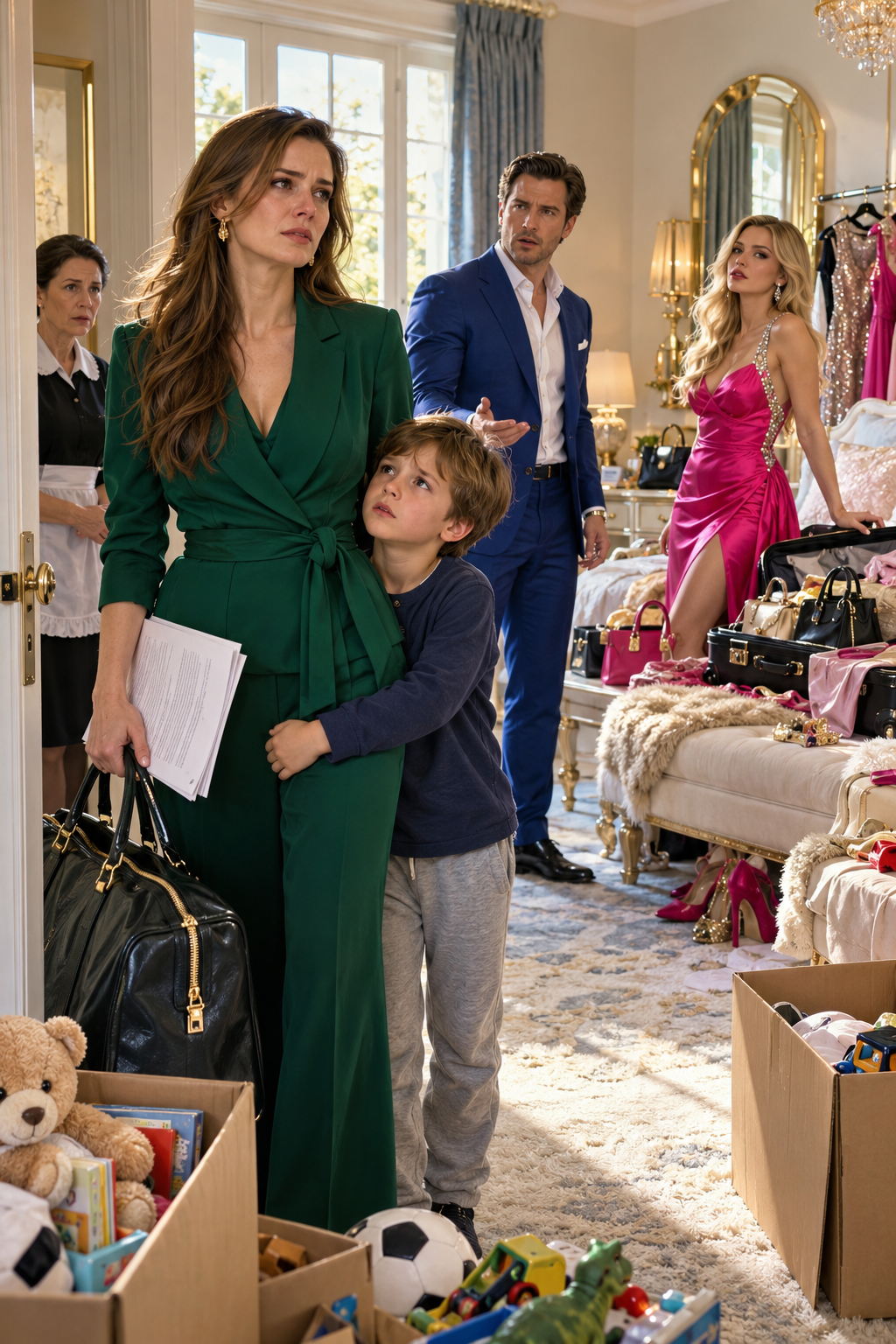
My Husband Gave His Mistress My Son’s Bedroom—Three Days Later, I Left With a Key He Never Knew Existed
My husband’s mistress was sitting on my eight-year-old son’s bed when I came home.
She had already thrown his dinosaur sheets into a black garbage bag.
Daniel stood in the doorway behind her, arms folded, and said, “Sophie needs the room more than Noah does. He can sleep downstairs until we figure things out.”
For a few seconds, I thought I had misunderstood him.
Not because the words were unclear.
Because some humiliations are so complete that your mind refuses to accept them on the first attempt.
Noah’s bedroom had always been the brightest room in the house.
Two tall windows faced the old maple trees along the east lawn. His model airplanes hung from fishing line above the desk. Glow-in-the-dark stars covered one corner of the ceiling because he had been afraid of thunderstorms when he was five. His baseball glove sat open on the dresser beside a crooked photograph of him and Daniel at a Yankees game.
And now a woman I had met exactly twice was folding silk blouses into my son’s drawers.
Sophie Carlisle looked up at me with the expression of someone inconvenienced by a hotel employee.
She was thirty-one, blond in an expensive, deliberate way, wearing cream trousers and a cashmere sweater that probably cost more than my first car.
“Oh,” she said.
Not I’m sorry.
Then she turned back to the drawer.
Daniel cleared his throat.
“Claire, don’t make this ugly.”
That was the moment something inside me became very still.
Not broken.
There is a difference.
I set my purse on the hallway table.
“Noah is where?”
“With Mom,” Daniel said. “I asked her to pick him up after school.”
His mother.
Eleanor Mercer.
I looked past him toward the staircase.
At the bottom stood Eleanor herself, wearing pearls at three in the afternoon, one hand wrapped around a wineglass.
Behind her was Daniel’s younger brother, Ryan.
So they had all come.
His mistress.
His mother.
His brother.
An audience.
A jury already convinced.
Eleanor gave me a thin smile.
“This has gone on long enough, Claire.”
I looked at her.
“What has?”
Her eyebrows lifted as though I were being deliberately stupid.
“This marriage. The tension. Your constant resentment. Daniel has been miserable for years.”
Daniel stared at the floor.
Sophie kept folding.
Ryan leaned against the banister.
And I understood something that made the room feel suddenly colder.
This was not a spontaneous cruelty.
It had been rehearsed.
They had discussed the bedroom.
They had discussed Noah.
They had discussed me.
They had decided exactly how much dignity I was allowed to keep.
Daniel finally looked at me.
“Sophie will be staying here for a while.”
I almost laughed.
Instead I asked, “Here?”
“This is my family’s house.”
That sentence mattered.
More than he knew.
Eleanor took a slow sip of wine.
“Technically, Daniel is right.”
I looked at her over Daniel’s shoulder.
Technically.
Another important word.
Daniel continued.
“I’m not throwing Noah out. Stop looking at me like that. The basement guest suite has a bedroom.”
“The room beside the furnace?”
“It’s finished.”
“It has one window.”
“It’s temporary.”
“For how long?”
He exhaled sharply.
“Why do you always do this?”
“Turn everything into a moral trial.”
Sophie closed one of Noah’s drawers.
The sound was soft.
Almost polite.
Then she said, “Maybe because she wants you to feel guilty.”
That was the first time I looked directly at her.
She had the confidence of a woman who believed the war was over because she had been allowed onto the battlefield.
I studied her face.
Then I studied Daniel.
The small muscles in his jaw tightened.
He wanted a reaction.
Tears, preferably.
Screaming would have been even better.
He needed me emotional enough to make his betrayal seem reasonable.
I gave him nothing.
I walked into Noah’s room.
Sophie shifted aside reluctantly.
I picked up the black garbage bag containing his bedding.
Then another bag containing his books.
On top was a copy of Charlotte’s Web, bent at one corner.
My mother had given him that book six months before she died.
I slid it carefully into my purse.
Daniel said, “Claire.”
I didn’t answer.
I opened Noah’s closet.
His clothes had been pushed to the far left.
Half the space already held Sophie’s dresses.
A black garment bag with a Manhattan boutique logo hung over Noah’s winter coat.
I took a small blue backpack from the shelf.
Then I walked toward the old wooden toy chest beneath the window.
Daniel stepped inside.
“What are you doing?”
“Getting Noah’s things.”
“I said he isn’t leaving.”
“You moved another woman into his bedroom.”
His face hardened.
“Don’t weaponize our son.”
That almost impressed me.
Not the cruelty.
He had betrayed his wife, displaced his child, moved his mistress into the child’s bedroom, and within fifteen minutes had found a way to accuse me of weaponizing motherhood.
Eleanor appeared behind him.
“You have a talent for drama, Claire.”
I crouched beside the toy chest.
Beneath Noah’s old train set was a narrow cedar box.
Sixteen inches long.
Brass corners.
Daniel had seen it many times.
He had never asked what was inside.
That was one of the advantages of being underestimated for a long time.
People stop noticing what you protect.
I lifted the cedar box.
For the first time that afternoon, Eleanor’s expression changed.
Only slightly.
But I saw it.
Her eyes moved from the box to my face.
“What is that?” Daniel asked.
“My mother’s.”
“You’re not taking furniture.”
“It isn’t furniture.”
“Anything belonging to this house stays in this house until we sort out the separation.”
I held the box against my side.
“Are we separated?”
His silence answered.
Sophie looked at him.
Eleanor looked at him.
Ryan looked at him.
And Daniel, who had probably imagined himself delivering a magnificent speech about needing space and finding happiness, suddenly looked irritated that I had forced him to name what he was doing.
“Yes,” he said. “I think we are.”
I nodded once.
“When did you decide?”
“That isn’t important.”
“When did Sophie decide?”
Sophie’s cheeks flushed.
Daniel took a step toward me.
Very slightly.
And that seemed to frighten him more than anger would have.
Because I had spent fifteen years giving.
I had given Daniel my twenties.
I had given his mother every Thanksgiving she insisted belonged to the Mercers.
I had given his father my weekends when his health failed.
I had given Ryan a job when his first business collapsed.
I had given Daniel the money from selling my first condo when Mercer Development nearly missed payroll.
I had given them my patience when they called those sacrifices “family obligations.”
I had given and given and given until they mistook generosity for surrender.
But that afternoon, standing in my son’s stolen bedroom, I stopped giving.
Daniel pointed toward the cedar box.
“Put it down.”
His face changed.
It was almost imperceptible.
For fifteen years, I had been reasonable.
Reasonable women become invisible in certain families.
Their compromises become expected.
Their silence becomes permission.
So a single no can sound like a gunshot.
Eleanor came up the last stair.
“Claire, nobody is trying to hurt you.”
I looked at Noah’s dinosaur sheets in the garbage bag.
Then at Sophie’s perfume bottles lined neatly across his dresser.
“You should say that again,” I said quietly. “I don’t think the room heard you.”
Ryan looked away.
Daniel rubbed his forehead.
“God, Claire.”
I walked past them.
No one stopped me.
At least not then.
I found Noah at Eleanor’s house thirty minutes later.
He was sitting on the front steps with his backpack between his sneakers.
Eleanor had apparently brought him there, left him with the housekeeper, and returned to our house for the performance.
He looked up when my car pulled into the circular driveway.
He ran to me.
I crouched and held him.
His shoulders were tight.
That was what I remember most.
Not questions.
The tightness.
Children know when adults have made decisions that threaten their world.
They just don’t know the vocabulary yet.
“Grandma said Dad needs some time,” he whispered.
I brushed his hair back.
“We’re going to stay somewhere else tonight.”
“Am I in trouble?”
“Is Dad mad because I left my glove downstairs?”
He hesitated.
“Did I do something?”
That nearly destroyed my composure.
I cupped the back of his head.
“You did absolutely nothing.”
“Can I go get Rocket?”
Rocket was his stuffed dog.
It had been in his crib when he was a baby.
I realized it was still upstairs at the house.
“In a little while.”
“Can we sleep at Aunt Megan’s?”
My sister lived forty minutes away in Stamford.
I could have called her.
Instead I said, “We’re staying at a hotel tonight.”
He looked worried.
“Are we poor now?”
I almost smiled.
Children ask the clean questions adults spend years avoiding.
I put him in the car.
Then I placed the cedar box on the passenger floor.
For most of the drive into White Plains, Noah watched the highway.
At one point he said, “Sophie’s staying at our house, isn’t she?”
I gripped the steering wheel.
“Who told you?”
“Saturday.”
Four days earlier.
That meant Daniel had told our son before he told me.
My voice stayed calm.
“What exactly did he say?”
Noah picked at the zipper on his hoodie.
“He said grown-ups change. And sometimes moms and dads need new lives.”
I swallowed.
“Anything else?”
“He said Sophie thinks my room has the best morning light.”
There are sentences that remain inside you forever.
Not because they are dramatic.
Because they are small enough to reveal everything.
The best morning light.
That was why my son had been removed.
Not logistics.
Not necessity.
I checked us into a hotel near downtown.
Nothing fancy.
I ordered grilled cheese for Noah and a coffee for myself.
While he watched a movie, I locked myself in the bathroom with the cedar box.
My mother, Margaret Bennett, had given it to me twelve days before she died.
She had been seventy-one.
Pancreatic cancer had reduced her body but sharpened her voice.
“Never open this because you’re angry,” she told me from her hospital bed.
I had been crying.
She had not.
“Open it because someone tries to erase you.”
At the time, I thought she was speaking metaphorically.
My mother liked metaphors.
She had taught English literature at a public high school for thirty-four years.
She wrote grocery lists in fountain pen.
She believed people revealed themselves most clearly when discussing money, grief, or waiters.
I had carried the box home.
Daniel asked what it was.
I told him.
He lost interest before I finished the sentence.
Inside the bathroom, I turned the tiny brass key taped beneath the lid.
The lock clicked.
The cedar smell was immediate.
Inside were three things.
A sealed cream envelope.
A brass safety-deposit key stamped 417.
And an old silver flash drive.
I touched the envelope first.
My name was written across the front in my mother’s handwriting.
CLAIRE — ONLY IF THEY TRY TO TAKE THE HOUSE FROM YOU.
I sat on the closed toilet.
For a moment, I could hear nothing but the ventilation fan.
Then I opened it.
My mother’s letter was only two pages.
If you are reading this, Daniel or one of the Mercers has finally said the sentence I have been waiting years for them to say.
“This is our house.”
Please do not argue with them.
Please do not correct them.
Please do not show them this letter.
Let them believe it.
Then call Miriam Cole.
There was a phone number.
My hands began to feel cold.
I kept reading.
You have spent too much of your life proving that you are kind. I am leaving you something better than kindness.
The ground beneath Mercer Hall has never belonged to the Mercers.
Neither has the eastern development tract, the lakeside office parcel, or the access road Daniel’s company uses for its commercial campus.
The Mercers know part of this.
They do not know all of it.
Your father and I allowed them to believe silence meant weakness. It did not.
If they ever remove you or Noah from the home, ask Miriam one question:
“Has the occupancy condition been broken?”
Do not ask Daniel.
Do not ask Eleanor.
Do not ask their attorney.
Ask Miriam.
And whatever you do, do not sign anything they put in front of you.
P.S. Your father used to say a locked door is only powerful when the wrong person believes he owns the key.
I read the letter three times.
Then I called the number.
A woman answered on the fourth ring.
“Miriam Cole.”
“My name is Claire Mercer.”
Not confusion.
Recognition.
Then: “Where are you?”
“A hotel in White Plains.”
“Is your son with you?”
“Are you safe?”
“Did they remove you from the house?”
I looked through the bathroom door.
Noah was asleep now, one hand curled beneath his cheek.
“They gave my son’s bedroom to Daniel’s girlfriend.”
Another silence.
This one longer.
“Claire,” Miriam said, “I need you to answer very carefully. Did Daniel tell you the marriage was over?”
“Did he tell you the house belonged to his family?”
“Did anyone ask you to leave?”
“Not exactly.”
“What did they say?”
I replayed the afternoon.
“This has gone on long enough.”
“Sophie will be staying here.”
Standing there like security.
Then I remembered something.
As I had walked downstairs with the cedar box, Eleanor had followed me into the foyer.
“You should take a few days,” she had said. “Pack what you need. Once you calm down, Daniel’s attorneys can discuss an orderly transition.”
I repeated it.
Miriam exhaled.
I didn’t understand.
“Tomorrow morning,” she said, “go back to the house. Take only what belongs to you and Noah personally. Clothing. Documents. Medication. Sentimental property. Photograph every room before you leave.”
“Because I need them to believe you accepted the eviction.”
My stomach tightened.
“I’m not interested in games.”
“Neither am I.”
Her voice was clipped, professional.
“I was your parents’ estate attorney for twenty-eight years. Your mother paid me to prevent exactly this.”
I sat straighter.
“What is the occupancy condition?”
“I won’t discuss that over the phone.”
“Because your husband’s company has been involved in two lawsuits concerning document interception, and I do not assume privacy where the Mercers are concerned.”
That was the first time I felt genuine fear.
Not of Daniel.
Of what I didn’t know.
Miriam continued.
“Tomorrow. Ten o’clock. My office.”
Then she added, “And Claire?”
“Take the box with you.”
The next morning, I returned to Mercer Hall with Noah.
Sophie’s black Range Rover was parked where my car usually sat.
That detail was almost funny.
People reveal their fantasies through parking spaces too.
Daniel opened the front door before I reached it.
“You shouldn’t have brought Noah.”
“He lives here.”
I stepped past him.
The smell of fresh coffee drifted from the kitchen.
Sophie sat at the breakfast island in one of Daniel’s shirts.
Eleanor sat beside her.
Ryan stood near the window on his phone.
The whole system.
Noah stared at Sophie.
Then toward the stairs.
“Is Rocket upstairs?”
Sophie smiled too quickly.
“I put some of your stuffed animals in the guest room downstairs, sweetheart.”
Noah looked at me.
I did not speak.
He walked toward the stairs.
Daniel blocked him.
“Buddy, why don’t you let Mom get your stuff?”
“My room is upstairs.”
“So I’m going upstairs.”
Daniel glanced at me.
For the first time in years, I saw shame flicker across his face.
A tiny amount.
Not enough.
But something.
He moved aside.
Noah climbed the stairs.
I followed.
Behind us, Eleanor said, “Claire, we should talk before this becomes hostile.”
I stopped halfway up.
“We can make this civilized.”
“You moved your son’s mistress into your grandson’s bedroom.”
Daniel snapped, “She is not my son’s mistress.”
The silence that followed was magnificent.
Ryan’s phone lowered.
Sophie stared at him.
Daniel closed his eyes.
I looked at him.
“Would you like to try that sentence again?”
His face went red.
“I know what you meant.”
I continued upstairs.
For the next hour, I packed quietly.
Noah packed Rocket, his glove, three books, his Nintendo Switch, a framed photograph of my parents, and nine completely unnecessary rocks he had collected from Maine.
I did not tell him the rocks were unnecessary.
Children deserve to decide what matters when adults are dismantling their homes.
I photographed every room.
The antique dining table my father had refinished.
The piano my mother played badly but enthusiastically every Christmas.
The framed blueprints in Daniel’s study.
The watercolor over our fireplace.
The staircase.
The upstairs hall.
Noah’s bedroom.
Sophie had changed the sheets overnight.
White linen now.
No dinosaurs.
On the dresser stood two silver picture frames.
One contained Sophie and Daniel on a beach.
The other contained Sophie alone.
I photographed those too.
When I came downstairs, Daniel was waiting with a folder.
Of course he was.
“Just something temporary,” he said.
I did not take it.
“What is it?”
“A separation framework.”
“Prepared when?”
“Recently.”
“How recently?”
“It doesn’t matter.”
Everything that supposedly didn’t matter was becoming extremely interesting.
Eleanor joined us.
“Claire, this arrangement is generous.”
I looked at the folder.
“What arrangement?”
“Temporary housing allowance. Living expenses. Noah’s school costs. You won’t have to worry.”
There it was.
The charity phase.
First, people take something that belongs to you.
Then they offer to help you survive without it.
Daniel held the folder toward me again.
I looked at the top page without touching it.
TEMPORARY VOLUNTARY RELOCATION AGREEMENT.
I almost admired the wording.
I looked at Daniel.
“Did your attorney draft this?”
“Which attorney?”
“Which attorney?”
“James Whitmore.”
I knew James.
He had attended our wedding.
He had toasted my parents.
He had eaten my mother’s apple pie every Thanksgiving for eleven years.
He was also Mercer Development’s general counsel.
Another member of the system.
“I’ll have my lawyer review it.”
Eleanor laughed softly.
“Your lawyer?”
I turned to her.
Something about my face made her stop.
Daniel dropped the folder onto the entry table.
“Fine. But we need stability. Sophie can’t live in a war zone.”
Noah was standing behind me.
He heard that.
I saw his face.
That was the moment Daniel lost something he would never get back.
Not the house.
His son’s uncomplicated love.
Noah carried his backpack to the front door.
I picked up my suitcase.
Daniel looked startled.
“You’re leaving now?”
“You asked me to.”
“I asked for space.”
“You gave my son’s room to another woman.”
“Stop saying it like that.”
“How should I say it?”
He opened his mouth.
Nothing came out.
I stepped closer.
Quietly enough that only he could hear me, I asked, “Do you remember my mother’s funeral?”
His brow furrowed.
“Do you remember what she said to you two weeks before she died?”
“I don’t know.”
We were in her kitchen.
Daniel had complained about the property taxes at Mercer Hall.
My mother looked at him for a long time and said, “Never get comfortable inside a blessing you didn’t build.”
Daniel had laughed.
He thought she meant marriage.
Maybe she did.
Maybe she meant everything.
He shook his head.
“Claire, what are you doing?”
For the first time since I had walked into Noah’s bedroom, I smiled.
“I’m giving you what you asked for.”
Then I left.
Miriam Cole’s office occupied the second floor of a brick building in Greenwich.
No dramatic glass walls.
No receptionist with a headset.
Just books, old wood, and the smell of coffee.
Miriam was sixty-three.
Silver hair.
No wasted movement.
She hugged me once.
Then she crouched and spoke to Noah.
“There are chocolate cookies in the conference room, but your mother has final legal authority over cookie quantity.”
Noah looked at me.
He nodded solemnly.
Miriam’s assistant took him to the conference room.
Then Miriam closed the office door.
“Show me the box.”
She examined the seal on the envelope.
Then the flash drive.
Then the key.
“What does the key open?”
“A safe-deposit box.”
“What’s in it?”
“Original documents.”
I stared at her.
“What documents?”
“Claire, when your father was thirty-two, he purchased one hundred eighteen acres outside Greenwich with two partners.”
“My father taught economics at Westchester Community College.”
“He also invested in distressed land.”
“That sounds like a different man.”
Miriam smiled faintly.
“People are often larger before their children know them.”
She opened a folder.
Inside was a property map.
I recognized the outline immediately.
Mercer Hall.
The office campus beyond the eastern trees.
The access road.
The old stone gate.
Miriam placed her finger on the center parcel.
“Your father eventually bought out both partners.”
I looked up.
“He owned this?”
“Through Bennett Land Holdings.”
“I’ve never heard of Bennett Land Holdings.”
“That was intentional.”
She slid another document toward me.
“When Daniel’s father, Charles Mercer, nearly lost Mercer Development in 1998, your father entered a ground-lease arrangement with him.”
I stared at the words.
Ninety-nine-year ground lease.
One dollar annual consideration.
Conditional family occupancy.
“Because Charles was your father’s closest friend.”
I remembered Uncle Charles.
Not actually my uncle.
Daniel’s father.
He died seven years before my mother.
He had always treated me kindly.
Kinder, in fact, than Eleanor ever had.
Miriam continued.
“Charles needed land to secure a development loan. Your father refused to sell, but he leased the land to Mercer Development at nominal cost. The company built its headquarters on the eastern tract. The family renovated the original farmhouse into Mercer Hall.”
“Our house.”
“Daniel believes his father owned it.”
“Daniel believes many convenient things.”
I looked down.
My pulse had begun pounding.
“Who owns the land now?”
Miriam’s eyes held mine.
I said nothing.
“The controlling interest in Bennett Land Holdings passed to your mother when your father died. It passed into the Margaret Bennett Protective Trust at her death. You are the sole lifetime beneficiary. Noah is the successor beneficiary.”
I pushed back from the desk.
“No. My mother left me her apartment, investments, some jewelry. Her estate was barely—”
“The trust was non-probate.”
Then sat again.
“Why didn’t she tell me?”
“She wanted your marriage to survive without the land becoming part of it.”
“That makes no sense.”
“It made sense to her.”
Anger flashed through me.
At my mother.
“She watched me sell my condo to save Daniel’s company.”
“She watched me work twelve-hour days while he built that campus.”
“She knew?”
“Why would she let me do that?”
Miriam’s expression softened.
“Because you were an adult, Claire. And because your mother believed there was a difference between protecting you and controlling you.”
I looked toward the window.
Cars moved below us.
Normal people having normal mornings.
I whispered, “What is the occupancy condition?”
Miriam opened another folder.
This one was thicker.
“The one-dollar lease contains protective covenants your father insisted upon after Charles’s second divorce.”
“Protective how?”
“The Mercer family could occupy the residence and operate the commercial property while the lease remained in good standing.”
“One condition prohibited the tenant from excluding the landowner’s direct descendants from the primary residence if those descendants established family occupancy.”
I looked at her.
“Translate.”
“You and Noah lived there for fourteen years. Under the lease, you became protected family occupants.”
“So Daniel can’t throw us out.”
“And if he does?”
“The residential ground lease terminates.”
My mouth went dry.
“What happens to the house?”
Miriam folded her hands.
“It follows the land.”
I stared at her.
“The house becomes mine?”
“The house is already an improvement on land controlled by your trust. Upon lease termination, all permanent improvements revert to Bennett Land Holdings.”
I thought of Daniel saying this is my family’s house.
I thought of Eleanor saying technically.
I thought of Sophie choosing the room for its morning light.
Then another thought arrived.
“The office campus.”
Miriam did not smile.
But something in her eyes changed.
“That covenant has a related cross-default provision.”
I stood again.
“If the residential lease is terminated due to intentional exclusion of a protected Bennett descendant, the commercial lease enters thirty-day cure status.”
“What does that mean?”
“It means Mercer Development must either negotiate a new market-rate ground lease or vacate.”
“How much is market rate?”
“Current valuation?”
She turned one page.
“Approximately 3.8 million dollars annually across the developed parcels.”
I actually laughed then.
Sharp and unbelieving.
“Daniel’s company can’t pay that.”
“How do you know?”
“Because I have their public debt filings.”
I stared at her.
“They refinanced heavily over the last eighteen months.”
“How heavily?”
“Forty-two million.”
The room became silent.
“They borrowed against buildings on land they don’t own?”
“They borrowed against leasehold improvements and operating income. Legal when properly disclosed.”
“Was it properly disclosed?”
Miriam’s answer came too slowly.
“I’m investigating.”
There was the first real crack beneath everything.
Not an affair.
Not a divorce.
Something larger.
“Does Daniel know about the trust?”
“He knows Bennett Land Holdings exists.”
“Does he know I control it?”
“He should.”
“What does that mean?”
“Charles received annual ownership notices. After his death, those notices went to Daniel as Mercer Development’s chief executive.”
My chest tightened.
“So Daniel knew?”
“I said he should have known.”
“That isn’t the same thing.”
“Did he sign anything?”
Miriam opened another folder.
There was Daniel’s signature.
I recognized it instantly.
LEASEHOLD OWNERSHIP ACKNOWLEDGMENT.
Dated fourteen months earlier.
My hands went cold.
Miriam looked at me.
The affair hurt.
My son’s room hurt more.
But that signature changed the shape of the betrayal.
Daniel had not humiliated me because he believed I was powerless.
He had humiliated me while knowing I might not be.
Which meant either he had forgotten what he signed—
or someone had convinced him it no longer mattered.
“Why would he do this?”
“That,” Miriam said, “is the question I would like answered.”
I thought of Eleanor.
Technically, Daniel is right.
The way her eyes had moved toward the cedar box.
She knew something.
Maybe not everything.
Enough to be afraid.
Miriam slid a final sheet toward me.
“I need you to decide whether to enforce termination.”
“How long do I have?”
“Your mother wrote a grace period into the trust.”
“Of course she did.”
“Seven days after exclusion.”
Three had already passed.
“What happens if I do nothing?”
“The violation can be waived.”
“And if I enforce it?”
“I send formal notice.”
“To Daniel?”
“To Daniel. Mercer Development. Their general counsel. Their lender. And the title insurer.”
I stared at her.
“That would blow up the company.”
“It would force everyone to examine what they actually own.”
There was no triumph in her voice.
That mattered.
Because this was not revenge.
At least I did not want it to be.
I thought about the receptionist at Mercer Development who had brought Noah baby blankets when he was born.
The construction crews.
The accountants.
The project managers.
Hundreds of employees.
My father had not protected the land so I could destroy innocent people during a divorce.
“What if I enforce the residential clause but negotiate the commercial lease?”
Miriam’s eyebrows lifted.
“Keep the employees safe. Market rent, but phased.”
“And Daniel?”
“What about him?”
“Can he stay in the house?”
Miriam waited.
“That is your decision.”
I looked at the property map again.
The house I had cleaned after parties.
The gardens I had replanted after Eleanor said hydrangeas were common.
The porch where Noah learned to walk.
The room where my mother slept during chemotherapy because she was too tired to drive home.
Suddenly the asset was not valuable because it was worth millions.
It was valuable because I finally understood what my parents had done.
They had not left me a jackpot.
They had left me the power to say no.
No to being erased.
No to my son being displaced.
No to a family that had spent years treating my labor as invisible because there had never been an invoice attached.
I looked at Miriam.
“Send the residential notice.”
“And the commercial cure?”
“You understand this becomes public very quickly.”
“You understand Daniel may accuse you of using the trust as leverage in the divorce.”
“You understand Eleanor will likely call you cruel.”
“I’ve survived worse adjectives.”
Miriam reached for the phone.
I stopped her.
“One more thing.”
“Wait until tomorrow morning.”
I remembered Daniel’s folder.
The voluntary relocation agreement.
“They think I’m signing something tonight.”
Miriam studied me.
Then she nodded.
That evening, Daniel called six times.
I answered the seventh.
His tone was softer.
I hated that hey.
Fifteen years of marriage collapsed into a syllable.
“What do you need?”
“We should talk.”
“Everything.”
“I’m listening.”
“I don’t want attorneys turning this into a bloodbath.”
Interesting.
Less than twenty-four hours after giving my son’s bedroom to his mistress, Daniel was suddenly worried about conflict.
He hesitated.
“Mom thinks you’re getting bad advice.”
I almost smiled.
“From whom?”
“She said you might speak to some old lawyer your mother used.”
There it was.
Eleanor knew.
“How would your mother know who I speak to?”
Another pause.
“She’s guessing.”
“No, she isn’t.”
“Does Eleanor know Miriam Cole?”
“Everybody knew Miriam.”
“Does Sophie?”
I felt something shift.
“Sophie has nothing to do with finances.”
Not what I asked.
I looked at Noah sleeping on the hotel bed.
“What does Sophie do again?”
Daniel sighed.
“Don’t start.”
“I’m asking.”
“She works in corporate strategy.”
“Wexler Capital.”
I knew the name.
Everybody in regional real estate knew Wexler.
Private equity.
Distressed assets.
Restructuring.
Suddenly the blond woman in my son’s room became much more interesting.
“How did you meet her?”
“At a conference.”
“What conference?”
“Why does that matter?”
“Last year.”
Before Daniel signed the leasehold acknowledgment.
I closed my eyes.
The first twist had just acquired teeth.
Sophie was not some random woman from a cocktail bar.
She worked for a firm that specialized in distressed companies.
Mercer Development had refinanced forty-two million dollars.
Daniel knew his company stood on land controlled by my trust.
And Sophie had appeared almost simultaneously.
I kept my voice neutral.
“Send the separation agreement to my attorney.”
“You have an attorney already?”
“You’ll hear from her.”
He went silent.
Then, almost angrily, he said, “This doesn’t have to become a war.”
“Then why are you acting like this?”
I looked at the cedar box.
“How am I acting?”
I almost laughed.
He had wanted a hysterical wife.
Something he could explain to Sophie.
Something Eleanor could condemn.
Something his lawyers could document.
Instead, he had a woman taking notes.
“I’m tired, Daniel.”
His voice softened.
“Come home tomorrow. Alone. Noah can stay with your sister. We’ll talk.”
I let the silence sit.
Then I asked him the question my mother had taught me.
“Daniel, has the occupancy condition been broken?”
Not breathing.
Not movement.
Then the line went dead.
That was how I knew.
He knew exactly what I was talking about.
At the next morning, Miriam sent the notice.
At , Daniel called.
At , Eleanor called.
At , James Whitmore called.
At , Daniel called again.
At , Ryan texted:
WHAT THE HELL DID YOU DO?
I made Noah pancakes in the kitchenette of my sister’s apartment.
Megan had insisted we stay with her after learning what happened.
She was furious enough for both of us.
“You’re really not going to answer?” she asked as my phone vibrated across the counter.
“I want to answer.”
“I could be extremely helpful.”
“I have vocabulary.”
She pointed a spatula at me.
“Your calm is making me nervous.”
“It’s making them nervous too.”
At , Miriam called.
“Mercer Development’s lender has acknowledged receipt.”
“They have requested copies of the controlling leases.”
“What does that mean?”
“It means their lawyers are awake.”
At , James Whitmore sent an email accusing me of “weaponizing obscure legacy provisions.”
I read that sentence twice.
Provisions.
Lawyers have elegant vocabulary for documents their clients wish did not exist.
At , Eleanor left a voicemail.
“Claire, whatever Miriam has told you, you need to understand that this property was always intended for Daniel. Your father and Charles had an understanding. Legal technicalities do not change moral reality.”
That one I saved.
Not because it hurt.
Because it contradicted yesterday.
Yesterday, the paperwork made Daniel right.
Today, paperwork was merely technical.
At 10:03, Daniel sent one text.
COME HOME. SOPHIE IS LEAVING.
I looked at it for a long time.
Megan leaned over.
“He thinks removing her fixes it.”
At noon, I went to Mercer Hall with Miriam.
Not because Daniel asked.
Because the notice gave us the right to inspect the property.
Daniel opened the door himself.
He looked like he had not slept.
Sophie’s Range Rover was gone.
So were her clothes.
Noah’s room was half-restored.
The dinosaur sheets had returned.
Not on the bed.
Folded at the foot.
As though someone had staged an apology.
Eleanor waited in the living room.
James Whitmore stood beside her.
Ryan was there too.
The system.
But something had changed.
They were no longer relaxed.
Miriam entered behind me.
James gave her a hard smile.
“This is unnecessary.”
Miriam removed her coat.
“So was displacing an eight-year-old.”
Eleanor looked at me.
“Claire, we are family.”
I almost admired the speed of that transformation.
Yesterday, I needed an orderly transition.
Today, we were family.
Daniel approached.
“Can we speak privately?”
His mouth tightened.
Miriam walked toward the study.
“I’ll inspect the document cabinets.”
James followed immediately.
“I object.”
Miriam looked at him.
“To cabinets?”
“To your presence.”
“Then you may write a letter.”
They disappeared into the study.
Eleanor took my arm.
I removed her hand.
That word sounded unnatural coming from her.
“I know you’re angry.”
“You should be.”
“Now I’m careful.”
Her face changed.
Daniel stared at me from across the room.
Eleanor lowered her voice.
“Your mother hated us.”
“My mother disliked entitlement. You may have confused that with something personal.”
Ryan muttered, “Jesus.”
Eleanor ignored him.
“Charles and your father built all this together.”
“My father owned the land.”
Her expression hardened.
“He let Charles use it.”
“Because he wanted Daniel to have a future.”
“He did not intend for you to destroy that future over an affair.”
I looked at her.
She seemed relieved.
Then I continued.
“He probably didn’t expect Daniel to move his mistress into his grandson’s bedroom either.”
Daniel turned away.
Eleanor’s nostrils flared.
“You are enjoying this.”
That accusation finally angered me.
I stepped closer.
“No. Do you know what I would have enjoyed?”
She said nothing.
“I would have enjoyed my husband coming home six months ago and saying he was unhappy.”
Daniel looked at me.
“I would have enjoyed counseling.”
His face fell slightly.
“I would have enjoyed honesty.”
I looked around the room.
“I would have enjoyed my son never asking whether he had lost his bedroom because he left a baseball glove downstairs.”
Nobody moved.
“That would have been enjoyable.”
Eleanor looked toward the floor.
“I didn’t know he asked that.”
“No. You were busy drinking wine while his room was emptied.”
That landed.
She recovered quickly.
“You have always judged me.”
“No. I excused you.”
Her eyes lifted.
“For years.”
I stepped back.
“That was my mistake.”
Daniel finally spoke.
“Sophie is gone.”
“I ended it.”
He stared at me.
“That’s all you have to say?”
“What would you like?”
“I don’t know.”
“That has been a theme lately.”
His eyes flashed.
“I made a mistake.”
He frowned.
“You made decisions.”
“An affair can be called a mistake if someone kisses the wrong person once and immediately hates themselves.”
His face flushed.
“You arranged for your mother to take Noah. You packed his belongings. You moved Sophie into his room. You had a relocation agreement ready. You asked your family to stand there while you did it.”
His eyes dropped.
“Those are decisions.”
For the first time, Ryan spoke to Daniel.
“She’s right.”
Everybody looked at him.
Eleanor snapped, “Stay out of this.”
Ryan gave a humorless laugh.
“I’ve been in it from the beginning.”
I looked at him.
“What does that mean?”
He glanced at Daniel.
Daniel’s face changed.
But enough.
Ryan had said something he was not supposed to say.
Eleanor stepped between us.
“He means family business.”
“No,” I said. “He doesn’t.”
Ryan shoved his hands into his pockets.
“Forget it.”
I walked toward him.
“What were you in from the beginning?”
Daniel’s voice carried warning now.
I ignored him.
Ryan looked miserable.
And that scared me more than arrogance would have.
He shook his head.
“I thought you knew.”
“Knew what?”
Daniel moved fast.
“That’s enough.”
Miriam emerged from the study at exactly that moment.
In her hand was a red folder.
James followed, furious.
“We are done here.”
Miriam looked at me.
“No. We’re just starting.”
She placed the folder on the dining table.
Inside were copies of property valuation reports.
Bennett Land Holdings.
Three valuations.
Twenty-six million.
Thirty-one million.
Thirty-four point eight million.
All completed within the previous eleven months.
I looked at Daniel.
“You had my property appraised?”
He said nothing.
I turned another page.
WEXLER CAPITAL — CONFIDENTIAL ACQUISITION SCENARIO.
Sophie’s employer.
My skin went cold.
Eleanor sat down.
Ryan whispered, “Damn it.”
I looked at Daniel.
“What is this?”
He walked toward me.
“Claire, it isn’t what you think.”
“That sentence has never improved anything in human history.”
“It was exploratory.”
“What was exploratory?”
Miriam read from the page.
“Potential acquisition of leasehold position contingent upon beneficiary relocation, marital dissolution, or waiver of protected occupancy rights.”
The room went silent.
Beneficiary relocation.
My hotel room.
Marital dissolution.
The divorce.
Waiver of protected occupancy rights.
The document Daniel had tried to get me to sign.
Voluntary Relocation Agreement.
I looked at him.
The affair had not created the plan.
The affair had been folded into it.
“How much?” I asked.
Daniel stared at me.
“How much was Wexler going to pay you?”
“No one was paying me.”
“Mercer Development, then.”
He rubbed both hands over his face.
“It wasn’t a sale.”
“What was it?”
“A recapitalization.”
Miriam almost smiled at the word.
People in trouble love nouns.
They make betrayal sound like accounting.
“How much?”
Daniel finally whispered, “Twelve million.”
Megan had asked me the night before whether I would enjoy watching them panic.
Standing there, I learned the answer.
I felt tired.
Not victorious.
Not thrilled.
Just finished.
“You were going to remove me from my own house so Sophie’s company could secure control of my land.”
Daniel stepped closer.
“I was trying to save Mercer Development.”
“By lying to me.”
“The company employs four hundred people.”
“Then why didn’t you ask me?”
That stopped him.
“Why didn’t you come to your wife and say the company was drowning?”
His face twisted.
“Because you would have had control.”
There it was.
The clean truth.
Not Sophie.
He would rather betray me than depend on me.
I nodded slowly.
“Thank you.”
“For what?”
“For finally saying it.”
He looked terrified.
Not of losing the company.
Of understanding himself too late.
Eleanor stood.
“Claire, Daniel was protecting his father’s legacy.”
I looked at her.
“And I’m protecting mine.”
“My husband built this company.”
“My father kept it alive.”
“That is not the same thing.”
I looked toward the window where the eastern campus rose through the trees.
“It isn’t.”
Miriam closed the red folder.
“Claire, we should go.”
Daniel reached for my arm.
I stepped away before he touched me.
There it was again.
He looked suddenly older.
“What happens now?”
I picked up the cedar box.
“You move out of the house by Friday.”
His face went blank.
Eleanor inhaled sharply.
“Excuse me?”
“The residential lease terminated.”
“You cannot throw Daniel out of his childhood home.”
I looked at her.
She had no answer that did not condemn herself.
Daniel whispered, “Where am I supposed to go?”
The question was so absurd that for half a second I wondered whether he meant it.
Then I realized he did.
He genuinely believed displacement was cruel now.
I looked at him.
“You have the basement guest suite.”
Ryan covered his mouth.
Miriam looked away.
Even I nearly smiled.
Daniel did not.
I turned toward the door.
He called after me.
“Are you divorcing me?”
I looked back.
He looked smaller standing in that enormous foyer than I had ever seen him.
“When did you decide?”
I thought about it.
Not when I discovered Sophie.
Not when I found Noah’s sheets in a trash bag.
Not when I saw Daniel’s signature on the lease acknowledgment.
I knew exactly when.
“When Noah asked if losing his room was his fault.”
Daniel closed his eyes.
That was the answer.
Three weeks later, Noah and I returned to Mercer Hall.
Not as guests.
Not as tolerated relatives.
I let Noah decide what to do with his bedroom.
He chose the dinosaur sheets.
Then asked if we could repaint one wall navy blue.
Sophie’s Range Rover never returned.
Daniel rented a townhouse six miles away.
Mercer Development survived.
I did not evict the company.
Instead, Miriam negotiated a ten-year ground lease beginning well below market rate and increasing gradually.
Employees kept their jobs.
Projects continued.
The company was required to disclose the true land ownership to lenders and investors.
Daniel lost his controlling vote because the recapitalization attempt triggered lender covenants.
His board appointed an interim CEO.
He blamed me for exactly nine days.
On the tenth, he stopped.
Maybe someone finally told him consequences and sabotage were not the same thing.
Eleanor did not speak to me for two months.
Then she appeared at the front gate one Sunday morning.
Holding a cardboard box.
“I found these in Charles’s things.”
Inside were letters.
From my father.
Business letters.
Birthday cards.
Proof of a friendship deeper than any of us had understood.
Near the bottom was a photograph of Charles Mercer and my father standing on the undeveloped property in 1998.
Mud on their boots.
Cheap jackets.
On the back my father had written:
Charlie says this land will save his company.
I told him land saves nobody.
People save each other.
Let’s hope our children remember the difference.
I read it twice.
Then I handed it to Eleanor.
I did not comfort her.
I did not punish her either.
Some boundaries are neither forgiveness nor cruelty.
They are simply doors you no longer leave unlocked.
The divorce mediation began in November.
Daniel did not fight for the house.
He could not.
He did fight for more time with Noah.
I supported that.
Not because Daniel deserved generosity.
Because Noah deserved a father who had an opportunity to become better than his worst month.
Daniel started therapy.
Whether it changed him was no longer my responsibility.
Sophie disappeared from his life and from Wexler Capital.
Miriam discovered Wexler had never formally approved the acquisition plan found in Daniel’s study.
Sophie had apparently been developing it independently with someone inside Mercer Development.
That someone was never identified.
By Christmas, the house felt different.
Not wealthier.
Noah put the star on the tree.
Megan burned the rolls.
I played my mother’s old Christmas records.
For the first time in years, I did not spend dinner anticipating Eleanor’s criticism or Daniel checking his phone beneath the table.
After Noah went to bed, I carried the cedar box into my mother’s old guest room.
I had decided to store the trust papers there.
The flash drive was still inside.
I had almost forgotten it.
The land documents had seemed like the entire secret.
Miriam had never asked about the drive again.
I plugged it into my laptop.
One folder appeared.
MARGARET — PRIVATE.
Password protected.
I tried my birthday.
Noah’s birthday.
My parents’ anniversary.
Then I remembered my mother’s postscript.
A locked door is only powerful when the wrong person believes he owns the key.
I typed one word.
The folder opened.
Inside were eleven files.
Ten were scans.
The eleventh was a video.
Dated six weeks before my mother died.
I clicked it.
My mother appeared on screen.
Thinner than I remembered.
Gray scarf around her head.
Sitting at her kitchen table.
For several seconds she said nothing.
Then she looked directly into the camera.
“Claire, if you are watching this, the land was not enough.”
Her voice continued.
“I hoped I was wrong about Daniel.”
My throat tightened.
Behind her on the table was the same red folder Miriam had found in Daniel’s study.
But this recording was two years old.
Long before Sophie.
Long before the refinance.
Long before the appraisals supposedly began.
My mother looked tired.
Afraid, almost.
“I need you to understand something,” she said. “Charles did not die believing Mercer Development belonged to Daniel.”
I leaned closer to the screen.
“He changed the succession documents three days before his death.”
I stopped breathing.
My mother looked toward something off-camera.
Then back at me.
“The original documents were never filed.”
A cold sensation moved through my stomach.
“The signature used on the replacement papers was not Charles’s.”
I whispered, “No.”
On screen, my mother opened a folder.
“And Claire…”
She held up a document.
I recognized Daniel’s name.
Then Eleanor’s.
And beneath both—
My mother’s eyes met mine across two years and a grave.
“If they pushed you out of the house, it means someone decided you were finally close enough to discover what they did.”
The video ended.
I stared at the black screen.
Then my phone rang.
Unknown number.
I almost ignored it.
I answered.
A man’s voice spoke quietly.
“Mrs. Mercer?”
“My name is Thomas Reed. I worked for your father-in-law.”
“How did you get this number?”
“Your mother gave it to me before she died.”
My grip tightened around the phone.
“Why are you calling now?”
“Because Daniel’s not the person you should be afraid of.”
I looked at the frozen image of my mother on the laptop.
The man exhaled.
Then said the one name I was not prepared to hear.
And suddenly every betrayal I thought I understood became only the front door.
I sat down slowly.
On my desk, the old brass key marked 417 caught the light.
I had assumed it belonged to the safe-deposit box containing the land documents.
But Miriam had never used it.
Never asked for it.
Never even mentioned opening box 417.
My mother had left me a key no one else seemed to know existed.
So I picked it up, turned it between my fingers, and asked the stranger on the phone the weakest question I could think of.
“Would tomorrow morning be too soon for you to show me what my family buried?”
✓ Lynn R. Adams
My Husband Gave His Mistress My Son’s Bedroom—Three Days Later, I Left With a Key He Never Knew Existed My husband’s mistress was sitting on my eight-year-old son’s bed when I came home. She had alr…