My husband brought his pregnant…
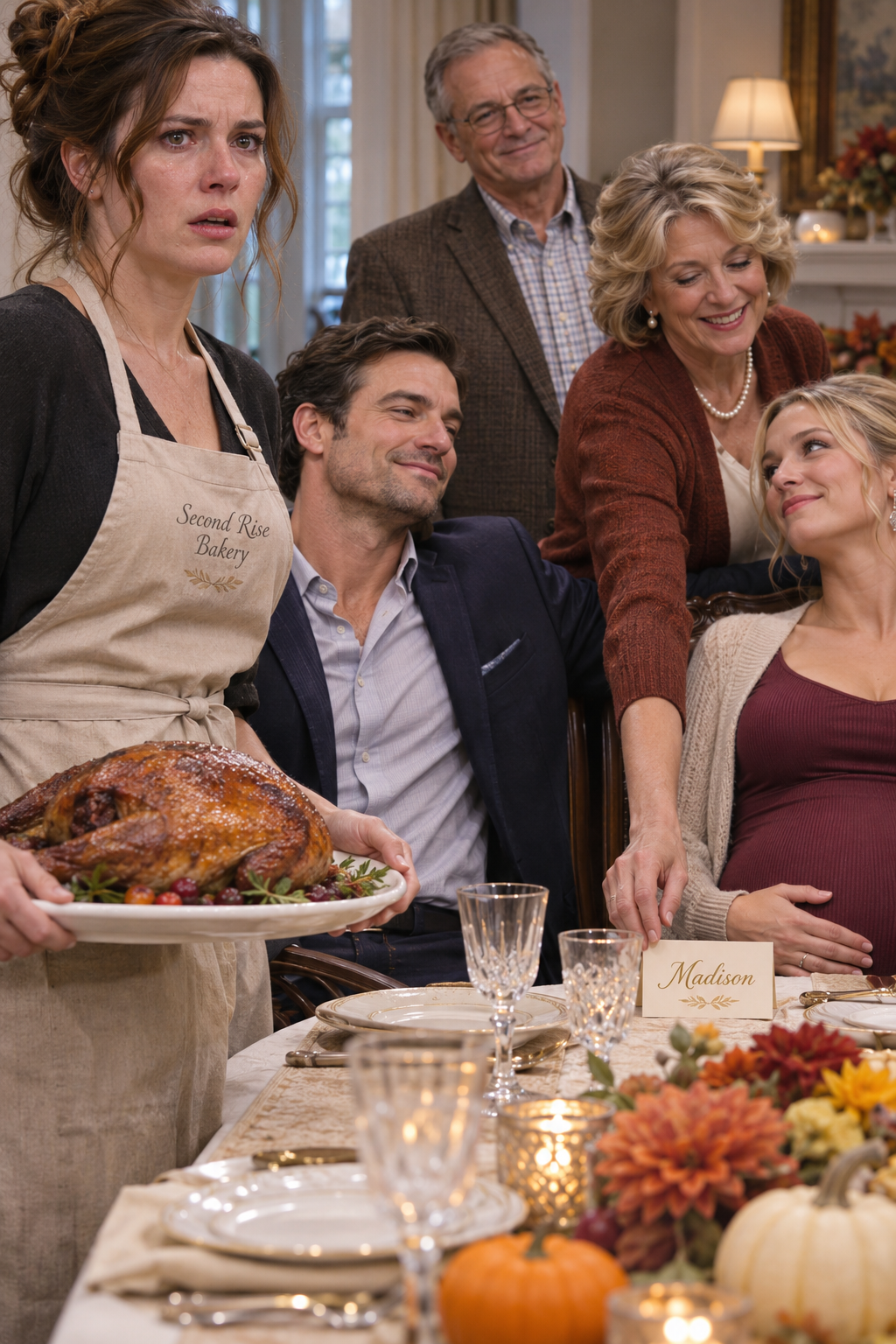
My husband brought his pregnant girlfriend to Thanksgiving in our home, and my mother had a place card ready for her. Then Mom asked me to hire the woman at my bakery, unaware of what I’d already discovered….
My name is Cora Ashby. I was 35 that Thanksgiving, standing in my Clintonville kitchen in Columbus, Ohio, holding a 22-pound turkey when my husband walked in with another woman. She was visibly pregnant. My mother didn’t look surprised. She walked over, kissed the woman on the cheek, and took her coat as if she’d been expected all along.
I owned Second Rise, a bakery on Third Street in German Village, with 12 employees and four ovens. I baked 340 Thanksgiving pies. I’d started the business at 28 with a loan and savings I’d scraped together since high school. It was mine before I married Beckett Lowry, and I kept the ownership in my name.
I was raised in Upper Arlington by Lillian and Dale Ashby. Dad ran an insurance agency; Mom ran every family occasion. Thanksgiving was her masterpiece. She invited widows, students, and people from church who had nowhere else to go, then wrote their names on little cream place cards with a gold pen. Every guest got one. I never did. “You’re family, honey,” she’d say. “You don’t need a card.”
When I was 16, Mom invited 14 guests but had only 13 chairs at the dining table. I ate beside the dishwasher in the kitchen while she toasted the guests. I told myself that being family meant not needing a seat.
Mom wasn’t always unkind. When I was eight, she stood behind me at the counter and helped me roll cinnamon dough into tight spirals. “Slow, Cora,” she said, guiding my hands. “Good things take time to rise.” It was the first thing I baked, and I remembered those gentle hands whenever her words hurt me.
At 19, I went to work for Mr. Farkas, an old Hungarian baker on the East Side. Four years later, he gave me a jar of sourdough starter already 20 years old. “Feed it every day,” he said, “and it will outlive your mistakes.” I called it Gus and fed it at four every morning.
I met Beckett at Second Rise when I was 30. He came in on a Saturday wearing a navy quarter-zip and asked what was good. I suggested the cardamom bun. He came back four Saturdays in a row and finally asked whether the baker ever took a day off. He was a regional sales director for a medical device company, charming and frequently on the road. My mother loved him immediately.
We married eight months later, in the bakery after closing, beneath string lights over the ovens. I’d baked the cake myself. Mom gave a long toast about how lucky I was to have a man who could pull me away from my apron. She barely mentioned the business I’d built. Everyone laughed, and I smiled along.
Beckett moved into the little brick house I’d bought two years before our marriage. On Sundays, he helped with the business books, so I authorized him to sign on the bakery’s account and pay vendors when orders overwhelmed me. I thought it was what trusting a husband looked like. My parents treated him like the son they never had.
She also wanted a grandchild. I kept saying I’d think about it when the bakery was steadier. Eventually Mom stopped asking me and started asking Beckett. He joked that I was “married to that bakery,” and she laughed. Once, he threw Gus’s jar in the trash because he disliked the smell. I rescued it and washed the glass without an argument. I wish I’d argued.
In June, Beckett attended a conference in Indianapolis. He returned wearing new cologne and taking phone calls on the back porch. Throughout July and August, there were more Indianapolis trips. By September, he was staying away on weekends. When I asked him to come to Second Rise’s seventh anniversary in October, he told me I didn’t need him there. He left before we cut the cake.
Mom’s calls became stranger, too. I overheard Beckett tell her, “Thanks, Lil. I’ll tell her soon.” He claimed they’d been discussing Christmas gifts. Then she called during the bakery lunch rush to ask whether part-time workers could get health insurance. I told her our plan covered employees working more than 20 hours a week. She said she was asking for a church friend and hung up.
On November 9, my bookkeeper, Dolores Kaminsky, set a printout beside my bread scale. She was 64 and could spot a missing nickel in a mountain of receipts. “Who’s SP Designs?” she asked. Seven payments had left my business account between July and November, totaling $14,700. The descriptions said menu board design and signage. Beckett had approved every one.
I looked at the chalkboard menu behind the counter. I’d written it myself in white chalk in spring 2021. No designer had touched it since. That night, after Beckett went to sleep, I checked the Ohio business filings. SP Designs LLC had been registered in June under a woman named Skylar Penn, using an apartment address in the Short North. The invoices had pretty logos, but no proof that a single sign had been delivered.
I printed the records and gave them to Dolores, who locked them in the bakery safe. “Not even your husband?” she asked when I told her to keep quiet. “Especially not my husband,” I said. I intended to deal with it after Thanksgiving. Two bakers were sick, the walk-in cooler broke, and I was sleeping four hours a night.
On Thanksgiving morning, I fed Gus, cooked the turkey, and set the table. Mom had said she was bringing an extra guest, a young woman from church with nowhere to go. That was normal for Mom. My parents arrived at noon with her box of place cards. Beckett texted that his Indianapolis flight was delayed and he’d come straight from the airport.
At , I heard his car and then two doors closing. He walked in with his arm around a young blonde woman, maybe 26, in a camel coat over a cream sweater stretched across her pregnant belly. “Cora, this is Skylar,” he said calmly. “I think it’s time we were all honest.” I held on to my grandmother’s turkey platter so tightly that my fingers ached.
Mom appeared, kissed Skylar’s cheek, and said, “There you are, sweetheart.” In the dining room, a cream card marked Skylar sat between Beckett’s place and my mother’s. Eight guests had cards. I had none. “Nobody eats alone on Thanksgiving, Cora,” Mom said when I looked at her. Dad stared down at the gravy and murmured, “Let’s get through dinner.”
Beckett’s brother and his wife, Renee, sat speechless beside two elderly neighbors. Mrs. Pruitt, 81, left early, claiming she had a cat to feed, but squeezed my arm and whispered, “I’m sorry, dear.” Dad said grace and thanked God for “new beginnings.” My mother’s hand rested on Skylar’s. Somehow I kept carving the turkey.
Skylar called my mother “Lil,” the nickname Mom reserved for her closest people. She asked, with apparent sincerity, whether I’d share my pie-crust recipe because Lil said I made Ohio’s best. “Cold butter,” I told her. “And don’t overwork it.” She smiled. Mom looked pleased, as if she were watching two friends get acquainted.
Before dessert, Mom put down her fork. Skylar was a freelancer, she explained, due in March and without medical insurance. “Give her a job at your bakery,” she said. “Twenty hours at the counter. Think about the baby.” Beckett nodded. Dad said it was the decent thing to do. I asked Mom how long she’d known. “Since September,” she replied. “I even went with her to her twelve-week scan.”
Eleven weeks of knowing. Eleven weeks of helping my husband hide another family while I worked before dawn. I carried out a bourbon-pecan pie, set it on the table, and looked at Skylar. “Come to the bakery a week from Saturday,” I said. “Six in the morning. We start early.” Mom clapped once and announced, “See? I told you. Family.” None of them knew why I’d said yes. Part 2…..
After the guests left, I washed every dish by hand. Beckett stood in the kitchen doorway and thanked me for being “mature.” When I asked how long the affair had lasted, he said since June, when he met Skylar at an Indianapolis design conference. The baby was his. He admitted Mom had suggested Thanksgiving because she knew I wouldn’t make a scene in front of company.
“She was right,” I said, turning off the tap. Beckett looked relieved. He announced he’d spend the night at Skylar’s to give me space. I told him to pack a big bag, and he took two. At the door, he repeated that I was married to the bakery and would barely notice he was gone.
Once his car left, I sat on the pantry floor between sacks of flour and finally cried. All I could picture was myself at 16, eating beside the dishwasher while Mom made room for everyone but me. At two in the morning I drove to Second Rise and baked bread until my arms hurt. At five, Dolores appeared with two coffees. She looked at my face, then toward the office safe. “It’s her, isn’t it? The SP girl?” I nodded. “Then we need a lawyer,” she said.
At nine, Mom texted to thank me for being gracious. She said Skylar had cried in the car because I’d been kinder than she deserved. I didn’t reply. On Monday, I sat across from attorney Corinne Tolliver in her brick office near the Ohio Statehouse and handed over the filings, invoices, and payment records. Corinne read them twice before she spoke.
She explained that Ohio divorce courts could consider financial misconduct when dividing marital property. The bakery had existed before my marriage, and payments for undelivered work could also give the company a claim against SP Designs. She said a written demand was possible and that I could consider reporting the matter to police, but I didn’t need to decide that day. The affair was one wound; the missing money was a separate problem that documents could prove.
Corinne’s instructions were practical: remove Beckett’s signing authority at the bank in writing, secure the accounting software, leave joint funds alone except for ordinary bills, and make no threats or public accusations. She warned that the house was mostly premarital property but Beckett might still have a claim based on contributions made during the marriage. She didn’t promise I’d get every dollar back. I trusted her more for that.
She filed for divorce Wednesday. Thursday, the bank removed Beckett from the bakery account and Dolores changed the passwords. That evening, Beckett stopped by to collect clothes and golf clubs. He noticed Gus bubbling on the counter and asked whether I still kept “that thing.” “He’s older than our marriage,” I said. “He’ll be here after it, too.” Beckett laughed. He hadn’t even tried to check the account.
Corinne sent SP Designs a written demand for the $14,700, with a 30-day deadline, arranged to arrive Saturday afternoon. Friday night, Mom called to say Skylar was nervous about starting work and that she and Beckett planned to accompany her. “Bring whoever you want,” I said. “We open at seven.”
On Saturday, December 5, I arrived at Second Rise at a.m. By six, cardamom and browned butter filled the kitchen, and my morning crew was rolling croissants. Dolores waited near the office with an envelope on her lap. At , the back door opened. Mom entered in her best red scarf, Beckett followed with a box of chain-store doughnuts, and Skylar came last wearing a new black apron. She stared at the racks of bread and whispered, “Wow.”
Mom hugged me and said I wouldn’t regret helping. I handed Skylar a clipboard and explained that every new employee filled out paperwork. “Before you sign anything,” I said, “there’s something you should see.” I nodded to Dolores, who laid the envelope on the stainless-steel table between the croissants and the egg wash.
Part 3 I spread out the seven payment records. “From July through November, Second Rise paid SP Designs LLC $14,700 for menu boards and signs,” I said. “Beckett approved each payment.” I pointed toward the old chalkboard visible behind the counter. “I wrote that menu myself in 2021. It hasn’t changed.” Then I showed them the state filing connecting SP Designs to Skylar Penn.
Skylar turned toward Beckett. “You told me those were real jobs,” she said, her voice unsteady. “You said the bakery was half yours. You said you were a partner.” Beckett reddened and asked her not to do this there. “You told me the divorce was already filed,” she continued. “You said Cora knew everything.” I told her I knew now. Mom tried to say the matter was between Beckett and me. “She’s on my books, Mom,” I answered.
Panicking, Beckett turned to Mom. “Lil, you said she never checks the books during the holidays. You said she’d be too busy with pies to notice until January.” My staff kept their hands near the dough, but the room fell silent. Mom went pale. I remembered her question about insurance. “You knew about the money?” I asked. She hissed that I should lower my voice because the employees could hear.
“They work for me,” I said. “They can hear the truth.” Mom admitted knowing Beckett was “helping” Skylar but claimed she hadn’t asked how. Then she said a baby cost money and I had so much. Finally she looked at me and said, “I’m going to be a grandmother, Cora. You were never going to give me that.” For a moment, I could hardly recognize the woman who’d taught me to make cinnamon rolls.
I set out the lawyer’s demand letter, the bank notice removing Beckett’s authority, and the divorce complaint. “Skylar, your company will receive its copy of the demand today,” I said. Beckett stared at the papers. “You filed? We could’ve worked this out.” “You worked it out in June,” I told him. “You just forgot to tell me.” Then I faced Mom. “You wanted her on my payroll. Beckett already put her there.”
Skylar took off the black apron, folded it, and placed it on the table. “I didn’t know it was your money,” she said. I believed she hadn’t been told the truth, but I also knew she hadn’t asked enough questions. I packed four cinnamon rolls from Mom’s old recipe into a white bakery box and handed them to her. “For the baby. On the house,” I said. “The money goes through my lawyer.” Skylar left, carrying the box.
Beckett followed with his doughnuts. Mom remained in the kitchen, surrounded by people who had heard everything. “I raised you better than to humiliate your mother,” she said. “You raised me to eat in the kitchen,” I replied. “I’m finally done doing it.” I held open the back door until she walked out.
At seven, I unlocked the front entrance. There was already a line down the block, and the cardamom buns sold out by . Tao, my head baker, had heard the entire confrontation. He came beside me at the register and said, “Morning, chef,” before returning to his ovens. Dolores squeezed my shoulder and told me it was our best opening of the year. Then we all went back to work.
The divorce took six months. Beckett’s lawyer argued he’d helped pay for the house and that the SP Designs invoices covered legitimate consulting. Corinne brought a photograph of my unchanged chalkboard to mediation alongside the invoices. The mediator asked Beckett’s attorney whether he needed a moment with his client. He took twenty minutes. The court ultimately counted the bakery money Beckett had taken against his portion of the property division, though I still owed him some house equity.
I recovered $11,500 of the $14,700 through the repayment and settlement process: $4,000 from SP Designs, which Skylar dissolved in January, and the remainder through adjustments to Beckett’s share of the house. The shortfall was $3,200. It hurt, but the bakery and the house stayed with me. I wasn’t going to let losing my marriage cost me the life I’d built before it.
Final In January, Beckett lost his sales job. His company’s expense audit had uncovered eleven Indianapolis hotel weekends he’d charged as client meetings. I hadn’t reported him; the expense records told their own story. Skylar left him that month after learning he’d lied about filing for divorce in June. She moved to Dayton to stay with her sister.
In February, Beckett called from an unfamiliar number. He said leaving had been the biggest mistake of his life and that he missed the house, the bread, and our Sunday nights doing the books. “You miss having someone to sign the checks,” I said. He didn’t deny it. I ended the call and returned to shaping baguettes.
Skylar gave birth to a healthy girl in March. I heard it through Dolores, who knew a vendor acquainted with Skylar’s sister, and I was genuinely glad the child was well. In April, Skylar sent a cashier’s check for $600 and a short apology saying it was what she could afford. I used the money for flour. I kept her note, though I didn’t write back.
Renee, my former sister-in-law, came to buy a dozen cardamom buns that spring. She told me she’d stopped speaking to Beckett after Thanksgiving. She also admitted that, at her church Christmas potluck, she’d started telling the story of Mom’s place cards and couldn’t seem to stop. By then, half the congregation knew what had happened at my dinner table.
In May, Mom wrote me a three-page letter in her familiar gold ink. She insisted she’d only wanted to make sure no one felt left out. She said the baby deserved a grandmother and that I had always been so independent she hadn’t imagined I needed her. Then she asked to come for Thanksgiving and offered to bring her place cards. I wrote back a single sentence: “You never made one for me, Mom.”
Dad didn’t call. In June, however, Dolores found an odd pattern in the online orders. Every Saturday since Christmas, someone named D. Ashby had paid for a loaf of sourdough and never collected it. I stared at the printout for a long time. I told her to give each unclaimed loaf to the shelter on Parsons Avenue, as we did with leftover bread. I didn’t contact Dad, and I didn’t cancel the order.
That November, Mom and Dad sat at their own Thanksgiving table without the crowd Mom had always gathered. Renee told me afterward. I hosted dinner again, but this year I invited the people who had worked beside me: my bakery crew, two of their children, Dolores and her sister, Mrs. Pruitt from next door, and a 20-year-old dishwasher from Venezuela who’d never celebrated American Thanksgiving. Mrs. Pruitt brought cranberry relish and confessed that the cat she’d supposedly rushed home to feed the previous year didn’t exist.
Before the guests arrived, I fed Gus at four, as I had every day for 13 years. Mr. Farkas had been right: that old starter outlived my mistakes and my marriage. I baked the bread from it and set the loaves at the center of the table. Then I took out cream cardstock and a gold pen and wrote a place card for everyone, carefully, in my best handwriting.
I wrote my own last: Cora. I put it at the head of the table, near the oven, and sat down. Halfway through dinner, our young dishwasher rose and held up his card. “Nobody ever wrote my name for dinner before,” he said. Everyone laughed and clapped. I looked down at my plate for a moment because I couldn’t quite speak.
Mom always said nobody eats alone on Thanksgiving. That year she was right. For the first time in my life, there was a card with my name on it at my own table.
THE END. I’ve shared the complete story, and I truly hope it touched your heart. If this story moved you, please , like, and share the post. Thank you for reading! ❤️
✓ Lynn R. Adams
My husband brought his pregnant girlfriend to Thanksgiving in our home, and my mother had a place card ready for her. Then Mom asked me to hire the woman at my bakery, unaware of what I’d already disc…