My husband and his mistress tried to make me take the blame for falsified truck inspections, and his mother told me that was what wives were for; after one sleepless night, I knocked on an injured driver’s door with a confession…
My husband and his mistress tried to make me take the blame for falsified truck inspections, and his mother told me that was what wives were for; after one sleepless night, I knocked on an injured driver’s door with a confession…
Six months before everything came apart in court, my husband moved a twenty-eight-year-old woman into the penthouse above Thorn Freight headquarters. Max called Daphne Quill his executive assistant, although her name was already on his late-night dinner reservations. Within a week, she was wearing the earrings he’d given me on our fifth anniversary.
My name is Juno Keen-Thorne. I was thirty-one, and I’d spent nine years keeping the books for Max Thorne’s trucking company in Ohio, starting when it had four trucks and a rented lot. I could read a diesel invoice as easily as a grocery list. By then we had about two hundred drivers, a headquarters building, and more debts and secrets than anyone outside our offices understood.
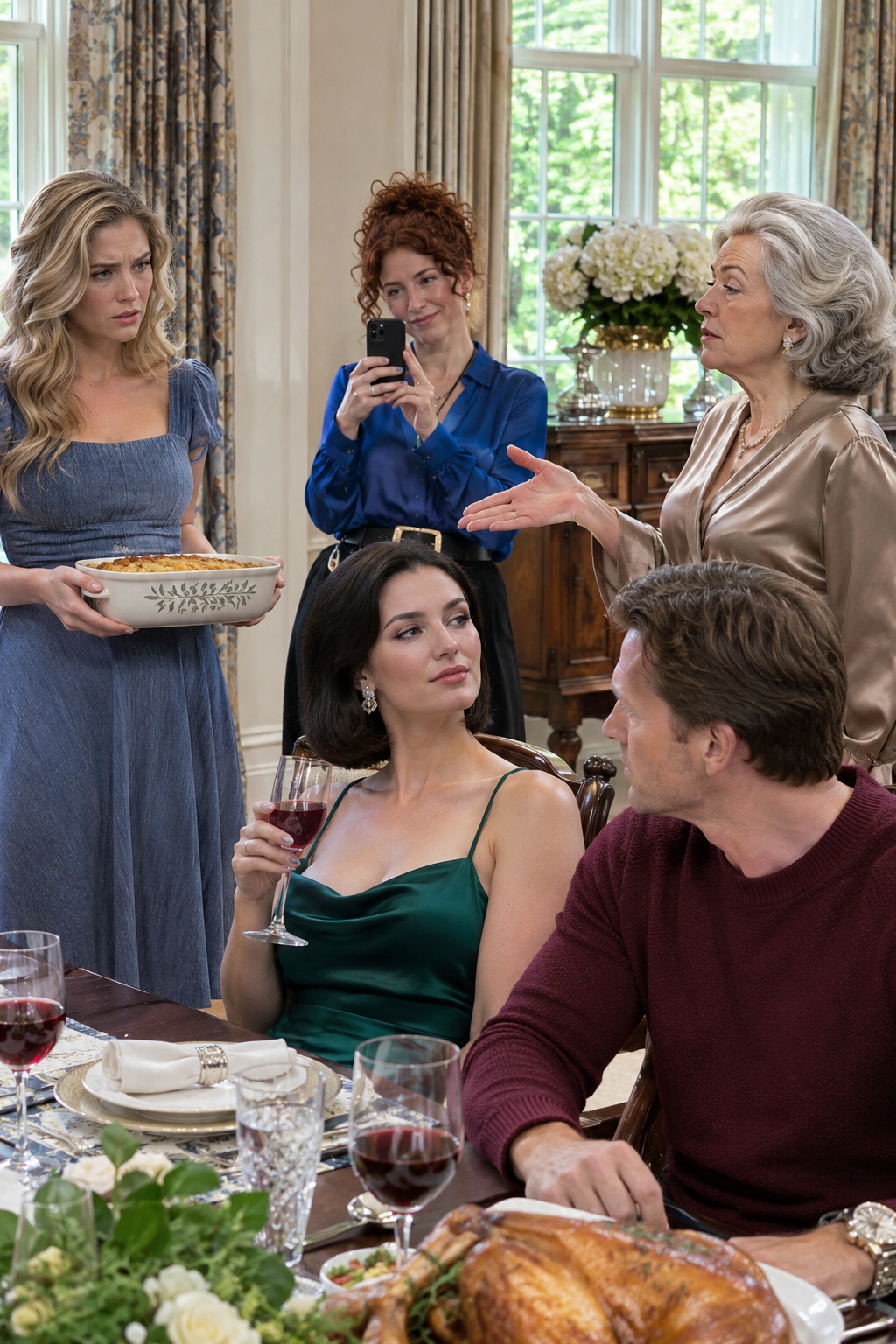
The first Sunday after Daphne moved in, we went to dinner at Max’s mother’s house. Rosalyn Thorne was sixty-three and had never hidden her disappointment that her son had married a bookkeeper’s daughter. For six years I’d sat in the same chair at her dining table; that evening, Daphne was sitting there, sipping wine in my anniversary earrings.
I was carrying a casserole when Rosalyn looked at me and said, “The kitchen needs you, dear. Daphne is our guest.” So I carried dishes while my husband talked business with his girlfriend, and his sister Carly held up her phone to record me doing it.
Later, Carly posted the clip online with a joke about “the help” trying to look elegant. Roughly forty thousand people saw it. Rosalyn even told me she’d spent six years praying Max would find someone better. I had bought that dress on sale because every spare dollar I could save had gone back into the company Max always called ours.
Max caught me in the hallway after dinner, adjusting the cuff links I’d bought him. “Tomorrow I’m taking your name off the company accounts,” he said. “You were never a real partner. You were a bookkeeper who got lucky.”
I asked him whether he had forgotten who balanced those accounts when the business could barely pay its drivers. He told me not to make things ugly and said Daphne understood his company better than I ever had. I didn’t argue, partly because I knew exactly what she had been studying.
Five years earlier, Thorn Freight had been close to failing. A grocery distribution contract could save us, but the customer required a clean safety inspection for our fleet. Twelve trucks failed their brake inspections, and putting them right would cost nearly $400,000 and take six weeks we didn’t have.
Max sat on our bed after midnight, looking sick with fear. He talked about the drivers losing their jobs, our home being taken, and the little company we’d built disappearing. Then he said, “You’re the only person I trust to fix the paperwork.”
He never said the word falsify. He didn’t have to. I signed the failed trucks’ inspection sheets as if they’d passed, using my own name, and told myself the brakes would be repaired as soon as that grocery contract paid.
Three weeks later, Hank Ruiz lost his brakes on a mountain grade outside Pittsburgh. He was forty-four, with a wife named Elena and two children, and he survived the crash with injuries that changed the way he walked. The company settled his claim privately, with a confidentiality agreement, and Max called the whole thing “handled.”
I wanted to believe him because the alternative was admitting what I’d done. Every night I could hear the accident again, although I’d never been on that road. I told myself I’d made one terrible choice to protect hundreds of paychecks, as if the number of employees could erase the man who’d been hurt.
Daphne eventually discovered the old inspection records. I don’t know whether she found them on a server or in a cabinet Max had foolishly opened to her. What I do know is that money began leaving the company for her benefit in larger amounts, and Max grew frightened whenever her phone rang.
A week after that Sunday dinner, a process server approached me in the grocery store. Max’s lawyers had filed a civil claim alleging that I alone had falsified the inspections and deceived the company. They wanted to recover damages from what they called my personal assets: our house, our savings, everything I believed we’d built together.
Daphne had also filed a claim asserting Max had promised her an equity interest in the business. Their filings told two different stories, but both depended on treating me as expendable. The documents shook so badly in my hands that I had to sit in my parked car before I could drive.
I went straight to Rosalyn, who was working on needlepoint in her sunroom. I set the papers beside her chair and asked whether she knew what Max was doing. She didn’t even lower her sewing. “Of course. I helped him find the lawyer.”
“He asked me to do it,” I told her. “And now he wants me to carry all of it.” Rosalyn pulled her thread through the cloth and said, “That’s what wives are for, Juno. Somebody has to take the fall, and it won’t be my boy.”
That night I went to the penthouse. Daphne was sprawled on the sofa with her feet in Max’s lap, and neither of them stood when I walked in. I asked my husband whether he would truly let me face prison for something we’d done together.
He studied me as though I were an employee asking for a raise. “Better you in a cell than me,” he said. Daphne laughed, and Max turned back to her as if the conversation were finished.
I slept in the guest room on a bare mattress because the bedding had been stripped off. Around three in the morning, I stopped going over the things I wanted to say to Max and started thinking about Hank. He was living with the damage from a decision I’d made at my own desk.
It would have been easy to tell myself I was only a betrayed wife. But I had signed those inspection forms; nobody had moved my hand across the page. Max had exploited my fear of poverty and my love for him, yet I had chosen to endanger people who trusted our trucks.
The next morning I drove to Pittsburgh instead of going to the attorney whose number Rosalyn had passed along. Hank’s little house had a ramp over the front steps. He opened the door holding a cane and recognized me before I could introduce myself.
“If you’re here to offer me more money to stay quiet, you can leave,” he said. I told him there was no offer, that I’d come to explain what had really happened before his crash. After a long look, he stepped aside and let me through.
Elena stood by the stove while I sat at their kitchen table. I told them about the twelve trucks, the inspection sheets, Max’s request, and my signature. I said I had known the brakes were not fixed, and that I had allowed myself to believe a later repair would make an earlier lie harmless.
Hank listened without interrupting, his cane leaning against the table. When I finished, I said I was sorry and wasn’t asking him to forgive me. “Sorry doesn’t fix my back,” he replied. “And I don’t forgive you, Mrs. Thorne. I may never.”
I told him I understood, even though understanding was the least I could give. Elena gripped the edge of a dish towel, her face tight, then asked whether I’d tell the same story somewhere it could actually matter. I said yes, knowing I had no right to ask either of them to believe me.
Hank opened a drawer and pulled out a sheet of paper he’d been keeping for years. On it were eleven names: drivers, dispatchers, and mechanics whose complaints or injuries had been ignored, buried, or bought off. There was Delroy, fired after reporting worn tires, and Patrice, whose husband died in another crash and whose settlement had been reduced.
“They won’t trust you,” Hank said, pushing the list toward me. “But maybe they’ll trust the truth.” I left his kitchen with those eleven names in my hand, not knowing whether I was about to lose my marriage, my freedom, or the last chance to do something decent with either one. Part 2…..
IF FACEBOOK BROUGHT YOU HERE, HERE’S THE CONTINUATION YOU’VE BEEN WAITING FOR. ENJOY! 👇 Over the next two weeks, I went to see every person on Hank’s list. Some shut their doors before I got through my name. Others let me speak because they were tired of being told there was nothing more to discuss.
Delroy showed me where he had written down his complaints about worn tires before he was fired. Patrice threw a coffee mug against her kitchen wall when she heard who I was, then sat with me for two hours talking about her husband. I took notes, but I stopped trying to make anybody’s grief fit neatly into a column.
The people I met had different stories, and I couldn’t assume every claim was proved just because I believed it. Still, the pattern of ignored safety warnings, broken promises, and silence bought with settlements was hard to miss. I began to understand that they wanted more than to see Max punished; they wanted work that wouldn’t cost them their health or their families.
Meanwhile, the civil case kept moving. Max’s attorneys tried to isolate my signature from the decisions that had led to it, and access to my accounts was tied up in the fight. The bank called about the mortgage, and I started quietly selling jewelry so I could put gas in the car.
One night, close to midnight, I was sitting on the guest-room floor reading old company files when Rosalyn called. She sounded nothing like the woman who had ordered me into her kitchen. “Juno,” she said, “I’m outside. Would you let me in?”
Through the front window I saw her standing in a coat over her nightgown, carrying a leather briefcase. Her silver hair was flattened on one side, and she was shaking. I opened the door and put on the kettle because neither of us seemed to know what else to do.
“They’re putting me out,” she said when we sat down. She told me Max and Daphne had arranged the sale of the big house her husband had left her, and she had learned about it when a realtor came to measure the rooms. The retirement account she’d built over forty years had also been drained into the business to cover payments connected to Daphne.
Rosalyn stared into her cup and kept saying she’d raised Max to care for his family. “You raised him to take what he wanted,” I answered before I could stop myself. She looked as though I’d struck her, but after a moment she nodded. “Yes,” she said. “I did.”
Then she opened the briefcase. Inside were Max’s private ledgers, a second set of books she’d found while searching his safe for papers about her house. They recorded payments to Daphne, transfers from the company’s safety fund, and bribes to inspectors who had ignored problems that should have shut trucks down.
I’d maintained the books Max showed accountants and lenders, but I had never seen this private set. The figures explained several gaps I’d been unable to reconcile and showed how much more money had vanished than I knew. Rosalyn’s hands trembled as she turned the pages.
“I want you to have them,” she said. “Not to protect you. For Hank Ruiz and the others my son hurt while I kept calling him a good man.” I asked her whether she understood what giving them to me might cost her.
“It already cost me,” she said. Then she looked straight at me and apologized for calling me the help, for taking my chair, and for telling me I was meant to fall for her son. I believed she was ashamed, but shame wasn’t the same thing as trust, so I took the ledgers and made no promises.
When Carly learned what her mother had done, she called Rosalyn a traitor. Max told her, “You’re dead weight, Mother. You’ve always been dead weight.” Rosalyn packed one suitcase, moved into a motel on Route 9, and did not ask me to persuade him to take her back.
I could have handed those books to a reporter and watched Max try to explain every entry. But I remembered something Hank had said after one of our visits: “Everybody wants somebody to burn. Nobody wants to rebuild.” I looked again at the numbers, this time not as Max’s wife but as the accountant who had lived with them for years.
Thorn Freight was insolvent. The debts I knew about were bad enough; the hidden payments, borrowed money, and missing safety funds made them impossible to manage. Some of the accounting tricks concealing that trouble were ones I’d helped create, and there was no honest way to pretend otherwise.
I brought both sets of books to a bankruptcy attorney named Ms. Okapor. She read them slowly, took off her glasses, and asked whether I understood how serious the disclosures would be for me as well as for Max. I told her that was why I was there.
She explained that the company’s financial condition could justify court supervision and a receivership sale, with the proceeds going toward creditors under the applicable priorities. An approved buyer would have to put real financing behind an offer. “That could include the employees,” she said, “if they can organize and meet the terms.”
I sat in her office thinking about drivers who knew those trucks and routes better than Max ever had. I didn’t have a hidden fortune to buy them a company, and I told her so. “Then don’t tell them you do,” she replied. “Show them the numbers and let them decide what risk they can take.”
That evening I called Hank, Patrice, and Delroy. We met around a kitchen table and discussed what an employee-owned trucking business might look like, including the money needed for repairs and the chance that the court wouldn’t accept our offer. I said plainly that their livelihoods were not mine to gamble away on a promise of redemption.
Over the next three weeks, we held meetings in a church basement with folding chairs and coffee that tasted scorched. One hundred forty drivers came to the first one. By the time we assembled a financed bid, one hundred ninety employees had signed on to the Keen Drivers Cooperative.
Some put in savings; others considered pensions or borrowing against their homes, knowing they might lose what they pledged. We argued over governance, maintenance spending, and what would happen if we failed. Patrice suggested the cooperative’s name, saying someone ought to make the Keen name mean something better than it had.
Rosalyn came to the third meeting and stood near the back in her plain coat. Conversations stopped when people recognized her. She walked to the front and said she’d come with $81,000 from the sale of her mother’s farm, the money she still had control of, and wanted to contribute it to the effort.
“I’m not asking you to forgive my son or me,” she said. “I’m asking you to use this for the people we failed.” Nobody applauded. Hank, sitting in the second row with his cane across his knees, gave her one small nod, and she returned to her seat.
The hardest thing came when our bid had to disclose the safety fraud and other known liabilities. The cooperative’s lawyers told me to be careful not to confuse the workers’ case with my personal criminal exposure. I spent one night considering what it would mean to leave my own signatures unexplained.
The following morning I wrote an eleven-page sworn statement describing every inspection form I had falsified, when I’d signed it, what I’d known, and what Max had asked me to do. I had it notarized and submitted through counsel with the bid disclosures, knowing that regulators and prosecutors could receive it. I wasn’t trading a confession for immunity; nobody had offered me any.
Hank read the statement slowly, his finger moving under the lines. When he reached the end, he closed the folder and said, “That’s the price of being trusted, isn’t it?” I answered, “I think it’s the minimum.” He signed as a witness to our bid and handed the pen back to me.
Part 3 By the morning of the sale hearing, I was living on nerves and instant coffee. I put on the gray suit I’d bought for my mother’s funeral and drove to the courthouse, wondering if the cooperative would survive the day even if the judge approved our offer. I was frightened of the prosecutors, frightened for the workers’ money, and frightened of seeing Max.
He and Daphne were in the hallway laughing about a preliminary decision that had suggested her promised-equity claim might have merit. They acted as though that meant she’d already won a large payment. Max had brought a bottle of champagne in a bag, and they’d made dinner reservations at a steakhouse.
He slid a set of papers toward me on a courthouse bench. “Sign it, Juno. Daphne won. You get nothing.” She touched the diamond bracelet on her wrist and said I’d been useful, like a good vacuum, before she turned toward him with a laugh.
I looked past them into the courtroom, where Rosalyn was taking a seat beside Hank and dozens of drivers in their best clothes. She wasn’t standing with her son anymore. “Before you celebrate,” I told Max, “you might want to find out who owns Thorn Freight’s building now.”
He laughed and said I was out of my mind. Then the bailiff called everyone to rise for Judge Abigail Strom. She was a lean, gray-haired woman in her sixties, and when she sat down she opened the receivership file rather than the papers Max was waving.
“We’re here to finalize the court-supervised sale of Thorn Freight Incorporated,” she said. She noted that Max and Daphne, through their lawyers, had received notice of the receivership proceedings three weeks earlier. Max looked at his attorney, then back at the bench, as though someone had switched the room while he wasn’t watching.
“Your Honor, this is about Miss Quill’s settlement,” he protested. The judge explained that the company had been placed under supervision on the fourteenth and that its assets could not simply be promised away by Max. He had appeared at four related hearings, she noted, but hadn’t seemed to grasp what the notices meant.
There had been three purchase offers. Two lacked adequate financing, and the receiver had recommended the third, submitted by the Keen Drivers Cooperative with full disclosures and committed funds. Judge Strom approved the sale on the record, confirming that the business and its headquarters property would pass to the cooperative under the sale terms.
Our workers owned it together, and I had been chosen to serve as the cooperative’s managing trustee. The effective transfer was recorded for nine that morning, subject to the sale order’s terms. I heard someone behind me exhale, but nobody cheered; there were still trucks to repair and debts to settle.
Max shoved his chair back. “She can’t own anything! She falsified safety inspections!” The judge said my signed statement was already in the file and the relevant information had been referred to the district attorney. I had not concealed my role to gain approval, she added, and the sale did not erase any criminal responsibility.
Daphne’s face changed as she understood that a preliminary view about her claim was not a check. Judge Strom explained that even if the claim were allowed as an unsecured obligation, it would rank behind higher-priority claims and receive only what the distribution could support. Current estimates, she said, suggested perhaps four cents for each dollar claimed.
“Max said the company was worth thirty million dollars. He told me I’d be a millionaire,” Daphne whispered, then said it louder. He snapped that she’d drained the company with payments and threats. “You paid me because you were afraid,” she shot back, and the people seated around us turned to listen.
The judge told them to let their attorneys handle allegations that were not before her for a final finding. But Daphne kept talking, insisting she had not been there when the old inspections were falsified. “He knew the brake sheets were fake from the beginning,” she said. “He told Juno to sign them. I have his texts.”
Max ordered her to be quiet. The judge cautioned Daphne to obtain independent counsel and directed that any potentially relevant records be preserved for the authorities. It was not a criminal trial, but what she’d said in front of those lawyers and witnesses could not be pulled back into her mouth.
Carly sprang up in the gallery, dressed in white, calling me a liar and insisting Max was a good man. Rosalyn rose a few seats away. “Sit down, Carly,” she said quietly. “I found the ledgers, and I gave them to the lawyers and the court.”
Carly stared at her mother as if she didn’t recognize her. “What have you done?” she asked. Rosalyn said, “I told the truth. It’s what I should have taught both of you.” For once, Carly had no reply.
Max finally turned and saw his mother sitting beside Hank. His face slackened, then hardened, but nothing he said changed the approved sale. Judge Strom concluded the hearing, leaving the civil claims to be addressed through the proper process and the potential offenses to prosecutors.
I’d imagined that moment would feel like winning. Instead I stood outside the courthouse with my hands trembling inside the pockets of my gray jacket. The cooperative had a chance, but it also had an exhausted fleet, injured people owed justice, and workers who had risked their savings on us.
Final Over the following months, the district attorney charged me for my part in falsifying the inspection records. I admitted what I had done in open court, with Hank sitting in the gallery. My sentence was three years of probation and eight hundred hours of community service, and I was barred from holding a safety certification in Ohio again.
I didn’t ask anyone to call that a bargain, especially not Hank. His injuries weren’t reduced by my probation, and no sentence could return the years he had lost. I accepted the restrictions and reported for the hours I owed, one ordinary day at a time.
The house was sold to pay creditors, and I moved into a one-bedroom apartment above a hardware store. The radiator clanked at night, and my only window faced a parking lot. For the first time in years, there wasn’t a room in my home I had to pretend belonged to someone else.
The evidence against Max went much further than the forms I’d signed. Daphne’s messages and Rosalyn’s private ledgers documented his knowledge, the payments, and his role in the deception. He accepted a plea agreement the following spring on charges more serious than mine and went to a minimum-security facility about two hours north.
He never wrote to me, and I never wrote to him. That silence suited me better than an apology he might have given only after losing everything. We had spent years calling the business a marriage and the marriage a business; neither had been honest for a long time.
Daphne sold the diamond bracelet, my anniversary earrings, and the other things she could turn into cash. She moved to Florida, and the last I heard she worked in a dental office. Carly stopped posting videos and moved in with a friend; she no longer spoke to her mother.
Rosalyn found a small apartment across town, supported by what remained from her mother’s farm and wages from a church thrift store. She was sixty-four now and ironed her own clothes. We didn’t become close just because she’d finally chosen to help the people her son had hurt.
The cooperative spent its first year doing the unglamorous work we’d promised to do. We replaced brake parts, documented repairs instead of inventing them, and made sure drivers could report safety problems without losing their jobs. Those changes took money we wished we could spend elsewhere, but the drivers refused to call them optional.
Hank became our safety director. He walked the yard each morning with his cane, resting a hand on a tire or a doorframe as he checked the trucks and spoke to mechanics. His experience mattered there, and the position was his because the workers trusted his judgment, not because he owed me anything.
A year after the hearing, I was driving a delivery route in a cooperative jacket. The truck had passed three inspections that month, with real work behind the paperwork, and I had checked the brake maintenance records without signing any safety certification. There was something steadying about getting the freight where it belonged and coming home tired for a reason I could explain.
One afternoon I backed into the loading dock after a long run. Hank was waiting there, watching me guide the truck between the cones. I set the brake, climbed down, and waited while he looked the vehicle over.
He didn’t forgive me or tell me he’d forgotten. He simply met my eyes and nodded once, the way he would to another driver who’d done the job correctly. I thought about that nod more often than I thought about the courtroom, because it asked me to keep doing the work tomorrow.
A few weeks ago, Rosalyn mailed me a three-page letter in careful, shaky handwriting. The first line said, “I do not expect a reply.” I read it twice at my small kitchen table, folded it, and put it in a drawer with the other things I’m still learning how to carry.
I may answer someday. I may not. Telling the truth did not make everyone whole or obligate anybody to forgive, and I had finally stopped demanding a tidy ending from people who’d lived through the mess I’d helped make.
For years I thought being a good wife meant protecting Max, and being a good person meant having a reason for whatever I did. I know better now. My fear was real, my betrayal was real, and so was the harm I chose to help conceal.
If there’s one thing I can say from that cramped apartment above the hardware store, it’s that telling the truth late is still better than keeping it buried. It cost me the life I’d been protecting, but it gave the people I’d hurt a chance to be heard, and it lets me sleep at night without calling my silence love.
THE END. I’ve shared the complete story, and I truly hope it touched your heart. If this story moved you, please , like, and share the post. Thank you for reading! ❤️
✓ Lynn R. Adams
My husband and his mistress tried to make me take the blame for falsified truck inspections, and his mother told me that was what wives were for; after one sleepless night, I knocked on an injured dri…