My HOA Sold My House to a Museum While I Was Away. I Found My Daughter’s Bedroom Strapped to a Truck.
My HOA Sold My House to a Museum While I Was Away. I Found My Daughter’s Bedroom Strapped to a Truck.
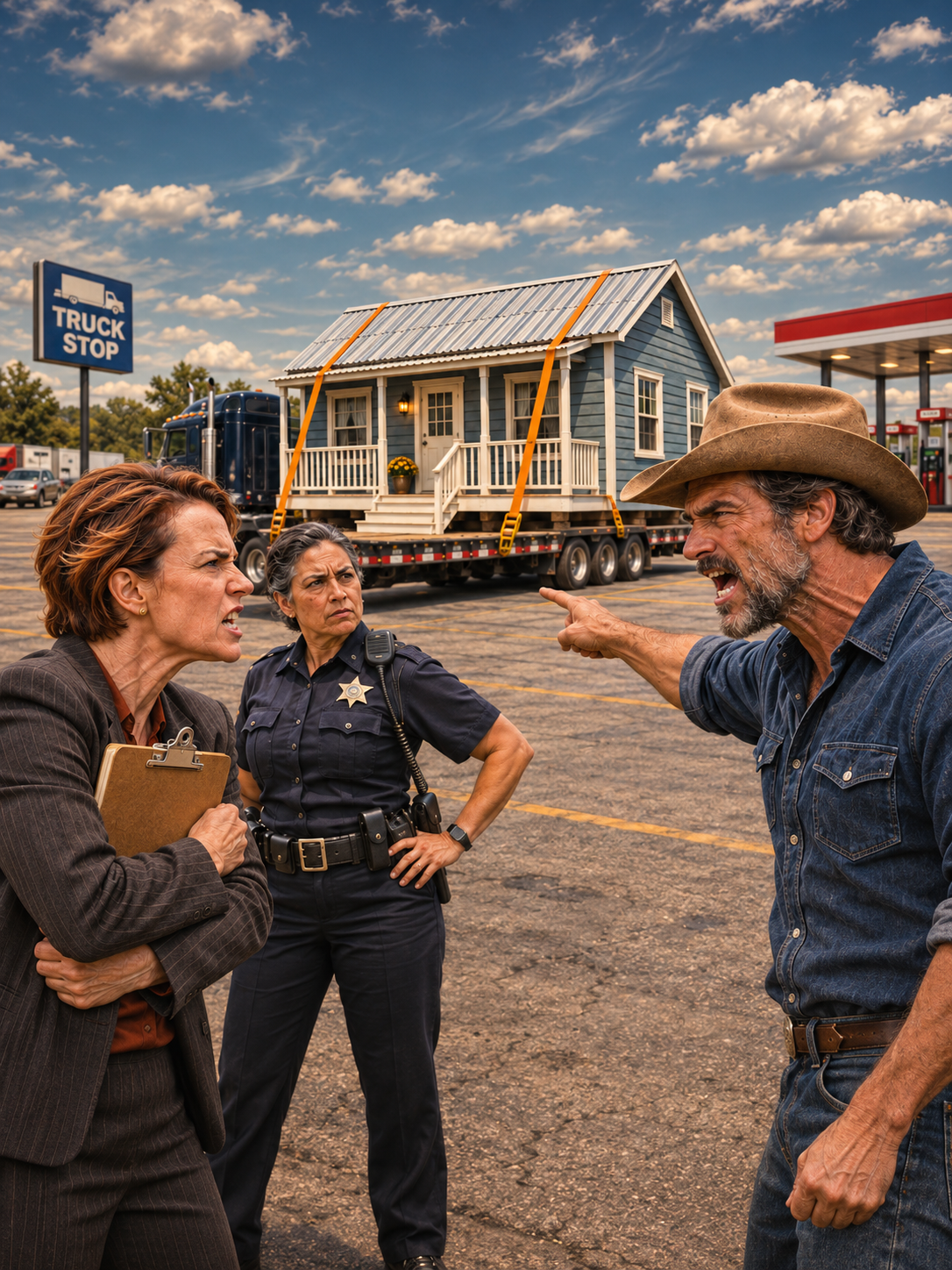
The president of my HOA was standing at a truck stop, telling a driver to take my house across the county line before the sheriff arrived.
My daughter’s bedroom was on a steel trailer in the row behind pump nine.
In the open front doorway, just past the yellow strap somebody had thrown over our porch roof, I could see the pencil mark my wife made the last time she measured our girl.
“Get him away from the truck,” Meredith Vale said.
She pointed at me without turning her head. The driver had his window down. He still had one elbow on the sill and one hand on the wheel. He looked from Meredith to me and back again.
“That’s my house,” I said.
“The museum is expecting that delivery.”
The diesel was rattling through the ground. I had to put one hand against the side of a concrete bollard to make myself feel how solid it was.
“Look through the window over your shoulder,” I said to the driver. “There’s a pair of work boots on the mat. The left one has blue paint on it. Ask her whose those are.”
The driver looked.
Meredith stepped between us. She wore white sneakers. There was a smear of the red clay from under my front steps on the right one.
“You signed it over, Silas,” she said.
I held my hands where the driver could see them.
“I signed for a broken step.”
From behind the fuel pump my daughter called, “Dad, the door.”
Something scraped inside the house. I knew the length of the scrape and the knock that came after. The little table in our hallway had one short leg. I used to hear it do that every Saturday when Ellen pulled it away from the wall to sweep.
Meredith took my sleeve. I pulled free, and her clipboard hit the ground all at once, like a board dropped flat.
Sheriff Ruth Ortiz came between us with both palms up.
“Driver, kill it.”
He turned the key.
The engine stopped. The trailer settled. Past the white edge of the porch, I could see the curtain in our hallway move in and out.
I wanted to climb onto that trailer and shut the door.
I wanted to get down on my knees in the dirt and find every nail they’d pulled.
I wanted to put my daughter’s little blue plate back beside the sink so she’d know I could fix at least one thing.
I wanted Meredith to say exactly how she’d gotten into the room where my wife used to sleep.
I wanted the last hour back, all sixty minutes of it, right up to the moment before my daughter said, “Dad, keep driving. That can’t be our lot.”
Instead I took my phone out of my pocket.
“What are you doing?” Meredith asked.
“Taking a picture of your clipboard.”
Ortiz looked down at it. Three pages stuck out from under the clip. I took a picture from where I stood. Then I asked the sheriff if I could get a picture of the road permit in the escort driver’s window before anybody thought to take it out.
“Grab it from here,” she said. “Keep your feet behind that stripe.”
I’d spent twenty-seven years making cabinets. Once, a customer in Pittsburgh swore a whole bank of kitchen drawers had dropped by half an inch over a weekend. I went out with a level and found the cabinets in the same place I’d left them. The stone crew had taken the floor up and put in a thinner tile.
The first thing I do when somebody tells me something moved is find a spot that stayed put.
I took a picture of the broken cable for our porch light hanging down against the trailer frame. Then I took one of the doorpost, with the measuring lines just visible under the top strap.
I’ve been back through the photographs since. The first one I took of my own house at the truck stop has my index finger in it. You can see where I cut that finger on a sheet of birch plywood the day Meredith came to offer me help.
She had waited while I put a Band-Aid on it.
“You could let somebody do a nice thing for you now and then,” she’d said.
That was six weeks earlier. Our house sat where it had sat for a hundred and twelve years, on the downhill side of Mill Road in Alder Bend, Pennsylvania. White porch, blue siding, tin roof that made sleeping through a shower impossible unless you were born in the house. We’d owned it for nineteen years. I’d replaced enough of it that I could tell you which boards under each room still belonged to whoever built it.
The street had been folded into a new subdivision on the old mill grounds. Once, our little stretch had been four houses and a company store. Then a developer built sixty-eight more houses, put up a stone sign at the entrance, and gave us all a homeowners association. By the time Meredith took over, the people at the far end of the development called Mill Road the historic section. I called it one lane when a delivery truck met a school bus.
Meredith had been our HOA president for almost three years. She could get three bids for a retaining wall before most people managed to find one phone number. She could also spend twenty minutes at a board meeting discussing where Mrs. Danner was allowed to put out a folding chair. She tended to remember the difference between a problem she could solve and a problem she could charge for.
The tread on my front step had been cracked since February. My wife Ellen used to step over it as if it were a game. In the winter after she died, I started putting one foot right in the middle of it. I knew the wood would take my weight, and every time it did, I got another day before I had to go outside with my tools and change something she’d touched.
Meredith had a photo of the crack. She also had a half-page form for a neighborhood restoration program that covered small exterior repairs. The lumber alone would have cost me a couple of hundred dollars by the time I matched what was there.
“I can fix it,” I told her.
“I know you can. Ever think about letting the fund buy the wood?”
I read the form. It gave a contractor permission to work on the front steps and porch during agreed hours. A printed line said a key could be copied where necessary. I crossed it out and wrote NO INTERIOR ACCESS beside it. Meredith set her coffee on a porch rail and held the paper down while I signed.
Then she tore off my yellow copy. She laid it flat on the rail to take a picture for the grant file before she handed it to me.
I should tell you something about the way I remember that morning. I remember the red polish on Meredith’s thumb had chipped. I remember a robin in the grass beside her left shoe. I remember how easy she made it to sign. I spent a month afterward trying to remember her face at the moment I did it, looking for the point at which she could have known what she’d use my signature for. The truth is she might not have known yet. It didn’t make me feel any better when that finally occurred to me.
Ten minutes after Meredith left, my daughter came through the screen door holding the bottom half of a sandwich.
“Are they painting the post?” Callie asked.
“I don’t think so.”
“You said that about the trim. Then you painted the trim.”
I put down a flowerpot and reached for my phone. There were eleven pencil lines down the inside of the white post. They went all the way back to kindergarten. The last one read Callie I7 because Ellen had broken her pencil trying to finish while Callie complained that her legs were going to cramp. Ellen used a capital I for the one. A cabinetmaker’s wife, and she’d picked up a piece of pencil lead between two fingers and written on the wood like that.
“Get the date in the picture,” Callie said.
“For what?”
“So if somebody paints it, I know when the last one was there.”
I asked Meredith in a text to tell the painters to leave the post alone. She gave it a thumbs-up.
Number 18 Mill Road was four houses closer to the old mill. Our house was number 81. The numbers threw people off because the county had renumbered one side after a bridge was removed, then left the other side alone. Packages had gone to the wrong house since before Callie was born.
Both cottages were built to the same plan. Both had been painted what the hardware store called Mill Blue, though anybody who mixed the color after the mill closed had only guessed at the recipe. Number 18 had plywood over the front windows. The county had acquired it years before and offered it to the West County Heritage Museum for an outdoor exhibit. There was a picture of it on a grocery store flyer with somebody’s spare plastic lawn flamingo on the porch.
I told one of the museum volunteers I was glad they were finally going to do something with it.
Then, two weeks before my house disappeared, a county inspector went down to number 18 and spent half an hour under the kitchen. I knew because he left the tailgate of his truck open and a crow kept getting in it to pull at a sandwich wrapper. When he came out, he wiped his fingers on a green rag and stapled an orange notice to the front.
That night Meredith asked in the HOA chat if anybody knew whether the old cottages had original sills. I knew about ours because I’d replaced the bad sections myself. I started to send her an album of the work. Callie reached across me for the mustard and asked whether I wanted to spend the whole evening trying to get fifteen pictures to load on the porch.
I put the phone away.
The crew came out the next Friday. There were two men in blue work shirts, one with a long tape and the other with a clipboard. One of them measured from the bottom of the porch to the road. The other took a photograph of the wires overhead.
“Pretty high up for a step,” I said.
The one with the camera smiled like somebody at a store who’d just been asked why it took two forms to return a drill. “They want the whole site in the folder. You’d be amazed how much of the job is taking pictures.”
I asked if he needed the four-foot level I had leaning under the porch.
He said no, he thought he had everything.
The next time I saw him, he was checking the chains that held the front of my house to a steel beam.
I’d told Meredith we would be out of town because Callie had an interview for a union carpentry apprenticeship. It was the first time in a year my daughter had bought clothes for something she wanted to do. I sat in a motel room in Butler while she walked the carpet in new boots and practiced how she was going to answer if somebody asked why she wanted to build houses.
“I’d say just tell them the truth,” I said.
“The truth is I don’t want to work for you.”
“That’s a good start.”
“Because you’d fix my cuts before I could see what I’d done wrong.”
I was about to tell her I didn’t do that. Then I remembered the window seat we built for our kitchen, and the look on her face the second time she turned to get a clamp and I reached past her.
“You’re right,” I said.
She kept walking a while. “I know.”
We left the interview at eight twenty on Saturday morning. She came out wearing her clean boots and holding an empty cup by its paper rim. She didn’t tell me whether she got the spot. I figured she needed time to decide what she’d thought of them.
On our way home we stopped at a farm stand and bought two peaches. We ate one in the truck. I rolled the windows down because juice was running up my sleeve and I wanted a napkin.
That was how I came around the bend to Mill Road with the windows open. I heard the truck tires on loose gravel. I heard somebody use a hammer twice. I didn’t hear our screen door, which had swung just enough to smack the frame in every gust since I took the spring off to paint.
Callie closed her hand around the half of the peach she had left.
“Dad, keep driving,” she said. “That can’t be our lot.”
There was a rectangle of pale dirt right where our living room should have been. The water pipe had a yellow cap on it. The two little holly bushes between the steps and the road were spread flat on the ground. From the cab of my truck I could see a tree I’d never seen from that direction in nineteen years.
I left the engine running.
Callie was out before I got the brake set. She walked across the old footprint a step at a time. At the place where the kitchen window used to be, she bent down.
There was a plate lying flat in the dirt, the small one with a blue rim. It had been on the drying rack the night before we left. She picked it up, shook the dirt out, and held it against her stomach.
“Did you let them go inside?” she asked.
I looked at her and said no. Then I had to say it again.
There’d been a little knock in the motel room at six fifteen that morning. Three careful knuckles. It was Callie, waking me up for her interview. I’d asked her to give me five more minutes. I would have slept through it if she hadn’t brought the ice bucket and set it on the blanket over my feet.
By six fifteen, somebody had probably already been inside her bedroom.
Sheriff’s dispatch asked Callie whether anything was missing besides the dwelling. Callie put the call on speaker and looked out over the dirt.
“I don’t have a way to answer that,” she said.
I called Meredith. You could hear a faucet running on her end. She let it run while I asked who’d been to the house.
“It’s a scheduled relocation,” she said.
The water shut off.
“Silas,” she said. “You knew there was work happening.”
“Where’s my house?”
She hung up.
Mrs. Danner came across the street in slippers with a dish towel around her waist. She held her phone in both hands.
“I’m trying to get it to show you,” she said. “It keeps going back to my grandson.”
Callie took the phone. The first video was a boy wearing church shoes and running around a picnic table. The next one was the side of our house at dawn, moving away from the road as slow as a shadow. A man in a yellow vest walked beside it. From the angle Mrs. Danner had caught, it looked like he was holding it up with one palm.
She’d made the video because she’d been told our house was getting a new foundation. The crew wanted her to move her Oldsmobile so they could swing the trailer around the power pole. She figured Callie would want to see it.
“What time did they knock?” I asked her.
“Five thirty-four. I was waiting for my pill to go down.”
“Did you see anyone from here?”
“Meredith. She had some flowers. I asked where she was going so early and she said they were with her for the ribbon cutting.”
Mrs. Danner looked over my shoulder at the pipe in the yard.
“I told them they could move my car themselves,” she said, so quietly I had to lean closer. “I just gave them the keys.”
Callie set the plate down on the truck hood and used two fingers to enlarge a corner of the video. She found the moving company’s name on the tractor door. I called the number on the side.
A dispatcher named Ellis picked up on the second ring. When I told him there was a mix-up with the house they’d moved that morning, he asked which house and then corrected himself and said which job. I could hear him hitting the same key repeatedly.
“Blue cottage,” I said. “Look for an upside-down porch bracket. There’s only one like it.”
Callie had been six when I put that bracket on. I held it up the wrong way while I was looking for a square. She told me it looked like it was waving. I turned it over to the position called for by the other five and asked if she liked it better. She said it looked like it wanted to be left alone. So I installed it the first way.
Ellis said he was unable to make delivery changes based on an unverified phone call. I said I understood and asked whether the driver was willing to read the house number on the mailbox he’d passed on the way out. There was another long silence.
“The house number in the log is eighty-one.”
“Can you look up number eighteen on the same job?”
His typing stopped.
“How’d you know about that?”
“Which one is on the permit?”
He didn’t answer. When he called me back three minutes later, he said they were at the Turnpike Travel Plaza off I-79 while the crew waited on a tire for one of the escort trucks. He had already spoken to his supervisor. He asked if I could take a picture of my driver’s license beside the lot number. I sent him a picture of my license beside the tax notice that was in the glove box, then forwarded Mrs. Danner’s video. He said those would do for him.
“For you?” I asked.
“The trailer’s still at the plaza,” he said. “I’m telling the driver to stay there.”
Callie called the museum on speaker while I drove. Dr. Annika Shaw picked up in the middle of talking to somebody else. I heard her say to give a volunteer four gallons of water if he was going to be out by the exhibits until noon.
Then Callie asked her what house the museum had bought.
“Eighteen Mill Road,” Dr. Shaw said. “It’s a county property. Are you asking about the walking tour?”
“We live at eighty-one,” Callie said. “They took our house.”
Dr. Shaw asked her to repeat those numbers. Callie said them separately. Eight. One. I was halfway down the on-ramp when the woman on the phone finally said, “Hold on,” and I heard her getting up. She didn’t come back on the line. Another voice asked for my number and promised they’d bring the purchase papers.
We got to the plaza about four minutes before Ortiz. Two workers were holding a tire upright by the service bay. There was probably enough room to roll it straight to the escort truck if somebody put the orange cones back in the holder and backed out the white pickup. I remember thinking how quickly an ordinary problem could be solved if the right three people happened to be standing together.
Then I saw Meredith.
She was where I started this story, by the tractor cab, already telling the driver to leave. After Ortiz got us away from the truck, she checked her watch, asked the crew to secure the house, and told us she’d like to see every piece of paper that carried my signature.
It took the museum director eleven minutes to get there. Her registrar, Lewis, climbed out of the passenger seat of her car with a laptop and a cardboard file box. He had one glass lens cloudy with dust. The other one looked like he’d cleaned it in the car.
Meredith stepped forward to greet them.
“There’s been some confusion with the previous owner,” she said.
Callie put the blue plate down on our tailgate.
“He’s standing right here.”
Lewis opened the file box. There were two packets clipped at different corners. The museum’s purchase agreement named the county as seller of 18 Mill Road, structure only, with no conveyance of land. The hauler’s work order listed 81 as its physical pickup. Beside it somebody had entered a note that the county had corrected a longstanding address error. The note was initialed M.V.
Ortiz asked Meredith who at the county had supplied the correction.
“I’ll have to find the thread,” she said.
“Look on your phone.”
Meredith kept her left hand close to the pocket where she’d put her phone. She didn’t go near the pocket with her right.
Lewis got to the page they were counting on. The words at the top said I’d authorized removal of the dwelling and all of its contents. At the bottom was my signature.
I knew it before my brain had a chance to say it could have belonged to somebody else. There was a place midway through the R where the pen had left a crescent of ink while I tried to steer around a rough spot in the clipboard. It was there. The tiny vertical scratch going up through the S was there, too.
“Where’s the one you gave me?” I asked Meredith.
“I don’t keep your copies.”
Callie turned and went for the truck. On the floor behind the passenger seat was a folder with the spare copies of her work history and the original drawing she’d taken to the interview. I had used the folder as a clipboard two weeks earlier. My copy of the release was still in its back pocket. She fetched it without asking me to turn the truck off or move it out of the sun.
We laid one sheet beside the other.
On mine, the letters of NO INTERIOR ACCESS started a few inches above where I’d signed. On the mover’s copy, a stray NO hung at the bottom of a paragraph. I slid the two pages until the words lined up. The signature and the stray word matched exactly. The rest of my handwriting had been cropped away.
“Why’s the bottom yellow?” Callie asked.
She held the suspect page by its corner and turned it toward the light. The bottom of the printout was a faint sandy color. The top was white.
“That’s from a photograph of a yellow copy,” Lewis said.
“My copy’s yellow,” I said.
Meredith started describing the reuse of forms in the grant program. She mentioned adapting templates for different jobs. Ortiz took a photograph of the pages together. Then she waited until Meredith noticed nobody was asking about the grant program.
Hank, the driver, came over with his phone in his hand. He had a dish towel stuck through the back of his belt. He gave it a tug like he was looking for somewhere to put his nerves.
“I asked her about the address last night,” he said. “That was the second time I asked.”
The first message he showed us was Meredith telling him the moving permit used 81 and the museum paperwork would stay at 18. The second said she’d be waiting to let the foreman in at five fifteen. The third said, If the house looks furnished, it is. Leave everything in place.
Hank scrolled farther. A question from him about whether the owner would be there. A reply from her.
He left town. He wants it handled while he’s out.
“Did you ask me where I was going because you needed a day when I couldn’t see you do it?” I said.
Meredith looked toward the entrance to the lot. A state police cruiser was coming in off the ramp. It slowed down at the cones. For half a second her whole body went loose with relief, as if somebody had finally come to sort out the trouble I’d caused her.
Ortiz lifted one hand. The cruiser pulled up behind hers.
Dr. Shaw wanted to know whether the file box had pictures. Lewis opened his laptop and found the museum’s walk-through photographs downloaded from a shared folder. The first showed an old porcelain switch on a blue wall. I’d installed that switch two Christmases earlier because Ellen hated the little flat plastic one the hardware store sold. It had turned out to be a nuisance to wire in the box. The second showed our yellow chair beside the window. The third showed the top of our mantel. Callie’s eighth-grade picture was there, the frame turned backward.
What I noticed before I recognized the frame was that somebody had plucked my wife’s glasses off the side table. Two clean spots sat in a layer of dust.
I pointed at them.
“Where’d you put them?” I asked.
Dr. Shaw looked from me to Meredith.
“Her glasses,” I said. “They sit there. I want to know where you put them.”
Meredith looked at the photograph. She opened her mouth. A truck at the next row let its air brakes off, and by the time the sound died, she had closed it again.
Lewis told the director the house in the pictures had been entered as Mill Cottage 18, period interior. She stared long enough for the laptop to start to dim. Then she asked the sheriff if she could borrow the back of her cruiser as a place to make a phone call.
“I need to stop a ribbon cutting,” she said.
Behind me the movers finally got the front door secured. Their foreman waited until the trailer was blocked and braced before he climbed in. A minute later he came down holding a key ring and a pillow with a peach-colored case.
Callie put both arms out for the pillow.
“Where’d you find that?”
“It was in the hall,” he said. “A table slid into it.”
I knew where she’d kept it before that. It belonged to Ellen. Callie had taken it from our room the week after the funeral. She said her own pillow was too flat. I bought her two better ones. She said I’d have to find somewhere to use them myself.
She pressed the pillow against her now, with the plate caught between the pillow and her chest.
Ortiz took the keys from the foreman and held the ring up by its edge. Three silver keys. One round green tag. It was the spare set I’d handed Ellen two years ago because I always got home after her on Wednesdays. Ellen used a paper punch to make a hole in the tag. The hole was exactly the right size to look like a little eye.
Those keys had been in my wife’s coat on the night she died.
I’d put the coat in a plastic bin myself when the hospital gave it back. I had gone through every pocket looking for them.
Ortiz asked how sure I was.
“About the tag? I made the tag. About where she carried them? I’ve got a text.”
I found it after three tries. Ellen had gone out to the old mill the night of the freezing rain. A volunteer was supposed to meet her there to take some papers to the county the next morning. She’d texted to tell me she had taken my spare instead of her own because I had to let myself back into the shop.
On the green thing. In my pocket. Back by eight.
I had replied with a picture of the lemon halves I was going to put in a pan with the chicken. I’d meant to ask if she wanted me to use one or both. We didn’t get that far.
“She put them in her pocket,” Ortiz said. “Things fall out. Somebody finds them and never thinks to say where.”
She wrote down the date on the message. “I want a copy of that anyway.”
Meredith was still close enough to hear. She studied the broken clipboard lying on the pavement. When she finally spoke, she asked if the county would be picking up the road charges while the load was held.
Hank took one step away from her.
“Read the room, Meredith,” he said.
I wanted to go home so badly I could feel the weight of my house behind me as if it were a large animal I had tied to the truck. I asked the foreman how soon they could get it back. He started to answer and then said he should show me something.
He knelt down in the gravel by the trailer, took his phone out and zoomed in on a picture. It showed the underside of our kitchen. Two holes were cut in the sill where he said he’d had to pass steel through. Several blocks had fallen over when the load came off. A length of pipe he hadn’t expected to find started tearing a hole in the floor before the crew cut it from below.
“If I’m taking this back,” he said, “I’m taking it back onto new supports. You’ll want your own engineer for those.”
“Put that in writing,” I said.
I kept standing where I was.
“Who emails it?” I said.
I gave him my address and watched him put it in.
We spent Saturday night in the same motel we’d left that morning. The woman at the desk offered the same room. I said yes and then Callie asked whether we could have any other room in the building. The woman found us one down the hall with the furniture on opposite walls. I reached for the lamp on the wrong side of the bed half the night.
At three ten, from the other bed, Callie said, “What happens if I tell them I can’t start on Monday?”
I looked around in the dark for my phone. Then I understood what she was asking.
“Did you get the place?”
“They said they’d try me for the first block. Then I’d have to show I can keep up.”
“That’s what they told you at the interview?”
“Were you going to tell me in the truck?”
“I was going to tell you when we got home.” Her voice changed. “I had it all planned. I was going to hang my badge on the hook where Mom put her keys. And when you asked what it was I’d tell you.”
I put the lamp on. She was holding her phone with the screen facing down. She’d had her eyes open a long time. I could tell by how slowly she blinked when the light came up.
“Let me see the badge,” I said.
She got her bag. They’d given her a paper pass with a blank space for the date. Somebody had written her name on it with a silver pen. The E and the D in Reed touched, and you could see where they had tried to fix it.
“Can we hang it here?” I asked.
She laughed once and wiped her nose with the back of her hand. I found a hanger built so solidly into the closet rod that nobody was ever going to steal it. She stuck the pass over the bar by its clip and turned it until it faced the bed.
“What if there’s a meeting and you need me to go?” she said.
“I’ll call you after. You can tell me what I should’ve said.”
She sat on the end of her bed. In the night the zipper on her bag had left a little checked mark in her cheek.
“They asked why I wanted to work with wood,” she said. “I told them my dad could take me anywhere in this county and show me something he fixed.”
“Did you tell them I fix your cuts?”
“I said you used to.”
Sunday morning, I ate breakfast with a wooden fork while I called the insurance company. I waited through a recorded message about a tree falling on an outbuilding. When a person picked up, I started with the street address. She wanted to know if the house was currently habitable.
“It’s currently in the last row of a truck stop,” I said.
There was a silence. Then I heard the click of her taking herself off speaker.
“They got the whole house?”
“Most of it. Front light’s still in the yard.”
“We’re going to need more than the two boxes they gave me,” she said. “Will you stay on with me while I get somebody else?”
She came back with a supervisor who promised a claim number in writing. I gave him the sheriff’s report number. I sent the pictures to both of them and saved copies for myself.
While I was on hold, Callie put on socks and went out for vending machine coffee. It came with two lids pushed together. She pulled them apart and put one beside my hand. I’d been picking at a strip of veneer on the motel table. She knew I needed something else to touch.
At ten, Dr. Shaw called to tell me the museum had declined the delivery in writing. She offered to have the cottage guarded while it was parked. State police had shut a lane of the lot, but nobody expected them to hold it for the length of time a property dispute might take.
“Where were you going to put it?” I asked.
“On the north side of the museum, across from the machine shed.”
“No. Where were you going to put my things?”
She started to answer, then waited. I could tell she was taking me seriously enough to go back over what might have happened from the point of view of a man trying to find his shoes on a Sunday morning.
“People would have come in to label the furniture,” she said. “Furniture, dishes, art. We would have signed for every item. If we came across personal possessions, we would have followed up.”
“A yellow chair and a school picture,” I said. “What part of that is it I needed to put my name on?”
“I can’t give you a good answer.”
I heard a clink. At first I thought it was her setting down a cup of coffee. Then she told somebody to turn off the microphone.
“Are people there?” I asked.
“We’ve got the board and some donors waiting for an explanation.”
“Tell them the truth about what they came to get.”
I hadn’t set out to make her cry. It was barely a sound. She took a moment and said she’d call again after the meeting.
That afternoon the moving company arranged a place where we could safely enter the house. I thought that meant another trip with my whole life bouncing on a piece of steel. The police and the mover settled on a fenced service lot just beyond the fuel islands. A hoist crew came from a paving company and set up steps and a landing beside our front door. A court order would eventually keep the structure there. At the time it was a promised favor from the man who owned the lot, the sheriff’s written agreement with the mover, and three men saying they’d still be there when it got dark.
The foreman walked us in. Callie went straight to her room. I stood in the hall and saw that someone had used the loose end of an orange cord to keep the kitchen chairs against the table. There was a good knot in it. The ends were cut clean. A person I had never met had walked into our house and done a competent job with a piece of cord.
In the living room I found Ellen’s glasses in a drawer under the couch blanket. The drawer also held her paperback, our town’s extra trash tags, and the bolt I was going to use to fix the front latch. There were three pairs of glasses in the house while she was alive. She could only ever find this pair. They still had a narrow fingerprint at the top of one lens.
I took them, a canvas bag of work clothes, and the six photographs from our mantel. In the kitchen Callie took the peach she hadn’t eaten the day before out of her jacket and put it in the fruit bowl. She stood there looking at it. Then she put it back in her pocket.
“I want one day when I come in here and put something down and it stays there,” she said.
We left the bowl.
The next morning she punched in at the apprenticeship shop at six fifty-eight. She sent me a photograph of the round end of a workbench with a screw set crooked in it. She wrote, It’s not even mine and I know you’re going to want to fix it.
I wrote back, Turn the phone so I can see if it’s crooked from the other side.
There were three dots for a little while. Then I got a thumbs-up.
Around lunchtime Lewis called. The trustees wanted to schedule an open session before their regular meeting on Wednesday. He’d looked up the grant terms, he said, and there were some records I might want the sheriff to see. He was going to send her what he could.
I asked how he knew the records would still be there if they were going to have a public meeting.
He said, “Because someone already asked me to take them down.”
Lewis sent me a short note after he’d spoken to Ortiz. It contained one number and the name of Meredith’s company.
One hundred eighty thousand dollars.
I’d known she billed the neighborhood association for some of her time on the museum project. She’d used a table at one meeting to show us how a trail could run from the old mill to the county road without coming within fifty feet of the nearest garage. We’d approved postage, printing and six weekends of consulting. Elsewhere, she’d signed an agreement to collect a fee more than a hundred times as large.
That check would have come due after the museum took possession of the first cottage. The foundation supporting the trail had pledged four million six hundred thousand dollars. It would release the first construction payment once the cottage was received. The payment window closed on Sunday.
Meredith’s invoice had arrived the Friday before we left for Butler. She’d put a due date on it and attached special instructions for the first draw. Part of her fee was already pledged to a lender. The whole package went through the museum’s account portal because she wanted it to be there when the museum signed the delivery receipt.
Then she asked Lewis to remove a page that said Payment required on physical delivery.
Lewis had printed it for the bookkeeper. He’d done it while he was waiting for a meeting about rain gutters. He still had the email the copier sent him after it went through.
“Did you ask her why she wanted it down?” I said.
“She said it had a bad address on it.”
I let that answer sit for a while.
“The foundation probably would’ve given them more time,” he said. “Over a day or two. If it was logistical.”
“Was the other house going anywhere in a day or two?”
“No. The inspection notice said it couldn’t be lifted. We got the full report on Friday. The inspector said a corner could collapse while they were loading it.”
I remembered Meredith asking the chat whether anybody had worked on their original sills. She could have asked us to help find somebody who could stabilize the other house. She could have stood up in front of the trustees and told them she was out of time. When she saw two men measure from my porch to the road, she knew my house was going to take the weight.
“What happens to you if this trail goes away?” I asked Lewis.
“My contract says they can give me thirty days.”
He had a boy who wore glasses in another photograph on his desk. I had seen it when I went in to sign for a copy of the purchase papers. There was no edge of the world beyond Meredith. Everybody she stepped past had a place they expected to be on Monday.
On Wednesday, Callie got a ride from the shop to meet me at the museum. She was late. The woman in front of me had parked her minivan near the door with an old raffle basket on the seat. She said the quilt in it was supposed to go to the person who cut the ribbon. She’d spent the drive figuring out who she was supposed to give it to instead.
Inside there were forty-nine chairs and about sixty people. Most of the front two rows had filled up before I came in. Meredith had supporters there. One of them, a man I’d built a mudroom bench for, came over and told me he hoped we could keep the meeting about what’s best for the community.
“The community’s got my kitchen tied to a trailer,” I said. “I’d like to start there.”
He took his program out of his jacket pocket and folded it down the middle. He didn’t ask me to find him a seat.
Dr. Shaw opened with the address they thought they’d bought. She put both addresses up on a white screen, beside a map, and turned her head so she could see the labels from where she stood. I liked that. I wanted everybody who had ever received a packet where no street number mattered to look at the distance between the two dots.
She said no one from the museum had walked through number 18 after the county took possession. They had relied on images they understood to be recent. Nobody had asked when the yellow chair was brought in or who had turned the picture frame. Two trustees said they had believed the director inspected the house. The director said she didn’t remember telling anybody she did. A pause went all the way around the room and came back to her.
“That’s my signature on the museum contract,” she said. “If somebody drove up to my home and said they had a paper that let them take it, I’d expect them to know a little more than I knew on Saturday.”
Somebody in the back asked if it was legal to store a house at the truck stop. Somebody else wanted to know if I’d paid the HOA bill on time.
It turned out my neighbor Hannah, who had dropped two baskets of clothes off at the motel, had come to the meeting straight from work. She brought up the trustees’ own photographs of my living room on her phone.
“Here’s my kids’ Christmas picture,” she said, holding the phone up. “It’s the one to the left of Callie’s. You can see it in the photograph they got for the exhibit. Did the company want my children, too, or just the frame?”
There was a little nervous laugh. Nobody laughed the second time she asked.
The trustee she’d been looking at reached for his water with both hands.
Meredith came in while the museum’s lawyer explained that a shipping permit was a road document. The route and axle weights had been approved. One office checked that the trailer could make the turns. A different office expected the contractor and the customer to settle who owned the cargo. Those things could all proceed at the same time. Anybody on one end of it could reasonably assume somebody on the other end had already asked to see a real owner’s release.
She took a seat near the aisle. Her shoes were clean.
The chair recognized her, and she stood up.
“I think we have to remember that the cottage was always going to be preserved,” she said. “At no point was anyone asked to surrender a home so it could be destroyed.”
The man from the front row who’d wanted to talk about the community found his voice.
“Couldn’t the museum buy it from Silas now? Give him enough to put up a new house. The community still gets a museum. He gets a better foundation and whatever kitchen he wants.”
I caught myself rubbing the inside of my thumb, where the grain from the old porch post had left a splinter years ago. Ellen took that one out under a reading lamp using the little sewing scissors. It had taken her so long we’d watched a whole round of Jeopardy and she’d answered two questions with my hand in hers.
I didn’t want a new kitchen.
Before I could put a sentence together that anybody in that room would listen to, Callie came through the door. She’d left the top half of her work shirt undone over a white T-shirt. The paper pass she’d hung on the motel hanger was still clipped above her pocket. She looked at me for a second, then went to the microphone.
“Can I show you something?” she asked the room.
She pulled the picture of the post up on her phone. It took a little while to get it onto the screen. All of us saw a blurry image of her bare feet on our porch first. A boy two chairs over leaned around his mother to get a better look.
Then the picture righted itself.
The marks stood up straight on the white wood. My wife’s writing came through better in the picture than it ever did when I stood there myself. I could see the piece where the pencil skipped.
“My mom measured me here every year,” Callie said. “That was the last one.”
She waited. Nobody said a word.
“Please take it off the map,” she said.
She came and sat beside me. Nobody asked me what I wanted for the house after that. Dr. Shaw put her copy of the exhibit map face down on the table.
The trustees voted to withdraw the acquisition, preserve the grant records and put money up for an engineer and a place for us to live while the house came back. They set the money aside even though the claims were going to take months. They had brought the checkbook with the wrong name on it. Lewis went downstairs to get the right one.
Meredith waited in the lobby afterward with the coat she hadn’t worn into the room. I thought she might ask to see Callie. She asked to see me.
I told her she could talk beside the drinking fountain.
“Have they got someone to do the brickwork?” she asked.
“Blocks. It was blocks.”
“I know a guy who could do it quick.”
She worked a button through the cloth of her coat. Through the lobby glass you could see where the new path had been cut across the grass in the shape of a hook. It ended about thirty feet before the foundation they’d laid for someone else’s house.
I took out my phone and showed her a picture of the keys.
“How did you get the green one?”
She glanced down. “We found those during the cleanout.”
“You found a set of house keys inside the house you needed them to open?”
“The foreman had a system.”
“He showed Ortiz his system. He sent you a message about leaving the door locked until you got there.”
“I don’t remember everything about the morning, Silas.”
“I remember twelve minutes of it. If you want to know what the rest was like, come ask Callie.”
Meredith looked past me at the empty room. Somebody had stacked all the folding chairs except the one Callie sat in. Her pass had come off her shirt. She was bending over to pick it up without putting a knee on the tile in her clean work pants.
Meredith said she’d lost enough money already. Quietly, almost to herself. Then she reached for the outer door and stood there holding it open too long for somebody who wasn’t going through it.
“You wanted me to find it empty,” I said.
She let the door go.
The sheriff called that afternoon to say she’d got a warrant for Meredith’s business records. Some of the same project folders had been copied to the county’s system. There was a separate question about who accepted the moving paperwork. All Ortiz could tell me yet was that the inspector who’d posted the orange notice at number 18 had refused to take it down. Somebody else had gone into the county file in the middle of the night and changed the status of the building to cleared.
I asked when.
“The Friday you went to Butler.”
“What time?”
“Just before midnight.”
At midnight in Butler, Callie had still been walking the carpet in her work boots. I’d thought the night was taking so long because she was nervous and I couldn’t say anything to make it go faster.
“Did you find anything on the keys?” I asked.
“I’m still asking.”
I knew that was hard for her to tell me. She was the person who stood in our driveway in the freezing rain in February and told me there’d been an accident. Her rain hat had a buckle on the side that tapped her cheek every time she turned her head. I remembered watching it through the whole conversation because I couldn’t put her words together into the thing they meant.
“Would you try something about that night?” I said.
“Look up number eighteen. We kept talking about the mill. Ellen said she was headed to the mill. That’s where she ended up. But if there’d been a call about the house, would anybody have pulled it?”
“I’ll check,” she said.
She didn’t say we would’ve found it the first time. Six days earlier, all of us would have thought the same thing about a truck driving away with a house.
It took twenty-seven days to bring our house back.
For the first six we lived in the motel. For the next twenty-one we had a place over a beauty shop on Third Street. Our kitchen window there looked at a brick wall close enough to touch with a mop handle. I know because Callie tried it. The owner sold us an ironing board for five dollars, and for the first week it was the only table we had.
When Callie came home with her first paycheck, she put a paper bag from the grocery store down on it. In the bag was a new plate with a blue rim. It was half an inch bigger than the old one. I reached into the cabinet and took out the one she’d carried from the truck stop.
“We can use them both,” she said.
We did. We had supper at the ironing board with its feet spread across an uneven patch in the linoleum and a work glove under one leg. The whole arrangement held. Neither of us said anything about that until we’d put the plates in the sink.
Meanwhile, the contractors found a chunk of our cracked stair tread under the bushes, with a painted screw still in it. The crew had cut the step in two so they could get in from the front. If there had ever been a new tread ordered, nobody could show me so much as a receipt for it.
I put that piece in the back of my toolbox. I had a little room because a set of hinge templates I’d bought the week Ellen died had disappeared somewhere inside the cottage. I found out they’d dropped under the hall table after it tipped and rolled to the end of the room. When you live in a house you can get fond of the places a small object would never end up on its own.
The permission to put the house back came after we had a signed agreement from the mover, the museum and their insurers, and a released inspection hold. The museum drew up a note saying it made no claim on the cottage or its furniture. The first draft referred to me as the prior owner. I drew one line through the word prior and waited for them to send it again.
At the hearing on the return, Meredith’s lawyer argued that the condition of the incoming lot had changed. He wanted the duration of storage and the size of the repair bill reserved for another hearing. My lawyer had a letter from the engineer saying we were ready to accept the load. When the judge asked if there was anybody left who disputed that it was my house, nobody answered.
A week later the county charged Meredith with fraud and forgery. The HOA board met in a borrowed church basement and took away her access to the accounts. It turned out that the password hint she’d left everyone was the name of the street. Several homeowners brought a folding table so the board could work on the books and leave the chairs free. My old neighbor Hannah made coffee for anybody who stayed long enough to initial the direct debits.
The museum returned the first part of the grant, the money they’d received to do their planning. Number 18 stayed where it was. The inspector had lumber put under its good wall and asked if I’d be willing to show him how our original kitchen sill had been supported. I told him I would, when I had time. He said he’d be working on it for a while.
On the morning the house came home, there was no room to park on Mill Road. Mrs. Danner put two orange chairs where the escort would have to make its last turn. She’d already told every passing driver they belonged to the police. They were plastic lawn chairs she’d owned since the year somebody got a mortgage on an interest rate she’d been talking about ever since.
She offered me one while we waited. I sat beside her by the phone pole. She pulled a small folded photograph out of her shirt pocket.
“My mother rented this house before the mill closed,” she said.
The figure in the picture was nineteen, with a headscarf and an open grocery sack. There was a dinner bell where our porch light had been.
“Is that her?” I asked.
“That’s me. My mother took it. We were coming back from the store.”
She borrowed my glasses, though she had a pair of her own hooked on her collar, and tilted the picture until she could see the teenager she’d been.
“Maybe it would’ve looked nice in a museum,” she said. “I still think we should decide which of our things they get to look at.”
I told her I’d make a frame for it if she’d let me borrow it for an afternoon.
She put it back in her pocket. “Ask me tomorrow. Today I have a house to watch.”
The new foundation had passed its inspection. I’d watched the engineer write down each measurement and checked the photograph of each square corner on my own phone. I sent them to Callie. She replied with a question about one line in the back. I went out and took that photograph again with the tape measure where she could see it.
The foreman had her paint a stripe on a little strip of sacrificial wood below the porch. When the load came in, the stripe was supposed to land against another one she made on the block. She asked me what I thought and I told her to put it where she wanted the house.
He stopped halfway down. Even from the other side of the tape I could see five men asking each other with their eyes if anybody liked what they saw. Callie stepped close enough to look at the two lines, then told the foreman he was two fingers off to the left.
He asked if she was sure.
“Two of my fingers,” she said. “Maybe one and a half of yours.”
He went down to look for himself. Then he gave a signal, and the house shifted until the two lines touched.
That afternoon we got water at the kitchen faucet. The first half cup came out brown. Callie stood at the sink in her work clothes watching the color change.
“Maybe Mom’s mark should get a frame,” she said.
“We’d have to take the post down.”
“Then no. I didn’t spend four weeks getting it here.”
I took the door latch out of my pocket and showed it to her. The man at the hardware store had found a new spring for it. She held the front door while I fitted it. After it swung shut for the third time without catching, she turned one screw on the striker plate by about half a turn. I opened and shut the door from inside. It caught.
We ordered a pizza because the stove wasn’t connected. Mrs. Danner brought over a watermelon and a knife sharp enough to get through the rind. We carried the plates out to the porch and ate with our backs against the railing.
When I went back in to get a dish towel, the setting sun reached through the open front door and hit the little nick by the top height mark. Somebody, probably the crew that wrapped the porch, had rubbed through part of the pencil line. I ran my thumb over it. I could still see where the pencil had broken.
My phone rang.
Ortiz asked whether I was at the house.
“Front porch,” I said. “We just shut the door and it stayed shut.”
She let me have that for a second.
“Do you remember the night Ellen died, a deputy knocking on your door before I got there?”
“No. I was in the shop until you called.”
“He was sent to eighty-one Mill Road at seven fourteen. The entry says he checked the house and didn’t find anybody. The car made it back to the station. That’s where that call ends.” Papers shifted on her end. “Silas, the address when the call first came in was eighteen.”
I stepped into the kitchen. The empty hook by the door swung a little when I went by.
“Was it Ellen who called?”
“From the old landline in number eighteen. The county was still paying for service. The operator transferred it as a trespass complaint. When we pulled the audio, that’s what she said it was at the beginning. She was calling about somebody getting into the house.”
“County house.”
“Can I hear it?”
“I’ve got somebody coming to see you in the morning. What I can tell you now is she gave the correct address. There was no question about where to send somebody.”
Through the window I could see Callie’s hands around a piece of watermelon. Mrs. Danner was telling her about the photograph. Callie moved her fingers apart so juice would fall between them and onto the dirt.
“What happens after the first part?” I asked.
Ortiz was quiet long enough for the light over the sink to buzz twice.
“Somebody comes in while Ellen’s still on the line. She talks to them directly. Then she asks the dispatcher to stay on while she goes out to the porch. We can hear somebody behind her. Her last words are about a set of keys.”
I had expected to feel better when she found them. I had imagined Meredith picking them up off a sidewalk on her way to a meeting and having the ordinary bad manners to keep them. I had imagined that a thing could go missing the day a person died and have nothing to do with the reason they died.
“What’d she say?”
“‘That green one is for my house. Give it back.’”
I leaned against the sink.
“There was one other thing,” Ortiz said. “Your wife put the phone down while she got her coat. The other person stayed close enough for the operator to hear him talk. He used your daughter’s name.”
Outside, Callie stood up. A county pickup had stopped across from our drive. The driver stayed in his cab with his window down, asking her a question I couldn’t hear.
“What’d he say about her?” I asked.
Ortiz took a breath.
“He said, ‘Leave the father alone. If we’re going to get into number eighty-one, the girl will open the door for me.’”
On our porch Callie put her plate down. She smiled at the man in the pickup.
“Dad,” she called through the screen. “It’s the guy who came to get Mom.”
✓ Lynn R. Adams
My HOA Sold My House to a Museum While I Was Away. I Found My Daughter’s Bedroom Strapped to a Truck. The president of my HOA was standing at a truck stop, telling a driver to take my house across th…