My HOA Destroyed the Bridge My Father Left Me—Then Their $12 Million Luxury Resort Discovered I Controlled Its Only Legal Entrance
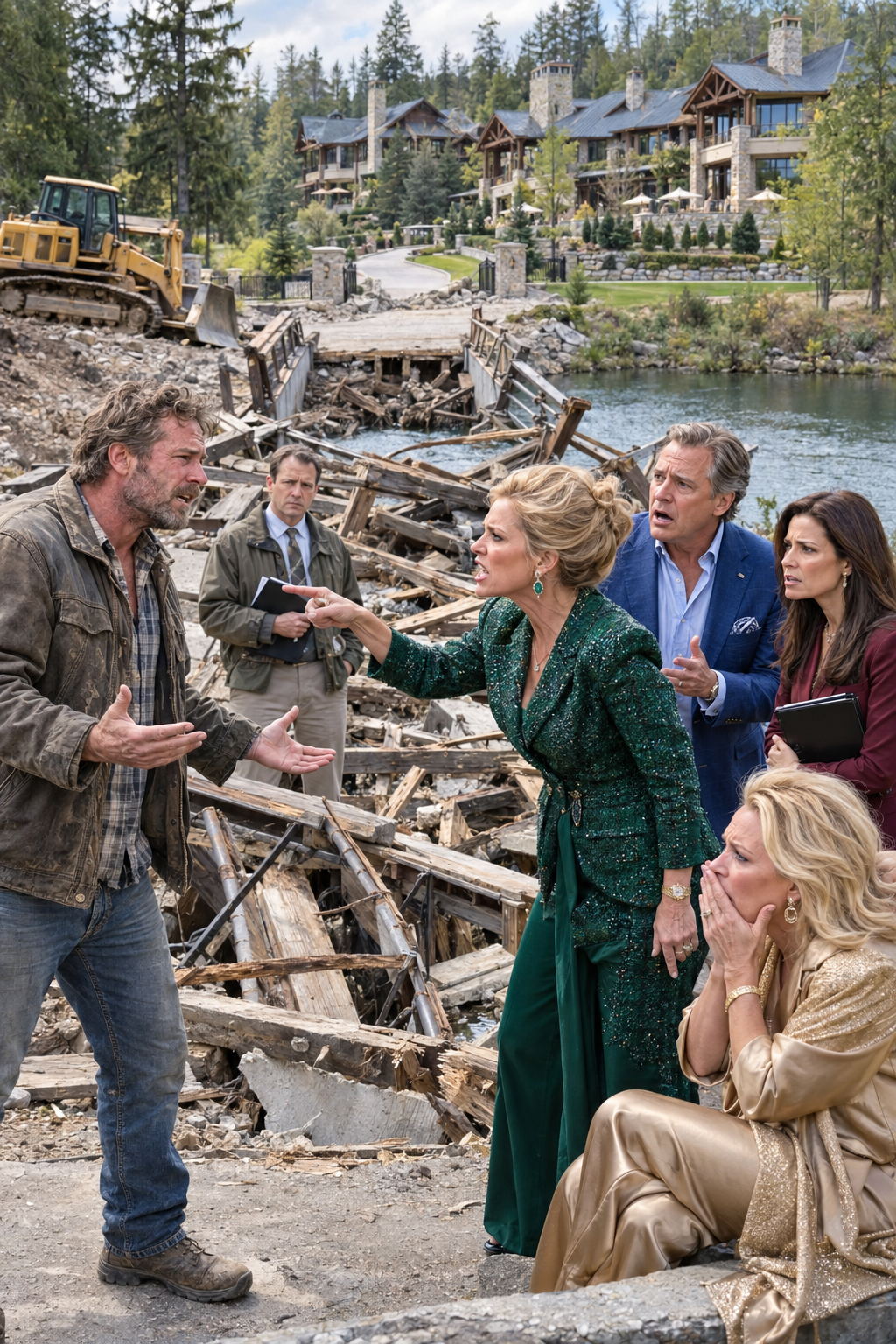
My HOA Destroyed the Bridge My Father Left Me—Then Their $12 Million Luxury Resort Discovered I Controlled Its Only Legal Entrance
The morning Karen Whitfield demolished my father’s bridge, she stood on the opposite bank holding a champagne-colored coffee cup and told me my dead father had finally stopped being a problem.
Then she handed me a $25,000 bill for obstructing a community improvement project.
What Karen didn’t know was that the bridge wasn’t the most valuable thing my father had left me.
The land beneath it was.
And the only legal entrance to the $12 million luxury resort her HOA had spent eighteen months planning ran directly across that land.
My name is Claire Bennett.
I’m thirty-eight years old, I live in the mountains of western North Carolina, and until that Tuesday morning, I had never considered myself particularly dangerous.
I paid my taxes.
I kept my fences repaired.
I waved at strangers passing my driveway.
And when someone needed help getting a truck out of the mud, I usually brought my tractor before they finished asking.
My father raised me that way.
He believed that living in a small community meant taking care of people, even the ones who sometimes made that difficult.
But he also believed that there was a difference between being generous and being foolish.
That distinction would eventually cost Karen Whitfield everything she thought she controlled.
At that morning, I was standing in my kitchen waiting for the coffee maker to finish when I felt the first vibration.
It was subtle.
A low, mechanical tremor that traveled through the floorboards of my father’s old farmhouse.
I thought it was thunder.
Then came a metallic shriek.
The kind of sound that makes your teeth hurt.
I went to the window.
Beyond the pasture, through the thinning October fog, something enormous and yellow moved beside Blackwater Creek.
My stomach tightened.
I grabbed my boots, my phone, and the faded denim jacket hanging beside the back door.
By the time I reached the pasture gate, I could hear the excavator.
And by the time I reached the creek, I knew exactly what it was destroying.
The bridge.
My father’s bridge.
The fifty-eight-foot steel-and-timber structure he had rebuilt after the flood of 1987.
The bridge where he taught me to ride my bicycle.
The bridge where my mother stood every Fourth of July, watching fireworks above the mountains.
The bridge where my father and I scattered her ashes when I was twenty-six.
The bridge he had maintained for thirty-seven years, replacing boards and tightening bolts because he believed anything worth owning was worth caring for.
Now an excavator was tearing through its western railing.
A second machine had already ripped away the approach.
Three men in orange safety vests stood behind temporary barriers.
And Karen Whitfield, president of the White Pine Ridge Homeowners Association, was watching from the other side.
She was wearing white pants, an expensive camel-colored coat, and sunglasses despite the gray morning.
Her Range Rover sat behind her.
When she noticed me, she smiled.
That smile bothered me more than the machinery.
I raised my phone and began recording.
“Who authorized this demolition?” I asked.
The nearest worker looked toward Karen.
She walked closer, stopping several feet from the damaged bridge.
“Good morning, Claire.”
“Turn the machines off.”
“I’m afraid we’re past that point.”
I kept my voice level.
“Who authorized the demolition?”
She lifted a folder.
“The HOA board approved removal of an obsolete structure as part of the Blackwater Valley redevelopment initiative.”
“This is private property.”
She sighed.
“Your father may have believed that.”
I looked at her.
She looked back without blinking.
“The county recognizes this corridor as a community access route,” she continued. “We’ve reviewed the documentation.”
“Then show it to me.”
“All the proper people have seen it.”
Behind her, the excavator operator pulled another steel beam free.
The bridge groaned.
A flock of crows exploded from the trees.
I felt something twist painfully beneath my ribs.
But I didn’t scream.
I didn’t run toward the machinery.
And I didn’t give Karen the confrontation she clearly wanted.
Instead, I moved my phone slowly across the scene.
The excavator.
Its company name.
Its equipment number.
The workers.
The damaged structure.
Karen’s Range Rover.
The time displayed on my screen.
Then I asked one more question.
“Did you obtain a demolition permit from Briar County?”
Karen’s smile narrowed.
“Claire, I’m not going to stand here discussing paperwork while professionals do their jobs.”
“That’s fine.”
I lowered the phone.
“What’s the contractor’s name?”
She laughed.
“You’re being ridiculous.”
I looked at the company logo on the excavator.
“Never mind. I have it.”
My father had taught me many things.
How to sharpen an ax.
How to recognize a copperhead.
How to determine whether a storm-damaged tree was safe to cut.
But the most useful lesson he ever gave me came when I was seventeen and a neighbor tried to claim six acres of our pasture.
My father had walked me into the county records office, pulled out a deed book, and shown me the original survey.
“Claire,” he said, tapping the paper, “people can argue about what they remember. They can argue about what they were promised. They can even argue about what’s fair.”
Then he pointed to the recorded boundary.
“But a good piece of paper can make a liar very uncomfortable.”
At that morning, I remembered those words.
And I made my first phone call.
Not to the sheriff.
Not to a lawyer.
Not even to the county.
I called the man who had surveyed our property with my father nineteen years earlier.
His name was Walter Ellis.
He was seventy-one, officially retired, and still the most stubborn surveyor in three counties.
He answered on the fourth ring.
“Walter, Karen Whitfield is demolishing Dad’s bridge.”
There was silence.
Then the unmistakable sound of a chair scraping across a floor.
“Which bridge?”
“The one over Blackwater Creek.”
Another silence.
Longer this time.
“Tell me you mean they’re repairing it.”
“They’ve removed the west approach. They’re pulling down the railing now.”
Walter said something I had never heard him say in front of a woman.
Then he asked, “Are they on your side of the creek?”
“Both sides.”
“Did they give you notice?”
“Did you sign anything?”
“Don’t sign anything. Don’t agree to anything. Keep recording.”
He exhaled.
Then his voice changed.
“Claire, do you still have the brown metal document box your daddy kept beneath his desk?”
I turned toward the hill where my farmhouse stood.
“Because somebody over there has made a mistake bigger than they understand.”
He ended the call.
At , the bridge collapsed.
Not all at once.
First came the upper truss.
Then the center span twisted sideways.
The old steel screamed against itself.
Timbers snapped.
The eastern support shifted.
Finally, the middle section dropped into Blackwater Creek with a crash that sent muddy water splashing against both banks.
I stood very still.
For a moment, I was eleven years old again.
My father was beside me, his large hand wrapped around mine, pointing out where trout sheltered beneath the bridge.
I could hear his laugh.
I could smell the sawdust on his shirt.
Then a construction worker shouted.
And the memory disappeared.
Karen walked toward me carrying a document.
“Since you’re here,” she said, “I need to provide formal notice.”
She held out three stapled pages.
I didn’t take them immediately.
“What is it?”
“A violation assessment.”
“For what?”
“Obstructing approved development.”
I stared at her.
“The bridge was there before your HOA existed.”
“And that’s part of the problem.”
She extended the paper farther.
“Twenty-five thousand dollars. Payment due within thirty days. Additional penalties may apply if you interfere with scheduled improvements.”
I accepted it.
The first page carried the White Pine Ridge HOA logo.
The second listed fines.
The third contained a warning about possible legal action.
At the bottom, beneath Karen’s signature, was a sentence that would become important later.
The HOA reserved the right to recover all costs associated with removing unauthorized structures from the community’s designated access corridor.
I read it twice.
Then I folded the pages.
“Karen, how much did you pay the demolition contractor?”
She looked pleased.
“That’s association business.”
“Was it more than eighty thousand?”
Her expression changed.
Only slightly.
But enough.
“Where did you get that number?”
I hadn’t gotten it anywhere.
I’d guessed.
And her face told me I wasn’t far off.
“Have a good morning, Karen.”
I turned and started walking uphill.
Behind me, she called, “You might want to hire an attorney, Claire.”
Looked back.
And smiled.
“I already know a very good one.”
That wasn’t entirely true.
At that moment, I hadn’t spoken to my attorney in eleven months.
But I knew her number.
And by , she knew exactly what had happened.
Her name was Rebecca Lawson.
She was forty-four, wore reading glasses on a silver chain, and had spent sixteen years handling land-use disputes in western North Carolina.
Rebecca rarely raised her voice.
She also rarely lost arguments that depended on recorded property rights.
When I explained what Karen had done, she didn’t interrupt.
She asked for photographs.
She asked for the violation notice.
She asked whether anyone had threatened me physically.
Then she asked a question that made me sit down.
“Claire, did they demolish the entire bridge?”
“The center span is in the creek.”
“What about the foundations?”
“Both abutments are still there.”
“Are they working around the foundations?”
“They were when I left.”
Rebecca went quiet.
“Send me a photograph of the southern abutment.”
“Just send it.”
I opened the video.
Paused at a clear frame.
Thirty seconds later, my phone rang again.
“Claire, who is operating that equipment?”
“Blue Ridge Excavation.”
“Do you see anyone from a company called Summit Ridge Development?”
“Because Summit Ridge is the development manager for Blackwater Crest Resort.”
I’d heard the name.
Everyone in Briar County had.
For almost two years, colorful s had appeared in local newspapers, on Facebook, and along Highway 74.
BLACKWATER CREST.
LUXURY MOUNTAIN LIVING REIMAGINED.
Seventy-two private vacation villas.
A heated infinity pool.
A mountain-view restaurant.
A wellness spa.
A private event venue.
Estimated development value: twelve million dollars.
Karen had promoted it relentlessly.
She called it an economic miracle.
She promised that property values in White Pine Ridge would rise by forty percent.
She claimed the resort would bring jobs, tourism, tax revenue, and national attention.
At one HOA meeting, she’d stood beside a giant rendering of the proposed entrance and declared that our neglected valley was finally moving into the future.
I remembered the rendering.
A broad stone entrance.
Landscaped flowerbeds.
An impressive sign.
And a two-lane road crossing Blackwater Creek.
Exactly where my father’s bridge stood.
I’d asked about that road eighteen months earlier.
Karen had dismissed the question.
“The developer has already addressed access.”
When I asked for the engineering plans, she told me they were confidential.
When I requested the HOA meeting minutes, she sent me three paragraphs from a newsletter.
And when I reminded her that my property bordered the crossing, she said I was confusing historical use with legal ownership.
Now the bridge was gone.
And their twelve-million-dollar resort was supposed to rise on the far side.
Rebecca’s next question was simple.
“Claire, did your father ever grant the HOA permission to widen that crossing?”
“Did he grant Summit Ridge an easement?”
“Absolutely not.”
“Then get me every document in that brown box.”
I walked into my father’s office.
Five years after his death, I still called it that.
His desk was still beside the north window.
His reading lamp still leaned slightly to the left.
A faded photograph of my mother sat beside a coffee mug filled with pencils.
The brown metal document box was under the bottom drawer.
I carried it to the kitchen table.
Inside were property tax receipts, insurance papers, surveys, a handwritten maintenance log, and several yellowing deeds.
At the very bottom was a thick envelope.
Across the front, in my father’s blocky handwriting, were four words.
BLACKWATER CROSSING. DO NOT DISCARD.
Inside was a copy of a recorded 1987 agreement.
My father had mentioned it before.
But I’d never read every line.
I spread the pages across the table.
There were sixteen.
The first identified the landowners who had signed the agreement after the original wooden bridge washed away.
The second described the crossing.
The third contained the easement language.
I followed the legal description with my finger.
Then I reached paragraph seven.
And stopped.
I read it again.
Then once more.
By the time Rebecca answered my return call, my hands had stopped trembling.
“Rebecca,” I said, “I think I understand why Dad kept this.”
“What does it say?”
I read the paragraph aloud.
The easement permitted access for existing residential parcels specifically identified in the attached schedule, together with reasonable maintenance and emergency use.
It did not permit commercial development traffic, public resort access, or material expansion of the crossing without a separate written agreement from the owner.
Then came the sentence Karen should have read before she ordered an excavator onto my land.
Ownership and control of the bridge structure, its supporting improvements, and the underlying fee property remained with the Bennett family and its lawful successors.
Rebecca said nothing.
I continued.
“There’s another paragraph.”
Any proposed widening, replacement, or alteration beyond ordinary maintenance required the landowner’s prior written consent.
And no easement holder acquired independent authority to demolish or relocate the bridge.
When I finished, Rebecca made a sound like someone quietly closing a door.
“Do not discuss that agreement with Karen.”
“Because I want to see what she claims to own before we show her what she doesn’t.”
At , I received an email from the HOA.
Its subject line read:
FINAL NOTICE OF NONCOMPLIANCE.
The message warned that any interference with Blackwater Crest construction would result in additional assessments.
It also instructed me to remove a small equipment shed near the creek by Friday.
I opened the attached map.
And laughed.
Not because anything was funny.
Because whoever had created it had made a remarkable mistake.
They had drawn the new resort entrance directly across my property.
Not merely across the bridge.
Across the entire sixty-foot strip of land my father had inherited from his uncle in 1974.
The route crossed the creek, climbed along my eastern boundary, and joined an old logging road behind the pasture.
It was the shortest connection between the public highway and the proposed resort entrance.
It was also the only feasible connection that didn’t cross land belonging to someone else.
That strip had its own legal description.
Its own parcel identification number.
And its own tax history.
My father had paid taxes on it for almost half a century.
Since his death, I’d paid them.
I opened the county geographic information system.
The public parcel map appeared.
My farmhouse sat inside one outlined tract.
The creek followed the eastern edge.
And there, like a narrow finger extending across the valley, was the crossing parcel.
Owner: Claire M. Bennett.
I took a screenshot.
Then another.
Then I downloaded the county tax card.
The name was mine.
The address was mine.
The property description was unmistakable.
At , I received a text from Karen.
I hope you understand this isn’t personal. Progress requires cooperation. Your father never learned that.
I stared at the message.
Then I placed my phone facedown.
There are some insults you can forget.
There are some insults you can forgive.
And there are some insults that tell you exactly who you’re dealing with.
Karen had chosen a dead man because she thought he couldn’t defend himself.
She hadn’t considered that he had spent forty-seven years making sure his daughter could.
At , Walter Ellis arrived in a dusty Chevrolet Silverado.
He stepped out carrying a battered leather survey case and a thermos.
His white beard had grown longer since I’d last seen him.
His hands still looked strong enough to bend nails.
He studied the collapsed bridge without speaking.
Then he removed his hat.
“Your daddy would’ve hated seeing this.”
Walter stood there another moment.
Then put his hat back on.
“Well,” he said, “let’s see what the idiots actually tore up.”
We spent the next two hours walking the boundary.
Walter identified three old survey markers.
One was an iron pin near a walnut tree.
Another was a brass cap embedded in stone.
The third sat beneath a tangle of honeysuckle close to the eastern approach.
He photographed each marker.
Measured their positions.
Checked the deed descriptions.
Then compared them with the construction stakes recently placed around the bridge.
The developer’s orange stakes were inside my property.
So were the equipment tracks.
So was the temporary gravel staging area.
Walter crouched beside a marker and pointed toward the creek.
“See that?”
I followed his finger.
A fresh wooden stake had been driven six inches from the old iron pin.
The orange plastic flag attached to it read:
SUMMIT RIDGE PROPERTY LIMIT.
Walter snorted.
“That’s a nice trick.”
“They’ve marked your land as theirs.”
I photographed the stake.
He stood slowly.
“Doesn’t change the property line. But it tells us somebody wanted the crews to believe it did.”
“Could it be an honest surveying error?”
Walter looked across the creek.
“One marker? Maybe. Two? I’d want an explanation. Every marker along the proposed entrance shifted in the same direction?”
He shook his head.
“I’ve been doing this too long to call that a coincidence.”
We reached the eastern approach.
A construction supervisor walked toward us.
He introduced himself as Dale Henson.
He was a broad-shouldered man in his fifties, with a red face and mud on his boots.
“Ma’am,” he said, “you can’t be here. Active work zone.”
Walter folded his arms.
“Funny. I was about to tell you the same thing.”
Dale frowned.
“Who are you?”
“Licensed surveyor.”
“Retired,” I added.
Walter glanced at me.
“Only when it suits me.”
Dale looked uncomfortable.
I showed him my identification and the property tax map.
“This is my land,” I said. “Your equipment is operating on it without permission.”
He rubbed his jaw.
“We have authorization from the HOA.”
“Does the HOA own this parcel?”
“That’s above my pay grade.”
“Then who gave you the site boundaries?”
“Summit Ridge.”
“Can you provide the name of the person who approved the demolition?”
He hesitated.
“I’ll have to talk to the office.”
“Please do.”
Walter pointed toward the water.
“And don’t move another piece of that bridge until the county environmental inspector sees it.”
Dale glanced at the debris.
“Look, we were told it had already been cleared.”
He didn’t answer.
But he reached for his radio.
Within fifteen minutes, the excavators stopped.
Not because Karen had changed her mind.
Because the contractor suddenly wanted paperwork.
That was the first small victory.
The second came at 12:43.
A Briar County environmental compliance officer arrived at the creek.
Her name was Melissa Ortiz.
She wore rubber boots, carried a camera, and asked direct questions.
I liked her immediately.
She examined the broken steel in the water.
The disturbed banks.
The scattered timber.
The muddy runoff moving downstream.
Then she asked Dale for the stream-disturbance authorization and approved erosion-control plan.
He produced a folder.
Melissa read it.
Looked at the creek.
Read it again.
“This approval covers vegetation clearing and grading outside the protected stream corridor.”
Dale shifted his weight.
“That’s what we were given.”
“It doesn’t authorize demolition debris entering the creek.”
“The structure was unsafe.”
“Do you have an emergency determination from the county?”
Melissa photographed the site and issued a written directive suspending the unauthorized stream work pending review.
She also required immediate erosion-control measures.
No more excavation in the creek.
No debris removal without an approved plan.
No additional disturbance to the banks.
Karen arrived while Melissa was finishing her inspection.
Her Range Rover stopped hard enough to throw gravel.
She climbed out without her sunglasses.
“What’s going on?”
Melissa introduced herself.
Karen smiled the smile she used at public meetings.
“Oh, wonderful. We’ve been expecting you.”
Melissa didn’t smile back.
“Who is responsible for this demolition?”
Karen glanced toward Dale.
“The contractor is managing the work.”
“Who commissioned it?”
“The association approved the improvement.”
“Are you the association president?”
Melissa opened her notebook.
“Then I need a copy of the authorization, the demolition plan, and the erosion-control documents.”
Karen stiffened.
“Those are with our attorneys.”
“Please have them contact my office.”
“You’re stopping a twelve-million-dollar investment over some old bridge debris?”
Melissa looked at the broken steel spanning the creek.
“I’m stopping unauthorized work in a regulated stream corridor. The value of the development doesn’t change the requirements.”
I nearly smiled.
Karen noticed.
Her expression sharpened.
“This is Claire Bennett’s doing.”
Melissa closed her notebook.
“I came because a regulated waterway was disturbed. Who reported it isn’t the question.”
Karen looked at me.
There it was again.
That expression.
Not anger exactly.
She wasn’t accustomed to having people refuse to accept her version of reality.
And I was beginning to realize that every time someone asked her for documentation, she lost a little more control.
By late afternoon, the machines were silent.
The bridge was destroyed.
The creek was still muddy.
And my father’s crossing looked like the aftermath of a small war.
I stood on the western bank while Walter packed his equipment.
He looked at me for a long moment.
“How’re you holding up?”
I looked at the water.
“I’m not fine.”
For the first time that day, my voice broke.
“Dad fixed this bridge after every storm. Every winter. Every flood. He was out here with a shovel three days after his first chemotherapy treatment.”
Walter put a hand on my shoulder.
“He loved that bridge.”
I swallowed.
“He loved what it connected.”
Walter stayed with me until the light began to fade.
Before he left, he handed me a photocopy from his survey archive.
It was an old map.
A 1974 boundary survey showing the original crossing parcel.
In the lower right corner was my father’s signature.
Walter tapped it.
“He wanted the property line recorded before he built anything permanent. Said he didn’t want you fighting over it after he was gone.”
I held the paper.
The ink was slightly faded.
But the signature was unmistakable.
Henry Bennett.
My father had been twenty-nine when he signed it.
I was thirty-eight now.
And thirty-eight hours hadn’t passed since Karen destroyed the thing he spent half his life protecting.
Walter stepped toward his truck.
Then paused.
“There’s something else, Claire.”
“Those resort people didn’t start making mistakes yesterday.”
I looked up.
“What do you mean?”
He nodded toward the valley.
“Last spring, a man from Summit Ridge asked me whether the old crossing parcel could be considered abandoned.”
My stomach tightened.
“What did you tell him?”
“That I wasn’t interested in being hired to rewrite history.”
“Who was he?”
“Didn’t give me his real name, I suspect. But he left a card.”
Walter opened his wallet.
Removed a folded business card.
And handed it to me.
SUMMIT RIDGE DEVELOPMENT.
DANIEL PRICE.
LAND ACQUISITION CONSULTANT.
On the back, Walter had written the date.
Six months before the demolition.
“Why didn’t you tell me?”
“I called your number. Left a message.”
I remembered.
I’d been in Atlanta that week helping a client resolve a title discrepancy.
I’d listened to Walter’s voicemail while boarding a plane.
He’d said something about a developer asking strange questions.
I’d intended to call back.
Then life happened.
And I hadn’t.
“I should’ve called you,” I said.
Walter shook his head.
“They should’ve respected the deed.”
That night, I did something I hadn’t done since my father’s funeral.
I sat at his desk.
Not beside it.
In his chair.
The leather was worn where his elbows used to rest.
I opened his maintenance log.
The first entry was dated March 12, 1988.
Replaced two western deck boards. Creek high. Claire helped carry nails.
The next entry described a railing repair.
Then repainting.
Then flood debris.
Then a cracked support bracket.
Thirty-seven years of notes.
By the final entry, my father’s handwriting had become shaky.
It was dated three months before his death.
June 4, 2021.
Inspected eastern pier. Sound. Claire needs new deck boards by spring. Call Walter if anything changes.
Beneath that, in smaller writing, he had added:
Keep the crossing private. They will promise anything once the valley becomes valuable.
I sat there for a long time.
Then I closed the book.
And began preparing for the HOA meeting scheduled for Thursday.
Karen had called it an emergency session.
The notice claimed the association needed to address misinformation regarding the Blackwater Crest development.
I knew what that meant.
She intended to make me the villain.
I had forty-eight hours to make sure the paperwork spoke louder than she did.
The next morning began with an email from Rebecca.
She’d reviewed the deeds, the easement, and the county parcel records.
Her first sentence was brief.
The documents support your ownership of the crossing parcel and bridge structure, subject to the recorded residential access rights.
Her second sentence mattered more.
I am requesting certified copies and the developer’s asserted basis for access before we seek emergency relief.
I called her.
“How bad is this for them?”
“That depends on how they represented access to the county, their lender, and their investors.”
“Can they claim the HOA has always used the bridge?”
“They can claim it. Historical residential use doesn’t automatically create a commercial development easement.”
“What about the families in White Pine Ridge?”
“Their recorded residential rights still matter. We protect those.”
“Of course.”
Rebecca paused.
“I want you to understand something, Claire. You don’t get to punish innocent homeowners because Karen acted without authority.”
“I don’t want to.”
“Good. Because that’s going to distinguish you from her.”
We discussed an emergency injunction.
A preservation demand.
Claims for trespass and property damage.
The need for a structural engineer.
And the possibility that the county would suspend certain development approvals if the proposed access wasn’t legally secured.
Then Rebecca said something unexpected.
“There’s a bigger question.”
“What’s that?”
“Why would a developer spend millions before confirming its only entrance?”
I looked at the map spread across my kitchen table.
“I’ve been wondering the same thing.”
“Exactly. Somebody either gave them bad information, or somebody gave them a document we haven’t seen.”
I didn’t like either possibility.
At 10:17, I drove into Briar County’s administrative center.
The town of Millstone wasn’t large.
One main street.
A courthouse square.
A hardware store.
A diner where everybody still ordered pie by pointing at the display case.
The county planning department occupied the second floor of a brick building beside the library.
I knew the receptionist, Linda Parker, from high school.
She saw me enter and lowered her voice.
“Claire, I heard about your dad’s bridge.”
“News travels.”
“Especially bad news.”
I requested the publicly available site plans for Blackwater Crest.
Linda directed me to the planning records counter.
Twenty minutes later, a young planner named Jason Miller placed a digital application file on a monitor.
I studied the project.
Seventy-two luxury villas.
Two restaurants.
A recreation building.
Maintenance facilities.
A pool complex.
Estimated peak daily traffic far higher than the old residential crossing had ever carried.
I opened the transportation plan.
There it was.
The main entrance route.
A widened bridge.
A landscaped driveway.
And a note identifying the corridor as:
EXISTING HOA-CONTROLLED ACCESS TO BE IMPROVED UNDER SEPARATE AUTHORIZATION.
I pointed at the screen.
“What authorization?”
Jason clicked through the file.
“Looks like the applicant submitted a property access certification.”
“Can I see it?”
He opened another attachment.
A two-page letter on Summit Ridge letterhead.
It stated that the development possessed sufficient legal rights to improve and use the existing community access corridor.
The letter referred to documentation maintained by the HOA.
It was signed by a development vice president named Richard Voss.
I photographed the monitor with permission.
Then asked Jason to identify the specific recorded easement supporting the proposed commercial use.
He searched.
Then frowned.
“I don’t see one in this application package.”
“Could it be somewhere else?”
“Possibly. The applicant would need to provide supporting documentation if requested.”
“Has the county issued final access approval?”
“No. The plan has conditional site approval. Several items remain outstanding, including final access and fire review.”
That distinction mattered.
The resort had permission to perform certain preliminary work.
It did not yet have permission to open.
And the project documents treated legal access as something that could be resolved later.
Outside the building, I called Rebecca.
“I found the certification.”
She read it while I sat in my truck.
Then asked, “Did they attach a recorded instrument number?”
“Did they identify your parcel?”
“Did the county approve the bridge replacement?”
“Not in this file.”
Rebecca sighed.
“All right. Now we have something concrete.”
“What happens next?”
“Now we make them produce the instrument they claim gives them access.”
That afternoon, my phone began ringing.
First came a neighbor.
Then another.
Then a woman I’d known since childhood.
All three asked essentially the same question.
Why was I trying to ruin the resort?
I explained that Karen had destroyed my private bridge without permission.
The first neighbor apologized.
The second sounded uncertain.
The third said, “Well, Claire, the development is going to help everybody.”
I asked her whether helping everybody included bulldozing somebody’s property.
She changed the subject.
By dinner, the White Pine Ridge Facebook group had become a battlefield.
Karen posted photographs of the collapsed bridge.
Not the excavator.
Not the demolished approaches.
Just the wreckage.
Her caption read:
Unfortunately, an aging and dangerous structure has delayed an important infrastructure modernization project. Certain private interests are attempting to obstruct improvements benefiting our entire community.
More than eighty people liked it.
A few congratulated Karen for taking action.
One man wrote that selfish landowners should be forced to cooperate.
Another suggested eminent domain.
I didn’t reply.
Instead, I saved the post.
Then I saved every comment that threatened my property or referred to the demolition.
At , Karen posted again.
This time she included a photograph of my father standing beside the bridge twenty years earlier.
I recognized the picture.
It had been taken at the annual neighborhood picnic.
Karen had cropped me out.
Underneath, she wrote:
Some residents remain emotionally attached to infrastructure that no longer serves modern safety standards.
I stared at the screen.
My father had been a volunteer firefighter for twenty-three years.
He’d pulled people from wrecked cars.
He’d repaired neighbors’ roofs after hurricanes.
He’d driven through snowstorms to deliver medicine.
And Karen was using his photograph to justify destroying his property.
I wanted to type something cruel.
Something that would hurt her.
Instead, I opened a new email.
To Rebecca.
Subject: Additional evidence.
I attached the post.
Then I wrote:
Please preserve this. It establishes that Karen knew the bridge belonged to my father while publicly characterizing it as association infrastructure.
Rebecca answered eight minutes later.
Excellent. Do not respond publicly.
I slept badly.
Not because I was afraid of Karen.
Because I could hear the bridge collapsing every time I closed my eyes.
On Thursday morning, a structural engineer named Aaron Fitch arrived.
Rebecca had hired him to document the damage.
Aaron was quiet, methodical, and unimpressed by arguments.
He photographed every remaining component.
Measured the abutments.
Examined the steel members.
Then reviewed photographs I’d taken two weeks before the demolition.
After three hours, he told me something important.
“The original bridge had maintenance issues, but your photographs don’t establish that it required immediate demolition.”
“Could it have been repaired?”
“Possibly. A full inspection would have been needed before deciding whether repair or replacement was appropriate.”
“What about the way they demolished it?”
He looked toward the creek.
“Whatever its previous condition, this demolition created significant damage to the approaches and foundations.”
“Can we rebuild?”
“Probably. But it will need a new engineered design and permits.”
“How much?”
He hesitated.
“Depends on the design and site conditions. Several hundred thousand dollars wouldn’t surprise me.”
I thought about the $25,000 fine in my kitchen drawer.
Karen had destroyed something that might cost ten or fifteen times that amount to replace.
And she expected me to pay her.
Aaron continued.
“There’s one other thing.”
“The eastern abutment shows fresh excavation below the original footing.”
I looked at the stone and concrete foundation.
“Is that normal during demolition?”
“Not unless it was part of an approved removal plan.”
“Could they have been trying to widen it?”
“Possibly. But the excavation extends farther below the footing than I’d expect for simply removing the deck.”
I photographed it again.
At that moment, I assumed it was careless construction.
Later, I would remember that conversation.
And wish I’d asked one more question.
The HOA emergency meeting began at Thursday evening.
White Pine Ridge had a clubhouse with exposed wooden beams, a stone fireplace, and chairs that always smelled faintly of lemon furniture polish.
Forty-three homeowners attended.
That was more than half the subdivision.
Karen sat at the front beside the HOA treasurer, a nervous accountant named David Monroe.
To her right sat Richard Voss from Summit Ridge Development.
He wore a navy suit and a watch worth more than my truck.
Beside him was a woman with a laptop.
Karen opened the meeting with a prepared statement.
“Our community is at a critical moment.”
I sat in the third row.
Walter sat beside me.
Rebecca sat on my other side.
Karen described the resort’s economic benefits.
She talked about tourism.
Property values.
She called the bridge removal a necessary first step toward creating safer, modern access.
Then she reached the part she’d been waiting for.
“Unfortunately, one neighboring property owner has chosen to obstruct progress through a combination of personal grievances and unsupported ownership claims.”
Several people turned toward me.
I kept my hands folded.
Karen continued.
“We cannot allow individual emotions to override the needs of an entire community.”
Walter muttered, “She’s got nerve.”
Rebecca touched his arm.
Karen looked directly at me.
“Ms. Bennett, would you like to address the board?”
“Yes. Thank you.”
I carried a single folder to the front.
Karen leaned back.
I could tell she’d expected anger.
Maybe tears.
Maybe a dramatic speech about my father.
Instead, I placed one page on the table.
“Before I say anything else, I’d like to ask a question.”
Karen smiled thinly.
“Go ahead.”
“Who owns the land where the bridge stood?”
She blinked.
“The access corridor is maintained by the association.”
“That wasn’t my question.”
A few people shifted in their chairs.
I repeated it.
“Who holds title to the land beneath the bridge?”
Karen looked toward Richard Voss.
He adjusted his cuff.
“The developer has relied on the association’s certification of access rights,” he said.
“Rights to use a road aren’t the same thing as ownership of the land,” I replied.
He didn’t answer.
I took out a second page.
“This is the current county tax record. It identifies me as the owner of the crossing parcel.”
I placed it beside the first.
“This is the recorded 1974 survey.”
A third page.
“This is the 1987 easement agreement.”
Then I looked at Karen.
“Can you identify any recorded document transferring ownership of my bridge to the HOA?”
Karen reached for her water.
“The legal situation is more complicated than you’re presenting.”
“Then please explain it.”
“Our counsel has reviewed the matter.”
“Is counsel here?”
“Did counsel authorize the demolition?”
Karen’s face reddened.
“Claire, this isn’t a courtroom.”
“You’re right.”
I glanced at the residents.
“But it is a room full of people whose association dues paid for a demolition. They deserve to know whether the association owned what it destroyed.”
David Monroe, the treasurer, shifted uncomfortably.
One of the homeowners raised his hand.
His name was Frank Dorsey.
He was seventy-four and had lived in White Pine Ridge since its first houses were built.
“Karen, I thought Henry Bennett owned that bridge.”
She turned toward him.
“Frank, the board has addressed—”
“No, ma’am.”
His voice was firm.
“I remember when Henry built it. My brother helped him haul the steel.”
Another woman spoke.
“Henry used to ask us not to overload it with construction trucks.”
Someone else nodded.
“My husband helped paint it.”
Karen tapped her microphone.
“We’re getting distracted.”
I looked toward Richard Voss.
“Mr. Voss, your company’s access plan shows a two-lane entrance across my parcel.”
He folded his hands.
“Our engineers designed an appropriate improvement.”
“Did you obtain my written consent?”
“We relied on information provided by the association.”
“Did you obtain my written consent?”
He said nothing.
Finally, he answered.
“Not directly.”
The room went quiet.
I nodded once.
“Thank you.”
Karen leaned forward.
“Claire, you’ve made your point.”
“One more question.”
I looked at David Monroe.
“How much association money has been committed to the bridge demolition?”
He looked at Karen.
She shook her head slightly.
So did Walter.
“David,” I said, “I’m asking because members may be personally affected by a lawsuit if this wasn’t authorized properly.”
David swallowed.
“The demolition contract was eighty-six thousand four hundred dollars.”
A murmur moved through the room.
“How much has been paid?”
“Forty-three thousand two hundred.”
“And where did that money come from?”
He looked down.
“The capital reserve account.”
Someone behind me said, “That’s our storm-repair fund.”
Another voice asked, “Who approved that?”
Karen struck the table with her palm.
“The board acted in the community’s best interests.”
I turned toward the residents.
“Your reserve money paid for demolition of a bridge the association doesn’t appear to own. The work has been stopped for environmental review. And the proposed resort entrance still lacks a recorded commercial access right across my land.”
Richard Voss stood.
“That is a disputed characterization.”
Rebecca rose beside me.
“Then please identify the recorded instrument supporting your client’s position. We’ve requested it in writing.”
He looked at her.
“Who are you?”
“Rebecca Lawson. Counsel for Ms. Bennett.”
For the first time that evening, Richard Voss appeared genuinely surprised.
Rebecca handed him her business card.
“Please direct further communications concerning the crossing to my office.”
Karen’s expression had become rigid.
She looked around the room.
“We’re not turning this meeting into a legal spectacle.”
Frank Dorsey stood.
“Karen, you spent eighty-six thousand dollars of our money on a bridge that wasn’t ours?”
“The work was necessary.”
“Did you know it belonged to Claire?”
Karen didn’t answer.
And that silence did more damage than anything I could have said.
By the time we left, eighteen homeowners had signed a written request for access to the board’s contracts and financial records.
Three had asked for a special meeting to review Karen’s leadership.
And David Monroe had quietly approached Rebecca.
“I think you should know,” he said, “some of the records you asked about aren’t in the association files.”
Rebecca looked at him.
“Which records?”
“The original access certification.”
“Where is it?”
David glanced toward the parking lot, where Karen was arguing with Richard Voss.
“I don’t know.”
He lowered his voice.
“But Karen told me not to ask.”
That was the first time I saw real fear in someone’s face.
The next day, Karen changed tactics.
At Friday morning, I received a certified letter from an attorney in Asheville.
It claimed that I was interfering with established access rights.
It demanded that I cease making defamatory statements about the HOA and Summit Ridge.
It warned me not to block any existing roads.
It also offered a confidential settlement.
Thirty thousand dollars.
In exchange, I would grant permanent, unrestricted access across the crossing parcel and release all claims arising from the demolition.
I read the offer twice.
Thirty thousand dollars.
For the only lawful entrance to a twelve-million-dollar resort.
And for the destruction of my father’s bridge.
I forwarded it to Rebecca.
She called immediately.
“Don’t respond.”
“I wasn’t planning to.”
“There’s something interesting here.”
“They’re now asking you to grant a new easement.”
“Yesterday, they claimed they already had the rights they needed.”
I looked at the letter.
“That’s quite a change.”
“What do we do?”
“We reject the offer and request the documents supporting their original claim.”
I glanced through the kitchen window toward the pasture.
The leaves were turning gold.
A red-tailed hawk circled over the far ridge.
“I don’t want their thirty thousand dollars.”
“I want my bridge replaced. I want the damage repaired. And I want them to stop treating other people’s property like an inconvenience.”
“That’s a reasonable starting point.”
I hesitated.
“And I want to know who told them they could do this.”
Rebecca’s voice grew quieter.
By noon, the story had spread beyond White Pine Ridge.
A local reporter named Megan Shaw called me from the Millstone Herald.
She asked whether the HOA really bulldozed a privately owned bridge without permission.
I told her that ownership was supported by the recorded deeds, and the destruction was documented.
She asked whether I hated Karen.
“You’re not angry?”
“I’m angry about what happened.”
“Then why don’t you sound angry?”
I looked at my father’s photograph on the mantel.
“Because anger isn’t going to rebuild a bridge.”
Megan paused.
Then asked, “What will?”
“Accountability.”
The article appeared online that evening.
Its headline was simple.
PRIVATE BRIDGE DEMOLITION RAISES QUESTIONS ABOUT LUXURY RESORT ACCESS.
Megan had spoken to the county.
To the contractor.
To several homeowners.
To Rebecca.
And, apparently, to Karen.
Karen’s quoted response said the board remained confident that all necessary rights would be confirmed.
Not had been confirmed.
Would be confirmed.
Rebecca highlighted those words in the email she sent me.
Then wrote:
Useful distinction.
By Saturday morning, the article had been shared almost four thousand times.
Some people supported the resort.
Others thought I should sell.
A few called me greedy.
But many wanted to know why a private structure had been demolished before legal access was secured.
A retired contractor from Tennessee wrote that no responsible builder should remove a bridge without confirming ownership.
A woman from Georgia asked who had inspected the demolition.
And a man whose family had lived in Briar County for generations posted an old photograph showing my father standing proudly beside the completed bridge in 1988.
I printed it.
In the picture, Dad was forty-three.
His hair was still dark.
His sleeves were rolled to his elbows.
His work boots were covered in mud.
And his smile was the kind that made everyone around him smile, too.
I put the photograph beside his maintenance log.
Then went back to work.
Because something important had changed.
Until then, Karen had controlled the public story.
Now people were asking questions she couldn’t answer with a newsletter.
And Richard Voss had a problem much larger than bad publicity.
His construction schedule depended on trucks reaching the far side of Blackwater Creek.
The developer owned roughly ninety acres on the eastern slope.
But that land was surrounded by steep terrain, protected forest tracts, and private property.
There was a narrow old logging trail to the north.
The developers had considered it during the early planning stages.
I knew because Walter had shown me the maps.
The trail was nearly five miles long.
Parts of it crossed state-managed conservation land.
Other sections ran through property owned by a family trust that had refused previous offers.
Several slopes were too steep for ordinary construction traffic without extensive engineering.
And no continuous legal commercial access had been secured.
That left the bridge corridor.
My corridor.
Karen had presented it as a convenient community improvement.
Summit Ridge had treated it as the centerpiece of its transportation plan.
And now, with the bridge lying in Blackwater Creek, they had no completed crossing at all.
On Monday, Rebecca filed for emergency relief in Briar County Superior Court.
The filing included the recorded deed, the easement agreement, Walter’s boundary report, photographs, video, and Aaron Fitch’s preliminary engineering observations.
It sought to stop further unauthorized entry and construction on my parcel while preserving the rights of lawful residential easement holders.
We also requested that evidence relating to the demolition be preserved.
Meanwhile, the county continued reviewing the site.
I didn’t expect everything to happen immediately.
Courts move on their own schedules.
Agencies have procedures.
And wealthy developers can afford expensive attorneys.
But I knew one thing.
Their urgency was not my emergency.
That sentence became my private rule.
Whenever Karen sent another demand, I repeated it.
Their urgency was not my emergency.
Whenever someone said the project would lose money, I repeated it.
Their urgency was not my emergency.
Whenever I imagined twelve million dollars pushing against the small boundaries of my family’s land, I repeated it.
Their urgency was not my emergency.
And whenever someone suggested I should surrender my property just to make the pressure stop, I remembered what my father had paid to protect it.
Their urgency was not my emergency.
On Tuesday, exactly one week after the demolition, a black SUV appeared at the end of my driveway.
Two men stepped out.
One was Richard Voss.
The other was older, with silver hair and a dark overcoat.
I was replacing a broken hinge on the pasture gate.
I set down my wrench.
Richard approached with the careful confidence of a man accustomed to being welcomed.
“Ms. Bennett.”
“Mr. Voss.”
He gestured toward his companion.
“This is Jonathan Mercer, principal investor in the Blackwater Crest project.”
Jonathan smiled.
“Thank you for speaking with us.”
“I didn’t know we had an appointment.”
Richard’s jaw tightened.
“We hoped you might be willing to have a conversation.”
I glanced toward the property sign beside the driveway.
PRIVATE ROAD.
NO UNAUTHORIZED CONSTRUCTION ACCESS.
“Rebecca handles legal discussions.”
Jonathan raised a hand.
“Of course. We aren’t here to pressure you.”
He wore polished brown shoes that were collecting red clay.
He glanced toward the valley.
“Beautiful property.”
“Thank you.”
“Your father built the bridge?”
“Impressive achievement.”
I said nothing.
Jonathan continued.
“I understand this has been upsetting. And I want to say that we’re prepared to take your concerns seriously.”
I folded my arms.
“Then you should contact my attorney.”
He smiled again.
“But sometimes the best resolutions happen between reasonable people before attorneys make things complicated.”
That sentence told me a great deal about him.
He didn’t want attorneys involved because attorneys asked for documents.
He wanted a personal conversation because personal conversations could be denied later.
“I’ve worked with property records for most of my adult life,” I said. “I’m comfortable with attorneys.”
His smile faded slightly.
Richard stepped forward.
“The reality, Claire, is that this project represents a major opportunity for the county.”
“I’m aware.”
“Delays have consequences.”
“I’m sure they do.”
Jonathan looked at me carefully.
“Would you consider selling the crossing parcel?”
“At what price?”
Richard brightened.
“We’re prepared to be generous.”
Jonathan said, “Four hundred thousand dollars.”
I felt nothing.
Not excitement.
Not temptation.
Just a strange clarity.
Four hundred thousand dollars was more than I’d earned in several years.
It could pay off my mortgage.
It could replace my aging truck.
It could provide financial security.
But it wouldn’t restore my father’s bridge.
And it wouldn’t explain why they’d destroyed it without asking.
“What’s the offer based on?” I asked.
Jonathan blinked.
“The value of the parcel.”
“Or the value of access to your resort?”
He studied me.
“The crossing is indispensable to your approved concept plan.”
Richard interrupted.
“We have alternatives.”
“Then you should use one.”
His face hardened.
Jonathan raised his hand again.
“Let’s not make this adversarial.”
I looked from one man to the other.
“Your contractor demolished my bridge. Your development team claimed rights I never granted. Your HOA partner sent me a $25,000 fine. And now you’re standing in my driveway suggesting attorneys are the problem.”
Neither man answered.
I picked up my wrench.
“Send any offer through Rebecca.”
Jonathan watched me for a moment.
Then he asked, “Are you really willing to jeopardize twelve million dollars over a bridge?”
I looked him directly in the eyes.
“Are you really willing to jeopardize twelve million dollars because you didn’t ask who owned one?”
That ended the conversation.
They returned to the SUV.
But before Jonathan climbed inside, he stopped.
“Ms. Bennett.”
I looked up.
“Property disputes have a way of becoming expensive.”
“So does demolishing property you don’t own.”
They drove away.
I finished repairing the gate.
Then I called Rebecca and told her everything.
Including the amount.
She was silent for several seconds.
“Four hundred thousand?”
“Did you accept anything?”
“Rebecca, I think they’re getting nervous.”
“They should be. Their lender’s attorney contacted me this morning.”
That surprised me.
“What did they want?”
“Confirmation of the legal access dispute.”
“What did you say?”
“That the recorded residential easement does not appear to authorize their proposed commercial resort access, and that ownership and demolition claims are now before the court.”
“Why would their lender contact you?”
“Because legal access affects whether the collateral can be developed and operated as represented.”
I leaned against the gate.
For the first time, I understood the scale of their problem.
The resort wasn’t merely a construction project.
It was a financing arrangement.
Draw schedules.
Construction contracts.
Future bookings.
Every piece depended on access.
And the only road they had shown investors depended on a piece of land owned by a woman they’d tried to fine into silence.
Rebecca continued.
“Claire, be careful.”
“People who have money at risk sometimes make decisions they wouldn’t make otherwise.”
I looked toward the creek.
“Like destroying a bridge?”
That night, someone drove slowly past my house three times.
A dark pickup.
No visible company markings.
I recorded the times.
At 11:18, the truck stopped near the lower pasture gate.
Its headlights went off.
I watched from my upstairs window.
A man stepped out.
He approached the gate.
Stood there.
Then turned toward the creek.
I called the sheriff’s nonemergency number.
A deputy arrived eighteen minutes later.
By then, the truck was gone.
The deputy took my report.
He promised extra patrols.
Then he suggested installing a camera.
I told him I already had two.
What I didn’t tell him was that I’d ordered four more that afternoon.
My father believed locks were useful.
He believed photographs were better.
And he believed that when someone started asking you to trust them instead of showing you paperwork, you should check the paperwork twice.
The next morning, the county fire marshal inspected the resort’s proposed access.
His name was Captain James Harper.
He’d worked with my father on the volunteer fire department.
I hadn’t seen him in years.
He arrived in a county vehicle with another inspector and spent more than an hour studying the crossing.
I watched from a distance.
They examined the destroyed approaches.
Measured road widths.
Reviewed the proposed emergency vehicle route.
Then drove toward the existing White Pine Ridge entrance.
That entrance connected the residential subdivision to a public county road on the northern side.
It was adequate for the existing homes under their current approvals.
But it did not continue through to the resort property.
At the eastern edge of the subdivision, the road ended at a private lot.
Beyond that was a ravine.
The resort’s proposed emergency route had relied on the new bridge crossing.
By late afternoon, Captain Harper called me.
“Claire, I’m sorry about your daddy’s bridge.”
“Thank you.”
“He was a good man.”
“I’m contacting you because you may receive questions about our review.”
“What did you find?”
“I can’t discuss every detail of an ongoing permit process. But I can tell you the proposed resort still has to demonstrate lawful, adequate emergency access before certain approvals can proceed.”
“Does the destroyed bridge affect that?”
“Obviously.”
He let the word hang.
Then added, “You don’t need to approve construction access just because someone needs it. But we do have to account for the rights of the existing residents.”
“I understand.”
Before he hung up, he said, “Your father would’ve wanted you to stand your ground.”
I looked at the framed photograph beside the kitchen window.
“He taught me how.”
Two days later, Briar County issued a formal notice to Summit Ridge.
The notice suspended further work dependent on the disputed access arrangement pending submission and acceptance of a lawful alternative, while allowing certain unrelated site-protection activities to continue.
It did not terminate the entire project.
It did not award me ownership of anything I didn’t already own.
And it did not settle the lawsuit.
But it stopped the most important part of the resort’s construction schedule.
Heavy equipment could not lawfully use my crossing.
A new bridge could not simply be installed without my permission and the necessary approvals.
And the resort’s existing plans could not be treated as final access authorization.
The news reached Karen before it reached me.
She called at .
I didn’t answer.
She called again at .
At , she left a voicemail.
“Claire, you need to stop this nonsense immediately. You are damaging the entire community. Do you understand how many people are depending on this project?”
I saved the message.
At , another arrived.
“This is not what your father would’ve wanted.”
I listened to that one twice.
Then I sent both recordings to Rebecca.
Her reply consisted of four words.
Do not call her.
Instead, I walked down to the creek.
The water had cleared.
The broken bridge lay across the stream like the skeleton of a fallen animal.
A yellow maple leaf floated between the twisted beams.
I stood where Dad and I had once painted the railing.
He’d let me choose the color when I was thirteen.
I’d wanted bright red.
He’d laughed and said the bridge would look like a fire truck.
We painted it red anyway.
For years, the neighbors called it Bennett’s Red Bridge.
Eventually, the paint faded to rust.
But I could still see traces of red beneath the broken railing.
I touched one of the old boards.
A splinter pierced my finger.
I pulled it free.
Then I sat on a flat rock and cried.
Not loudly.
Not dramatically.
Just enough to let the grief out.
Because for eight days, I’d been busy protecting property.
And I’d barely allowed myself to mourn what was gone.
I missed my father.
I missed his voice.
I missed the sound of his boots crossing the kitchen floor.
And I hated that strangers had turned something he loved into an obstacle on a construction schedule.
After a while, I wiped my face.
Then took out my phone.
Opened the county notice.
And read it again.
The project was suspended at the crossing.
The developer needed lawful access.
And I was not going to sign away my father’s land because Karen Whitfield disliked being told no.
The following Monday, the situation became even more complicated.
David Monroe, the HOA treasurer, came to my house.
He parked on the road and walked up the driveway carrying a grocery bag.
I met him on the porch.
He looked exhausted.
“Claire, can we talk?”
“Is this association business?”
“Not officially.”
I opened the screen door.
He placed the grocery bag on my kitchen table.
Inside were three binders.
“Copies,” he said quickly. “I haven’t taken any originals.”
I looked at him.
“What are these?”
“Board financial reports. Contracts. Correspondence.”
“Have you given these to Rebecca?”
“Then that’s where they need to go.”
“I know. I just wanted you to understand why I came.”
I poured him coffee.
David sat down.
His hands shook slightly.
He was fifty-nine, with thinning hair and the weary expression of someone who had spent too many years trying to keep everybody happy.
“I’ve been treasurer for six years,” he said. “Before Karen, we argued about landscaping budgets and whether the clubhouse needed new gutters.”
“What changed?”
“Blackwater Crest.”
He stared into his coffee.
“Karen said the resort would stabilize our finances.”
“Why did they need stabilizing?”
David rubbed his forehead.
“Two years ago, the association approved a retaining-wall repair project. It ran over budget.”
“Nearly three hundred thousand dollars.”
“That should have required special assessments.”
“We used reserves. Then borrowed against anticipated dues.”
“Did the members approve the borrowing?”
He looked away.
“That’s one of the things we’re reviewing.”
He continued.
“Summit Ridge offered to fund road improvements and reimburse some association expenses as part of a community development partnership.”
“With conditions.”
David nodded.
“Across my property.”
“What did Karen tell the board?”
“That the crossing was an HOA-controlled easement. That the Bennett family had no meaningful remaining rights beyond a small strip of land.”
I looked at him.
“And you believed her?”
He swallowed.
“She said the attorneys had verified it.”
“Did you ever see their opinion?”
“Did you ask?”
“What happened?”
“She told me financial officers weren’t responsible for legal interpretation.”
I leaned back.
David looked close to tears.
“I should’ve insisted.”
“Yes,” I said.
He flinched.
I didn’t soften it.
“David, eighty-six thousand dollars was committed to demolish a private bridge. The residents deserve to know who approved it and what documents they relied on.”
He pushed one binder toward me.
“There’s something else.”
“The HOA didn’t authorize eighty-six thousand dollars as one payment.”
I opened the binder.
He pointed to a sequence of expenditures.
Twenty-eight thousand for road preparation.
Twenty-nine thousand for access modernization.
Twenty-nine thousand four hundred for structural removal.
Three separate approvals.
Different descriptions.
All related to the same demolition contract.
“Why split it?” I asked.
David answered quietly.
“Our bylaws require a membership vote for certain capital projects above fifty thousand dollars.”
I looked up.
“Did anyone vote?”
“Did Karen know?”
“She signed the approvals.”
I closed the binder.
David stared at his hands.
“I don’t think she expected anybody to look closely.”
I thought about the meeting.
Karen’s perfect clothes.
Her expensive vehicle.
Her confident voice.
And the way she’d always treated questions as personal attacks.
Maybe she hadn’t expected anyone to look closely.
Or maybe she’d been counting on the fact that most people were too busy living their lives to examine every document in a neighborhood association.
I slid the binders back toward him.
“David, take these directly to Rebecca. If there are records the association needs to preserve, she’ll tell you how to handle them properly.”
Then looked toward the photograph of my father.
“Henry helped me when my basement flooded in 2016.”
I remembered.
Dad had spent two days pumping water and replacing damaged wiring.
David’s voice grew thick.
“He wouldn’t take a dollar.”
“No,” I said. “He wouldn’t.”
David stood.
“I’m sorry, Claire.”
I looked at him.
“Then help make it right.”
Three days later, the HOA board announced an independent financial review.
Karen called it unnecessary.
The homeowners called it overdue.
That same week, White Pine Ridge held a special meeting.
I didn’t attend.
Rebecca advised me to let the residents handle their own association affairs.
But Frank Dorsey called afterward.
“Claire, I thought you’d appreciate hearing this.”
“What happened?”
“We voted to appoint a committee to review the demolition contract and call for the release of the board records.”
“That’s good.”
“And Karen’s furious.”
“I assumed.”
Frank chuckled.
“She said people were being manipulated by outside interests.”
“Meaning me?”
“Probably. But I reminded her you were here before the HOA.”
“Claire, I owe you an apology.”
“For what?”
“I should’ve spoken up sooner.”
“Frank, you didn’t bulldoze the bridge.”
“No. But I heard Karen saying things about your daddy’s property, and I knew some of them weren’t true.”
I looked out the window.
A deer stood near the orchard.
“Thank you for telling me.”
“Your daddy helped half the people in this neighborhood. Some of us are finally remembering.”
After we hung up, I sat at the kitchen table feeling something unfamiliar.
Not because the problem was solved.
But because the entire community wasn’t against me.
Karen had spent months making me feel isolated.
Now the silence around her was breaking.
The next morning, Summit Ridge filed its response to our lawsuit.
Rebecca sent it to me with a warning.
Read this carefully. Do not react publicly.
The document denied wrongdoing.
It claimed the developer had acted in good faith based on representations from the HOA.
It suggested the bridge was obsolete and posed safety concerns.
It argued that the development possessed implied and historical access rights.
And it asserted that any dispute over the crossing should be resolved through compensation rather than delaying the resort.
I read every page.
Then called Rebecca.
“Can they force me to sell?”
“Not simply because their project needs your land.”
“What about eminent domain?”
“That’s generally a governmental power. This private developer doesn’t acquire it just by building something expensive.”
“So they have to negotiate.”
“Or establish some existing legal right in court, if they have evidence supporting one.”
“Not in what they’ve produced so far.”
I looked at the response again.
“They keep calling the bridge obsolete.”
“That’s relevant to whether repairs were needed. It doesn’t give them permission to destroy it.”
“And they’re claiming historical access.”
“Historical residential access isn’t necessarily permission for commercial resort traffic.”
I thought of my father.
For decades, he’d let people cross the bridge.
He’d helped ambulances get through during storms.
He’d allowed neighbors to haul furniture.
He’d even let the volunteer fire department use the crossing for training.
He hadn’t charged tolls.
He hadn’t demanded favors.
He’d simply been a good neighbor.
Now a developer was trying to turn that generosity into a permanent commercial entitlement.
“Can you make sure the existing homeowners keep their lawful access rights?”
“That’s already part of our proposed relief.”
I hesitated.
“I don’t want to become someone who punishes people for what Karen did.”
“You won’t.”
“How do you know?”
“Because you’re asking that question.”
The following Tuesday, we went to court.
The hearing wasn’t dramatic in the way television makes courtrooms dramatic.
There were no shouting lawyers.
No surprise witnesses rushing through the doors.
No judge pounding a gavel and declaring instant victory.
There was a wooden bench.
A court reporter.
Stacks of documents.
And two sides arguing about property rights while an overworked judge asked precise questions.
Judge Evelyn Carter was in her sixties.
She wore narrow glasses and listened more than she spoke.
Rebecca presented the recorded deeds.
The easement.
Walter’s survey.
The demolition video.
Aaron Fitch’s preliminary findings.
Then she explained why continued unauthorized activity could cause additional damage before trial.
The developer’s attorney argued that the resort faced substantial economic losses.
He described construction delays.
Idle contractors.
Financing commitments.
Potential damage to the region’s tourism economy.
Judge Carter listened.
Then asked one question.
“Counsel, where is the recorded instrument authorizing commercial resort access across Ms. Bennett’s parcel?”
The attorney turned to a document.
“We contend that the historical easement should be interpreted broadly.”
“That wasn’t my question.”
He cleared his throat.
“The association has represented that it possesses sufficient access rights.”
“Has the association produced the recorded instrument?”
“Not a separate commercial easement, Your Honor.”
I watched Rebecca make a note.
Judge Carter looked down at the paperwork.
“Then the court is not going to assume such a right exists merely because the development depends on it.”
Karen was sitting two rows behind the attorneys.
She shifted in her seat.
The judge continued.
“The existing residential easement rights must be respected. But those rights do not, on the evidence presently before this court, authorize unrestricted construction access for a new commercial resort.”
The attorney tried again.
“Your Honor, the financial consequences—”
“The financial consequences of a private development do not determine title to someone else’s property.”
I felt Rebecca’s hand briefly touch my arm.
The judge granted temporary relief restricting further unauthorized construction activity on the crossing parcel and requiring preservation of relevant evidence.
She left broader ownership, damages, and easement interpretation issues for later proceedings.
It wasn’t a final judgment.
But it was a meaningful order.
And it gave us time.
Outside the courthouse, reporters gathered near the steps.
Megan Shaw approached first.
“Claire, do you consider this a victory?”
I thought about the destroyed bridge.
The unpaid demolition bill.
The homeowners caught between Karen and the developer.
“Today the court recognized that ownership has to be addressed before construction continues.”
“Are you going to sell?”
“No decision about my property will be made under threats or pressure.”
“Do you want the resort canceled?”
I looked toward the mountains.
“I want the law followed, the damage repaired, and the people responsible held accountable. What happens to the resort after that isn’t mine to decide.”
Megan nodded.
Then asked, “What would your father say?”
For a moment, I couldn’t answer.
I pictured him leaning against his truck.
One hand in his pocket.
That familiar half-smile.
Finally, I said, “He’d probably ask whether I’d eaten lunch.”
Several people laughed.
And for the first time since the bridge fell, the memory didn’t hurt quite as badly.
Karen emerged from the courthouse five minutes later.
Her face was pale.
Richard Voss followed her, speaking rapidly into his phone.
Jonathan Mercer walked several steps behind them.
He didn’t look at me.
She stopped near the bottom of the steps.
For several seconds, neither of us spoke.
Then she said, “You have no idea what you’ve done.”
I looked at her calmly.
“I know exactly what I’ve done.”
“You’ve humiliated this community.”
“No, Karen. I asked for proof that you had permission to demolish my bridge.”
She stepped closer.
“You think this makes you powerful?”
I shook my head.
“No. It means the property still belongs to its owner.”
Her eyes narrowed.
“You should’ve taken the money.”
I studied her.
“Which money?”
Only for a second.
But that second mattered.
Because I hadn’t mentioned Jonathan Mercer’s offer in public.
Rebecca had communicated through counsel.
And the settlement negotiations were supposed to be confidential.
Karen looked away.
“Whatever they’re offering you.”
I didn’t answer.
Instead, I watched Richard Voss approach.
He touched Karen’s elbow.
“We need to go.”
She pulled away.
“I’m speaking to Claire.”
His voice sharpened.
She glared at me.
Then walked to the waiting SUV.
As it pulled away, Rebecca joined me.
“What did she say?”
I told her.
Rebecca’s expression changed.
“Interesting.”
“Because she’s acting like the developer’s money is hers.”
I looked down the street where the SUV had disappeared.
And for the first time, I wondered whether Karen’s obsession with the resort was about something more than property values.
The answer began arriving two days later.
Not through a confession.
Not through a hidden recording.
Through paperwork.
David Monroe forwarded additional association records to Rebecca after the HOA’s independent review committee requested them.
Among the documents was a development cooperation agreement.
It had been signed eleven months earlier.
Summit Ridge would provide certain infrastructure improvements and reimbursements.
The HOA would assist with permitting, community coordination, and access arrangements.
The agreement also contained a separate schedule of anticipated payments to a project management consultant.
The consultant was a limited liability company called Valley Bridge Advisory.
I hadn’t heard the name.
Rebecca asked me to look it up.
North Carolina business registration records identified the company.
Its registered agent was an attorney in Charlotte.
Its business address was a rented office suite.
And its manager was listed as Karen’s husband, Michael Whitfield.
I stared at the screen.
Michael rarely attended HOA meetings.
He sold commercial insurance and spent most weekends golfing.
I’d never heard Karen mention his involvement in the resort.
I sent the registration to Rebecca.
She called back.
“This doesn’t prove wrongdoing by itself,” she said.
“But it’s a conflict?”
“At minimum, it raises questions about disclosures and the nature of the payments.”
“How much were they supposed to receive?”
“The schedule includes potential consulting fees and milestone payments totaling up to two hundred forty thousand dollars.”
I sat very still.
Two hundred forty thousand.
Karen had told the neighbors the project was about helping the community.
She had accused me of selfishness.
She had demolished my father’s bridge.
And a company managed by her husband stood to receive substantial money connected to the development.
“Did the residents know?”
“That’s something the association needs to investigate.”
“What about Richard Voss?”
“His company signed the agreement.”
I looked toward the creek.
The water moved steadily beneath the ruined span.
“Rebecca, I think I understand why she wouldn’t stop.”
“Maybe part of it.”
“What do you mean?”
“Claire, people rarely take this much risk for only one reason. There may be financial pressure, personal ambition, or commitments we haven’t seen.”
I thought about the divided demolition invoices.
The empty reserve account.
The confident promises.
The sudden urgency.
Karen hadn’t merely wanted a resort.
She needed the resort to happen on schedule.
And she needed everyone to believe she had the authority to make it happen.
Because if the project stalled, people would start reading the documents.
Which was exactly what had happened.
By the end of October, White Pine Ridge had become a very different neighborhood.
The residents were no longer debating whether a new clubhouse sign should have gold lettering.
They were discussing financial controls.
Legal exposure.
Missing meeting minutes.
And whether Karen should remain president.
Frank Dorsey called me one Saturday afternoon.
“We’re holding a recall vote.”
“Is it official?”
“We’ve got the signatures required under the bylaws.”
“Karen’s calling everybody.”
“I imagine.”
“She told Mrs. Patterson that if we remove her, the HOA will lose millions.”
“Did she explain how?”
Frank laughed without humor.
“No. She hung up when Mrs. Patterson asked.”
Three evenings later, the homeowners voted.
Karen arrived wearing a red blazer.
She brought an attorney.
She carried a thick folder.
And she spent twenty minutes explaining why the association needed strong leadership during a crisis.
Then the votes were counted.
Thirty-six in favor of removing her.
Seven against.
Karen Whitfield was no longer president of the White Pine Ridge Homeowners Association.
When Frank called with the result, I was making soup.
I turned off the stove.
“Thirty-six?”
“Thirty-six.”
“Was she there?”
“Oh, she was there.”
“What did she do?”
“Demanded a recount. Then demanded another one.”
I couldn’t help laughing.
Frank chuckled.
“Claire, I’ve lived here twenty-eight years. I’ve never seen a room so quiet after somebody lost an election.”
“What happens now?”
“Interim board. Full financial review. And the new board is meeting with your lawyer.”
I looked toward the window.
The kitchen lights reflected against the dark glass.
Outside, the mountains were invisible.
“Make sure the new board doesn’t forget the residents who need the crossing.”
“We won’t.”
“And don’t let them spend another dollar on the developer without a proper vote.”
“We’ve learned that lesson.”
After we hung up, I sat at the table.
For several minutes, I did nothing.
Then I opened my father’s maintenance log.
I ran my finger over his final entry.
Keep the crossing private.
They will promise anything once the valley becomes valuable.
I whispered, “You were right, Dad.”
And for the first time, I felt something close to peace.
It lasted until Monday morning.
At , Rebecca called.
“Claire, are you alone?”
I was in the barn checking a leaking water line.
“Sit down.”
I set the wrench on a workbench.
“What’s wrong?”
“The developer’s lender has issued a notice requiring additional proof of access rights before further funding tied to the affected work can proceed.”
“That sounds good.”
“It is, from our perspective.”
“Then why do I need to sit down?”
“Because Summit Ridge’s attorney has just offered a revised settlement.”
“How much?”
“One million two hundred thousand dollars.”
For several seconds, I heard nothing but rain tapping the barn roof.
“Did you say one point two million?”
“For the crossing parcel?”
“For a permanent access easement, a release of claims, and cooperation with the replacement bridge project.”
I leaned against the workbench.
The amount was almost impossible to comprehend.
My entire farmhouse and surrounding acreage had last been appraised at less than half that.
The crossing parcel was less than four acres.
Without the resort, it was worth relatively little as an independent tract.
But with the resort depending on it, its strategic value was enormous.
And the developer knew.
Rebecca continued.
“I want you to understand that this is an offer. There are many issues we would have to negotiate, including liability, restoration, environmental obligations, and protecting existing residential access.”
I stared at the old tractor parked beside the barn.
“What happens if I say no?”
“They’ll have to decide whether to negotiate further, pursue litigation, redesign the access, or reconsider the project.”
“What do you recommend?”
“First, I recommend we ask for the full terms in writing.”
Even though she couldn’t see me.
“Claire, don’t make a decision based on how large the number sounds.”
I closed my eyes.
My father had left me the property because it was home.
Not because he expected it to make me wealthy.
I thought about him patching deck boards in winter.
About the way he checked every bolt after heavy rain.
About the red railing.
About my mother laughing beside the creek.
Then I remembered Karen standing there with her coffee, watching it all disappear.
“I’m willing to discuss a properly engineered replacement that respects my property rights.”
“That’s reasonable.”
“But I am not signing away permanent commercial access until we know exactly what happened.”
“And the people who destroyed the bridge need to pay for it.”
“Absolutely.”
I looked toward the open barn door.
The rain had strengthened.
“And if they think a million dollars makes the documents irrelevant, they still don’t understand my father.”
Rebecca didn’t answer immediately.
Then she said, “I’ll convey your position.”
That afternoon, a representative from Blue Ridge Excavation contacted Rebecca.
The company had retained its own lawyer.
Its insurance carrier had become involved.
The contractor was now disputing whether it had been given accurate ownership and permitting information.
The company’s attorney provided copies of instructions received before demolition.
One email from Summit Ridge was particularly important.
It directed the contractor to proceed with removal based on HOA assurances that the crossing was under association control.
Another requested that existing improvements be removed before the next county planning review.
Rebecca read that line to me twice.
“Why does the timing matter?” I asked.
“It may matter to what they knew and when. We need the rest of the communications.”
“Do you think they were trying to create a situation where I’d have to agree to a new bridge?”
“It’s one possibility. We aren’t going to accuse anyone of that until we have evidence.”
I respected that about Rebecca.
She didn’t turn suspicions into facts.
She collected facts until the truth had nowhere left to hide.
The contractor also supplied an equipment activity log.
Demolition had started at a.m.
The original work order called for removing the deck and upper structure.
But a revised instruction directed deeper excavation near the eastern foundation.
It wasn’t signed by Karen.
It carried an approval code assigned to Summit Ridge’s site manager.
I remembered Aaron Fitch examining the disturbed soil beneath the eastern abutment.
I remembered his question about whether the excavation was normal.
And I remembered how the machines had kept digging even after the bridge span fell.
“Rebecca, could they have been trying to remove the foundation, too?”
“Maybe. We’ll ask for the engineering scope and any revised drawings.”
The next day, Aaron returned to the site.
He brought a geotechnical specialist.
They examined the eastern foundation from the accessible bank without disturbing the regulated area.
Afterward, Aaron called me.
“Claire, I can’t tell you why the contractor excavated so deeply without seeing the full plans.”
“Is the foundation damaged?”
“Yes. There is substantial undermining and disturbance.”
“Can it still be used?”
“Not without a detailed engineering assessment. Replacement may be necessary.”
I swallowed.
Another piece of my father’s work destroyed.
Aaron continued.
“One detail bothers me.”
“There’s a rectangular excavation beyond the original foundation footprint.”
“How large?”
“About eight feet long and roughly four feet wide, from what we can observe.”
“Could that be for the new bridge?”
“Possibly. But it doesn’t match the concept drawings I’ve seen.”
I wrote it down.
Then thanked him.
At that point, I still thought the strange excavation was part of a rushed construction plan.
I didn’t know how significant it would become.
November arrived with cold rain.
The leaves fell.
Blackwater Creek rose.
The wrecked bridge remained in place while the responsible parties and regulators argued about how to remove the debris without causing more damage.
My lower pasture stayed fenced off.
The nearby residents used their northern entrance.
The resort site remained largely quiet.
Sometimes I could see work lights glowing on the eastern ridge.
But the heavy trucks had stopped coming.
The developer’s s disappeared from the highway.
The Blackwater Crest website removed its opening date.
And the large billboard outside Millstone was covered with a plain white banner.
For eighteen months, Karen had told everyone the resort was inevitable.
Now nobody could say when it would open.
Or whether it would open at all.
On the second Thursday in November, the new HOA board met with Rebecca and me.
Frank Dorsey attended as interim president.
David Monroe was there as treasurer, although he had already announced that he wouldn’t seek another term.
A woman named Susan Keller served as secretary.
They arrived carrying binders and looking embarrassed.
Frank began.
“Claire, on behalf of the association, I want to apologize for what happened to your father’s bridge.”
I looked at him.
“Thank you.”
He continued.
“We understand that the recorded documents limit what the easement permits. We also understand that the prior board exceeded its authority by commissioning work without proper approval.”
Rebecca made a note.
Susan slid a paper across the table.
“The board has voted to withdraw the $25,000 violation assessment.”
I almost laughed.
I’d forgotten the fine existed.
Not because twenty-five thousand dollars meant nothing.
But because so much had happened since Karen handed it to me.
Frank cleared his throat.
“We also want to cooperate in reaching a solution that restores safe residential access while respecting your ownership.”
“That’s what Dad would’ve wanted.”
For a moment, nobody spoke.
Then David said something that caught my attention.
“Claire, I want to show you a document from the financial review.”
He opened a binder.
Inside was an invoice from Valley Bridge Advisory.
Karen’s husband’s company.
The description read:
Access rights verification and stakeholder coordination.
The amount was forty-eight thousand dollars.
The invoice had been submitted ten days before the demolition.
“Was it paid?” I asked.
“No,” David said. “The payment was pending when the dispute began.”
Rebecca leaned forward.
“What services did the company provide?”
David shook his head.
“There’s no report attached.”
“No memorandum? No legal opinion?”
“Nothing we could locate.”
Rebecca studied the invoice.
Then asked, “Who approved it?”
David looked miserable.
The room went quiet.
I pictured Karen standing beside the excavator.
Her confidence.
Her expensive coat.
Her certainty that everything would go according to plan.
I no longer believed she’d simply misunderstood an old easement.
But I also knew what Rebecca would say.
Suspicion wasn’t proof.
So I said nothing.
After the meeting, Frank stayed behind.
“Claire, I have a question.”
“If we restore the bridge, would you consider allowing emergency vehicles and the existing residents to use it like before?”
“Of course. Their recorded rights haven’t disappeared.”
“And if the resort people eventually offer enough money?”
I looked at him.
“Then any agreement would have to address the bridge, safety, insurance, maintenance, traffic, environmental damage, and my rights. It wouldn’t be a favor for Karen.”
Frank smiled faintly.
“Fair enough.”
He reached into his coat pocket.
Then placed a small object on the table.
It was an old metal bolt.
About six inches long.
“Found that beside the creek before the rain,” he said.
I picked it up.
The head was painted faded red.
“I think it’s from your daddy’s bridge.”
I ran my thumb over the paint.
“Thank you, Frank.”
That night, I placed the bolt on my father’s desk.
Beside his photograph.
I couldn’t rebuild the bridge with it.
But I could keep one piece of what he’d made.
And somehow that mattered.
The following week, the developer’s situation worsened.
A local bank that had participated in the construction financing confirmed publicly that the project was undergoing a routine collateral and access review.
The statement was carefully worded.
It didn’t accuse anyone of fraud.
It didn’t announce foreclosure.
It didn’t say the resort was dead.
But it confirmed that the uncertainty was financially significant.
Several subcontractors filed payment disputes.
A scheduled delivery of prefabricated villa components was postponed.
The development company requested modifications to its county timeline.
And Jonathan Mercer stopped appearing at public events.
Karen, meanwhile, began selling the story that she’d been betrayed.
On social media, she wrote about disloyal board members.
She complained about wealthy outsiders.
She accused local officials of obstructing investment.
She never mentioned my father’s bridge.
Then one Friday afternoon, she came to my house.
No Range Rover.
No attorney.
She drove an older silver sedan and parked at the end of the driveway.
I saw her on the security camera before she reached the porch.
I opened the door but left the screen closed.
She looked different.
Her hair was pulled back.
Her face was pale.
She wasn’t wearing makeup.
For several seconds, she just stood there.
Then she said, “I want to talk.”
“Any legal discussion needs to go through Rebecca.”
“This isn’t legal.”
She looked toward the pasture.
“Do you have any idea what this has done to my life?”
I felt something cold settle in my chest.
“You came to my house to ask me that?”
She looked back.
“Michael’s business is being investigated. People are saying horrible things. We’ve had to hire attorneys.”
I said nothing.
“The board has turned on me.”
I glanced toward the creek.
“Karen, you destroyed my father’s bridge.”
She flinched.
“That wasn’t supposed to happen the way it did.”
It was the first sentence she’d spoken that sounded anything like an admission.
I kept my voice even.
“What was supposed to happen?”
She pressed her lips together.
“The contractors were supposed to prepare the corridor.”
“By removing the bridge?”
“The replacement was supposed to follow.”
“With whose permission?”
Her eyes filled.
Not with tears.
With frustration.
“I was told it was handled.”
“Who told you?”
She looked away.
“People who should’ve known.”
She faced me again.
That word surprised me.
She’d never said it to me before.
“Please what?”
“Just agree to a settlement. Let the project move forward. Everybody can stop fighting.”
I studied her.
“Are you asking me to sell my land?”
“I’m asking you to be practical.”
“What about the bridge?”
“Your attorney can negotiate compensation.”
“What about the contractor’s unauthorized work?”
“They’ll fix it.”
“What about the missing approvals?”
Her face tightened.
“Why do you always make everything so difficult?”
There she was.
The real Karen.
Not the tired woman asking for peace.
The woman who believed that other people’s boundaries were obstacles she shouldn’t have to respect.
I took a slow breath.
“Karen, when you came here in June and told me the resort would use the crossing, I asked you for the plans.”
“You’ve said that a hundred times.”
“And you refused.”
She looked away.
“In August, I sent a certified letter asking whether anyone had obtained an easement.”
“You didn’t answer.”
She folded her arms.
“In September, I asked the HOA board whether demolition was planned.”
“You told everyone I was spreading rumors.”
She stared at me.
“And then you came here with excavators before sunrise.”
For a moment, neither of us spoke.
I could hear leaves rattling across the porch.
Finally, Karen whispered, “You don’t understand how much was riding on this.”
I looked at her.
“Then tell me.”
Her jaw moved.
She seemed to consider it.
Then she shook her head.
I watched her walk back to the silver sedan.
Before she got in, she turned.
“Your father was stubborn, too.”
I didn’t respond.
She looked toward the valley.
“He should’ve made the deal when he had the chance.”
Then she drove away.
I stood there until her car disappeared.
Her final sentence bothered me.
Not because she’d insulted Dad again.
Because it suggested there had been an earlier deal.
One she’d known about.
One I hadn’t.
I called Walter.
“Did Dad ever negotiate with Summit Ridge?”
“Not that I know of.”
“What about another developer?”
Walter thought for a moment.
“People asked about the crossing for years. Especially after the highway expansion.”
“Did anyone make a serious offer?”
“I remember a company from Charlotte approaching him around 2019.”
“What company?”
“Can’t recall. Your daddy told them no.”
“Did he say why?”
Walter was silent.
Then he said, “I remember him being angry.”
“About what?”
“He said they weren’t interested in buying the bridge. They were interested in making the bridge disappear.”
I sat down.
“Walter, what does that mean?”
“I never asked.”
“Because Henry told me the matter was closed.”
I looked toward the brown document box under the desk.
Maybe it wasn’t closed.
Maybe it had never been closed.
That weekend, I went through every paper in my father’s office.
Tax returns.
Old insurance correspondence.
Survey notebooks.
Photographs.
Christmas cards.
I searched his computer.
I checked a filing cabinet in the barn.
I found an envelope of old utility bills beneath the kitchen sink.
Nothing explained the developer Walter remembered.
By Sunday evening, I was exhausted.
The house looked like a records warehouse.
Paper covered the dining table.
Folders lined the sofa.
My father’s desk drawers stood open.
I sat on the floor, leaning against a cabinet.
Then I remembered something.
Dad’s fishing tackle box.
Not because it contained documents.
Because he’d used it to store things he didn’t want to lose.
Pocketknives.
A photograph of my mother.
A silver dollar from his father.
I found it on a shelf in the mudroom.
The hinges squeaked when I opened it.
Inside were hooks, sinkers, and two rusted lures.
Under a removable tray sat a small yellow envelope.
No writing.
Just an envelope.
I opened it.
Inside was a folded piece of paper.
A photocopy of a letter dated September 18, 2019.
It was addressed to my father.
The sender was a company called Laurel Mountain Holdings.
The letter proposed purchasing the Blackwater crossing parcel for $185,000.
It referred to a future recreational development.
And it included a request for exclusive negotiation rights.
My father had written one sentence across the bottom.
No sale. No lease. No bridge removal. H.B.
I read the signature beneath the letter.
Jonathan Mercer.
I stared at it.
The same Jonathan Mercer who had stood in my driveway offering four hundred thousand dollars.
The same man whose twelve-million-dollar resort now depended on my land.
He hadn’t discovered the bridge after buying the resort property.
He’d known about it for at least seven years.
And my father had already refused him.
I called Rebecca.
She listened while I explained.
Then asked me to photograph the letter.
A moment later, she said, “This changes our understanding of what Mercer knew.”
“He told me the project relied on HOA assurances.”
“Those assurances may still be part of the story. But this shows he knew the Bennett family claimed ownership years earlier.”
“Do you think he was lying?”
“I think we need to ask him about the letter under oath.”
I looked down at my father’s handwriting.
No bridge removal.
Three simple boundaries.
Every one of them ignored.
Rebecca continued.
“Claire, keep looking for the original correspondence.”
“And make another copy of that letter.”
I glanced toward the kitchen counter, where a scanner sat beside the coffee maker.
“Already doing it.”
By Monday morning, Rebecca had sent a preservation and supplemental discovery request referencing the 2019 offer.
Summit Ridge’s response came through counsel.
The company acknowledged that Laurel Mountain Holdings had once explored an acquisition but said no agreement was reached.
It also said the present developer relied on later representations concerning access rights.
The statement was carefully limited.
But it confirmed something important.
Jonathan Mercer knew my father owned the crossing.
He had personally tried to buy it.
And years later, a development associated with him had demolished the bridge without securing the rights my father refused to sell.
I didn’t need to invent a conspiracy.
The documents were troubling enough.
The second week of December brought the first snow.
Only three inches.
Enough to whiten the pasture and soften the mountains.
I woke early, made coffee, and stood watching flakes settle on the old apple trees.
For a few minutes, the valley looked peaceful.
Then my phone rang.
“Claire, can you come to my office today?”
“What’s happened?”
“We received additional documents from the developer.”
“What kind?”
“Records relating to the claimed access rights.”
I gripped the mug.
“Did they finally produce a deed?”
“Something they’ve described as a memorandum of agreement.”
“Is it recorded?”
“Not in the county deed index under the information they’ve given us. I want to examine the original.”
“Who signed it?”
Rebecca paused.
“That’s why I want you here.”
Her office was forty-five minutes away.
I drove carefully through the snow.
When I arrived, Rebecca was standing beside the conference table.
Several documents lay beneath a desk lamp.
She looked more serious than I’d ever seen her.
“Sit down.”
She slid a photocopy toward me.
At the top, in large letters, were the words:
MEMORANDUM OF PROPERTY ACCESS AGREEMENT.
I read the first paragraph.
It described the Blackwater crossing.
My father’s parcel number.
The eastern approach.
The proposed right to replace and expand the bridge for future commercial use.
It named Laurel Mountain Holdings as the prospective beneficiary.
Then I reached the signature page.
I stopped breathing for a moment.
At the bottom was a signature.
Henry Bennett.
I stared at it.
The handwriting looked familiar.
The capital H.
The way he crossed both t’s.
The slight upward angle of the final letters.
But something was wrong.
I leaned closer.
The date beside the signature read October 22, 2022.
My father died on September 14, 2021.
Thirteen months earlier.
For several seconds, I couldn’t speak.
Then I looked at Rebecca.
“That’s impossible.”
She nodded.
“He was dead.”
I pushed the paper away.
“Where did this come from?”
“Summit Ridge’s attorney produced it in response to our request for their supporting access documents.”
“Are they saying it’s valid?”
“They describe it as evidence of a prior understanding. They’ve reserved their position pending authentication.”
I stared at the page.
My father had spent his final months in a hospital bed.
He’d struggled to hold a pen.
He’d barely been able to write his own name.
And thirteen months after his death, somebody had apparently put his signature on an agreement granting commercial access to the very company he’d refused.
Rebecca leaned forward.
“We need the original, the document history, and the identities of everyone involved.”
I looked at the signature again.
“Who witnessed it?”
She pointed to the bottom.
There was a notary block.
A printed name.
A commission number.
And a seal that had been reduced to a blurry gray circle in the photocopy.
I read the name aloud.
“Margaret L. Foster.”
Rebecca nodded.
“I’ve already requested verification of the notary information.”
“Did she notarize a dead man’s signature?”
“We don’t know what happened yet.”
“But the date—”
“The date is plainly inconsistent with your father’s death. That’s why we’re treating this as a serious authenticity issue.”
I looked up.
“Rebecca, this isn’t just about the bridge anymore.”
She gathered the papers carefully.
“It isn’t.”
For a long moment, we sat in silence.
Outside, snow brushed against the office windows.
Then Rebecca reached for another folder.
“Claire, there’s something else.”
I felt my stomach tighten.
“The developer didn’t send only one document.”
She opened the folder.
Inside was a photocopy of an email exchange.
It referenced the access agreement.
The proposed bridge reconstruction.
And an internal project code.
BLACKWATER PHASE ZERO.
Below it, someone had written:
Original crossing file must be located before final site clearance. Do not disclose the legacy foundation issue to outside consultants.
I read that sentence twice.
“The legacy foundation issue?”
Rebecca nodded.
“That’s what I want to understand.”
I thought about the excavation beneath the eastern abutment.
The unusual rectangle in the soil.
The revised demolition instructions.
The contractor digging deeper than the approved plans appeared to require.
And Karen’s strange comment that my father should have made the deal years earlier.
For the first time, a disturbing possibility occurred to me.
What if the bridge wasn’t demolished merely to make room for a new one?
What if someone had wanted access to the ground underneath it?
I looked at Rebecca.
“We need to know what was under that foundation.”
She studied me.
“Because Dad was worried about something before he died.”
I told her about the maintenance log.
The 2019 offer.
Walter’s recollection.
And the unexplained excavation.
Rebecca listened.
Then said, “Don’t go digging around the site yourself. The area is unsafe, and the environmental restrictions are still in place.”
“We’ll request the full excavation records and photographs.”
But my mind had already gone somewhere else.
Back to my father’s office.
Back to the small details I’d overlooked.
Back to the tackle box.
The unsigned yellow envelope.
The warning in the maintenance log.
I left Rebecca’s office with certified copies of the documents and a terrible sense that the bridge had been hiding something my father never told me.
By the time I reached home, darkness had settled over the valley.
The farmhouse was cold.
I lit the woodstove and made coffee.
Then I returned to the brown metal box.
I emptied it onto the kitchen table.
Every deed.
Every survey.
Every receipt.
Every maintenance entry.
I wasn’t looking for ownership anymore.
I knew who owned the bridge.
I was looking for the reason my father had been so determined to keep it.
At , I found a folded index card tucked into the back of the maintenance log.
I’d missed it because it had slipped between the cardboard cover and the binding.
It was yellowed.
The edges were soft.
My father’s handwriting covered one side.
There were only six lines.
If anyone ever tries to remove the eastern foundation, call Walter before you call anyone else.
The original bridge plans are not complete.
There is a second survey.
Do not trust the one filed in 1987.
I read the card three times.
Then picked up my phone.
Walter answered on the first ring.
“Walter, I found something Dad wrote.”
I read it aloud.
For a moment, I heard nothing.
Then Walter said, very quietly, “Where are you?”
“Are the doors locked?”
I looked toward the kitchen window.
“Walter, what’s going on?”
“Answer me.”
“Yes. They’re locked.”
He exhaled.
“Don’t leave the house.”
My heart began beating harder.
“Because there’s something your father made me promise never to tell you unless somebody disturbed that foundation.”
“Walter, they dug beneath it.”
He didn’t answer.
His breathing had changed.
I heard a door close in the background.
Then the sound of keys.
“Listen to me carefully, Claire.”
“I’m listening.”
“Your father didn’t rebuild that bridge in 1987 just because the flood destroyed the old one.”
I gripped the edge of the table.
“What does that mean?”
“He needed the eastern foundation to stay exactly where it was.”
Another silence.
Then Walter said something that turned my blood cold.
“Because the night before your father poured that foundation, three men buried something beneath it.”
I stared at the dark kitchen.
“What did they bury?”
“I can’t tell you over the phone.”
“Your father made me promise.”
“What kind of promise?”
His voice shook.
“Claire, the men who came to your property in 2019 weren’t the first people who wanted that land.”
I heard an engine start.
“Stay inside. I’m coming over.”
The line went dead.
I stood motionless.
Then opened the maintenance log again.
The pages trembled slightly in my hands.
I flipped back to 1987.
The first entries about rebuilding the bridge.
I searched for anything about the foundation.
There were measurements.
Material costs.
Names of suppliers.
And a note dated August 11.
Eastern footing completed. No further excavation. W\.E. witnessed.
Walter Ellis.
I stared at the initials.
Then turned the page.
An entry had been written in darker ink.
The handwriting was hurried.
August 14, 1987.
If Mercer ever comes back, do not let him near the east bank.
Jonathan Mercer.
The same man offering to buy my property.
The same investor behind the resort.
The man who had been trying to acquire the crossing for years.
But in 1987, Jonathan Mercer would have been barely twenty.
Why would my father have written his name?
I grabbed my phone.
Searched public business records.
Laurel Mountain Holdings.
Summit Ridge.
Jonathan Mercer.
Then I found an old newspaper archive.
A photograph from 1986.
Three men standing outside a courthouse after a land development hearing.
The headline described a proposed timber access project near Blackwater Creek.
One man was identified as Jonathan Mercer’s father.
Charles Mercer.
He had died in 2009.
I enlarged the photograph.
Charles Mercer stood between two other men.
One was unfamiliar.
The other wore a county surveyor’s jacket.
I recognized his face.
Not because I’d known him in 1986.
Because I’d seen him at church.
At community dinners.
At my father’s funeral.
Walter Ellis.
My father’s oldest friend.
The man now racing to my house in the middle of the night.
My phone buzzed.
A security notification.
Motion detected: Lower pasture gate.
I opened the camera feed.
A black pickup truck was parked beside the gate.
Its headlights were off.
Two men stood outside.
One carried a flashlight.
The other was opening a toolbox.
I zoomed in.
The second man removed a long pair of bolt cutters.
My heart slammed against my ribs.
I called 911.
Gave my address.
Reported two unknown men attempting to enter my fenced property.
Then I switched cameras.
The men cut the chain.
The gate swung open.
They climbed back into the truck.
And drove toward Blackwater Creek.
Not toward the farmhouse.
Not toward the barn.
Toward the destroyed bridge.
I told the dispatcher.
She asked me to stay inside.
I locked the deadbolt.
Turned off the kitchen lights.
And watched the security feed.
The truck stopped near the eastern approach.
One man stepped out carrying a shovel.
The other carried a metal detector.
Then both disappeared beyond the camera’s view.
My phone rang.
I answered.
“Walter, someone is at the bridge.”
His voice sounded strained.
“What do you mean, you know?”
“Claire, listen to me. I need you to find something.”
“In your father’s office, bottom drawer. Behind the wooden divider. There’s a second compartment.”
I looked toward the hallway.
“Walter, two men just cut my gate chain.”
“Stay inside. The deputies are coming?”
“Good. Find the compartment.”
I carried the phone into Dad’s office.
The bottom drawer was full of old maps.
I pulled it open.
Removed the folders.
Found the wooden divider.
It was nailed in place.
I grabbed a screwdriver.
Pried it loose.
Behind it was a shallow space.
Inside lay a black leather notebook.
And a small cassette tape.
Across the tape’s paper label, my father had written:
FOR CLAIRE. ONLY IF THE BRIDGE IS REMOVED.
My throat tightened.
“Did you find it?”
“Don’t play it yet.”
“Because I need to tell you something first.”
There was a loud sound over the phone.
Tires on gravel.
Then Walter cursed.
I heard a horn.
A sudden metallic crash.
Then the line went dead.
I called back immediately.
Straight to voicemail.
I tried again.
Outside, through the office window, I saw headlights moving rapidly down the county road.
Then the distant flash of red and blue emergency lights.
I stood holding the cassette tape.
My hands were cold.
I called the dispatcher again.
Told her about Walter.
Gave his vehicle description.
Then I looked at the black notebook.
The cover was cracked.
The pages smelled faintly of oil and old paper.
I opened it.
The first page contained a hand-drawn map of Blackwater Creek.
The bridge.
The eastern abutment.
A rectangular shape beneath the foundation.
And an arrow pointing toward it.
Below the arrow were four words.
NOT GOLD. NOT MONEY.
I turned the page.
August 10, 1987.
Then a list of three names.
Charles Mercer.
Raymond Foster.
Walter Ellis.
Beneath the names, my father had written:
Three witnesses. One secret. If this ever comes out, people will die.
My breath caught.
I turned another page.
There was a photograph taped inside.
It showed three men standing beside an open excavation near the creek.
Charles Mercer.
Walter Ellis.
And a third man holding a rectangular metal case.
Behind them stood my father.
He wasn’t smiling.
He looked terrified.
I flipped the photograph over.
A message was written on the back.
Claire, if they ever remove the eastern foundation, it means they finally found out what I kept from them.
I sat down hard in my father’s chair.
Outside, sirens were growing louder.
My phone rang.
An unknown number.
I answered cautiously.
A man’s voice spoke.
Controlled.
Almost familiar.
“Ms. Bennett?”
“Who is this?”
“I think you have something that belongs to my family.”
I felt my fingers tighten around the phone.
“Jonathan Mercer?”
He didn’t answer.
Instead, he said, “Your father should have left that foundation alone.”
I looked at the photograph.
At the metal case.
At the names.
“What was buried under my bridge?”
Then the man said, “That depends.”
“On whether Walter Ellis managed to reach you.”
My blood went cold.
“What did you do to Walter?”
Then I heard a soft click.
The call ended.
I stared at the phone.
A new security notification appeared.
Motion detected: Front porch.
I opened the camera.
A man stood outside my door.
He wore a dark coat.
His face was hidden beneath a baseball cap.
He wasn’t carrying tools.
He wasn’t carrying a shovel.
He was holding a white envelope.
He looked directly into the camera.
Then raised the envelope until I could read the words written across the front.
CLAIRE BENNETT.
YOUR FATHER DID NOT DIE THE WAY YOU WERE TOLD.
The man placed the envelope on my porch.
Then turned toward the driveway.
Before he disappeared, he looked back at the camera.
And spoke three words.
I couldn’t hear them through the window.
But the camera recorded his voice.
I turned up the volume.
Played the clip.
And listened.
“Ask your mother.”
My mouth went dry.
My mother had been dead for twelve years.
I’d personally helped scatter her ashes from the bridge.
I looked down at the cassette tape in my hand.
Then at the notebook.
Then at the photograph.
And suddenly I noticed something I’d missed.
On the back of the photograph, beneath my father’s warning, was another sentence.
Written in my mother’s handwriting.
If Claire ever learns what happened in 1987, tell her I am sorry I let her bury the wrong woman.
I stopped breathing.
Outside, the front porch light went out.
Then came three slow knocks.
And a woman’s voice I hadn’t heard since I was twenty-six whispered through the door.
“Claire, sweetheart. Please don’t open that envelope.”
✓ Lynn R. Adams
My HOA Destroyed the Bridge My Father Left Me—Then Their $12 Million Luxury Resort Discovered I Controlled Its Only Legal Entrance The morning Karen Whitfield demolished my father’s bridge, she stood…