My HOA Bulldozed My 200-Foot Dock, My Brother Took Their Side—Then the State Seized Everything They Thought Was Theirs
🔥HERE’S THE NEXT PART OF THE STORY, ENJOY !! The explosive twist and the final ending of this story ! ⬇️💬 Thank you ❤
“What does it open?”
“Something your brother shouldn’t see until he shows you exactly who he is.”
I remember feeling irritated.
Dad had become cryptic near the end.
Sometimes illness does that.
People sense time tightening around them, so they begin speaking as though every ordinary sentence ought to sound like scripture.
I tucked the key into my purse.
Three days later, he died.
The funeral brought one hundred and forty people.
Dean gave the eulogy.
Of course he did.
He stood beneath the stained-glass windows of First Methodist wearing a dark navy suit and told everyone how Dad had taught him the meaning of integrity.
I sat in the front pew holding Dad’s old watch.
Nobody asked me to speak.
I didn’t mind.
I was tired.
Afterward, Dean hugged me near the church steps.
“You okay?”
“You sure?”
He looked almost disappointed.
Maybe he expected me to collapse.
I had already done my collapsing.
Months earlier.
In hospital bathrooms.
In parking garages.
At two in the morning while Dad slept.
Grief does not always arrive after death.
Sometimes death is when grief finally stops changing shape.
The reading of the will happened four days later.
Dean arrived with his wife, Melissa, and a lawyer I did not recognize.
That bothered me.
Our father’s attorney was a woman named Eleanor Pike.
Seventy-one years old.
Silver hair.
Voice like a locked filing cabinet.
She had represented Dad for thirty years.
When I saw Dean’s attorney, I understood immediately that he expected a fight.
Eleanor read the will.
Dad left Dean several investment accounts, two commercial properties, and his collection of vintage cars.
Considerable value.
Probably more than four million dollars.
Then Eleanor read my portion.
“The Mercer residence, all eighty-six acres adjoining Lake Bellweather, all appurtenant shoreline rights, water rights, structures, easements, access agreements, permits, and related interests.”
Dean’s jaw tightened.
Melissa looked at him.
His lawyer began taking notes.
I sat perfectly still.
The farmhouse and land were valuable.
Very valuable.
But the moment I heard the phrase “related interests,” I remembered the brass key.
Dean waited until Eleanor finished.
Then he said, “That’s ridiculous.”
Eleanor removed her glasses.
“It is your father’s will.”
“The lake property is worth double everything else combined.”
“Potentially.”
“I run a real-estate business built around that lake.”
“That was known to your father.”
Dean looked at me.
“You knew.”
“You manipulated him.”
“You were with him every day.”
“You had access to everything.”
“So don’t sit there pretending this surprised you.”
I looked at my brother.
“I’m not pretending.”
His face changed.
It was subtle.
But I saw it.
Dean had spent his entire life believing silence meant surrender.
That was the first mistake he made.
The second came five days later.
I was staying at Dad’s farmhouse while sorting his belongings.
A black SUV pulled up around nine in the morning.
Dean stepped out.
Behind him came Melissa and two people I recognized from HOA newsletters.
Richard Voss, president of Bellweather Shores.
And Pamela Kent, chairwoman of the architectural and shoreline committee.
Richard wore loafers without socks and a pale blue blazer.
Pamela wore cream slacks, gold sunglasses, and the expression of a woman arriving to correct a hotel manager.
Dean walked onto the porch without knocking.
“We need to talk.”
“The property.”
“What about it?”
Richard stepped forward.
“Caroline, first, condolences.”
I looked at him.
Apparently he expected gratitude.
Then he continued.
“Thomas and our association had several unresolved shoreline compliance matters.”
“No, he didn’t.”
Pamela removed her sunglasses.
“We have documentation.”
“Then send it to my attorney.”
Dean exhaled hard.
“See? This. This is exactly what I’m talking about.”
“The hostility.”
“You brought an HOA president to my dead father’s house five days after the will reading.”
“It’s not about Dad anymore.”
That sentence landed harder than Dean intended.
I watched him realize it.
He looked away.
Richard cleared his throat.
“The association is prepared to resolve matters amicably. We’d like to purchase twenty-two acres, including the dock corridor.”
“We haven’t discussed price.”
Dean stepped closer.
“Caroline, don’t be stupid.”
I looked at him.
He lowered his voice.
“They’re offering eight point five million.”
Pamela smiled.
Like the number was supposed to loosen something inside me.
I said, “No.”
Dean laughed once.
Disbelieving.
“You spent your whole life complaining Dad didn’t appreciate you, and now he hands you a lottery ticket and you’re too stubborn to cash it.”
That was the first open betrayal.
Not the worst.
But the first.
I didn’t correct him.
I had never complained that Dad didn’t appreciate me.
Dean had confused my exhaustion with resentment.
People who rarely sacrifice often misunderstand those who do.
They assume sacrifice must be a negotiation.
I said, “You need to leave.”
Richard’s smile disappeared.
Pamela crossed her arms.
Dean stared at me.
Then he pointed toward the lake.
“But understand something. That dock is noncompliant. The HOA has authority over shoreline structures visible from association property.”
“No, it doesn’t.”
“You haven’t even read the covenants.”
“I don’t need to. This parcel isn’t in your HOA.”
Pamela smiled again.
“Boundary questions can be complicated.”
“No. They’re usually surveyed.”
That wiped the smile off her face.
Dean stepped closer.
“You have no idea how much trouble you’re making for yourself.”
I looked at him.
Then at Richard.
Then Pamela.
And I felt the brass key in my pocket.
I had started carrying it with me.
I still didn’t know why.
But I could hear my father’s voice.
When someone tells you the dock doesn’t belong there, you’ll know.
So I asked them something very simple.
“Are you threatening to remove it?”
Richard shook his head.
“We’re discussing compliance.”
“Are you threatening to remove it?”
Pamela answered.
“If an unlawful structure remains after proper notice, enforcement options exist.”
Dean frowned.
“Please put that in writing.”
Nobody spoke for a second.
Then Dean laughed.
“You always do this.”
“Act like you’re smarter than everybody.”
I looked at him.
“No, Dean. I just like records.”
That afternoon, I called Eleanor.
She was silent when I told her what had happened.
Then she asked, “Do you still have the key Thomas gave you?”
My stomach tightened.
“How do you know about the key?”
“Because I told him to give it to you.”
Twenty minutes later, I was driving to a storage facility outside Asheville.
The brass key opened a gray metal locker.
Inside were four banker’s boxes.
A waterproof document tube.
A hard drive.
Three bound engineering reports.
And a letter with my name written across the front in Dad’s handwriting.
I sat on the concrete floor.
For a long time, I didn’t open it.
I just looked at his handwriting.
Then I unfolded the paper.
If you are reading this, someone has finally decided the dock is an inconvenience.
Do not stop them too early.
I read that sentence three times.
Do not stop them too early.
Below it, Dad had written:
The dock is protected by State Water Agreement 54-B and Reservoir Access Covenant 12. The shoreline corridor is also tied to a conservation easement established with the state after your mother’s death.
If the association interferes physically, call Eleanor.
If Dean is involved, do not argue with him.
Let documents do what emotions cannot.
Then came the final paragraph.
There are people who will mistake your patience for weakness because they have never understood the strength required to wait.
You spent your life fixing problems other people created.
For once, let them finish creating this one.
I stared at the page until the words blurred.
Then I opened the document tube.
Inside were original plats dating back to 1954.
State engineering maps.
Signed reservoir agreements.
Environmental covenants.
Inspection records.
And one document that changed everything.
A conservation enforcement agreement signed nine years earlier.
The shoreline around Dad’s property had been designated as part of a protected riparian corridor after my mother died.
Dad had donated development rights to a state conservation trust.
Not ownership.
Development rights.
That meant the land could remain private, but major shoreline modifications required state approval.
Including demolition.
Including dredging.
Including removal of legacy water structures.
Including the dock.
The fine schedule attached to unauthorized destruction was staggering.
But that still wasn’t the biggest secret.
At the bottom of one file was a memorandum from Eleanor.
It referenced “contingent reversion rights relating to Bellweather Club parcel.”
I called her immediately.
“What is this?”
She sighed.
“Your father wanted you to discover the first layer before I explained the second.”
“What second layer?”
“Do you know where the Bellweather private club sits?”
“On Parcel 19.”
“And do you know who owned Parcel 19 before the association?”
“Your grandfather.”
I went quiet.
Eleanor continued.
“In 1978, your grandfather sold that land to the original club corporation under a restrictive deed.”
“What restriction?”
“The property had to remain in compliance with state shoreline law and could not use adjoining Mercer land or water rights without consent.”
My pulse slowed.
Not because I was calm.
Because my brain had shifted into the place it always went when a structural failure became serious.
Weak points.
“What happens if they violate it?”
“The deed contains a reversion clause.”
“The Mercer estate.”
I looked around the storage unit.
Dust floated in the light beneath the roll-up door.
“You’re telling me Dad could take their club?”
“Not exactly.”
“Then what are you telling me?”
“I’m telling you that under specific circumstances, title can revert to the successor holder of the original Mercer property.”
“Does Dean know?”
“Does the HOA?”
“They should. It is recorded.”
That sentence taught me something I would remember through everything that followed.
People do not always miss legal risks because they are hidden.
Sometimes they miss them because arrogance makes them invisible.
I drove back to the farmhouse.
I did not call Dean.
I did not call Richard.
I did not warn Pamela.
Instead, I hired a land-use attorney named Marcus Bell.
I hired an independent survey crew.
I installed trail cameras covering the dock access road.
And I moved the original documents into a bank vault.
That was Friday.
On Monday, the HOA sent me a violation notice.
They gave me seventy-two hours to remove the dock.
The letter claimed the structure interfered with “community navigational safety” and violated “Bellweather shoreline aesthetic standards.”
I forwarded it to Marcus.
He called five minutes later.
“This is nonsense.”
“You want me to respond?”
Then he said, “Eleanor told me you might say that.”
“I want to see what they do.”
“Caroline, if they physically demolish the dock, replacement is going to be expensive.”
“Possibly hundreds of thousands.”
“You’re willing to risk that?”
I looked through the kitchen window.
The dock stretched across the water under a pale November sky.
I could almost see Dad there.
Plaid shirt.
Coffee mug.
Hands resting on the rail.
Not because I wanted revenge.
That distinction mattered to me.
I wanted certainty.
For years, Bellweather Shores had treated ordinary people around the lake like obstacles.
Families with old cabins.
They pressured owners into selling shoreline access.
They threatened fines they had no authority to issue.
They used private security to intimidate people using public boat ramps.
They had lawyers.
Connections.
And most people surrendered because defending yourself costs time.
Defending yourself costs money.
Defending yourself costs sleep.
I knew that better than most.
And suddenly I possessed something rare.
The ability to force the system to test them.
So I waited.
The seventy-two hours expired.
Nothing happened.
Then Dean came by.
He didn’t enter the house.
He stood beside his Range Rover.
“You got the notice?”
“Richard’s giving you one last chance.”
“To do what?”
His jaw clenched.
“Eight point five million, Caroline.”
“You know Melissa and I planned to invest in that shoreline.”
I stared at him.
There it was.
The real motive.
Small enough to sound almost innocent.
Large enough to explain everything.
“You planned?”
He looked away.
“Dad and I talked about it.”
“No, you talked at Dad about it.”
“You weren’t there for every conversation.”
“I was there for most of them.”
His face hardened.
“You think sitting beside his hospital bed made you his saint?”
“You think he gave you that land because you deserved it?”
That answer threw him.
I continued.
“He gave it to me because he wanted me to have it.”
Dean stepped closer.
“You’ll ruin this property just to prove something.”
“What am I proving?”
“That you matter.”
That one hurt.
He knew it.
I let the silence sit between us.
Then I said, “You should go.”
He shook his head.
“You know what your problem is?”
“You keep thinking being quiet makes you strong.”
I looked at my brother.
Then I said something he would remember later.
“Sometimes being quiet just means I’m letting you finish.”
Four days later, at in the morning, my phone alerted me to movement near the dock.
I was in Asheville meeting Marcus.
I opened the camera feed.
Two excavators.
A skid steer.
A dump truck.
Nine workers.
Richard Voss.
Pamela Kent.
I watched them cut the chain across my private access road.
I watched Pamela point toward the dock.
I watched Richard hand papers to a contractor.
Then I watched the first excavator drive onto my property.
Marcus leaned across the conference table.
“Call the sheriff.”
“Caroline.”
The bucket came down.
It struck the boathouse roof.
Cedar split.
Metal screamed.
My father’s dock shook from end to end.
My throat closed.
I gripped the phone so hard my knuckles hurt.
Marcus stared at me.
“You okay?”
“Then stop them.”
I shook my head.
The second strike tore through the roof.
Boards dropped into the water.
A section of railing collapsed.
I thought about Dad teaching Dean and me to tie a cleat hitch.
I thought about Mom reading paperback mysteries beneath the boathouse.
I thought about my daughter, Emily, catching her first bass there.
I thought about Dad after Mom’s funeral, sitting alone at the end of the dock until midnight.
And still I waited.
Because Dad had told me something nobody else understood.
Let them finish creating the problem.
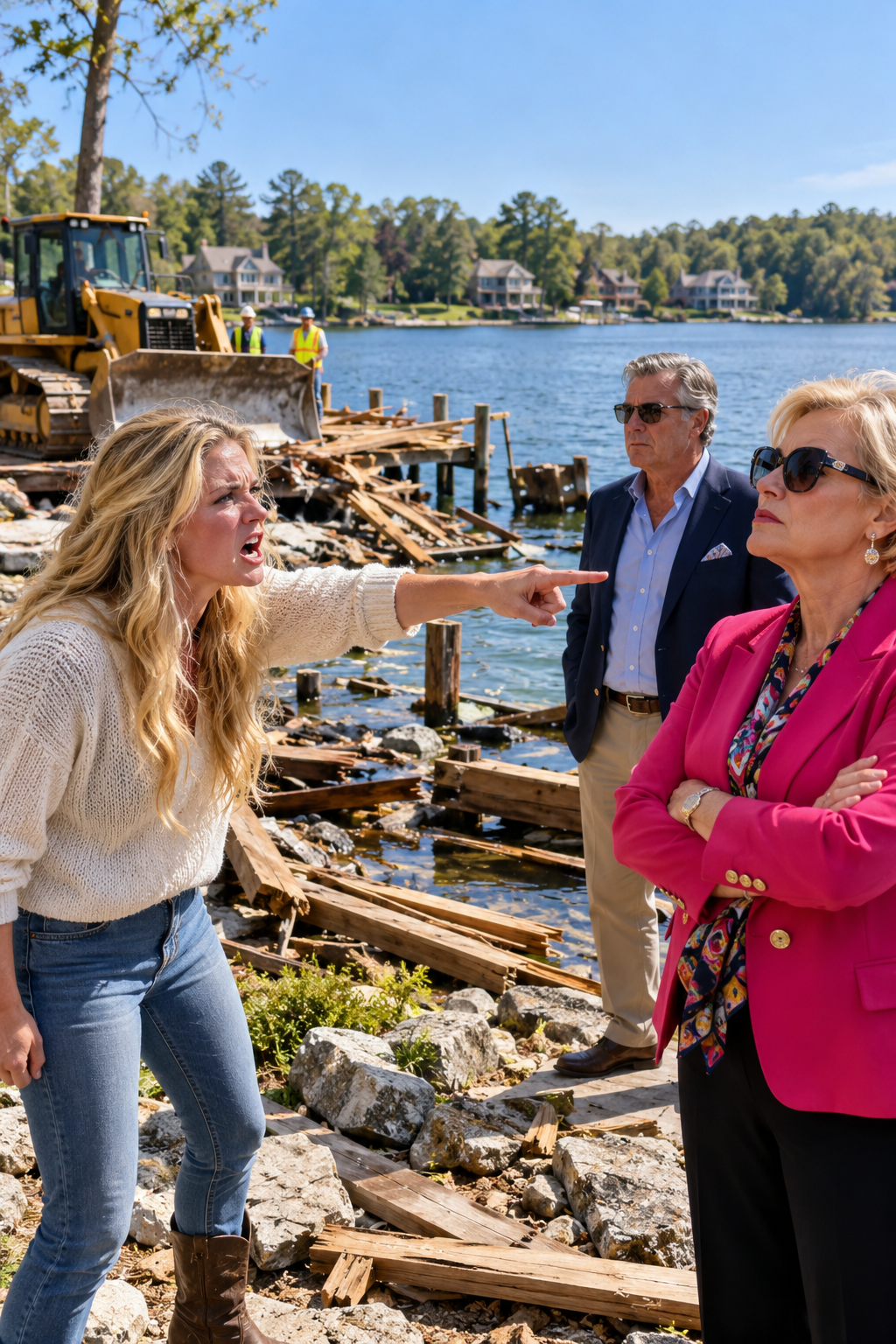
They demolished all two hundred feet.
The workers dragged beams onto the shore.
They ripped steel pilings from the lake bed.
They pushed debris into piles.
Then they loaded most of it onto trucks.
By noon, there was almost nothing left.
That was when Marcus called the state Department of Environmental Quality.
Then the conservation office.
Then the reservoir authority.
Then the county sheriff.
I drove home.
By the time I arrived, the equipment was still there.
Dean stood near the water with Richard and Pamela.
When he saw me, he walked up the drive.
“You should’ve learned when to stop being difficult.”
Behind him, another cedar beam snapped beneath the excavator.
I put one hand inside my coat pocket.
Around Dad’s brass key.
“What did you do with the demolition debris?”
Dean laughed.
“Seriously?”
“Contractor hauled it.”
“I don’t know.”
“Did you remove the submerged pilings?”
“Most of them.”
“Did you dredge the lake bed?”
His smile faded slightly.
“Just asking.”
Richard approached.
“Caroline, this didn’t have to happen.”
“We gave you multiple notices.”
“This is enforcement.”
Pamela came beside him.
“You’re surprisingly calm.”
I looked at her.
“I’ve been told that.”
Dean folded his arms.
“You can still sell.”
There it was.
They believed they had won.
No leverage.
A scarred shoreline.
An aging woman living alone in a farmhouse surrounded by hostile development.
In their minds, destruction had reduced the land’s usefulness and increased pressure on me to accept their offer.
I nodded slowly.
Then asked my brother:
“Are you sure you want me gone?”
“Finally getting realistic?”
“Just answer.”
Richard said, “Caroline, everyone benefits if you move on.”
Pamela added, “Including you.”
I looked at all three of them.
Then I stepped aside.
A white state SUV was coming down the drive.
Behind it was another.
Then a sheriff’s cruiser.
Richard frowned.
Pamela’s face lost color.
Dean looked at me.
“What did you do?”
I shook my head.
That was technically true.
They had done everything.
The first state officer stepped out.
Her name was Dr. Naomi Pierce.
Environmental enforcement.
She wore khaki field pants, boots, and a navy jacket.
She looked at the destroyed shoreline.
Then at the excavators.
Then at Richard.
“Who authorized this work?”
Nobody answered.
She asked again.
“Who authorized the shoreline disturbance?”
Pamela stepped forward.
“The Bellweather Shores Association acted under its covenants.”
Naomi stared at her.
“Do your covenants override state conservation law?”
Pamela blinked.
Naomi pointed toward the lake.
“This shoreline is protected under Riparian Conservation Agreement 09-771.”
Richard shook his head.
“That cannot be correct.”
“That property is private.”
“We were removing an illegal structure.”
Naomi looked at the wreckage.
“The structure is listed in the protected-site inventory.”
Richard’s face changed.
Dean looked at me.
I said nothing.
Naomi continued.
“Did your contractors disturb the lake bed?”
One contractor raised a hand weakly.
“We pulled pilings.”
“How many?”
“Maybe twenty-eight.”
“Any dredging?”
He looked at Richard.
Naomi noticed.
“Sir, I suggest you answer me, not him.”
“How much?”
“Maybe forty cubic yards.”
Naomi closed her eyes for one second.
Then she turned to another officer.
“Photograph everything. Nobody moves equipment.”
Richard stepped forward.
“You can’t impound private machinery.”
Naomi looked at him.
“We can preserve equipment involved in an active environmental violation.”
“This is absurd.”
She nodded toward the dock.
“But your day is about to get worse.”
The reservoir authority arrived fifteen minutes later.
Then another investigator.
Then a state wildlife officer.
By two o’clock, nobody from Bellweather Shores was smiling.
The first emergency violation assessment was $680,000.
That was before laboratory testing.
Before habitat damage.
Before unauthorized dredging.
Before removal of protected materials.
Before restoration costs.
Before penalties related to the historical permit.
And before anyone discovered where the demolition debris had gone.
That came two days later.
The contractor had dumped several truckloads into a ravine behind an abandoned commercial parcel owned by one of Richard’s companies.
The ravine drained into a tributary.
When inspectors tested the old dock timbers, they found creosote-treated material from the original structure.
Legal when installed decades earlier.
Highly regulated when disposed of now.
The dumping transformed an expensive civil violation into a much larger environmental case.
Bellweather Shores hired three law firms.
They sent me a settlement offer.
One million dollars.
I rejected it.
They offered two.
They offered restoration plus three million.
Dean came to the farmhouse at night.
I did not invite him inside.
He looked older.
Just ten days had passed.
But arrogance ages badly when exposed to consequences.
“What do you want?”
“Nothing from you.”
“Stop this.”
“Yes, you can.”
“No. The state is investigating.”
“You filed the complaint.”
“My attorney notified them.”
“You knew.”
I looked at him.
“Knew what?”
“That the dock was protected.”
His mouth opened.
“You let us tear it down.”
“Yes, you did.”
“I didn’t give you permission.”
“You could’ve stopped us.”
“So could you.”
He stared at me.
“I’m your brother.”
“That means nothing to you?”
I almost laughed.
Not because it was funny.
Because sometimes hypocrisy becomes so complete it circles back into absurdity.
“You stood beside an excavator while strangers destroyed Dad’s dock.”
Dean looked away.
“You don’t understand the pressure I was under.”
“Then explain it.”
He rubbed both hands over his face.
“Richard had already promised me a development position.”
There it was.
Not the whole conspiracy.
Just enough.
“What position?”
“Broker of record on the expansion.”
“What expansion?”
He hesitated.
I said nothing.
Silence does remarkable things to guilty people.
They rush to fill it.
“They wanted to redevelop the club.”
“Using my shoreline.”
“It would’ve increased values across the lake.”
“And your commission?”
Dean looked away.
There was my answer.
He said, “Caroline, you’re sitting on land you don’t even use.”
That sentence did something to me.
For the first time, I felt anger cleanly.
I stepped closer.
“Do you know why I don’t live here full-time?”
He said nothing.
“Because I spent the last year taking care of Dad.”
Still nothing.
“Do you know why the downstairs bathroom has grab bars?”
He looked at the porch.
“Do you know why the dining room became a bedroom?”
“Do you know why Dad stopped going down to the dock?”
His jaw tightened.
I continued.
“Because he couldn’t walk that far.”
“I said don’t.”
“And do you know who carried his chair onto the porch every evening so he could still see it?”
He looked at me.
I did not raise my voice.
That made it worse.
“You weren’t there.”
I was there when Dad’s hands shook too badly to hold a spoon.
I was there when his insurance company told him no.
I was there when he forgot Mom was dead and then remembered.
I was there when he apologized for becoming a burden.
I was there when he asked me whether you were coming that weekend.
I was there when I lied and said yes because the truth hurt him more.
Dean’s eyes dropped.
There was the anaphora Dad deserved.
Not theatrical.
Not shouted.
For almost a minute, neither of us spoke.
Then Dean whispered, “I had a business.”
“So did I.”
“I had employees.”
“So did I.”
“I have a family.”
I looked at him.
“So did Dad.”
He flinched.
Then he said, “You always hated me.”
“No, Dean.”
I stepped back.
“I kept expecting you to become someone I could respect.”
Three days later, the HOA filed a petition claiming temporary administrative control over part of my property.
Their lawyers argued that emergency shoreline stabilization required association access.
Marcus read the filing twice and laughed.
“They’ve just made the third biggest mistake in this case.”
“What were the first two?”
“Bulldozing your dock.”
“And second?”
“Putting their motive in writing.”
The petition included maps.
Detailed ones.
Maps showing the proposed club expansion.
A restaurant deck.
A members-only boat channel.
And a service road cutting across my property.
The plans were dated six months before Dad died.
Dean’s name appeared in the project emails.
So did Richard’s.
So did Pamela’s.
They had not reacted impulsively after my refusal.
They had been planning around Dad’s death.
The emotional betrayal was terrible.
The legal value was excellent.
Marcus filed our response.
Then he added a counterclaim I had been waiting for.
Deed reversion.
Bellweather Shores exploded.
Richard went on local television and called my claim “an opportunistic attempt to steal community property.”
I watched from Dad’s kitchen.
The private club behind him had stone columns, a slate roof, and a terrace overlooking the lake.
Fourteen thousand square feet.
Tennis courts.
Private marina.
Restaurant.
Estimated value: eighteen million dollars.
And beneath all that polished stone was a seventy-eight-year-old deed condition Richard apparently had never bothered to read carefully.
The state investigation widened.
Financial records were subpoenaed.
Then came the first major twist.
The HOA had not been paying demolition expenses from its normal operating account.
It had created something called the Lake Enhancement Fund.
Residents had been charged special assessments for five years.
Officially, the money was for erosion control, safety improvements, and public shoreline maintenance.
But more than three million dollars had been redirected toward the private club expansion.
The club was technically owned by a separate nonprofit controlled by several HOA board members.
The same people.
Two entities.
One pool of homeowners’ money.
And no meaningful separation.
That was when the attorney general’s office became involved.
The HOA stopped sending me settlement offers.
Instead, they sent threats.
One letter claimed my farmhouse violated setback standards.
Another claimed my driveway encroached on common land.
Another claimed my septic field had never been approved.
Each allegation collapsed within days.
Then they did something more personal.
They tried to remove me from the house.
Dean signed an affidavit claiming Dad had verbally promised him partial ownership.
The HOA used that affidavit to argue my title was disputed.
A judge issued a short temporary access restriction while the issue was reviewed.
Because of the wording, the sheriff advised me not to occupy the disputed residence for several days until the emergency hearing.
So eleven days after the dock demolition, I packed one suitcase.
I carried Dad’s documents to my car.
I locked the farmhouse.
And I left the home my father had given me.
Dean watched from the end of the driveway.
He did not look happy anymore.
But he still believed forcing me out would pressure me into settling.
Melissa stood beside him.
She wouldn’t meet my eyes.
I drove past them without lowering the window.
I checked into a modest hotel in Asheville.
A view of a parking structure.
I made coffee.
Opened my laptop.
And kept working.
No dramatic breakdown.
No midnight phone call begging my brother to reconsider.
No social-media rant.
No public accusation.
Because humiliation is sometimes most dangerous when the humiliated person knows exactly what comes next.
The emergency hearing took place four days later.
Dean sat with his attorney.
Richard and Pamela sat behind him.
The judge reviewed the deed.
Then he reviewed Dad’s will.
Then the survey.
Then Dean’s affidavit.
He looked at Dean.
“Mr. Mercer, do you possess any written document granting you ownership?”
“No, Your Honor.”
“Any deed?”
“Any amendment to the will?”
“Any financial record showing ownership interest?”
The judge turned one page.
“Then on what basis did you claim an immediate property interest sufficient to remove Ms. Mercer from the residence?”
Dean’s attorney stood.
“Your Honor—”
The judge raised one hand.
“I asked Mr. Mercer.”
Dean swallowed.
“My father told me the property would stay in the family.”
The judge looked toward me.
“Is Ms. Mercer not family?”
Nobody moved.
That was the mini-payoff I needed.
Not vengeance.
The restriction was dissolved.
I returned home that afternoon.
On the porch was a package.
No return address.
Inside was a USB drive.
And one handwritten note.
CHECK THE CLUB’S LOWER MARINA PERMITS.
That was the second twist.
And the only one I didn’t see coming.
I gave the drive to Marcus without plugging it into my own computer.
He sent it to a forensic specialist.
The files contained scanned permits, internal emails, invoices, and photographs.
Someone inside the HOA had been collecting evidence for years.
The lower marina had been expanded illegally.
Not recently.
Six years earlier.
Pilings installed outside approved boundaries.
Wetland fill placed without authorization.
A retaining wall constructed across a state drainage easement.
And most important, dredging records had been falsified.
The private club was not simply in violation because of what they had done to my dock.
Their own property had been carrying concealed environmental violations for years.
We sent everything to the state.
Then we waited.
Bellweather Shores held its annual winter gala on December 9.
Despite the investigation.
Despite the lawsuits.
Despite the mounting legal bills.
Richard refused to cancel.
Later, one homeowner told me he insisted the gala would “demonstrate stability.”
Three hundred members attended.
String quartet.
Valet parking.
Dean was there.
So was Melissa.
Pamela wore a red evening gown.
Richard gave a speech from the ballroom stage.
He told members their community was “under attack from outside interests.”
He promised the board would prevail.
At p.m., state investigators entered through the front doors.
Not dramatically.
No guns drawn.
No shouting.
That would have been easier for Richard.
Instead, they walked in calmly.
Professional.
Impossible to dismiss.
An investigator asked the musicians to stop playing.
Conversations faded.
Champagne glasses remained suspended in people’s hands.
The lead officer stepped onto the stage.
He handed Richard a folder.
Then he announced that the premises were subject to an immediate administrative seizure order pending enforcement action related to environmental violations, fraudulent filings, misuse of restricted funds, and unlawful destruction of protected shoreline infrastructure.
Someone dropped a glass.
Richard looked at the paperwork.
Then at the room.
Then at Pamela.
She was already moving toward a side door.
An investigator stopped her.
“Ma’am, please remain available.”
Dean stood near the bar.
Our eyes met across the ballroom.
I was not there.
But I saw the security video later.
He looked directly into the camera mounted above the terrace door.
For some reason, that image stayed with me.
My brother surrounded by marble floors, crystal fixtures, and wealthy people in tuxedos.
Everything he had valued.
Everything that looked like victory.
And suddenly none of it belonged to them.
The state’s initial civil assessments totaled $11.2 million.
Unauthorized shoreline destruction.
Protected habitat disturbance.
Improper dredging.
Hazardous material disposal.
False permit certifications.
Unlawful wetland alteration.
And restoration costs.
The attorney general separately pursued claims involving the Lake Enhancement Fund.
Bellweather Shores members revolted.
Within seventy-two hours, Richard resigned.
Pamela resigned two days later.
Three other board members followed.
Dean’s development contract vanished.
Then came the deed hearing.
The HOA’s attorneys argued that seizure did not trigger the old reversion clause.
Marcus argued that years of environmental violations, combined with unauthorized attempts to access Mercer shoreline rights, constituted exactly the prohibited conduct described in the original deed.
Eleanor testified.
She brought the original closing papers from 1978.
The judge asked her whether my grandfather had intended the clause to be enforceable.
Eleanor looked at him and said, “Judge, Harold Mercer did not put decorative sentences in contracts.”
The courtroom laughed.
Even the judge smiled.
Then Eleanor produced a letter written by my grandfather to the club’s original board.
It contained one paragraph that changed the hearing.
You may build your club on Mercer land, but you may never use your membership, money, or influence to take shoreline rights from the people who remain here. If you do, the land comes home.
The room went quiet.
That was the legal warning from a dead man.
Written nearly half a century earlier.
Waiting patiently.
The judge did not immediately transfer title to me.
Instead, he entered an order freezing any sale, refinancing, redevelopment, or transfer of the club property until the reversion claim could be resolved.
That was enough.
The club could not borrow against the property.
Could not sell it.
Could not restructure ownership.
Could not hide it.
Bellweather Shores had believed they owned everything that mattered.
In reality, they had been renting certainty from an old deed.
Weeks passed.
The environmental case grew.
Then something unexpected happened.
Homeowners started contacting me.
At first, I ignored them.
Then I read their messages.
Most were not rich villains.
They were retirees.
People who had bought homes without understanding what their board was doing.
One widow named Janet had paid more than $19,000 in special assessments.
She believed the money was repairing stormwater systems.
A young couple had been threatened with liens because they fell behind on “lake improvement” fees.
Another family had paid legal bills for two years after challenging an HOA fine that turned out to be unsupported.
The system had hurt them too.
That changed my goal.
I no longer wanted the club.
Not personally.
Dad had not preserved the land so I could become another person obsessed with controlling access.
I wanted accountability.
So I made an offer.
Not to the old board.
To the homeowners.
If the reversion claim succeeded, I would transfer the club property into a new lake conservation trust.
The ballroom could remain available for community events.
The marina could reopen only after lawful reconstruction.
Part of the property would become public shoreline access.
A portion of membership revenue would fund habitat restoration.
And homeowners who had been improperly assessed would receive priority repayment from recovered funds.
My attorneys thought I was giving away too much.
Eleanor did not.
She smiled.
“Thomas would approve.”
That mattered more.
Dean came to see me again in January.
Snow had dusted the dock ruins.
The state required temporary erosion barriers along the shore.
I was standing near the water when he approached.
No Range Rover this time.
Melissa had taken it during their separation.
I learned that from Eleanor, not him.
Dean stopped several feet away.
“You’re giving the club away?”
“Putting it into trust.”
“That place could be worth twenty million.”
“You could keep it.”
“I don’t want it.”
He laughed bitterly.
“That’s always been your thing.”
“Pretending money doesn’t matter.”
“Money matters.”
“Then why give away an asset like that?”
I looked toward the water.
“Because Dad didn’t leave me the land so I could become Richard.”
Dean was quiet.
Then he said, “You destroyed me.”
“You knew what would happen.”
“I knew what could happen.”
“You let me walk into it.”
“I asked you to stop.”
“The day you came with Richard.”
“That wasn’t asking.”
“I said no.”
He looked away.
I continued.
“You were so used to people giving you what you wanted that you stopped hearing the word.”
His face tightened.
“You think Dad was proud of you?”
I said nothing.
“You think this proves something?”
Still nothing.
“He loved me too.”
That surprised him.
I stepped closer.
“He loved you very much.”
Dean’s eyes became wet.
For the first time in my life, my brother looked small.
Not defeated.
He whispered, “Then why did he leave you the land?”
I thought about Dad’s letter.
About the brass key.
About thirty-seven years of being the person who stayed.
And I gave Dean the only answer I had.
“Because he knew which one of us would protect it.”
Dean nodded once.
Then he walked away.
The final civil settlement was approved in March.
The combined environmental assessments, restitution obligations, and restoration costs exceeded eleven million dollars.
Several penalties were adjusted through negotiated compliance agreements, but the number that appeared in the state’s public enforcement announcement was $11.2 million.
The old HOA board was permanently barred from managing the restoration funds.
The association entered court-supervised governance.
The Lake Enhancement Fund was audited.
Improper assessments were identified.
Some homeowners received credits.
Others received direct repayment.
Richard Voss faced separate criminal charges connected to falsified environmental documents and unlawful disposal records.
Pamela entered a cooperation agreement.
She provided investigators with internal communications.
Those communications made one thing painfully clear.
Dean had not invented the plan.
But he had supported it.
He had shared information about Dad’s declining health.
He had discussed timing.
He had told Richard that after Dad died, I could be “pressured into taking cash.”
That sentence hurt more than the bulldozed dock.
Because machines destroy wood.
Family destroys memory.
For months, I wondered whether I should ever speak to Dean again.
Maybe someday I will know.
Maybe forgiveness is not a door.
Maybe it is a road.
Maybe some people never walk far enough down it to reach you.
In April, the court approved the deed reversion settlement.
The private club property transferred out of the old corporation.
Not directly into my personal ownership.
Into the Mercer Bellweather Conservation Trust.
The name embarrassed me.
Eleanor insisted.
The marina closed for reconstruction.
Illegal pilings were removed.
Wetlands were restored.
The ballroom reopened under new management six months later.
The first major event held there was not a fundraiser.
It was a public meeting explaining exactly where every dollar of restoration money would go.
I sat in the back row.
Nobody recognized me at first.
That was fine.
I had never needed the room to know my name.
The dock was rebuilt the following year.
Same length.
Two hundred feet.
Same general design.
Cedar boards.
Steel pilings.
Simple rails.
No cocktail bar.
No private-members sign.
The state approved every inch.
At the end, I installed a small bronze plaque.
Not on the landward side where visitors would see it.
At the far end.
Facing the lake.
THOMAS AND MARGARET MERCER SOME THINGS ARE WORTH MORE THAN THEIR PRICE.
That was all.
No explanation.
The first evening after construction finished, I carried Dad’s old folding chair to the end.
The sunset turned the lake copper.
A fishing boat moved slowly across the old river channel.
For the first time in two years, the property felt quiet.
There is a difference.
My daughter Emily called.
She asked if I was happy.
I told her yes.
Then she asked if the fight was finally over.
I looked at the water.
At first, I almost said yes.
But my phone vibrated.
A message from Marcus.
One attachment.
One sentence.
CALL ME BEFORE YOU OPEN THIS.
I stared at the screen.
Then I opened it anyway.
It was a scanned property ledger from 1954.
One I had never seen.
Across the top was my grandfather’s name.
Below it were six shoreline parcels.
The Mercer property.
The club property.
And four others now occupied by some of the most expensive developments on Lake Bellweather.
Each parcel carried the same handwritten notation.
SUBJECT TO ORIGINAL RESERVOIR ACCESS CONDITIONS.
My heart slowed.
I scrolled down.
A second page listed easements.
Water rights.
Reversion clauses.
Then one final note.
Signed by my grandfather.
If any successor entity attempts consolidation of the northern shoreline through coercion, the restrictions shall be reviewed collectively.
Collectively.
Not separately.
I called Marcus.
He answered on the first ring.
“Tell me I’m reading this wrong.”
“You’re not.”
“How much land are we talking about?”
“Potentially?”
He was quiet.
“About nine hundred acres.”
I stood at the end of the rebuilt dock.
The lake looked peaceful.
Almost innocent.
Across the water, lights were coming on inside mansions that had sold for five, ten, fifteen million dollars.
I thought the story had been about one dock.
Then one HOA.
Then one club.
Dad had known.
Maybe Grandpa had known too.
The dock had never been the treasure.
The farmhouse had never been the treasure.
Even the club wasn’t the treasure.
The real inheritance was leverage.
A legal promise buried beneath seventy years of arrogance.
A promise designed to protect people who did not have lobbyists, lawyers, or boardrooms.
I heard Dad’s voice again.
Price isn’t the same thing as value.
My phone buzzed.
Another message.
This one from Dean.
I HAVE SOMETHING DAD GAVE ME. YOU NEED TO SEE IT.
For a long time, I stared at those words.
Then I slipped the phone into my pocket.
The same pocket where I still carried the brass key.
My brother had betrayed me.
My father had prepared me.
An entire system had tried to push me off land they believed they were entitled to own.
And I had spent most of my life being mistaken for the woman who would quietly move aside.
Maybe that was why Dad chose me.
Not because I was louder.
Because I could wait.
Because I could read.
Because I could remember.
Because I understood that justice is not always a courtroom explosion.
Sometimes justice is a document nobody bothered to read.
Sometimes justice is an old key.
Sometimes justice is a woman standing silently while arrogant people finish making the worst mistake of their lives.
And sometimes the person who appears to be retreating is only stepping far enough back to see the entire battlefield.
I looked once more across Lake Bellweather.
Nine hundred acres.
Four developments.
One buried agreement.
And one brother who suddenly claimed to possess something our father had hidden from everyone else.
Then I smiled.
Not because I knew what would happen next.
Because for the first time, I knew exactly what question to ask.
I called Dean.
He answered immediately.
His voice was shaking.
“Caroline?”
I looked at the rebuilt dock beneath my feet.
At the water Dad had protected.
At the shoreline powerful people had spent decades assuming belonged to them.
And I asked softly:
“Dean… are you absolutely sure you want to show me what Dad left you?”
✓ Lynn R. Adams
🔥HERE’S THE NEXT PART OF THE STORY, ENJOY !! The explosive twist and the final ending of this story ! ⬇️💬 Thank you ❤ “What does it open?” “Something your brother shouldn’t see until he shows you …