My four children walked into a billionaire’s jewelry launch and started calling him “Daddy.” I’d never met Alexander Sterling, and I certainly hadn’t sent them there. But when his company’s creative director tried to throw them out, my son pointed at the jewelry on display and said, “Mommy designed that.” The woman presenting those designs as her own was the same woman who had just fired me. And now she was demanding that I prove my work belonged to me, in front of the press.
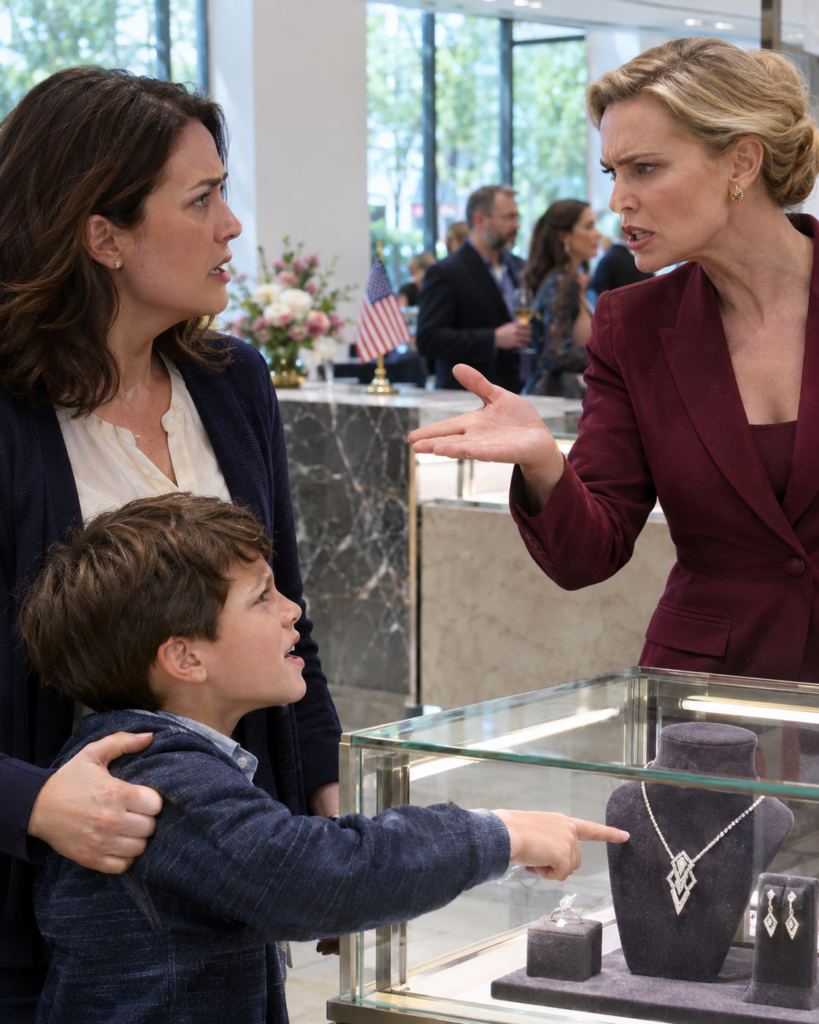
My Four Children Called a Billionaire CEO “Daddy” at His Jewelry Launch—Then My Son Recognized the Designs My Boss Had Stolen
The moment I accepted Alexander Sterling’s offer, Victoria Grant turned toward the reporters and gave a small, disbelieving laugh.
“This is ridiculous,” she said. “Are we seriously going to let a woman who was fired for poor performance represent Sterling Jewelry?”
Alexander didn’t answer her immediately. Instead, he turned to the woman standing beside his head of production.
“Meredith, I want the original Guardian project files preserved. Every design revision, every approval, every production order. Nothing gets changed or deleted until we’ve reviewed them.”
Victoria’s smile disappeared.
The woman, whom he introduced as the company’s general counsel, nodded and stepped away to make a call.
I stood beside a display case filled with jewelry I had spent months designing. My name appeared nowhere in the launch materials. Victoria’s photograph was printed on a large panel behind the collection, along with a paragraph describing her creative vision.
Ten minutes earlier, I’d been a former employee trying to retrieve my children from a public embarrassment.
Now the company’s chief executive was asking questions Victoria clearly didn’t want answered.
“This is unnecessary,” she said. “I supervised the entire collection.”
“Then the records should support that,” Alexander replied.
Victoria looked at me.
“You have no idea what you’ve started.”
I wanted to tell her that she’d started it herself when she took my drawings, dismissed me from my job, and presented the finished collection as her own.
But my youngest daughter was holding my hand so tightly that her little fingers had begun to hurt.
I looked down at her instead.
“Sweetheart, loosen your grip a little.”
She did, then whispered, “Are we in trouble?”
“No,” I said. “But we’re going home soon.”
Alexander heard her.
He crouched to her level, careful not to come too close.
“Nobody’s in trouble for telling the truth,” he said.
My daughter studied him for a moment.
“Then why is that lady so mad?”
Behind him, Victoria drew a sharp breath.
Alexander stood.
“That’s a question for the adults.”
He asked his staff to clear a quiet room away from the reporters. I was grateful. My four children had already attracted more attention than any mother would want, especially after deciding that a billionaire they’d never met would make an excellent father.
I still hadn’t figured out how they’d reached the launch without my permission.
And I was determined to find out.
Before we left the showroom, Alexander stopped me.
“The opportunity I mentioned is real,” he said. “But I want you to understand the terms.”
“Not all of them. Sophia’s representatives have agreed to review one final proposal for our annual collection. We have eighteen days to prepare it. She hasn’t endorsed a jewelry brand in ten years, and she has turned down every concept we’ve submitted so far.”
Victoria folded her arms.
“Because she knows quality when she sees it.”
Alexander continued speaking to me.
“If Sophia approves your work, you’ll receive a proper design contract. If she doesn’t, you’ll still be paid for the proposal and the time required to develop it.”
I hadn’t expected that last part.
For the previous three weeks, I’d been calculating how long I could manage without a paycheck.
“Who decides whether the proposal is good enough to send her?” I asked.
“An independent design team. Victoria won’t supervise your work.”
“Of course I won’t,” Victoria said. “I refuse to participate in this circus.”
Alexander glanced at her.
“That arrangement wasn’t a request.”
For a moment, I almost smiled.
Then I remembered the four children waiting to go home, the rent coming due, and the fact that a famous actress had absolutely no obligation to save my career.
“Eighteen days,” I repeated.
Alexander nodded.
I looked once more at the Guardian collection.
“All right,” I said. “I’ll need a workbench.”
My name is Elena Hart. I’m a single mother of four, and until that afternoon, my greatest professional achievement had been hanging behind a glass display with another woman’s name attached to it.
My oldest, Ethan, was ten. Mia was eight, and the twins, Oliver and June, were six.
All four had strong opinions about nearly everything, from breakfast cereal to the proper way to arrange sofa cushions. They argued over the television remote, borrowed one another’s sweaters, and occasionally worked together on schemes so complicated that I wondered why they couldn’t apply the same energy to cleaning their rooms.
Looking for a father had been their most ambitious scheme yet.
Our neighbor, Mrs. Alvarez, had been watching them while I attended an employment appointment. She’d taken them downtown to a children’s exhibit, and somehow Ethan had persuaded his siblings to follow him into the public showroom attached to Sterling Jewelry’s event space.
The launch itself was supposed to be restricted to invited guests. During the confusion of arriving reporters and vendors, the children had slipped past a reception area.
By the time Mrs. Alvarez realized where they’d gone, Ethan had already approached Alexander Sterling and announced that he and his siblings had come to meet their father.
Alexander had repeatedly explained that he wasn’t their father.
My children, apparently, had considered that a minor objection.
Mrs. Alvarez met us at the entrance afterward. She was pale and close to tears.
“Elena, I turned around for one minute.”
“I know,” I said.
“I should never have let them out of my sight.”
“We’ll talk about it later.”
I wasn’t angry enough to forget that she was a good neighbor who had helped me through school closures, late shifts, and more childcare emergencies than I could count.
But the children had been in a crowded public building without an adult who knew where they were. I wasn’t going to pretend that was harmless because the story happened to involve a famous businessman.
At home, I made everyone sit around our kitchen table.
Ethan tried to take responsibility immediately.
“It was my idea.”
“Mia told me it wasn’t a good idea.”
Mia looked offended.
“I said we should call Mom first.”
“That’s what made it a bad idea,” Ethan muttered.
I took a breath.
“None of you is ever to leave the adult responsible for you again. Not to find somebody. Not to help me. Not for anything. Do you understand?”
Four heads nodded.
June climbed into my lap.
“But Mr. Sterling was nice.”
“I’m glad he was. You still didn’t know him.”
Oliver, who had been quiet, finally spoke.
“We thought you needed somebody.”
I looked at him.
“Somebody for what?”
Ethan pushed the corner of a paper napkin around with his finger.
“There was that thing at school,” he said.
“What thing?”
“The fathers’ breakfast. And you had to come instead of Dad. Then you got fired, and you cried in the kitchen when you thought we were asleep.”
I hadn’t known they’d heard me.
I’d sat at that table after midnight, staring at a termination email while a pot of pasta cooled on the stove. I remembered crying, but I thought I’d been quiet.
Ethan went on.
“We looked up Mr. Sterling because he owns the company. He wasn’t married, and he looked strong. And he’s rich enough that maybe he could make that lady give your job back.”
For several seconds, I couldn’t speak.
I had spent years telling my children they weren’t missing anything essential because our family looked different from the families around us. I had chosen to have them. I had wanted them with all my heart.
Yet they’d somehow decided it was their responsibility to find someone powerful enough to protect me.
I reached across the table and covered Ethan’s hand.
“Listen to me. My job is to take care of you. You don’t have to find a husband for me or a father for yourselves.”
“What if we want one?” Mia asked.
That was a harder question.
“Then we can talk about what you’re feeling,” I told her. “But you can’t choose a person from the internet and decide he belongs to us.”
June considered this.
“Even if he’s nice?”
“Even then.”
She sighed.
“That’s disappointing.”
Despite everything, I laughed.
I’d never finished college, although not because I lacked the desire.
I took design classes when I could afford them, worked at a repair counter for a small jewelry shop, and learned from older craftsmen who were willing to show me things they hadn’t learned in school themselves.
I knew how metal behaved under pressure. I knew how to adjust a setting without weakening its support, how to make a clasp lie flat against the skin, and how to draw something a person could actually wear rather than merely admire in a photograph.
I loved the work.
Before joining Sterling Jewelry, I’d spent years making custom pieces for anniversaries, graduations, retirements, and memorial gifts. Most were modest commissions. A woman might bring me her mother’s broken chain and ask whether I could turn it into something wearable. A husband might want a new ring incorporating the small stone from his late wife’s engagement band.
Those jobs taught me to listen.
Victoria Grant had seemed to appreciate that when she hired me.
She was everything I wasn’t on paper: formally educated, internationally recognized, confident in any room, and comfortable speaking to wealthy clients as though she’d known them all her life.
At first, she encouraged me.
“You understand sentimental design,” she told me after reviewing my portfolio. “That’s valuable. People buy jewelry because they want to feel something.”
I was proud to work under her.
The trouble began gradually.
A sketch I made for a client presentation appeared in a departmental meeting without my name on it. A clasp I’d redesigned was described as Victoria’s innovation. When someone praised a prototype, she accepted the compliment without mentioning my contribution.
I told myself that was how big companies worked.
The creative director received the applause. The designers beneath her supplied the work.
I wasn’t entirely wrong. Collections were collaborative, and Victoria had responsibilities I didn’t. She managed budgets, selected concepts for production, and understood the luxury market far better than I did.
But there was a difference between directing a collection and claiming to have personally created every design in it.
The Guardian collection was where that difference became impossible to ignore.
I’d conceived its central motif at home one rainy evening.
The children had spread their schoolwork across the kitchen table. Oliver was trying to fix a toy with a broken plastic wheel. June was insisting that everyone make room for her crayons. Mia was helping Ethan untangle a necklace chain I’d brought home from a repair job.
At one point, all four children leaned over the table, each holding a different section of the chain while Ethan worked on the knot.
Their hands formed a loose circle around the problem.
I drew the shape later that night.
Four gently curved supports surrounding a center stone, leaving enough open space for light to pass through.
The first version was rough. I refined the angles, worked through the setting’s weight, and created several variations for rings, pendants, and earrings.
I called the concept Guardian.
Victoria loved it.
She asked for my original drawings and the working files. That was ordinary enough. We used shared company systems, and the collection belonged to Sterling Jewelry as work I’d created for my employer.
I wasn’t trying to take company property.
I wanted my work acknowledged.
When the marketing materials began circulating with Victoria listed as the collection’s designer, I asked her about it.
She told me not to be difficult.
A week later, I was fired.
The following Monday, I returned to Sterling Jewelry through a side entrance reserved for employees and contractors.
It felt strange to walk into a building I’d left carrying a cardboard box of desk supplies.
A security guard recognized me and smiled uncertainly.
“Good morning, Ms. Hart.”
My temporary badge had my name on it, followed by the words INDEPENDENT DESIGN CONSULTANT.
That meant something.
It wasn’t an apology or a restored career, but it was a written agreement. I would be paid for the next eighteen days, given studio access, and allowed to retain copies of my new working records. Any future use of my proposals would require a separate contract.
I had asked for those terms after spending most of Sunday reviewing the draft agreement.
Alexander had approved them without argument.
The workshop was on the third floor, away from Victoria’s office.
An older goldsmith named Ruth Calder was waiting inside.
Ruth had worked in production for more than thirty years. Her hands were broad and strong, with faint scars near her knuckles from a lifetime at the bench.
She examined me over her reading glasses.
“Are you the woman who caused all that excitement?”
“My children did most of the work.”
She pointed toward an empty workbench.
“Well, if you’re going to make something, you’ll need light. That bench gets the morning sun.”
There was no grand welcome. Ruth showed me the tools, the ventilation controls, the materials inventory, and the procedures for requesting samples.
I liked her immediately.
By noon, I’d spread three design concepts across the work surface.
All three were wrong.
The first resembled Guardian too closely. I didn’t want to spend my second chance producing another version of the collection Victoria had taken credit for.
The second was beautiful on paper but too elaborate. Its delicate assembly would have made it expensive to manufacture and difficult to repair.
The third looked like something I’d designed to impress Sophia rather than something a woman would choose to wear.
I put my pencil down.
Ruth leaned over the table.
“What’s bothering you?”
“I’m trying too hard.”
“That’ll do it.”
She lifted the third drawing.
“Who is this for?”
“Which Sophia?”
I stared at her.
“The actress.”
“I know who she is. I meant, what do you know about how she lives?”
“Not much.”
“Then perhaps you ought to find out before drawing a necklace for her.”
I felt foolish, but Ruth was right.
That evening, I read everything Sterling Jewelry had received from Sophia’s representatives.
There wasn’t much.
Her team wanted a collection with a strong point of view and exceptional craftsmanship. They specifically rejected campaigns built around celebrity glamour, oversized stones, or personal tragedy.
Victoria had submitted a diamond collar designed to dominate a red carpet photograph.
Sophia had declined to consider it.
I studied that detail for a long time.
Then I turned off my laptop and looked around my kitchen.
Mia was helping the twins finish their reading assignments. Ethan had fallen asleep with a science book open beside his plate.
A bent spoon lay near the sink. One cabinet door needed tightening. My own necklace, a simple gold chain I’d worn for years, had broken again at the clasp.
I picked it up.
The clasp was so small that even with steady hands, I had trouble fastening it behind my neck.
I thought about the women who had brought jewelry to my old repair counter.
Women with stiff fingers. Women who lived alone and no longer had someone standing behind them to fasten a necklace. Women who stopped wearing beautiful things because getting them on and off had become too difficult.
I opened my sketchbook.
This time, I knew where to begin.
Two days later, Alexander appeared at the workshop door.
He wore a dark suit and carried no entourage, although I’d learned that people tended to clear a path for him wherever he went.
“May I come in?”
I was filing the edge of a small silver prototype.
“It’s your building.”
“That wasn’t what I asked.”
I put the file down.
He looked at the workbench, taking care not to touch anything.
“Ruth says you’re making progress.”
“Ruth says I keep forgetting to eat lunch.”
“She told me that, too.”
For a moment, neither of us spoke.
Then he asked about the children.
“Are they all right after the launch?”
“They’re fine. A little embarrassed now that they understand what happened.”
“I hope you didn’t blame yourself.”
“They left their sitter and walked into a private event. I had to have a serious talk with them.”
“I can imagine.”
He smiled faintly.
“No. I don’t have children.”
There was no bitterness in his voice. It was a straightforward statement.
Still, I thought about the way he’d stood between Victoria and my children, and how gently he’d addressed June.
“Thank you for protecting them,” I said.
“Victoria had no reason to speak to them that way.”
“She was angry with me.”
“That doesn’t excuse involving children.”
I returned to my prototype.
He watched for a moment.
“May I ask something about the Guardian collection?”
“Why did you use four supports?”
“Because of my children.”
I explained the kitchen-table scene.
Alexander studied the small silver shape I’d made.
“My father noticed that motif immediately,” he said. “He thought it was the strongest design in the launch.”
“Your father was kind to my children.”
“He liked them.”
“They called him Grandpa.”
“Yes. He told my mother about that.”
I groaned softly.
“Please tell him I’m sorry.”
“Don’t be. I haven’t heard him laugh that much in months.”
Alexander paused.
“Actually, my mother asked about them, too.”
He seemed uncertain whether to continue.
“She thought they looked familiar.”
“She said Ethan reminded her of me at that age.”
I looked up.
“Children resemble people who aren’t related to them all the time.”
“And they were trying to convince everyone you were their father. Your mother may have been influenced by that.”
“Probably.”
He didn’t pursue it, and I appreciated his restraint.
Before leaving, he asked whether I needed anything for the proposal.
“Reliable access to the sample equipment,” I said. “And I need the production team to know that Victoria isn’t approving my designs.”
“I’ll make sure those instructions are clear.”
After he left, I tried to return to work.
But I kept remembering Catherine Sterling’s face at the launch.
She hadn’t stared at my children the way people stare at an odd spectacle. She’d looked genuinely startled, as though she’d recognized something she couldn’t place.
I told myself it meant nothing.
There was too much else to do.
The investigation into the Guardian collection progressed while I worked.
Meredith, the company attorney, asked me to provide the original audio file from my phone and explain how it had been recorded.
I told her the truth.
Several months earlier, I’d brought Ethan to work when his school closed unexpectedly and my childcare plans fell through. He’d waited in a spare office while I finished a meeting.
He’d been playing with the voice recorder on my phone, trying to make a message for me, and accidentally left it running.
I took the phone into Victoria’s office without realizing the recorder was still on.
Later, I discovered that it had captured part of our conversation about Guardian.
I hadn’t intended to record Victoria, and I hadn’t made the file public. But after she challenged me in front of the press, I’d played the relevant portion because I couldn’t bear to stand there while she called me a liar.
Meredith listened to the entire recording, not just the section heard at the launch.
Then she asked for the date, the phone’s file information, and any other records I still had.
“I gave Victoria the original drawings,” I reminded her.
“We understand. We’re looking at more than drawings.”
I didn’t hear anything for several days.
Then the production director asked whether I remembered working with a model maker on the Guardian pendant.
He’d prepared an early wax form from my measurements, then sent it back because the first version was too heavy.
I remembered spending most of a Friday afternoon changing the shape of the back plate.
The production director found the old order.
It named me as the designer requesting the revision.
Additional records followed: dated files saved under my company account, comments on preliminary renderings, and an internal meeting invitation identifying me as the person presenting Guardian.
Each piece was ordinary by itself.
Together, they told a story much more reliable than a dramatic recording.
Victoria had supervised the collection. She’d made legitimate decisions about which pieces to manufacture and how to present them.
But the records showed that I had developed the central designs and solved several of the technical problems that made them possible.
That distinction was exactly what I’d been trying to explain before she fired me.
The recording mattered because it supported the timeline.
In it, Victoria discussed which of my designs would be selected for production and asked me to leave my original drawings with her. When I mentioned credit, she said we’d address it later.
She had never addressed it.
Instead, she’d put her own name on the work.
On the ninth day of the competition, I received a message asking me to attend a meeting.
Victoria was there.
She sat at the far end of a conference table wearing a cream jacket and a diamond necklace from the Guardian collection.
Meredith sat between us with several folders.
Alexander wasn’t present.
He had decided that the review should proceed without him, which I thought was appropriate given the strange attention my children had brought to our first meeting.
Victoria looked tired.
For the first time since I’d known her, she wasn’t performing for an audience.
Meredith explained that the company had reviewed the available design history and spoken with members of the production team. Victoria had been given the opportunity to respond.
Then she invited me to describe what had happened when I asked for credit.
I kept my hands folded in my lap.
“I told Victoria I didn’t expect to be introduced as the creative director. I knew that was her job. I asked her to identify me as the designer of the Guardian pieces.”
Victoria leaned forward.
“That isn’t how major luxury houses operate.”
“Some do,” I said.
“Not ours.”
“You could have said the collection was developed by your team.”
“I did develop it.”
“You directed it. I drew it.”
Victoria gave a short laugh.
“You think drawing a few pretty shapes makes you responsible for a commercial collection? I dealt with budgets, suppliers, approvals, and the entire launch.”
“I know you did.”
That seemed to surprise her.
I continued.
“I never said you contributed nothing. I said you took credit for what I contributed.”
For a moment, Victoria looked away.
Then she turned back to Meredith.
“This company has spent years building my reputation. If you undermine it over an employee dispute, you’ll damage the entire brand.”
Meredith closed one of the folders.
“The company’s reputation is one reason we’re reviewing this carefully.”
Victoria looked at me again.
“You have no idea what it takes to reach my position.”
“You’re right,” I said. “I don’t.”
She seemed ready to respond, but I continued before she could.
“I know what it takes to reach mine. I know how many evenings I worked after my children went to bed. I know which clasps failed and which settings had to be rebuilt. I know what I brought to you.”
Victoria’s expression tightened.
“I gave you opportunities.”
“You did. I was grateful for them.”
“Then why are you doing this?”
“Because being grateful doesn’t mean I have to agree when you say my work is yours.”
The room went quiet.
Meredith asked several more questions about the termination. The reasons listed in my personnel file did not match the sequence of emails I’d kept, and the company was reviewing that issue separately.
No one announced a verdict in the room.
Victoria left first.
At the door, she stopped and looked back at me.
“You think they’ll treat you differently?”
I didn’t know the answer.
“I think I’ll be more careful about what I sign,” I said.
After she was gone, Meredith told me the company would provide its findings in writing.
I thanked her.
Then I returned to the workshop.
There were nine days left.
By then, Ruth and I had developed a small collection built around a simple idea.
A piece of jewelry should belong to the person wearing it, not to the room watching her.
The centerpiece was a gold pendant shaped like an open oval. Four narrow curves approached the center without closing it, leaving a small space through which the wearer’s clothing could be seen.
It wasn’t a literal picture of a family.
It could mean different things to different people.
The chain had an adjustable length, and I’d designed a larger clasp with a textured lever that could be operated more easily by someone with limited finger strength.
Ruth tested every version.
She refused to accept a beautiful clasp that wouldn’t hold securely, and she insisted that the pendant sit flat rather than twist when the wearer moved.
The first sample failed.
The chain caught under the hinge.
The second sat properly but was uncomfortable against the back of the neck.
The third worked.
Ruth placed it on the workbench beside my sketches.
“There,” she said. “That one’s worth showing.”
I picked it up.
The gold was warm from her hands.
It was modest compared with the elaborate pieces surrounding us in the Sterling workshops, but its proportions were right. Nothing felt excessive.
I called the design Open Place.
Sophia’s representatives had agreed to a private presentation.
I prepared drawings, a sample, and a short explanation of the construction.
Then I received a message that nearly made me stop working.
Sophia would see the proposal, but she would not agree to any promotional use of her name or image merely because she’d attended the meeting.
Her representatives also wanted confirmation that the designs were original and that the person presenting them had the authority to speak for the work.
I read that condition twice.
Victoria’s dispute had reached them.
For a moment, I considered withdrawing.
I didn’t want to walk into another room and spend half my time defending my right to be there.
Ruth saw my expression.
“What happened?”
I handed her the message.
She read it, then set it down.
“Can you answer their questions?”
“Then answer them.”
“Victoria is going to make sure everyone thinks I’m difficult.”
Ruth removed her glasses.
“Elena, I’ve watched you remake the same clasp four times because the first three weren’t good enough. You’re plenty difficult when something matters.”
I laughed despite myself.
“That’s different.”
“Not as different as you think.”
She pointed at the pendant.
“Take your work. Let it speak. And if they ask a question, answer it.”
I packed the sample carefully.
Sophia was nothing like the publicity photographs I’d seen.
She arrived at the private meeting wearing dark trousers, a soft gray sweater, and almost no jewelry.
Her hair was pulled back loosely. She looked older than she did on screen, which was to say she looked like a woman who had lived a full life and had no interest in pretending otherwise.
Her agent and a stylist joined us. Two Sterling representatives were there to discuss production, but Alexander stayed out of the center of the room.
Sophia greeted everyone politely.
When she reached me, she held out her hand.
“You’re the designer?”
“Yes. Elena Hart.”
“Then let’s see what you’ve made.”
I placed the pendant on a velvet pad.
She didn’t touch it immediately.
Instead, she studied the shape.
“What’s it called?”
“Open Place.”
“Because the center isn’t filled.”
“I can see that.”
I smiled nervously.
She looked up.
“Tell me why you left it empty.”
I thought about the polished explanation I’d prepared, the one describing negative space and contemporary elegance.
Then I put it aside.
“I started with four shapes because I have four children,” I said. “But I didn’t want the piece to mean only motherhood. Some people have families they were born into. Some build them. Some lose people. I wanted the space to be somewhere the wearer could put her own meaning.”
Sophia considered that.
“It’s a better answer than most I’ve heard.”
She lifted the pendant and turned it over.
“May I try it on?”
“Of course.”
She fastened the chain herself.
That was the moment I cared about most.
Her fingers found the clasp without difficulty. She adjusted the length, then looked in the mirror.
The pendant rested just below her collarbone.
“It doesn’t turn,” she observed.
“We adjusted the weight.”
“And it doesn’t catch on the sweater.”
“We tested that, too.”
She examined the clasp again.
“My mother loved jewelry,” she said. “Near the end, she could barely close the clasps on anything she owned. She kept wearing the same old ring because she could manage it herself.”
I didn’t know what to say, so I let her continue.
“The last jewelry company I worked with wanted to make a campaign about my mother’s illness. They thought people would find it moving.”
She touched the pendant.
“I found it unbearable.”
That explained why she’d stayed away from endorsements for ten years.
“I wouldn’t ask you to do that,” I said.
“Everyone says that before the contracts arrive.”
“Then your lawyer should make sure the contract says what you need.”
She looked at me with renewed interest.
“Are you always this direct?”
“Only when I’m nervous.”
For the first time, she smiled.
She wore the pendant for the rest of the meeting. She walked around, sat down, and tested how it moved against her sweater.
Then she removed it and placed it carefully in its box.
“It’s good work,” she said.
My chest tightened.
“But I want one change.”
“The edges are comfortable, but the clasp is still a little too small. I can manage it. My mother couldn’t have.”
“We can improve that.”
“Without making it look like medical equipment?”
“Then I’d like to see the revised sample.”
It wasn’t an endorsement.
It was another chance.
And we had four days left.
Back at the workshop, Ruth examined the clasp and shook her head.
“We’re going to need another mechanism.”
“The current one is safe.”
“But it’s not easy enough.”
Ruth turned it in her fingers.
“You’re right.”
That agreement mattered more than praise.
We spent the next day working through variations. A larger lever ruined the proportions. A wider housing made the chain look clumsy. One mechanism felt smooth but opened too readily when pulled at an angle.
Ruth rejected it immediately.
“Pretty is no use if the necklace ends up on the sidewalk.”
We finally developed a broader, low-profile clasp with a slightly recessed grip. It was secure, easier to operate, and still looked intentional as part of the chain.
But the deadline had become frighteningly close.
At home, the children were tired of hearing me say I needed another hour.
On Thursday evening, Ethan placed a school notice beside my sketchbook.
His class was presenting a science project the following morning.
I’d promised to attend weeks earlier.
He didn’t remind me of that promise.
He just set down the paper.
“It’s okay if you’re busy,” he said.
I knew that tone.
It was the voice he used when he was trying to make disappointment easier for me.
“What time?”
I looked at the clock, then at the sample I still needed to approve.
“I’ll be there.”
“You don’t have to.”
“I said I would.”
The next morning, I called Ruth before leaving home.
“I need you to supervise the final clasp test. I’ll come straight in afterward.”
“Where are you going?”
“My son’s school.”
There was a pause.
“Good,” Ruth said. “I’ll keep the bench warm.”
Ethan’s science project was a small bridge made from craft sticks. He’d built it with two classmates, and their assignment was to explain how it carried weight.
When he saw me standing at the back of the classroom, his face changed.
He didn’t run over or make a scene.
He just stood a little straighter.
After the presentation, he walked me to the door.
“Did you really like it?”
“It’s not as important as the necklace.”
I put my arm around his shoulders.
“It’s important to me.”
At the workshop that afternoon, Ruth had the final clasp waiting.
It passed every test.
We sent the revised sample to Sophia’s representatives with a short note explaining the changes.
Then we waited.
The answer came the next evening.
I was making grilled cheese sandwiches when my phone rang.
It was Alexander.
“Are you somewhere you can talk?”
“Good. Sophia has approved the revised design.”
I leaned against the kitchen counter.
For a second, the room seemed unusually quiet.
“Approved it?”
“She wants to proceed with the endorsement, subject to the final contract and production approvals. Her team specifically mentioned the clasp.”
I covered my mouth with my hand.
Mia looked up from the table.
Alexander continued.
“She also asked whether you would remain the credited designer throughout the campaign.”
I closed my eyes.
“Yes,” I said.
“She made that a condition.”
I heard him smile.
“So did we.”
After the call, I told the children.
Oliver asked whether Sophia was famous enough to be on television.
“Very famous.”
“More famous than Mr. Sterling?”
“Probably.”
June wanted to know whether Sophia liked the necklace because it was shiny.
“She liked that she could put it on by herself.”
June looked puzzled.
“I can put on my own necklace.”
“Then you understand why that’s important.”
Ethan didn’t say much.
He waited until the twins were busy arguing over who would finish the last sandwich.
Then he came beside me.
“Does this mean that lady can’t say you copied her anymore?”
I knelt so we were eye to eye.
“It means people are starting to see what I can do.”
“Are they going to give you your job back?”
“I don’t know if I want that job back.”
He frowned.
“But you liked designing there.”
“I did. I still like designing. I just want to do it somewhere my work is respected.”
He nodded slowly.
Then he hugged me.
It was the first time since the launch that I felt he had stopped believing he needed to fix things for me.
The company completed its internal review several weeks later.
Meredith invited me to a meeting and gave me a written summary of the findings.
The records supported my authorship of the Guardian designs. They also showed that Victoria’s public statements had been misleading and that my termination had not been handled appropriately.
Sterling Jewelry agreed to correct the collection’s published credits, update its internal records, and provide financial compensation related to my dismissal and the misuse of my work.
The compensation didn’t make me wealthy.
It covered the weeks I’d been without income and gave me breathing room to decide what I wanted next.
Victoria was removed from responsibility for the collection while the review was underway. After the company finished its process, her employment ended.
I didn’t attend that meeting.
I didn’t need to watch someone lose a job to know what losing a job felt like.
When I heard the news, I sat at my kitchen table for a long time.
Victoria had once been generous with advice. She’d introduced me to people I couldn’t have reached on my own and encouraged me to believe I belonged in a serious design studio.
I couldn’t erase those memories.
I also couldn’t excuse what she’d done.
Meredith asked whether I wanted to return to my former position.
I thanked her and declined.
Instead, I signed an agreement to design an independent collection for Sterling Jewelry. The terms provided clear credit, approval procedures, and royalties if the pieces went into commercial production.
Alexander had the purchasing terms reviewed through the company’s usual process, with other executives making the final contracting decisions.
I appreciated that.
Our lives had become complicated enough without anyone being able to say I’d received a professional opportunity because my children had decided to call him Daddy.
The Guardian collection’s corrected credits appeared on the company website and in revised materials sent to retail partners.
Beneath a photograph of the pendant I’d created, the design credit finally read:
Elena Hart.
I printed the page.
Not because I thought I needed to frame my own name, but because I wanted something I could show the children years later.
I put it in the drawer with their report cards and school photographs.
The oddest part of the story was still waiting for us.
It began when Catherine Sterling invited me to lunch.
I hesitated before accepting.
She had been kind to my children at the launch, but she was Alexander’s mother, and I didn’t want my professional relationship with Sterling Jewelry to become a family curiosity.
Her invitation was straightforward.
She said she wanted to apologize for how overwhelming the event must have been and thank me for allowing her husband to spend a few minutes with the children afterward.
We met at a small restaurant where she seemed to know the staff.
Catherine asked about the children, their schools, and whether my new work arrangement was manageable.
She never asked why I was unmarried.
I liked that about her.
After lunch, she brought out a small photograph.
“This is Alexander at about Ethan’s age,” she said.
I looked at the picture.
A dark-haired boy stood on a porch holding a battered baseball glove. He had serious eyes and a slightly crooked smile.
I understood why Catherine had been startled at the launch.
Ethan had the same expression when he was concentrating.
“There’s a resemblance,” I admitted.
Catherine nodded.
“I thought I was imagining it.”
“People resemble strangers.”
“I know. Richard has told me that several times.”
She put the photograph away.
“I don’t want to intrude, Elena. I just wanted to explain why I seemed so surprised when I met your children.”
I appreciated the honesty.
Before we separated, she asked whether the children had a father who was involved in their lives.
I told her the truth.
“I chose to become a mother through assisted reproduction. I used donor sperm. My children know that in a way they can understand. I’ve raised them on my own.”
Catherine’s expression softened.
“Four children. You must have worked very hard.”
“I have. Most days, I’m still learning how.”
She smiled.
“So am I, and my son is grown.”
I expected the conversation to end there.
But two evenings later, Alexander called.
He sounded unusually cautious.
“There’s something personal I’d like to ask you,” he said. “It has nothing to do with the company.”
I sat down.
“Go ahead.”
“My mother told me what you said about the children being donor-conceived. She shouldn’t have repeated something personal without asking you first.”
I was disappointed.
“Then why are you calling?”
“Because I need to tell you something about myself.”
“When I was twenty-four, I registered with a licensed sperm-donor program.”
I looked at the refrigerator, where June had taped a drawing of our family.
“I don’t understand.”
“I was younger. A close friend had gone through years of fertility treatment, and the experience made me think about how difficult it was for some people to start families. I went through the screening process and donated. I never knew whether anyone used the samples.”
I gripped the phone.
“Are you suggesting you’re my children’s donor?”
“No. I’m saying it’s a possibility I can’t completely dismiss, given the resemblance and what I’ve just learned.”
My first instinct was anger.
Not because he’d done anything wrong by donating, but because the last thing my children needed was another exciting possibility that could disappear.
“They already think you’re their father,” I said.
“If we look into this and you’re not, I have to help them through that disappointment.”
“I understand.”
“And if you are?”
There was a long silence.
“I don’t know exactly what that would mean,” he admitted. “But I wouldn’t want you to face it alone.”
For the first time since I’d met him, Alexander Sterling sounded like a man who genuinely didn’t know what to do next.
I found that more reassuring than a confident promise.
I didn’t agree to anything immediately.
I took several days to think.
Then I went through the documents I’d kept from my fertility treatments.
All four children had been conceived using sperm from the same donor program. I’d deliberately kept the donor information available because I wanted them to have access to their medical and family history when they were older.
The donor’s identity wasn’t included in my records.
The program’s name, however, matched the one Alexander remembered.
That wasn’t proof.
Many people had donated through that organization.
I contacted the program to ask what information could be verified and what consent would be necessary. The representative explained that donor and recipient records were protected and couldn’t simply be released because two people suspected a connection.
Alexander and I discussed the matter with independent professionals, including a counselor familiar with donor-conceived families.
We decided that if we wanted to establish a biological relationship, the clearest route would be a voluntary, properly documented DNA test.
Nobody would test my children without my knowledge. Alexander would provide his sample willingly. We would tell the children what we were doing in language appropriate to their ages and make sure they understood that the results wouldn’t change my love for them.
That conversation was harder than I’d expected.
Ethan listened seriously.
“So he could really be related to us?”
“Like for real?”
“Possibly.”
Mia looked worried.
“What if he isn’t?”
“Then we will know something we didn’t know before.”
June climbed onto the sofa beside me.
“Will he stop being nice?”
I swallowed.
“I don’t think so. But being related to someone doesn’t automatically tell us what kind of person they’ll be.”
Oliver asked a question I hadn’t anticipated.
“If he is, does that mean we have to live in his big house?”
“No,” I said quickly. “You live with me. Nothing about our home is changing because of a test.”
That seemed to satisfy him.
Ethan wasn’t finished.
“Does Mr. Sterling want to know?”
“Yes. He asked me, and he agreed that we should make the decision carefully.”
Ethan thought about it.
“Then I want to know, too.”
The results took longer than the children expected.
Every evening for the first few days, June asked whether the laboratory had called.
I explained that these things took time.
She thought the people working there were probably taking too many coffee breaks.
Alexander didn’t come to our apartment during that waiting period.
We spoke on the phone several times, and he sent the children a short note thanking them for being patient.
There were no presents, no offers of a new house, and no promises about what the future might look like.
I was relieved.
I’d already seen how quickly money and attention could complicate an ordinary situation.
When the results arrived, I asked Alexander to come to a private meeting with me before either of us spoke to the children.
We sat at opposite sides of a small table.
I opened the report.
The results showed a biological father-child relationship between Alexander and the children tested. Their shared donor records were consistent with the findings.
I read the conclusion twice.
Then I looked at him.
He was staring at the paper.
“I didn’t know,” he said.
“I believe you.”
He rubbed his hands together.
“I never imagined I’d meet anyone connected to the donation. Much less four children.”
“Neither did I.”
He gave a quiet, almost helpless laugh.
“And they found me.”
I thought about Ethan searching the internet for a man he believed could help his mother.
The coincidence was extraordinary.
But I wasn’t going to let the extraordinary part decide how we handled the ordinary responsibilities waiting afterward.
“Alexander,” I said, “they’re children. They’ve imagined having a father for a long time. They won’t understand business meetings, travel schedules, or why you can’t always answer a phone.”
He looked up.
“They’ll believe what you tell them.”
“Then I need to be careful about what I promise.”
He glanced at the report again.
“What do they need from me?”
I considered the question.
“Consistency. Honesty. Time. And permission to feel whatever they feel about this.”
“I can start there.”
We also spoke with a family attorney about the legal arrangements surrounding donor conception. The test established a biological connection, but it didn’t automatically rewrite the parentage and responsibilities established through the donation process.
I remained the children’s legal parent. Any future decisions about Alexander’s involvement would have to be made thoughtfully, with the children’s welfare first.
He didn’t argue.
In fact, he seemed relieved to have boundaries he could understand.
We told the children together.
Alexander came to our apartment on a Saturday afternoon wearing jeans and a plain blue sweater.
He looked nervous standing in my small living room.
Ethan noticed immediately.
“Are you scared?”
“A little,” Alexander admitted.
“Because this matters.”
We sat around the coffee table. The twins shared one end of the sofa, Mia sat beside me, and Ethan perched on the armchair.
I explained what the test had shown.
Alexander was biologically related to all four of them. His donation had helped me become their mother.
For a moment, nobody spoke.
Then Oliver asked, “So you really are our daddy?”
Alexander looked at me before answering.
“Biologically, yes,” he said carefully. “But being a good dad is something a person has to do, not just something a test can say.”
Ethan frowned.
“Does that mean you don’t want to?”
“No,” Alexander said. “It means I want to get to know you properly. And I want to do what I say I’ll do.”
Mia leaned against my shoulder.
“Will you come to our house again?”
“If your mom says it’s okay.”
“We’ll work out visits together.”
June climbed down from the sofa and stood in front of him.
“Can I hug you?”
Alexander opened his arms.
“If you want to.”
Then Oliver joined her.
Ethan stayed where he was.
That was fine.
Nobody asked him to move.
Later, while the twins showed Alexander a collection of toy animals, Ethan came into the kitchen where I was making lemonade.
“Are you happy?”
I put down the pitcher.
“I’m glad we know the truth.”
“That’s not what I asked.”
“I think I’m happy,” I said. “And a little overwhelmed.”
Then he helped me carry the glasses into the living room.
Richard and Catherine learned the results after Alexander and I agreed that the children were ready for them to know.
Catherine cried quietly when Alexander told her.
Richard had to sit down.
Neither of them treated the news as permission to take over my children’s lives.
They asked questions.
What did the children like? What made them nervous? Would they be comfortable visiting? How should Richard and Catherine introduce themselves?
I liked those questions much more than any dramatic declaration about family destiny.
The first visit was at our apartment.
Catherine brought homemade cookies. Richard brought a box of simple wooden puzzles he’d enjoyed making with Alexander when he was young.
He didn’t bring expensive gifts.
Ethan appreciated that.
For nearly an hour, Richard sat on the rug helping Oliver figure out how to fit the pieces together.
June eventually climbed beside him.
He looked up.
“Yes, sweetheart?”
“Do you know how to make pancakes?”
Richard smiled.
“I’ve been making them for a long time.”
“Good. Mommy makes them too brown.”
“June,” I warned.
Richard laughed so hard he had to take off his glasses.
It wasn’t a grand family reunion.
Nobody stood for a photograph.
We ate cookies, cleaned up a small spill, and argued pleasantly about whether the puzzle box was missing a piece.
It was exactly the kind of afternoon I’d hoped my children could have.
The months that followed weren’t perfect.
Alexander had a demanding job. His calendar was crowded, and he had spent years arranging his life around meetings, investors, and travel.
Children didn’t care about any of that.
If he said he’d attend a school event, they expected him in the chair he’d promised to occupy.
Once, he arrived late to Ethan’s soccer game because a meeting ran longer than planned.
Ethan didn’t yell at him.
He simply stopped looking toward the sidelines.
Afterward, Alexander apologized without making excuses.
“I should have planned better,” he said. “I told you I’d be here when it started.”
Ethan stared at his shoes.
Alexander stayed to help the parents fold chairs and collect water bottles.
The following week, he arrived early.
That mattered.
My children were learning that people could disappoint them and still take responsibility. Alexander was learning that showing up wasn’t something he could delegate.
We also learned to disagree.
I didn’t want him paying for everything simply because he could. He thought I sometimes refused practical help out of habit.
He wasn’t entirely wrong.
When my old car needed repairs, he offered to replace it.
I declined.
When he suggested covering a regular share of the children’s activities and expenses, I agreed we should discuss a fair arrangement.
There was a difference between preserving my independence and pretending another adult couldn’t contribute to children he wanted to know.
We worked through those decisions gradually.
Meanwhile, my professional life began to change.
The Sophia collection moved through the final production stages. Her endorsement agreement was signed after her team approved the terms, including the restrictions on publicity we’d discussed.
She wore Open Place during a televised interview.
When the host complimented it, Sophia touched the pendant and said she liked jewelry that didn’t need someone standing behind her to put it on.
That single comment brought more attention to the collection than the elaborate s Victoria had planned.
Sterling Jewelry began accepting orders.
My contract provided royalties, but I didn’t become an overnight millionaire. There were production expenses, launch costs, and the slow practical work of building a business.
What changed was steadier and more valuable.
I had income I could plan around.
I had my name on my work.
And I had clients who came to me because they wanted my designs, not because I happened to work under someone famous.
I rented a small studio of my own.
Ruth visited on the day I opened it.
She walked around inspecting the lighting, the bench, and the storage drawers.
Finally, she sat down.
“You need a better chair,” she said.
“I’ve been open twenty minutes.”
“And your back will be complaining in twenty years. Buy a better chair.”
She handed me a small box.
Inside was the old silver prototype of Open Place, the one we’d made before we perfected the clasp.
I looked at her.
“You kept it?”
“I asked production whether I could save it. It’s a useful reminder.”
“That the first version doesn’t have to be the last.”
I hugged her.
She pretended to be annoyed.
About a year after the jewelry launch, I attended a small Sterling family dinner with the children.
There was no photographer, no public announcement, and no elaborate effort to make us look like a perfect family.
Richard overcooked the vegetables. Catherine forgot where she’d put the serving spoon. Oliver spilled water on the tablecloth, and Alexander had to kneel under the dining table to retrieve one of June’s shoes.
I helped Catherine carry the plates into the kitchen afterward.
She glanced at the pendant I was wearing.
“Is that the final version?”
“It looks lovely.”
I touched the clasp.
“Ruth would tell you the mechanism is more interesting than the pendant.”
“Then Ruth and I would get along.”
From the dining room came the sound of Ethan explaining a new school project to Alexander.
Catherine listened for a moment.
“Thank you for letting us know them,” she said.
I dried a plate.
“They’re getting to know you, too.”
She nodded.
“I hope we do right by them.”
I looked through the doorway.
Richard was helping June straighten a crooked drawing she’d taped to a cabinet. Mia was telling Oliver not to touch the dessert before everyone sat down.
There was no way to guarantee that a family would never hurt or disappoint one another.
But there were ways to make sure everyone had a voice.
“You can start by saving them some cake,” I said.
Catherine smiled and reached for the plates.
I never married Alexander simply because a DNA test connected him to my children.
We became friends first. Over time, affection grew in places neither of us had expected: beside a soccer field, over a sink full of dishes, in late conversations after the children went to sleep.
We didn’t rush to give that relationship a name.
My children had already experienced enough sudden changes.
They continued living with me, attending their schools, and filling our apartment with noise. Alexander spent regular time with them, and Richard and Catherine became familiar, welcome parts of their lives.
Sometimes the children called Alexander Dad.
Sometimes, especially when they were asking for something, they called him Alexander.
He answered to both.
Victoria moved on after leaving Sterling Jewelry. I heard she was doing consulting work, although I never tried to find out more.
I didn’t need an apology from her to continue my life.
The correction to Guardian remained public. My designs were properly credited, and the annual collection carried my name on its materials.
I kept the first Guardian sketch in my studio.
Not on the wall where clients could admire it, but in the top drawer of my workbench, beside the old silver prototype Ruth had saved.
One Sunday morning, the children were making pancakes when Alexander arrived.
He’d promised to help Ethan build a model for school, and he was fifteen minutes early.
June opened the door before I reached it.
“Dad! We need another plate!”
Alexander stepped inside carrying a bag of groceries.
“Good morning to you, too.”
“We have strawberries,” she told him. “But Oliver ate most of them.”
“I heard that!” Oliver called from the kitchen.
I was standing at the stove with a spatula in one hand.
Alexander set the groceries on the counter.
“Where do you want me?”
I nodded toward the cupboard.
“Plates are on the second shelf.”
He took out two, then looked at the five already on the table.
Ethan pulled out the empty chair beside mine.
“That one’s yours,” he said.
Alexander put down the plate and sat.
Then Ethan reached across the table, handed him the syrup, and began telling him everything he’d missed at school on Friday.
✓ Lynn R. Adams
My Four Children Called a Billionaire CEO “Daddy” at His Jewelry Launch—Then My Son Recognized the Designs My Boss Had Stolen The moment I accepted Alexander Sterling’s offer, Victoria Grant turned t…