My family called my Air Force career a video game for twenty years, but when a young airman ordered me off a Nevada flight line and summoned his supervisor, one look at me changed the entire afternoon…
My family called my Air Force career a video game for twenty years, but when a young airman ordered me off a Nevada flight line and summoned his supervisor, one look at me changed the entire afternoon…
My name is Eleanor Maddox, though most people who know me well call me Nell. In the spring of 2026, I was fifty years old and several days away from assuming command of the Air Force’s combat remotely piloted aircraft enterprise. I arrived at Creech Air Force Base in Nevada early, wearing ordinary travel clothes and carrying none of the outward signs of a brigadier general.
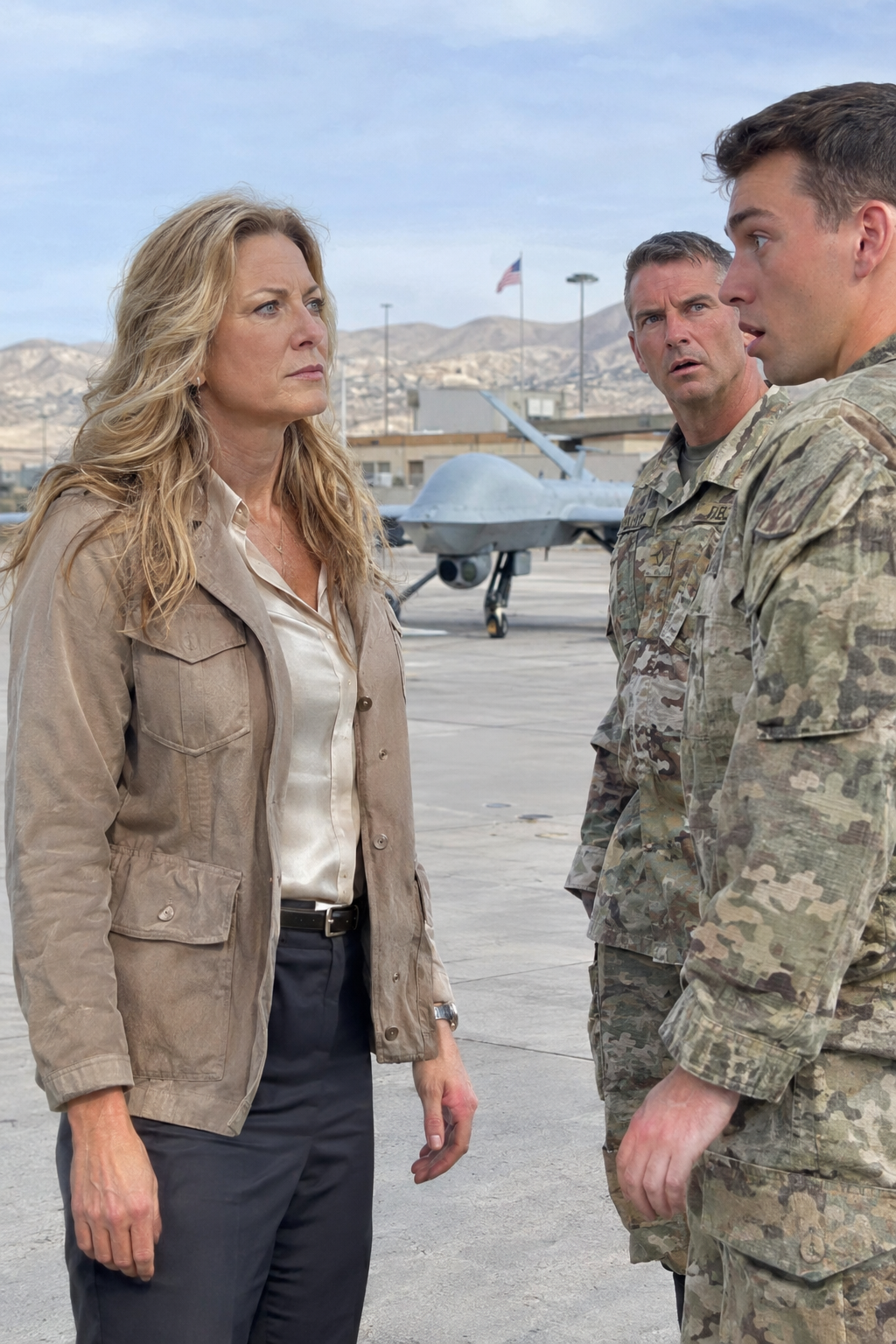
I wanted five quiet minutes beside a parked MQ-9 Reaper before the ceremony and speeches began. Instead, a young senior airman stepped in front of me, raised his hand, and said, “Get off my flight line, now.” His name tape read Doyle. He saw a civilian without a flight-line badge, and he was determined that I would not take another step.
For one strange second, I remembered being seven, standing outside our base house with my chin lifted toward the sky. My father, Colonel Raymond Maddox, flew fighters, and the sound of his squadron returning could rattle our windows. I used to wait by the fence with him on weekends, asking questions until he ran out of answers.
Back then, I believed we understood each other completely. We both loved aircraft, the thunder of an approach, and the idea that discipline could put a person in the sky. Then my little brother Grant was born, and without anybody saying so, he slowly became the child my father pictured in a cockpit.
Dad measured nearly everything by flying hours. The pilot made the decisions; everyone else, in his view, supported the person in the seat. My mother, Sylvia, knew how badly I wanted to fly, but she was practiced at keeping peace with my father. When I announced my plans, she would smile and say, “We’ll see, sweetheart.”
I worked my way into the Air Force Academy in 1994, when I was eighteen. I ran before sunrise, studied calculus at our kitchen table, and earned my place near the top of my class. When Dad read my acceptance letter, he nodded and said, “Let’s see if you can hack it.” I carried those words with me for four years.
For most of that time, I thought I’d become the pilot I’d always imagined. Then a flight physical in my final year uncovered a depth-perception finding that disqualified me under the standards in effect. A doctor was kind and clear. I left the appointment knowing the cockpit I’d pictured since childhood was no longer an option.
In 1998, at twenty-two, I still graduated and became a second lieutenant, serving in operations and intelligence. I hadn’t washed out or abandoned the Air Force. But when Dad heard I wouldn’t fly fighters, he seemed to hear only that I’d failed, and the distinction never reached him.
That summer he introduced me to his old squadron friends at a backyard gathering. He patted my shoulder while I stood there in my new uniform. “This is Nell. She’s Air Force, too. The office side. Somebody’s got to push the paper.” The men laughed, and ten-year-old Grant repeated the joke that evening.
I stood near the picnic table holding a paper plate, trying not to show how much it hurt. I decided I wouldn’t spend my career begging people to respect a path I hadn’t chosen. I’d build something worth doing, even if the people around that table never understood what it was.
A few years later, the Air Force was figuring out how to use remotely piloted aircraft in combat. They were ungainly, unfamiliar machines, and plenty of ambitious officers thought the program was a professional dead end. I was a twenty-six-year-old captain when I volunteered. A friend warned me people would forget I existed.
But I could see what others overlooked. An aircraft that could remain overhead for hours could protect people on the ground in ways a fast jet couldn’t always manage. The cockpit might be miles away, yet judgment, endurance, and responsibility still belonged to the crew. I wanted to help make that kind of flying better.
At a holiday dinner when I was about thirty, Grant grinned and said, “So you fly a plane with a joystick from a trailer? That’s a video game with a paycheck.” Dad laughed along with him. I could have argued, but most of the details of my missions weren’t mine to share, and I refused to turn classified work into a dinner-table defense.
The work was nothing like a game. On one long night, my crew kept watch over a small team of Americans trapped far from immediate help. We stayed overhead until dawn. They were alive when the sun rose, and I drove home with trembling hands while traffic around me moved as if it were any ordinary morning.
My family never knew about that night. At a wedding, Mom described me as doing safe computer work. At cookouts, Dad spent ten minutes praising Grant’s flying and mentioned that I was in the Air Force “doing her thing.” I learned to smile, refill a glass, and let them believe what they wanted.
I made major by thirty-three in 2009, after hundreds of combat missions flown from the ground. Alongside other officers, I helped develop procedures and standards for a field still finding its footing. At thirty-eight I became a lieutenant colonel and led a squadron. At forty-three I became a colonel and commanded a group.
Every promotion brought another call home. Dad would ask whether they’d given me a bigger office, and I’d say something like, “Yes, Dad, something like that.” I told myself his approval didn’t matter. Eventually the crews I trained and the people they helped bring home made that statement feel less like a lie.
In 2025, at forty-nine, I pinned on my first star. I was assigned to lead the combat remotely piloted aircraft enterprise I had helped build. The formal change of command was scheduled for the following spring at Creech, where the Reapers and the people who fly, maintain, and support them are part of daily life.
I flew in ahead of the ceremony without an entourage. My permanent base credentials were still being processed, and I was dressed like any other traveler. I should have arranged an authorized escort before approaching a restricted aircraft area. I didn’t, and that mistake belonged to me, not to the airman who noticed.
Doyle looked about twenty-three. He held his ground in front of the Reaper and told me I had no badge and no business being there. When I didn’t immediately turn away, he said he could have security forces remove me. His face was tense with the responsibility of protecting an aircraft that cost millions.
“Call your flight chief,” I told him. “That’s the right procedure.” I kept my hands visible and my voice level. Doyle took the suggestion as a challenge and edged closer. “I don’t need anybody to walk a civilian off the line,” he said, mentioning handcuffs if I made trouble.
I didn’t feel the anger he probably expected. He had recognized an unauthorized person and challenged her; that part was right. What needed correcting was his assumption that shouting would make him more authoritative. I repeated, “Call your flight chief, Airman. Make the call.”
Something about my calm finally got through to him. He raised his radio and requested his supervisor, never taking his eyes off me. We stood with the Nevada wind moving around us and the parked Reaper behind him. I knew my own error had created the situation, and I would own it.
Master Sergeant Eli Brandt came toward us at a quick jog, prepared to support his airman. He glanced first at Doyle, then at me, and stopped so sharply that his boots scraped the pavement. My photograph had been circulated to senior personnel ahead of the ceremony. He knew my face.
Doyle turned toward the man he’d called for backup. Brandt’s expression had changed from irritation to startled recognition, and for a heartbeat no one spoke. Then the master sergeant found his voice. “Airman, stand down. That’s the general who runs every Reaper we fly.” Part 2…..
IF FACEBOOK BROUGHT YOU HERE, HERE’S THE CONTINUATION YOU’VE BEEN WAITING FOR. ENJOY! 👇 Doyle’s raised hand fell to his side. His mouth opened, but the words he’d been so certain of a minute earlier seemed to have deserted him. I could almost hear him replaying his threat to call security forces while he stared at the woman he had called “lady.”
Chief Master Sergeant Yvonne Pratt, the wing’s senior enlisted leader, arrived soon afterward and took in the scene. She brought the nearby flight to attention and greeted me as General Maddox, plainly surprised to see me ahead of schedule. I told her the unannounced arrival was mine to explain. Doyle had challenged someone who wasn’t displaying the required credentials.
He tried to apologize, stumbling over “Ma’am” and “I didn’t know.” I stepped close enough to speak without turning his embarrassment into a show. “Look at me, Airman. You did your job by stopping somebody you couldn’t identify. The part to improve is how you speak to people while you do it.”
I told him I wouldn’t want him to ignore the next stranger just because the previous one turned out to outrank him. He swallowed, straightened his shoulders, and nodded. I recognized the fear in his face; I had spent years worrying that one mistake would be the only thing anyone noticed about me.
Colonel Brian Toth, the wing commander, arrived in a staff car looking deeply unsettled. He offered an apology and said he could have Doyle taken off the line. “No, Colonel,” I said. “He stays. We can reinforce proper procedure without punishing a man for protecting an aircraft.” Toth paused, then agreed.
I also made clear that I had no business approaching that area without the right access arrangements. Rank wasn’t a substitute for following the rules. After the excitement passed, I made my way to temporary quarters, where a uniform with a single star hung in the closet. I should have slept; instead I thought about my father.
Doyle had seen me for ninety seconds, in civilian clothes, and had been missing essential information. My father had known me for fifty years. Yet he’d kept the same small picture of my life long after I had become the officer now preparing to assume command at Creech.
In that plain room, I remembered Dad at the fence line, pointing out aircraft as they came in to land. I missed that version of him with an ache I had never properly admitted. I had tried for decades to win my place beside him again, even as the work itself had become bigger than his opinion.
By morning, I knew how I wanted to handle both the airman and my family. I asked Master Sergeant Brandt to bring Doyle to see me. He came in looking as though he expected the real reprimand to begin, and I could see him measuring every step across the room.
“Do you know what the aircraft you guard actually do?” I asked. He admitted that he understood the security requirements better than the missions. I told him I wanted him to learn from the crews, within whatever access his duties allowed, and then attend the change-of-command ceremony with his flight.
His face changed as he realized this wasn’t a trick. Brandt watched quietly from the back of the room. I wanted Doyle to carry away a lesson about responsibility and professional restraint, not a warning that it was dangerous to question someone with rank.
The next call was harder. Dad answered the phone and, when I mentioned the ceremony, asked whether they were finally giving me an office with a window. Usually I would make a small joke and end the call before his words could get under my skin. This time I simply said, “Come, Dad. Bring Mom. Bring Grant. I’d like you there.”
He muttered something about flying all the way to Nevada for a paperwork ceremony. I let the silence sit rather than defending what the ceremony meant. “I know it’s a long trip,” I said. “I’d still like you to be there.”
Grant, now a major and a fighter pilot, said he would rearrange some “real flying” to make it. I thanked him without calling out the phrase. I had spent too many years trying to talk my family into seeing my life clearly; I wanted them to encounter it without me reducing it to something they would find comfortable.
Over the next few days, I visited the operations floor. Young crews sat at ground control stations, carrying out missions that demanded long stretches of concentration. Their work wasn’t an imitation of flying just because their boots remained on the ground. They knew that distance didn’t make the people on their screens any less real.
I watched a pilot and sensor operator, both in their twenties, work quietly through a long mission. The endurance of that work, and the decisions they might need to live with afterward, reminded me of the young captain I’d once been. I wished my family could understand it without seeing anything they weren’t authorized to see.
Technical Sergeant Dana Cole was there, a gifted sensor operator I’d mentored years earlier. I asked whether she could give Doyle an appropriate introduction to the mission and the people supporting it. She did, and he stayed longer than scheduled, asking how maintainers, aircrews, and commanders depended on one another.
When Cole told him I’d helped develop the standards he was learning about, he looked across the room at me with new curiosity. She later said, “He’s a good one, ma’am. He needed somebody to show him the bigger picture.” I thought about how different my own childhood might have felt if Dad had done the same.
Not everybody agreed with my restraint. A staff officer suggested the flight-line incident could be useful for establishing authority, especially given how my own relatives had dismissed my career. I told him I wasn’t going to use the respect I’d earned to humiliate someone who hadn’t recognized me.
I knew how it felt to be treated as smaller than you were. I could repeat that habit with the people below me, or refuse to pass it along. After seeing Doyle ask sincere questions instead of retreating into embarrassment, I was sure I’d chosen correctly.
Then something happened I hadn’t expected. Standing behind the crews on the operations floor, I realized I no longer needed my father’s approval to tell me what my work was worth. I had the people, the standards, and the responsibility in front of me. That didn’t erase the hurt, but it changed what I wanted from the ceremony.
I wasn’t planning to surprise my family to make them feel ashamed. I wanted them present for an important day in my life. If seeing the work and hearing the official orders finally corrected the picture they’d held for years, I would welcome it. But the command itself wasn’t something I needed their permission to be proud of.
Part 3 My family arrived the day before the ceremony. I met them at the base gate, and Dad began looking around with the attentive expression he’d always worn near an active flight line. “They’re taking this paperwork thing seriously,” he said. I resisted the old urge to explain every person and vehicle around us.
Mom walked beside me more quietly than usual. When Dad paused to watch some airmen at work, she touched my arm. “Nell, what exactly do you do here?” she asked. I had waited a long time for her to ask that as a real question rather than as an opening for her own reassuring answer.
“You’ll hear more at the ceremony,” I told her. “And I’ll explain whatever I can afterward.” She kept her hand on my arm for another moment. It wasn’t an apology, but it was a small sign that she might finally be willing to listen.
As we made our way in, officers greeted me with the deference due an incoming commander. Colonel Toth stopped to check a detail with me, addressing me as “ma’am” before moving on. Grant watched him leave and leaned close. “Nell, that was a full colonel,” he whispered. “I know,” I answered.
Senior Airman Doyle appeared in dress uniform near the formation. He spotted my parents and Grant looking uncertain about where to stand, so he stepped over to help. He didn’t know who they were, and I was close enough to hear him introduce himself without interrupting.
Somehow the conversation turned to me. “I ordered the general off the flight line a few days ago,” he told Dad with an embarrassed half-smile. “No badge, civilian clothes. I thought I was protecting the aircraft, and I got too aggressive about it.”
He paused, looking toward me. “She could’ve made an example out of me. Instead she corrected me, kept me on the job, and made sure I understood what we’re protecting. She’s the kind of commander you’d follow.” He excused himself to take his place, unaware he’d just said more to my father than I had managed to in twenty years.
Dad stood very still. This was a young airman who hadn’t known my name three days earlier, and already he understood something about my leadership that my own family had never thought to ask. I didn’t feel triumphant. Watching Dad absorb it, I felt sad about the time we’d lost.
The ceremony began in the Nevada morning, with airmen in formation and aircraft behind them. I walked the review, conscious of Doyle somewhere in those ranks. The same flight line where he’d stopped me was now filled with people assembled to witness a change of command.
I thought of myself at twenty-two in that crisp new uniform, standing by a picnic table while men laughed at “the office side.” I thought of long nights in a ground control station, crews who had gone home safely, and young aviators who would carry the mission after me. No one in my family had witnessed those years, but they were watching now.
The presiding general read the orders aloud. He said my name, Brigadier General Eleanor Maddox, and described the responsibility I was assuming for the combat remotely piloted aircraft enterprise. It was official language, plain and unsentimental, which made it impossible to mistake for a family story I’d embellished.
I kept my eyes ahead. Behind me, I heard Mom make a small sound, and I sensed a shift in the quiet where my family sat. I didn’t turn around to see their faces. I wanted to be fully present for the people whose work I was there to lead.
When the ceremony ended and the formation was released, Dad came across the field toward me. He moved slowly, empty-handed, his face without the easy certainty I’d known all my life. For a moment he looked past me toward the aircraft before speaking.
“I spent all these years thinking you didn’t make it,” he said. His voice caught. “But I was the one who didn’t see it.” I looked at him, suddenly remembering the little girl who waited for his aircraft to come home.
“Do you see it now?” I asked. He nodded. “That’s enough for today, Dad.” It wasn’t a neat forgiveness that made everything disappear; it was a place where we could finally begin speaking honestly.
He told me he’d mourned the flying career I lost so completely that he’d acted as though the daughter standing in front of him had been lost too. “I am sorry, Nell,” he said. “You were doing something important all that time, and I wouldn’t look at it.” He took a breath that seemed to cost him.
I reached for his hand. It was the same hand that once pointed through the fence toward fighters breaking into the pattern, older now and less steady. We stood together for a moment as airmen dispersed around us, and for the first time in years I didn’t feel I needed to prove another thing to him.
Grant approached next, no joke ready on his lips. He came to attention and gave me a clean salute, one Air Force officer to another. “Permission to stop being an idiot about your job, General,” he said, his voice rough. I returned the salute and hugged my little brother.
He admitted he’d told people I flew a desk, even after he knew it wasn’t fair. “I think I needed you to be smaller so I could feel bigger,” he whispered. I told him he’d grown into a good pilot, and he still had time to be a better brother. He held on a little longer before stepping back.
Mom stood with us, taking in a side of my life she had always called safe because it frightened her less to imagine it that way. I couldn’t give her the details of every mission. But I could tell her how much the people I served with meant to me, and this time she listened without finding a smaller word for what I said.
Final Before the crowd had cleared, I found Doyle. He straightened when he saw me, as though part of him still expected some delayed punishment. “You stopped a person you couldn’t identify near a combat aircraft,” I told him. “Keep that instinct. And remember you can be firm without making someone feel small.”
He nodded, looking relieved enough to smile. I told him I was glad he’d stood in the formation and had taken the time to learn about the crews. He thanked me, then went back to his duties. That was how I wanted our first encounter to end: with an airman more confident in his responsibilities, not afraid of them.
A few months later, Dana Cole told me he’d applied to retrain for work on the mission side. Doyle wanted to become one of the people who flew the aircraft he’d once guarded. When the request reached me through the appropriate channels, I supported it. I liked the thought of him moving toward something he hadn’t understood before.
That evening after the ceremony, I went back toward the flight line with my credentials properly displayed. The light was turning gold over the desert, just as it had on the afternoon Doyle stopped me. A Reaper sat parked in the distance, the ungainly aircraft that had once been dismissed as a career dead end.
My family was somewhere behind me, finally beginning to see my life as it was. In front of me were the aircraft and the airmen whose work had given my life its purpose. I had wanted my father’s acknowledgment for so long, and I was grateful it had come. But the best part of that week was realizing that I no longer needed it to know who I was.
I thought about the girl standing by the base fence with her father, and the young officer holding a paper plate while people laughed. Neither one could have pictured this evening. I wished I could tell them that the path they hadn’t chosen would still lead somewhere worth going, and that they would have the chance to hold a door open for somebody else.
THE END. I’ve shared the complete story, and I truly hope it touched your heart. If this story moved you, please , like, and share the post. Thank you for reading! ❤️
✓ Lynn R. Adams
My family called my Air Force career a video game for twenty years, but when a young airman ordered me off a Nevada flight line and summoned his supervisor, one look at me changed the entire afternoon…