My Ex-Wife Left Our Kids for “True Love,” Then Demanded Camp Fees—While My Family Celebrated a $28 Million Trust They Never Legally Owned
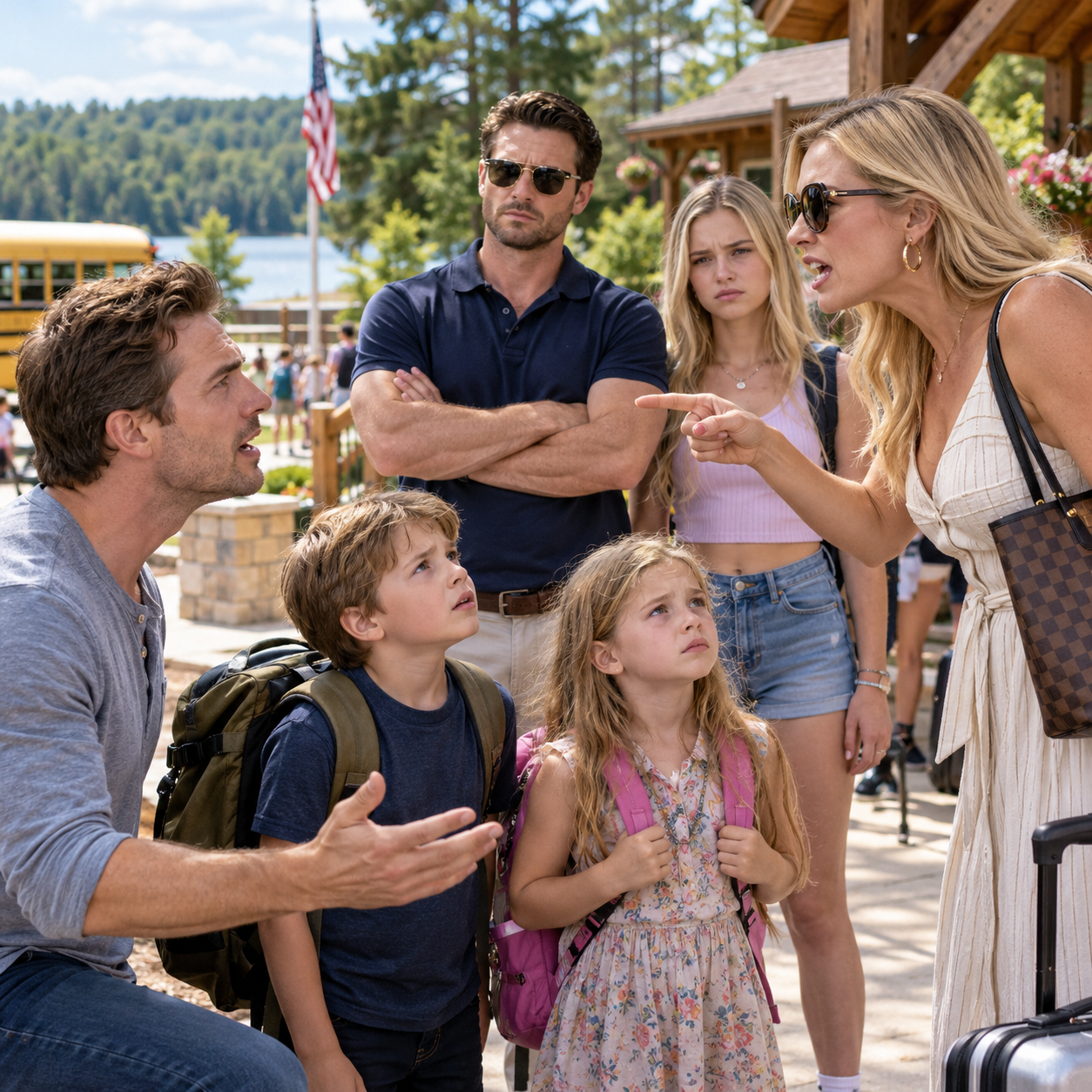
🔥HERE’S THE NEXT PART OF THE STORY, ENJOY !! The explosive twist and the final ending of this story ! ⬇️💬 Thank you ❤
Rain had been falling that day too.
Maybe that’s why I remember the sound.
The old house smelled like cedar, medicine, and the peppermint candies he kept in a glass bowl beside the bed.
“Close the door,” he whispered.
He pointed toward his workbench.
Dad had insisted on keeping a small carpenter’s bench in his bedroom after he became too weak to reach the barn.
On it sat a battered red toolbox.
I knew that box.
It had traveled in his truck for thirty years.
He used to joke that if the house caught fire, he would save three things.
His children.
And that toolbox.
“Bring it here.”
I set it beside him.
His fingers rested on the dented lid.
“Your mother thinks she knows what’s in this house.”
I said nothing.
“Vanessa thinks she knows what I own.”
Still nothing.
Dad looked directly at me.
“Kristen thought she knew too.”
That surprised me.
By then Kristen and I had already been divorced almost two years.
Dad had never spoken badly about her.
Not even after what she did.
Especially not in front of the children.
He tapped the toolbox.
“Take it when I’m gone.”
His voice had enough authority left in it to stop me.
“Do not leave this box here.”
He coughed.
I poured water.
He waved it away.
“The brass key is under the false bottom.”
“What does it open?”
“You’ll know when you read the letter.”
“What letter?”
“Safe-deposit box.”
He closed his eyes for several seconds.
Then opened them again.
“Daniel, I made mistakes.”
“We all did.”
His mouth tightened.
“Don’t make death prettier than life. I made mistakes.”
I sat beside him.
He continued.
“I let your mother reward Vanessa for being loud because dealing with her was easier than telling her no.”
That sounded like Dad.
“I let you become the reliable one.”
I looked away.
“That wasn’t a compliment.”
He took a slow breath.
“It meant whenever the roof leaked, I called you. Whenever payroll was short, I called you. Whenever I got sick, I called you. Whenever your mother panicked, I called you. Reliable people become invisible, son.”
I looked down at his hand.
The skin seemed almost transparent.
He continued.
“They stop thanking the bridge because they get used to walking over it.”
That sentence stayed with me.
I had driven five hours home from college when Dad broke his leg.
I had postponed graduate school when the sawmill lost its biggest contract.
I had spent my first wedding anniversary negotiating a tax lien against Mercer Timber.
I had refinanced my own house to keep sixteen employees paid during the recession.
I had changed Dad’s dressings.
I had learned his medication schedule.
I had shaved him when his hands shook too badly.
I had never considered those things heroic.
They were simply what needed to be done.
But people adapt quickly to another person’s sacrifice.
Eventually they stop seeing sacrifice.
They see availability.
I had stayed when leaving would have been easier.
I had paid when refusing would have been smarter.
I had repaired what other people assumed would repair itself.
I had forgiven what other people never apologized for.
I had become so dependable that my own family mistook endurance for permission.
Dad squeezed my wrist.
“When they think they’ve won, don’t interrupt them.”
“Won what?”
“You’ll see.”
I stared at him.
“Dad, what did you do?”
For the first time that afternoon, his eyes brightened.
“Something I should’ve done twenty years ago.”
He died seventy-two hours later.
The funeral was on a Tuesday.
My mother threw me out of the family house on Saturday.
That was all it took.
Her name was Diane Mercer.
She had been married to Dad for forty-six years.
I loved my mother.
That is important.
People like simple villains because simple villains make betrayal easier to understand.
My mother wasn’t simple.
She could sit beside a sick neighbor for twelve hours.
She remembered birthdays.
She mailed handwritten thank-you cards.
She made chicken soup when Sophie had the flu.
She also had one weakness that poisoned almost every relationship around her.
She wanted peace more than she wanted fairness.
And Vanessa knew it.
My sister had spent most of her life discovering that the person willing to create the biggest scene usually gets the room rearranged around them.
At twenty-one, she screamed until Dad paid her credit-card debt.
At twenty-six, she stopped speaking to Mom until Mom funded her wedding.
At thirty-five, she threatened to keep her children away unless Dad gave her a down payment for a house.
She called it setting boundaries.
Dad called it extortion once.
After that, Mom didn’t speak to him for three days.
So he stopped calling it anything.
The morning after Dad’s funeral, Vanessa arrived at the house with folders.
Not flowers.
Her husband, Greg, came with her.
Greg sold commercial real estate and wore loafers without socks even in January.
He hugged me like we were business partners.
“Hell of a week, man.”
I remember looking at him and thinking my father had been buried less than twenty-four hours.
Hell of a week.
Vanessa spread documents across Dad’s dining-room table.
Mom looked exhausted.
“I spoke with Russell,” Vanessa said.
Russell Greene was the family attorney.
Or, more accurately, the attorney Mom and Vanessa believed was the family attorney.
“Probate should be straightforward.”
I stayed near the window.
The red toolbox was already in the trunk of my car.
Dad’s instructions had been specific.
Do not leave this box here.
So I hadn’t.
Vanessa tapped a document.
“Mom gets the residence and personal property.”
“That’s what the will says,” I replied.
Vanessa glanced at me.
She had expected resistance.
I gave her none.
“And we’ll probably sell the ridge.”
Mom flinched.
“I haven’t decided that.”
“Twenty-eight million dollars is not something you get sentimental about.”
“It was your father’s land.”
“And now it’s ours.”
I noticed that word.
Vanessa’s vocabulary always revealed the future she had already written in her head.
Greg leaned forward.
“Ridgeline Development is prepared to move fast. They’d do luxury homes, retail, maybe a hotel component. It’s a phenomenal opportunity.”
“Dad hated those developers,” I said.
Greg smiled.
“Frank hated everything built after 1985.”
Mom almost laughed.
Vanessa didn’t.
“You’re not going to make this difficult, are you?”
I looked at her.
“Why would I?”
Again, disappointment crossed her face.
She wanted the fight.
People who have spent years accusing you of being difficult become uncomfortable when you make things easy.
Three days later, I returned from taking Sophie and Caleb to school and found cardboard boxes in the driveway.
Mom stood on the porch.
Vanessa stood behind her.
Greg’s SUV was parked beside the garage.
“What’s this?” I asked.
Mom folded her arms.
It was cold that morning.
She wore Dad’s old gray cardigan.
Seeing it hurt more than the boxes.
“Daniel, I think you should stay at your place.”
“My place is being renovated.”
I had been staying with Dad during his final months because he needed overnight care.
My own house had suffered serious water damage after a pipe burst.
Half the drywall was gone.
The kitchen floor had been removed.
Mom knew that.
“You can get a hotel,” Vanessa said.
I looked at her.
“I wasn’t speaking to you.”
Mom closed her eyes briefly.
That tiny reaction.
That was my mother’s entire life with Vanessa.
Avoid the explosion.
Pay whatever peace costs.
“I just need some space,” Mom said.
“From everything.”
Vanessa stepped forward.
“You’ve been acting like this is your house.”
I looked around.
Dad’s truck was still in the driveway.
His boots were still beside the mudroom door.
A sympathy wreath still hung from the porch railing.
“I’ve been caring for Dad here for eleven months.”
“And now Dad’s gone.”
Vanessa said it casually.
Too casually.
Mom turned toward her.
“What? He is.”
Then my sister looked at me.
“This house belongs to Mom now.”
“That’s true.”
“So you need to go.”
I could have argued.
I could have reminded them that I had repaired the furnace six weeks earlier.
That my own money had replaced the septic system.
That I had paid Dad’s property taxes twice when cash flow was bad.
That I had slept on a cot beside him through the last stage of his illness while Vanessa visited for ninety minutes every other Sunday.
I could have said many things.
Instead I picked up the first box.
Vanessa watched me.
“That’s it?”
“What were you expecting?”
She stared.
I carried the box to my truck.
Then another.
Then another.
Mom followed me halfway down the driveway.
She looked suddenly smaller.
“I’m not choosing sides.”
Those words almost made me laugh.
People usually say they’re not choosing sides after they’ve already chosen one.
“You can come for dinner next week.”
“We just need to settle everything.”
“I understand.”
She studied my face.
The quiet bothered her too.
Maybe it reminded her of Dad.
I put the last box into my truck.
Then I opened the passenger door and checked the red toolbox.
Still there.
Dad’s entire plan fit beneath a pile of old socket wrenches.
Vanessa called from the porch.
“Don’t take any documents from Dad’s office.”
I looked over my shoulder.
“Russell said everything needs to stay with the estate.”
She narrowed her eyes.
“Did I what?”
“Take anything?”
There it was.
The first sign she was afraid.
Not because she knew what Dad had done.
Because she knew what she had done.
I didn’t understand that yet.
“No estate documents,” I said.
That answer was completely true.
I drove away.
At the first stoplight, my hands were perfectly steady.
At the second, I opened the glove compartment.
Dad’s red toolbox key sat inside.
At the third, I decided I would follow his instructions exactly.
I rented a small furnished house near Caleb’s school.
The first night, the three of us ate Chinese takeout on folding chairs because the dining table hadn’t arrived.
Sophie made paper napkin crowns.
Caleb asked whether Grandma was mad at us.
“Then why did she make us leave?”
I considered lying.
Children deserve protection.
They do not deserve confusion disguised as protection.
“Grandma is overwhelmed,” I said. “And Aunt Vanessa thinks she knows what’s best.”
Caleb frowned.
“She always thinks that.”
I looked at him.
Eleven years old.
Already observant.
“That doesn’t mean we hate them.”
“I don’t hate them.”
“I just don’t trust Aunt Vanessa.”
I took a bite of cold lo mein.
“That’s allowed.”
Two days later, I opened Dad’s toolbox.
The false bottom was beneath the socket tray.
Dad had built it himself.
Inside were three things.
A brass key.
A business card for Blue Ridge Community Bank.
And a folded piece of paper.
My name was written on the front.
Dad’s handwriting.
I sat alone at the kitchen counter and opened it.
If you are reading this, I am dead, your sister is probably moving faster than the undertaker, and your mother is telling herself she can keep everyone happy.
That was Dad.
Even dying, he had timing.
The next lines were different.
More serious.
Do not confront anyone.
Do not sign anything.
Do not tell Kristen.
Do not tell Vanessa.
Go to the bank.
Everything you need is there.
The house is your mother’s.
Let her have it.
The cars, furniture, accounts listed in the will are hers.
Let them have exactly what the will gives them.
Nothing more.
You earned the rest long before they decided it was valuable.
There was one final line.
And Daniel—if Vanessa presents a document dated June 14, call Martin Hale before you call the police.
I read that sentence five times.
Martin Hale.
I knew the name.
Corporate attorney in Charlotte.
Dad had used him years earlier for Mercer Timber.
I called the number written beneath the letter.
Martin answered himself.
“Daniel Mercer?”
There was a short silence.
“I’m sorry about Frank.”
“Thank you.”
“Have you opened the box?”
“Your father made me promise I’d ask one question before we discussed anything.”
“What question?”
“Where are you?”
“My rental house.”
I looked toward the hallway.
The kids were at school.
“Then go to the bank.”
Blue Ridge Community Bank had the kind of lobby that looked unchanged since 1997.
Fake plants.
A bowl of peppermints.
The branch manager took me downstairs.
Box 714 was long and narrow.
The brass key turned smoothly.
Inside sat a black binder, a sealed envelope, three flash drives, two original certificates, and a green ledger.
I didn’t touch anything for several seconds.
Then I called Martin.
He arrived from Charlotte that afternoon.
We spent four hours in a conference room.
By the end, I understood why Dad had told me to stay quiet.
Mercer Ridge did not belong to Dad’s probate estate.
Not most of it.
It hadn’t for six years.
The land was held by Mercer Stewardship Holdings, LLC.
Dad had created the company after a tax dispute nearly forced him to sell 600 acres.
At first, Dad owned 72 percent.
I owned 18 percent because I had contributed cash to stop the tax sale.
A longtime employee trust held the remaining 10 percent.
Over the next five years, Dad transferred additional membership interests to me.
Not as an inheritance.
Not as a deathbed gift.
As documented compensation for capital contributions, debt guarantees, management work, and money I had put into Mercer Timber when nobody else would.
There were tax filings.
Board resolutions.
Bank records.
Independent valuations.
Signed transfer agreements.
Everything.
Dad had eventually reduced his own interest to 21 percent.
I held 69 percent.
The employee trust held 10.
When Dad died, his 21 percent passed through a separate trust.
The beneficiary?
Not my mother.
Not Vanessa.
The Frank Mercer Youth Foundation.
A charity Dad had quietly created to fund outdoor programs, vocational training, and summer experiences for children from low-income families.
I stared at Martin.
“So Mom owns…”
“The residence, approximately eleven acres surrounding it, personal assets, and the accounts specified in the will.”
“And the ridge?”
“Controlled by Mercer Stewardship Holdings.”
“Which I control.”
“What’s it worth?”
Martin folded his hands.
“Depends on development restrictions.”
“What restrictions?”
“That’s the second part.”
Dad had placed a conservation covenant on nearly 1,200 acres.
The remaining acreage could be commercially developed only under conditions requiring approval from holders representing more than 60 percent of the LLC.
Without my signature, Ridgeline Development couldn’t build their resort.
Couldn’t build their subdivision.
Couldn’t even install the access road their proposed plan required.
Twenty-eight million dollars existed only if I agreed.
Otherwise, the land remained forest, pasture, and timber property generating modest but steady income.
I looked at the binder.
“Vanessa thinks Mom owns everything.”
“Vanessa never asked the right questions.”
“Russell Greene?”
“Represented your mother regarding probate. He was not involved in the LLC.”
“Does he know?”
“He should know the difference between probate property and company property.”
I leaned back.
“And June 14?”
Martin became very still.
“Has Vanessa shown you anything dated June 14?”
“Then we wait.”
“For what?”
“For her to show us what your father suspected she might.”
That was the beginning.
For fourteen months, I said almost nothing.
Vanessa posted photographs from Mercer Ridge with captions about “the next chapter.”
Greg brought investors to the property.
My mother met with architects.
Ridgeline Development paid for preliminary surveys.
A glossy concept package appeared.
RIDGELINE AT MERCER.
Luxury homes.
Boutique hotel.
Retail village.
Equestrian center.
Private trails.
Three hundred and twelve residences.
Vanessa sent me the brochure.
Thought you should see what progress looks like.
I replied with one word.
Martin called me immediately afterward.
“I liked the renderings.”
He laughed for almost thirty seconds.
Meanwhile, I kept working.
I had an engineering consulting company with twelve employees.
Not glamorous.
Profitable.
I drove a seven-year-old Ford.
I packed Sophie’s lunches.
I attended Caleb’s baseball games.
I kept every custody exchange polite.
That last part drove Kristen insane.
She wanted evidence that leaving me had destroyed me.
Instead, she found me in grocery-store parking lots holding soccer cleats and reminding Sophie to bring her science folder.
Ryan occasionally came with her.
He liked expensive sunglasses.
He also liked looking at me as if we were still competing.
I had stopped competing before he realized the contest was over.
Then came the camp demand.
Two days after Kristen called, Vanessa texted me.
Mom needs you at the house Saturday.
Estate matters.
That was enough.
Martin told me to go.
“Listen more than you talk.”
“That seems to irritate everyone.”
Saturday was bright and cool.
The Mercer house looked almost unchanged from the road.
White siding.
Stone chimney.
Green shutters.
Dad’s machine barn beyond the trees.
But three black SUVs sat near the garage.
Inside, I found Mom, Vanessa, Greg, Kristen, Ryan, Russell Greene, and two men I didn’t recognize.
One introduced himself as Charles Wexler.
Ridgeline Development.
The other was Ridgeline’s attorney.
I looked at Kristen.
“Why are you here?”
She lifted her chin.
“Vanessa invited us.”
Of course she had.
Mom looked uncomfortable.
“Sit down, Daniel.”
A thick stack of papers rested on the dining table.
The same table where Dad had taught Caleb to play checkers.
Charles Wexler smiled.
“We’re hoping to resolve the remaining ownership issues today.”
“What ownership issues?”
Vanessa exhaled dramatically.
“Daniel, please.”
I looked at her.
“We’ve been trying to include you.”
“The sale.”
“You haven’t asked me to sell anything.”
Greg leaned forward.
“We’re asking now.”
I looked at the contract.
“Twenty-eight million?”
“Twenty-eight point four,” Charles said.
Kristen’s eyes flicked toward me.
There it was.
The number she had already spent in her head.
Vanessa folded her hands.
“Mom gets half. You and I split the rest.”
I looked at Mom.
“Is that your understanding?”
She hesitated.
“Your father wanted us taken care of.”
“That’s not what I asked.”
Her eyes moved toward Vanessa.
Kristen finally spoke.
“This is why I asked you about camp.”
Everyone looked at her.
I almost admired the timing.
Vanessa didn’t.
Kristen shrugged.
“It’s eleven thousand dollars. Daniel was acting like he couldn’t afford it when he’s about to receive seven million.”
Ryan shifted beside her.
I looked at him.
“Did you ask her to call me?”
He straightened.
“We’re all family.”
“No, Ryan. We aren’t.”
Kristen’s jaw tightened.
“This attitude is exactly why your father wanted the property divided fairly.”
Interesting sentence.
I turned toward her.
“My father discussed the estate with you?”
She looked briefly at Vanessa.
“Not directly.”
“Then how do you know what he wanted?”
“Everyone knows.”
The most dangerous source in any family.
Vanessa slid the documents toward me.
“This doesn’t need to become a production.”
“What am I signing?”
“Consent to sale.”
She stared at me.
“Mercer Ridge.”
I looked at the signature line.
Then at Russell.
“You reviewed this?”
Russell cleared his throat.
“I reviewed the estate’s proposed participation.”
“That wasn’t my question.”
The Ridgeline attorney looked up.
Russell shifted in his chair.
“I represent Diane.”
I pushed the document back.
“Then Diane can sign whatever Diane owns.”
Vanessa’s face hardened.
“You own one-third.”
Mom stared at me.
“What do you mean, no?”
“I mean I don’t own one-third.”
Kristen leaned back with a tiny smile.
She thought I had just admitted I owned less.
Vanessa thought so too.
“Fine,” she said. “Whatever Russell determines.”
“Russell can’t determine it.”
“Because this property isn’t in the estate.”
Nobody moved.
You can feel a room change before anyone speaks.
It happens in courtrooms.
A second when people realize the conversation they thought they were having is not the conversation they are actually in.
Vanessa blinked.
I took a folder from my briefcase.
Not Dad’s originals.
Martin had insisted.
I placed the first page on the table.
Mercer Stewardship Holdings, LLC.
Greg reached for it.
I put my hand over the page.
He pulled back.
His expression changed.
Charles Wexler leaned toward him.
Russell stood.
“Where did you get this?”
“Company records.”
“What company?”
“The company that owns 1,829 acres of the 1,840 acres everyone keeps trying to sell.”
Mom sat completely still.
Vanessa grabbed the paper.
“This is ridiculous.”
“Dad owned the land.”
“Dad owned an interest in the company.”
“So did I.”
Greg was reading faster.
“How much?”
I looked at him.
“Sixty-nine percent.”
Kristen’s mouth opened.
No sound came out.
Ryan looked at her.
Then at me.
Vanessa laughed.
“This is fake.”
I expected that.
People who believe possession equals ownership often call paperwork fake when paperwork disagrees with them.
Russell held out his hand.
“Let me see.”
I gave him the copies.
He read the first agreement.
Then the second.
Then the tax schedule.
His face drained.
Mom looked frightened.
“Did Frank ever discuss Mercer Stewardship Holdings with you?”
Vanessa interrupted.
“Because it doesn’t exist.”
Russell ignored her.
Mom shook her head.
“He handled the business.”
Vanessa slapped the table.
“Dad would never give Daniel everything.”
I looked at her.
“He didn’t.”
“He kept twenty-one percent.”
“That went to the foundation.”
“What foundation?”
“The Frank Mercer Youth Foundation.”
Nobody spoke.
I continued.
“It funds outdoor programs, vocational scholarships, and summer camps.”
Kristen’s face changed.
Just slightly.
The word hung there.
I looked at her.
“Interesting coincidence.”
Her cheeks reddened.
Ryan crossed his arms.
“So what are you saying?”
“I’m saying there is no twenty-eight-million-dollar estate sale.”
Charles Wexler spoke carefully.
“Mr. Mercer, Ridgeline has negotiated in good faith for months.”
“With people who didn’t own the property.”
His eyes moved to Greg.
Greg loosened his collar.
Vanessa stood.
“Mom owns the house.”
“And the access road.”
“The driveway from the county road crosses company property after the first four hundred feet.”
Charles closed his eyes briefly.
I continued.
“The utility easement is controlled by the LLC.”
Greg whispered something I couldn’t hear.
The Ridgeline attorney was already pulling documents from his bag.
Vanessa pointed at me.
“You knew.”
“For how long?”
“Since after the funeral.”
Mom stared at me.
“You let us do all this?”
Not because it was fair.
Because some part of her truly believed I had done something to her.
“I let you own what Dad gave you.”
“You watched us negotiate.”
“I wasn’t invited.”
“You knew!”
“You could have stopped us.”
“I could have.”
“Why didn’t you?”
I looked at the brochures stacked near the window.
Architectural drawings.
Road plans.
Luxury cottages.
Other people had spent months designing a future on land they never checked carefully enough to own.
“Because nobody asked me anything,” I said.
Vanessa’s voice rose.
“You were waiting to humiliate us.”
“Then what were you waiting for?”
I looked at her.
“For you to put everything in writing.”
That silenced her.
Martin entered the room.
Nobody had heard the front door.
He wore a charcoal suit and carried a leather case.
Vanessa stared at him.
“Who are you?”
“Martin Hale.”
Russell recognized him immediately.
His face changed again.
Martin nodded at me.
“Sorry I’m late.”
“You’re right on time.”
He sat beside me.
Charles Wexler knew his name too.
That was obvious.
“Mr. Hale,” he said.
“Mr. Wexler.”
Vanessa looked between them.
“What is happening?”
Martin removed another folder.
“Ridgeline’s proposed transaction cannot proceed without authorization from Mercer Stewardship Holdings.”
Charles nodded slowly.
“I understand that now.”
“And Mr. Mercer controls the company.”
Vanessa looked at me.
“You’re not selling?”
Twenty-eight million dollars.
That was the moment they finally understood the money had never been the point.
Dad knew it.
They had never understood.
Mercer Ridge contained the creek where my grandfather taught Dad to fish.
The workshop where Dad trained apprentices who later opened businesses of their own.
The pasture where local firefighters held benefit events.
The forest where Dad took children from a group home hiking every October for fifteen years without once putting his name on a donation banner.
Developers saw acreage.
Vanessa saw money.
Dad saw evidence that a man could spend his life building something useful and leave it useful.
I intended to keep it that way.
“We’re expanding the foundation,” I said.
Mom looked at me.
“Two hundred acres near the east ridge will become a permanent youth outdoor center. Cabins. Vocational workshops. Conservation programs.”
Martin opened a rendering.
Not Ridgeline’s rendering.
Simple timber buildings.
A lake-access trail.
Classrooms.
A workshop.
A climbing area.
Scholarship housing.
Dad’s old sawmill preserved at the center.
Caleb had helped choose where the baseball field would go.
Sophie had insisted the cabins needed porches.
My mother covered her mouth.
On the top of the page was the name.
FRANK MERCER OUTDOOR LEARNING CENTER.
I watched her eyes fill.
I did not enjoy that.
Justice and cruelty are not the same thing.
I had no interest in becoming cruel simply because cruel people had made mistakes around me.
“Dad planned this?” she whispered.
“Part of it.”
“The rest.”
She touched the rendering.
Vanessa didn’t.
Her attention remained fixed on the numbers.
“What happens to Mom’s eleven acres?”
“Whatever she wants.”
“The house?”
“So the company doesn’t control it?”
She seemed relieved.
Too relieved.
Martin noticed.
That was when he took out one final document.
“However,” he said, “we do need to discuss a title issue.”
Vanessa froze.
Not dramatically.
Just enough.
A tiny pause.
A tiny tightening around the eyes.
I remembered Dad’s letter.
If Vanessa presents a document dated June 14, call Martin Hale before you call the police.
Martin slid a copy toward Russell.
“This warranty deed was recorded six months before Frank Mercer died.”
Mom looked confused.
“I never signed a deed.”
“You didn’t.”
Vanessa stepped forward.
“What deed?”
Martin looked at her.
“The one transferring Diane Mercer’s future interest in the residence parcel to Blue Stone Asset Partners.”
Greg stood so quickly his chair scraped across the floor.
Charles Wexler looked at him.
“Blue Stone?”
Nobody answered.
Martin continued.
“Blue Stone Asset Partners is a limited company registered to a holding company managed by Gregory Price.”
Greg was Vanessa’s husband.
Mom went white.
Vanessa’s face hardened.
“That was part of estate planning.”
“No,” Russell said quietly. “It was not.”
He was reading now.
“Diane’s signature isn’t here.”
“No,” Martin replied.
“Frank transferred it?”
“According to the document.”
Mom stared at the signature.
“That doesn’t look right.”
Vanessa snapped.
“Mom, you don’t even know what his signature looked like at the end.”
For months.
Dad’s hands had changed.
His handwriting had changed.
After a minor stroke on June 2, he could no longer sign his full name normally.
By June 14, he could barely grip a pen.
But the signature on that warranty deed was strong.
The signature of a healthy Frank Mercer.
A version that had not existed for years.
Martin continued.
“There’s another problem.”
Vanessa glared at him.
“The notary.”
Nobody moved.
“The notary listed here surrendered her commission eight months before this document was supposedly executed.”
Greg sat back down.
Very slowly.
Kristen whispered, “Jesus.”
Ryan looked toward the door.
That was interesting.
People who entered expecting money were suddenly searching for exits.
Vanessa turned to me.
“You did this.”
“You set us up.”
“You knew about that deed.”
“I knew Dad was worried about something dated June 14.”
Her face changed.
Dad had been right.
He had known.
Not everything.
Martin reached into his folder.
“Frank met with me on June 21.”
One week after the deed date.
“He brought a copy someone had left in his office printer tray.”
Vanessa looked at Greg.
Greg stared at the table.
Martin continued.
“He believed someone was preparing documents involving his property.”
Mom’s voice trembled.
“Why didn’t he tell me?”
“Because he didn’t know who was involved.”
Vanessa pointed toward me.
“This is insane. We didn’t steal anything.”
Martin’s expression remained neutral.
“I didn’t say you did.”
“You’re implying it.”
“I’m reading documents.”
“You think Greg forged Dad’s signature?”
“I haven’t accused Greg of anything.”
“Then stop acting like this is some criminal case.”
Martin closed the folder.
“That decision will not be mine.”
The room became silent again.
Mom sat down hard.
I looked at her.
The betrayal in her face was different from mine.
Unprocessed.
I had lived with mine long enough to understand its shape.
She had just met hers.
Vanessa moved closer to her.
“Mom, listen to me.”
Mom lifted one hand.
“Greg was protecting the deal.”
“You don’t understand how these transactions work.”
“I said no.”
I had not heard my mother use that tone with Vanessa in years.
Maybe ever.
Vanessa stopped.
Mom looked at Greg.
“Did Frank sign this?”
Greg didn’t answer.
He rubbed both hands across his face.
“I was told he did.”
Another silence.
Vanessa’s eyes flashed.
Greg looked at her.
That single word told everyone more than a confession would have.
Kristen stood.
“We should leave.”
I looked at her.
She avoided my eyes.
Ryan picked up his keys.
They had made it three steps toward the hallway when Martin spoke.
“Mrs. Dalton?”
Kristen stopped.
She hated when people called her that around me.
Martin looked down at another sheet.
“Before you leave, I need to clarify something.”
“I’m not involved in this.”
“I hope not.”
Her shoulders stiffened.
“What does that mean?”
Martin slid a printed email across the table.
I had not seen it before.
That surprised me.
He looked at me.
“Daniel, this came in this morning.”
“Ridgeline’s document archive.”
Charles Wexler frowned.
“What document?”
Martin tapped the page.
“An email from seventeen months ago requesting a valuation of expected inheritance interests.”
He looked at Kristen.
“The sender was you.”
My ex-wife went completely still.
Ryan turned.
Kristen laughed.
“That’s ridiculous.”
Martin pushed the page toward her.
She didn’t take it.
He read only the relevant line.
“‘Once Frank Mercer passes, Daniel will control at least one-third of the ridge. Please estimate his likely net proceeds so we can determine whether post-divorce asset claims are worth revisiting.’”
Ryan’s face changed.
Kristen looked at me.
I said nothing.
Martin continued.
“The email attached a draft declaration prepared for family court.”
“I never filed it.”
“So it means nothing.”
I finally spoke.
“How did you know Dad was dying?”
Her mouth opened.
Everyone knew Dad had cancer.
Few people knew, seventeen months earlier, how serious it had become.
We had kept that private at his request.
Vanessa looked away.
That answered enough.
I stared at my sister.
“You told her?”
Vanessa folded her arms.
“She’s the mother of your children.”
“That wasn’t my question.”
Kristen jumped in.
“I was protecting Sophie and Caleb.”
“By calculating my inheritance before my father died?”
“You would do the same.”
“You don’t know that.”
“Yes, Kristen. I do.”
Ryan was still staring at her.
“You were planning to reopen the divorce?”
She turned.
“It was only if Daniel hid assets.”
“The divorce was already final.”
“I was protecting our household.”
“Our household?”
His voice had changed.
Not because I wanted their marriage destroyed.
Because truth should at least enter the room before everyone chooses what to do with it.
Kristen lowered her voice.
“Ryan, not here.”
He laughed once.
“You asked him for my kids’ camp money because you thought he was getting seven million dollars.”
She stared at him.
“I asked because we needed help.”
“You told me he owed you.”
“I said he had money.”
“You said he owed you.”
“I meant morally.”
Calm people notice details during chaos.
Greg’s hands were trembling.
Vanessa kept looking toward Martin’s case.
Russell had stopped acting like anyone’s family lawyer and started acting like a lawyer who wanted his name nowhere near the situation.
Charles Wexler was whispering to his attorney.
Mom was staring at Dad’s supposed signature.
And Kristen was still angry at me.
Not embarrassed.
Not frightened.
Because somehow the truth had become something I had done to her.
“You could have told me,” she said.
“About what?”
“We share children.”
“That doesn’t make you my business partner.”
“You let me look stupid.”
My voice stayed quiet.
“You volunteered.”
Her eyes narrowed.
“You enjoy this.”
“Yes, you do.”
I thought about that.
Then shook my head.
“I wanted one thing.”
“For everyone in this room to stop confusing my silence with weakness.”
No one answered.
I gathered my papers.
But Mom touched my wrist.
I looked at her.
Her eyes moved toward the front window.
Beyond it, the ridge rose green against the afternoon sky.
“Are you really not selling it?”
“Even for twenty-eight million?”
She nodded slowly.
Then she surprised me.
“Your father would be glad.”
Vanessa turned.
My mother didn’t look at her.
“I said your father would be glad.”
For once, the room did not rearrange itself around Vanessa’s anger.
For once, Mom let silence stand.
That should have been the end.
Big family disasters rarely end when the loudest secret is exposed.
They become quieter.
More dangerous.
Over the next three weeks, Ridgeline withdrew its offer.
Charles Wexler sent a formal letter stating the company had negotiated based on inaccurate representations regarding ownership authority.
Greg hired an attorney.
Vanessa hired a different attorney.
Mom changed the locks on the Mercer house.
She also changed her estate documents.
Kristen stopped asking about camp.
Mason and Lily eventually attended a less expensive YMCA program.
I anonymously covered the scholarship fund for that program, but I never told Kristen.
Children should not pay for adult arrogance.
That principle had not changed.
Ryan moved into a hotel for eleven days.
Then he went home.
I didn’t ask why.
Their marriage was not my business.
Something else was.
Law enforcement began reviewing the documents quietly.
Dad’s medical records established that on June 14 he had been hospitalized overnight for complications after his stroke.
A nurse documented that he could not independently sign discharge paperwork.
The supposedly notarized deed had been executed that same afternoon at the Mercer house.
Impossible.
Then investigators found metadata from the original file.
The deed template had been created on Greg’s office computer.
That was bad.
What came next was worse.
A recovered revision contained an earlier filename.
VANESSA_MERCER_TRANSFER_FINAL2.
Martin called me at on a Tuesday morning.
“I think you need to see this.”
I drove to his Charlotte office after dropping the kids at school.
A federal-style evidence envelope sat on his desk.
“What is it?”
“Not federal.”
“I didn’t ask what it wasn’t.”
He almost smiled.
Then pushed the envelope toward me.
“Your father’s green ledger.”
I recognized it immediately.
It had been inside Box 714.
“I’ve seen it.”
“Not this section.”
Martin opened near the back.
Dad recorded almost everything.
Fuel purchases.
Timber yields.
Property tax dates.
Equipment maintenance.
But in the last months of his life, he had started recording conversations.
Short summaries.
April 9 — Vanessa asking again about transferring ridge before death. Told her no.
April 22 — Greg brought valuation. Told him land not personal estate. He became agitated.
May 3 — Kristen called Vanessa during dinner. Heard my name and “post-divorce.” They stopped when I entered.
May 19 — Greg asked me to sign “planning papers.” Refused.
June 1 — Vanessa angry about foundation.
Then June 12.
Two days before the forged deed.
Vanessa said Daniel doesn’t deserve control because he will “waste it on Dad’s charity nonsense.” Told her Daniel earned every acre he controls. She said she would fix it after I’m gone.
I stared at the page.
Martin said nothing.
The final entry was dated June 21.
Found unsigned transfer document in printer. Signature already copied onto draft. Greg says clerical mistake. Vanessa says I’m confused from medication. I am not confused.
Below that, Dad had underlined four words.
I am not confused.
My throat tightened.
Not from weakness.
Not even grief.
Recognition.
Dad had spent his final months being treated the same way families often treat quiet people when quiet people become inconvenient.
Anything except correct.
Martin turned the page.
There was one final note.
If they use my illness to take what Daniel protected, show him this. He will know what to do.
I looked out Martin’s window at Charlotte traffic moving below us.
“What exactly did Dad think they were trying to take?”
“The land.”
“They couldn’t. He had already transferred control.”
“So why forge the deed to the house?”
Martin leaned back.
“That bothered me too.”
He removed another document.
An old site map.
Mercer Ridge.
The family house.
The driveway.
The company parcels.
And beneath the house, marked decades earlier by my grandfather, was a narrow shaded strip.
“What is that?”
“An easement corridor.”
“For what?”
“Originally? Timber access.”
“Originally?”
Martin tapped the map.
“The county’s preliminary transportation expansion plan puts the future connector road almost exactly here.”
The corridor ran through Mom’s eleven-acre parcel.
“How valuable?”
“If the county proceeds?”
“Potentially several million dollars.”
I sat back.
So Greg and Vanessa hadn’t been trying merely to steal Mom’s house.
They had been positioning themselves to control the only practical corridor connecting the development property to the future county road.
If they had succeeded in selling the ridge, Blue Stone Asset Partners could have charged millions for access.
A private tollbooth in the middle of the family’s inheritance.
Vanessa had spent months accusing me of greed while quietly preparing to profit from land Mom thought she owned.
“That’s the second secret,” I said.
Martin nodded.
“I believe so.”
“Does Mom know?”
I closed the ledger.
“Then she should hear it from me.”
Mom was sitting on the back porch when I arrived that evening.
Dad’s cardigan again.
Two glasses of iced tea.
For the first time since his death, the house looked like a home rather than disputed evidence.
She listened while I explained the corridor.
She didn’t interrupt.
When I finished, she looked toward the barn.
“Your father knew.”
“Some of it.”
“And he didn’t tell me.”
“He was trying to confirm it.”
She rubbed one thumb along the condensation on her glass.
“I made you leave four days after we buried him.”
“I believed Vanessa when she said you were planning to fight me for the house.”
“She said you had been moving documents.”
“I moved Dad’s toolbox.”
“Because he told you to.”
Mom nodded.
A long silence passed.
Then she said something I had waited my entire life to hear.
“I chose peace over you.”
I looked at her.
She didn’t soften it.
Didn’t add excuses.
Didn’t say but.
“I told myself I wasn’t taking sides,” she continued. “But every time Vanessa threatened to explode and you stayed calm, I asked you to absorb the damage.”
A bird landed on the fence.
Somewhere down the hill, a tractor started.
Mom looked older than she had at Dad’s funeral.
“I knew you’d forgive me.”
“That made it easier.”
“You knew I’d still answer the phone.”
“You knew Vanessa might not.”
“So I became cheaper to hurt.”
Her eyes closed.
“That’s exactly what happened.”
I appreciated the answer because it was ugly and accurate.
People apologize badly when they are more interested in being forgiven than understanding what they did.
Mom seemed interested in understanding.
That was new.
“What happens now?” she asked.
“With Vanessa?”
“That depends on Vanessa.”
“And Greg?”
“That depends on investigators.”
She nodded.
Then she looked toward me.
“Are you going to build the camp?”
“The learning center.”
“Your father called it a camp.”
“He also called Wi-Fi ‘the internet machine.’”
Mom laughed.
A real laugh.
The first I had heard since Dad died.
“Yes,” I said. “We’re building it.”
“Can I help?”
I studied her.
“With what?”
“Anything.”
I thought of Dad.
Reliable people become invisible.
They stop thanking the bridge because they get used to walking over it.
“I’m not going to give you meaningless work to make you feel better.”
She nodded.
“But the foundation needs someone to coordinate the family scholarship program.”
“What family scholarship program?”
“One I’ve been considering.”
“For whose families?”
“Employees. First responders. Single parents. Foster families. Whoever the board approves.”
She smiled faintly.
“Your father would hate meetings.”
“He’ll be dead for all of them.”
She laughed again.
That was how rebuilding started.
Not with forgiveness.
The kind that costs something.
By June, construction began on the first six cabins.
Caleb helped Dad’s old foreman, Earl, mark trail routes.
Sophie designed a ridiculous logo involving a bear wearing hiking boots.
The professional designer eventually kept the bear.
Just removed the boots.
The foundation announced that its first full summer program would reserve at least half its spaces for scholarship campers.
Applications flooded in.
One afternoon, I found an application from a boy whose father had worked for Mercer Timber twenty years earlier.
Another came from the daughter of a paramedic who had treated Dad.
Another from two siblings whose mother was undergoing cancer treatment.
The land had become something larger than an asset.
That mattered.
Twenty-eight million dollars could disappear.
Companies fail.
Markets collapse.
Money gets divided until the pieces stop meaning anything.
But a place can carry memory.
A workshop can teach someone a trade.
A trail can become a child’s first safe place.
A scholarship can become the difference between being trapped and having one open door.
Dad understood that before I did.
Vanessa did not speak to me for months.
Then, one night in August, she appeared outside my house.
No expensive coat.
I opened the door but didn’t invite her inside.
“Can we talk?”
She looked past me.
“Are the kids home?”
That was true.
They were with Kristen.
Vanessa folded her arms.
“Greg is being charged.”
“You knew before I did.”
“Don’t do that.”
“That calm thing.”
She looked exhausted.
“They think I helped.”
Her jaw tightened.
“I didn’t forge Dad’s signature.”
“That wasn’t my question.”
“I knew about the transfer.”
“How much?”
“Did you know Dad hadn’t signed it?”
She looked toward the street.
There was my answer.
“I thought Greg would handle it.”
I almost laughed.
Not because it was funny.
Because people have used that sentence to explain half the disasters in human history.
“I thought Greg would handle it.”
As if delegating wrongdoing transforms it into administration.
Vanessa continued.
“He said Dad was irrational.”
“Dad wrote that you said the same thing.”
Her eyes snapped toward mine.
“The ledger.”
“What ledger?”
I said nothing.
Fear moved across her face.
That was the first time I understood Dad’s final advantage.
He had not simply left documents.
He had left uncertainty.
Vanessa didn’t know how much he recorded.
She didn’t know who had copies.
She didn’t know what dates appeared.
People can prepare lies for evidence they know exists.
They struggle against evidence they cannot measure.
“What did Dad write?”
She stepped closer.
“I’m your sister.”
“You’re really going to let them destroy my life?”
I looked at her.
Relief appeared too quickly.
Then I finished.
“You’re responsible for what destroys your life.”
The relief vanished.
“You always hated me.”
“Yes, you did.”
“No, Vanessa. I spent forty years cleaning up after you. That isn’t hate.”
“You think you’re better than me.”
“I think I finally stopped volunteering to be worse off so you could feel better.”
She stared.
Then she said the cruelest thing she could find.
“Dad loved you because you were useful.”
Of course I did.
Calm is not the absence of pain.
It is refusing to hand pain the steering wheel.
I nodded once.
She seemed disappointed that I didn’t collapse.
Then I added, “But he trusted me because I was trustworthy.”
That landed.
She left without another word.
The grand opening of the Frank Mercer Outdoor Learning Center happened the following May.
Mom cut the ribbon.
I wanted her to.
Earl stood beside her.
Caleb and Sophie held opposite ends of the ribbon.
Almost three hundred people attended.
Former employees.
County officials.
Even Russell Greene came.
The old sawmill had been restored as a vocational workshop.
Dad’s red toolbox sat inside a glass display near the entrance.
Except for a small plaque.
FRANK MERCER’S TOOLBOX.
No explanation.
No story about the brass key.
No mention of Box 714.
Some things did not need to become family mythology.
Kristen arrived with Sophie and Caleb.
Ryan came too.
Mason and Lily were with them.
I hadn’t expected that.
Kristen approached while the children ran toward the climbing wall.
“Looks expensive,” she said.
“Parts of it were.”
She looked around.
“So you really spent millions on this.”
“The foundation did.”
“But you could’ve sold.”
“And been rich.”
“I’m doing fine.”
She shook her head.
“I’ll never understand you.”
“That’s okay.”
For once, she didn’t seem angry.
Just tired.
Ryan approached.
He looked uncomfortable.
Then he held out his hand.
I shook it.
His grip was brief.
“Mason and Lily wanted to come.”
“They’re welcome.”
He glanced toward the cabins.
“I owe you an apology.”
Kristen turned toward him.
He continued anyway.
“I thought you were trying to punish us.”
“For what?”
“The divorce. Kristen. Everything.”
“I wasn’t.”
He put his hands into his pockets.
“Mason got accepted into the scholarship leadership session next summer.”
I looked at him.
“I didn’t know.”
“We didn’t ask for special treatment.”
“I wouldn’t have given it.”
“Yeah. I figured.”
Kristen crossed her arms.
“We can pay.”
“I’m sure you can.”
“The scholarship was automatic based on the school program.”
“Then let him use it.”
She stared at me.
After everything, she still expected an insult hidden somewhere.
There wasn’t one.
“He’s a kid,” I said.
That was all.
Later, during the dedication ceremony, Mom read a short passage from Dad’s ledger.
Not the part about Vanessa.
Something older.
A line he had written when he bought the first forty acres with my grandfather.
Land is only worth owning if somebody is better off because you kept it.
That became the foundation’s motto.
Vanessa did not attend.
Greg eventually pleaded guilty to fraud-related charges connected to the deed.
Vanessa avoided the most serious charges but entered a diversion agreement involving false statements and document submission.
She lost her real-estate license for a period.
Her marriage ended.
Mom saw her grandchildren.
I never interfered.
Family justice does not require family annihilation.
It requires boundaries strong enough that love cannot be used as a burglary tool.
As for Kristen, she never again asked me to pay for Mason or Lily.
We became something I once thought impossible.
Functional.
Not friends.
Not enemies.
Sophie grew taller.
Caleb became obsessed with mountain biking.
The learning center filled every summer.
Dad’s name appeared on camp shirts, workshop certificates, scholarship letters, and a small wooden sign beside the creek.
Sometimes I walked the property before sunrise.
Those mornings were my favorite.
Fog hung between the trees.
Cabins remained dark.
The gravel trails smelled like rain.
Dad had spent his life protecting that ground from people who thought value existed only when converted into cash.
In the end, the land protected his intentions.
And maybe mine.
I thought the story was finished.
Then, twenty-two months after the Saturday meeting that destroyed the Ridgeline deal, Martin called.
His voice was different.
“Daniel, are you sitting down?”
“You should.”
I was in the machine workshop replacing a broken cabinet hinge.
I set the screwdriver down.
“What happened?”
“We received something from Greg’s attorney.”
“A cooperation file.”
“With investigators?”
“There’s another email chain.”
I felt the old stillness return.
That should have relieved me.
Martin exhaled.
“Russell Greene.”
The old family attorney.
I stared through the workshop windows toward the ridge.
“That doesn’t make sense.”
“What did he do?”
“We’re still reviewing it.”
Another pause.
“Frank may have discovered more than one attempt to redirect Mercer assets before he died.”
“How much more?”
“I don’t know yet.”
“Who benefited?”
“That’s the problem.”
“The documents mention an entity we’ve never seen before.”
“What entity?”
“Carolina Heritage Educational Trust.”
“Never heard of it.”
“Neither have I.”
“Who controls it?”
“That information was shielded through another company.”
“Then find out.”
The silence on the phone lasted two seconds.
It felt longer.
“Daniel, the original beneficiary designation names Sophie and Caleb.”
My children.
I gripped the workbench.
“For what?”
“We don’t know.”
“How much?”
“We don’t know.”
“Then what do we know?”
“Your father transferred something into that trust nine years ago.”
Nine years.
Before my divorce.
Before Dad’s cancer.
Before any of this.
Martin answered carefully.
“Mineral rights.”
I looked toward the mountains.
Mercer Ridge had never produced oil.
No coal anyone cared about.
No commercial mining.
At least, none we knew of.
“What mineral rights?”
“That’s what we’re trying to determine.”
“Why would Russell hide that?”
“I’m not saying he did.”
“You just said his emails are in Greg’s cooperation file.”
“What do they say?”
“Enough that I want everyone in a room before anyone answers questions.”
“Tomorrow.”
“Who’s everyone?”
“You. Diane. Vanessa. Russell.”
“And investigators?”
Martin paused.
I closed my eyes.
Dad’s last warning returned to me.
When they think they’ve won, don’t interrupt them.
The next morning, we gathered in a conference room in Charlotte.
Mom sat beside me.
Vanessa arrived alone.
She looked thinner.
Russell entered last.
He stopped when he saw Martin.
Then he noticed the two investigators near the far wall.
His expression barely changed.
Martin placed a folder on the table.
Nobody touched it.
“We’re here because newly recovered correspondence concerns the Carolina Heritage Educational Trust.”
Russell adjusted his glasses.
“I don’t recognize the name.”
Martin nodded.
“That’s interesting.”
“Because your email address appears on seventeen messages discussing its structure.”
Russell’s face became still.
Vanessa looked at him.
Mom whispered, “Russell?”
He gave her a reassuring smile.
“Diane, there are perfectly reasonable explanations for old estate-planning correspondence.”
“Then explain it,” I said.
Russell looked at me.
“Daniel, complex trusts often use preliminary names.”
“Was this one preliminary?”
“I’d need to review the documents.”
Martin slid the folder toward him.
Russell did not open it.
That told me almost everything.
One investigator shifted his chair slightly.
The sound of metal legs against the floor was the loudest noise in the room.
Russell finally reached for the folder.
His fingers stopped before touching it.
Martin watched him.
I watched Vanessa.
Vanessa watched Russell.
My mother watched me.
For years, everyone had assumed the quietest person in the room understood the least.
Dad had built his final defense around that mistake.
I thought about the toolbox.
The ledger.
The forged deed.
The corridor.
The foundation.
My children’s names buried inside a trust nobody had mentioned for nine years.
And a lawyer who suddenly didn’t want to touch a folder.
I leaned back.
I did not accuse him.
I did not threaten him.
I did not raise my voice.
I simply looked at Russell Greene and asked the smallest question I could think of.
“Russell, before you open that folder, would you mind telling us who asked you to create the trust?”
✓ Lynn R. Adams
🔥HERE’S THE NEXT PART OF THE STORY, ENJOY !! The explosive twist and the final ending of this story ! ⬇️💬 Thank you ❤ Rain had been falling that day too. Maybe that’s why I remember the sound. Th…