My Ex Told Me Economy Was in the Back. Then My Daughter Ran to Me, and He Recognized Her Rabbit.
My Ex Told Me Economy Was in the Back. Then My Daughter Ran to Me, and He Recognized Her Rabbit.
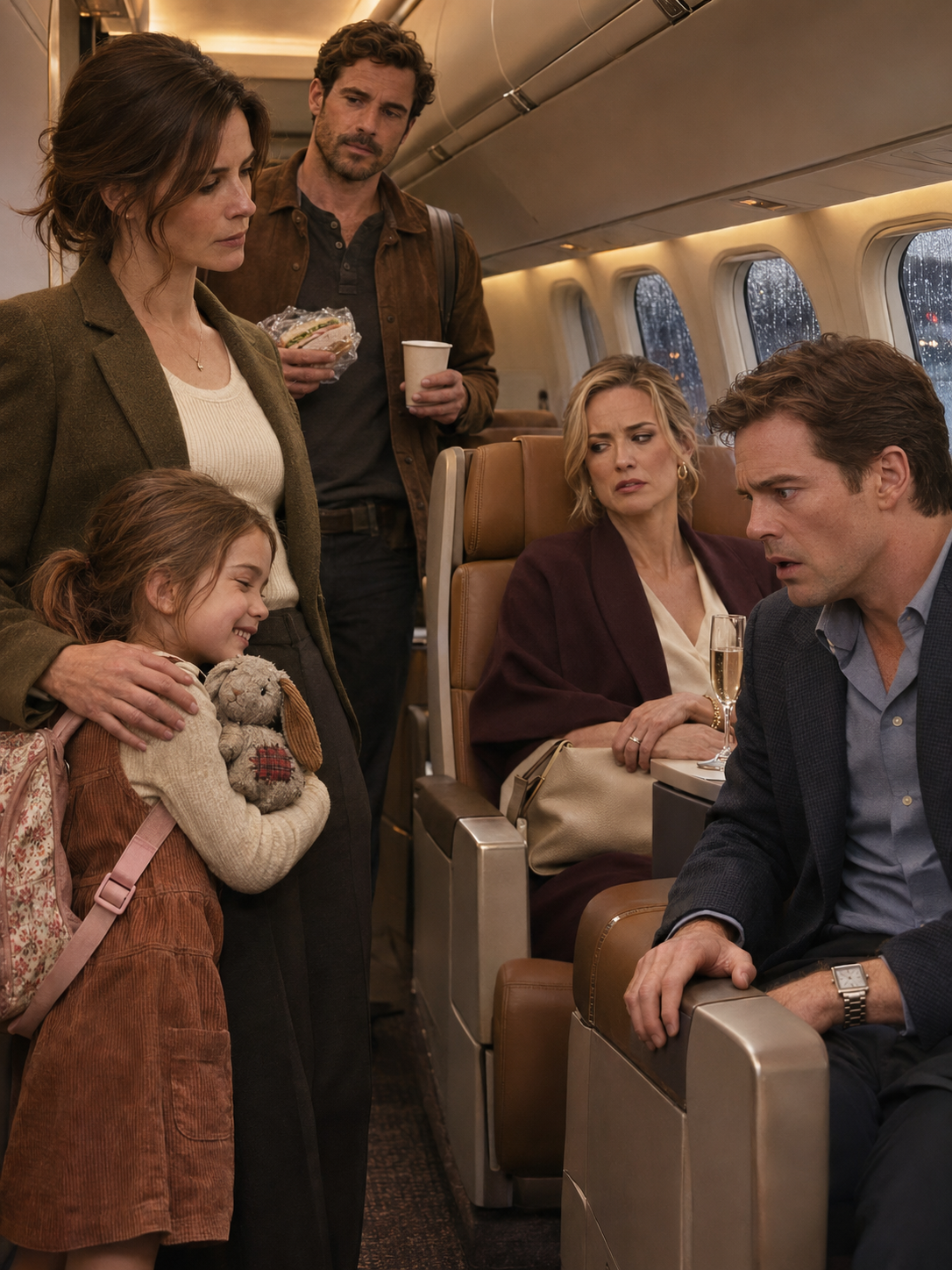
Six years after our divorce, Grant Vale looked at my boarding pass and asked, loud enough for the whole business-class cabin to hear, whether I knew economy was in the back.
The woman who’d helped him empty our house smiled into her champagne.
Then my six-year-old barreled up the aisle, threw her arms around my waist, and yelled, “Mommy! Daddy said we’d find you!”
Grant’s smile went first. His color went when he saw the rabbit tucked under her arm.
It was an ugly little thing with one corduroy ear and a patch of red plaid across its stomach. The other ear still had a milk stain I’d never been able to get out. I knew where the plaid had come from. Grant did, too.
It came from his own shirt.
“Careful, bug,” I said. “You’re standing on my foot.”
Ruby stepped sideways. She put the rabbit in my hand so she could use both of hers to take off her backpack. It had a pink plastic buckle she kept trying to operate with mittens on, despite the fact that we were headed to Southern California and her mittens were packed at the bottom of my suitcase.
“Daddy found a sandwich,” she told me. “He got one without anything.”
“It has turkey. Nothing wet.”
Behind her, my husband appeared with the sandwich, two paper cups, and the expression of a man who’d made it all the way down a jet bridge with a six-year-old without losing a shoe. He went still when he saw Grant.
“Eli,” Grant said.
Eli looked at the boarding passes I’d put on the little ledge beside seat 3A. “We switched her to the window?”
“She wanted to see the wing.”
He put the sandwich down. Ruby climbed in, pulled up her knees, and looked for the buckle. Eli crouched to help her the way he always did, one forearm braced on the edge of her seat. When she got it herself, he held his hand up so she could slap it.
Grant watched the whole thing.
Vanessa Pierce set her glass down so hard the stem clicked against the tray. She had a pale leather bag across her knees. Six years earlier, in a house I could still describe room by room, I’d found an identical bag on the foot of my bed.
“Are we all on the right flight?” she asked.
“Unless you wanted to go somewhere besides Los Angeles,” I said.
The flight attendant came by with a basket. Vanilla cookies, pretzels, a wet napkin in plastic. Ruby asked if she could have two cookies, one for now and one for when we got there.
The woman gave her two. Then she looked at me. She’d heard what Grant said. I knew because she addressed me as Ms. Caldwell and asked whether my party would like our coats hung together.
It was a small thing. I could have hugged her.
Grant sat across the aisle in 3D with Vanessa on his right. He had a fresh haircut and the same square watch he’d worn the day he told me to take the washer and leave the dryer. His cuff was caught on the watchband. He didn’t fix it.
“How old?” he asked.
Ruby answered for herself. “Six and a quarter.”
Her birthday was May tenth. For most of her sixth year she’d believed the extra fractions accrued according to how many teeth you’d lost. This was the first week she could say a quarter without anybody correcting her.
Grant turned toward the dark window.
I could have asked him why he still remembered the rabbit.
I could have asked him whether he’d ever looked at the back of the picture he carried out of the hospital.
I could have asked him where he was on May tenth, a year later, when there was a candle stuck in a mashed banana and a whole room singing.
I could have asked him whether he wanted to tell the woman beside him why his hands wouldn’t stay still.
I could have asked him what he thought he was owed for finally getting the age right.
Instead I tucked Ruby’s rabbit under the seat belt beside her and showed her which button turned on the light.
Eli was in the row ahead of us. He leaned over the divider before he sat down.
“Want to swap?” he asked quietly.
I understood what he meant. He would sit by Ruby. I could move forward and spend five hours without Grant in my side vision. There was nobody in Eli’s aisle seat yet, and we could probably work something out with the flight attendant if I wanted.
“I’m good here.”
He looked at me for one more second. Then he handed me the extra cup of water and sat down.
We finished boarding. Nobody else came up the aisle for a minute or so. I heard the rain tick against the plane in Detroit, and over the cabin speakers somebody tried the microphone three times.
Grant leaned over.
“Does she know?” he asked.
“She knows where the bathroom is. She knows whose sandwich she’s holding. Anything else you want to ask me, wait until we’re on the ground.”
His eyes went to the rabbit again. The old plaid showed through the belt.
When the flight attendant came back to check our buckles, he was still looking.
My name had been Nora Vale for five years. It took eleven minutes at a county clerk’s window to get Caldwell back, and I went to work the same day with a paper receipt folded into my shoe because the purse I had taken to the courthouse came apart at the strap.
What I remembered from the divorce hearing was the smell of somebody’s lunch coming through an air vent. Somebody had heated up chicken soup while Grant’s lawyer explained that the patent for the lift I’d designed belonged to the company. I could have the washer, a station wagon with a broken hatch, and enough cash to pay off my student loans. There was a signature line where I could agree that my work on the prototype had ended the previous March.
I’d worked on it through October.
My attorney put his pen down on the wrong side of the paper so Grant couldn’t see how badly his hand shook. He asked if we could have the room. Grant and Vanessa waited in the hallway, and through the wired safety glass of the door I watched her fix his collar.
“You could fight for this,” my attorney said.
“With what?”
He turned his legal pad around so I could see the projected bill.
I didn’t take the washer. Moving it would have cost eighty dollars, and I could get ten loads done at the laundromat before I spent half that. I kept the station wagon. I drove it for six more years with a stick in the back to prop up the hatch.
I’d driven it to the airport that morning.
A client in Ohio had paid for my seat. I’d cashed in a stack of miles to get the other two. She owned a small company that built school buses, and I had agreed to spend a weekend looking at why the wheelchair lift on one of her bids sometimes refused to finish its cycle. A week later a buyer in Long Beach asked her to send the review directly to the city’s purchasing office. Eleven people would be in a room the next morning, and they’d be deciding whether to proceed with a new fleet of vans equipped with lifts from Grant’s company.
I was there because I’d put my name on a report recommending they hold the purchase.
Valid on paper, dangerous at a curb. I’d watched the test video six times before I could make myself write those words plainly.
Eli and Ruby were coming because three months earlier I had promised to let her put both feet in the Pacific before she started first grade. She’d pointed out a few weeks ago that school started Monday. I’d promised again. Eli took two vacation days and booked a motel with an outdoor pool she’d been looking at online since July. He was going to take her to the aquarium while I was in the hearing.
We didn’t know Grant would be on the flight. We knew he’d be at the hearing. I’d spent some time deciding which shoes I could wear while talking to him about a woman who tipped out of a van in front of her speech therapist. Those shoes were in my carry-on with a clean blouse and a paper notebook, because somebody had requested that the commission treat my written findings as confidential and I wanted a place to keep track of exactly what they said about them.
As we leveled out, Vanessa took a packet of almonds from the flight attendant and asked me how I was paying for my legal fees.
I turned my head.
“Your indemnification,” she said. “Or do you have somebody offering you protection? I’d want to have that sorted out if I were going to circulate a report accusing a company of lying on its certification.”
I peeled the plastic back from Ruby’s sandwich so she could get at the end with the most turkey.
“My report says what the lift did,” I said.
“The rest of the commission hasn’t seen it.”
That got my attention.
Vanessa opened the almonds. “I imagine you’ll get an email.”
I got it sixteen minutes later, when my phone managed to join the cabin Wi-Fi. The hearing notice had been amended. I was still listed as a speaker. The review I’d written, which had been attached under Exhibit D, was gone from the materials available to the commission.
There was a one-line explanation at the bottom. I read it twice. Then I put my tray table down and got out the paper notebook.
The report had been removed at the request of the manufacturer, pending proof that I was qualified to conduct the inspection.
Under qualifications I had listed my six years working on commercial lifts and the nineteen months I spent developing the original Vale prototype.
Somewhere, probably in the pale leather bag across the aisle, there was a piece of paper signed by me saying the prototype never existed while I was there.
I wrote down the time and the name of the person who’d sent the notice. Then I started a reply to the commission clerk.
Before I could hit Send, Ruby took off her headphones and tapped my arm.
“What does Daddy mean when he says we’re going to see somebody get thrown out of a bathtub?”
I stopped typing.
There was a tank at the aquarium designed to show what happened when waves broke on the shore. Eli and I had looked it up with her. He’d said it was like sitting too close to a bathtub in a raincoat.
“I think he meant the water comes over the rocks. The animals get to stay where they are.”
“Oh. That’s good.” She thought about it. “Do they get wet?”
“They get very wet.”
She went back to her movie. On the laptop screen, the clerk’s name waited in the address bar.
I wrote that I was available to establish my qualifications in person. I asked that the city keep the original report and the amended agenda as part of its records. Then I asked if the lift involved in the incident was still being held for inspection.
The public notice had stopped at one fall. The purchasing office had sent me a spreadsheet with three, including one in a used unit whose VIN was incomplete. When I asked for a look at the equipment, they offered two hours with the van from the most recent incident. I spent the first forty minutes waiting in a parking lot while two men from Vale Mobility took pictures of my rental car. I spent the next eighty trying to show the city’s fleet supervisor what could happen with a loaded lift at a downhill curb.
It took fourteen attempts.
A test weight marked 450 LB. A wheelchair stand-in with hard rubber casters. A little orange strap, just loose enough for me to see movement before it caught. On number fourteen, the metal barrier at the end of the lift went flat while the platform was still in the air.
The test weight took half a second to move.
I had the photograph of the orange strap stretched straight across the platform. I’d taken it after I stopped shaking.
Eli came back to see if I wanted the last of his pretzels. He squeezed my shoulder once. The arm of his plaid shirt was pushed up past the line where the skin on his forearm lightened in the winter. Ruby sometimes tried to draw freckles in that space with marker. We found the last one two days after Christmas.
I showed him the amendment.
“Are they going to let you talk?” he asked.
“We’ll see. What I need is for them to stop clearing the hardware.”
“Is the lift still on the van?”
“Okay. In the meantime, there’s a kid back here who’s just discovered you can make a napkin float by blowing the air vent straight down.”
The first napkin hit Grant on the collar while he was putting his watch into airplane mode. Ruby hadn’t meant for it to travel. There was a gust from another vent, and it drifted high enough to go over the aisle.
Grant caught it between two fingers.
“Sorry,” she said.
He looked right at her for the first time without glancing down at the rabbit. He smiled the kind of smile I used to see coming thirty seconds before everybody else.
“Want it back?”
She nodded.
He held it out. She took it and put it straight into the paper cup where she’d been saving the sandwich crusts.
“Thanks,” she said.
Then she climbed into Eli’s seat and asked him to tell her when they came to a mountain with snow. Grant watched her lean against his shoulder.
There are a few ways to tell the story of how Ruby came to live with us. We use a board book somebody at the family court library gave us. We use a photo of her in a bathing suit, sitting in a black roasting pan filled with an inch of water. We use the word died. Eli asked a pediatric grief counselor about that one. The two of us practiced saying it at the kitchen table until we could say it without looking down.
Ruby’s first mother was Hannah Whitaker. Eli’s little sister.
She was a customer training rep in the Vale shop. She had a spinal cord injury from a wreck in high school and knew how long you could wait in a freezing parking lot for a van to show up before your hands stopped working. My first design for the lift controls required a person to hold down two buttons on opposite sides of the handset. She watched me do an entire demonstration. Then she took one of her gloves off with her teeth and said, “Make it work with one hand in February.”
I went back to the bench.
We fought about cold weather, grit, and how much space you needed at the edge of a sidewalk. We got along about almost everything else. I knew she made good soup, never threw a pickle spear away, and had a boyfriend she was trying to stop seeing. I found out who the boyfriend was after the divorce.
The night Hannah called me about him, Ruby was four months old. I was at a gas station returning a little carpet washer I’d rented to get a stain out of the wagon. Hannah said she needed to talk to somebody who knew Grant. I said, “Is this about your job?”
“No,” she said. “It’s about my daughter.”
I sat in the car with the cleaner still in the back until the gas station turned off half its lights. I remember thinking I’d have to go back inside and pay for another day. I needed one thing I could be mad at in an ordinary way.
Grant had asked Hannah to keep his name off Ruby’s birth certificate. He’d met her twice at the hospital, when she was pregnant and when Ruby was born. At the second visit he’d taken his flannel off and handed it to her. Said somebody had brought him one of those fat rabbits from the gift shop and he wanted to give the baby something she could tell was from him. The shirt smelled like oil and wintergreen. Hannah washed it and used a square of it to mend the rabbit after it ripped.
There’s a photo of Grant with the rabbit on his knee. He’s looking down at the hospital bassinet. Hannah used to keep it in the back of a battered copy of Goodnight Moon.
I had known Grant for nine years. I knew which of his teeth was false. I knew he wrote his check numbers in a book even when he didn’t write any checks. In nine years I’d never managed to persuade him it was worth hanging a wet towel so it would dry. It took Hannah twenty-five minutes to tell me what he was prepared to do to make sure there was no photograph of him with his own daughter in the same frame.
Hannah wanted a legal arrangement if she died. She had a surgery coming, and for the first time since she’d had Ruby, she let herself write the whole question down. Grant confirmed paternity in private and told Hannah he wouldn’t seek custody. After she died, he signed the consent for Eli to adopt Ruby. He made his lawyer handle every exchange.
We met in person once more while Hannah was alive. She came by my rental with a box of tools she’d found in an office that was being cleared. I brought out a folding chair and she said she had a chair. We sat on opposite sides of the living room with two mugs of instant coffee. Ruby was asleep against her chest.
“Do you hate looking at her?” Hannah asked.
I let myself look. Ruby had one hand closed around a shoelace Hannah had cut off an old boot. The lace went right through her fingers and back out the side of her closed fist.
“I don’t hate looking at her,” I said. “I just have a hard time tonight.”
Hannah nodded. When Ruby stirred, she tugged the lace gently, and Ruby closed her hand harder. I can still see the way the weight of her made Hannah’s shirt sag on one side.
Three months later, on a Tuesday, I got a call from Eli.
Hannah had gone off the rear of a van lift at work. She fell to the concrete. She died the next evening in a hospital that had no space for another visitor in the family room, so Eli and I ate half a bag of dry cereal in the hall while we waited to see her.
For the first year after Hannah died, death was about things you couldn’t buy on the way home from work. A baby’s pajamas that smelled like somebody. A lint roller with a grocery list stuck to it in blue ink. A fresh page on an old calendar. Eli left the calendar on the wall in Hannah’s kitchen for eleven months until Ruby pulled it down herself.
I got to know him while we were trying to figure out why the latch on Hannah’s side gate wouldn’t shut. He tackled it from below. I stood on a step stool and said it was the drop in the post. We were both right, and it took an hour for both of us to admit it. By then Ruby was asleep in a grocery cart cushion in the back of my wagon with both doors open and the radio playing low.
Four months later, the day he asked me to go to dinner with him, I laughed so hard I frightened him. The baby had just thrown a boiled egg into his shirt pocket. It felt wrong to go anywhere he couldn’t wear the shirt.
He got a clean one.
People sometimes assumed I’d married Eli to make a family with Ruby. The grocery-store shirt and the egg were a fairer description of how it started. When we married, she’d been calling him Daddy for more than a year. At first she called me Nor, pronounced like the beginning of north. One day in the produce aisle she called me Mom because I wouldn’t let her eat an unwashed grape and it seemed to carry more authority.
I still had her handwritten name tag from the day my adoption became final. She’d spelled RUBY with a very small U, then put a sticker over the Y so the judge would have to look under a rainbow to see it.
Nobody owed a stranger the story of how she got her family. A man who’d been there twenty minutes when she was born didn’t get to ask for it while she sat across from him trying to save a cookie.
When I came back from the airplane restroom, Grant stood in the aisle. He held my coat. He’d asked the flight attendant for his, and she’d handed him mine by mistake.
“Did you know before you got married?” he asked.
I took the coat.
He glanced behind him at Vanessa. She had her eyes closed and her hand closed around her phone.
“You could’ve kept clear of all that,” he said.
“She was seven months old, Grant.”
He looked down at the sleeves of my coat. He had one of the buttons caught in the fold of his handkerchief. He worked it loose.
“What does she know about me?”
“She knows Hannah had a baby. The rest is a family conversation. You’ll hear from us if there’s a reason for you to be part of it.”
“Your father would have said I deserve a chance to explain.”
“My father told you to stop parking on his grass. You didn’t hear that, either.”
For about a second, I thought he was going to laugh.
I sat down and put my coat over Ruby’s knees. In her sleep she worked one foot out from under it. The plastic window shade was open just wide enough for me to see the mountains Eli had promised to find.
My phone vibrated again.
The clerk had sent a reply. I could appear at the hearing. I could bring any paperwork I wanted, subject to the commission’s review. And the subject vehicle had been released from inspection hold at two thirty Pacific, at the request of its owner.
That was twenty minutes after we left the gate in Detroit.
I turned the phone off after that. For the last forty minutes of the flight I helped Ruby work on an activity book. She had to find five things beginning with the letter B. She found boat, ball, and blanket, then pointed to the picture of a goat and declared it a baby.
“I’m willing to allow that,” I said.
She leaned her whole weight against me. “I know.”
We landed in the early evening. Grant stood up the second the seat belt light went dark. He reached out to get his bag and caught his hand between the edge of the bin and somebody’s metal carry-on. It must have hurt. He kept his thumb in his fist until everyone else in our row had gone.
Vanessa let him walk ahead to the jet bridge. Then she turned to me.
“You told him about Detroit?” she asked.
I waited for her to tell me what she meant.
“Tomorrow, if anybody asks you. The employee accident. There are reasons families sign those agreements.”
Eli had been reaching for Ruby’s backpack. He put it down on the seat.
“You’re welcome to address me,” he said. “I’m the family that signed it.”
Vanessa looked down at the backpack. There was a card in the clear name slot. Ruby had written Dad’s number with her own hand. She had made the D backwards both times she wrote it.
“Hannah was good at her job,” Vanessa said.
“She was,” Eli answered. “You let somebody write down that she didn’t know how to lock her brakes.”
Vanessa’s mouth opened. People were coming up behind us. She put a hand against the top of the seat to steady herself, then picked up her bag and left.
Eli pulled out a raised handle on our suitcase. He got it too high, lifted it again, and pushed it all the way down.
“You good?” I asked.
He nodded once. “Can you tell Ruby we’re going to get ice cream?”
Ruby was standing right there.
“I can,” I said.
For trips with Ruby we’d worked out a rule. On the first day we found the one thing that would make it worth having come even if everything after that went wrong. The pool at the motel had closed hours earlier because somebody had dropped a lightbulb into it. We took our shoes off at the edge of the ocean instead.
Ruby ran from the foam three times. On the fourth she stood still and let it wash over her ankles. She grabbed my first two fingers. The water took the sand under her heels, and for one small second she pitched forward. I lifted my arm so she could settle her feet again.
“Does it always go out like that?” she asked.
“Pretty much.”
She went back in and watched. There on the sand were three little marks from her toes, the same on each foot. I had to look twice to see them before they washed away.
The custard stand a block up had only strawberry left. Ruby ate the top half of a cone and gave me the bottom. While Eli went to the car for a towel, I called the city’s fleet supervisor.
His name was Mateo Ruiz. He’d watched the test at the curb with me. I liked him because when I told him I needed a loaded test rig, he’d brought two bags of gravel and a whole pallet of printer paper, then let me pick. Now he answered on a number that had a California area code and introduced himself as if I’d never spoken to him in my life.
“Did Vale get the van?” I asked.
“Their dealer sent a flatbed.”
“Is the lift still on it?”
“It was when it left.”
“Whose decision was that?”
A wave broke close enough for me to put my hand over the phone.
“The city doesn’t own it,” he said. “Pilot agreement. They gave us six vans for ninety days. Dealer takes them back whenever they want.”
“Were the units logged as returned?”
“Five were.”
“And the sixth?”
“It’s in the wash bay. We use it for a Saturday morning run when there’s a substitute driver. They’re supposed to get it Monday.”
I crouched down in the wet sand and took a piece of shell out of Ruby’s rolled-up jeans. It had left a little white mark on her shin.
“What year?”
“Same as the one you tested.”
“Can you send me the plate number?” I asked.
“I’ve got two guys who signed that van out this week. I can’t let you on the lot tonight.”
“Can one of them check whether the rear barrier opens during the pre-trip?”
“He’ll have to have a weight.”
“Whatever he has in the bay. Tell him to keep everybody well clear.”
Mateo went quiet. In the background I heard a TV announcer give the scores of a baseball game.
“My mother rides a van with one of those lifts,” he said.
“Give me an hour,” he said. “I’ll go myself.”
The towel Eli brought was one he’d taken from our own bathroom. It was big enough to cover Ruby’s head and shoulders when he draped it around her. She reached up under both sides and put her fingers through the loops.
“What should I call him?” she said.
His hands stopped for a second.
“The man on the plane?”
“He said my name once. I heard him when you were putting your shoes on.”
“His name is Grant,” I said.
“Does he know Hannah?”
Eli looked over at me. I shifted until I could sit close enough for all three of us to fit under the far end of the towel.
“Yes. He worked with her.”
“Like you?”
Ruby pressed her face into my arm for a second. Then she went back to trying to catch the water running down the tilt of the beach.
Six months earlier we’d talked to the family counselor about doing this when Ruby started to ask questions. We were going to start with the facts she could carry. Hannah gave birth to you. You had your own father before I got to be your dad. He knew which hospital you were born in. He knew the weight on the little card beside the bassinet. We had held one piece back until she was old enough to ask how we knew.
She asked that night while Eli scraped sand off her between her toes in the motel sink.
“Who’s in the bunny?”
I thought I’d misheard her.
“The red part. You said Hannah fixed it with somebody’s shirt.”
I could see Eli’s face reflected in the mirror. He gave a little nod.
“That was Grant’s shirt,” I said. “He gave it to Hannah when you were born.”
“Was he there?”
She picked up the rabbit from the towel rack. He’d left some peppery grains of sand in the fold.
“Does he get to have it back?”
“It’s been yours since you were born.”
Ruby put him beside her foot and watched the muddy water drain. She didn’t ask anything else. Eli got the clean pajamas out of her bag. After he wrapped her in the blue bath towel, she crawled into bed and waited to see who was going to turn out the light.
I did it. She asked me to turn it back on twice.
At nine forty that night, Mateo sent me a forty-eight-second video of the lift at the wash bay. It went down slowly, held midway, and stayed there. A man out of frame said “ready?” and somebody else wheeled a test weight forward. The bar dropped.
Mateo had watched the test with a grease pencil in his hand. He had used it to mark the point at which the metal barrier was supposed to stay raised. After the weight stopped against its safety strap, he put one mark on the side of the platform where it actually came down. The distance between the two marks looked long enough to park a bicycle.
A separate photograph showed the serial plate on the back of the lift.
I was still enlarging the picture when an email arrived from an address I didn’t recognize. It was Grant. The subject line said There’s coffee by the ice machine. It was an old joke from the years we used to drive to see his mother and stop at whatever place took walk-ins after midnight. There could be an actual coffee maker by the ice machine. There could be a pot someone had left beside the bucket with a note about paying a quarter.
He was asking me to meet in the lobby of an airport hotel ten miles from where we were staying.
I called him instead and put him on speaker. Eli sat at the edge of the other bed, taking a grain of sand out of the seam of Ruby’s sneakers with the metal corner of a hanger.
“What do you need?” I asked.
“I have a way to fix the agenda.”
“How much does it cost?”
“You take the old test question out of your report. I tell them you were authorized to work on the first lift. The whole record goes back up.”
“What old test?”
“The one tied to Hannah.”
“Hannah’s accident isn’t in my report.”
There was a long enough pause that I looked at the bars on my phone.
“You’re sure about that?” he asked.
The question stayed with me. He hadn’t asked why I was talking about her now. He’d assumed I had something to show the commission.
“What’s the part you think I should take out?” I asked.
“I need you to tell me if you’re willing, Nora.”
He sounded tired. My mother always used to say the real test of knowing somebody came when you got a call from them late at night and heard how they pronounced your name when the day was over. Grant had said mine like that at the hospital when my father was dying. I’d left one room to follow him into another. He’d taken my coat and made me eat a bag of barbecue chips. I still couldn’t swear that he hadn’t loved me then.
The man on the phone wanted to know what I was willing to give him for a chance to be heard.
“Nothing,” I said. “Tell them the truth if they ask.”
He hung up.
Eli worked the last bit of sand out of the sneaker and set it beside the other one.
“Tell me something,” I said. “When did Vale send you Hannah’s lift report?”
“When I asked for it the second time. She’d been dead four months. They gave me a summary with three signatures.”
“A guy from the insurer. Somebody from the shop I didn’t know.” He raised his eyes. “Vanessa.”
“What did it say the lift did?”
“It said the barrier was up and the chair went over it.”
We’d talked about Hannah’s death a few times in the years we’d been together. Eli had kept the most concrete parts to himself. I used to think that was because of the settlement. Now I thought about that sentence and understood there was a picture that came with it. A chair going up over a lip of metal under its own power, his sister watching the concrete coming. He’d been asked to believe it and had never wanted to pass the picture on to me.
“Where’s your copy?” I asked.
“Top shelf of the closet. Inside the box for the humidifier.”
I held up the phone. Our neighbor Dottie had the key to feed the cat. It was close to one in the morning in Michigan. I started a message I could send in a few hours, then saw the little marker saying she’d been online two minutes earlier.
She answered with a phone call.
“Honey, how come the cat has a blanket with my initials on it?”
“Because you gave it to her.”
“I gave you that blanket for when you went to the hospital.”
“I know. She loves it.”
Dottie let that go. She found the box in the closet. When I asked if she’d open it and take a couple of photographs, she said, “Of course I can. But next time you hide something, do it at a height I can reach without using your husband’s good cutting board as a step.”
We heard her carry the box to the bed. A zipper caught. Then she asked if I was able to see what she was doing.
I was. The camera turned and I saw her slipper and the edge of the bedspread before the picture settled on the report.
The print was tiny. I could just make out an entry for the time of the accident. The field for the serial number was blank. In its place somebody had written Demonstrator 04.
Four. I knew that number. I had written it in orange inside the back housing of the fourth lift I ever built. I’d left a reserve space for a switch we had planned to add when we moved beyond trials on flat ground.
The paper said the lift carried the final design. The paper said there was no place for a switch.
I sent the report to myself and to Eli. Then I went out to the walkway in my socks so the light from the phone would stop falling across Ruby’s face.
Our motel room was behind the ice machine. There was a strip of concrete you could walk along to look down into the pool. Whoever had cleaned it left the net leaning against the fence. I could see the shallow end and all the shadows made by the drain covers.
I called a man named Frank Sutter who’d done electrical work for Grant’s company before it was called Vale Mobility.
He answered, “It’s Friday.”
“It still is out here, too.”
“Where are you?”
“Long Beach.”
Frank went quiet. He’d grown up out here. Every time Michigan got the first snow of the year, he threatened to use his next paycheck to go home. He never did. His girls played hockey.
“I need to establish where I was when we built one of the prototypes,” I told him.
“You were on the floor,” he said. “Where else would you be?”
“Can you put a date on it?”
“Which one?”
“Four. We left an opening for a second switch.”
“March nineteen,” he said.
It came so fast I took the phone away from my ear and checked that I was still on the call.
“How do you know?”
“It’s my wife’s birthday. I got home after she went to bed. And before you ask, I’ve still got the job card. I took a picture of it to prove where I’d been.”
I told him what had happened to Hannah. He knew about the fall. I told him what the investigation report said about Four being a finished production model. He walked a few steps with the phone close enough to his leg for me to hear it hit his pocket.
“We put that board in upside down,” he said finally. “You remember? The controls ran, but we didn’t have the guard switch yet. You wrote a warning on the plate so nobody would take it outside.”
“That’s the one.”
“Need me to say that tomorrow?”
“Okay. Can you send me whatever link I’m supposed to click?”
He sent the job card three minutes later. I forwarded it to the purchasing office and asked them to confirm the right way for a witness in Michigan to supply a statement. I kept watching the other end of the walkway, where the bushes bent away from a sprinkler head. I thought about what it meant that somebody could put the wrong lift in a report and get away with it simply because no one ever had the thing in front of them again.
I went back downstairs to ask Mateo whether the city had any records from older Vale demonstrations. He answered from the back of the wash bay. I could hear a floor squeegee scraping. He’d pulled the last pilot van out of service. He was already working his way through the names of regular Saturday riders so they could send the city’s spare minibus instead. There was some confusion about a woman who couldn’t ride early because her home aide didn’t get there until nine.
“Give her my name,” he told someone. “We’ll still go get her.”
Then he turned back to me.
“There’s a state purchasing library,” he said. “We used to have to put all the videos in it. Before somebody realized what it cost to store ten years of men pointing at buses. What am I looking for?”
“Something made before the first production year. Big number four on the top of the frame. Orange marker.”
He asked me to send him a picture if I had one. I didn’t. I drew the four on a motel notepad and photographed it in the light from the soda machine. I had always left the top open and pulled the crossbar so far over it looked like I’d meant to write a second number. I could still do it with my eyes closed.
By morning, Mateo had found a clip. Twelve seconds, no sound. A customer demonstration on a patch of blacktop at a warehouse outside Sacramento. Frank was wearing the blue sweatshirt he’d had on every day of the first year I knew him. I was standing next to him with my hair caught in the Velcro at the neck of my coat. The watermark said October.
At the very end somebody swung the camera down as I fitted the housing. You could see the orange four, and you could see the two mounting points, one with a switch and one empty.
The clip had been received by the purchasing library the day it was shot. Seven months after I had supposedly stopped development.
I got coffee from the motel lobby. The cardboard sleeve was too wide and slid up every time I lifted the cup. Ruby was awake by the time I got back. She’d put the rabbit on top of the remote control and was moving him with two buttons, one for up and one for down.
“Wrong way,” she told him patiently.
Eli handed me the paper bag with a piece of toast in it. He’d written the aquarium’s address on the bag so I had it even if my phone quit. There was a white path where he had written through a little circle of butter.
“Ruby wants to know if we have to wait until you’re there to feed the fish,” he said.
“I don’t think they’re going to wait for me.”
“I said you’d understand.”
Ruby turned off the television while I hunted for the second of my two good shoes. It was at the bottom of the bag I’d used to pack her coloring books. She pulled it out by the toe and handed it to me with a pencil inside.
“You can have this one,” she said. “The eraser’s gone but you can still write with it.”
I put the pencil in my jacket pocket.
The commission held its meetings in a city building with a picture of the harbor on the side. In the lobby there was a lady in a blue cardigan filling out a form for two hours of parking. She read the parking app aloud to her husband as she did it. When she got to the box that asked what they wanted to accomplish today, she looked up at him and said, “We’re trying to get the hell out of this garage.”
I knew her from the spreadsheet.
Her name was Lucinda Bell. She was the woman who’d gone off a lift in front of her speech therapist. She’d broken her wrist and come out of surgery with four screws. The injury report had a photograph of her chair on its side, wheels pointed at the curb. In person I recognized the pair of sneakers she’d been wearing. There was a little patch of blue cloth over a tear beside her right toe.
I introduced myself. She looked down at my badge.
“You the one that tested it?”
“Did it do it to you, too?”
“We used a weight. It did.”
She turned back to her husband. Her jaw shook once. Then she got the parking app to accept the number from their license plate.
Vanessa arrived with a patent lawyer and two slim black cases. She stopped to talk to every person standing where she might need them to sit. Grant came in a minute behind her. He’d put on a tie that didn’t match his suit. I knew where he’d bought it because I’d chosen it for his father’s funeral. He’d stood in the men’s section of a department store with his arms hanging open while I tried to remember how to fit the knot around his throat without being able to see what I was doing.
He saw Lucinda Bell. He looked at the band she wore around her wrist.
“How have you been holding up?” he asked her.
She held the phone out to her husband.
“Does he work for the city?” she asked me.
“Then I’m going to save it for the people who do.”
She wheeled herself toward the room. Grant moved his feet out of the way.
There were eleven people on the hearing side of the room, just like the notice said. I knew six of their names. Vanessa sat down directly across from the purchasing director and plugged her laptop into the monitor. A picture of a garden appeared, briefly, before she brought up her first slide.
The garden was at my old house. The hydrangeas were still the color we walked around the nursery for forty minutes trying to find.
I looked at my notes until the slide filled the screen.
Vanessa made a good presentation. She knew what the city had paid the last contractor for repairs. She knew how many riders had to be turned away when there weren’t enough vans with lifts. She knew the delivery schedule down to the number of days a driver would be out of rotation for training. She gave the address of the factory in Michigan and the exact number of people they stood to put back on full-time work if this contract went through.
That last number was forty-eight.
When Grant and I were married, a guy named Jeremiah used to ride in to open the plant at five and sell breakfast burritos out of the insulated bag on his bike. It took three years to find out he gave half the money to the woman who made the burritos and the other half to his mother. If Vale lost its contract, Jeremiah might lose a shift, and his mom might miss the payment on the car he was saving up to buy her. I had eaten his burritos four mornings a week. I wanted him to have his job.
I also wanted Lucinda Bell to be able to leave her house.
The purchasing director asked about the withdrawn report. Vanessa folded her hands as if she’d been waiting for that question and was glad somebody had finally asked it.
“I want the record to show that Ms. Caldwell was once married to our founder,” she said. “Ms. Caldwell herself signed a statement dating the end of her development work. She could have attached it to her report. We attached it to our objection when we noticed she hadn’t.”
Nobody looked at me at first. They looked at Grant. He was the person they knew.
“I’m happy to address the date,” I said.
The director let me come up. I walked too close to the corner of the table and caught my pocket on it. The pencil Ruby had given me stuck across the fabric. I had to stop and get it free.
“When I signed the statement,” I said, “I took a car and enough money to close out some debts. The signatures went through. The dates on the prototype didn’t change.”
I handed over Frank’s work card. I showed them where the state archive had recorded the date of the Sacramento demonstration. When my face came up on the monitor in that old coat, nobody said a word. I watched myself turn my head slowly to get my hair free of the Velcro. Then the camera dropped to the housing.
There was the number four.
“That’s certainly her,” one commissioner said.
Vanessa’s attorney turned sideways in his chair and whispered something. She kept her eyes on me.
“Ms. Caldwell,” she said, “presumably you know the difference between visiting a demonstration and developing a product.”
“I do. I also know how to see that a guard goes down with the platform still in the air.”
Mateo brought up the video from the previous night. He asked everyone’s permission to dim the lights. He didn’t wait for a discussion about whether I knew what I was looking at. That was his van, his employee’s voice, his grease pencil on the side of the platform.
When the test weight went over, somebody in the audience said, “Jesus.”
Lucinda Bell raised her good hand. The director called on her.
“That’s where I was,” she said. “Right before I hit.”
Nobody asked what she meant.
The first question after that came from the man who’d negotiated the fleet price. He asked if the two vans that had shown the same problem were close in serial number.
Mateo read him the plates. They were separated by more than four hundred units.
“Can you tell which ones are safe by looking at them?” the man asked.
“No,” Mateo said.
Vanessa opened one of the black cases. Most of what was inside was printed on heavy paper with full-color diagrams. She handed out the certification summary, starting at the end of the table farthest from Lucinda.
I waited until it got to me. Then I turned to the test conditions.
“Do you have the page for the loaded test on a slope?” I asked.
Vanessa didn’t turn around.
“It’s a standard certificate.”
“There’s a box for the test on a slope. It’s checked. Do you have the page with the result?”
She went back to her case. It was a good case. The lid stayed upright and both hinges moved quietly. I watched her work all the way to the bottom of it.
Her attorney said there were limits to what could be expected of a lift that was used incorrectly.
Lucinda raised her hand again. She didn’t wait until she was called on.
“My driver put the brakes on,” she said.
The attorney looked at the monitor instead of her. “I didn’t have a particular passenger in mind.”
The director asked the clerk to put Lucinda’s statement into the record. Then she asked for my report. It was the first time anyone had requested the thing itself. I took it out of my bag and set it down beside the manufacturer’s certificate.
Across the table, Grant had his hands tucked under his elbows. I could see him holding them there as tightly as he’d held his thumb after he caught it on the plane.
“Mr. Vale,” I said. “Can you show us who signed the original test results?”
He looked at Vanessa. She stopped moving paper.
“I can tell you who kept them,” he said. “The plant manager. There was a server migration a few years back. How complete the records are is something we’ll have to establish.”
He hadn’t said he would get them. I knew the intermediate step he’d just put between the room and the records. He’d used it the day I found Vanessa’s bag in our bedroom. He’d said he had to establish what she’d come to the house to do.
I’d asked Grant about the ordinary certificate to give him a chance to tell one simple truth while it was still easy. He’d let the chance go.
I put the paper with Hannah’s name on it beside the certificate.
“This report was given to a family after a fatal fall in Michigan,” I said. “It identifies the lift as Demonstrator Four. It also says the design was a final production model.”
Vanessa’s attorney straightened. “We have been told this matter was resolved privately.”
“The report describes the equipment. I’d like to correct that part of the record.”
I gave the directors an enlarged still from the archive. At seven times its original size, the empty mounting point was a bright circle that would have fit the eraser Ruby’s pencil was missing.
“There’s supposed to be a switch here,” I said. “That’s what keeps the barrier from dropping early. Without it, you have a prototype for trial use on flat ground. The current lift uses a different arrangement, but right now we have evidence of the same failure.”
“Are you saying that’s the unit that killed her?” Lucinda asked.
“It’s the unit Vale listed in the report.”
The director asked Grant what distinguished Demonstrator Four from the production model.
He worked his tongue along the inside of his cheek. It was where his fake tooth was anchored. I’d sometimes seen him wedge things there he didn’t want to swallow.
“At that point in development, it had a warning on the housing,” he said.
I let him tell them what it said.
“Flat surfaces only.”
“And where did Hannah fall?” I asked.
He knew the spot. So did I. The test lane was behind the parts cage. On dry days, the delivery truck rolled three inches after you put it in park. Everybody who’d ever parked a car in that lane knew to turn their tires toward the building.
“The ramp outside receiving,” he said.
Lucinda’s husband pulled their parking receipt out of his breast pocket, folded it all the way in half, and put it away again.
Vanessa’s attorney asked for time to confer. The director gave him eight minutes. When he went out with Vanessa, Grant stayed in his seat.
“Who cleared that test?” I asked him.
He pressed two fingers against the corner of the certificate and squared it with the edge of the table. Then he stood up and followed her out.
The commission came back on the record after twelve minutes. By then, the city attorney had spoken to the director, counsel for the company had emailed in two objections, and someone from operations had called Mateo to argue about the mileage on the spare bus.
The members voted to suspend the purchase and order an independent inspection. They also voted to keep the original agenda, the changed agenda, my report, both videos and every document received that morning in the public record. The letter telling them I wasn’t qualified went in with everything else.
On the first vote, Vanessa walked out. On the second, she held the door open while the patent lawyer carried both cases after her.
Grant stayed for the clerk to say the time.
I thought I might feel good when it was over. For a few seconds I could only smell somebody’s coffee. It smelled like the coffee that had been in my car the morning I got the call about Hannah.
Lucinda’s husband waited for the crowd to thin out before he backed her chair away from the inside edge of the table. He asked if there was going to be a van for the Saturday ride the following week.
Mateo said there was.
“Same time?” Lucinda asked.
“Want to give me your number in case it changes?”
She gave it to him. He got a digit wrong in the middle. She made him read the whole thing back.
I called Eli from the hallway. He said Ruby had bought a rubber sea turtle with the eight dollars she’d been saving to buy me a present. She’d told him I could borrow it on my birthday.
“Tell her I’ll put it on the calendar.”
“I will. We’re heading out soon. There’s some kind of food festival next door. She wants to see if anybody made tacos without the salad in them.”
I asked him to wait until I got there. I wanted to hear her order a taco without salad. For the first time since the plane, my chair at a table and what I was going to eat in it seemed like something I could decide right then.
I was by the elevators when Grant caught up.
“Is she staying with you in Michigan?” he asked.
I moved out of the way of a woman pushing a stroller. The woman pressed Down, then left her hand on the button long enough for her small boy to put his palm over hers.
“Ruby lives with me and Eli,” I said. “You don’t need to know where.”
He lifted his head. His eyes were red.
“I saw the patch and I thought she was going to hand it to me,” he said. “I don’t know why. I could see her getting ready to pass it to somebody.”
“She did. To me.”
He stood so close to the elevator that it couldn’t open all the way without his moving. When it came, I reached around him and touched the edge of the door with my fingertips to keep it from shutting on the back of his coat.
“She looks like Hannah when she gets ready to laugh,” he said.
“Yeah. She does.”
“I didn’t come because I thought she’d be okay if I stayed away.”
“Do you want me to tell her that?”
He looked at me.
“What do you want me to tell her, Grant?”
I’d expected that he’d ask me to say he loved her. I’d made room in my head for how I could use those words in a way Ruby would understand. He looked me in the eye and asked me not to tell her what he’d said about economy.
The door shut and came back open.
“She was still on the jet bridge,” I said. “She didn’t hear you.”
He put his hand over his mouth.
I went down. In the lobby, the clerk was waiting by a machine that used to validate parking tickets. She said someone had sent an additional document to the hearing email account while the commission was in recess. The sender had asked for it to be forwarded to me, specifically.
“What kind of document?”
“Private. It’s a link. I didn’t put it in the record.”
I waited with her while she opened the message on her computer. From where I stood I could see the name in the subject line.
Hannah Whitaker.
The clerk read it aloud, then pointed to the subject line.
I could hear all the chairs being folded upstairs. I thought of Eli taking the calendar off the floor after Ruby pulled it down. He wiped the dust from the edges with the side of his thumb, then turned every page until he got back to the month Hannah had been alive.
“Would you forward it to me?” I asked.
I went outside and found a bench behind a bicycle rack. The sun was warm on the seat. I had to shade my phone with my jacket to see the screen.
The link led to a message from a state investigator whose name was on the bottom of the old incident report. She’d been the one who had asked to preserve the vehicle in the first place.
The investigator said she had seen the hearing online. She’d found one more piece of evidence in a file marked closed, and she was trying to determine whether the woman in it was Hannah. She asked whether I could help identify her. The clip was fifteen seconds long.
It started with a van on the receiving ramp in Michigan. I could see the yellow paint going up the edge of the concrete. I knew the color of the building, the shape of the vent somebody had painted over. I watched enough of the clip to see the door open.
Hannah was there in a light jacket I remembered from the day I brought out the folding chair. She waved at somebody standing to the right of the camera. Then she turned her head, and I saw what she’d put in the seat just inside the van.
A baby carrier. The handle was up. A rabbit with a square of red plaid on its stomach was wedged between the handle and a yellow blanket.
I stopped the video. I needed a few seconds before I could make myself look at it again.
One of the things I’d always been grateful for, when I could be grateful for anything about the day Hannah died, was that Eli had told me Ruby was with a neighbor. A woman who made the kind of baby oatmeal that came in a cardboard box. She’d fed Ruby some and called Eli when Hannah was late. That was the story we’d been given. For six years I had put my head down on the pillow and thanked that woman for being there.
On the video, Hannah lifted a hand toward the ground. Someone out of frame said, “Hold that,” and the picture froze while the sound carried on.
“Take the baby inside first,” Grant said.
I knew him before he finished saying baby. I had listened to that voice through the wall of a motel shower. I’d listened to it across a county courtroom. I had listened to it ask how old my daughter was while he stared at the patch on a rabbit.
Another voice answered. “Leave her. Hannah won’t get off the platform without her.”
Then I heard a door slam.
I played the clip twice more to be sure. I recognized that second voice, too. It belonged to Art Bellamy. I’d worked beside him for months. He used to call out the lunch order from the other end of the shop because he knew we’d hear him over the compressor. He had been the plant manager, and he had signed the original report as the man from the shop. He was the one Grant had just put in charge of keeping records that might no longer exist.
The investigator had attached a still from the end of a second clip. She wanted me to confirm one more thing.
I opened it.
Same concrete. Same van. Same yellow blanket. The baby’s seat was empty.
A note under the picture gave the timestamp. It was eleven minutes before the ambulance arrived.
My phone lit up with a call from Eli. I picked up before it finished vibrating.
“Nora,” he said, “did you tell a man named Art he could take Ruby?”
I got up so fast my jacket slid off the bench.
“Where is she?”
I heard him start running. A second later, a van door slammed.
✓ Lynn R. Adams
My Ex Told Me Economy Was in the Back. Then My Daughter Ran to Me, and He Recognized Her Rabbit. Six years after our divorce, Grant Vale looked at my boarding pass and asked, loud enough for the whol…