My ex-husband drove his Bentley up my cracked Vermont driveway with his young girlfriend
IF FACEBOOK BROUGHT YOU HERE, HERE’S THE CONTINUATION YOU’VE BEEN WAITING FOR. ENJOY! 👇 “You filed under your maiden name,” he said. I reminded him that Callaway had always been my professional name, on my papers, affiliations, and grant applications. He looked back at the page as if a different spelling might change the date.
He argued that Ashford Biodistribution had funded laboratory work and therefore owned anything that came from it. I turned to the highlighted provision in our 2018 consulting agreement. The independent research carveout was not a secret; his own company had signed it.
The foundational design and early synthesis work had been mine before the company established its formal drug-development program. In return for infrastructure support, the company had received a limited, nonexclusive license under the research partnership agreement, not ownership of my patent. The scope and termination terms were written down, and two weeks earlier I had formally terminated that license.
Reginald read the documents again. His company had built much of its oncology strategy around a platform it did not own outright. Kellerman’s request for a clean chain of title was not a clerical nuisance; it went to the heart of what Ashford Biodistribution could promise to license.
He called Patrick, his company attorney, and put the phone on speaker. Patrick sounded exhausted before Reginald finished explaining where he was. He said the legal team had been conducting an emergency review since Kellerman raised the ownership issue.
The carveout was genuine. The archived research agreement supported it, and the original records traced the invention to Callaway Scientific Ventures. Previous counsel had treated the provision as an ordinary academic exception without appreciating its scope. Reginald demanded that Patrick challenge it, but Patrick asked what grounds they actually had.
Then Patrick said Kellerman had withdrawn its letter of intent that morning. I watched Reginald’s hand flatten against the table. For a man who usually filled a room with words, he seemed suddenly unable to find any.
Patrick wasn’t finished. Because Ashford Biodistribution had represented that it held clear rights to Veradine, Kellerman’s lawyers were examining whether those representations had been materially misleading. Patrick urged Reginald to speak with his own attorney, separate from company counsel, and ended the call.
Tatum set down her mug. “The eight hundred million,” she said, looking at Reginald. “That’s not happening?” He didn’t answer, and she reminded him of the Beacon Hill townhouse they were supposed to close on the following month.
She said she had declined a two-year skincare brand partnership after he promised their finances would change by the first quarter. I heard the hurt beneath her anger, though I also heard how much of their relationship had been organized around a projected deal. Reginald told her this was not the time.
“Then when is?” she asked. She looked around the laboratory, then down at her heels. I did not interrupt them. I had spent enough of my marriage being asked to manage Reginald’s discomfort, and I wasn’t going to resume that job now.
Part 3 Eventually Reginald looked at me. “Tell me what I missed,” he said. His voice had lost the smoothness he used in meetings, and I could see that he was asking about more than a paragraph in a contract.
I told him that eighteen months earlier a colleague had forwarded the announcement of Kellerman’s interest in his company’s oncology pipeline. I had kept an eye on Ashford Biodistribution’s investor communications because they concerned research I had developed. I knew a serious buyer would eventually investigate who owned the underlying platform.
I had not wanted to disrupt the process with accusations. Instead, I made sure my records were complete and available for legitimate review. Twelve weeks earlier, I had contacted Kellerman’s chief scientific officer, someone I knew professionally from my time at the Broad Institute, to flag the independent research history and offer documentation.
She had accepted. The resulting discussions were professional and detailed, not a scheme to hide facts from Reginald. My patent filings, research agreements, and dated laboratory records could speak for themselves.
“You planned this,” he said. I told him I had planned to protect my work. The carveout had been negotiated years before our divorce, and the license termination followed the terms the company had agreed to. I had no obligation to pretend those protections did not exist because he found them inconvenient.
He looked toward the glass wall and the instruments beyond it. I remembered him saying during mediation that the market rewarded vision, not execution. I had carried that sentence around longer than I liked to admit, but it no longer had the power it once did.
“I identified what mattered, kept the records, and waited until I could make an informed decision,” I told him. “That’s what you always said a good businessperson should do.” He pressed his fingertips against the table, thinking.
Then he offered to buy Callaway Scientific Ventures himself. Fifty million, he said, perhaps a hundred million with a personal guarantee, and a restructuring that could save the deal. He spoke quickly, as though increasing the number might restore the version of our marriage in which he named the price and I accepted it.
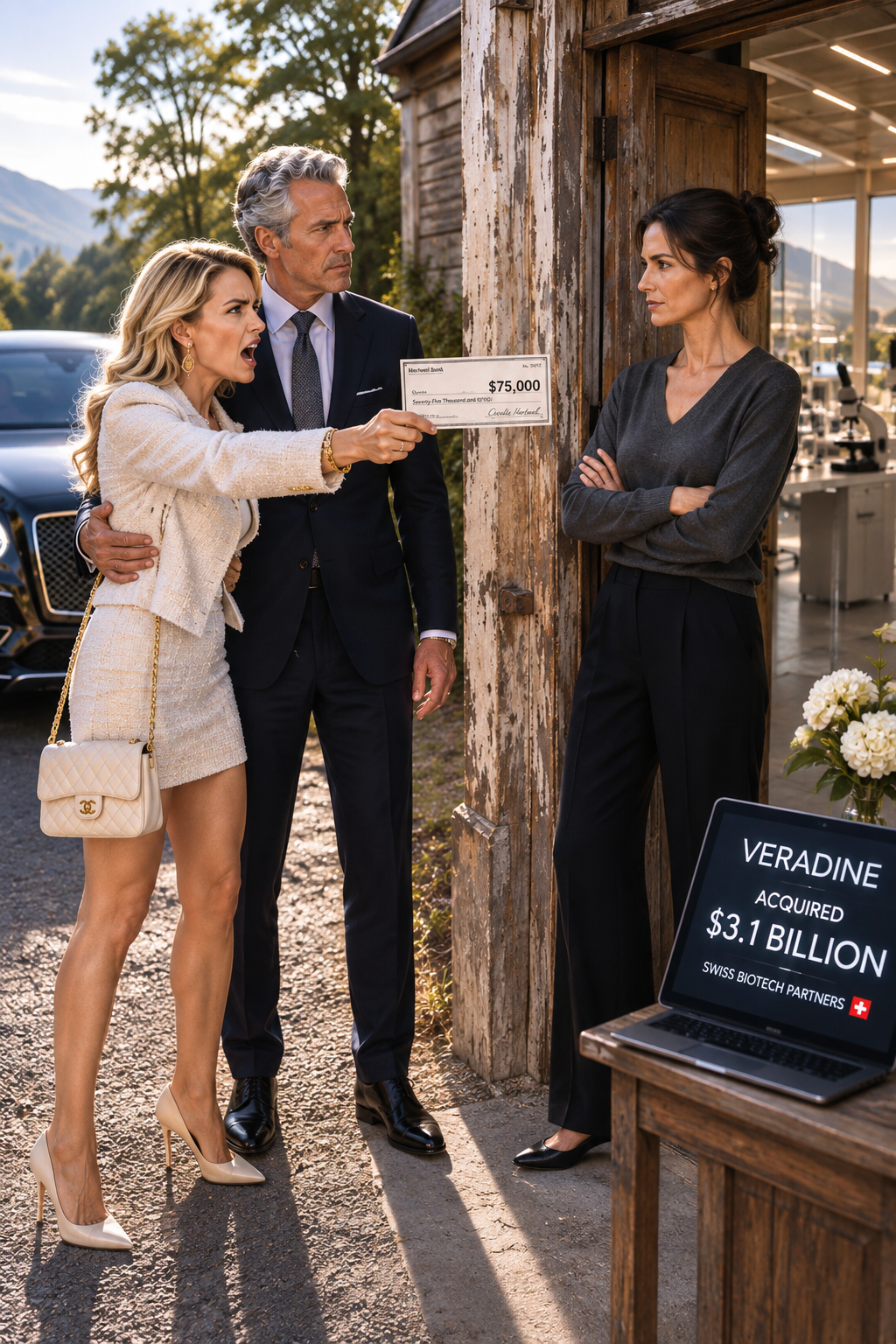
I shook my head. Kellerman had not merely been evaluating his company’s proposed license. Its acquisition team had been negotiating directly with mine for eleven weeks. My attorneys had accepted a formal offer on Tuesday: $3.1 billion in cash and stock, subject to the transaction’s agreed terms.
Reginald sat motionless. I did not enjoy watching him struggle to understand the difference between the value he had assigned to me and the value another company had assigned to my work. I only wished he had once been willing to ask the question without needing a price tag to prompt it.
“Kellerman is acquiring my company,” I said. “Not yours.” The $75,000 check lay face down between us. Neither of us touched it.
Final Tatum rose and collected her coat. She told Reginald she needed time to think and would wait at the car. Before leaving, she glanced at the reading room and said, without any trace of sarcasm, “Your house is actually beautiful.”
When the front door closed, Reginald stayed in his chair. He spoke of his investors, his board, and the roughly two hundred employees whose jobs could be affected if Ashford Biodistribution’s oncology strategy failed. Those were real people, and I did not dismiss his concern simply because he had treated me badly.
He admitted that he had undervalued me. Then he asked for some kind of licensing arrangement he could take back to the board, even a small one. I listened carefully, because there was a time when I would have mistaken that request for the apology I had wanted.
But my company’s future was no longer mine to rearrange alone. Under the accepted Kellerman transaction, I was joining its executive team as chief scientific officer for the oncology platform. The program was preparing for Phase III trials in the spring, and any future commercial rights would need to be addressed through the appropriate corporate and legal channels.
“I can’t offer you a new license,” I told him. “Not as a personal favor, and not from this table.” I also told him that his company’s future was a matter for its board and advisers. The potential misrepresentation issue was serious, and Patrick was right that he needed independent legal counsel.
He closed his eyes for a moment. I didn’t feel the rush of triumph I might once have imagined. I felt tired, and relieved, and conscious that tomorrow there would still be experiments to review and difficult questions to answer.
I stood and told him he could let himself out. Then, almost without thinking, I warned him about the bottom porch step, which was two inches shorter than the others. It had caught visitors before. He gave a small nod and left.
I rinsed my mug at the lab sink. Beyond the window, autumn light lay across the back meadow, and cedar waxwings moved among the old apple trees. The building was quiet enough that I could hear the front door latch settle into place.
My phone buzzed on the bench. My attorney had confirmed that the first agreed tranche of the acquisition proceeds had cleared at that afternoon. I read the message twice, not because I doubted it, but because I had learned to read important things carefully.
Then I set the phone down and opened my research notebook. A question about cell membrane permeability had been waiting since morning. Outside, the Bentley started, rolled over the gravel, and disappeared down the tree-lined drive.
I had not taken the farmhouse so I could sit there waiting for Reginald to see what I had become. I had chosen it for its good bones, its quiet land, and the room it gave me to work. In 2019, at a secondhand laboratory bench in Burlington, I had watched the earliest promising data emerge and understood that the molecule deserved years more careful study.
That was still true, regardless of what anybody paid for it. I wrote the date at the top of a clean page and went back to work.
THE END. I’ve shared the complete story, and I truly hope it touched your heart. If this story moved you, please , like, and share the post. Thank you for reading! ❤️
✓ Lynn R. Adams
IF FACEBOOK BROUGHT YOU HERE, HERE’S THE CONTINUATION YOU’VE BEEN WAITING FOR. ENJOY! 👇 “You filed under your maiden name,” he said. I reminded him that Callaway had always been my professional name,…