My Dog Found a Deputy Tied to a Tree in Montana, and the Name She Whispered Changed Who We Could Trust…
My Dog Found a Deputy Tied to a Tree in Montana, and the Name She Whispered Changed Who We Could Trust…
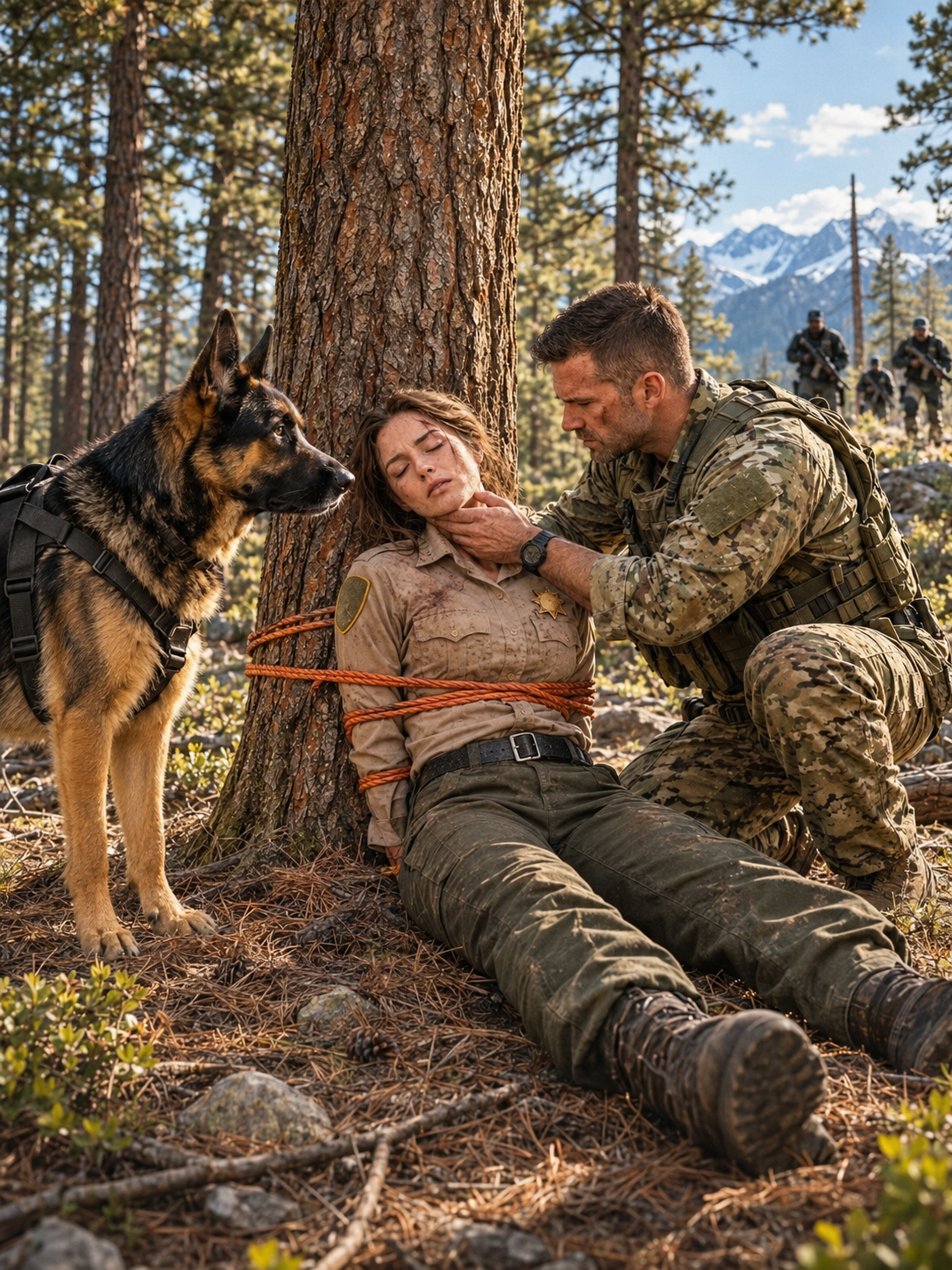
The first thing I saw was a sheriff’s star above a uniform shirt stained almost black at the shoulder. The second was orange cord cutting into a woman’s wrists, tight enough to show she’d spent hours trying to get free. Somebody had left a deputy tied to a Douglas fir in freezing Montana timber, without her gun or radio, and I wasn’t certain she’d survive another ten minutes.
My dog had found her. That was the simple truth I would repeat to investigators, doctors, and eventually anyone who asked why I happened to be in that ravine. Rex had stopped on a trail three miles from the nearest working telephone, turned his head toward the eastern trees, and refused to take another step until I paid attention. At the time I thought he had caught the scent of an injured deer or a bear moving through the drainage.
I was thirty-eight, a Navy SEAL with twelve years behind me, and I had come to the Bitterroot Mountains because my commanding officer said I needed rest. He meant a beach, a hotel, perhaps a week without looking over my shoulder. Instead I loaded seven days of supplies into a waterproof rucksack, put Rex in my truck, and drove west until pavement became gravel and gravel dwindled into a narrow road between the pines.
There were things I could do in my sleep that I wished I’d never learned. I could wake at a strange sound and be back in Kandahar before I remembered my own address. Sitting peacefully on a porch, though, was a skill I’d never managed to acquire.
Rex was four, a German shepherd with a black saddle and amber eyes, and I’d raised him since he was eight weeks old. He knew when I wanted him to heel, when I needed him to search, and when I was pretending I felt fine. That morning he’d watched me fight with an instant-coffee packet as though I were the one who needed training.
Late-October ice glazed the rocks, clouds pressed against the ridgeline, and cold air stung my lungs. I had walked for three days without seeing another person, exactly as I’d planned. Wind moved through the pines while Rex’s collar clicked softly beside me.
Then Rex went rigid. He planted his paws, lifted his nose, and stared into the trees east of Garnet Ridge. I crouched and laid a hand between his shoulders; the fur there stood straight up. He wasn’t begging to chase something. He was warning me that something was wrong, and I had learned never to dismiss that particular stillness.
I checked the holster at my hip and followed Rex off the trail. We moved through two hundred yards of dense timber and down into a muddy, dry creek bed. He tracked left another fifty yards, lifted his head toward a fir, and stopped.
The woman was slumped against the tree, her chin resting against her chest. A tan uniform shirt and dark green cargo pants marked her as law enforcement even before I saw the star badge. I could see a cut near her brow and a swollen lip, but the dark patch at her right shoulder worried me most. Her hair covered her face; I moved it aside, pressed two fingers to her neck, and finally felt a faint, irregular pulse.
I didn’t know her name. I didn’t know who had brought her there. I didn’t know whether the men responsible were still watching. I didn’t know how long her heart could keep working in that cold. I knew only that I had found a living woman, and leaving her there was not an option.
“Ma’am, I’m going to get you down,” I said, though she showed no sign she could hear me. I cut the loops around her wrists and torso with my folding knife, catching her as the cord fell away. Her skin felt frighteningly cold through my gloves. I eased her onto her side, protected her head from a stone, and took stock of what I could actually fix before the mountain made everything worse.
The right shoulder had been hurt badly, and the uniform was stiff with dried blood. I pulled out a compression dressing, applied pressure, and reinforced it without trying to do more than I safely could in the field. Then I spread an emergency blanket over her and slid my spare insulating layer beneath it where possible. Rex stood several feet away facing the ridge, not looking at us once, as if he’d decided his job was to make sure nobody approached unnoticed.
The woman stirred while I checked her breathing. Her eyelids fluttered and two dark green eyes struggled to focus on my face. “Easy,” I told her. “My name’s Garrett. Your shoulder is dressed, but I need you to keep still. Can you tell me your name?” Her lips moved twice before any sound came out, and I leaned close enough to hear the answer over the wind.
“Tara Reeves,” she whispered. “Deputy. Garnet County.” Her eyes shifted to Rex and back, as though finding a dog in that cold ravine were stranger than finding me. I told her his name, told her he was the reason I’d come down from the trail, and watched her try to nod. Her whole body trembled beneath the silver blanket, but she stayed conscious long enough to answer my next question.
She had gotten out of her vehicle around four the previous afternoon. She remembered darkness, rain, and the terrible slow passage of hours, but she couldn’t say exactly when she’d lost consciousness. I did the math quietly: fourteen or fifteen hours exposed to the cold, plus blood loss, and a long way to go before any hospital could help. “Are the people who did this still nearby?” I asked her, keeping my hand steady on the bandage.
Her face changed. The dazed expression disappeared, and for one sharp second I saw a working deputy behind the exhaustion. “Three of them,” she said. “Maybe four. They’ve got rifles. They were waiting to see if I died out here.” She swallowed hard and caught the edge of my sleeve with her good hand. “I think they’re coming back to check.”
Rex was still watching the eastern timber. The creek ran north toward an old Forest Service emergency station with a landline, three miles away. That sounded close until I considered her injuries and the armed men somewhere in the trees.
“They took my sidearm and radio,” she told me. “I tried the radio before they took it, but I don’t know if anybody heard.” I asked if she could stand. Tara looked down at her right knee and tried to flex it; the effort drained what little color remained in her face. “Not well,” she admitted, and there was something in the honesty of that answer that made me trust her judgment.
I checked the dressing, adjusted the blanket, and helped her rise from the uninjured side. She leaned against me, managing a few steps while Rex ranged ahead. Every step cost her, but she kept moving.
We were still in the drainage when Tara asked me not to call her department. Her voice was barely there, but the words came out deliberate. I stopped beneath a leaning pine and waited until she could breathe without fighting the pain. “Tell me why,” I said. She studied my face long enough to decide whether a stranger carrying her through the woods could be trusted with what she knew.
“I found fentanyl in a cache along an old logging route two days ago,” she said. “Someone was using the back country to move it toward the highways. I took pictures and called my sergeant. When the men tied me up, one said into his phone that the deputy was secured and neutralized.”
She stopped, not because she’d forgotten the rest, but because the next words cost her something. “He called the person on the other end Sergeant,” she said. “My sergeant’s name is Foley. I’ve worked under him for four years.” I kept my expression neutral, but the path in front of us seemed to narrow. The man she had trusted with her location might have been the man who sent her killers. Part 2…..
IF FACEBOOK BROUGHT YOU HERE, HERE’S THE CONTINUATION YOU’VE BEEN WAITING FOR. ENJOY! 👇 “You heard one side of a call,” I said, because facts mattered more than fear. “We don’t know for certain who was listening.” Tara nodded, grateful, I think, that I hadn’t forced her suspicion into a verdict. “But I know who I called,” she answered, “and I know those men reached me before anyone came to help.” I felt Rex brush my leg and turned to find him staring uphill again.
At first I saw only gray trunks against a gray sky. Then a dark shape crossed a gap high on the eastern bank, moving at the steady, deliberate pace of somebody following a trail rather than enjoying a hike. I guided Tara lower against the bank and watched until the figure disappeared behind a lodgepole pine. She didn’t ask me what I’d seen; her fingers had already tightened on my arm. The men who’d left her to die were coming back.
We moved north with as little noise as possible. Rex picked out firm ground along the center of the creek, occasionally turning to check the wind. I supported Tara’s weight with one arm, and every few dozen yards I stopped just long enough to make sure her breathing stayed regular. She wanted to ask about my military service, I could tell, but she saved every breath for the next step instead.
The snow above us had not yet settled into a clean white sheet. It collected in patches under dead branches and made the hollows under the trees look darker than they were. A grouse exploded out of the brush and Tara flinched so hard she nearly went down. I caught her, waited while she got her feet, and told her the truth: “A bird. That’s all.” Neither of us laughed, but her grip loosened a little after that.
I have worked beside people who talked through every hard moment and others who said almost nothing. Tara belonged to the second group. When she needed a stop, she asked for it without making excuses; when she could walk, she walked. Her eyes kept traveling along the banks, reading things I might have missed because I was concentrating on keeping her upright. We didn’t have to know one another to work together, and that mattered more than a grand speech about trust.
At the next bend she asked whether I’d heard from my commanding officer recently. It surprised me enough that I glanced at her. “He told me to rest,” I said. “This was apparently my version of following orders.” She looked at Rex, who had stopped to wait at the next fallen log, and managed a faint smile. “Your dog has a strange idea of vacation,” she whispered. “He’s never been particularly good at taking days off,” I said.
We had covered perhaps a quarter mile when Rex lowered himself without a sound. I knew the movement as well as I knew the difference between rain and sleet on a tent fly. I steered Tara behind the exposed roots of a fallen cottonwood, helped her sit, and pressed one finger against my lips. A few seconds later I heard loose gravel moving high on the east bank. One set of footsteps became two.
They were above and behind us, heading north. I could not see them from the root ball, but I could hear the short pauses as they searched the ground below. I kept Tara low and crouched beside her, trying to judge whether they already knew our position. Rex folded his body close to her legs without being told twice. When Tara reached for his collar, he allowed her fingers to rest there and kept his eyes on the slope.
“We can’t outrun them,” Tara said, not as a complaint but as an observation. She was right. We could try hiding until dark, but the temperature would drop and she was losing strength. The Forest Service station was still our best chance, provided those men didn’t follow us directly to it. I studied the bank and chose the least terrible of the options available.
“I’m going to buy us a little distance,” I told her. “I don’t plan to chase anybody, and I don’t want you moving until I come back or Rex leads you out.” Her hand found my wrist, firm despite her shaking. “Don’t get killed over a stranger,” she said. “Then help me make sure neither of us gives them the opportunity,” I answered, and eased my arm out of her grip.
I left Rex with her and moved uphill through the pines, careful not to silhouette myself against the pale sky. I found the two men near a granite ledge, looking down into the creek bed. One was tall and narrow in a dark hunting jacket, a scoped rifle hanging ready in his hands; the other was heavier, with a shotgun slung over his shoulder. They looked like men who’d been outside in the cold a long time, and neither had the distracted manner of somebody out looking for elk.
The taller man pointed at a scuff in the dirt. His partner took out a phone, glanced at it, and began searching ahead along the drainage. I didn’t know whether he was checking a message or trying to call someone, but I couldn’t risk waiting to find out. A loose rock on the shelf gave me one chance to make them look the wrong way. I sent it crashing into a cluster of young firs well off their line of travel, and both men turned toward the noise.
What happened next took less time than it takes to explain. I closed the distance while they were distracted, knocked the shotgun carrier off balance, and stopped the rifleman before he could bring his weapon around. There was a brief, ugly scramble against the stony ground. Then both men were down, breathing, disarmed, and in no position to follow us immediately. I secured them with what I had, separated them from their weapons, and took a moment to check they weren’t seriously hurt.
I did not feel triumphant. I felt cold through the knees of my pants and aware that I had no idea how many more men might be nearby. The men’s phones could contain evidence, but I was no investigator, and I wasn’t going to stand on a mountainside scrolling through somebody else’s messages while Tara needed a hospital. I noted the position on my watch, left the weapons safely out of reach, and went back down to the creek.
Part 3 Tara’s eyes lifted when she saw me. Rex rose once, gave his tail a single restrained sweep, and settled again. “Are they coming?” she asked. “Not those two,” I said. “We still need to move.” She looked at the place where my sleeve had torn on a branch, then at my face, and apparently decided not to waste time asking the question I wasn’t going to answer in detail.
We made better time for fifteen minutes and worse time after that. Tara’s injured shoulder began shaking uncontrollably, and her right knee buckled whenever the path tilted sideways. I gave her small, direct choices: this side of the log or that one, two more minutes before we stopped or one. She chose carefully, refusing the easier answer when she could manage the harder one. By the time the first open meadow came into view, she was barely keeping her boots beneath her.
“Tell me about the station,” I said, partly to keep her conscious. “Low green building,” she answered. “North edge of the valley. Maps inside. Emergency line mounted by the desk.” She closed her eyes for half a second and opened them when I asked her to. “I went there once on a lost-hiker call. Old ranger said the phone was the one thing they never let go dead.”
I hoped the old ranger had been right. Around us the forest thinned, making the sky seem enormous and exposed. Rex moved out into the meadow, stopped, and turned in a slow circle to sniff the air. He returned to us, head lowered, and I took that as the best assessment we were going to get. I bent my knees, lifted Tara more securely against me, and began covering the last half mile with most of her weight off the ground.
She apologized once. “For being heavy?” I asked. “For dragging you into this,” she managed. I couldn’t see her face against my shoulder, but I heard the strain in her voice. “You didn’t invite those men into the mountains,” I told her. “And you didn’t make Rex follow your scent. Save the apologies for something you actually did.”
I could feel her fighting to stay awake. She counted breaths under her breath, a steady little pattern that matched the way she had counted steps. At one point she said she could hear an engine, and I stood still until I was certain it was only wind pressing through the spruce farther downhill. False sounds are common when somebody is exhausted and cold, but I never told her she had imagined it. I listened, then gave her the facts, and we went on.
The station appeared between the trees as a squat green rectangle with a shallow roof and a bare patch of earth in front of it. For a moment I was so relieved to see it that I almost walked straight across the open ground without checking. Rex’s nose lifted; he scanned the empty yard, then approached the steps. I followed more slowly, set Tara down under the roof overhang, and tried the handle. Locked.
There was no time to search for a keyholder in a valley with no cell service. I used a rock to break the old exterior handle, shouldered the door inward, and helped Tara to a desk chair just inside. The room smelled of damp paper and old plywood. Maps were pinned to a board, a radio sat beside the desk, and a wall-mounted telephone waited where she had said it would be. I lifted the receiver and heard a clean dial tone.
I called 911, gave my location from the coordinates on my watch, and identified Tara as an injured county deputy who had survived an apparent abduction and assault. I explained that we had reason to suspect a supervisor at her department was involved and requested immediate medical evacuation and contact with federal law enforcement. The dispatcher asked me to repeat the location, then asked whether the injured woman was breathing normally. I answered every question I could; I did not try to sound more important than the situation required.
Tara sat with both boots planted on the floor, her good hand pressed against the dressing to help me hold it. Rex lay across her feet, watching the open doorway. When the operator said she was connecting us to another agency, Tara exhaled as though she’d been holding that breath since the previous afternoon. Her eyes stayed on the phone. “They’re going to ask why I went up there alone,” she said quietly.
“You can tell them what happened,” I answered. “That’s all.” She looked down at Rex, who had shifted his chin onto her boot. “I knew something was wrong before that cache,” she said. I waited. Then she told me about the three months of missing evidence, the numbers that didn’t match from intake to storage, and the private notes she’d started keeping because she couldn’t yet prove what the discrepancies meant.
Her voice carried no self-pity. She was angry with herself for believing she could document the pattern without telling anyone outside her chain of command. I told her building a case was different from making a mistake, though I also knew how easy it was to say that when I hadn’t spent the night tied to a tree. “I should’ve gone to the FBI,” she said. “Maybe,” I told her. “What matters now is that you still can.”
The federal line came through and a calm voice asked for a fresh account, beginning with names, times, and the safest way to reach the station. Tara straightened in the chair. She spoke slowly, correcting herself when she wasn’t certain, and clearly separated what she had seen from what she only suspected. I had heard witnesses give statements in rooms far more comfortable than this one, and few of them had been as careful about the truth as the shivering woman beside me.
The person on the line told us a medical response was being arranged and that investigators would meet us on site. I asked for a safe method to notify the responding team about the two men I’d left secured uphill. The voice told me to leave that information for the arriving agents and to avoid going back alone. For once, I had no argument. We were indoors, we had a working phone, and Tara had a chance that hadn’t existed an hour earlier.
Part 4 Waiting was its own kind of labor. I found a clean cup in a cabinet but no bottled water I was willing to give someone with a possible head injury before medical assessment. I draped my dry jacket around Tara’s uninjured side and checked the bandage again. Outside, the wind lifted a little drift of snow against the step. Rex raised his head at each change in the sound, and I was grateful for the ordinary certainty of his attention.
“How’d you train him to do that?” Tara asked. “Do what?” I said. “Know when somebody needs him.” I looked at the dog stretched across her boots and thought of the four years we’d spent learning each other’s habits. “Mostly he trained me to notice,” I said. She made a small sound that might have been a laugh, then winced because even that hurt her shoulder.
She asked if I had family waiting for a call. I told her my people were used to hearing from me when I got out of the woods, and that I didn’t have anybody wondering why I was late for dinner that night. I did not tell her about every lost friend or the mornings I woke with the names lined up in my head. She didn’t ask. We were strangers, but there was a kind of consideration in the silence that felt more useful than being pressed to confess things neither of us could repair.
After what felt like much longer than it probably was, a vehicle approached from the north. Rex stood before I heard the tires on gravel. I stepped to the doorway and watched two people climb from an unmarked truck, holding their identification where I could see it. I checked what I could, gave them our names, and pointed them toward Tara before answering their questions. The agents looked at her pale face and the dressing at her shoulder, and the pace of everything changed.
They secured the area around the building and coordinated with the incoming medical crew. One of them asked Tara whether she wanted me to remain within earshot while they confirmed her identification and the basic sequence of events. She looked at me, then at the agent. “He’s the reason I’m here to answer,” she said. I stayed by the door with Rex, close enough to respond if she needed help and far enough away that her story belonged to her.
The Forest Service helicopter came down in the meadow with a thumping noise that seemed impossible after so many hours of careful silence. The medical team moved fast, setting up an IV, checking her responsiveness, and examining the shoulder without demanding she repeat the whole ordeal. They told her the wound appeared serious but treatable, and that the trauma center in Missoula would be ready. No one promised a perfect recovery. They promised to get her to the people who could give her the best chance.
When they wheeled her toward the aircraft, Tara asked them to stop. She reached past me toward Rex, and the dog sat down of his own accord beside the stretcher. She put a shaking palm against his cheek. He leaned into it just enough to tell her he understood. “I owe you,” she said to me. “You don’t,” I answered. “Then I owe him,” she said, and I saw the first real smile she’d managed since the tree.
“He’s pretty good at his job,” she added. I looked at the amber eyes fixed on her face and felt my own mouth twitch. “Best partner I’ve ever had,” I said. The medical crew moved again; Tara held my gaze for another second, then vanished behind the helicopter door. Rex watched until the aircraft lifted and the rotor wash stopped flattening the grass around our boots.
The agents spent the next forty minutes asking me for a careful account. I told them exactly how Rex had behaved on the trail, where I’d found Tara, what she’d said about the alleged call, and how I’d encountered the two men. I gave them the coordinates I’d recorded and described the weapons I’d moved out of reach. When one agent asked whether I had searched the men’s phones, I told her no. That was their work, and I wanted it done in a way that could stand up in court.
They explained that the two men would be located and brought in, and that an investigation into Sergeant Foley was already moving through appropriate channels. I could see that they were working under pressure, but neither agent made the mistake of pretending suspicion was the same as proof. One mentioned that phone records and other early information were giving investigators reason to act quickly. I answered the remaining questions, agreed to give a formal statement in Missoula the next morning, and watched them prepare to leave.
The sun finally broke the clouds when the last vehicle departed. High snowfields turned a dull pink above the valley, and the shadows of the pines stretched across the meadow. I stood beside the damaged station door with my pack at my feet and Rex leaning against my thigh. My leave wasn’t over. Four days remained, if I chose to count time the way I’d counted it when I’d left the truck.
“Four days,” I told the dog. He looked toward the trail north of the building, then back at me, waiting for the decision. For the first time all week, I didn’t feel the usual urgency to keep walking until I was too tired to think. I picked up my pack anyway. We climbed toward the ridgeline, leaving the valley to people who now had the authority and resources to finish what Tara had started. The cold caught up with me after dark. We made camp on a patch of dry ground above the ridge, where Rex could sleep with his back against my legs and I could see the pale line of the trail through the trees. My hands shook when I tried to open dinner, not from fear exactly, but from the hours of working against it. Once the stove had boiled water, I sat with the food untouched and kept hearing Tara say that someone had used the word sergeant.
Part 5 I had seen people betrayed by men who wore the same uniform as they did. The particulars were never the same, but the damage had a familiar shape. A person could survive a physical attack and still spend years wondering whether the next friendly voice on the radio belonged to someone who wanted them dead. I stared at the little flame beneath my cooking pot until Rex nudged my wrist with his nose. He wasn’t hungry; he’d already eaten. He was reminding me that the evening hadn’t disappeared just because my thoughts had gone somewhere else.
I slept in shallow stretches, waking to the scrape of branches against the tent and the weight of the dog curled alongside me. Before dawn I made a decision that would have embarrassed the version of me who’d packed for seven days. I’d told the agents I could come to Missoula for a statement in the morning, and I meant to keep my word. We followed a descending trail toward the service road, taking the long route around the dangerous ice rather than trying to beat the daylight by scrambling straight down.
I reached my truck with wet socks and a sore back, after cutting more of the afternoon than I’d intended. The windshield was filmed with frost. Rex stood by the passenger door and waited while I brushed it clear, then climbed into his seat as though we’d only been gone for a quick walk. I started the engine, watched the heater struggle to clear the glass, and called the contact number the agents had given me when I found enough signal. We arranged a time I could reasonably reach the field office the following day.
I spent that night at a plain roadside motel outside Missoula. Its carpet was worn thin near the door, the coffee maker was missing its lid, and the shower pressure could have been stronger. I considered all three things blessings. Rex circled his blanket twice before settling near the bed, and I kept waking to make sure I hadn’t left anything important in the woods. Every time I checked the corner where he slept, he opened one amber eye, then closed it again.
The first message from my commanding officer arrived while I was buying breakfast at a gas station. He’d seen an alert routed through the right channels and wanted to know whether I was safe. I wrote back that I was unharmed and available if anyone needed a statement. A minute later he called and asked whether I was capable of taking leave without becoming involved in a federal investigation. “Apparently not,” I told him. He let a little silence pass, then asked how the deputy was doing.
“Last I heard, she’s alive,” I said. He replied, “Then make the statement and get some sleep.” There was nothing dramatic in his voice. He knew what it cost me to be useful and how easily I could hide from myself inside a mission. I promised to call when I knew more, then paid for a breakfast sandwich I could barely taste. The cashier asked whether Rex wanted a dog biscuit, and I said yes with more gratitude than the occasion probably required.
At the FBI office, I was seated in a room with a clock that ticked just loudly enough to be irritating. I turned over the coordinates from my watch, drew a rough diagram of the creek bed, and described the fir where we’d found Tara. The agents asked the same questions more than once, sometimes in different order. It wasn’t because they doubted every word; careful investigators look for what changes when a person grows tired of telling the story. I kept my answers plain and admitted uncertainty whenever I had it.
One agent asked what made me certain that Rex had been alerting to a person rather than an animal. “I wasn’t certain,” I said. “I followed him to find out.” That answer seemed to satisfy her more than any tale of a dog’s supernatural ability would have. The dog had caught a scent, held his position, and led me to someone in need. The important thing wasn’t magic. It was that I had listened.
They showed me photographs only when they needed to confirm a location or identify a piece of equipment. I didn’t ask to see images of Tara’s wounds, and they didn’t volunteer them. When they asked about the two armed men, I described their clothing and general builds, explained how we’d come into contact, and acknowledged exactly what force I’d used. I was prepared for scrutiny. Being helpful hadn’t given me permission to do whatever I wanted, and the fact that no one had died that morning mattered a great deal to me.
Near the end of the interview, the agent who had come to the station told me the two men had been recovered and were receiving medical attention in custody. She said investigators were pursuing the evidence discrepancies Tara had reported and taking steps concerning Foley. I didn’t demand details about warrants or interviews that she couldn’t share. The case belonged to people who could preserve records, test assertions, and put evidence before a court. My job had been to get one witness to a phone while she could still speak.
I learned Tara had reached Missoula safely through a brief update provided with her permission. She had undergone surgery to clean the injured shoulder and was being monitored for the head injury, cold exposure, and blood loss. There were no promises about when she’d return to work. I thanked the agent, went outside, and stood with both hands braced against the truck for a moment. I realized then that I’d been trying not to imagine the other outcome ever since Rex went still on the ridge.
For several days I stayed within driving distance of town. I told myself it was because investigators might need another interview, which was true, but not the whole truth. I had spent hours carrying a stranger who’d tried not to be a burden and who had defended the accuracy of her own statement while trembling so hard her teeth clicked. I wanted to know she’d made it through the next night. Wanting that seemed ordinary enough, but ordinary concern was something I had gotten out of the habit of admitting.
Part 6 Rex was the only one unimpressed by my uncertainty. He ate on schedule, slept where he was comfortable, and demanded walks even when I preferred to sit staring at a blank television screen. On our second evening in town, he led me down a sidewalk past a hardware store, a closed bakery, and a little patch of grass with a bench overlooking the river. We sat there until the daylight turned silver. When I went back to the motel, I bought a bag of decent coffee and made the first cup I’d enjoyed all week.
Tara called me four days after the rescue. Her voice sounded scratchy but stronger, and I could hear the hospital machinery humming quietly behind her. “I got your number from the agents,” she said. “They asked first.” I looked at Rex sleeping on the rug and told her I’d been hoping to hear she’d gotten through the surgery. “I did,” she said. “The nurses are starting to get tired of me asking when I can use my arm again.”
I asked what the doctors had told her. There would be physical therapy, follow-up appointments, and no rushing back into a duty belt or patrol vehicle. She talked through those facts the way she’d described the terrain from the creek bed: step by step, without pretending the difficult parts weren’t there. “They say I’ll keep the shoulder,” she added. “I intend to make it inconvenient for anybody who doubts it.” I laughed before I could stop myself, and she was quiet for a beat, as if the sound surprised her.
“How’s Rex?” she asked. I glanced down at him. “He managed to steal half a piece of toast this morning and seems pleased with himself.” Tara made a low amused noise. “Tell him I haven’t forgotten what he did.” I said I would, though she already knew he wouldn’t understand the words the way she meant them. Some debts aren’t really debts. They’re ways of saying you remember the hands that held you up when everything else gave way.
When the conversation turned toward the case, she became careful. Investigators had interviewed her, collected her notes, and asked for the original photographs she’d taken at the logging-road cache. She had answered what she could, and anything beyond that was in their hands. “They asked me how long I’d suspected Foley,” she said. “I told them the truth. I didn’t suspect him until I heard that call.” She drew a slow breath. “That answer makes me feel stupid.”
“Not suspecting your supervisor is a normal way to do your job,” I told her. “You aren’t supposed to begin every shift assuming the person who signs your reports wants you dead.” She said nothing for several seconds. Then I heard a paper cup set down beside the phone. “I keep thinking about the last time he asked whether I’d eaten lunch,” she said. “It felt so ordinary. I can’t decide if I want to remember that or forget it.”
I didn’t tell her what to do with the memory. The friendly version of Foley had existed in her working life for years, and one act of betrayal wouldn’t instantly erase every routine exchange they had shared. People could be helpful in small ways and guilty of terrible things. That didn’t excuse them; it made the reckoning harder. “You don’t have to settle that from a hospital bed,” I said, and she let out a breath I’d been waiting for her to release.
Before hanging up, she asked whether I would bring Rex by once she could sit up without getting dizzy. I said we’d need to check the hospital’s rules, but if a visit was allowed we’d come. “Good,” she said. “He’s got more bedside manners than most people.” When the line went quiet, I stood in the middle of the motel room holding my phone. Rex raised his head as if wondering why I was smiling at a device that had never once given him a treat.
The visit happened after she was discharged, not in the hospital. Tara was staying in a modest place near Missoula while she recovered, close enough to her appointments that she didn’t need to negotiate the mountain roads with an arm in a sling. She opened the door wearing a plain gray sweatshirt and loose black pants. Without the badge and uniform, she looked younger than she had in the creek bed and far more tired than she’d sounded on the phone. Her dark hair was pinned back carelessly, a few strands falling loose near the cut above her brow.
Rex recognized her before I finished saying hello. He went to her slowly, tail moving low, and sat at a polite distance as though he understood the sling. Tara crouched as far as she comfortably could and offered her good hand. He leaned his cheek into her palm, the same small motion he’d made beside the helicopter. She closed her eyes for one second and rubbed the fur behind his ear. “I thought I remembered this,” she said. “I wasn’t sure I did.”
We stayed for half an hour. Her kitchen table held a pharmacy bag, a paper calendar marked with therapy appointments, and a stack of mail she hadn’t opened. I made coffee while she explained that one of her neighbors had been driving her to appointments when possible. She was grateful for help but disliked needing so much of it. I knew better than to tell a competent person she should enjoy being cared for. Instead I asked whether the cabinet above the sink was the one with mugs, and she pointed me toward it with a look that said she appreciated the question.
She wanted to hear what I’d done after the helicopter left. I told her about the frost, the camp stove, and the miserable motel coffee. I skipped over the part where I had spent most of the night staring at a wall, until she looked at me and said, “You didn’t sleep, did you?” I admitted I’d slept some. “That’s a deputy’s answer,” she said. “Technically responsive, emotionally useless.” I tipped my coffee cup toward her in acknowledgment of a fair accusation.
Part 7 We talked about Rex’s training instead. I told her about the first time he’d learned to stay put in a thunderstorm and the morning he stole one of my socks, then waited beside the washing machine like he was helping with laundry. She showed me the scar on her thumb from trying to untangle a fishing line in high school, a story involving cold hands and a stubborn trout. By the time I stood to leave, her shoulders had relaxed a little. Ordinary stories had given us both something to stand on outside the ravine.
As I reached the door, Tara asked whether she could tell me something without my trying to fix it. I said yes. She looked down at the sling, then toward the room where her uniform jacket hung behind a half-closed closet door. “I don’t know if I’ll ever put that on again without seeing the tree,” she said. I didn’t reach for a comforting answer. I told her I believed her, and that she didn’t owe anybody a decision about her future before she’d gotten her strength back.
I drove away with the heat turned down and the windows open a crack so Rex could smell the cold air. He had slept beneath Tara’s table like a dog who belonged there. Somewhere between her building and the first traffic light, I noticed I wasn’t replaying the moment I’d found her. I was thinking about a scar on a thumb and the way she’d mocked my answer about sleep. It wasn’t a cure for anything. It was a different memory, and I let it stay.
The investigation moved in the slow, uneven way real investigations do. Sometimes weeks passed without news I could repeat to anyone. Sometimes an agent called to clarify a time or ask whether a particular logging-road junction matched the coordinates in my notes. Tara was asked to account for the evidence log entries she’d copied and the dates she had accessed the records. Nobody could responsibly build a prosecution on a wounded witness’s instincts alone, even when those instincts made sense.
As the initial work went forward, Foley ceased to be a rumor hanging over Tara’s shoulder. She learned that the government was pursuing formal charges, but the process took people who could prove what they’d found and others whose job was to test it. I was careful not to turn each update into a story about a villain finally getting what he deserved. There were documents to preserve, witnesses to interview, and procedural decisions that could either strengthen the case or give a defense attorney an opening later.
One day Tara asked if I thought a person could be both competent and completely wrong about someone else. We were walking beside the river after one of her therapy sessions, moving slowly because her shoulder was sore and she didn’t like to admit when she was tired. Rex trotted between us with a stick he’d been carrying for half a mile. “Yes,” I said. “I’ve been wrong about people I trusted. I’ve also been right about people I distrusted for the wrong reasons. Neither makes me a mind reader.”
“Four years,” she said. “Every schedule change, every overtime slip, every time I asked for another pair of eyes on a report.” She wasn’t asking me to investigate those old moments. She was trying to understand how ordinary they had seemed. “He knew where I’d be because I told him,” she said. “The job depended on me telling him.” Rex dropped the stick at her feet and looked at her expectantly. Tara picked it up with her good hand and tossed it only a few yards, but she threw it cleanly.
We didn’t speak about Foley for the next ten minutes. Rex ran after the stick, brought it back, and waited for the next throw. The river moved steadily beyond the path, and somebody on the opposite bank was trying to get a fishing line out of the branches. Tara watched the stranger struggle and said, “I’ve done that exact thing.” There was a relief in hearing her recognize herself in a small, harmless mistake.
My own leave ended, but I remained in contact when work allowed. I did not tell Tara she’d become my reason for getting out of bed, and I didn’t pretend we’d forged a destiny in the woods. We had met at the worst possible moment of her life and then found out there were quiet conversations we both wanted to keep having. Sometimes we talked for three minutes about whether Rex had eaten something he shouldn’t. Sometimes she called after therapy and needed someone to listen while she complained about a movement she could no longer manage without pain.
I learned the names of her favorite stretches of river without learning anything she wasn’t ready to say about her family. She learned that I could tell her exactly how to pack a seven-day ruck but regularly forgot to buy dish soap. When I was away, I sent photographs of ordinary views without my face in them: a sunrise over an empty parking lot, Rex asleep under a chair, the crooked handle of a coffee cup somebody had repaired instead of throwing out. She sent back notes about tiny victories, written with the practical pride of someone counting progress in inches.
One afternoon she told me she’d buttoned a shirt with both hands for the first time since surgery. I was in a hallway between meetings, and I stopped walking to hear the rest. “That’s the whole news,” she said, almost apologetically. “It took me nearly five minutes, and I wanted to throw the thing across the room.” I said I thought it was very good news. She laughed, then admitted she’d put the shirt on even though she had nowhere to go, just because she could.
Those were the updates that stayed with me. The grand facts of an investigation mattered, but so did whether somebody could reach for a mug without guarding a wounded shoulder. I found myself noticing the small freedoms I used every day without thinking. I could lift Rex into the back of the truck if he ever needed it. I could shoulder a pack, open a heavy door, sleep without being afraid of the room I was in. Tara was earning some of those freedoms back one stubborn movement at a time.
Part 8 When she had a bad week, she didn’t disguise it. She told me the physical therapist had adjusted an exercise and she was furious at having to start with less weight. I listened while she described the careful, unglamorous work of moving her arm through a range that used to come naturally. “It feels like somebody stole three months of my life,” she said. “They did take time from you,” I answered. “You can be angry about that without letting it take the next three months too.” She went quiet and said she’d think about it.
I thought about it myself afterward. My commanding officer had told me to rest, and I had treated that request as an obstacle to be outsmarted. I knew every way to keep moving and very few ways to recover without measuring myself against the next task. Tara had no choice but to learn the slower skill. Watching her practice it, sometimes with patience and sometimes with terrible impatience, made my excuses look less convincing than they had before.
The weather turned hard as November deepened. Snow sat along the shoulders of the road, and the riverbank grew slick in the places where water froze overnight. Tara sent me a photograph of Rex’s borrowed tennis ball, which I’d accidentally left in her kitchen on a visit, sitting beside her boots. She said it had become a reminder to keep walking even when she was tired. I wrote back that the ball was technically evidence of his ongoing campaign to abandon his toys wherever people would return them.
There were nights when Tara called and couldn’t decide what to say. I could hear her breathing and the small noises of a home settling in cold weather. Once she asked whether I ever woke up thinking I was someplace else. I told her yes, without giving her a catalogue of things I’d rather forget. “Does that go away?” she asked. “Not on a schedule I can promise,” I said. “But it changes, and there are people who know how to help with it.”
She said a counselor had explained something similar and that she was trying to give the process a fair chance. I told her I was glad, and didn’t turn the conversation into a lecture about being strong enough to accept help. She was already doing the difficult part by showing up. When we hung up, I put the phone down and admitted to myself that I could use a conversation with a professional too. That acknowledgment did not make me feel brave. It made me feel slightly less alone.
The first appointment I arranged for myself wasn’t a dramatic turning point. I showed up on time, talked more plainly than I expected, and left with a couple of things to practice when memories ran ahead of the present. In the parking lot, Rex waited in the truck with his chin on the console. I opened the door and put a hand on his neck, feeling the steady rise and fall of his breath. For once I had asked a person, rather than a dog or a mountain, to help me carry something.
Tara never asked for the details, and I didn’t ask for hers. We traded the simple truth that we’d kept the appointments. Sometimes that was enough. The world around us had not become safe just because we had reached a working phone, and neither of us could make the past disappear by describing it correctly. We could, however, decide what to do with the morning after a difficult night. Rex was particularly good at insisting that the morning still required breakfast.
I saw her in early December when she was able to lift her arm almost to shoulder height without grimacing. She demonstrated in the little living room, then stopped before the movement became painful. “The doctor says I’m improving,” she told me. “My patience hasn’t caught up.” I noticed she had moved her uniform jacket farther back in the closet, out of the line of sight from her chair. I didn’t mention it. Her space was hers to rearrange, and there was no hidden meaning I needed to demand from every small choice.
We cooked dinner together that evening, which mostly meant I chopped vegetables while she supervised with one hand on the counter. The pot took forever to boil, and I managed to spill half the rice when I tried to drain it. Tara leaned against the refrigerator and laughed until she had to hold her sore shoulder. “Twelve years as a SEAL,” she said, “and defeated by a saucepan.” I informed her that the saucepan had the advantage of home territory. She shook her head, still laughing, and handed me a dish towel.
For an hour we were two people eating dinner while a dog hoped something would fall on the floor. Tara told me about an old school friend who’d once taught her to cast a fly rod on the wrong side of the river. I told her about my terrible first attempt at making biscuits from scratch. She said I was describing an assault on breakfast, and I couldn’t disagree. There were no revelations that night, but by the time I left, the room felt different from the one where I’d first watched her lower herself into a chair.
The next major news arrived as a phone call from an agent who wanted to confirm how Tara had identified the voice on the one-sided call. My part was limited: what she had told me, when she’d told me, and whether she had seemed confused about the events. I answered those questions and declined to speculate about conversations I hadn’t heard. It was important to me that my certainty about rescuing her not be mistaken for certainty about evidence only she had encountered.
Tara later said investigators were working through the chain of custody for the missing product. That phrase sounded dry until she explained what it meant to her: a number entered into a log, a seal recorded on a container, a name beside a handoff, and the expectation that nobody would treat those details as optional. She had spotted discrepancies because she believed the small entries mattered. If someone could make evidence vanish between intake and storage, every case that depended on those records was put at risk.
Part 9 I asked what made her check the logs in the first place. “A boring mistake,” she said. “A total that didn’t balance with the intake sheet. I thought I’d copied the number wrong.” She had gone back, compared it again, and then found another record that failed to match. The pieces hadn’t formed an accusation at first, only a reason to keep looking. I understood the habit; the smallest thing out of place can tell you where a larger system has stopped behaving as it should.
“Do you wish you’d ignored it?” I asked. We were sitting with takeout coffee in the truck while Rex investigated the air through a cracked window. Tara considered the question long enough that I thought she might not answer. “I wish I’d asked for outside help sooner,” she said. “I wish I’d never told Foley where I was going. But if I had ignored it, other people would still be paying the price for whatever was happening in those records.” She looked at her hands. “That’s the part I can live with.”
I wondered how many of her colleagues were now reexamining their own memories of Foley. He’d been a supervisor for years, and a department couldn’t simply act as if the ordinary trust built around him had never existed. Tara didn’t tell me their private reactions. Some officers had reached out to her, she said, and others hadn’t known what to say. She wasn’t keeping score. She was trying to recover enough stability to decide whether going back to the job she’d loved would still be possible.
One evening she asked what I would do if I no longer trusted the people who’d trained beside me. I thought about giving her a crisp answer, then stopped. “I’d want to know which people had actually done something wrong,” I said. “I’d want the rest judged by their own choices.” She nodded slowly. “That’s what I keep telling myself,” she said. “I don’t want Foley to take every good partnership I’ve ever had and poison it retroactively.”
At the end of December, she took her first long walk without needing to turn around because of the shoulder. Rex joined us along the edge of a park, shaking fresh snow from his coat and trying to persuade Tara that a tennis ball should be thrown every twenty seconds. Her steps were steady, and she kept checking how far we’d gone, almost surprised by the number. When we reached the truck, she rested a hand on the hood and smiled in quiet satisfaction. “I wasn’t sure I could do that before winter ended,” she said.
I didn’t call it a miracle. I knew how many therapy appointments, bad nights, and stubborn attempts had gone into one hour in the cold. Instead I held the passenger door while she climbed in and asked whether she wanted something hot to drink. She said yes and requested the strongest coffee I could find. Rex placed his head between the front seats as if he were contributing to the conversation. I told him he was not getting coffee, regardless of his qualifications.
Eleven weeks after the night on the mountain, Tara testified before a federal grand jury. I didn’t ask what happened inside the room. Those proceedings were not for me, and she had already spent enough of her life explaining herself to strangers. I met her afterward outside, where the air was painfully cold and a few cars moved slowly through the parking lot. She came down the steps with her coat zipped high and a look that told me she’d used more energy than she wanted to admit.
I opened the truck door and let her sit before asking a question. “How are you?” I said. She rested her hands on her knees, examined the pale scar near her wrist, and finally said, “Finished for today.” The answer carried its own relief. I handed her a thermos of coffee and waited while she drank. She didn’t need me to tell her she’d been brave. She needed the day to end without another person asking her to perform strength for them.
We drove to the river and watched sheets of dark water moving between shelves of ice. Rex curled up behind the seats, satisfied to be warm and close to both of us. Tara said she’d told the truth, answered what she knew, and made clear when she wasn’t certain. “That’s what I had,” she said. “It’s going to have to be enough.” I told her that was all anyone had a right to ask. She leaned back and let herself rest for the first time that afternoon. The indictment came later, after investigators had worked through the records, interviews, and evidence they were entitled to use. Foley was charged on four counts, including conspiracy to commit murder. I read the public announcement twice, not because the words were difficult, but because I knew how far away a court filing was from the winter morning when Tara had whispered his name against my jacket. An indictment wasn’t a conviction, and I refused to pretend the legal work was over. It meant the accusation had crossed a serious threshold, and the people responsible for testing it would now do their jobs.
Tara called that evening. She wasn’t celebrating. She told me she’d set her phone on the kitchen table and stood looking at it for nearly ten minutes after she received the news. “Four years,” she said again, but this time the words sounded less like a question. She had made a cup of coffee and forgotten to drink it. I asked whether she wanted company. She said she did, and I went over with Rex, a bag of groceries, and no clever speech prepared.
We cooked a simple meal and ate while the dog slept under the table. When Tara wanted to discuss the charges, I listened. When she turned to talking about the shoulder stretches her therapist had assigned, I listened to that too. Somewhere in the middle of dinner she said, “I thought I’d feel different when I heard it.” I asked what she had expected. “Safer, maybe,” she said. “More certain that what happened out there belonged to the past.”
Part 10 I could have told her she was safe now, but I didn’t know enough to make that promise. “A piece of paper can’t do all that at once,” I said. “Neither can a single good day.” She nodded, reached down with the arm she’d fought so hard to recover, and scratched Rex behind the ears. There was relief in the room, but it had edges, and I understood why she wasn’t ready to smooth them over for my comfort.
Over the following months, the distribution route investigators had been working to uncover broke apart. The criminal network Foley had protected collapsed under pressure from the case and the work that followed his arrest. I knew only the broad outline, and that was enough. Every time I heard that a route had been interrupted, I thought less about the men in dark jackets and more about the small entries Tara had refused to ignore. Nothing in the dramatic rescue would have mattered to the larger investigation if she hadn’t already done the quiet work of noticing.
Her recovery didn’t advance in the same straight line as the case. On a good week she could walk long distances and reach most of the shelves in her kitchen. On a bad one, the old shoulder pain and poor sleep made an afternoon feel endless. She learned to plan appointments around what she could manage and to ask for help before the task had become a test of pride. I learned to offer a ride without making it sound like I was volunteering for a heroic mission.
The first time she drove herself to an appointment, she called me from the parking lot afterward. “I got there and back,” she said. “Didn’t hit a mailbox, didn’t need anybody to carry me, and remembered my wallet.” I told her she was setting a very high standard for the rest of us. She laughed, then grew quiet. “I never thought I’d have to be proud of something that used to be so simple,” she said. I reminded her that there was nothing wrong with noticing how much work a simple thing now required.
She wasn’t sure yet whether she’d return to regular patrol. The department would have to decide what responsibilities were appropriate, and she would have to decide what kind of work she could do without sacrificing the recovery she’d earned. I never tried to make that choice for her. Being able to put on the uniform again and choosing to wear it were two different victories. She was allowed to want one, both, or neither.
My life was changing too, though in ways that looked less impressive from the outside. I slept through a night without checking the window three times. I went through a day off without needing to exhaust myself before I could sit still. When I felt the old restlessness, I could sometimes identify it instead of obeying it. Rex remained unconvinced that my progress excused me from taking him on walks, so I continued to get plenty of fresh air whether I wanted it or not.
In March, Tara invited me to a little diner outside town where the booths were patched with dark vinyl and the servers knew most of the regulars by their coffee orders. She had left her sling behind for weeks, and her hair fell around her shoulders without a clip. We talked about the first warm days coming to the valley and whether the rivers would run too high for decent fishing. Tara said the shoulder was nearly ready for a gentle cast and that her therapist had been surprisingly enthusiastic about the idea as long as she didn’t overdo it.
“You fish?” I asked, remembering the story about her thumb. “Badly, with a great deal of confidence,” she said. “How about you?” I admitted I had packed a rod on my October trip and never once taken it out of its case. She glanced toward Rex, waiting patiently beneath the table. “Then we have unfinished business with those mountains,” she said. There was no sudden declaration tucked inside the sentence, just a possibility laid carefully between two people who had learned how quickly life could stop being ordinary.
We planned for spring without trying to make the plan into a promise neither of us could keep. Tara checked the weather and the state of her shoulder, and I checked the roads and the condition of the backcountry trails. We agreed to stay near accessible water and avoid the higher, icy ground. I told her I still had the same scratched coffee mug I’d used on the October hike. She said she was bringing better coffee because she didn’t trust anyone who thought a packet of instant powder was an acceptable breakfast.
The morning we drove west, the mountains looked nothing like the place where I’d found her. Snow still capped the distant peaks, but the lower valleys had opened into green, and water ran under the bridges instead of holding itself motionless beneath ice. Rex sat upright in the back, watching every turn with the serious expression he wore whenever he suspected we were taking him somewhere useful. Tara held a thermos between her knees and pointed out a bend in the river she’d known since she was younger.
We stopped at a turnout where the river spread into shallow, bright channels over smooth stones. Tara climbed out carefully and stood looking upstream for a long time. The breeze moved her hair across her cheek; she tucked it back with the arm that had once been wrapped in layers of bandage. I knew exactly why the movement mattered, but I didn’t comment on it. Instead I unloaded the fishing rods and clipped Rex’s leash to his collar until we could get our bearings.
We fished for an hour without catching much. Tara lost a fly in a willow branch and laughed at herself before I could offer help. I had one respectable strike and failed to land it, which she considered adequate evidence that she should be the one giving lessons. Rex watched the water, stepped into it until his paws were wet, and retreated with an expression of deep offense at the temperature. For once the three of us were exactly where we’d intended to be, and nobody needed rescuing.
Final At lunch we sat on a flat rock above the bank, sharing sandwiches while the sun warmed the backs of our jackets. Tara asked whether I remembered telling her not to apologize for something she hadn’t done. I said I did. “I’ve been practicing that,” she said. “Not very gracefully. But when I get tired, or my shoulder hurts, I try not to turn it into a character flaw.” I told her I was trying something similar with the days when my mind wouldn’t settle. She tapped her paper cup against mine, a quiet acknowledgment of two kinds of work still in progress.
She didn’t ask me to explain the whole war. I didn’t ask her to relive the tree. We could speak about both when we needed to, and we could also let a good afternoon remain good without testing it. The river carried spring runoff past us, and the dog slept with one paw resting against my boot. I thought of the October morning when I had come into these mountains hoping to disappear for a week. I had been found, in a way, by the same animal who found Tara.
Near the end of the afternoon, Tara wanted to take one more short walk before we drove back. A side path led toward the older Forest Service road, where the forest thickened and the river noise became a distant rush. We agreed to turn around well before the trail reached the drainage. It wasn’t about proving we could face the exact place where she had nearly died. It was about making an ordinary choice on an ordinary spring day, with an easy way back to the truck.
Rex walked ahead of us, relaxed and attentive. Tara noticed the change first when his pace shortened, then I saw the fur rise between his shoulders. He had reached a patch of pine needles near the old road, a place where a few pale stones marked the boundary between mud and dry ground. He stopped, planted all four paws, and turned his nose toward the timber. I felt the old October cold return in my chest even though the sun was warm on my neck.
“Rex?” I said softly. He didn’t move. Tara stayed beside me, her breath calm but shallow, looking along the same line as the dog’s gaze. There was no orange cord in sight, no abandoned uniform, no visible person, only the road bending into trees and a thin shadow beneath the first spruce. I was about to suggest we turn back when Tara’s phone vibrated inside her jacket.
She looked at the screen and showed me the caller. It was the federal agent who’d kept in touch during the investigation, a woman whose calls had become less frequent after the indictment. Tara answered and put the phone to her ear. “Deputy Reeves,” she said out of habit, then corrected herself. “Tara speaking.” I watched her eyes as she listened. Whatever the agent said took the warmth out of her face.
“We’re on the old Forest Service road,” Tara said. “No, not at the station. We’re about to head back.” Her good hand came to rest against my sleeve, exactly where she’d held it in the creek bed. She asked the agent to repeat the last part. Then she looked at me, and for the first time since winter I saw the expression she’d worn when she told me somebody had called a man Sergeant.
“Garrett,” she said, very evenly, “they finally traced the call those men made while I was tied to the tree.” I waited, listening to the faint voice on the line and the breeze moving through the branches. Rex had begun a low growl, aimed at the old road ahead of us. Tara’s eyes stayed fixed on mine as she finished the sentence. “Foley wasn’t the sergeant they called.”
I looked past her toward the empty road and felt Rex push hard against my leg. The agent’s voice sharpened through the phone, suddenly loud enough for me to hear one instruction clearly: “Get away from the station. Now.” Tara and I turned together. Through the trees, where the old green building had stood empty the previous fall, a door slowly opened from the inside.
THE END. I’ve shared the complete story, and I truly hope it touched your heart. If this story moved you, please , like, and share the post. Thank you for reading! ❤️
✓ Lynn R. Adams
My Dog Found a Deputy Tied to a Tree in Montana, and the Name She Whispered Changed Who We Could Trust… The first thing I saw was a sheriff’s star above a uniform shirt stained almost black at the sh…