My Daughter Sent Me Through the Staff Entrance at Her Wedding—Then Federal Agents Walked In Asking for Her New Husband
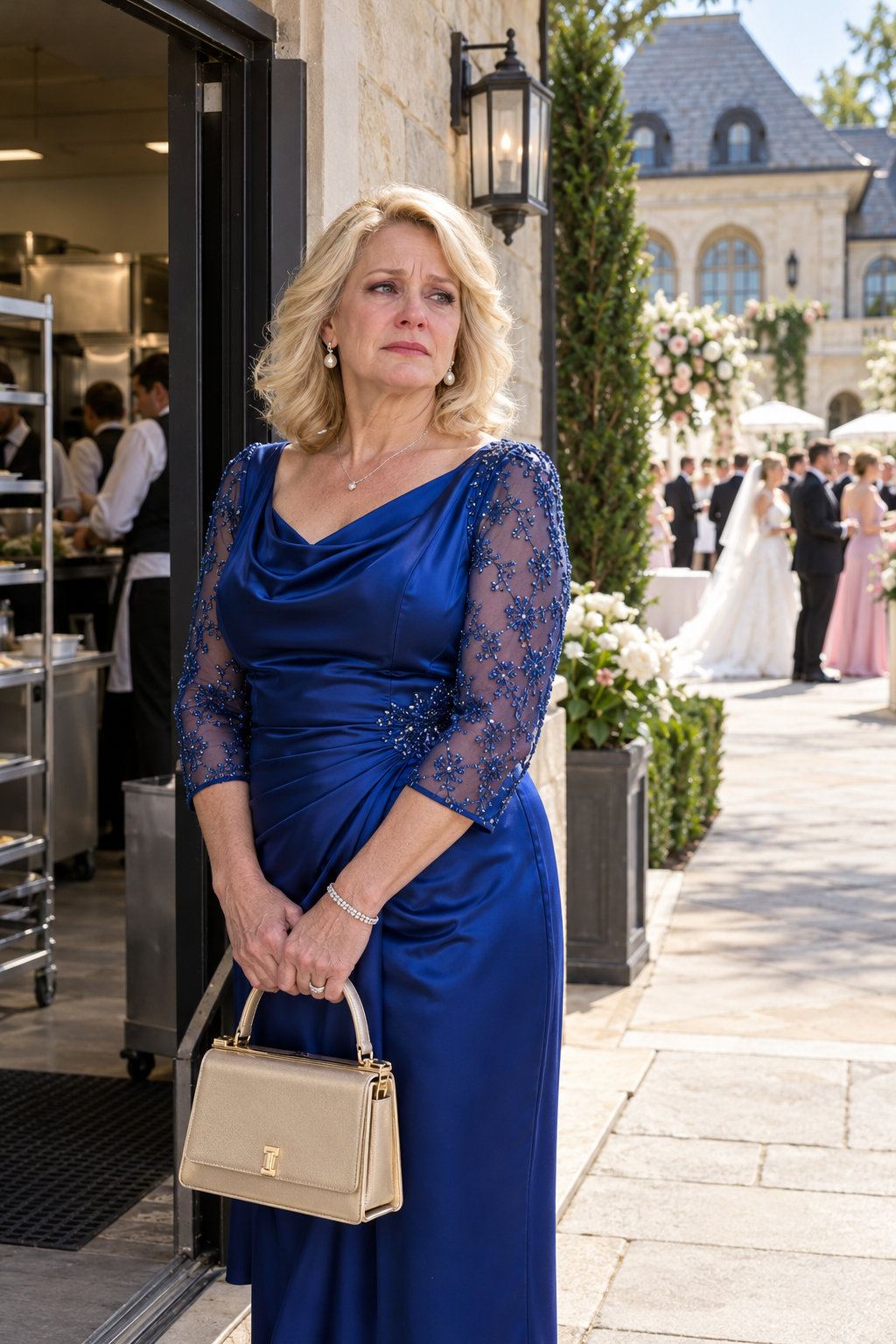
My Daughter Sent Me Through the Staff Entrance at Her Wedding—Then Federal Agents Walked In Asking for Her New Husband
“Mom, you can’t go through the front.”
My daughter Madison said it without lowering her voice.
Behind her, two bridesmaids went completely silent.
I stood beneath the stone archway of the Willowmere Estate outside Richmond, Virginia, holding a small ivory gift box in one hand and staring at the daughter I had raised alone for almost twenty years.
Madison glanced toward the circular driveway, where black SUVs and luxury sedans were delivering guests in tuxedos and designer gowns.
Then she looked at my simple navy-blue dress.
“There’s a staff entrance around back,” she said.
For a moment, I genuinely thought I had misunderstood her.
“The staff entrance?”
She forced a smile.
“Please don’t make this difficult.”
One bridesmaid suddenly became very interested in her phone.
The other stared at the ground.
Madison stepped closer.
“Evan’s family has clients here. Investors. Political people. His father invited half the board.”
“And I’m your mother.”
The answer came too quickly.
Then she whispered the sentence I would remember long after the flowers died and the photographs disappeared from social media.
“But today, I need you to understand what kind of family I’m marrying into.”
I looked at her.
Twenty-nine years old.
Perfect blonde hair pinned beneath a cathedral-length veil.
A wedding gown that had cost more than my first house.
Diamond earrings.
A smile practiced for cameras.
And eyes that looked absolutely terrified of disappointing people she had known for less than two years.
“What kind of family is that?” I asked.
Madison glanced toward the main entrance.
“The kind where appearances matter.”
I almost laughed.
Instead, I nodded slowly.
“Then you’re right.”
Relief flashed across her face.
“Thank you.”
“You should probably protect appearances.”
She missed the meaning completely.
A wedding coordinator hurried over and pointed toward a gravel path running beside the catering trucks.
“This way, ma’am.”
I followed her.
I did not argue.
I did not cry.
I did not remind Madison that I had worked night shifts when she was six so she could attend summer camp.
I did not remind her that when she wanted to study at Georgetown, I had written tuition checks without telling her how many weekends I spent working.
I did not remind her that when her father disappeared from our lives, I had sat beside her bed every night until she stopped asking why he left.
I simply walked around the back of the mansion.
Not because I was ashamed.
Not because Madison had won.
Not because I belonged with the staff.
Not because Evan Whitmore’s family intimidated me.
Not because I had nowhere else to go.
I walked to the back because, for the past eleven months, I had learned something extremely useful.
Sometimes the person everyone ignores sees everything.
And I had seen more than Madison could possibly imagine.
Evan Whitmore had entered Madison’s life eighteen months earlier.
Thirty-four years old.
Educated at Duke.
Vice president of Whitmore Capital Partners, the private investment firm founded by his father, Charles Whitmore.
According to magazine profiles, the Whitmores managed more than $400 million in private assets.
According to Evan, they owned homes in Georgetown, Palm Beach, and Jackson Hole.
According to Madison, they were “everything she had worked her entire life to become.”
That sentence bothered me.
Not because I disliked wealthy people.
I had money myself.
Madison simply never knew how much.
After my divorce, I started a tiny bookkeeping service from our kitchen table.
Three clients became twelve.
Twelve became forty.
Over the next twenty-three years, that little operation became Hayes Compliance Solutions, a financial auditing and risk-management firm servicing construction companies, healthcare groups, and regional investment firms across six states.
I eventually sold eighty percent of the company.
The transaction made me wealthier than Madison ever suspected.
But I kept my life simple.
Same brick house in Arlington.
Same fifteen-year-old kitchen cabinets.
Same habit of driving cars until the repairs became unreasonable.
Madison interpreted simplicity as failure.
The Whitmores interpreted it as irrelevance.
The first time I met Charles Whitmore, he asked whether I still “did bookkeeping for small businesses.”
“Something like that.”
His wife, Vivian, spent dinner explaining how exhausting it was maintaining three houses.
Evan barely looked at me.
Madison spent the entire evening trying to prove she belonged with them.
Six months later, she was engaged.
That was when strange things began happening.
The first was a phone call from an old colleague.
“Eleanor,” he said, “does the name Whitmore Capital mean anything to you?”
I sat straighter.
“My daughter is marrying into the family.”
There was a long silence.
Then he said, “You might want to look at something.”
He forwarded me three corporate filings.
Whitmore Capital had created a group of small investment entities over the previous four years.
Nothing illegal about that.
What interested me were the vendors receiving money from those entities.
Consulting firms.
Technology companies.
Property-development contractors.
Most had impressive names.
Several barely existed.
One had been registered to a mailbox in Delaware.
Another shared an address with a vacant warehouse.
A third company had received more than $2.8 million for “strategic advisory services.”
Its listed president was a twenty-six-year-old former golf instructor.
I started digging.
That was my first mistake.
My second was finding something.
Whitmore Capital was not simply moving investor money aggressively.
Someone appeared to be generating fake expenses, routing money through shell companies, then moving portions into luxury assets.
Properties.
And wedding expenses.
Madison’s wedding expenses.
I stared at one payment for almost ten minutes.
It had gone from an investment entity called WCP Growth Fund III to an event-management company.
The description read:
Corporate Client Hospitality.
The event-management company was handling Madison’s wedding.
Another $92,000 went toward floral design.
Another $61,500 toward catering deposits.
Another $48,000 toward accommodations.
All labeled as business expenses.
I called Madison that evening.
“Who is paying for your wedding?”
She laughed.
“Evan’s dad. Why?”
“Are you sure?”
“Mom, please don’t start.”
“Start what?”
“The suspicion thing.”
“I’m asking a question.”
“And I answered it.”
“Has Evan asked you to sign anything related to his company?”
Then irritation.
“A few documents.”
“What documents?”
“I don’t know. Investor-event paperwork.”
My stomach tightened.
“You signed documents you didn’t read?”
“Evan explained them.”
“Mom, enough.”
She hung up.
Three days later, I received another call.
This one was from a federal investigator I had worked with years earlier during an unrelated corporate fraud case.
Special Agent Daniel Reeves.
Federal Bureau of Investigation.
“Mrs. Hayes,” he said, “we’d like to discuss Whitmore Capital Partners.”
That conversation lasted four hours.
I gave them documents.
They showed me others.
The scheme was far larger than I had realized.
Dozens of investors.
Millions in questionable transfers.
Fake invoices.
False financial statements.
Potential wire fraud.
Potential securities fraud.
Possible money laundering.
And one particularly troubling detail:
Evan had recently created two companies with Madison listed as an officer.
She claimed she barely knew what they did.
Federal investigators weren’t so sure.
Neither was I.
I confronted Madison six weeks before the wedding.
Not dramatically.
No shouting.
No threats.
I asked her to meet me at a quiet coffee shop in Alexandria.
She arrived twenty minutes late wearing sunglasses and carrying a handbag Vivian Whitmore had given her.
I slid copies of three documents across the table.
“What is this?” she asked.
“You tell me.”
Her expression changed.
“These are company documents.”
“With your signature.”
“One company received $740,000 last year.”
Madison removed her sunglasses.
“I don’t handle Evan’s businesses.”
“You’re listed as president.”
“That’s paperwork.”
“No, sweetheart. That’s liability.”
Her eyes narrowed.
“Where did you get this?”
“Does that matter?”
“Madison, listen carefully. You need an independent attorney.”
She pushed the papers back toward me.
“Unbelievable.”
She laughed bitterly.
“You could not stand one minute of me having something better than you.”
I felt the words like a slap.
“Better than me?”
“The Whitmores respect success.”
“And you think I don’t?”
“I think you resent them.”
“For what?”
“For having everything you didn’t.”
I sat back.
Suddenly, I understood.
She had rewritten our entire life.
The modest house had become evidence of failure.
The used Honda I drove through her high school years had become embarrassment.
The evenings I spent working were no longer sacrifice.
They were proof that I had never achieved enough.
“Did Evan tell you that?” I asked.
“He didn’t have to.”
“Madison, those people may be using your name to move money.”
“You’ve always done this.”
“Done what?”
“Made me afraid.”
Her voice cracked.
“Be careful about school. Be careful about credit cards. Be careful about men. Be careful about contracts. Be careful, be careful, be careful.”
“Because consequences are real.”
“No. Because fear is the only world you understand.”
She grabbed her bag.
“I’m marrying Evan.”
“And you’re going to behave at my wedding.”
“No questions. No suspicious looks. No interrogating his family.”
I stared at her.
Then she said something quieter.
“Just let me have one day where I’m not embarrassed by where I came from.”
That hurt more than the staff entrance would six weeks later.
Because I finally understood that Madison was not ashamed of poverty.
We had never been poor.
She was ashamed of me.
I gathered the papers.
“All right.”
She hesitated.
“That’s it?”
“That’s it.”
She walked away.
That afternoon, I called Agent Reeves.
“I assumed you would.”
“She won’t listen.”
“Then don’t push her.”
“Is she in trouble?”
“We’re still determining that.”
That sentence kept me awake for several nights.
Willowmere Estate looked like something built specifically for magazine covers.
White columns.
Rolling lawns.
A reflecting pool behind the reception hall.
Nearly three hundred guests.
A string quartet.
Champagne towers.
More flowers than I had seen at most botanical gardens.
I entered through the service corridor at p.m.
A young caterer carrying silver trays nearly collided with me.
“Sorry, ma’am.”
“No problem.”
He glanced at my dress.
“You’re not staff.”
Apparently everyone could tell except my daughter.
“I’m the bride’s mother.”
His jaw dropped.
“That was my reaction too.”
A woman standing near the kitchen heard us.
She wore a black dress and had a radio clipped inside her purse.
I recognized her immediately.
Special Agent Maria Torres.
We had met twice.
She did not acknowledge me.
Neither did I.
That was when I realized today was the day.
I had known an arrest warrant was likely.
I had not known when.
Apparently the government had chosen Madison’s wedding.
Or perhaps Evan had chosen it for them.
Agent Reeves had previously told me federal agents would act when they believed evidence might disappear or money might move.
A wedding reception filled with phones, laptops, private offices and members of the Whitmore organization apparently qualified.
I walked into the ballroom.
Vivian Whitmore saw me first.
Her smile tightened.
“I thought family was entering through the main foyer.”
“So did I.”
Her eyes flicked toward Madison.
Understanding appeared.
But not sympathy.
“She’s under tremendous pressure.”
“I’m aware.”
“You know how these events are.”
“No,” I said. “I don’t think I do.”
Charles Whitmore approached.
Gray-haired.
Perfect tuxedo.
Confident smile.
“Eleanor. Glad you could make it.”
I studied him.
Months earlier, his presence had felt intimidating.
Now I knew federal investigators had traced millions of dollars through companies tied directly to him.
He looked smaller.
Not physically.
“Wouldn’t miss it,” I said.
Charles smiled.
“Madison has been wonderful for Evan.”
“I’m sure she has.”
“We’re making her part of the family business.”
His smile weakened slightly.
“How much have you heard?”
I held his gaze.
Before he could answer, the quartet began playing.
Everyone turned.
Madison appeared.
And despite everything, my breath caught.
She looked beautiful.
For a few minutes, I forgot shell companies.
I forgot signatures.
I forgot the staff entrance.
I remembered a five-year-old Madison running through sprinklers.
A ten-year-old Madison crying over her first failed math test.
A seventeen-year-old Madison hugging me when Georgetown accepted her.
She walked down the aisle on Charles Whitmore’s arm.
That had been another decision.
“The optics are better,” she had explained.
Evan waited beneath an arch covered in white roses.
He smiled at her.
For a moment, I wondered if I had been wrong about everything.
Maybe he loved her.
Maybe greed and love could somehow coexist.
Then the officiant began.
The ceremony lasted twenty-eight minutes.
They exchanged vows.
They exchanged rings.
They kissed.
Guests applauded.
Madison became Madison Whitmore.
And forty-seven minutes later, federal agents entered the reception.
Dinner had just begun.
Evan was standing near the head table laughing with two investors.
Charles was speaking to a state senator.
Vivian was correcting a waiter about wine glasses.
Madison was surrounded by bridesmaids.
I sat at Table Nineteen.
Not the family table.
Not even near it.
Table Nineteen was beside a speaker and two empty vendor seats.
Apparently my daughter had planned the seating chart with the same philosophy as the entrance.
Keep Mother out of sight.
Then the ballroom doors opened.
Six people entered.
Dark suits.
Plain expressions.
Two carried identification folders in their hands.
Conversations began dying one table at a time.
Agent Reeves walked directly toward Evan.
Charles noticed first.
His face changed instantly.
That was all the confirmation I needed.
People who are innocent usually look confused.
Charles looked prepared.
Evan turned.
Reeves showed his credentials.
“Evan Charles Whitmore?”
Music stopped.
Every phone in the room seemed to appear at once.
Evan stared at the badge.
“What is this?”
“We need you to step away from the table.”
Madison laughed nervously.
“There must be some mistake.”
Another team moved toward Charles.
Vivian stood.
“What are you doing?”
Agent Torres approached her calmly.
“Ma’am, please remain where you are.”
Charles took one step backward.
“Who authorized this?”
Reeves looked almost bored.
“A United States District Court.”
Guests began whispering.
Madison grabbed Evan’s arm.
“Tell them.”
Evan said nothing.
His face had gone gray.
Federal agents moved quickly.
One positioned himself between Evan and the ballroom exit.
Another began speaking quietly to Charles.
Then two additional agents walked toward a private office beside the ballroom.
I noticed one carrying a search warrant.
Madison finally looked around the room.
Her eyes found me.
She stared.
Then she marched toward my table.
“What did you do?”
The entire ballroom seemed to hear it.
I remained seated.
“What did you do?”
“I didn’t do this.”
“You hated them from the beginning!”
“I warned you.”
Her face twisted.
“You called the FBI?”
That was technically true.
They had called me.
But I wasn’t interested in hiding anymore.
“I cooperated with them.”
Her face went blank.
The nearby tables fell silent.
“You what?”
“I gave them financial records after they opened an investigation.”
“You betrayed me.”
“I tried to protect you.”
Evan suddenly shouted from across the room.
“Madison, don’t say anything!”
Every head turned.
Agent Reeves immediately looked at her.
That one sentence changed everything.
Madison looked toward Evan.
“Just don’t talk.”
“Why are you telling me not to talk?”
His attorney apparently wasn’t present, because Evan made the kind of mistake frightened men make when they have spent their entire lives believing confidence is the same thing as intelligence.
“Because your name is on the companies.”
Madison froze.
I closed my eyes.
There it was.
Not proof of guilt.
But proof that Evan knew exactly where he had placed her.
“What companies?” Madison whispered.
Evan said nothing.
“What companies, Evan?”
Reeves stepped between them.
“Mrs. Whitmore, I strongly recommend you obtain independent counsel before answering questions.”
She looked at me again.
This time, there was no anger.
I walked toward her.
“What companies?”
“The ones I showed you.”
She shook her head.
“No, Evan said those were holding companies.”
“They were.”
“For real estate.”
“Some were.”
Her breathing quickened.
“What were the others?”
I did not want to answer.
But she deserved the truth.
“Federal investigators believe some were used to move investor money.”
She looked toward her husband.
The man she had married less than two hours earlier.
“Did you use my name?”
Evan looked away.
That hurt her more than any confession could have.
She crossed the ballroom.
He refused to look at her.
“DID YOU USE MY NAME?”
“Madison,” Charles snapped. “Stop talking.”
She turned toward him.
Something finally broke.
All the admiration.
All the intimidation.
All the desperate hunger to belong.
“You knew too?”
Charles said nothing.
Madison backed away from them.
Then Agent Torres approached.
“Mrs. Whitmore, we need to speak with you.”
Madison looked like she might collapse.
“Am I under arrest?”
“Am I going to be?”
“I cannot answer that.”
Madison whispered, “Mom.”
I walked beside her.
Agent Torres raised a hand.
“She should speak to counsel first.”
Madison looked at me.
“You know a lawyer?”
Because unlike what she believed, I had not spent my life being small.
“I’ve worked in corporate compliance for twenty-three years, Madison.”
“No. You know I ‘did bookkeeping.’”
She stared at me.
“I built a compliance firm with offices in six states.”
“I sold most of it four years ago.”
Her expression changed again.
“For how much?”
Even now, part of me almost smiled.
“That doesn’t matter.”
Apparently it mattered to Vivian.
From several feet away, she stared at me.
Charles did too.
Madison whispered, “You sold your company?”
“You never told me.”
“You never asked.”
“How much?”
She understood.
For the first time that day, perhaps for the first time in years, she looked embarrassed for the correct reason.
Evan and Charles were taken into custody that evening.
The wedding never reached the cake-cutting.
Guests fled.
Phones recorded everything.
By midnight, photographs of federal agents at Willowmere were circulating online.
By morning, reporters were outside Whitmore Capital’s offices.
The federal indictment became public two days later.
Prosecutors alleged that Evan, Charles and two senior employees had diverted more than $18 million through false vendors, misleading investment reports and related companies.
Some money had funded personal expenses.
Luxury travel.
Real estate.
And parts of Madison’s wedding.
Madison was not charged.
But that did not mean she was safe.
Her signatures were everywhere.
I hired an independent federal defense attorney for her.
Not one recommended by the Whitmores.
Not one connected to Evan.
Madison spent seventeen hours over three days going through documents.
She cried twice.
Vomited once.
And learned something about her husband that destroyed whatever remained of their marriage.
He had deliberately placed assets and business registrations in her name because he believed investigators would be less suspicious of accounts tied to his fiancée.
There were emails.
In one message to an associate, Evan referred to Madison as:
clean paper.
She read those two words six times.
Then she removed her wedding ring.
She filed for an annulment the following week.
Federal prosecutors eventually treated her as a cooperating witness.
Her own arrogance had nearly ruined her life.
But arrogance was not the same as criminal intent.
She had signed documents recklessly.
She had ignored warnings.
She had chosen appearances over judgment.
But investigators ultimately concluded she had not knowingly participated in the fraud.
Evan was not so fortunate.
Neither was Charles.
The case took more than a year.
Both eventually pleaded guilty to federal charges rather than face trial on every count.
Assets were seized.
Whitmore Capital collapsed.
Investors filed lawsuits.
The Palm Beach property was sold.
The Georgetown townhouse was sold.
The yacht was sold.
Vivian moved into a condo outside Richmond and stopped returning Madison’s calls.
The family Madison had been desperate to join disappeared faster than the wedding flowers.
But our relationship did not magically repair itself.
Life is rarely that convenient.
Three weeks after the wedding, Madison came to my house.
She stood on the porch wearing jeans and an old Georgetown sweatshirt.
No diamonds.
No expensive handbag.
I opened the door.
“Can I come in?”
She followed me into the kitchen.
For several minutes, neither of us spoke.
Finally she said, “Why didn’t you tell me about the company?”
“I did tell you about my work.”
“Not the sale.”
I poured coffee.
“Because I wanted to know whether you respected me without knowing what I was worth.”
Her eyes filled.
I continued.
“For a long time, you did.”
She looked down.
“When did I stop?”
“I don’t know.”
She rubbed her hands together.
“When I met Evan.”
I said nothing.
“He made everything feel like a competition. Houses. Cars. Schools. Vacations. Families.”
“He didn’t force you to send me through the staff entrance.”
Her voice broke.
“That was me.”
She looked surprised that I did not immediately forgive her.
“I’m sorry.”
“I believe you.”
“But an apology doesn’t erase what happened.”
She wiped her cheek.
I sat across from her.
“The federal agents embarrassed you for one day.”
She nodded.
“What you did embarrassed me in your heart long before that.”
Her face crumpled.
“I was horrible.”
“You were cruel.”
“I thought—”
“I know what you thought.”
She looked directly at me.
“I thought if I got far enough away from the life we had, people like Evan would never be able to look down on me.”
I leaned back.
“And instead?”
“I started looking down on you.”
There it was.
Just truth.
“That’s something you’ll have to live with,” I said.
She nodded.
She reached into her purse and placed something on the table.
The ivory gift box I had carried to the wedding.
Apparently someone had recovered it from the venue.
“You never gave this to me.”
I looked at it.
Inside was a silver bracelet.
Nothing extravagant.
Engraved on the inside were the words I used to tell her before every important day of her childhood:
Know who you are before someone else tells you.
Madison covered her mouth.
Then she cried.
Not gracefully.
Not like a movie.
She cried with her head down at my kitchen table while morning traffic moved beyond the windows.
Eventually, she asked, “Can we fix this?”
She looked up.
“Trust isn’t a wedding decoration, Madison. You don’t put it back because guests are watching.”
“What do I do?”
“Start with your own life.”
So she did.
She moved out of the apartment Evan had paid for.
She sold several expensive gifts and donated the proceeds to a court-approved restitution fund connected to the defrauded investors.
She found a job with a nonprofit housing organization.
Nothing glamorous.
Nothing prestigious.
Nobody cared who she had married.
Nobody cared which restaurants she had visited.
Nobody cared about her Instagram photographs.
For the first time in years, Madison had to decide who she was when nobody impressive was watching.
Seven months later, she invited me to lunch.
A normal restaurant.
No valet parking.
No photographers.
No people to impress.
When I arrived, she was already seated.
She stood when she saw me.
Then she smiled.
“You can use the front entrance.”
I stared at her.
She winced.
“Too soon?”
“Much too soon.”
Then I laughed.
She laughed too.
It was the first time either of us had laughed about the wedding.
We were not completely healed.
But we were healing.
The following spring, Madison testified during one of the remaining proceedings connected to Whitmore Capital.
I sat in the courtroom.
When she walked out afterward, several reporters waited in the hallway.
One shouted:
“Madison, do you have anything to say about your former husband?”
Another asked:
“Do you regret marrying into the Whitmore family?”
Madison stopped.
For a second, I worried she would answer.
Instead, she looked at me.
Then she walked directly past every camera.
We left through the front doors together.
Outside, the sunlight was bright.
She hooked her arm through mine.
“I finally understand something.”
She looked back at the courthouse.
“I spent years trying to get into rooms filled with important people.”
“The most important person in my life was the one I sent around back.”
I squeezed her hand.
“I’m glad you figured it out.”
She smiled.
Then we kept walking.
No photographers followed us.
No investors.
No wealthy family waiting to judge us.
Just a mother and daughter heading toward my old car parked three blocks away.
Madison looked at it and laughed.
“You still haven’t replaced this thing?”
“It runs perfectly.”
“You’re impossible.”
“And yet you’re riding with me.”
She opened the passenger door.
This time, she did not care who saw.
And after everything that happened, that simple moment meant more to me than the wedding ever could.
✓ Lynn R. Adams
My Daughter Sent Me Through the Staff Entrance at Her Wedding—Then Federal Agents Walked In Asking for Her New Husband “Mom, you can’t go through the front.” My daughter Madison said it without lowe…