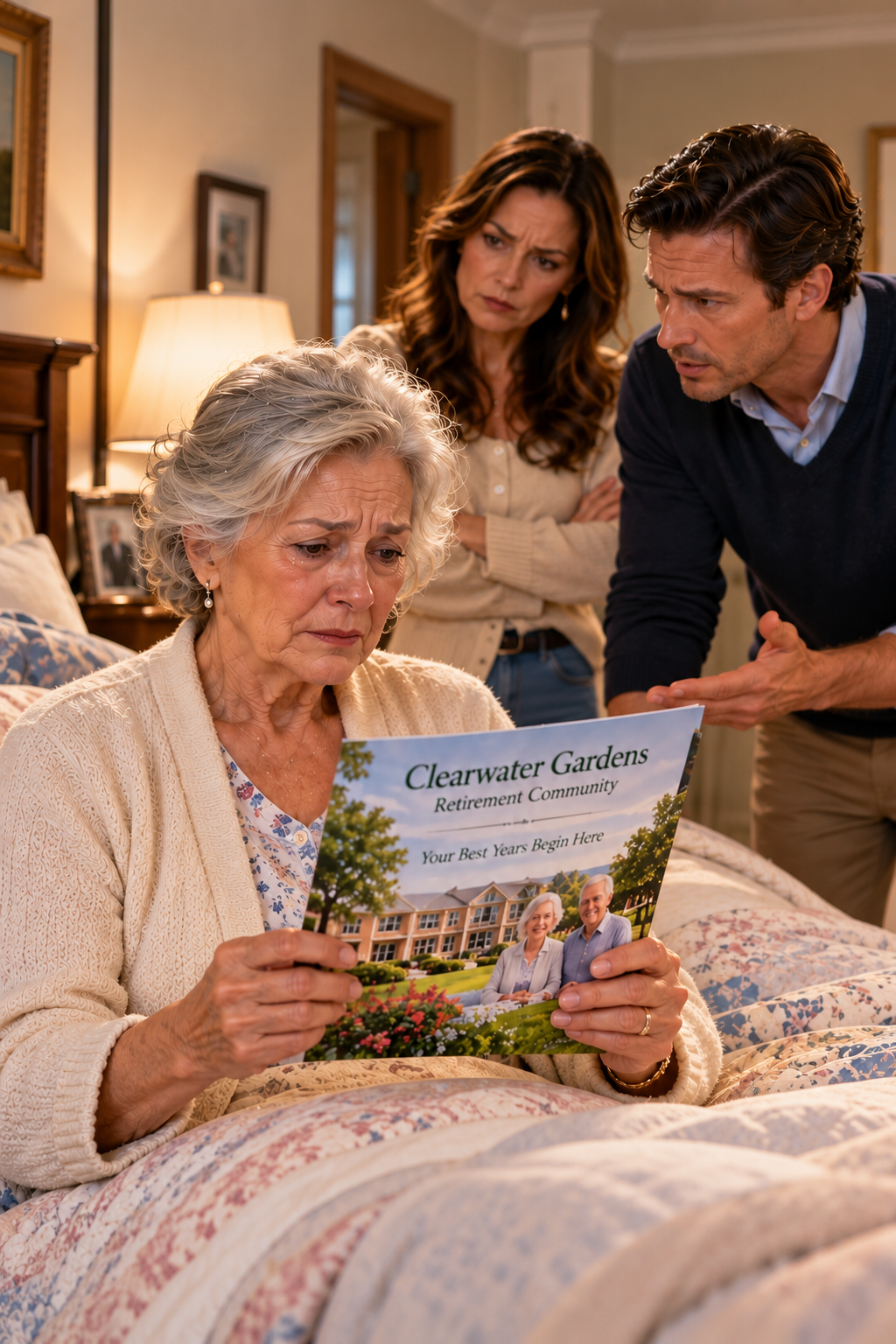
My daughter-in-law left a retirement-home brochure on my pillow, and three days later,
Part 2: Three years of disrespect turned my family home into theirs
To understand why I finally decided to sell my house, you need to understand how thoroughly my family had changed the meaning of home. When Daniel first asked to move in, I imagined Sunday dinners, school pickups, birthday celebrations, and the comforting noise of four people sharing a place that had become too quiet. Candace promised they would contribute to household expenses, respect my routines, and leave as soon as their house in Phoenix sold. I believed her because I wanted to believe her, and because admitting that my son might take advantage of me felt like questioning everything I had taught him. For several months, our arrangement seemed almost successful.
The first serious warning arrived when the Arizona property sold fourteen months after they moved in. Daniel and Candace celebrated with an expensive bottle of wine, announcing that they had received a better offer than expected. I assumed they would begin searching for their own home, perhaps somewhere close enough for the boys to visit after school. Instead, Candace announced plans to convert my sunroom into a private office for Daniel, complete with built-in shelving and soundproof doors. When I reminded her that Bernard and I had spent winter mornings reading newspapers there, she told me the room was being wasted.
The contractors arrived while I was attending my Thursday book club. By the time I returned, they had removed the wicker chairs, disconnected the ceiling fan Bernard installed, and stacked my houseplants in the garage. Candace stood in the middle of the room holding fabric samples and discussing electrical outlets with a man carrying a measuring tape. She greeted me cheerfully and asked whether I preferred charcoal gray or midnight blue for the walls. I told her I preferred the pale yellow Bernard had painted them, but she laughed and said that color belonged in another decade.
I could have stopped the project immediately, and sometimes I still wonder why I didn’t. Perhaps I feared being labeled difficult, or perhaps I had spent so many years putting my family first that asserting myself felt unnatural. Daniel was working hard, the boys were happy, and Candace insisted the renovations would benefit everyone. I convinced myself that losing one room was a reasonable price for keeping my family close. Unfortunately, once people discover that you will surrender something important to avoid conflict, they often begin asking for more.
Next came the backyard patio, where Candace hired landscapers to replace Bernard’s vegetable beds with decorative pavers and an outdoor kitchen. She told me gardening was becoming too demanding for someone my age, although I had never complained about caring for the plants. The tomatoes disappeared, followed by the roses Bernard planted beside the fence during our thirtieth anniversary year. When I objected, Daniel promised they would replace everything with something easier to maintain. They never did, and I stopped looking out the kitchen window for several weeks because the empty soil hurt more than I expected.
The guest bathroom followed, then the dining room furniture, then the holiday decorations I had collected throughout my marriage. Candace preferred minimalist design and considered my family photographs visual clutter. She moved most of them into a hallway closet, replacing them with framed prints that matched the new furniture. One afternoon, I found Bernard’s portrait leaning against a cardboard box beside the vacuum cleaner. When I carried it back into the living room, Candace sighed and asked whether we really needed so many pictures of someone who had been gone for over a decade.
I remember standing there, holding the frame against my chest, unable to believe what I had heard. Daniel was sitting nearby, looking at his phone, and he did not say a word. I waited for him to defend his father, to remind his wife that Bernard had built much of that house with his own hands. Instead, he suggested that the photograph might look better in my bedroom. That was the moment I realized my family had begun treating my memories as obstacles to their plans.
Even my daily routines slowly changed. Candace preferred early dinners, so I stopped eating at the time I liked, and Daniel needed quiet for conference calls, so I stopped listening to music in the afternoon. The boys’ schedules filled the family calendar, leaving little room for my church activities or visits with friends. When guests arrived, Candace introduced the property as “our house,” occasionally adding that Daniel’s mother lived with them. I heard that phrase dozens of times before understanding how completely she had rewritten our arrangement.
The only bright spots were Archer and Reed, who remained affectionate despite their parents’ growing entitlement. Archer, the older boy, often helped me carry groceries and asked about Bernard’s woodworking projects. Reed preferred sitting beside me on the back porch, where he could talk about school without competing for anyone’s attention. One evening, he asked whether I was happy living with them, and I struggled to answer honestly without burdening a child with adult problems. Finally, I told him that loving the people in a house was not always the same as loving what happened inside it.
He looked at me for a long moment, then quietly asked whether I was going somewhere. I assured him that whatever happened, he and Archer would always have a place in my life. At the time, I had not made any final decisions, but his question stayed with me. Children notice more than adults realize, especially when the people around them are trying to pretend everything is normal. That night, I opened a notebook and began recording the changes that had slowly made my home unrecognizable.
Part 3: One secret phone call gave me back my financial power
The morning after Daniel suggested Clearwater Gardens, I called Martin Giddings, the attorney who had handled Bernard’s estate. Martin had known our family for more than twenty years and possessed the rare ability to listen carefully without immediately telling someone what they should do. I explained the retirement brochure, Daniel’s conversation, and the three years of renovations that had gradually displaced me from my own home. He asked whether I had ever transferred any ownership interest to Daniel or Candace. When I told him the deed remained entirely in my name, he said, “Then you are the person who decides what happens to that property.”
Hearing those words spoken so plainly felt like someone opening a window in a room that had become difficult to breathe in. Martin reviewed the ownership records and confirmed that the mortgage had been paid off years earlier. He explained that selling the house was legally possible, although we would need to address the family’s occupancy and any applicable notice requirements before transferring possession. I appreciated his caution because I did not want revenge to create unnecessary legal problems. My goal was not to punish my grandsons or humiliate my son; it was to regain control over a life that had slowly stopped belonging to me.
Martin asked whether I wanted to remain in the house and establish firmer boundaries. I considered that possibility, imagining a difficult conversation followed by agreements about privacy, household expenses, and renovations. But I had already tried smaller versions of those conversations, and each time my objections were acknowledged before being forgotten. I could demand that Daniel and Candace move out, yet the house would still carry the memories of how easily they had dismissed me. Somewhere beneath my sadness, I had begun wanting a different place entirely.
“I think I want to sell,” I finally told Martin. He was quiet for a moment before asking whether I had somewhere else in mind. I described a small town about forty miles north, where a friend had once taken me for lunch beside a narrow creek. There were cottages along the water, walking trails beneath old trees, and a quiet main street with a bakery and a small public library. I remembered thinking how peaceful it would be to live somewhere that did not require constant negotiation. Martin offered to help me evaluate the financial implications and recommended that I speak with a trusted real estate professional.
I already knew whom I wanted to call. Her name was Lena Voss, a woman from my church who had been selling homes throughout the county for more than thirty years. Lena was discreet, practical, and entirely unimpressed by people who confused loud opinions with good judgment. When I explained that I wanted to explore a private sale without immediately announcing my plans to the household, she agreed to meet while Daniel and Candace were away. She also made clear that we would need to handle the occupants’ rights properly and avoid promising buyers immediate possession without a lawful arrangement.
Two days later, Lena arrived with a leather folder and a small notebook. We walked through the house while I described its history, beginning with the original kitchen tile and ending beneath the magnolia tree Bernard planted during our second spring there. She examined the renovated sunroom, now crowded with computer monitors, and asked what the space had been like before. I told her about winter breakfasts, the sunlight through the windows, and Bernard falling asleep in his favorite wicker chair. Lena listened, then said the property had qualities that serious buyers would appreciate, particularly its location and mature landscaping.
Her preliminary valuation surprised me. Property values in our neighborhood had risen considerably, and the renovations Daniel and Candace completed had increased the home’s market appeal despite my personal dislike of them. Lena believed we could attract buyers without a public listing by contacting several clients already searching for established homes in the area. She warned that a private sale might limit competition, but I was willing to consider that trade-off for greater privacy. We agreed on a realistic asking price and began preparing the necessary information.
Meanwhile, I met with Martin to review my finances. Bernard and I had maintained separate emergency savings throughout our marriage, and after his death I continued contributing to an investment account Daniel knew almost nothing about. My mother had also left me a modest inheritance, which I had preserved rather than spending on household luxuries. Martin helped me evaluate how the sale proceeds could be managed securely, including the possibility of placing certain assets in a carefully structured trust. For the first time in years, I was making financial decisions without wondering whether Daniel or Candace would approve.
I also contacted the manager of the creekside cottages I remembered from my earlier visit. One unit had recently become available, a small two-bedroom rental with a screened porch and windows overlooking the water. I arranged a viewing and drove there alone on a Tuesday afternoon, telling my family only that I had an appointment outside town. The cottage smelled faintly of fresh paint, and sunlight fell across the wooden floorboards in long golden rectangles. I stood on the porch listening to the creek and felt a strange certainty that I could be happy there.
That evening, Daniel asked whether I had scheduled a tour of Clearwater Gardens. I told him I was considering my options, which was entirely true, although not in the way he imagined. Candace smiled approvingly and said she was glad I was approaching the transition with an open mind. I returned her smile and continued eating dinner, knowing that my plans were moving forward without their knowledge. They had spent three years making decisions about my home without consulting me, and now I was making the most important decision of all.
Part 4: The buyers loved the house my family had taken over
Lena called on a Wednesday afternoon to tell me she had found two serious buyers. Their names were Ingrid and Harold Mercer, a retired schoolteacher and her husband who had recently moved back to Georgia after spending several years in Oregon. They wanted an older home with character, mature trees, and enough space to entertain their grandchildren. Lena had shown them a private description of the property, and they were interested in seeing it before making any decisions. We arranged a Saturday appointment when Daniel and Candace would be attending Archer’s baseball tournament.
I spent Friday evening preparing the house as carefully as I once prepared for Christmas guests. I polished the dining table, washed the kitchen windows, and baked a lemon pound cake using the recipe Bernard always requested for his birthday. I did not remove Candace’s decorations or attempt to disguise the renovations, because buyers deserved to see the property as it actually existed. Instead, I opened the curtains and placed fresh flowers on the kitchen counter, allowing the house’s natural warmth to return. By Saturday morning, it looked more welcoming than it had in months.
Ingrid and Harold arrived shortly after ten, accompanied by Lena, and immediately struck me as people who understood that a house could hold a lifetime of stories. Ingrid had silver hair braided neatly down her back and wore comfortable shoes suitable for walking through a garden. Harold carried a small notebook and paused frequently to examine the original woodwork. They asked thoughtful questions about the roof, plumbing, neighborhood, and maintenance history, but they also wanted to know what the home had meant to us. I found myself telling them stories I had not shared with anyone in years.
When we reached the backyard, Harold stopped beneath the magnolia tree and looked up through its branches. I explained that Bernard had planted it in 1979, using a sapling we bought with money left over from our first anniversary celebration. Harold asked whether my husband had cared for it himself, and I told him about the weekends Bernard spent pruning branches and checking the soil. He smiled and said his father had loved magnolias, too. Ingrid touched my arm gently and told me they would take good care of the garden if they became its next owners.
Those words affected me more than I expected. I had spent months feeling that the house was being stripped of its history, yet these strangers seemed interested in preserving the very things my family dismissed as outdated. Ingrid loved the original kitchen tile, Harold admired Bernard’s craftsmanship, and both appreciated the sunroom’s natural light despite its current use as an office. They were not searching for a blank canvas to transform into something fashionable. They wanted a home that already possessed a personality.
We sat in the living room afterward, drinking coffee and eating cake while Lena reviewed practical details. The Mercers asked about the current occupants, and I explained that my adult son and his family were staying there temporarily. Lena clarified that any sale would need an agreed possession date and proper arrangements for their departure. Ingrid and Harold understood and said they could be flexible because they were currently renting a furnished apartment. Their patience relieved me, since I had no intention of creating a housing emergency for my grandsons.
Before leaving, Ingrid asked whether I was certain I wanted to sell. I looked around the living room, noticing the empty space where Bernard’s portrait had once hung and the unfamiliar furniture Candace selected. For a moment, I felt the old grief rising, reminding me that leaving would mean surrendering the physical setting of nearly every important memory in my adult life. Then I remembered the brochure on my pillow and Daniel’s relief when I promised to consider moving. “I’m certain,” I told her, “because sometimes loving a place means knowing when it is time to let someone else care for it.”
That evening, Lena called with an offer. The Mercers were willing to pay the full asking price, subject to routine inspections and the agreed occupancy arrangements. They also offered flexibility on the closing date, which gave Martin time to coordinate the legal requirements surrounding Daniel’s family’s departure. I accepted after reviewing the terms carefully and discussing the situation with my attorney. The sale was not yet complete, but the decision felt irreversible in the best possible way.
Over the following weeks, Martin helped arrange a written agreement establishing when Daniel and Candace would need to vacate the property. Because I knew that announcing the sale would cause conflict, he handled the formal notice and explained the process clearly. Daniel reacted with disbelief, insisting that I had misunderstood our conversation about Clearwater Gardens. Candace demanded to know why I had involved an attorney rather than discussing the matter with them. I reminded them that they had discussed my future for months without asking what I wanted.
The confrontation was painful, but it also revealed something important. Daniel repeatedly spoke about the inconvenience of moving, the boys’ school schedules, and the expense of finding another home. Candace complained that they had invested money in renovations and believed they deserved consideration for those improvements. Martin reviewed the relevant documents and helped us resolve those issues without allowing emotional pressure to determine the outcome. I remained firm that the house would be sold and that everyone needed to prepare for the agreed departure date.
That night, Reed found me sitting on the back porch and asked whether I was leaving forever. I pulled him close and explained that I was moving to a smaller home, not disappearing from his life. He asked whether he could visit, and I promised that he and Archer would always be welcome. When he rested his head against my shoulder, I understood that leaving the house did not mean abandoning the people I loved. It meant finally refusing to abandon myself.
Part 5: I signed the deed and left them facing reality
The weeks before closing were among the most emotionally complicated of my life. Daniel and Candace searched for a rental home while continuing to express frustration about the sale, and the atmosphere inside the house became tense. I tried to avoid unnecessary arguments, concentrating instead on packing the possessions that mattered most to me. Bernard’s fishing rods, my mother’s handmade quilt, our wedding photographs, and the chipped blue mixing bowl from my first apartment went into carefully labeled boxes. Every object reminded me of a different chapter, and choosing what to keep became a way of deciding which memories I wanted to carry forward.
Archer helped me pack several afternoons after school. He was old enough to understand that his parents had behaved badly, although I avoided asking him to take sides. One day, he found Bernard’s old pocket watch inside a wooden drawer and asked why I had never shown it to him. I explained that his grandfather carried it to work every day, even after digital watches became popular, because it had belonged to his own father. Archer turned it carefully in his hands and asked whether he could learn how to repair it. I told him we could work on it together once I settled into the cottage.
Reed was more openly upset about the move. He worried that his friends would think something terrible had happened and that he would no longer be able to visit after soccer practice. I explained that families sometimes change where they live without changing how much they care about one another. He asked whether I was angry with his parents, and I answered honestly that I was disappointed by some of their choices. Then I reminded him that adult disagreements were not his responsibility to solve. He seemed relieved to hear that, and we spent the rest of the afternoon making chocolate chip cookies.
Candace remained distant throughout the process. She occasionally made pointed comments about the inconvenience of packing or the difficulty of finding affordable housing near the boys’ school. Once, she suggested that I had become unusually stubborn and might benefit from speaking with someone about the emotional challenges of aging. I looked directly at her and said that deciding where to live was not evidence of confusion. She flushed, muttered something about being concerned, and left the room.
Daniel tried a different approach. He began asking whether I would reconsider the sale if they agreed to pay rent or restore the sunroom to its original condition. I appreciated the offers more than I expected, but they arrived only after the consequences became unavoidable. I explained that I was no longer interested in negotiating for permission to feel comfortable in my own home. He listened quietly, and for once he did not immediately offer an excuse.
On the morning of closing, I woke before sunrise and walked through the house alone. The rooms were nearly empty, and the familiar echoes made me remember the day Bernard and I first received our keys. We had stood in the kitchen laughing because the refrigerator was broken and the wallpaper was peeling, yet we believed we had purchased the most beautiful house in Georgia. I touched the ivory wall I painted in 1989 and remembered Daniel helping me tape the baseboards when he was still a little boy. Then I stepped outside and stood beneath the magnolia tree, thanking Bernard silently for everything we had built together.
Martin met me at the closing office shortly after nine. The paperwork took longer than I expected, with documents to review, signatures to provide, and final questions about the transfer. Lena sat nearby, offering quiet reassurance whenever I needed a moment to collect myself. When the closing was complete, the proceeds were handled according to the arrangements Martin had helped establish. I walked outside feeling lighter than I had in years.
The Mercers were scheduled to receive possession after the agreed move-out date, and Daniel’s family had secured a rental house near the boys’ school. I had deliberately structured the transition so nobody would be left without a place to sleep. Still, the reality of losing the house they had come to consider theirs finally struck Daniel when he saw the final paperwork. He called that afternoon, asking whether I had truly gone through with it. I told him the sale was complete and that I was on my way to the cottage.
For several seconds, he said nothing. Then he asked, “Mom, how could you sell the house without letting us decide what to do?” I felt a familiar sadness, but this time it did not weaken my resolve. “Daniel,” I replied, “you spent three years deciding what to do with my house without asking me.” He began explaining the renovations and the boys’ needs, but I interrupted gently and told him that those things did not change who owned the property.
He asked whether I was trying to punish him. I thought carefully before answering because I wanted him to understand the difference between revenge and self-respect. “I’m not doing this to hurt you,” I said. “I’m doing it because I deserve a home where nobody treats me like an inconvenience.” His voice changed, and for the first time, he sounded less angry than ashamed.
When I arrived at the cottage, the property manager handed me the keys and showed me how to operate the heating system. I carried my overnight bag inside, opened the windows, and stood on the screened porch overlooking the creek. The water moved slowly beneath the trees, reflecting the pale afternoon sky. I had no idea how the next several months would unfold, but I knew that every room belonged to my future rather than someone else’s expectations. That evening, I made tea in my own kitchen and slept more peacefully than I had in years.
Part 6: My son’s angry phone call revealed what he truly feared
Daniel called repeatedly during the first week after I moved. At first, his messages focused on practical problems, including moving expenses, school transportation, and the difficulty of fitting their furniture into the rental house. Then the tone shifted toward confusion and regret. He asked whether I was comfortable, whether the cottage was safe, and whether I had enough money to manage the rent. I answered the practical questions but refused to let concern become another way for him to control my decisions.
One evening, he called while I was sitting on the porch watching the sunset. He sounded exhausted and admitted that Candace had been furious about the move. She believed I had embarrassed them by selling the house and forcing them to explain their sudden relocation to friends. Daniel said the boys were adjusting, but the household had become tense and arguments were frequent. I listened without offering to solve their problems, which was harder than I expected after decades of doing exactly that.
Eventually, he asked why I had not simply told him how unhappy I was. I reminded him of the conversations we had about the sunroom, the garden, the family photographs, and my daily routines. Each time, he had dismissed my concerns or promised changes that never happened. He became quiet, then admitted that he had assumed I would always be there because I had never seriously threatened to leave. “That’s the problem,” I told him. “You believed my love meant I would accept anything.”
Daniel did not argue. Instead, he began asking questions about the cottage, the creek, and whether I missed the old neighborhood. I told him that I missed certain memories, but I did not miss feeling invisible. He asked whether I had been lonely while living with them, and I admitted that some of my loneliest moments occurred when the house was full of people. That seemed to surprise him more than anything else I had said. He apologized quietly before ending the call, although I could tell he still had much to understand.
The following Saturday, Archer called to ask whether he could visit. I told him he was welcome and arranged with Daniel to bring both boys the next afternoon. They arrived carrying backpacks, fishing equipment, and enough snacks to feed a small army. Reed immediately ran toward the creek, while Archer inspected the screened porch and announced that it needed a better chair. Their excitement filled the cottage with the kind of warmth I had feared losing when I sold the house.
We spent the afternoon exploring the walking trail behind the property. Archer discovered a fallen tree that made a perfect place to sit beside the water, and Reed collected smooth stones to arrange along the porch steps. I showed them the small garden where I planned to grow tomatoes, and they volunteered to help prepare the soil. When Daniel returned to collect them, both boys protested that they wanted to stay longer. I smiled and promised they could come back the following weekend.
Daniel lingered after the boys climbed into the car. He looked around the cottage and admitted that it suited me better than he had expected. I told him I had chosen it because it was peaceful and manageable, not because I was incapable of living independently. He nodded, then asked whether he could visit alone sometime. I agreed, provided he called first.
A month later, Daniel arrived with groceries and a small toolbox. He said he wanted to repair a loose porch screen and help install shelves in the kitchen. I accepted because the work needed doing and because he had asked rather than assuming he could change things without permission. We spent the morning measuring, drilling, and laughing over his father’s old habit of keeping every spare screw in labeled jars. For the first time in years, we worked together without tension.
After lunch, Daniel sat across from me at the small kitchen table and finally offered the apology I had been waiting to hear. He admitted that he and Candace had treated my house as though it belonged to them and that he had allowed his wife’s plans to override my wishes. He said he had been so focused on providing more space for his children that he forgot his mother was a person with needs of her own. I listened carefully, resisting the urge to reassure him before he finished. When he finally looked up, I told him I appreciated the apology but needed to see lasting change.
He nodded and said he understood. Then he asked whether I thought we could rebuild our relationship. I told him that I wanted that, but it would require mutual respect rather than another arrangement where I quietly surrendered my boundaries. He promised to try, and for once I believed he understood that trying meant more than making promises. Before leaving, he fixed the porch screen and cleaned up every scrap of material.
Watching his car disappear down the road, I felt cautiously hopeful. I did not expect one conversation to erase three years of disrespect, but it was a beginning. More importantly, I no longer needed Daniel’s approval to feel secure. I had a home, financial independence, and the freedom to decide how much space anyone occupied in my life. That freedom made reconciliation possible without making it necessary for my happiness.
Part 7: My daughter-in-law discovered that respect could not be demanded
Candace did not visit the cottage for nearly three months. She sent occasional messages through Daniel, usually asking about the boys’ schedules or whether I could help with transportation. I responded politely but declined requests that interfered with my own plans. At first, she seemed irritated by my new willingness to say no, but eventually the requests became more reasonable. I suspected Daniel had begun challenging some of her assumptions, although I never asked him to report on their marriage.
The first direct message from Candace arrived on a rainy Tuesday afternoon. She wrote that she had been thinking about everything that happened and now understood why I felt hurt. She did not offer a detailed apology, but she acknowledged that leaving the retirement brochure on my pillow had been insensitive. I read the message several times before deciding how to respond. Finally, I wrote that understanding was a good beginning and that I hoped we could treat one another differently in the future.
I did not invite her over immediately. I wanted time to see whether her words would translate into changed behavior, and I had learned that rushing toward peace could sometimes mean returning to the same old patterns. Instead, I focused on building a life in the cottage. I joined a local book club, began volunteering at the library, and planted tomatoes in the small garden behind the porch. The days filled with activities I chose rather than obligations assigned to me.
My sister Diane visited from Asheville in early spring, bringing two suitcases, a box of family photographs, and enough opinions to fill the entire cottage. She had always been the person who could tell when I was pretending to be happy, and she wasted no time asking whether I regretted selling the house. I told her that I missed Bernard’s magnolia tree but not the constant feeling of being displaced. She smiled and said our mother would have been proud of me. Then she insisted we celebrate with dinner at the nicest restaurant in town.
During her visit, Diane helped me organize the photographs I had packed from the old house. We spent hours remembering childhood summers, family holidays, and the strange little details that become precious with age. She found a picture of Bernard holding Daniel as a newborn and asked whether I had shown it to my son recently. I admitted that I had not, partly because looking at those photographs still made me emotional. Diane suggested that rebuilding our relationship might require remembering the love that existed before the resentment.
I thought about that advice for several days. Daniel had disappointed me deeply, but he was still the boy who once brought me dandelions because he thought they were flowers worth saving. He was also the man who had allowed his wife to push me toward a retirement community without asking whether I wanted to go. Both versions were real, and neither erased the other. Accepting that complexity helped me approach our relationship with clearer expectations.
When Thanksgiving approached, Daniel asked whether he could bring Candace and the boys to the cottage for dinner. I hesitated because the house was small and the memories of our last holiday together were still uncomfortable. Then I decided that inviting them did not mean surrendering my boundaries. I agreed on the condition that everyone respect the space and that no one attempt to turn the gathering into an argument about the past. Daniel promised they would.
Candace arrived carrying a pumpkin pie and a bouquet of flowers. She looked nervous as she stepped onto the porch, and for a moment we stood facing each other without speaking. Then she apologized directly for the brochure, the renovations, and the way she had treated my home as though my opinions were irrelevant. She admitted that she had become comfortable relying on my generosity and had stopped considering what the arrangement cost me. I thanked her for saying those things and invited her inside.
Dinner was not perfect, but it was peaceful. Archer and Reed argued over who would carve the turkey, Daniel accidentally spilled gravy on the tablecloth, and Candace helped wash dishes without rearranging my cabinets. We talked about school, work, books, and the boys’ plans for winter break. Nobody mentioned Clearwater Gardens, and nobody suggested improvements to the cottage. For the first time in years, I felt like the host of my own family gathering rather than an elderly relative occupying borrowed space.
After everyone left, I sat alone beside the fireplace and considered how much had changed. I had not forced Daniel and Candace to become different people, and I could not guarantee they would never disappoint me again. What had changed was my willingness to accept disrespect simply to preserve the appearance of family harmony. I had learned that boundaries were not punishments; they were instructions for how relationships could continue without causing unnecessary harm. That understanding made the evening feel like a genuine step forward.
Part 8: One year after selling my home, I finally belonged to myself
A year after I sold the house, I returned to the old neighborhood for the first time. Ingrid and Harold had invited me to see the magnolia tree in bloom, knowing how much it had meant to Bernard and me. I hesitated before accepting because I was uncertain whether seeing the house again would reopen feelings I had worked hard to settle. Eventually, curiosity overcame my anxiety, and I drove south on a clear Saturday morning. The familiar streets looked smaller than I remembered, and several houses had been repainted since my last visit.
When I turned into the driveway, I immediately noticed the garden. Harold had restored several flower beds, and Ingrid had placed a wooden bench beneath the magnolia tree. The sunroom windows were open, allowing the spring breeze to move through the house, and the backyard looked alive again. Ingrid greeted me warmly and led me inside, where I discovered that they had preserved much of the original character I loved. They had even returned the sunroom to a comfortable sitting area filled with books and plants.
I stood near the window where Bernard used to read his newspaper and felt tears gathering in my eyes. For years, I had believed that leaving the house meant abandoning the memories we created there. But seeing the Mercers care for it helped me understand that a home could continue being loved by people who had not built it. The walls did not need me to remain standing, and the magnolia did not need my grief to keep blooming. Bernard’s life had mattered because of the love he gave, not because I continued living at the same address.
Harold invited me into the garden and showed me the new flowers he had planted beside the fence. He explained that he had studied the magnolia’s care requirements and intended to protect it for as long as possible. I thanked him, then told him a story about Bernard climbing a ladder during a thunderstorm because he was convinced one of the branches needed immediate attention. Harold laughed and said he would probably have done the same thing. We spent nearly an hour sharing memories beneath the tree before I finally said goodbye.
Driving back toward the cottage, I realized I felt no desire to reclaim the old house. It belonged to another family now, and that was exactly as it should be. My memories had traveled with me, stored in photographs, familiar objects, and stories I could share with my grandsons. I no longer needed to protect a building to honor the life Bernard and I had created. The love remained, even though the address had changed.
That summer, Daniel and Candace purchased a modest home of their own. It was smaller than the property they had occupied with me, but they seemed proud of having secured it without relying on anyone else’s generosity. Daniel invited me to visit after they finished painting, and I brought a housewarming gift along with Bernard’s old pocket watch for Archer. Reed proudly showed me his blue bedroom, reminding me that we had spent an entire afternoon debating paint samples. Candace asked whether I liked the kitchen, then laughed and said she promised not to change anything without discussing it with Daniel first.
I smiled because I understood that she was trying to acknowledge the past without turning the visit into another apology. Their home was not perfect, and their marriage still required work, but they were learning to make decisions as responsible adults. More importantly, they no longer expected me to solve every problem by sacrificing my comfort. Daniel had begun calling simply to ask how I was doing, not because he needed money, transportation, or another favor. Those conversations mattered more to me than any elaborate gesture.
My own life continued expanding in ways I had not anticipated. I began teaching basic budgeting classes at the community center, drawing on my years as a bookkeeper and the financial lessons Bernard and I learned together. Several participants were older women who had spent decades allowing spouses or children to handle every important decision. I encouraged them to understand their accounts, review legal documents, and ask questions whenever something felt wrong. I never told them what choices to make, but I reminded them that age did not erase their right to make those choices.
Diane visited again in October, and we spent five days walking beside the creek, drinking coffee on the porch, and laughing about childhood memories. She told me I seemed younger than I had during her previous visit, although I suspected she meant happier rather than physically younger. I admitted that the cottage had given me something I had not realized was missing: the ability to hear my own thoughts. For years, my days had been shaped by other people’s schedules and expectations. Now I could decide whether to spend an afternoon reading, gardening, visiting friends, or doing absolutely nothing.
On the anniversary of the sale, I invited Daniel, Candace, Archer, and Reed to dinner. We ate on the screened porch because the weather was unusually warm, and the boys entertained us with stories about school. After dessert, Daniel handed me a small framed photograph he had found while unpacking boxes from the old house. It showed Bernard and me standing beneath the magnolia tree shortly after we planted it, both of us young, smiling, and covered in dirt. I held the photograph for a long time, remembering how hopeful we had been about the future.
Daniel sat beside me and quietly said that he finally understood why I had sold the house. He admitted that he had confused my willingness to help with an obligation to keep helping forever. He also acknowledged that watching me build a happy life elsewhere had forced him to reconsider what respect meant within a family. I told him I appreciated his honesty and that I was proud of the progress he had made. We sat together for several minutes, looking at the photograph without needing to say anything else.
Later that evening, after everyone had gone home, I carried the picture into my bedroom and placed it beside Bernard’s favorite books. I looked around the cottage, noticing the curtains I had chosen, the furniture arranged exactly as I liked, and the small collection of photographs that made the rooms feel warm. Nothing in the house was particularly expensive, but every object belonged there because I wanted it there. I had spent decades working to provide a good life for the people I loved, and I was finally allowing myself to enjoy the results. The realization filled me with a quiet gratitude that no amount of money could purchase.
I often think about the brochure Candace left on my pillow and how differently my life might have unfolded if I had simply accepted it. Perhaps I would have moved into Clearwater Gardens, spent my days attending activities chosen by someone else, and convinced myself that surrendering my home was the loving thing to do. Perhaps Daniel would have visited occasionally, bringing the boys when their schedules allowed, while Candace continued redesigning the house Bernard and I built. I might have spent my remaining years wondering why I felt so lonely despite having a family. Instead, I chose to ask what I wanted before deciding what everyone else deserved.
That choice did not destroy my family, although Daniel initially feared it would. It forced us to recognize that love without respect eventually becomes another form of control. My son learned that being an adult meant accepting responsibility for his own household, while Candace discovered that generosity was not permission to take over someone else’s life. My grandsons learned that their grandmother could love them fiercely without surrendering her independence. And I learned that I could begin again at sixty-seven without apologizing for wanting something different.
The following morning, I woke early and made coffee in the chipped blue mug I had owned since my first apartment. Sunlight filtered through the trees, and the creek moved gently beyond the porch as birds gathered along the fence. I thought about Bernard, my mother, the old house, and the difficult year that had brought me here. Then I opened the front door and stepped outside, breathing in the cool air of a life that finally felt entirely my own. My family had tried to write the ending of my story without asking me, but they had forgotten one important thing: I was still holding the pen.
✓ Lynn R. Adams
Part 2: Three years of disrespect turned my family home into theirs To understand why I finally decided to sell my house, you need to understand how thoroughly my family had changed the meaning of ho…