My Daughter-in-Law Introduced Her “Head Chef” at Thanksgiving—So I Put Down the Gravy and Took Back Everything I Paid For
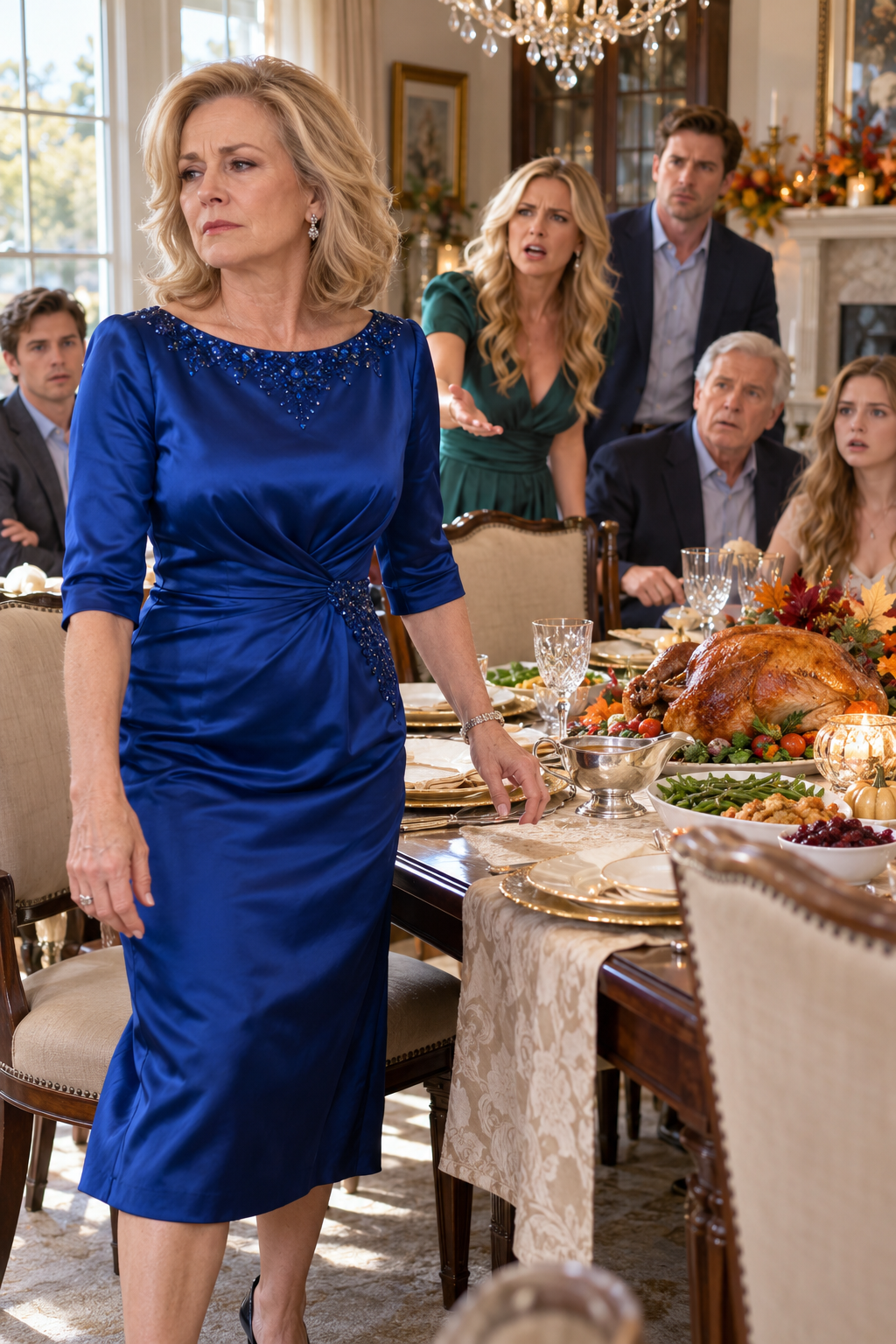
My Daughter-in-Law Introduced Her “Head Chef” at Thanksgiving—So I Put Down the Gravy and Took Back Everything I Paid For
The first thing my daughter-in-law did on Thanksgiving was bring a stranger into my kitchen.
The second thing she did was call him her head chef.
The third thing she did was smile at me as if I were the hired help.
And that was when I understood something I should have understood years earlier.
Vanessa had never mistaken my kindness for weakness.
She had simply been waiting to see how much weakness she could manufacture from it.
My name is Evelyn Mercer. I was sixty-three that Thanksgiving, a widow for seven years, and the owner of a brick Colonial outside Richmond, Virginia, where my husband, Thomas, and I had raised our only son.
For twenty-nine Thanksgivings, I had cooked the same meal in that house.
Roasted turkey with sage butter.
Cornbread dressing from my mother’s recipe.
Sweet potatoes with pecans.
Green beans cooked with bacon and onions.
Cranberry relish made the night before.
And Thomas’s favorite gravy, which I still served from the same white porcelain gravy boat we received as a wedding gift in 1984.
After Thomas died, I considered stopping.
Ryan convinced me not to.
“Dad would hate that,” my son told me.
So I kept cooking.
I kept setting the table.
I kept opening the door.
I kept pretending that family traditions could somehow keep people from changing.
That year, Vanessa arrived at eleven twenty in the morning wearing a champagne-colored coat, high heels, and the expression she usually wore when entering a restaurant she planned to criticize.
Ryan followed behind her carrying two bottles of wine.
Then came a tall man in a charcoal chef’s jacket carrying three stainless-steel containers.
Vanessa swept into my kitchen without asking.
“Evelyn,” she said brightly, “meet Adrian Cole.”
I wiped my hands on my apron.
“Happy Thanksgiving.”
Adrian offered an uncomfortable smile.
“Happy Thanksgiving, Mrs. Mercer.”
Vanessa placed one hand dramatically on his shoulder.
“He’s my head chef.”
“Your what?”
“My head chef.”
She said it louder the second time.
My sister Diane, who had been arranging rolls in the dining room, stopped moving.
Ryan suddenly became fascinated with one of the wine labels.
Vanessa continued.
“Adrian is taking over the food today.”
I looked at the turkey roasting in my oven.
Then at the dressing.
Then at the sweet potatoes.
Then at the saucepan where my gravy had been simmering for nearly an hour.
“I wasn’t aware the food needed taking over.”
Vanessa laughed.
Not a warm laugh.
The kind people use when they want everyone else to understand that someone has just said something embarrassingly outdated.
“Oh, Evelyn. Don’t make this weird.”
Adrian stared at the floor.
Vanessa opened one of his containers.
Inside were tiny roasted carrots arranged in neat rows.
Another container held something she called truffle potato espuma.
I thought she was joking.
She wasn’t.
“Thanksgiving can evolve,” Vanessa said. “Adrian’s doing a more elevated menu.”
Diane appeared in the doorway.
“Elevated above what?”
Vanessa ignored her.
Then she turned back to me.
“Besides, it’s time you enjoyed the holiday instead of controlling the kitchen.”
That word caught my attention.
Controlling.
For fifteen years, Vanessa had called me generous when she needed money.
Supportive when she needed childcare.
Thoughtful when she needed a place to stay.
Family-oriented when she wanted me to host something.
Now I was controlling.
“Ryan?” I asked.
My son finally looked at me.
“It’s just food, Mom.”
Four words.
Sometimes four words can explain fifteen years.
Vanessa smiled triumphantly.
I picked up my gravy boat.
It was warm between my hands.
Vanessa glanced at it.
“Oh, Adrian probably won’t need that. His sauce is much lighter.”
I looked at my son again.
He said nothing.
I looked at Adrian.
He looked mortified.
Then I looked at Vanessa.
“Where exactly are you head chef?”
That smile returned.
“Juniper & Ash.”
The room became very quiet.
Juniper & Ash was the restaurant I had paid to open.
Not partially.
Not symbolically.
I had written the first check.
I had guaranteed the equipment loan.
And, through an LLC Vanessa apparently believed I had forgotten about, I owned the building.
Vanessa crossed her arms.
“We’re restructuring.”
“Ryan and I.”
My son finally spoke.
“Mom, we were going to talk to you.”
“After the holidays.”
Vanessa added, “There’s no reason to turn Thanksgiving into a business meeting.”
I almost admired that sentence.
She had brought the chef from my restaurant into my house, replaced the food I had prepared, announced that she and my son were restructuring a company I had financed, and then warned me not to make Thanksgiving about business.
Something inside me became remarkably calm.
No screaming.
No slammed doors.
I simply carried the gravy boat to the table.
I set it beside Thomas’s empty chair.
Then I removed my apron.
Vanessa blinked.
“What are you doing?”
“Taking your advice.”
“What advice?”
“Enjoying the holiday instead of controlling the kitchen.”
I picked up my purse.
Ryan stepped forward.
“Enjoy your elevated Thanksgiving.”
Then I walked out of my own house.
I heard Vanessa say my name.
I heard Diane laugh once.
And before I reached my car, I heard the front door open behind me.
It was Adrian.
“Mrs. Mercer.”
He looked nervous.
“I think there’s something you should know.”
That sentence changed everything.
Adrian stood on my front steps while cold November air moved through the oak trees.
“I didn’t know this was your house,” he said.
“That makes two surprises today.”
“I also didn’t know you were Ryan’s mother.”
Now he had my full attention.
Adrian looked back toward the house.
“Vanessa told me the original investor in Juniper & Ash was completely passive.”
I smiled slightly.
“She said you had been bought out.”
I said nothing.
Adrian’s expression changed.
“You haven’t been bought out.”
That single syllable carried more fear than Vanessa had shown all morning.
“What exactly has she promised you?” I asked.
“Executive chef. Profit participation. New concept. Second location.”
“Second location?”
“She said financing was approved.”
“I assumed your investment group.”
I almost laughed.
There was no investment group.
There was me.
My late husband had spent thirty-eight years building a regional commercial refrigeration company. When he died, he left me financially comfortable.
I never discussed numbers with Vanessa.
That was intentional.
She saw my old Buick and modest house and assumed Thomas and I had lived an ordinary middle-class life.
We had also saved aggressively, invested carefully, and owned commercial property through Mercer Holdings.
Vanessa knew I had “helped” with Juniper & Ash.
She did not understand what that meant.
Three years earlier, Ryan had come to me with the restaurant idea.
He had spent most of his career managing hotels. Vanessa had worked in marketing.
They had a polished presentation and almost no capital.
They needed $180,000 for the leasehold.
Another $140,000 for equipment.
Operating reserves.
The numbers climbed until the opening cost was a little over $420,000.
Banks said no.
I said yes.
But I had spent too many years beside a businessman to write a check without documentation.
My attorney structured everything.
Mercer Holdings purchased the building.
A separate company owned the kitchen equipment.
Ryan and Vanessa’s operating company leased both.
I also held a secured note against the business.
They ran the restaurant.
I owned most of what made the restaurant possible.
For three years, I never interfered.
I never demanded free meals.
I never walked into the kitchen giving orders.
I never reminded them who had made the dream possible.
Perhaps that was my mistake.
Vanessa eventually confused discretion with ignorance.
“What else did she tell you?” I asked Adrian.
He hesitated.
“That the restaurant was becoming hers.”
I stared at him.
“She said Ryan wanted to move into development and you were transferring your interests to them by the end of the year.”
That explained several conversations from the previous month.
Ryan asking whether I had updated my estate plan.
Vanessa asking casually whether Mercer Holdings was “really necessary.”
Ryan requesting copies of old property records.
I had assumed they were planning for taxes.
Now the pattern looked different.
“Adrian,” I said, “go back inside.”
“I’m sorry.”
“You haven’t done anything to me.”
“I feel like I walked into the middle of something.”
He gave a weak smile.
“What should I tell Vanessa?”
That made him look more nervous.
“Eat Thanksgiving dinner.”
I opened my car door.
“And Adrian?”
“Try my gravy.”
For the first time, he smiled.
“I was hoping you’d say that.”
I drove three miles to my sister’s house.
Diane arrived fifteen minutes later carrying my coat, a pie, and the gravy boat.
“You forgot this,” she said.
“I left it on purpose.”
“I know. I stole it on principle.”
I laughed for the first time that day.
Then she handed me her phone.
“You should see this.”
Vanessa had posted a picture online.
My dining room.
Adrian standing beside a platter.
The caption read:
A new era begins. So grateful for our incredible chef and the future we’re building.
My name wasn’t mentioned.
Neither was my food.
Neither was the fact that the photograph had been taken in my house.
Diane sat beside me.
“What are you going to do?”
I stared at the post.
“Find out what future she thinks she’s building.”
The next morning, at eight thirty, I called my attorney, Martin Keller.
He had represented Thomas for twenty-two years.
“Evelyn,” he said, “you realize most people wait until Monday after Thanksgiving before creating legal problems.”
“I’m not creating one.”
“That sounds worse.”
“I think Vanessa may be trying to transfer or refinance Juniper & Ash.”
Then papers moved on Martin’s desk.
“She can’t.”
“Does she know she can’t?”
“I’m beginning to suspect she doesn’t.”
Martin pulled up the company records.
Five minutes later, his tone changed.
“We need to meet.”
“What did you find?”
“There were two requests this month for lender verification on the restaurant.”
“I didn’t request them.”
My fingers tightened around the phone.
That hurt more than Vanessa’s performance in my kitchen.
Vanessa was ambitious.
Vanessa was arrogant.
Vanessa had always regarded family relationships as a kind of negotiation.
But Ryan was my son.
I had trusted him.
Martin continued.
“There’s also a draft financing package in the shared company records.”
“For what amount?”
“Eight hundred fifty thousand dollars.”
I closed my eyes.
“Against what collateral?”
“The restaurant equipment and leasehold improvements.”
I almost admired the stupidity.
“They don’t own either.”
“Anything else?”
Martin hesitated.
Of course there was.
“There’s a proposed second location.”
“Charlottesville.”
“And who owns the proposed property?”
Another pause.
I opened my eyes.
Thomas had purchased that commercial parcel eleven years earlier.
Vanessa wasn’t planning merely to take control of one restaurant.
She was planning an expansion using my assets while quietly removing me from the story.
“Martin,” I said.
“Freeze everything that requires my approval.”
“Already doing it.”
“And send me every document Ryan submitted.”
Then I made one more call.
This time to the restaurant’s accountant.
By noon, Thanksgiving had stopped being about gravy.
The first unauthorized expense was $6,800.
Vanessa had classified it as “brand consulting.”
The payment went to a company registered to her college roommate.
Then came $14,200 for “executive travel.”
A resort in Scottsdale.
There were dinners, luxury hotels, spa charges and two airline tickets booked under Vanessa’s maiden name.
Then I found the payroll changes.
Adrian’s salary had been approved without consulting me, which was technically allowed within the operating company.
What wasn’t allowed was the $75,000 “recruitment and concept development advance” Vanessa had promised him from funds tied to the equipment reserve.
Adrian had not received the money yet.
Vanessa had simply promised money she did not control.
Then came the bigger surprise.
Ryan and Vanessa had been paying themselves management bonuses.
Thirty thousand dollars to Ryan.
Forty-five thousand to Vanessa.
The restaurant was profitable, but barely.
They were stripping cash from the company while telling suppliers they needed longer payment terms.
I spent Friday and Saturday reviewing documents.
I did not call Ryan.
He called me eleven times.
I ignored ten.
On the eleventh, I answered.
“Hi, sweetheart.”
There was a long silence.
“Mom, why is Martin emailing me?”
“Because he’s my attorney.”
“He suspended the refinancing package.”
“You told him to?”
“Vanessa is freaking out.”
“I imagine so.”
“Can we come over?”
Another silence.
“Mom, this is getting ridiculous.”
I looked down at a spreadsheet showing $96,438 in questionable expenses.
“Which part?”
“The Thanksgiving thing.”
“This isn’t about Thanksgiving anymore.”
“It feels like it is.”
“That would be convenient.”
He exhaled sharply.
“You’re punishing us because Vanessa brought a chef.”
“No, Ryan.”
“Then what are you doing?”
“Reading what?”
“The business records.”
That silence was different.
Fear has weight.
Even over the telephone, you can feel it land.
“How long have you been trying to refinance the restaurant?”
“We were going to explain.”
“You keep saying that.”
“Because it’s true.”
“No. It’s what people say when they get caught before they finish.”
He raised his voice.
“We’re not children!”
“Then stop using my assets as though they belong to you.”
“It’s our restaurant.”
“Your operating company runs it.”
“That’s the same thing.”
“No. It isn’t.”
He should have known that.
Vanessa certainly should have known it before promising an expansion.
Ryan went quiet.
Then he said something I will never forget.
“Dad would have wanted me to have it.”
There it was.
The sentence people use when the dead cannot correct them.
I looked toward Thomas’s photograph on the bookshelf.
“No, Ryan. Your father wanted you to build something.”
“That’s what I’m doing.”
“Using someone else’s property as collateral isn’t building.”
“I’ll speak to you Monday.”
Monday morning, I arrived at Juniper & Ash at nine.
The restaurant was closed until four.
Vanessa was waiting inside.
So was Ryan.
So was Adrian.
And to my surprise, so was Martin.
Vanessa wore a navy-blue suit and carried a leather folder.
She looked prepared for battle.
I was prepared for arithmetic.
“Evelyn,” Vanessa began, “before this becomes uglier than it already is—”
“Sit down.”
She stopped.
I had never spoken to her that way.
Neither had Ryan.
I placed three folders on the table.
One for Ryan.
One for Vanessa.
One for Adrian.
Adrian opened his immediately.
Vanessa didn’t touch hers.
“What is this?” Ryan asked.
I turned to Adrian.
“Your folder contains the employment agreement Vanessa offered you, the ownership structure of the restaurant, and confirmation that the $75,000 advance she promised you was never authorized.”
His jaw tightened.
Vanessa spun toward him.
“Adrian, this is between family.”
“No,” he said quietly. “You made it between us when you recruited me.”
I liked him more every minute.
Vanessa looked back at me.
“What do you want?”
It was revealing that she skipped past denial.
“I want an explanation for $96,438 in non-operating expenses.”
Ryan looked at Vanessa.
She finally opened her folder.
Her face changed.
“You went through my accounts?”
“Our accountant went through company accounts.”
“The travel was business development.”
“Was the couples massage in Scottsdale business development?”
Ryan’s head snapped toward her.
Vanessa flushed.
“That was part of a hospitality conference.”
“And the $3,200 bracelet purchased from the hotel boutique?”
“I reimbursed that.”
“No, you didn’t.”
Her jaw tightened.
I turned another page.
“Then there’s the refinancing package.”
Ryan leaned forward.
“That deal would have solved everything.”
“What needed solving?”
He struck the table with his palm.
Adrian remained perfectly still.
Martin looked bored.
Lawyers are comforting that way.
Ryan continued.
“We had a chance to turn one restaurant into three. Vanessa has investors interested.”
“Investors?”
Vanessa jumped in.
“People who understand scalability.”
I nearly smiled.
“You don’t, actually.”
There she was.
The woman from Thanksgiving.
The mask had slipped again.
“You understand property,” Vanessa continued. “You understand savings accounts and old-fashioned businesses. Restaurants are different now. Branding matters. Expansion matters. Media matters.”
“Does ownership matter?”
Her mouth closed.
I slid one document across the table.
“This is the deed to the building.”
“This is the equipment ownership agreement.”
“This is the secured note.”
“This is the Charlottesville property deed.”
Vanessa stared at them.
“Nearly every asset you intended to use for your expansion belongs to Mercer Holdings.”
Ryan rubbed his forehead.
“We know that.”
“No. You knew it on paper. You behaved as though it wasn’t real.”
Vanessa pushed the documents away.
“Fine. What do you want? An apology because Thanksgiving hurt your feelings?”
I looked directly at her.
“Thanksgiving didn’t hurt my feelings.”
That confused her.
“It clarified them.”
Adrian lowered his eyes.
Ryan whispered, “Mom.”
I continued.
“I spent years wondering whether the little insults mattered. The jokes about my clothes. The comments about my cooking. The way you stopped thanking me for things and started expecting them. Thanksgiving answered the question.”
Vanessa crossed her arms.
“So this is personal.”
“Of course it’s personal. You’re my family.”
She opened her mouth.
I held up a hand.
“But my decision is business.”
I placed the final page on the table.
“I’m terminating the equipment lease for material breach and exercising my rights under the secured note.”
Ryan went pale.
Vanessa stared at me.
“What does that mean?”
Martin answered.
“It means Mercer Holdings is taking possession of the equipment and enforcing the financial covenants.”
Vanessa looked at Adrian.
Then back at me.
“You’re closing our restaurant?”
I folded my hands.
“I’m removing you from control of the assets that belong to me.”
She actually laughed.
It was a frightened laugh.
“You can’t run a restaurant.”
“I don’t intend to.”
Then I looked at Adrian.
“Would you?”
Everyone turned toward him.
Adrian slowly closed his folder.
Vanessa’s face went completely still.
That was the first twist she hadn’t anticipated.
The second was about to arrive.
Adrian had called me Saturday evening.
He told me he wanted out.
Not because of the Thanksgiving embarrassment.
Because after reviewing his contract, he realized Vanessa had misrepresented almost every important part of the offer.
But Adrian had another problem.
He had already resigned from his previous job.
He had a wife.
Two children.
A mortgage.
I told him I would not punish him for believing Vanessa.
Then I asked about his experience.
Twelve years in professional kitchens.
Four years as executive sous-chef at a respected Washington restaurant.
Two years running food operations for a boutique hotel group.
He understood cost controls, staffing and vendor management.
More importantly, he understood something Vanessa never had.
A restaurant was not a backdrop for social media.
It was a business where real people worked.
So I offered him an opportunity.
Not ownership.
Not promises.
A six-month management contract with clear targets and the possibility of becoming executive chef if the restaurant stabilized.
He had accepted.
Now Vanessa stared at him as though he had betrayed her.
“You went behind my back?”
Adrian’s expression hardened.
“You lied to me.”
“I recruited you!”
“You recruited me with someone else’s money.”
Ryan turned toward me.
“So what happens to us?”
That was the hardest question.
Because for all my calmness, he was still my son.
I remembered teaching him to ride a bicycle.
I remembered his first day of college.
I remembered Thomas standing beside me at Ryan’s wedding, whispering, “He looks terrified.”
I remembered holding Ryan when his first business failed.
Love makes consequences harder.
It does not make them unnecessary.
“You and Vanessa are free to continue operating a restaurant,” I said.
Ryan looked hopeful.
His face fell.
“The current operating agreement ends in thirty days.”
Vanessa shot out of her chair.
“You’re evicting us?”
“I’m terminating a commercial agreement after documented breaches.”
“You vindictive old—”
Ryan’s voice stopped her.
For once, he sounded ashamed.
She stared at him.
“You’re taking her side?”
“I’m asking you not to call my mother names while sitting in a building she paid for.”
Vanessa’s mouth dropped open.
It might have been the first time in their marriage he had contradicted her publicly.
“The restaurant will close for ten days after your agreement ends. It will reopen under new management.”
Vanessa looked almost sick.
“You’re stealing our concept.”
I slid another page toward her.
“The name Juniper & Ash belongs to your operating company. Take it.”
She blinked.
“You can’t use the name?”
“I don’t want it.”
That surprised everyone.
I continued.
“You’ll retain your company, your trademarks, your social accounts, your recipes that are legally yours, and whatever cash remains after legitimate obligations are paid.”
Vanessa looked suspicious.
“Then what are you reopening?”
I glanced at Adrian.
He smiled slightly.
“Mercer House.”
Ryan stared at me.
“That was Dad’s idea.”
Years earlier, Thomas had joked that if we ever opened a restaurant, we should call it Mercer House and serve food people actually wanted to finish.
I had forgotten the conversation until Adrian asked me what kind of restaurant I wanted.
The answer came immediately.
One Thomas would have enjoyed.
Vanessa sank back into her chair.
“You’ve been planning this.”
“For three days.”
“You’re destroying everything we built.”
“No, Vanessa. I’m separating what you built from what I paid for.”
Those were not the same thing.
By the end of December, Juniper & Ash had vacated the building.
It wasn’t graceful.
Vanessa posted vague statements online about “toxic family dynamics” and “older generations refusing to let younger entrepreneurs succeed.”
I did not respond.
People who know the truth do not have to chase every lie.
Ryan called me twice.
The first conversation ended in shouting.
The second lasted only six minutes.
Then we stopped speaking.
More than I expected.
Christmas came quietly.
Diane spent it with me.
We ordered Chinese food and watched an old Cary Grant movie.
At one point, Diane looked at the cartons spread across my coffee table.
“Your restaurant chef know you’re eating egg rolls on Christmas?”
“Don’t tell him.”
She raised her glass.
“To elevated cuisine.”
But when she went home, I cried.
Consequences can be right and still hurt.
That is something revenge stories often leave out.
Winning does not mean nothing was lost.
I had protected my business.
I had protected myself.
But my son was gone from my Christmas table.
For nearly three months, there was silence.
Then one February morning, Ryan walked into Mercer House.
He looked tired.
Not tragic.
Not broken.
Just tired.
Adrian saw him first.
“Mrs. Mercer is in the back.”
Ryan shook his head.
“I’ll wait.”
I watched from the kitchen doorway.
My son sat alone at a two-person table.
No Vanessa.
I walked over.
I poured two cups.
For a while, neither of us spoke.
Then Ryan said, “Vanessa left.”
I felt no satisfaction.
“Three weeks ago.”
“I’m sorry.”
He laughed bitterly.
“No, you’re not.”
“I’m sorry you’re hurting. That’s different.”
He looked at me.
Fair enough.
Vanessa had convinced two investors to back a smaller restaurant concept in Northern Virginia.
Ryan refused to sign personal guarantees.
They fought.
Then they fought about the missing company money.
Then everything else came out.
The Scottsdale trip had not been a hospitality conference.
Vanessa had met privately with potential investors without Ryan because she intended to structure the new company so she controlled it.
My son had not been her partner.
He had been another asset.
“She was going to leave eventually,” he said.
“You knew?”
“I suspected she wanted control.”
Ryan stared into his coffee.
“I let her treat you terribly.”
That was the apology I had needed.
Not “sorry you were offended.”
Not “sorry things got complicated.”
Not “sorry Thanksgiving became awkward.”
He named what he had done.
“Yes,” I said.
He swallowed.
“I kept telling myself I was keeping the peace.”
“Whose peace?”
He gave a tired smile.
He looked around the restaurant.
Mercer House had been open six weeks.
It was doing well.
Adrian had simplified the menu.
Roast chicken.
Braised short ribs.
Seasonal vegetables.
Fresh biscuits.
A burger Thomas would have loved.
And on Sundays, one special dish from my recipe box.
“You really did it,” Ryan said.
“Adrian did most of it.”
“You gave him the chance.”
“So did Vanessa, accidentally.”
Ryan laughed.
It felt good to hear.
Then his expression became serious.
“I don’t expect my old job back.”
He blinked.
“I’m glad we understand each other.”
“I love you, Ryan.”
“But love isn’t payroll.”
He nodded slowly.
“I know that now.”
We talked for nearly two hours.
We did not repair everything.
Real relationships rarely repair themselves in a single conversation.
But we began.
The following Thanksgiving, I woke at five thirty in the morning.
Out of habit.
For nearly thirty years, Thanksgiving meant getting out of bed before sunrise.
I lay there for a moment before remembering.
I wasn’t cooking.
Not alone, anyway.
At nine, I drove to Mercer House.
Adrian was already in the kitchen with six members of his staff.
“Morning, boss,” he said.
“Don’t call me that.”
“Morning, terrifying majority owner.”
He pointed toward a prep station.
“Your domain.”
There it was.
My mother’s cornbread dressing.
We had added it to the Thanksgiving menu.
Not deconstructed.
Not elevated.
Not transformed into foam.
Just dressing.
At eleven, Ryan arrived carrying pies.
He had started working for a hotel development company in Richmond.
No family connection.
No investment from me.
He had earned the position himself.
Our relationship was better.
Not perfect.
That mattered more.
Vanessa and Ryan’s divorce had become final in September.
Her Northern Virginia restaurant project never opened.
One investor pulled out after due diligence uncovered her previous company expenses.
The other demanded terms she refused to accept.
The last I heard, she was working for a hospitality marketing agency in Maryland.
I did not celebrate her failure.
I did not rescue her either.
At twelve thirty, Diane arrived.
Then two cousins.
Then neighbors.
Then some of the restaurant employees’ families.
We closed Mercer House to the public that afternoon and put together one long table through the center of the dining room.
Twenty-eight people.
At the last minute, Adrian’s wife and children joined us.
His youngest daughter carried a paper turkey she had made at school.
Someone turned on music.
Someone opened wine.
Someone burned a tray of rolls.
It was messy.
Right before we sat down, Adrian came out of the kitchen holding something behind his back.
“I have a presentation.”
“Oh, Lord,” Diane said.
He placed a white porcelain gravy boat in front of me.
The same one I had set down and walked away from the year before.
I stared at it.
“Where did you get this?”
Diane raised her hand.
“I may have stolen it twice.”
Everyone laughed.
Adrian lifted a ladle.
“Mrs. Mercer, would you do the honors?”
I filled the gravy boat.
Ryan watched me from across the table.
His eyes were wet, though he pretended they weren’t.
Before we ate, he stood.
“I want to say something.”
The room quieted.
He looked at me.
“Last Thanksgiving, I watched my mother walk out of her own house because I didn’t have the courage to speak up.”
I felt my throat tighten.
“I thought keeping quiet made me neutral,” he continued. “It didn’t. It just meant the person behaving badly had all the power.”
Nobody moved.
Ryan looked around the table.
“So this year, I’m thankful Mom taught me something I should’ve learned a long time ago.”
He lifted his glass.
“Generosity isn’t permission.”
Diane immediately lifted hers.
“I’ll drink to that.”
Everyone laughed.
Glasses clinked.
Then Adrian’s eight-year-old daughter tugged his sleeve.
“Are you really the head chef?”
The entire table went silent for half a second.
Then Diane nearly choked on her wine.
Adrian looked at me.
Ryan covered his face.
I began laughing so hard I had to put down the gravy boat.
The little girl looked confused.
Adrian kissed the top of her head.
“Yes, sweetheart. I really am.”
She pointed at me.
“Then what is she?”
Adrian considered that.
Before he could answer, I did.
“I’m the woman who owns the gravy boat.”
Another explosion of laughter rolled across the table.
And somehow that felt like the perfect answer.
Because a year earlier, I had believed I was walking away from Thanksgiving.
I was walking away from a version of family where love required silence.
I was walking away from the belief that giving endlessly made people grateful.
I was walking away from the idea that keeping the peace was worth losing my dignity.
And most importantly, I finally understood what Thomas had tried to teach our son—and perhaps what he had tried to teach me too.
You can give someone an opportunity.
You can give someone money.
You can give someone forgiveness.
You can even give them another chance.
But you should never give them ownership of your self-respect.
That Thanksgiving, I passed the gravy to my son.
Ryan poured some onto his dressing and smiled.
“Still better than espuma.”
Across the table, Adrian pointed his fork at him.
“I heard that.”
Ryan grinned.
I looked around at my family.
Not the family I had imagined.
Not the family I had tried desperately to preserve.
The family that remained after the truth.
And for the first time in years, that was enough.
I had not destroyed my son’s future.
I had forced him to build one of his own.
I had not stolen Vanessa’s restaurant.
I had simply stopped letting her build her ambitions on property that wasn’t hers.
And I had not ruined Thanksgiving by setting down that gravy boat and walking away.
I had saved every Thanksgiving that came after it.
So when people later asked me what happened that year—why Juniper & Ash disappeared, why Mercer House opened, why my son suddenly changed careers—I never gave them the whole story.
I simply smiled and said:
“Thanksgiving got complicated.”
Because some lessons take years to learn.
Some take a lawyer.
And some begin with three little words spoken by the wrong person in your own kitchen.
“My head chef.”
✓ Lynn R. Adams
My Daughter-in-Law Introduced Her “Head Chef” at Thanksgiving—So I Put Down the Gravy and Took Back Everything I Paid For The first thing my daughter-in-law did on Thanksgiving was bring a stranger i…