My Daughter-in-Law Announced My House Was Hers at Thanksgiving—But Henry’s Signature Told Another Story 243
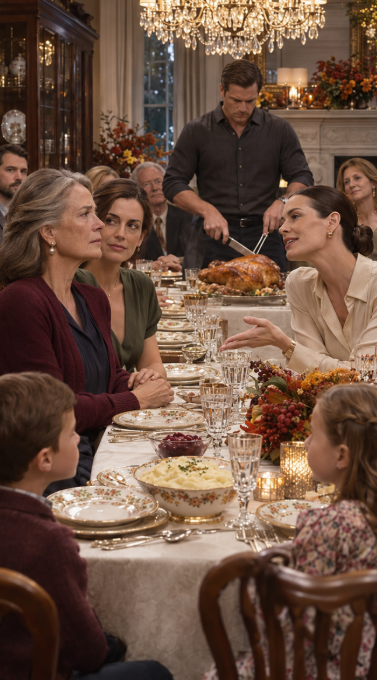
PART 1: The Announcement Across Henry’s China 243My daughter-in-law waited until Thanksgiving dinner to announce that I no longer owned my home, and the worst part was how quickly my son looked away.Eleven people sat around the table, including my grandchildren, while Caroline smiled as though she had just offered everyone a second helping of pie.The turkey still steamed beneath the chandelier, and the mashed potatoes remained untouched beside the good china Henry and I bought for our thirtieth anniversary.It was my first Thanksgiving without my husband, and I had already used every ounce of strength I possessed just to set his empty place.My niece Nora sat beside me, slipping her hand beneath the linen tablecloth every few minutes to remind me I wasn’t entirely alone.Across from us, Eric stood with the carving knife poised over the turkey, making careful little cuts that seemed designed to keep him occupied forever.His children had been laughing about school and reaching across their plates for rolls, blissfully unaware that the adults had been carrying secrets into my dining room.Henry had always made the holidays noisy, first by complaining that I cooked for twice as many people as we invited and then by eating twice his share.He claimed to be a terrible carver, although every Thanksgiving he insisted that nobody else should be trusted with the turkey.Sometimes I caught myself turning toward his chair with a small story on my lips before remembering there was no one there to hear it.That morning I had nearly left his favorite china wrapped in its tissue paper because unpacking it felt too much like admitting I would use it without him.Then I pictured Henry laughing at the idea of serving Thanksgiving dinner on paper plates when we owned something beautiful.So I polished every plate and lined up the glasses, doing the familiar work as though the repetition might keep me standing.When Eric arrived with his family, I embraced the children first, grateful for their warm arms and the way they still called the house Grandpa’s place.Caroline kissed the air near my cheek and looked past my shoulder before she even took off her coat.She asked whether I had managed the cooking myself, then walked slowly through the hall, pausing beside the photographs Henry had hung.Eric carried the pies into the kitchen without asking where I wanted them, which was unlike the boy who once helped me bake them.He seemed tired, and when I tried to catch his eye, he studied the pie boxes instead.I told myself grief was making every gesture look suspicious, although I had already learned how useful that excuse could be to other people.The first time Caroline had come to discuss my future was ten days after we buried Henry.She arrived with Eric and a cardboard box full of folders, insisting they were only there because there was too much paperwork for one grieving woman.I was still moving through the house in Henry’s worn robe and waking each morning with my hand stretched toward the empty side of our bed.His glasses stayed on the coffee table where he had last set them, and his chipped mug remained beside the sink.I couldn’t bear to put either away, because such ordinary objects seemed to hold the shape of a life that had vanished too quickly.Caroline spread folders across the dining table and used a cheerful, efficient voice that made me feel like an inconvenience in my own kitchen.She talked about bills, accounts, household maintenance, and how confusing property matters could become when a spouse died.I listened because she was my son’s wife and because I was too exhausted to argue with someone who called every suggestion an act of kindness.But while Eric sorted papers, Caroline wandered toward the windows and looked out over the porch Henry had built with his own hands.I could still remember him standing in the autumn sunshine, measuring the boards twice and pretending he wasn’t pleased when I brought him lemonade.Caroline studied those same boards as though she were calculating how much they added to the property.“This house is so big for just one person,” she remarked, with the casual tone someone might use to comment on the weather.I told her the house felt exactly the same size it always had, except that Henry was no longer in it.She gave me a sympathetic look that lasted barely long enough to be convincing.Three days later she returned with another stack of folders, this time without the cardboard box that had made her first visit seem harmless.She placed transfer forms, property papers, and a revised deed in front of me, arranging them with the confidence of someone presenting a finished decision.According to Caroline, Henry had signed documents while I was in Florida helping my sister, and the arrangements had somehow never been mentioned to me.She said he wanted everything settled and implied that questioning the papers would mean questioning my husband’s judgment.I asked which attorney had prepared them, and she answered too quickly that the name and details were all in the packet.I asked why Henry hadn’t told me, and she pressed her lips together before saying there were things people sometimes kept private to spare their families.That answer hurt more than she could have expected, because Henry and I had spent decades making decisions together, including the hardest ones.We had sat at this very table discussing savings, our wills, the children’s future, and what should happen when one of us died first.He had never promised me a life without trouble, but he had promised not to let me face trouble built from secrets between us.A transfer of our home was not something he would have hidden inside a folder for Caroline to unveil after his funeral.I turned to the page bearing his signature and felt the first cold, steady sensation I had experienced since the burial.At a glance it resembled Henry’s writing, with his broad capital letter and the familiar sweep at the end of his name.But the upper curve of the H curled inward instead of outward, and the final Y tilted in the wrong direction.Those details might seem small to anyone who hadn’t watched the same hand write birthday cards, shopping lists, and love notes for decades.I knew how Henry formed those letters even when he was tired, angry, distracted, or struggling to hold a pen.Once, after a long argument about whether to repaint the porch, he had left me a note that simply said he loved me more than the porch color.I had kept it tucked inside a recipe book, where its crooked signature could still make me smile.The name in Caroline’s packet was close enough to fool someone who saw it only occasionally, but it didn’t make my heart recognize my husband.Then I looked at the date printed beside the signature, October twelfth, and had to grip the edge of the table.That was the week Henry was in the hospital with pneumonia, so weak that he needed help lifting a glass of water.I remembered sitting beside him while he tried to sign a meal-choice slip, then giving up because his fingers trembled around the pen.The nurse had told him not to worry about it, and I had written his choice while he watched from the pillow.Caroline’s papers claimed that same exhausted man had traveled to an attorney’s office and completed an important legal transaction.For a moment I considered telling her everything I noticed, but I saw how intently she was studying my face.She seemed prepared for tears or confusion, not a quiet widow who might ask what the date actually meant.So I lowered the paper, folded my hands, and said I needed time to understand it.Caroline relaxed so visibly that I had to look away to keep my own expression steady.She told me there was no need to rush, although she gathered the pages as soon as I asked whether I could keep them.I watched Eric carry the folders to the door, his shoulders hunched beneath the weight of something that plainly wasn’t cardboard.Before they left, Caroline reminded me that she and Eric only wanted what was best for the family.I thanked them for visiting because I wanted them to keep believing that grief had left me too helpless to challenge anything.After the car disappeared, I took Henry’s old letters from my bedroom drawer and laid several signatures beside the copy Caroline had briefly allowed me to photograph.The difference in the H was clearer when the names stood together, and the shape of the Y troubled me even more.I placed the photograph and the older letters in a folder of my own, along with the hospital dates I could remember without checking.Over the next few days I made quiet inquiries about property records, careful not to tell Caroline how unsettled I had become.A woman answering the recorder’s office telephone explained that recorded documents could be inspected, but recording one did not establish that every claim in it was true.I wrote that sentence down because Caroline had spoken as if placing a piece of paper in a government office could settle every question.I also called an attorney for an appointment, though the earliest useful conversation would require me to bring the actual documents rather than guesses.Each small action frightened me because it meant admitting someone close to my family might be trying to take advantage of Henry’s death.Still, doing nothing frightened me more, particularly when I imagined his porch and coffee mug becoming objects I needed permission to visit.By Thanksgiving morning, Caroline had telephoned twice to ask whether I was feeling well enough to host and whether I would prefer to rest upstairs.I said I was capable of greeting my family and putting a turkey in the oven, even if grief made both tasks harder.She sounded disappointed in a way I couldn’t quite prove, and that sharpened my determination to sit in my own chair.Nora arrived early with flowers and found me standing in front of Henry’s place setting, holding a plate against my chest.I told her only that I was worried about paperwork Caroline had brought and that I needed her to stay beside me during dinner.She didn’t demand an explanation, just took the plate from my hands and helped me finish setting the table.Now, as the afternoon meal finally began, I noticed Caroline watching Eric’s carving knife instead of the food on her plate.He cut the same piece of turkey twice, and when his daughter asked for white meat, he answered without seeming to hear her.I tried to catch his gaze again, but he kept his face lowered, as if eye contact might require him to make a choice.Then Caroline put down her fork, smoothed her napkin, and raised her chin with the same polished smile she had worn beside those folders.The little clink of metal against china silenced the room faster than any request for attention could have done.“As of yesterday,” she said, looking directly at me, “the house no longer belongs to you.”Nora inhaled sharply, a child’s fork struck a plate, and Eric stopped carving with the blade still pressed into the turkey.I felt my heartbeat against my ribs, but I kept my hands folded because I would not let her choose the shape of my grief.Caroline’s smile widened as the others turned toward me, and I could almost hear her waiting for me to beg.Instead I looked at Eric, whose face had drained of color, and asked a question so quietly the children leaned forward to hear.“Did you know she was going to do this?” I asked, while the carving knife trembled in his hand.He looked at Caroline, then at Henry’s empty chair, and finally at me with an expression that made the room seem to tilt.“Yes, Mom,” he whispered, “I knew.”PART 2: The Name Beneath the Signature 243For several seconds I heard nothing except the faint rattle of the knife as Eric lowered it onto Henry’s favorite serving platter.My son had answered the question, but what hurt most was the careful way he had avoided answering it for weeks.Nora’s hand tightened around mine, and I realized every person at the table was waiting to learn what I would do with those two words.Caroline leaned back as if Eric’s admission had settled the matter and told us there was no reason to turn Thanksgiving into an argument.“You’ve already turned it into one,” Nora said, her voice sharper than I had ever heard it in this house.I asked Eric whether he had known about the document before Caroline brought it to me, and he stared at his unfinished carving.He said he knew she had paperwork, knew she planned to file it, and believed the arrangement reflected what his father had wanted.I reminded him that Henry had spent years teaching us to speak openly about difficult decisions instead of hiding them until someone died.Caroline interrupted to say that feelings could not change a recorded deed and that I needed to start being practical about my future.“Practical about where I sleep?” I asked, and her quick glance toward the hallway answered more than her rehearsed words did.She said there was no reason I couldn’t find somewhere smaller, perhaps nearer to my sister, where upkeep would not be such a burden.My grandson looked from her to me and asked whether Grandma was moving away, bringing a silence that made Caroline’s confidence look suddenly cruel.I told him he didn’t need to worry about grown-up paperwork during dinner, then asked Nora to take the children into the sitting room.Nora hesitated, but when she saw my expression, she gathered them gently and promised they could finish their food in a moment.Their footsteps faded down the hall, leaving adults who could no longer pretend this was a misunderstanding over holiday manners.Caroline produced a folded copy from her handbag and placed it beside the cranberry sauce as though an official stamp could substitute for kindness.She pointed to the recording information and repeated that the paperwork had been accepted the previous day.I told her filing a document did not prove Henry had signed it, and for the first time her smile tightened.Eric looked up quickly, almost pleading with me to stop before we reached a question he already feared.I placed my photograph of the earlier paperwork beside Caroline’s copy and asked which of them had personally seen Henry sign.Caroline said she trusted the professional who had handled it and that accusing her of dishonesty was a terrible way to honor Henry.I turned toward my son because he had known his father longer than anyone else in the room apart from me.“Eric, did you ever hear your father say he wanted this house transferred?” I asked, keeping my voice level.He admitted that he had not heard those exact words, but Caroline quickly insisted that Henry’s intentions were obvious from the documents.I asked why the papers were dated October twelfth, and Eric’s hand moved toward the edge of the table as if seeking something to steady himself.Caroline replied that Henry had been ill for weeks and that people could have good days during a difficult illness.“He was in the hospital that week,” I said, remembering the water glass he couldn’t lift and the slip he couldn’t sign.She answered that she wasn’t responsible for keeping track of every hospital visit, which was an extraordinary thing to say about a document she had defended so confidently.Eric rubbed both hands over his face, then told me he had signed something because Caroline said a family member needed to confirm the signature looked like Dad’s.I asked whether he had read what he signed, and the pause before his answer told me more than any speech could have.He said he had been upset after the funeral, exhausted from arrangements, and eager to stop fighting about financial matters at home.Caroline snapped that he had agreed with the decision and could not now pretend she had acted alone.I watched my son flinch at her words, not because she was necessarily wrong, but because she had said them where his mother could hear.I asked to see every page he had signed, and Caroline said that wasn’t necessary because the transfer was already complete.Nora returned to the doorway after settling the children and told Caroline that refusing to show the papers was hardly the behavior of someone with nothing to hide.Caroline pushed the copy toward me with two fingers, her expression daring me to find anything useful.I began turning the pages slowly, pausing over dates, initials, and the typed account of how Henry had supposedly completed the transaction.There was a separate statement bearing Eric’s signature, the familiar slant of his handwriting unmistakable beneath the printed declaration.For one hopeful moment I thought it would merely say he had identified his father’s name after the fact.Then I read the sentence immediately above his signature, and the room seemed to contract around my chair.It stated that Eric had been personally present when Henry signed the deed on October twelfth.I looked at my son, remembering how he had called me from the hospital parking lot that week to ask whether Dad wanted his blue sweater.Eric followed my finger across the page, and the color left his face for a second time.“Eric,” I asked, with the document trembling in my hand, “why does this say you watched your father sign?”PART 3: The Handwriting I Had Taught Him 243Eric stared at the declaration as though he had never seen the sentence above his name, although his signature sat beneath it in dark, confident ink.Caroline reached for the page, but I drew it back and asked her to leave it where everyone could see the words.My son said he had understood the statement to mean he recognized Henry’s handwriting, not that he had witnessed the actual signing.“Those are not the same thing,” Nora said from the doorway, and even Caroline had no answer ready for that distinction.I asked Eric where he had been on October twelfth, and he said what we all remembered: driving to the hospital and sitting beside his father.He described Henry sleeping between coughing fits while machines clicked quietly near the bed, making Caroline’s story about a separate appointment sound increasingly impossible.When I asked why he hadn’t challenged the statement before signing, he admitted he had trusted Caroline’s explanation more than his own memory.He had wanted the paperwork finished, he said, because every conversation about Dad’s death made him feel as though he were losing him again.I understood that exhaustion because I lived with it every morning, but I could not understand using it to justify surrendering someone else’s home.Caroline insisted that Eric was confused by grief, and I noticed how easily she applied that explanation to whichever person was questioning her.I closed the folder before the conversation became an argument the grandchildren could hear from the next room.I told Caroline and Eric that dinner was over for them and that I expected copies of everything before they contacted me again.Eric started to protest that he was still my son, and I answered that being my son was precisely why this hurt so much.He left without touching the turkey he had carved, while Caroline gathered her handbag with movements so abrupt that the clasp snapped shut like a warning.After their car pulled away, Nora helped me put the china in the sink, and neither of us spoke until the house was quiet again.She found me holding Henry’s chipped mug, and I confessed that I had known the signature was wrong long before Caroline’s announcement.Nora asked whether I had kept the photograph, and I showed her the folder of old letters, hospital dates, and notes from the recorder’s office.Instead of praising me, she asked the question I had been avoiding: whether I was prepared to challenge Eric as well as Caroline.I said I didn’t know, because the idea of losing my son while I was still learning to live without my husband felt almost unbearable.The next morning I brought the folder to the attorney I had contacted, a woman named Ms.
Bennett who listened without interrupting my account.She explained that the recording stamp showed the papers had been filed, not that the signatures or statements were authentic.She also warned that setting aside a disputed deed would require evidence and formal proceedings rather than one convincing conversation at my kitchen table.I signed an authorization for her to obtain certified copies, and I agreed to request Henry’s medical records from the week in question.Those records would establish where he was receiving treatment, although Ms.
Bennett cautioned that hospitalization alone did not settle every possible question about a signature.Back home, I opened the recipe book where Henry’s note about the porch paint had remained tucked between the pages for years.The old signature’s H swung outward with a confident loop, while the one on the disputed deed turned inward and cramped toward the next letter.The difference reminded me of the handwriting exercises I had once given Eric when he was a child who wanted his letters to look like his father’s.He admired Henry so fiercely that he copied the way Dad crossed a T, held a hammer, and folded his sleeves before working outside.His earliest attempts at Henry’s signature had amused us both, especially the stiff capital H that never quite curved the way his father’s did.I felt guilty even considering that memory, because a mother’s mind will search for an innocent explanation long after her eyes recognize a pattern.Nora found an old birthday card Eric had written to Henry, and she placed it near the photograph without telling me what to think.The H in the word Happy leaned inward, and the Y at the end of his message dropped at the same unusual angle as the disputed name.Still, the comparison gave me a question I could no longer pretend was only about Caroline’s intentions.When Eric called that evening, I asked him to come alone, and he agreed after a silence long enough to make me wonder who stood beside him.He arrived without a coat despite the cold and looked around the living room as though Henry might step out and explain what everyone should do.I spread the signatures across the coffee table, leaving room between them so he could examine each one without my guidance.Eric recognized Dad’s porch note immediately, and his lips trembled when he saw the affectionate message beneath it.Then his eyes moved to the signature on the deed, and he leaned back as though the paper were too close to his face.I asked whether Caroline had ever shown him the document before the day he signed his statement, and he admitted she had brought papers home repeatedly.He said she kept asking whether he thought the signature looked right, and he had answered that it looked close enough.“Close enough for what?” I asked, and he could no longer meet my eyes.I lifted the birthday card he had written years earlier and placed it beside the copy of Henry’s supposed signature.The same cramped H stood on both pages, and for the first time I understood why Eric had looked frightened instead of surprised at Thanksgiving.He reached toward the card, then stopped his hand just above it, as though touching his childhood words might make the present impossible to deny.“Mom,” he whispered, his voice cracking, “there’s something I haven’t told you about that signature.”PART 4: The Question My Son Could Not Escape 243I waited while Eric stared at the two pages, because I had spent too many nights imagining an answer to interrupt the one person who might know it.He said Caroline had been determined to put the house into their hands after Henry died, insisting it would protect the grandchildren and relieve me of responsibility.At first he had argued that I wanted to stay, but she replied that I would thank them once the practical difficulties were settled.Then she began asking him to help check whether the signature on the proposed paperwork resembled his father’s writing.He admitted he had made several marks while showing her the differences, including the stiff H I had recognized from his childhood cards.I felt a sickening certainty rising in me, but he stopped short of saying what had happened to the final page.When I asked whether he had ever seen Henry sign the deed, he shook his head and started crying without making a sound.I wanted to reach for him the way I had when he was small, yet doing that would have allowed us both to avoid the truth again.I asked why he had signed a statement saying he was present, and he answered that Caroline told him it was standard language that didn’t matter.He had allowed those words to stand, knowing his father had been sick and that I had never agreed to the transfer.“That language matters to me,” I said, “because it put your name between me and the truth about your father.”Eric begged me not to involve the authorities, saying he would persuade Caroline to undo everything if I gave him more time.I reminded him that I had already spent weeks being told to wait quietly while other people made plans for my home.I did not promise to protect him from consequences, but I told him the next decision he made had to be his own and had to be honest.The following week, Ms.
Bennett reviewed the certified deed and Eric’s witness statement alongside the hospital records I had obtained.She explained that the inconsistencies supported a challenge but that the court would need to decide the deed’s validity through proper evidence and testimony.On her advice, I authorized her to begin a legal action and request protection against further transfers while the dispute was pending.Signing those papers was harder than I expected, because the name listed among the people whose actions had to be examined was my own son’s.I sat outside her office for several minutes afterward, remembering the little boy who had once followed Henry across the porch carrying a toy hammer.He had grown into a man who could make choices I could neither erase nor excuse, however desperately I loved him.Caroline called when she learned of the challenge, her pleasant voice stripped of the careful sympathy she had once used in my living room.She accused me of embarrassing Eric, threatening the grandchildren’s future, and treating the family like strangers over an ordinary piece of property.I told her it wasn’t ordinary property to me, and that calling a false statement ordinary did not make it harmless.She said Henry would have wanted his son to benefit, and I asked why someone so certain of his wishes needed paperwork dated during his hospitalization.There was a brief silence before she replied that I had always been too sentimental to make difficult decisions.I ended the call rather than trade insults, then sat with Henry’s photograph until my hands stopped shaking.The grandchildren still visited with Nora bringing them for an afternoon, and I kept our conversations about school, recipes, and Grandpa’s funny stories.I refused to make them choose sides in a dispute their parents had created, even as the adults around them struggled to manage their loyalties.Eric came several times but never stayed long, and each visit ended with him looking toward the porch as if asking his father for instructions.I told him that telling the truth was the only instruction I had left, and that it would not become easier by postponing it.As the case moved forward, Caroline maintained that the recorded deed reflected Henry’s wishes, while our filings questioned its execution and the accuracy of Eric’s statement.Ms.
Bennett prepared me for the possibility that a hearing would establish only temporary protection before a final decision could be made.I was grateful for every honest qualification, because I no longer trusted anyone who described a complicated matter as already settled.On the morning we went to court, I wore the navy blouse Henry liked and the pearl earrings he had given me on our anniversary.Nora sat beside me, while Caroline took a seat across the aisle and Eric waited near the front with his hands clasped so tightly his knuckles blanched.The judge reviewed the dispute, heard about Henry’s hospital treatment, and asked why the papers described a signing that no reliable witness had yet established.When the disputed statement was presented, Eric was called to answer questions about his own signature and what he had actually observed.I watched him take the oath and felt the same terrible divide between love and truth that had followed me since Thanksgiving.He confirmed that his father had been ill, that he had not traveled with Henry to an attorney’s office, and that Caroline had shown him documents afterward.Then Ms.
Bennett asked whether the signature on the deed had been written by Henry in his presence, as his signed statement claimed.Eric opened his mouth, glanced toward Caroline, and seemed to search her expression for permission he had spent too long needing.The judge quietly told him to answer from his own knowledge, and I leaned forward without realizing I had moved.“No,” Eric said, and the single word made Caroline grip the edge of her chair.Ms.
Bennett asked whether he knew who had written Henry’s name, and Eric’s face folded into the expression I had seen over the Thanksgiving turkey.He looked at the floor, then lifted his eyes to me with tears running openly down his cheeks.“I know who wrote Dad’s name,” he whispered, “and I can prove it.”PART 5: The House Henry Left Me 243“I wrote it,” Eric said, and the courtroom became so quiet that I could hear the soft scratch of the clerk’s pen.My son said he had written Henry’s name on the deed after Caroline insisted the transfer was what Dad would have wanted for the family.He admitted he had practiced the signature, first to show how close he could make it look and then because he allowed himself to believe the outcome justified the lie.Caroline turned sharply toward him, but he continued speaking, explaining that he had never seen Henry sign the document and had falsely claimed otherwise.For weeks I had suspected someone had copied Henry’s name, yet suspicion had not prepared me to hear Eric claim the act as his own.He said Caroline handled the paperwork and filing, while he supplied the signature he knew was not his father’s and the statement meant to support it.He had imagined I would accept a smaller house, that his children would eventually inherit the family home, and that the conflict would fade once everything seemed official.As he described that reasoning, I understood how grief had offered him an excuse for taking something he knew I had not given.Caroline tried to object to his description of her involvement, and the judge reminded everyone that the proceedings concerned evidence rather than family arguments.Ms.
Bennett asked Eric whether Henry had ever authorized him to sign on his behalf, and he answered that his father had not.She asked whether I had agreed to any transfer, and he answered again that I had not.The judge heard those admissions alongside the recorded papers, the medical information, and the examples of Henry’s genuine writing.The court did not decide every possible consequence of the deception that morning, but the hearing gave us protection against another transfer while the case continued.Ms.
Bennett explained afterward that the deed’s validity still had to be formally resolved and that there could be separate consequences for anyone involved in making false statements.That choice was not revenge, although Caroline later called it exactly that when she caught me in the courthouse hallway.She said I was destroying my son’s life over a house and demanded to know whether I valued walls more than my own family.I told her I valued the truth inside those walls, including the truth that Henry had not chosen to give our home away.I also told her she could have asked for help, discussed the children’s future, or admitted she was afraid of losing an inheritance she expected.Instead, she had announced my supposed defeat in front of our grandchildren while I was still grieving their grandfather.Caroline looked away, and for the first time I saw no polished answer waiting behind her smile.Eric stood farther down the hall, looking smaller than he had at the Thanksgiving table, and he approached only after Caroline left.He said he was sorry and that he would never have let her put me out immediately, as though the timing of an injustice could make it smaller.I asked whether he understood that he had already tried to take away my right to decide where I belonged.He nodded, then admitted that he had let Caroline convince him good intentions could make dishonesty harmless.I told him that I loved him and always would, but love did not require me to pretend his actions had not happened.He asked whether he could ever earn back my trust, and I said I didn’t know because trust could not be promised on demand.For once he accepted an answer he didn’t like without arguing, and I watched him walk away without trying to make the moment easier.The legal process took time, and I learned to live with uncertainty without surrendering the routines Henry and I had built.I watered the plants near the porch, repaired a loose kitchen hinge, and made coffee in the mug I had finally begun to use again.Nora helped me organize the growing folder of records, and her steady presence reminded me that family could also mean the people who stood beside you when silence was easier.Eventually, after the evidence and Eric’s admissions were considered in the proper proceedings, the disputed deed was set aside and the public property record was corrected.Ms.
Bennett gave me copies of the final documents, explaining what they meant and reminding me to keep them with my other important papers.The house remained my home, and I could decide what repairs to make, what memories to keep, and whether to invite someone through the front door.Eric began visiting only when we agreed in advance, sometimes sitting quietly on the porch where Henry had once taught him how to measure a board.Our conversations were awkward, and some ended sooner than either of us wanted, but he no longer asked me to deny what he had done.Caroline stayed away, and I did not force the grandchildren to carry messages between adults who needed to answer for themselves.I made certain they knew they were welcome here and that none of the grown-ups’ mistakes had changed how much I loved them.When the next Thanksgiving approached, I unpacked Henry’s anniversary china again, more slowly and with less dread than the year before.Nora helped set the table, and I put the turkey platter at the center without pretending the empty place at my side would ever stop hurting.The grandchildren arrived with stories and laughter, and I welcomed them into the house their grandfather had filled with ordinary, precious noise.Before dinner, I stepped onto the porch and traced the rail Henry had sanded smooth, feeling its familiar wood warm beneath my palm.For the first time since his death, I could remember him there without seeing Caroline measuring the house with her eyes.I had not saved this place by becoming colder than the people who tried to take it, but by refusing to let my grief silence what I knew.Then I went inside, where the good china was waiting, and sat down at my own table.
✓ Lynn R. Adams
PART 1: The Announcement Across Henry’s China 243My daughter-in-law waited until Thanksgiving dinner to announce that I no longer owned my home, and the worst part was how quickly my son looked away.E…