My Brother-in-Law Called Me a Freeloader and Threw Me Out of My Lake House, Then an Army Vehicle Pulled Into the Driveway
My Brother-in-Law Called Me a Freeloader and Threw Me Out of My Lake House, Then an Army Vehicle Pulled Into the Driveway
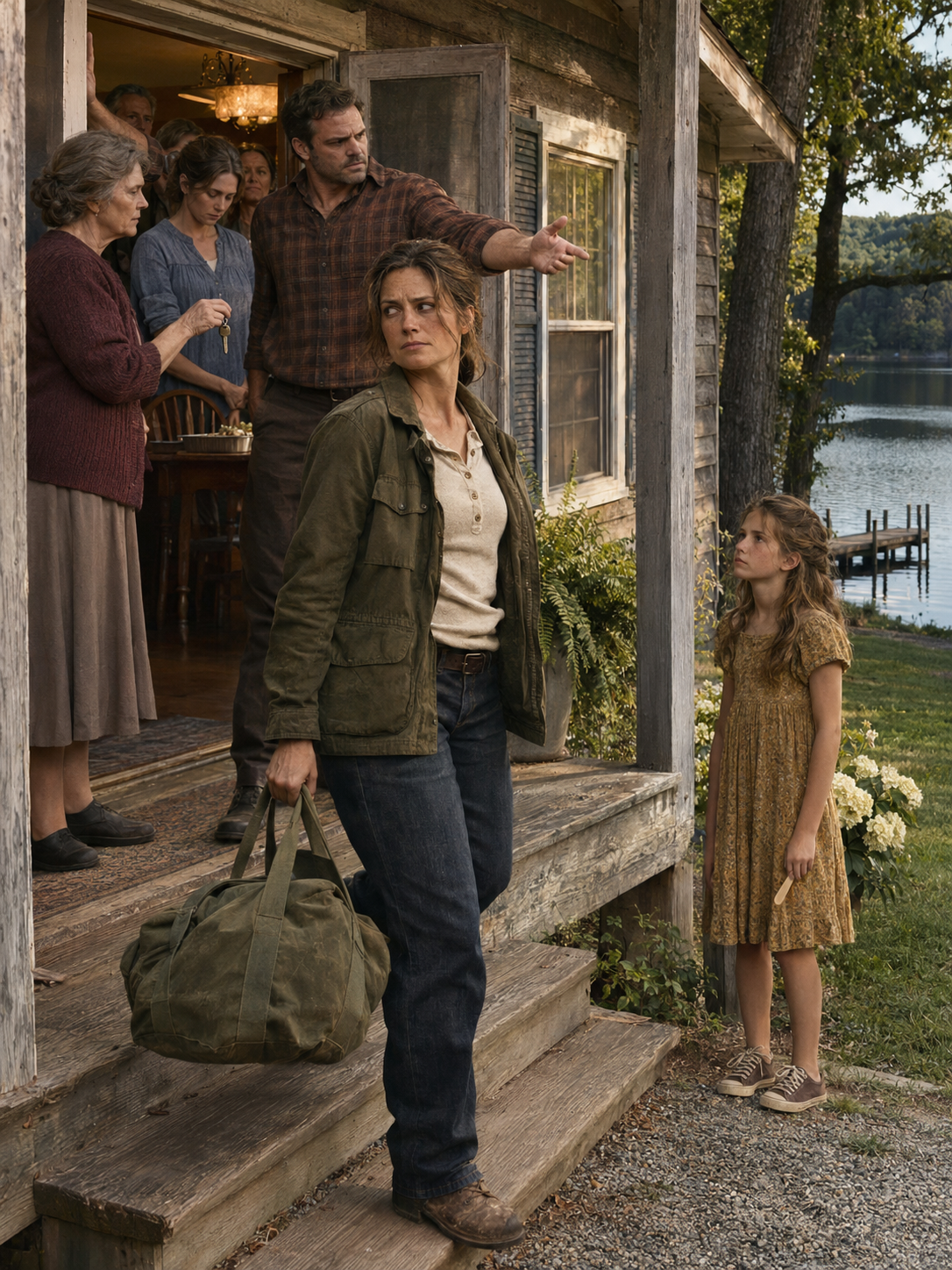
My brother-in-law threw me out of my own lake house in front of twenty relatives, and my mother handed him my spare key.
“You heard Ryan,” she said. “Don’t make your sister watch us do this twice.”
Then Ryan lifted a glass of my father’s bourbon and called me a worthless freeloader.
I set my own glass down. It was plastic. My niece had put a red rubber band around it so I’d know which one was mine. Red was the first color she could spell because it had been on the side of every fire truck in every book she’d owned.
“Did my sister ask me to leave?” I said.
Ryan Mitchell took a step closer. Behind him twenty people stood between the dining room and the open door to the deck. My cousin April was peeling foil off the tray she’d brought. Halfway up the side, she quit peeling and left the foil sticking out.
“This is our family reunion,” Ryan said. “You’re not invited.”
The front door stood open in his hand. My faded T-shirt was damp at the collar where I’d carried two bags of ice from the marina. I could see my sneakers in the strip of glass beside him, the worn gray left one and the white one with the torn heel. I could also see the patrol-shaped dent in his belt where he usually wore his work phone. Today he’d tucked the phone into the breast pocket of his shirt with the camera facing me. A red recording timer was counting up along the part of the screen he’d left visible.
I looked past him at my sister, Lauren.
She was standing beside the framed picture of our father holding a bass in one hand and the bill of a child’s ball cap in the other. The child was me. Lauren was three feet away from that photograph. She got as far as moving one of her feet, then looked down at the floor where it stopped.
My mother closed her hand after she gave Ryan the key. She wore the blue dress she’d worn when we buried Dad. I knew, without looking, that she had folded a handkerchief through the handle of her purse. She always did if she thought she might cry and didn’t want to be seen opening it.
“Are you going to tell her what you told us?” my cousin April asked Ryan.
He looked over his shoulder. April made herself busy with the foil.
“What did he tell you?” I asked her.
Nobody answered me. A little fan turned at the end of the hall. I’d installed it the first week I moved back, using wire Dad had folded into a coffee can. The ceiling box had hung down so far I had to put the screws back in by feel.
I could have shown them the deed in the file box beneath the stairs.
I could have shown them the mortgage statements Dad kept until I paid off the last of them.
I could have shown them the message where Lauren asked me to buy a second ham because Ryan had invited more people.
I could have shown them the text where my mother asked whether there would be room for her to stay over.
I could have shown them the three scratches Dad made on the kitchen door frame the week he noticed I was taller than he was.
Instead, I picked up my duffel.
It was an old Army bag. A quarter of my name had rubbed off the tape above one handle. Ryan had found it beside the stairs and kicked it into the hall before he started. When I raised it, I could tell by the way it shifted that he’d moved the boots I kept in the bottom.
“Leave the other key,” he said.
“I’m taking what’s in the bag.”
He stood there until he realized I’d said it loud enough for everybody in the house to hear. He moved his shoulder away from the door an inch. I had to turn sideways to get out.
At the bottom of the steps, my niece Sophie was holding a cherry ice pop by the stick with nothing on it anymore. She’d let it melt down her fingers watching the grown-ups. She was eleven. The red had worked through a seam in the front of her dress.
“Are you going home, Aunt Mara?” she asked.
I wanted to say it was home. I wanted to say she should go back inside and ask her father where I’d bought the blue bowl she used for cereal every morning of the week they stayed with me during August.
“Walk me to the mailbox,” I said.
She came as far as the flagstone at the drive, where the shade ran out. I handed her a clean bandanna from the side of the duffel. She wiped one finger at a time.
“Tell your mom I’m going to the bait store,” I said. “She can call.”
“What if Daddy says I should stay here?”
“Then stay with your mom.”
Sophie nodded. She went back up the steps before I did anything that might make her stop in the middle and look at me again.
I walked the half mile down to Mullen’s Bait & Grocery. At the foot of the hill was a dirt cut where the Army Corps trucks sometimes parked when they inspected the shoreline. My father used to set a coffee cup on a stump at that corner when he went down with the crews. You could collect it on the way back by putting one arm out through the window. When they found him drowned the previous October, there’d been a cup in the sink and a clean one on the stump.
My mother said he’d been trying to retrieve a loose boat. I was in Wisconsin, clearing out my last set of quarters before I got off active duty. I’d asked which boat. She told me whichever one I thought it was.
That answer used to make me feel mean for asking.
At Mullen’s, I bought a bottle of water and put my bag under a table by the window. A girl started to fetch a mop until she saw I was only changing out of the damp sneakers. There was one pair of boots in the bag. Mine were a half size larger than the ones I pulled out. Dad had written the size on the tongue in black ink because he never wanted to have to look at small numbers when he ordered the next pair.
I set them on the floor and phoned Lauren.
She didn’t pick up. I called again so she’d have two missed calls to look at before Ryan could tell her I’d tried once and left town. Then I sent her a message asking if she and Sophie wanted a ride. I took a photograph of the scuff Ryan’s boot had left on the bottom of the bag. I’d bought the Army patch on the side for four dollars in a shop that also sold socks and hair ties. I’d sewn it on in a barracks laundry room a year before I took command of a company of combat engineers. Now one yellow thread was lying across the dark part of the scuff, still attached at both ends.
I used the store’s paper receipt to write the time Ryan had asked me to leave.
Ten minutes later April sent me a photograph of a stack of sheets laid out under my father’s mounted fishing net. She had photographed it sideways from her chair. It was a formal document with spaces for three witnesses, a place for me to sign in front of a notary, and the heading Family Property Acknowledgment. The page below it was curling up. On the lower right I could make out the letters ROW and four digits. My father used to say if you didn’t know what something meant, you should copy enough of it to be able to ask.
I asked April to take a photograph of the whole second page if she could.
She wrote back, He just put it away.
The phone in my hand lit a second time. Colonel Ruth Dwyer.
I’d worked for Ruth twelve years before, up on the Missouri River, during the summer we put engineering crews into flooded towns to help clear roads. I had most recently called her with a question about the concrete footings visible beside my boathouse. The Army Corps operated the dam at our end of Lockwood Lake in western Kentucky. A narrow federal strip followed the shore below my house. The previous few weeks someone had been tearing out the tops of trees on the strip so boats could come in with the engines running up to the pilings. I’d asked for an inspection because no one had told me who was paying for it. Ruth was due with a project engineer at two, on the way back to the district office.
I answered.
“Mara, is the blue truck your sister’s?” she said.
“Ryan’s. Don’t go past it if it’s blocking the turn. I’m down at Mullen’s.”
“You all right?”
“I’ve been told to leave the house.”
“My brother-in-law.”
There was a beat before Ruth asked her next question. I knew what she was waiting for. In my old line of work you had to know whose call you were taking before you could hand anybody a shovel.
“Does he live there?”
“No. He was there for a reunion.”
“All right,” she said. “I’ve got Curtis Green from the project office with me. He’s carrying a copy of a notification that has your signature. I’d like you to see it.”
“Can you come down here?”
“We’ve already stopped. I don’t want anybody to take off in that blue truck until Curtis has a decent picture of what’s attached at the back.”
That was forty-six minutes after Ryan showed me the door.
At the house, everyone saw the Army vehicle. Sophie told me later. It was a dark utility truck with white government plates and the U.S. Army Corps of Engineers castle on the driver’s door. Ryan had been setting up a group photograph on the deck. He took the tripod inside as soon as he saw the truck. By the time my mother got to the front window, Ruth had stepped down from the passenger side in uniform, and Curtis had walked to the trailer in my driveway and squatted beside the wheels.
Ryan remembered he’d left the bourbon on the railing. He went outside to get it and came around the corner holding it in the same hand he’d used to point me down the road.
Sophie opened the front door before any of the adults.
“Did you come for my aunt?” she said.
Ruth told her it would be good if her aunt was there, but she had come to find out what someone had taken out of the lake.
My niece looked at the tarp strapped over the trailer, then at the adults crowded in the doorway behind her. That was her first chance to say something in front of all of them.
“I know what’s under there,” she said.
Ryan set the glass down on the corner of the railing and missed. It broke at the top of the steps.
In the bait store, Ruth had left the call open on her district phone. Later Sophie told me who’d been standing where. I could tell when Ryan got close enough to it to worry about being heard. He lowered his voice to almost exactly the level he used when he told a server she’d added a drink nobody had ordered.
“It’s scrap,” he said. “We cleaned out the old boat slip for Mara. I have an agreement right here.”
Curtis must have asked to see it. The phone carried a rustling sound.
“Who signed for the project?” he asked.
“I helped the owner with the paperwork,” Ryan said.
“Then where is the owner?”
Another pause. At Ryan’s end of the call a cousin said my name under her breath. Ruth asked Curtis to give her the papers after he’d finished looking at the top sheet.
“Mara,” she said to me, “stay where you’ve got a table. We’ll come down.”
I watched my own face reflect in the bait store window. The water bottle was half empty. I’d smeared dirt from the duffel along the bottom of it. I set it on the floor and asked the girl with the mop for another paper receipt.
A fishing boat rocked on the trailer at Mullen’s. As its owner strapped down a rod, I could see a buckle wag on the far end. In the lake house driveway, Curtis had found a Corps gauge frame under Ryan’s tarp. It had once held a pair of instruments and a small metal plate with the name of whoever was responsible for maintenance. Without it, the only thing left to show where the federal strip began was a bolted steel marker underwater at the outside corner of my slip.
Ryan had taken that too.
I didn’t yet know what he’d told my relatives he was giving them for dinner, after the ham and the potato salad and before the cake. I had a pretty good idea what he thought he’d taken away from me.
Ruth and Curtis came into Mullen’s fourteen minutes later. Ruth stopped just inside the door and wiped mud off both boots. Curtis went back outside to do the same thing. They sat facing the window. A boat motor inside the store had a hand-lettered tag asking customers not to pull the cord. Both of them looked at it before either looked at me.
“Your niece is with your sister,” Ruth said. “They were sitting in the car when we left.”
“Did they ask for me?”
“Sophie did. Lauren wanted to know if you were filing charges.”
I put the wet sneakers in my bag. “Did you tell her what you found?”
“Curtis explained where the frame came from. I asked your brother-in-law to leave it where it is. I also told him we’d be contacting the sheriff.”
Curtis set a photocopy on the table. “Here’s what I need you to look at.”
The page showed the little U-shaped lot on the county map where my house sat. A sketch of a dock the length of a basketball court ran in front of it. Above my name, in a box labeled owner notification, there was a signature. The last line of the M dropped sharply across the a in Mara. I used to do that when I signed something sitting at a folding table with nowhere to put my elbow. I hadn’t done it in eight or nine years.
“He copied an old one,” I said.
“You’re certain you didn’t sign this application?”
“I’d never seen that drawing until now. When did you get it?”
“Monday morning. Your address is listed as vacant and under rehabilitation, and the federal routing materials were attached as a photograph. See the diagonal shadow across the corner?”
I nodded. The edge of the page in the picture had been weighted with a large bolt. I owned a bolt that size. Dad used it when the storm windows rattled. It usually lived on the shelf where he kept the extra hinges, under a calendar from the hardware store.
“Did the application get approved?”
“The one in the project file is pending. He showed us a copy in the yard that says final.” Curtis leaned his elbows against the table. “I asked where he got that stamp and he turned three pages without looking at them. Said his office would call mine.”
Ruth looked at my bag. “Did you have a plan to go back up there?”
“I was going to wait till they left.”
“Have somewhere to wait indoors?”
“Right here.”
She glanced at the girl with the mop. The girl had brought out another chair and set it behind the counter, out of my line of sight. I’d heard her on the phone asking whether her manager wanted her to close early. She left the chair where it was.
Ruth took her district card out and laid it above the two pages. “I can ask a deputy to make sure the trailer stays put while we find out about the frame. For the house, I’d show the deputy what you own and who’s using it. We’ll keep what we know about the shoreline separate.”
I called the county sheriff on my own phone. I gave my name, the house number, and the name of the man who had put me out. Then I called my attorney, Martin Reed, whose father had done title work when there were still upright ashtrays outside every office in the courthouse. I said I needed the most recent deed from my closing and a complete record search, including anything filed that week.
“What makes you think there’s something new?” Martin asked.
“The paper he wanted me to sign took three witnesses,” I said. “He brought twenty.”
While I waited I went outside and watched two men put gas in a boat so old I used to see it go past the dock when I was in high school. The man holding the nozzle didn’t think they could lose enough gas standing on dry land to fill it a second time on the way out. His friend said they were going to be glad to have it when they got there. Both of them had lived long enough with the other man’s way of thinking to let the conversation die before they started the boat.
Last October I’d sat on the floor of my Wisconsin apartment with the small silver plate off my father’s service record in my hand. My plan had been to come home and make him live with me while he got his knees looked at. We’d share the taxes. He’d pretend not to like the chairs I bought and then sit in the same one every night.
The house was already in my name when he died. I’d bought it from him six years earlier, with an appraisal he insisted we order twice, and with both of us holding copies of the closing file. It was his parents’ place and his before it was mine. He kept living in it. I set up a little home office in my old bedroom between rotations and brought my mother there on Sundays after the two of them separated. They’d made a point of never asking me what either one had said about the other. In the last year that rule had fallen apart. Mom tended to ask with the refrigerator door open, as though a jar in there required her full attention.
The week before he died, Dad said he was coming to town to see somebody about the shoreline. He didn’t say the word Ryan. I knew he was thinking about Ryan because he asked how long Lauren and Sophie had been putting groceries on my credit card.
“As long as she needs,” I told him.
“She’s getting groceries,” he said. “What’s he getting?”
I’d told him I’d find out when I got home.
A deputy named Ben Wallace picked me up at Mullen’s. He was waiting while the shop girl brought the receipt from my bottle of water. When I went to get in, he opened the front door for the bag so I’d know where he expected me to sit. He wore glasses that had slipped down the same amount on both sides of his nose.
“Got proof of address?” he asked.
“On my phone.”
“Do you want anybody out besides him?”
“I want to see who’s there.”
He drove up, stopped before Ryan’s truck, and looked at the road on both sides. The Army vehicle was still there. Curtis was photographing a number on the underside of the metal frame. I could see where my mother had stepped around the broken glass to come down the porch. She was holding her purse with both hands.
“She’s upset,” Mom said when Wallace got out. She meant me. She was looking into the rear of the truck for me.
I came around the cab. “Where’s Sophie?”
“By her mother.”
“Where’s Lauren?”
“I think it would be better if you and I had a minute first.”
I went past her. I stopped at the top of the steps so Wallace could go through the door with me instead of having to catch me in the hall. Ryan came around the dining room table with a set of papers. He was already holding one of them up.
“Here’s the agreement that gives us the property,” he said.
Wallace kept his eyes on Ryan’s face for a second. “What name is on the current deed?”
“Trust has the beneficial interest.”
“Does the trust have a deed?”
Ryan tapped the paper with the side of his hand. “We’re sorting that out.”
“We don’t have to sort it out in the hall,” I said. “That’s the unsigned acknowledgment April showed me.”
April was still in the dining room. She pressed her lips together when I said her name. Ryan turned halfway toward her. That was when I knew he didn’t have a deed he trusted enough to hold up where both she and a deputy could see it.
Sophie came out of the pantry with the blue cereal bowl in both hands. Lauren was right behind her, holding a dry dish towel.
“We were getting her something to eat,” Lauren said. She looked at me so I would understand who she meant.
I handed Wallace my phone with the record up. First page, address. Second page, name. I had a photo of Dad picking up his set of keys at the closing. I let the photo stay where it was.
Wallace read every line on both pages. Then he asked Ryan and me to step outside, and he told Ryan that I had asked him to go. Ryan hadn’t actually heard me ask yet.
“I’m asking you now,” I said.
“Everybody?” April said from the doorway.
Sophie had come close enough to hear. I could see a dry square of cereal stuck against the rim of her bowl. She walked down one step, then came back up and handed me her father’s glass of water. She hadn’t meant to bring it out with her. She set it down almost without looking at it. Then she went straight to Lauren and held on to the hand with the dish towel in it.
Ryan went inside to get his keys. He walked close enough to me that the watch on his wrist clicked against the railing.
“I’ll tell you one thing,” he said. “They came up here because they still thought you’d do something for your sister.”
“Lauren asked me to buy a ham. What did you ask for?”
He went inside without answering.
He left in a car driven by one of his cousins. The blue truck stayed where it was. Curtis and the deputy had arranged for a tow and documentation of the equipment, and the deputy had instructed everyone to give them room. At the bottom of the steps, with his cousin waiting, Ryan handed my key back to Mom. She put it in her bag before she looked up.
A slow procession of people began carrying food out of my house. They left the ice, the ham and four unopened tubs of macaroni salad. Dad always bought another bag of ice when he wanted to be the last person home from a party. There were nights when Lauren and I had gone out ahead of him and waited in the car, watching him take his time at the cooler exactly long enough to have a conversation with the host.
My mother left with Uncle Neal. April finished closing up the kitchen and followed her out. She stopped beside me long enough to put a folded square of paper on the railing. It was a copy of a check.
“They said the money held a slip for us,” she said. “Dad had been talking about getting another boat before he died. I thought it would give my mom somewhere to go.”
“Who said it?”
“Ryan. He said you and Lauren wanted to keep the lake in the family. I don’t know who talked to my mom. She’s got receipts for everybody.”
I looked down. April had paid eight thousand dollars to a company called Lantern Shore. The memo said Slip 04 underwriting reserve. The payment was dated early in February.
“Did he tell you how many slips there were?”
“Twelve. He showed me a picture with room for fourteen, but he said he had two he’d promised the survey team.”
I watched her go to the car. Then I went back to the deck.
Lauren was sitting on the floor with her back against the railing. Sophie had found a blanket folded under the rocking chair and put it over both of their legs. They had moved where they could see boats on the lake instead of the driveway.
“Did you know about the slips?” I asked.
Lauren nodded.
“Did you know he signed my name?”
She didn’t move. Sophie ran the edge of the blanket through both hands and stopped when she got to the hem.
“He said you bought the house with Dad’s own money,” Lauren said eventually.
“That would’ve been a lot of trouble for Dad to go to. He saw every check.” I took the chair across from her. “What did he tell you we were supposed to sign today?”
“He called it a settlement. Mom told me to tell him you’d be more likely to say yes if everybody saw you look at it.”
Sophie lifted the blanket off her legs. “He had me take pictures from down by the water,” she said.
“The house and the things he’s been taking out. He wanted the pilot light on the gauge in the picture before he moved it. I turned the camera over too fast and he made me do it again.”
Lauren reached for her. Sophie put the blanket down and went inside. Through the glass door I saw her pull her school backpack out from under a chair. She brought it over, took a green camera out of a zippered pocket and put it on my knee.
“I turned it back over when he started talking,” she said. “I wanted him not to have to tell me all over again.”
The memory card was still in it. I asked her to turn the camera toward the three of us and show me which date she meant without erasing anything. She scrolled back a week on the camera. A row of pictures of the lake crept across the little screen.
“There,” she said.
A video opened. At the bottom of the frame was the spill of sunlight on the gray boards at the end of my slip. Ryan stepped over a rope, took a phone out, and spoke to somebody about the closing.
I heard him give a date.
It was the following Monday.
Then he said, “I know her name is on it. That’s why we need her out of the house before you come take pictures.”
I asked Sophie how long the camera had been running before Ryan took out his phone. She said she didn’t know. The sun had got in her eyes and she hadn’t wanted to see him get angry about the picture again.
“The camera sees a little more than the screen,” I said. “You got it right.”
She looked down at the end of the video. Her father was taking two big steps without holding on to anything. From where we sat, I could see the second board flex in the frame when he put weight on it. Dad used to step over that board because the screw at one end stayed loose no matter what screw he put through it.
“Dad said you bought your boots at the secondhand store because you spent all the Army money,” she said.
I took the duffel out of the hall and set the boots beside her. She pulled one up by the loop until she could see the number on the tongue.
“Different Dad,” I said. “These belonged to my dad. I’m going to see if a man in town can put new soles on them. You can have the laces if you’d use them.”
“Are they really his?”
“You can put one on your foot.”
She took one sneaker off. For a while Lauren and I watched her untie her grandfather’s boot and put it on. She stood the same way he used to when he tried a size in a shoe store, putting her weight back until all of it was on the heel.
“It’s a boat,” she said.
She laughed. Lauren folded the blanket into a smaller rectangle in her lap. I could see how hard she was trying to remember how she was supposed to look when Sophie laughed.
I asked Lauren to wait with her while I called Martin.
“April brought me a slip deposit from a company named Lantern Shore,” I said. “There are probably others. If Ryan’s trying to borrow on the house, he’s trying to finish by Monday.”
Martin already had the latest deed on his desk. There was a fraudulent-looking filing in the public index under the property number, recorded Thursday. It was a notice that an option had been granted to Lantern Shore, and it attached a page Mr. Mitchell claimed gave him authority to sign documents for me. Curtis’s sketch called the strip of water in front of my house a private marina. Every part of it depended on a surveyor locating a boundary in the middle of the old lake gauge. They took the gauge out, photographed the slip without it, and used my name to move the line.
“Do you know who scheduled the closing?” Martin said.
“We’ve got a voice on one end of a phone call.”
“Find that person. Don’t send the video around. If the information he’s given the lender hasn’t tipped them off, the timing might.”
I put my phone down and looked at Lauren. She had put the dry dish towel in the tray where we kept crackers for fishing. I’d watched her do it twice when we both still lived here and she was late for school. I used to put it back in the right place and ask her where she left the keys. She always knew where she left the keys.
“What name does he use for the man he keeps calling about the house?” I asked her.
“Gordon. Lately he goes outside to talk to him.”
“Bank or title company?”
“I think it’s an investor. Ryan said he was going to come up in a seaplane to inspect the slips. Sophie drew him a map.”
She’d drawn it on the back of a store receipt. It was tucked into the bottom of the backpack with an old cinnamon gum wrapper. At the top she’d written the name in blue marker and drawn a dotted line where he was supposed to land.
“Gordon Vale,” she said.
Martin recognized the name. He sent a notice of dispute to the local title office and a second one to Vale, using the contact information on a mortgage he’d handled for another business. The man called me Saturday evening from a bowling alley where his son was having a fifth birthday party.
“Who’s living in the house right now?” he asked.
“I was told the house was unoccupied for the last six months.”
I looked across my kitchen. On the door of the fridge, under a transparent circle from a packet of Bait Shop magnets, there was a school calendar with tiny Xs where Sophie had slept over. Some of the Xs crossed halfway into a second date. She’d been keeping a record of which nights we had breakfast for dinner.
“I can give you enough people to check that,” I said.
“Mr. Mitchell said your dad had one daughter who remained interested in the house.”
“He was right about the number. He was wrong about which daughter.”
“Can you tell me what kind of authority you gave him while you were away?”
“None. Dad had limited authority to write checks on a joint account we used to pay bills here. Only Dad.”
Gordon told someone to go ahead and cut the cake. He made up a number of minutes he’d be and waited until the person went away.
“There’s a photo session Monday,” he said. “He asked if we could take a statement from the departing occupant while the appraiser was there. He said there would have to be a family meeting before he could arrange that.”
I could still see the little green dot on Ryan’s phone. He had wanted an excerpt that went from leave to my back going out the door. The only question I’d asked about where I was supposed to go was whether my sister had asked him to tell me.
Gordon said he would contact his lawyers. He sounded angrier than he had five minutes earlier. The money would stay where it was until somebody called him back with a believable reason to move it. He said he’d wanted a dry house, a clean title and a marina profitable enough to pay back the loan in three years. I could hear the birthday song start up behind him. He turned his head and sang the first two words when the group got to his son’s name. Then he said goodbye to me and hung up.
The loan amount in the file was four hundred and sixty thousand dollars. Gordon said he would give the file to Martin if the seller’s signature sheet turned out to be false. On Sunday morning he did. Lantern Shore’s first payment would have sent more than a hundred and eighty thousand dollars straight to Mitchell Excavation, the company Ryan ran from a shop on the state road. The rest would have been split among an arrears payment on the equipment, a reserve for the loan itself, and a plan for replacing the old dock with slips that nobody had said he could build.
When Martin brought me a copy, I recognized the writing on the authorization. It was my older signature, the one at a desk with nothing to lean against. The jump at the bottom of the M had traveled with the black line under my name. Someone had taken it from a form I filed with Dad to change where the tax notices went while I was overseas. The older document had the initials of the employee who witnessed it. I found the edge of one of her letters in the newer one, exactly at the point where the copied line cut off.
I put both pages on the scanner at Mullen’s so Martin would have the same numbers I did. Then I took Sophie to breakfast. We sat on stools at a counter near the lottery ticket machine. I asked the waitress if they charged more if a pancake was the shape of a fish and brought it to Sophie on a plate still warm underneath. She took a bite out of the tail and put her fork down.
“I don’t want to get him in trouble,” she said.
“He’s already in trouble for what he did.”
“How much?”
“I don’t know yet.”
She looked at the empty place on the counter where the tip of the pancake had been before she moved it.
“He told me if I close one eye the lake looks closer than it is,” she said.
“Is that true?”
“I can make two shorelines with both eyes if I look at my finger.”
She held it up and showed me. I looked at it until I saw two shorelines. Then I asked her if I could see the picture she drew of the seaplane one more time. She made me hold it by the corners so it wouldn’t crinkle.
When we got back to the house, Ryan was sitting in his cousin’s car on the other side of the mailbox. The motor was running. The same cousin had driven back down to get his truck and hadn’t known what to do when he saw the space where it had been towed.
I stopped at the drive with my window closed. Ryan leaned past him and pointed at the passenger side of my car. Sophie set the drawing flat on her legs.
“You want me to say hi?” she asked.
“Do you want to?”
She thought about it. Then she raised all five fingers high enough for her father to see. I stayed beside the box until he raised a hand back. When he saw me start to turn, he mouthed something.
It was Tell your sister.
Lauren was in my kitchen with a grocery receipt from the previous month on one side of her and her laptop open on the other. She’d found the charges she’d made with the card I gave her. On the same days there would be a second set, made in round numbers at an ATM.
“How long was he using the business to keep the equipment paid up?” I asked.
“He kept saying he needed to finish a job and one check would take care of everything.” She turned toward the lake. “He never said which check.”
I set Gordon’s payment schedule on the counter. He had put a little star where the first wire would have gone. The wire would have put a good portion of the debt on my house. With one signature, the hand he’d been telling to get off my property would have been the one responsible for paying it.
Lauren put her index finger under the note about the excavator. When she spoke again, she sounded a lot younger.
“He took Sophie out in it after dinner once. He said the one good thing about working weekends was nobody was around to make him send her back home.”
I let her look at the page. There was an envelope addressed to Ryan in the file. The company had been notified that the excavator would be picked up if no payment came through before Monday. His last chance to pay fell on the same day he wanted somebody to certify I’d left my house.
“Can I stay here a few days?” Lauren asked.
“Can he call Sophie?”
“We can answer from the other room. Let’s set a time so she’s ready.”
Lauren looked down at the receipt again. I couldn’t count the number of times I’d heard her say she was going home after a visit. I could count the times I’d asked what she was going home to. On one of those occasions she’d told me the floor needed mopping twice because Ryan wouldn’t take his boots off. I remember asking what kind of flooring they’d put down. I wish I’d asked whether he mopped.
Wallace called in the afternoon. He’d taken Sophie’s account through a specialist so she wouldn’t have to tell it to a room of people. Curtis could identify the official marker and gauge frame as the ones from the bend at my house. He said the district would put up temporary markers and determine what had to be restored. Ruth was at the far end of the lake looking at another inspection. She’d asked him to tell me where to reach her if I saw the water running over the base of the slip again.
“I meant to ask,” I said. “Was there any other evidence about my father’s death in the file about the dock?”
Wallace took a moment. I’d heard him do that when an answer might come out sharper than he wanted.
“The report from October says your mother made the call, after she saw him in the water. Their boat was farther out than his arm could reach. A dock rope was torn.”
“Was he wearing anything that would hold him up?”
“Do you know if they checked any cameras?”
“There was a line in the report about a camera on the Corps channel pylon. They were told it didn’t record. Why?”
“It did when Dad worked down by the dam. He used to get mad if the fishermen asked him to send them clips. They’d think if you used it to catch something you couldn’t use it to check the water.”
Wallace said he’d ask for the file and call me if there was something new. I told him I’d leave it with him. Then I put the phone down and went to the dry sink by the mudroom door. A white plastic hook was screwed to the wall above it. For most of my life, Dad’s float coat had hung on that hook, with one pocket turned out because he used it to hold keys wet from old rain.
The hook was empty. There was dust on its upper edge and none underneath.
I asked Lauren if she’d seen the coat.
“Mom said she took it home,” she told me. “She wanted to wash it before the funeral. I said nobody was going to put it on him.”
“You were here?”
“I was waiting with Sophie after they took the boat. Ryan had gone down to his truck.” She turned a page without looking at it. “Mom made him come back in and help wash the dock.”
My knee touched the dry sink. Inside it was a little bit of black grit, as though somebody had shaken the dirt out of a front pocket before it could get on the floor.
I left it there.
On Monday a man came up to the lake house with a camera, a tape measure, and three questions about access. He drove a small white car with an Indiana plate. The man had been sent to appraise the property by a company Ryan had hired, separately from Gordon. He’d spent Sunday in a motel forty miles away because he was supposed to start by seven. No one had told him the closing was off.
I let him come as far as the picnic table. There he told me his name and spread the documents across two seats. He was still trying to find the right place to say he was sorry he’d come when Ryan pulled up behind him.
Ryan had his good shoes on. He took a black folio out of the back seat of the car and laid it on the hood. There was a pen clipped to the edge and a yellow tab marking a place to sign. He looked at the appraiser and said he hadn’t realized he was bringing so many papers out in the open.
“The owner asked to see them,” the appraiser said.
Ryan set his hand on the folio.
“I had an appointment with someone from the family,” the man added. “We were going to talk about the buildings and the permits. I was sent a list.”
“Show me the buildings,” I said.
He turned a page so I could see it. A list of improvements included the screened porch, the garage, and a proposed guesthouse where Dad’s lilacs stood. The fourth improvement listed was removable dock, acquired with existing operating rights. Beside it was an aerial picture of the lake with a dot where the shoreline marker ought to have been.
“I took a picture of that marker on Tuesday after I tripped on it,” I said. “They took it out of a federal strip. The Corps has it now.”
The appraiser drew a line through the fourth item. In the margin he wrote the time.
Ryan picked up his folio again. “Would you give us two minutes?”
“No,” the man said. He glanced at the road as if he’d just remembered how long it took to get anywhere else. “I was sent to do a job. I’ll need to report this back to my office first.”
“Send them the owner’s number.” I wrote my number on one of Martin’s cards, with my name clear enough on top that there would be no mistake. “Tell them they can call me.”
After the man went to make his call, Ryan stood there long enough that a drop of sweat ran down one side of his face. The blue parts of the lake were so still from where I stood that you could see the outline of the clouds.
“You going to tell him what it cost Dad to keep this place when you were gone?” Ryan asked.
“Which Dad do you mean?”
That stopped him. My father had been Tom until he started going round acting like he might get the house. I wished Lauren weren’t close enough to hear how easily he said it today.
“You know how humiliating this is for her?” he said.
Lauren had come out on the deck with a small notebook unopened in her hands. At the foot of the stairs Sophie’s ice pop stain had dried into a pink dot on the flagstone. It made a little mark where the water from the porch sprinkler couldn’t reach.
“Ask her,” I said.
Ryan turned. He looked like he was going to open the folio for Lauren and show her what was on the next page. When she started coming down, he closed it.
“He can help us cover the loan,” Ryan told her. “Vale backs out, we can go to the other person. You don’t have to panic over this, Laur.”
Lauren read something in the notebook. “What’s left to cover after the deposit money?”
Ryan stuck out his jaw. “That’s business money.”
“April thinks it’s her slip money. She’s called me twice this morning. Her mom called me, too.”
“Then tell her she can have a slip.”
“She can’t.”
He looked down at the notebook. “Who’s helping you with this?”
“Sophie did the adding. I read her the numbers and she wrote them underneath each other at the kitchen table.” Lauren lifted the book just high enough for him to see the open page. “You borrowed from her account, too?”
A bunch of grackles flew off the surface of the lawn. They went away low, almost in a straight line. I watched Ryan turn his head after them.
“You gave me permission to handle the bank,” he said.
“You took forty-three hundred dollars that she got from Grandpa. Tell me where it is.”
Ryan looked toward the man with the camera. He had gone back to his car to make a call. He stayed in his seat with one foot on the gravel. He had his face toward his own steering wheel.
“Same place as the rest of it,” Ryan said. “Keeping people working.”
He pulled his car keys out of his pocket. None of us moved to give him room because there was room all the way down the drive. He looked at me while he walked.
“I’ve got people coming to reclaim the parts that belong to me,” he said.
“What parts?”
“The old stairs on the slip. The aluminum poles. The wood I’m working with.”
“Tell them to call the deputy first.”
His face changed. For a second I thought he might come back to say it again in language he could fight over. Then he set his good shoes carefully on the running board of his cousin’s car, got in, and drove out.
I took the notebook from Lauren. She had multiplied the number of deposits by what April said she’d paid. Then she’d gone back and subtracted the ones she couldn’t name. The numbers she could name came to more than sixty thousand dollars. I could see four family members in the small stack of deposits that matched dates when Dad was still alive. One line in the notebook was the number of Sophie’s account with a square penciled around the last four digits.
“Were you going to tell me about that?” I asked.
“When I thought I could put the money back,” she said. “On a day when I didn’t have to tell her.”
I carried the notebook inside and put it on the table. I asked Lauren whether she wanted me to stay while she talked to Sophie. She said she wanted to do it herself and asked if I could make lunch. I made three sandwiches. I made Sophie’s first and left it at the counter until she came for it. When she did, she picked it up and ate it the way she ate anything that she thought she might need both hands for eventually. Straight down the middle to leave a good edge on both sides.
She brought her mother the pickle.
The truck that came up about eleven belonged to Mitchell Excavation. It was driven by a short man with long hair poking out below a cap that said Dewey. His helper was nineteen. He climbed down with a water jug almost too big to get through the door sideways. The older man told me he was there for a dock and a set of stairs. He said he’d been told to leave everything alone that was fixed to the house. His helper looked at the shoreline and asked him what was fixed to the lake.
“Do you want to get paid for today?” I asked.
The older man nodded and started to reach for his phone.
“Call the dispatcher first and get it on your time sheet how long you’ve already been here. I can tell you what’s in your boss’s paperwork and why his men need to stay out of the water. Then you can call whoever sent you.”
I showed them the deputy’s contact card and the photo of the gauge on the trailer. The nineteen-year-old went to the truck for a clipboard. There was a cancellation notice stuck to it with an old packing slip. He held it up to read the top part against the sun. Two projects were crossed out in pencil. My address was the only one left.
“He promised me three days this week,” the boy said.
The older man took the pencil from the clip and handed it to him. “Put down an hour and a half,” he said. “I’ll sign it when we get back.”
Nobody set a boot on the slip. They drove away with both hands of the helper around his water jug. I sent Martin the truck number and called Curtis to let him know what we’d done. He came up later with two other people to lock out the area until their survey wrapped up. One put a temporary orange marker where the old device had been. He had to go deep into the water to get the angle right. I watched from the deck until he signaled them to stop the boat and back away.
The water settled. A cormorant came in lower than the line of the dock. It got close enough to show both feet, then went under and didn’t come up again where I was watching.
It took three months to get Ryan’s filing removed from the property record. The title company had me bring copies of the tax form with the copied signature, and Gordon signed a declaration about the money he’d never sent. Dad’s closing attorney was dead, but his assistant remembered us. She said I’d come in an hour early because Dad had heard there would be powdered doughnuts. That was true. We’d had to get them ourselves.
Ryan was charged over the false papers and the deposits. He agreed to plead guilty to one fraud count in exchange for a repayment plan tied to what he had left. The auction took his excavator, two trucks and a machine that could shape rock out of a field the size of a parking place. Some of his customers came to the sale, expecting to get the things he’d promised them. A man he used to pay on Thursdays came with his wife and stayed long enough to see what the shop benches sold for.
Gordon had to go back and explain how he’d nearly lent so much for improvements no appraiser had seen. He called me after the hearing to ask what kind of coffee I bought when I was home. He sent me six pounds of it in an expensive tin. I gave the tin to Sophie so she’d have a place to put pencils. It had a ring inside the lid she could tie the bootlaces to when she needed to be able to open it with one hand.
Lauren and Sophie stayed with me through the end of the school year. She asked before she took the key out of my pocket to have one copied. The first night she came back from work late with it, she got the lock, came inside and put the chain on without making enough noise to wake me. I woke up just in time to hear her go back and undo the chain for me. I said her name so she’d know I was there. She said mine, too, then put the chain back.
Late in August, the man who repaired my father’s boots called to tell me they were ready. I went to his shop after somebody spilled a bag of seed between it and the hardware store. Little birds were hopping right up to the door. The man held one boot in each hand and waited for me to put mine out.
“I’ve got them a little heavier than he used to like,” he said.
“You knew him?”
“He’d come in before a trip and tell me he had two days before we had to let everybody else out on the lake. I asked him once why he bothered making it sound like he owned the whole thing when he knew I wouldn’t believe him.”
“What’d he say?”
“He said when those guys had to take the ham out of their lunch for the last time, he hoped somebody would get them out where they couldn’t hear a phone ring.” The man put the boots on the counter. “Yours won’t fit like his.”
They didn’t. The heel on the right pinched if I put my foot flat. I brought them home anyway. Sophie asked whether we could leave them next to my shoes by the door and put somebody’s feet into them if they ever needed to go through the mud to fetch a ball. I put them beside the bench. The first thing she slid into them was a grocery bag with all the keys she’d found in Dad’s tackle box. Most of them had no teeth sharp enough to open anything anymore. One opened a padlock on a window well by the shore. Dad had painted the head red. Sophie used it twice and put it back in the bag each time. I thought I was teaching her how to keep track of a key.
My mother still called Sundays. She went six weeks without mentioning the reunion. Then on an afternoon in September she asked if I remembered what she’d said at the door about making Lauren watch us do it twice.
“Yes,” I said.
“Your father left the night we split up. Lauren was standing by the banister. I told myself it was the same thing.”
“Did you have me mixed up with him?”
“I wanted Lauren to see me get my way for once without telling me I sounded like him.” It came out so quickly I had to look out the window for a second to decide whether I’d heard her right. “I know you didn’t ask me to explain that part.”
I told her Sophie was having friends over that Saturday. She asked whether it would be okay to drop a cake off early. I said if it was supposed to be a surprise she could leave it with Janice at Mullen’s. Mom didn’t bring a cake. She made seven dozen little cherry pastries Sophie could give away without asking one person to cut for everybody.
She came to the front door that time and waited for me to open it.
By October, the Corps put the rebuilt gauge back into place. Curtis wanted one more look at a line running out of the old assembly before he archived the demolition pictures. It was from hardware Dad had used back when he worked there. Curtis asked if I recognized a plastic housing mounted behind the gauge frame, below the level of the slip. I did. Dad bought two of those housings secondhand at Mullen’s. He used one at the house and one to keep a camera running when he couldn’t see the water from the road. The one Curtis found was split along the top. When he asked about the missing back plate, I told him the man who sold it to Dad had replaced that part with a metal sleeve. The sleeve held the card inside on a bar that ran across the middle.
Curtis told Wallace where to look. They still had the gauge frame and all the material that came off it in evidence. There was mud packed around the sleeve, enough that it could have been one solid piece. It took the lab several weeks to extract the card and recover a readable file.
They called me just before sunset on a Saturday. I was down by the little lilacs with a clean length of rope. Lauren was taking a double shift. My mother had asked if she could take Sophie down to the sandbar one last time before they put her boat away for the winter. I’d said to ask Lauren. Sophie had asked me to hold the rope for her when she came back because Grandma didn’t like getting her feet wet.
“What did you find?” I asked Wallace.
“Can you get inside the house?” he asked.
“I’m outside. I have my phone.”
“Is Sophie home?”
“She’s out on the lake. Why?”
Wallace started to say he needed me to look at a clip. Then he asked who had Sophie on the water. I told him. I looked up from the rope. The lake below the dock was catching the last sun. A white boat was halfway down the channel.
Wallace made a sound like he’d put his hand across the mouthpiece of his phone. He said a few words to somebody with him, then came back.
“I’m sending a boat to meet them. Stay where you can see the channel,” he said. “I need you to look at one video and tell me who you recognize.”
The file was twenty-two seconds. It began with the view from underneath the gauge, the one Sophie would’ve gotten if she’d lowered her camera until it sat on the boards. The camera had a microphone. I could hear the rope creak against a cleat. Dad was in the water, one hand on the side of the dock. I recognized the back of his head where the hair had been given up on. He reached for help with his other hand. The back of his wrist showed. There was a black thread hanging from the seam of his shirt.
My mother knelt beside him. She had his red life ring. Dad put his hand up for it and she drew it back into her lap.
Ryan’s voice came from somewhere above the frame. He told her they should get the boat and bring it around.
My mother looked up. “If he gets out, he’ll tell Mara whose money we took.”
Dad’s hand slipped off the dock. It came up again far enough to show his wedding ring. He wore it on fishing days so he’d know where it was.
My mother set the life ring behind her. She used both hands.
I looked up at the white boat going down the channel. It was slowing. I could see a person standing near the stern with something long in one hand.
My own phone buzzed against my cheek. Sophie’s picture came up. I put Wallace on hold and answered.
“Aunt Mara,” she said. “Grandma wants to know where I keep the green camera.”
I turned toward the road. Wallace was twelve miles away. Ruth and Curtis could get a boat into the water at the upstream ramp if the gate was unlocked. There was nobody on the opposite shore.
“Sophie, put your life jacket on,” I said.
“I did. Grandma says I can take it off till she’s ready to go back.”
“Keep it on, honey. Tell me what you see.”
A little gust picked up the loose end of the rope at my feet. Sophie took two deep breaths so close to the phone I knew she was holding it underneath her chin.
“The old stairs,” she said. “Grandma says I have to show her where Grandpa fell.”
The boat’s lights went out.
✓ Lynn R. Adams
My Brother-in-Law Called Me a Freeloader and Threw Me Out of My Lake House, Then an Army Vehicle Pulled Into the Driveway My brother-in-law threw me out of my own lake house in front of twenty relati…