My Brother Helped the HOA Cut 63 Trees From My Land—Then a Dead Man’s Letter Triggered $4.7 Million in Charges and Arrests
🔥HERE’S THE NEXT PART OF THE STORY, ENJOY !! The explosive twist and the final ending of this story ! ⬇️💬 Thank you ❤
Then I left.
Mark stood on the porch watching.
“Where are you going?”
He looked almost disappointed.
“You’re not going to argue?”
“You’re just leaving?”
I lifted my suitcase into my Subaru.
Mark crossed his arms.
“You know, Claire, this is probably for the best.”
I looked at the house.
Then at him.
“Probably.”
That smile returned.
He thought silence meant surrender.
He had no idea my father had spent his final months preparing for exactly this moment.
I checked into the Blue Ridge Motor Lodge six miles outside town.
One queen bed.
One humming air conditioner.
A Bible in the nightstand.
A coffeemaker that tasted like burned plastic.
I sat on the bed and opened the green metal box.
Inside were five things.
A brass key.
A survey map.
A flash drive.
A sealed letter from my father.
And a copy of a deed.
I read the deed first.
Then I read it again.
The forty-one acres behind the family house were not part of Dad’s estate.
They hadn’t been for eleven years.
They belonged to me.
Dad had transferred them into the Claire Bennett Land Trust in 2015.
I was the beneficiary.
My father’s longtime attorney, Samuel Price, was trustee.
Attached to the deed was something else.
A conservation covenant.
Twenty-seven of the forty-one acres had been placed under permanent woodland and watershed protection after the county approved Dad’s conservation application in 2017.
No commercial timber removal.
No grading within the protected buffer.
No road construction.
No subdivision without county review.
The trees on the northern ridge were specifically identified because their root systems protected a tributary feeding Pine Ridge Reservoir.
I stared at the paperwork for a long time.
Then I opened Dad’s letter.
If you are reading this, somebody has told you that you do not belong on the land you spent half your life protecting.
Do not argue.
Do not warn them.
Do not interrupt them while they are making the mistake.
Call Samuel.
Then call the county watershed office.
Your brother knows enough about the property to be dangerous, but not enough to be careful.
I made that mistake with him.
Do not make it again.
The land is yours because you stayed when everybody else found a reason to leave.
But understand something more important.
I did not give you the ridge because of what it is worth.
I gave it to you because some things should belong to the person who loved them, not the person who calculated them.
If anyone cuts protected timber, removes boundary markers, or files documents claiming ownership, ask Samuel about Section Nine.
He will understand.
I read the final sentence three times.
Section Nine.
I had no idea what it meant.
So at the next morning, I called Samuel Price.
He answered on the second ring.
“You knew.”
There was a pause.
“How much did you know?”
“Enough to be waiting for this call.”
I told him about Mark.
The suitcase.
The HOA folder.
When I said sixty-three, Samuel stopped me.
“Exactly sixty-three?”
“I counted.”
“Do not speak to Mark again.”
“I already did.”
“About the trust?”
“About the covenant?”
“About your father’s letter?”
His voice changed.
The gentle old attorney disappeared.
What replaced him sounded like a man reaching for a weapon he had kept polished for years.
“Take photographs of every stump. Wide angle and close. Photograph tire tracks. Equipment. Company logos. License plates. Boundary stakes. Anything disturbed. Do not trespass anywhere you do not own.”
“I’m going back now.”
“Because first you’re coming to my office.”
Samuel’s law office sat above a pharmacy in downtown Pine Ridge.
Same building for thirty-four years.
Same frosted glass door.
Same brass nameplate.
When I arrived, he had three files on his conference table.
One was mine.
One was Dad’s.
The third said SILVER CREEK DEVELOPMENT AGREEMENT.
I looked at it.
Samuel followed my eyes.
“Your father knew the HOA wanted access to the lake.”
“Dad never belonged to the HOA.”
“Neither does the house.”
“Neither does my land.”
“Then why were they cutting my trees?”
Samuel folded his hands.
“Because Silver Creek Estates has a problem.”
He opened the third file.
Silver Creek was a gated subdivision built on the eastern side of our ridge.
Eighty-six homes.
Artificial stone entrances.
Decorative streetlamps.
Quarter-acre lawns.
A clubhouse overlooking the reservoir.
Except the clubhouse did not actually have direct lake access.
Their original developer had promised residents a marina.
The county denied the permit because the only practical access route crossed protected watershed land.
Dad’s land at the time.
For years, the HOA had asked Dad for an easement.
He refused every offer.
The last one was $600,000.
Mark apparently knew about it.
Samuel slid a photocopy across the table.
It was an email.
From Mark Bennett to HOA President Diane Mercer.
My stomach tightened.
Samuel said nothing.
Once the estate issues are cleaned up, access should no longer be a problem. Claire has no financial capacity to fight this, and she has never shown any interest in development. My expectation is that she will relocate voluntarily.
Please proceed according to our discussed timeline.
I read it twice.
“Where did you get this?”
“Your father.”
“Three months before he died.”
“Dad knew?”
“Your father suspected.”
“Why didn’t he tell me?”
Samuel looked tired.
“Because he was ashamed.”
That hurt more than Mark’s email.
“Of believing your brother.”
I sat back.
Samuel continued.
“Mark convinced him two years ago that Silver Creek wanted a simple emergency access easement. Fire vehicles. Ambulances. Nothing more. Your father nearly signed.”
“But he didn’t.”
“No. Because he asked me to review it.”
Samuel opened another folder.
“The easement would have permitted a forty-foot access road, utility installation, drainage work, and shoreline improvements.”
“Eventually.”
“What does this have to do with Section Nine?”
Samuel almost smiled.
“Everything.”
He turned the conservation covenant toward me.
Section Nine dealt with unauthorized destruction.
If protected timber was knowingly removed in furtherance of unpermitted development, the responsible party could be assessed restoration costs, watershed mitigation, erosion remediation, lost canopy valuation, habitat replacement, and enhanced civil penalties.
If fraud or false ownership documents were used to authorize the work, the matter could be referred for criminal investigation.
I stared at him.
“If they cut what you say they cut?”
“How very?”
Samuel removed his glasses.
“Claire, do you remember how your father used to say not to interrupt a man who was digging his own hole?”
“Today would be an excellent day to honor his memory.”
We drove separately to the property.
By the time I arrived, the logging crew was gone.
But the damage looked worse in daylight.
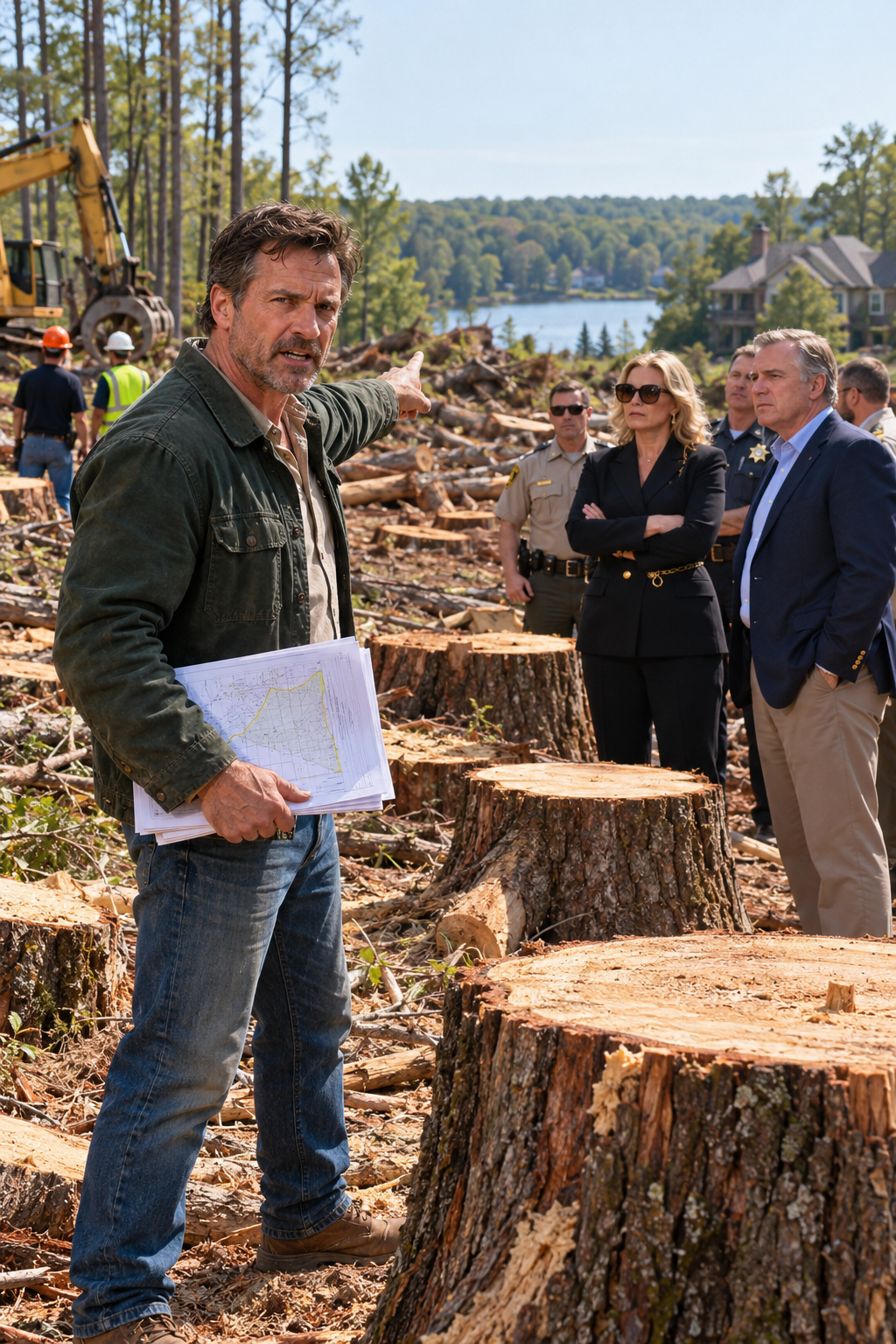
Sixty-three stumps.
Several were within twenty feet of the creek.
Tracks from heavy equipment had cut deep ruts into the slope.
Two orange boundary markers were lying in the dirt.
One had been snapped.
The other had been pulled out completely.
I photographed everything.
Then I noticed a wooden stake with pink ribbon near the northern edge.
A number had been written on it.
Thirty yards farther.
They continued toward the lake.
Road stakes.
My brother and the HOA weren’t just clearing views.
They had already surveyed a route.
That was the first mini-payoff.
The trees were not the crime.
They were the preparation.
Samuel called the county watershed office.
At that afternoon, a white county pickup arrived.
A woman in khaki pants stepped out.
Her name was Dr. Elena Ruiz.
County environmental compliance director.
She walked the site without speaking for almost twenty minutes.
She measured stumps.
Photographed streambanks.
Checked GPS coordinates.
Then she looked at me.
“Who authorized this?”
“I was hoping you could help me find out.”
She pointed toward the HOA neighborhood visible through the new opening in the trees.
“Silver Creek?”
“That appears to be where the equipment came from.”
“Your land?”
I handed her the deed.
She read it.
Then the covenant.
Her expression changed.
“Does the HOA know about this?”
“I don’t know what they know.”
“What did they tell the logging contractor?”
“I don’t know.”
Dr. Ruiz looked uphill.
“That creek feeds directly into the south fork intake.”
“Your father’s conservation filing is still active.”
She turned toward Samuel.
“Section Nine?”
Samuel nodded.
That was all they said.
I hated being the only person in the conversation who didn’t fully understand what those two words could do.
I learned soon enough.
At , a bright yellow county stop-work notice appeared at the entrance to the cleared area.
At , Diane Mercer called me.
I had never met Diane in person.
She sounded exactly like someone who had spent years being obeyed.
“Claire, this is Diane Mercer, president of Silver Creek Estates.”
“I know who you are.”
“We need to discuss the obstruction you caused today.”
“Which obstruction?”
“The county stop-work notice.”
“I didn’t issue it.”
“You reported us.”
“I reported tree removal.”
“Our contractor was operating under lawful authorization.”
“From whom?”
“Your family.”
“Which family member?”
There was a short pause.
“Mark has been handling the estate.”
I looked at Samuel.
He was sitting across from me in his office.
I had put the call on speaker.
“Could you do me a favor?”
“Could you bring the authorization to Thursday’s HOA meeting?”
Another pause.
“I’d like to see it.”
Her voice softened.
Mistake number one.
People often soften their voices when they think they are dealing with someone too weak to understand what is happening.
“Claire, I understand this is emotional for you.”
I said nothing.
“Your father recently passed. You’ve been displaced. There are complicated estate matters. Mark explained your situation.”
“My situation?”
“What did he say?”
“That you were temporarily staying elsewhere and that he had authority to manage the property.”
I looked at Samuel.
He wrote something on a legal pad.
LET HER TALK.
Diane continued.
“The tree removal was necessary for community safety and long-term property access.”
“Community safety?”
“Emergency route.”
“And the marina?”
Only two seconds.
But enough.
“Who told you anything about a marina?”
I leaned back.
“I’ll see you Thursday.”
Then I hung up.
Samuel smiled.
“That,” he said, “was useful.”
Thursday evening, nearly seventy residents filled the Silver Creek clubhouse.
I wore jeans, flat shoes, and Dad’s old navy windbreaker.
Diane wore a cream suit and pearls.
Mark sat beside her.
There were five board members at the front table.
Diane Mercer, president.
Todd Bell, vice president.
Lynn Carver, treasurer.
Gerald Pike, secretary.
And Peter Sloan, architectural committee chair.
A whole system.
Not one villain.
Five people with titles.
A developer.
A logging contractor.
My brother.
And, as I would later learn, two consultants being paid from a “special infrastructure reserve” nobody had properly explained to homeowners.
They had PowerPoint slides.
I had Dad’s green metal box.
I placed it on my lap.
Mark noticed immediately.
His face changed.
Just a little.
That was the first time I saw fear.
Diane opened the meeting by talking about “misinformation.”
Then “community development.”
Then “necessary vegetation management.”
Vegetation management.
That was what she called sixty-three trees.
She told the residents that a “nonresident family claimant” had caused the county to interrupt a legally approved emergency access project.
Nonresident family claimant.
I almost respected the creativity.
When public comments opened, I raised my hand.
Diane sighed.
“Claire, please keep your remarks to three minutes.”
“I only have a question.”
“Go ahead.”
Every face turned toward me.
Mark looked bored.
Diane looked patient.
The board looked confident.
“Who gave you permission to cut the trees on Parcel 17-B?”
Diane answered immediately.
“The estate representative.”
“Your brother.”
I looked at Mark.
He didn’t move.
“And what document established his authority?”
Mark leaned toward his microphone.
“Claire, this is ridiculous.”
I looked at Diane.
“The document?”
She glanced at Mark.
He opened a folder.
Then he pulled out a paper.
“We have a signed land-use authorization.”
“Signed by whom?”
My brother placed the paper on the table.
For one second, the room disappeared.
Not because I was shocked.
Because I finally understood Dad’s warning.
Do not interrupt them while they are making the mistake.
I stepped closer.
“Could you put that on the projector?”
Mark laughed.
“The authorization.”
“So everyone can see it.”
Diane looked irritated.
But residents were already whispering.
She gestured to the secretary.
The paper appeared on the screen.
There it was.
LAND ACCESS AND VEGETATION CLEARANCE AUTHORIZATION.
Walter Bennett.
My father’s name.
My father’s signature.
Dated February 14.
Six weeks after he died.
I let the room look at it.
Ten seconds.
Then I asked the weakest-sounding question I had asked in my life.
“Mark, are you sure that’s Dad’s signature?”
He smirked.
“I watched him sign it.”
Samuel Price stood from the back row.
“No, you didn’t.”
Every head turned.
Mark went pale.
Samuel walked forward carrying Dad’s death certificate.
“Walter Bennett died January third.”
Nobody spoke.
Samuel placed the certificate beside the projector.
Diane looked at Mark.
Mark looked at the board.
The board looked at the document.
And seventy homeowners began realizing the people managing their money had just projected a potentially forged legal instrument onto a twelve-foot screen.
That was the second mini-payoff.
I had not accused anyone.
They had introduced the evidence themselves.
Mark stood up.
“This is a clerical error.”
Samuel nodded.
“Possibly.”
“The date was entered wrong.”
“Possibly.”
“The signature is legitimate.”
“Then law enforcement will have no trouble confirming that.”
That sentence changed the room.
Diane snapped her folder shut.
“This meeting is adjourned.”
Dr. Elena Ruiz stood near the exit.
“No, ma’am.”
Diane froze.
Two sheriff’s investigators entered behind her.
Then a third person.
A county fraud examiner.
Dr. Ruiz held up a document.
“Silver Creek Estates has been served with an emergency administrative preservation order. All records related to Parcel 17-B, land access, timber removal, marina planning, and payments to Bennett Development Consulting are to be preserved effective immediately.”
Mark turned toward the side door.
One investigator stepped in front of it.
“Mr. Bennett, we need you to remain available.”
That was when my brother finally looked at me.
Not annoyed.
Not superior.
I didn’t smile.
Dad had taught me better than that.
The next morning, the county shut down the entire access project.
Two days later, investigators seized copies of the HOA’s financial records.
Within a week, the logging contractor’s owner asked to speak with investigators.
His company, Rutherford Land Services, had been told the HOA owned the corridor.
They had been given maps.
They had been shown the authorization with Dad’s signature.
They had also been instructed to remove orange conservation markers before clearing began.
That detail mattered.
The contractor had photographed the markers before pulling them because his foreman felt uncomfortable.
Those photographs had timestamps.
So did his text messages with Todd Bell, the HOA vice president.
One message said:
Remove marked posts before county inspection. We can reinstall after road is established.
Todd later claimed he meant construction markers.
The photographs disagreed.
Then came the tree valuation.
That was when people outside Pine Ridge began paying attention.
The county brought in two independent certified arborists and a watershed restoration engineer.
The sixty-three trees were not ordinary landscaping trees.
Many were mature native specimens.
Several were over eighty years old.
Eleven had been specifically cataloged in Dad’s conservation plan.
Their value was calculated not simply as timber, but as mature canopy replacement, environmental restoration, erosion prevention, watershed impact, slope stabilization, and long-term mitigation.
The creek bank had also been disturbed.
Heavy equipment had crossed a protected buffer.
Sediment had entered the tributary after rain.
The first estimate came to $1.8 million.
The second reached $2.6 million.
Then penalties were added.
Unauthorized clearing.
Violation of the watershed covenant.
Removal of conservation markers.
Failure to obtain grading approval.
Sediment-control violations.
Restoration bonding.
Emergency stabilization.
Replanting.
Monitoring.
And because investigators believed the work had been undertaken using a false authorization, several penalty multipliers applied.
The final county assessment against Silver Creek Estates and related responsible parties was $4,706,430.
Four point seven million dollars.
Diane called it government retaliation.
Todd called it an accounting error.
Lynn called an emergency board meeting.
Mark stopped answering my calls.
I didn’t need him to.
The flash drive from Dad’s box did more talking than he ever could.
I had almost forgotten about it.
Samuel reminded me.
We plugged it into an offline laptop in his office.
There were folders.
Scanned documents.
Photographs.
Audio recordings.
Dad had been collecting things for nearly three years.
The first recording was a conversation between Dad and Mark.
Mark was telling him the ridge was “dead acreage.”
Dad asked why anyone needed a forty-foot access corridor for emergency vehicles.
Mark said modern fire code.
Dad asked why the proposed corridor ended at the lake.
Mark changed the subject.
In another recording, Dad asked whether Mark was being paid by Silver Creek.
Mark said no.
Then we opened a bank record.
Bennett Development Consulting.
A company Mark had created eighteen months earlier.
Payments from Silver Creek Estates totaling $186,000.
Consulting services.
Samuel leaned back.
“There it is.”
I felt sick.
Not because of the money.
Because Dad had known.
He had spent the last year of his life learning that his son was trying to monetize the land behind his back.
I thought about all the nights Mark failed to visit.
All the holidays he skipped.
All the times Dad defended him.
“He’s busy.”
“He has responsibilities.”
“Don’t judge your brother too hard.”
Dad had spent decades giving Mark excuses.
At the end, Mark had turned those excuses into invoices.
That was the part that made the coming justice feel different.
It wasn’t revenge.
Revenge would have been watching Mark lose money and enjoying it.
This was something else.
This was putting weight back onto a scale that had leaned in one direction for too long.
Two weeks after the HOA meeting, I returned to the farmhouse.
The locks had been changed.
This time, Samuel had the locksmith do it.
My name was on the occupancy agreement.
My trust controlled the ridge.
Dad’s house itself was still part of the estate, but Mark had never had authority to evict me.
He had simply told me he did.
That was his favorite kind of power.
The kind people surrendered before checking whether it was real.
I carried my suitcase back upstairs.
The same blue suitcase he had put on the porch.
I placed it beside my bed.
Then I opened the window.
From there, I could see the wounded ridge.
Sixty-three empty spaces.
There was no pretending the damage had been undone.
Justice does not reattach a tree to its stump.
Money does not replace eighty years.
An arrest does not give a dead father another morning on the porch.
That mattered.
Too many stories make justice look like magic.
Sometimes you win and still have a scar where the loss happened.
Three days later, Diane came to the house.
No cream suit.
Gray sweater.
She looked older.
I met her on the porch.
“I need to talk to you.”
“The assessment.”
“I didn’t issue it.”
“You can influence it.”
“You can withdraw your complaint.”
“I didn’t file a private complaint. The county opened an enforcement action.”
“You started this.”
I looked toward the ridge.
“No, Diane.”
She followed my eyes.
“You cut those trees.”
Her jaw tightened.
“We relied on information provided to us.”
“You also removed conservation markers.”
“That was the contractor.”
“On Todd’s instructions.”
Her face changed.
She knew investigators had the messages.
She tried another approach.
“Do you understand what $4.7 million will do to this community?”
“Families could lose their homes.”
“Then your board should stop spending their money on lawyers and start cooperating with the county.”
“That is not your decision.”
“No. It’s theirs.”
I nodded toward Silver Creek.
“Maybe you should tell them everything.”
“No, you’ve told them Mark misled you.”
“Did he force you to pay him?”
She didn’t answer.
“Did he force you to approve the marina surveys?”
“Did he force Todd to remove conservation markers?”
She looked away.
“Did he force you to tell the residents you already had legal access?”
Her shoulders dropped.
That was when I knew she had come not to apologize.
She had come to find out how much I knew.
I stepped back.
“Goodbye, Diane.”
“If the county destroys this HOA, people are going to blame you.”
I looked at her.
“For what?”
“For refusing to settle.”
“Settle what?”
She gestured toward the ridge.
“The damage.”
I let the silence sit between us.
Then I asked, “How do you settle a tree that was planted by a dead man for a granddaughter he hadn’t met yet?”
Diane had no answer.
“Dad told your board no for eight years,” I continued. “You decided no meant wait until he died.”
Her eyes hardened.
“That isn’t fair.”
I looked again toward the stumps.
“It isn’t.”
Within forty-eight hours, someone leaked the HOA’s marina plans.
To the residents.
The plans showed forty-two private boat slips, a fuel dock, a clubhouse expansion, and a proposed $18,000 initiation package for “premium lake members.”
Emergency access had never been the real purpose.
The access road was for a marina.
And the marina wasn’t meant to help existing residents equally.
It was part of a property-value strategy designed to raise resale prices and attract higher-income buyers.
Suddenly, homeowners who had defended Diane stopped defending her.
A retired teacher named Susan Kelly discovered $14,000 of her annual dues had been transferred into what the board called a “future infrastructure reserve.”
A widower named Hank Pritchard found out the board had discussed a $22,000 special assessment before the tree cutting.
A young couple discovered their realtor had advertised “future private marina access” when they bought their home nine months earlier.
That was how systems collapse.
Not because one person gets angry.
Because enough people realize they were each told a slightly different lie.
The special meeting was chaos.
This time I sat in the back.
I didn’t need to speak.
Residents did it for me.
“Did we vote on this?”
“Who authorized the consulting payments?”
“Why was Mark Bennett paid?”
“What marina?”
“Why were conservation markers removed?”
“Did you know Walter Bennett was dead when the document was signed?”
Diane tried to maintain control.
Todd shouted.
Lynn started crying.
Gerald resigned from the board in the middle of the meeting.
Peter Sloan left through the kitchen.
The residents voted to recall Diane and Todd.
But the vote didn’t matter much.
By then, the sheriff’s office had already moved.
Mark was arrested first.
I was outside Samuel’s office when I saw two unmarked vehicles pull into the parking lot across the street.
Mark was leaving a bank.
Detective Ruiz—not Dr. Elena Ruiz, but her brother, Detective Mateo Ruiz—approached him.
Small county.
Long memories.
Mark looked around.
For half a second, I thought he might run.
Instead, he saw me.
Our eyes met across the street.
He looked exactly like the boy I remembered from childhood.
Not the developer.
Not the consultant.
Not the man with the Tahoe.
My brother.
The kid who used to put pennies on railroad tracks.
The teenager who broke Mom’s lamp and let me take the blame.
The college student Dad bragged about to everybody at church.
Then Detective Ruiz turned him toward the car and cuffed him.
Mark shouted my name.
I crossed the street.
Samuel told me not to.
I went anyway.
I stopped six feet away.
“You did this.”
“You gave them Dad’s files!”
“You’re destroying me!”
I looked at the handcuffs.
“No, Mark.”
He stared at me.
“You signed your name to $186,000 worth of payments. You submitted Dad’s authorization. You watched them cut trees you knew weren’t yours.”
“I was trying to fix the estate!”
“There was nothing to fix.”
“That property should have been mine too!”
There it was.
Not an apology.
Not denial.
Entitlement.
“It should have been split.”
“Dad decided otherwise.”
“You poisoned him against me.”
I almost laughed.
But I didn’t.
“You know what Dad said in his letter?”
Mark’s face changed.
“What letter?”
“The one he told me to open when somebody tried to take the ridge.”
I saw the moment he understood.
Dad had predicted him.
Not by name.
He didn’t have to.
Mark looked down.
Detective Ruiz opened the car door.
I walked away before my brother got inside.
Diane Mercer and Todd Bell were arrested the following morning.
Charges included conspiracy to commit property fraud, use of a false instrument, criminal damage to protected property, and obstruction related to removal of county-recognized conservation markers.
Other charges followed.
Some stuck.
Some didn’t.
That’s the reality of criminal cases.
Not every ugly act gets the dramatic label people think it deserves.
But the paper trail was strong.
The invoices were stronger.
And the forged authorization was devastating.
The forensic examiner concluded Dad’s signature had likely been copied from an older easement document.
More importantly, metadata from a draft recovered on Mark’s laptop showed the authorization had been created eleven days after Dad’s death.
Not six weeks.
Eleven days.
Eleven days after we buried him.
I sat alone in the kitchen when Samuel called with that information.
The old clock above the sink ticked.
The refrigerator hummed.
Outside, rain tapped softly against the porch roof.
I thought I would be furious.
Instead, I felt tired.
Some betrayals arrive so late that anger has already spent itself.
The county eventually reached a restoration settlement.
Silver Creek had to establish a $2.1 million environmental restoration fund immediately.
Insurance covered part of the claim.
A performance bond covered more.
The HOA sold a five-acre recreational parcel it had purchased for expansion.
Several board members became personally liable for amounts not covered because investigators found intentional misconduct.
The total county remediation, penalties, bonding, and associated obligations still came to approximately $4.7 million.
The residents were allowed to restructure the HOA rather than dissolve the entire community association immediately.
They elected a new board.
They opened the books.
They canceled the marina.
And they voted to prohibit secret development contracts without membership approval.
I was invited to join the board.
I declined.
I had spent enough of my life cleaning up other people’s messes.
The ridge became my work.
Not development.
Restoration.
I hired a forestry team.
We planted native oaks.
Serviceberries.
Some of the seedlings were no taller than my knee.
The arborist told me I would never see them mature.
I knew that.
I planted them anyway.
That was the point.
Dad had planted things he would never sit beneath.
Granddad had done the same.
Maybe ownership was never the right word.
Maybe stewardship was closer.
Mark accepted a plea agreement eighteen months later.
Forgery-related charges.
Conspiracy.
Financial misconduct.
He was ordered to pay restitution.
He lost his consulting company.
He lost his real estate license.
For a while, I thought he lost everything.
Then, three weeks before sentencing, he asked to see me.
I almost said no.
Samuel suggested I decide based on what I needed, not what Mark needed.
The county detention center smelled like disinfectant and old concrete.
Mark sat behind thick glass.
Gray uniform.
No expensive shoes.
He picked up the phone.
For several seconds, neither of us spoke.
“You look like Mom,” he finally said.
“That’s new.”
“She always looked tired when she was disappointed.”
I said nothing.
He looked down.
“I hated that Dad left you the ridge.”
“I thought you manipulated him.”
“You were always there.”
“And I thought that meant you had an advantage.”
“That’s one way to describe caring for a dying parent.”
He flinched.
“No, Mark. You know now.”
He swallowed.
“I thought I had time.”
“For what?”
“To fix things with him.”
I looked through the glass.
That was the first sentence he had said in years that sounded true.
“I kept thinking I’d come next weekend. Then the next. Then when work slowed down.”
“Work never slows down.”
“People die anyway.”
His eyes filled.
I didn’t enjoy it.
That surprised me.
For months I had imagined justice as a door slamming.
But sitting there, looking at my brother, it felt more like a room after everybody had left.
“What did Dad write about me?”
I hesitated.
Then I told him.
“Your brother knows enough about the property to be dangerous, but not enough to be careful.”
Mark closed his eyes.
A tear slipped down his cheek.
I did not reach through the glass.
I did not forgive him.
Maybe not ever.
Forgiveness is not the admission price for peace.
Sometimes peace arrives when you stop demanding that the person who hurt you become someone different.
Mark wiped his face.
“I’m sorry.”
I nodded once.
Not because it erased anything.
Because I heard him.
I stood to leave.
“Was it worth it?”
“The ridge.”
I looked at my brother.
The question was so deeply Mark that I almost smiled.
As if everything eventually needed a dollar sign.
“Ask me in eighty years.”
He gave a broken laugh.
I thought that was the end.
For almost two years, it was.
The new trees grew.
Silver Creek replaced its board.
The county stabilized the creek.
The old road stakes disappeared.
Dad’s farmhouse was transferred to me under the final estate settlement after Mark waived his remaining claim as part of restitution negotiations.
I repaired the porch.
I kept Dad’s mug.
I put the green metal box in his desk.
Every October, a group of county schoolchildren came to help plant trees along the lower slope.
We called it Walter’s Ridge.
I never named it officially.
A handmade wooden sign simply appeared one morning.
On the second anniversary of the arrests, I walked the ridge before sunrise.
The sky had turned pale behind the mountains.
Young maples stood inside protective tubes.
A barred owl called somewhere near the creek.
For the first time, the silence didn’t feel empty.
It felt protected.
That afternoon, a black government SUV pulled into my driveway.
Not county.
A woman in a dark jacket stepped out.
She showed me identification.
Special Agent Rebecca Cole.
Federal Bureau of Investigation.
My first thought was Mark.
“Is something wrong?”
“Ms. Bennett, do you still have the materials your father left you?”
“Especially the flash drive?”
She looked toward the ridge.
“May we speak inside?”
Samuel arrived twenty minutes later.
Agent Cole placed a thin folder on my kitchen table.
Inside were copies of five property transfers.
Different families.
Different parcels.
Same county.
Same development corridor.
Three elderly landowners.
One estate.
One widowed woman.
Each property sat along a proposed route running toward Pine Ridge Reservoir.
Each had been transferred or encumbered under unusual circumstances.
And each transaction involved one of three companies.
Bennett Development Consulting.
Silver Creek Infrastructure LLC.
And a company I had never heard of.
Blue Mountain Land Partners.
Samuel studied the page.
His face went still.
“What is it?” I asked.
He turned the document around.
One name appeared repeatedly in the corporate records.
A county commissioner.
Not a former commissioner.
A current one.
The same commissioner who had publicly praised the county for “acting swiftly” against the HOA.
My stomach tightened.
Agent Cole reached into her folder again.
“There’s more.”
She placed a photograph on the table.
It showed Mark leaving a restaurant eighteen months before Dad died.
Beside him was Diane Mercer.
Beside Diane was the commissioner.
And beside the commissioner stood a man I recognized immediately.
My father’s former accountant.
I stared at the photograph.
Samuel whispered, “Jesus.”
Agent Cole watched me carefully.
“We believe the clearing on your property may have been one piece of a larger land-acquisition scheme.”
I looked toward the window.
Toward the ridge.
Toward the place sixty-three trees had once hidden from view.
“What were they trying to acquire?”
Agent Cole slid one final map across the table.
Not forty-one acres.
Not eighty-six houses.
Not one marina.
Nine hundred and twelve acres.
A proposed private resort corridor surrounding the southern side of Pine Ridge Reservoir.
Estimated development value:
Two hundred and eighty million dollars.
My brother had not been trying to steal trees.
He had not even been trying to steal my ridge.
The ridge was the doorway.
Dad had known something.
Maybe not all of it.
But enough to build a trap.
I opened the green metal box again.
For the first time, I removed the thin cardboard liner at the bottom.
Something clicked underneath.
A false floor.
Samuel and I looked at each other.
I lifted it.
There was another envelope.
My name written across the front in Dad’s handwriting.
Underneath my name were six words.
FOR CLAIRE—ONLY IF THEY CUT TREES.
My hands went cold.
Agent Cole leaned forward.
I broke the seal.
Inside was a single sheet of paper.
At the top was a list of parcel numbers.
At the bottom was one sentence.
Claire, if Mark has reached the trees, they have already reached the courthouse.
I read it twice.
Then a third time.
Samuel stood so quickly his chair scraped across the floor.
Agent Cole took out her phone.
I looked at the map of nine hundred and twelve acres.
Then at Dad’s letter.
Then at the photograph of the commissioner.
For two years, everyone had believed the HOA board had been the center of the conspiracy.
They weren’t.
They were the front door.
I looked at Agent Cole.
She was already calling someone.
“Agent Cole?”
She covered the phone.
I held up Dad’s letter.
My voice sounded almost embarrassingly small.
“Can I ask one question?”
“Of course.”
I looked at the list of parcel numbers.
Then at the courthouse visible in the distance beyond my newly planted trees.
“If Dad knew they had someone inside the courthouse…”
“…how many deeds in this county do you think are actually real?”
Agent Cole slowly lowered her phone.
Samuel stopped breathing.
And outside my kitchen window, beyond the first green shoots rising where sixty-three trees had been cut down, three black SUVs turned onto my driveway.
✓ Lynn R. Adams
🔥HERE’S THE NEXT PART OF THE STORY, ENJOY !! The explosive twist and the final ending of this story ! ⬇️💬 Thank you ❤ Then I left. Mark stood on the porch watching. “Where are you going?” He loo…