My Billionaire Husband Cost Me
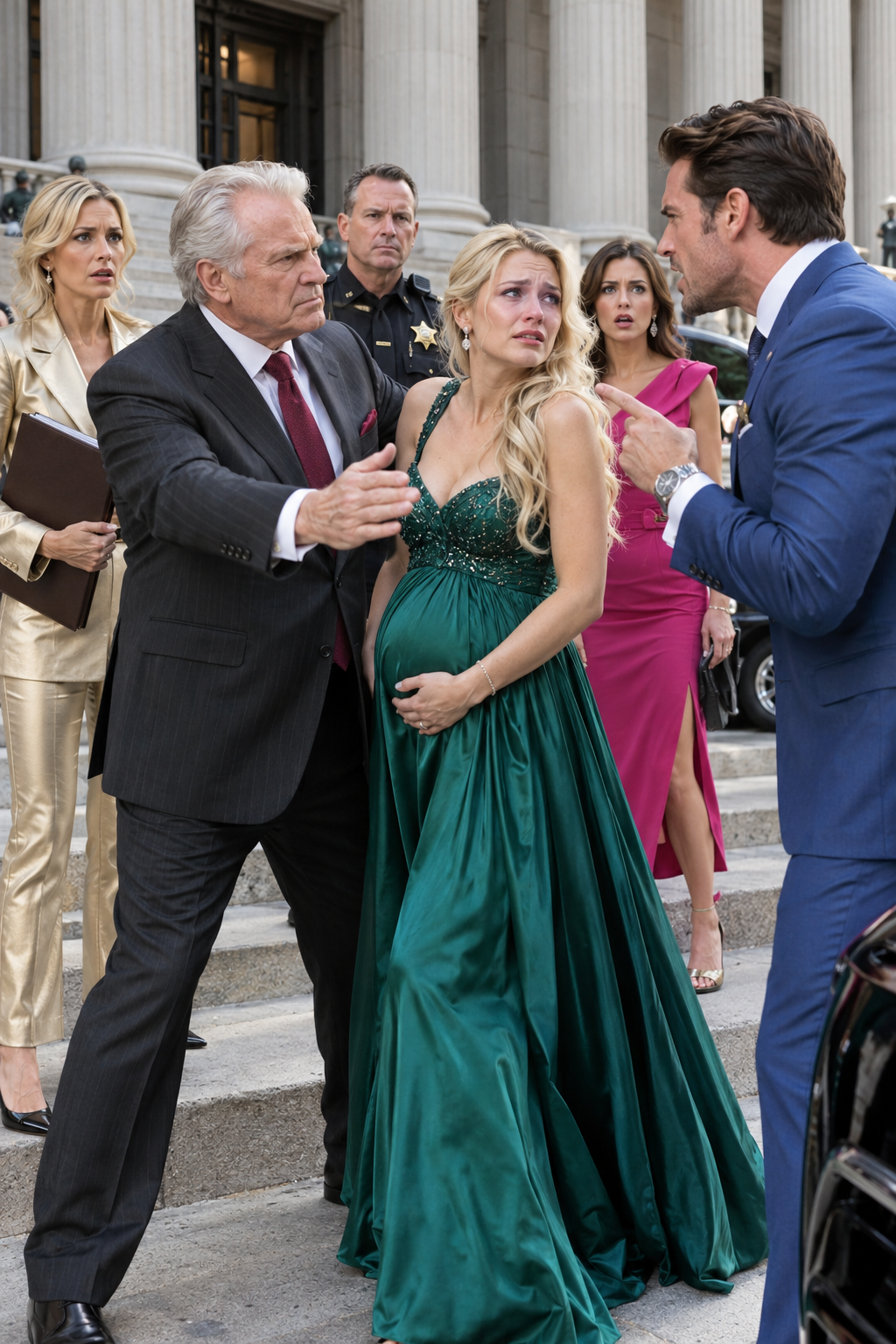
My Billionaire Husband Cost Me Our Baby, Then My Judge Father Opened the File His Family Thought Was Buried Forever
My husband announced that I was “too unstable to be trusted with our child” while I was seven months pregnant, standing three feet away from him at a charity dinner paid for with money that had once belonged to my mother.
Then he lifted his champagne glass and smiled.
The worst part was not that Grant Hale humiliated me in front of nearly two hundred people.
The worst part was that my older brother laughed with him.
I stood beneath the crystal chandeliers of the Monarch Hotel in Chicago with one hand resting beneath my stomach and the other wrapped around a tiny brass key inside the pocket of my emerald dress.
Nobody in that ballroom knew about the key.
Grant certainly didn’t.
He believed everything valuable in my life already belonged to him.
“Come on, Avery,” he said, loud enough for the nearest tables to hear. “Don’t make that face. We’re among friends.”
His mother, Victoria Hale, gave me the same thin smile she always used before saying something cruel enough to leave no fingerprints.
“You know how emotional pregnancy has made you.”
A few guests looked down at their plates.
Others pretended to check their phones.
Grant’s brother Owen leaned toward my brother Luke and whispered something that made both men grin.
I didn’t ask what it was.
That was another thing Grant hated about me.
I had stopped asking questions when I already knew the answer.
I knew his mistress, Serena Cole, was sitting three tables away in a silver dress, pretending she had been invited because her public-relations firm represented Hale Meridian Holdings.
I knew Grant had spent the previous Tuesday night in her penthouse because the company driver had mistakenly charged the trip to an account I still monitored.
I knew Victoria had quietly moved two of my jewelry cases from our Lake Forest house into a private vault registered to Hale Meridian.
I knew Grant had instructed our estate manager to change the access codes to the west wing.
I knew my brother Luke had accepted a new position at Grant’s company forty-eight hours after telling me I was imagining problems in my marriage.
And I knew something none of them knew.
My mother had warned me about people like this before she died.
Not specifically Grant.
Not specifically the Hales.
People who treated kindness like a weakness to be acquired.
People who mistook silence for stupidity.
People who believed ownership began the moment nobody stopped them.
That was why the tiny brass key was in my pocket.
Grant turned to the room with the relaxed confidence of a man who had spent his entire adult life watching people move out of his way.
“My wife thinks she should be involved in every major decision at Hale Meridian because her family made an early investment years ago.”
A few executives chuckled.
My stomach tightened.
Not from embarrassment.
From the baby moving.
Our daughter had been especially active that evening.
I pressed my palm gently against the place where her foot pushed beneath my ribs.
Grant saw it and rolled his eyes.
“There she goes again.”
The laughter was smaller this time.
Even cruel people sometimes recognize when cruelty has become indecent.
I looked directly at him.
“Finished?”
The room went quiet.
Grant blinked.
He expected tears.
He preferred tears.
Tears let him become the reasonable one.
He could lower his voice.
Touch my elbow.
Tell everyone I was exhausted.
Then take me home and explain, patiently, which parts of my memory were supposedly wrong.
But I had not cried in front of Grant Hale in eleven months.
Not when I found Serena’s earring beneath the passenger seat of his Bentley.
Not when Victoria told me the Hale family would be “better protected” if I signed over my voting rights.
Not when Luke said I should be grateful a man like Grant still wanted me while I was pregnant.
Not when Grant changed the beneficiary on his life-insurance policy without telling me.
Not when he called my unborn daughter “an unfortunate complication” during an argument he didn’t know I had recorded.
I had stopped giving them tears.
I had started collecting evidence.
Grant’s smile stiffened.
“We’ll discuss your attitude at home.”
“No,” I said softly. “We won’t.”
Something shifted behind his eyes.
The people closest to us felt it.
His jaw moved once.
Victoria placed her hand on his sleeve.
Not to calm him.
To remind him that witnesses were present.
I took my hand out of my pocket.
The brass key remained hidden.
But Grant stared at my closed fingers as though instinct had finally warned him there might be something in them.
“Excuse me,” I said.
I walked away from my husband in front of everyone.
No dramatic exit.
No thrown glass.
No accusation.
I simply crossed the ballroom, entered the ladies’ room, locked myself inside the largest stall, and finally allowed myself to breathe.
My phone vibrated.
I stared at the screen.
My father and I had spoken only four times in the previous six months.
Judge Thomas Bennett had spent thirty-two years on the federal bench before taking senior retirement that spring.
He was brilliant, disciplined, and maddeningly formal even with his own children.
After my mother died, grief had turned him inward.
Luke responded by becoming louder.
I responded by becoming useful.
That pattern never changed.
When Grant entered our lives, Dad disliked him immediately.
I interpreted that as arrogance.
For years, I defended my husband against my father.
By the time I understood which man had actually been trying to protect me, pride had built a wall too high to climb gracefully.
So I stopped climbing.
His message was only seven words.
Do you still have your mother’s key?
I went cold.
I read it again.
Then I typed one word.
Three dots appeared immediately.
His response came.
Whatever happens tonight, do not give it up.
I stared at the message until someone knocked on the stall door.
I slipped my phone away.
Her voice softened theatrically.
“I just wanted to make sure you were okay.”
I opened the stall.
Serena stepped backward.
She was thirty-one, polished, beautiful, and always dressed as if cameras were expected.
Tonight, however, there was something different in her face.
Confidence.
Not the borrowed confidence of a mistress waiting for a marriage to end.
The settled confidence of someone who believed it already had.
She glanced at my stomach.
“You really shouldn’t stress yourself.”
“Thank you for the medical advice.”
“I’m serious.”
Her expression flickered.
I washed my hands.
She watched me in the mirror.
“I don’t want us to be enemies.”
I almost smiled.
“Then you chose a strange job.”
Her cheeks colored.
“You don’t know everything.”
“No,” I said. “But I know enough.”
I reached for a towel.
She lowered her voice.
“Grant is going to leave you.”
I met her eyes in the mirror.
There it was.
No apology.
No more pretending.
“He’s been waiting until after the baby comes because of the optics.”
I dried my hands slowly.
“And you know this because?”
“He tells me things.”
“Grant tells everybody things. Usually different things.”
She crossed her arms.
“The house belongs to Hale Meridian. The cars belong to the company. Most of the investment accounts are controlled through family entities. You signed a postnuptial agreement two years ago.”
Serena smiled.
It was a mistake.
People only list your supposed weaknesses like that when somebody has given them a briefing.
And only a lawyer gives a briefing that organized.
“Did Conrad Pike explain the agreement to you himself,” I asked, “or did Grant summarize it?”
Her smile disappeared.
Conrad Pike was Grant’s longtime attorney.
He was also one of Luke’s new golfing partners.
Serena recovered quickly.
“You should think about what’s best for your daughter.”
I stepped closer.
“So should you.”
For the first time, she looked uncertain.
I left her standing under the fluorescent lights.
When I returned to the ballroom, Grant was gone.
Victoria was gone.
Luke was gone.
My coat was gone too.
The coat check attendant looked terrified.
“Mr. Hale took it, ma’am. He said you’d be leaving with him.”
My phone rang.
I answered.
“Where are you?”
His voice was low.
I could hear the distinctive hum of the Bentley.
“Still inside.”
“Get downstairs.”
Then, “Excuse me?”
“I’m taking a car home.”
“We came together.”
“We don’t have to leave together.”
His breathing changed.
I knew that sound.
It was the moment he stopped worrying about being charming.
“Avery, you have three minutes.”
I ended the call.
My hands were steady.
That frightened me more than shaking would have.
Outside, freezing rain polished the sidewalk.
The hotel doorman moved to call a cab.
A black SUV pulled up first.
My father stepped out.
For several seconds, neither of us spoke.
He wore a charcoal overcoat and carried an old leather document case I recognized from childhood.
Dad looked at my stomach.
Then at my face.
“What happened?”
“Nothing yet.”
His eyes hardened.
That answer meant more to a judge than a story would have.
He opened the rear door.
The moment I settled into the seat, he handed me the leather document case.
It smelled faintly of cedar and dust.
My mother’s initials were embossed near the brass clasp.
Eleanor Bennett.
I had not seen it since the week after her funeral.
My throat tightened.
“Where did you get this?”
“Your mother’s safe-deposit box.”
“She had one?”
“She had several things you did not know about.”
I held the case carefully.
Dad looked out the window.
“There were reasons.”
He turned back to me.
“Because your brother called me this afternoon.”
That surprised me.
“He wanted to know whether your mother ever placed assets in a separate trust for you.”
The cold inside me deepened.
“What did you tell him?”
“That he should ask you.”
A faint smile touched Dad’s mouth.
Luke hated answers that created more questions.
“Then,” Dad continued, “Conrad Pike called my former clerk.”
“Grant’s attorney?”
“He asked a very specific procedural question regarding the enforceability of an unsigned trust amendment executed before marriage.”
I tightened my grip on the case.
“I don’t understand.”
“You don’t have to. Not tonight.”
He looked at me.
“Your mother believed Grant was trying to gain access to something that did not belong to him.”
My heart seemed to pause.
“She died nine years ago.”
“Grant and I had only been married eighteen months.”
“Why didn’t she tell me?”
“She tried.”
I stared at him.
He tapped the document case.
“She was afraid you were too much in love to hear her.”
That hurt because it was true.
Outside the window, Chicago blurred into wet gold.
I rested both hands over my daughter.
For the first time in months, I felt the outline of something I had forgotten existed.
Not safety.
That would come later.
Dad dropped me at the house just after ten.
“I can stay,” he said.
“If Grant sees you here, he’ll perform. I need to know what he does when he thinks nobody is watching.”
Dad studied me.
“You’re recording him?”
That earned the smallest nod.
“I taught you something after all.”
“You taught me to read footnotes.”
“That may save your life before philosophy does.”
I almost laughed.
Then he touched my shoulder.
My father was not an affectionate man.
The gesture landed harder because of that.
“Call me if his voice changes.”
I knew exactly what he meant.
Grant’s voice always changed before he became dangerous.
I entered through the kitchen.
Every light downstairs was on.
Victoria sat at the island drinking tea.
Luke stood near the fireplace.
Grant was pacing.
And Conrad Pike was seated at our dining table with a folder open in front of him.
Four people.
Waiting for me.
That was when I understood.
This had never been an argument.
It was an intervention.
Only I was the property being divided.
Grant stopped pacing.
“Where have you been?”
“With my father.”
Luke swore under his breath.
Victoria put down her cup.
Conrad closed the folder.
Grant stared at me for a long moment.
“What did he give you?”
I set my purse on the counter.
“Don’t play games.”
“I’m tired.”
“You embarrassed me tonight.”
“You humiliated your pregnant wife in a ballroom.”
“I made a joke.”
“No. Jokes are funny.”
Luke stepped forward.
“Avery, can we not turn this into another war?”
I looked at my brother.
Another war.
As if he hadn’t accepted a six-figure job from my husband while telling me to be more patient with him.
As if he hadn’t sent Grant screenshots of private messages I wrote after discovering the affair.
I had found those screenshots on Grant’s iPad three weeks earlier.
Luke still didn’t know.
“I agree,” I said.
My brother relaxed.
I unzipped my purse and removed one folded sheet of paper.
His relief disappeared.
I placed it on the counter.
“What’s that?” Grant asked.
“A notice revoking Luke’s authority to speak for me regarding any Bennett family trust, estate, foundation, or privately held entity.”
Luke stared at me.
“You can’t be serious.”
“I signed it this afternoon.”
Grant’s face changed.
Only slightly.
But I saw it.
So did Conrad.
Conrad stood.
“Avery, before you make any decisions involving family assets, I strongly recommend independent counsel.”
That sounded responsible.
Almost ethical.
Except Conrad had known about the assets before I did.
I turned to him.
“That’s excellent advice.”
His mouth tightened.
“I can provide several names.”
“I already have one.”
Nobody moved.
I felt my daughter kick again.
I memorized the sensation.
I didn’t know it would be the last time I felt her move like that.
Grant walked toward me.
“Give me whatever Thomas gave you.”
He stopped.
Victoria inhaled sharply.
Grant had heard the word from employees.
Competitors.
Journalists.
He had almost never heard it from me.
“Say that again.”
His face became completely calm.
That was worse than anger.
He extended his hand.
I picked up my purse.
“I’m going upstairs.”
“You’re not walking away from me.”
“I already am.”
He grabbed my wrist.
Luke looked down.
Victoria said nothing.
Conrad took one step backward.
That detail never left me.
A lawyer watching a pregnant woman being physically restrained did not move toward the danger.
He moved away from liability.
“Let go,” I said.
Grant tightened his grip.
“Give me the key.”
The room vanished around me.
I looked straight at him.
“What key?”
His nostrils flared.
He had said it.
Somebody had told him.
My mother’s key was no longer a secret.
I stopped resisting.
Not because I was afraid.
Because I needed him to underestimate what I had just learned.
“Grant,” I said gently, “you’re hurting me.”
His grip loosened.
There was my weak question waiting somewhere in the future.
First, I needed him to believe I had surrendered.
I lowered my eyes.
“Can we do this tomorrow?”
Luke exhaled.
Victoria looked relieved.
Grant’s ego filled in the rest.
He released me.
I rubbed my wrist.
“Thank you.”
The gratitude disgusted him.
That helped.
He thought he had broken something.
He didn’t know I had just planted a flag.
I walked upstairs.
Behind me, I heard Victoria whisper, “She’s finally being sensible.”
I closed the bedroom door.
Then I took the brass key from my pocket.
Attached to it by a thin chain was a tiny oval tag engraved with one number.
I opened my mother’s document case.
Inside were three things.
A photograph.
And an old bank envelope.
I opened the letter first.
My mother’s handwriting was unmistakable.
If you are reading this because someone has made you believe you own nothing, then I was right to prepare for the day you finally needed proof more than comfort.
Do not sign anything.
Do not surrender the key.
Do not let affection persuade you that legal ownership is the same as moral worth.
And above all, do not believe anyone who tells you the Bennett assets were given to you because you were favored.
They were protected for you because you were the one who kept giving your share away.
My eyes blurred.
I sat on the edge of the bed.
That was my mother.
Even from the grave, she refused sentimentality unless it served a purpose.
I kept reading.
The trust exists because people who mistake generosity for weakness eventually become careless.
When they do, let the documents speak.
There was no signature at the bottom.
Only another line.
Your father has the map. You have the door.
I opened the envelope.
Inside was a safe-deposit receipt from First Continental Bank.
The photograph showed my mother standing in front of an old brick building in downtown Chicago.
Beside her was a woman I vaguely recognized.
Margaret Hale.
Grant’s grandmother.
On the back, my mother had written a date.
Six years before I ever met Grant.
And beneath it:
She kept her promise. Make sure they keep theirs.
A knock hit the bedroom door.
I put everything back in the case.
“Open the door.”
“I’m changing.”
I slid the case beneath the bed and started recording on my phone.
Then I unlocked the door.
Grant entered.
He closed it behind him.
“Where’s the key?”
“I don’t know what you mean.”
His smile was small and humorless.
“You’re a bad liar.”
“So are you.”
“Don’t what?”
His hand struck the wall beside my head.
The sound was explosive.
I didn’t flinch.
That made him angrier.
“Your mother left something behind.”
“It affects my company.”
“Your company?”
“You know what I mean.”
“No. Explain it.”
He stared at me.
He had expected fear.
Instead, I was making him define ownership.
That was dangerous to men like Grant.
Because they often realized halfway through the sentence that they could not.
He stepped closer.
“Hale Meridian employs eleven thousand people.”
“If some antique Bennett trust threatens those jobs because your mother hated my family, you have a responsibility not to weaponize it.”
There it was.
The moral inversion.
He wasn’t trying to steal from me.
He was protecting eleven thousand workers.
He wasn’t threatening his pregnant wife.
He was preserving stability.
He wasn’t cheating.
He was coping with a difficult marriage.
He wasn’t cruel.
I was emotional.
People like Grant did not need to believe their lies completely.
They only needed a version respectable enough to repeat in public.
“My mother didn’t hate your family,” I said.
“You don’t know that.”
“Apparently you do.”
His eyes narrowed.
I had pushed too far.
“Go to sleep.”
He turned toward the door.
I should have let him leave.
Instead, I asked, “How long have you known about Box 317?”
Grant stopped.
For one perfect second, every mask disappeared.
Then it was gone.
“I have no idea what you’re talking about.”
I locked the door again.
At in the morning, I woke to the sound of the knob turning.
The lock held.
At , my phone lit up.
A message from Luke.
Please don’t make this uglier than it has to be.
I stared at it.
Then another came.
Grant is offering you a generous exit.
Not our mother’s inheritance.
Not my safety.
Not the baby.
I typed nothing.
At the next morning, I called my father.
He was silent.
Then he said, “Are you alone?”
“Leave the house.”
“Dad, Grant knew the box number.”
Long silence.
“I don’t know.”
“Leave now.”
I heard urgency in his voice for the first time in my life.
That finally scared me.
I packed one suitcase.
Not jewelry.
Not dresses.
Medical records.
Hard drives.
The flash drive containing copies of Grant’s financial statements.
My passport.
The recording from the night before.
The leather case.
I was at the top of the staircase when Victoria appeared below.
“You’re not taking company property.”
I looked down at her.
“My underwear is still legally mine, Victoria.”
“This isn’t funny.”
She climbed three steps.
“The jewelry stays.”
“The Bentley stays.”
“I don’t want it.”
“The Hamptons house is not yours.”
“The Aspen property was purchased through a Hale entity.”
“Enjoy it.”
Her composure cracked.
“You think you’re being clever.”
“No,” I said. “I think I’m being finished.”
She looked at my suitcase.
“You’ll come back.”
“Because women like you always discover independence is more expensive than pride.”
I almost admired the line.
She had probably been saving it.
I continued down.
Grant walked in through the study.
He looked at the suitcase.
“You’re not leaving.”
“We’re discussing this tonight.”
He stepped in front of me.
“I said you’re not leaving.”
My phone was already recording inside my coat pocket.
“Give me the key.”
He grabbed the suitcase handle.
For several seconds, neither of us moved.
Then Luke entered from the breakfast room.
My own brother.
He looked from Grant to me.
“Avery, just give him whatever it is.”
I stared at Luke.
Something inside me settled permanently.
It wasn’t grief.
Grief has movement.
This was a door closing.
“You chose him.”
Luke’s face tightened.
“I chose reality.”
“No. You chose payroll.”
“That company matters to thousands of families.”
The moral cover.
Grant had trained them well.
I released the suitcase handle.
Grant stumbled half a step backward with it.
I walked toward the front door.
“Avery,” he snapped.
I didn’t turn.
He caught my upper arm.
“Don’t walk away when I’m talking to you.”
“Stop acting like a victim.”
I looked at his hand.
Then at Luke.
Then at Victoria.
All three of them could see it.
None moved.
That was the system.
Not just the man who hurt you.
The people who watched because his power fed them.
The people who explained you.
The people who corrected your tone.
The people who called survival dramatic.
The people who preferred your silence until your silence stopped serving them.
I looked at Grant.
“Take your hand off me.”
“There. Happy?”
I reached for the door.
That was when Serena walked in.
She had a key.
My husband’s mistress.
Carrying coffee.
For a moment, even Victoria looked embarrassed.
Serena froze when she saw me.
Grant muttered, “Not now.”
Something almost absurd rose inside me.
I looked at the coffee tray.
One labeled Grant.
The other labeled S.
I turned to Serena.
“You can have my closet.”
Her mouth opened.
“The left side sticks in winter.”
Then I stepped outside.
I had made it halfway across the marble entry landing when Grant followed me.
I kept walking.
My shoe reached the first exterior step.
His hand closed around my shoulder.
Not a dramatic shove.
Not a punch.
Just one furious backward jerk from a man who wanted to force his wife to face him.
My heel slipped on ice.
The world tilted.
The suitcase fell first.
I remember the sound of its wheels striking stone.
I remember turning instinctively to protect my stomach.
I remember my hip hitting the edge of the second step.
Then my shoulder.
Then a crushing pressure inside me.
For several seconds, nobody moved.
I lay on the frozen stone looking at the pale winter sky.
Grant’s face appeared above me.
I couldn’t answer.
Something warm spread beneath my dress.
Victoria screamed.
Serena dropped the coffee.
Luke finally moved.
“Oh my God.”
Grant knelt.
“I barely touched her.”
Those were his first words.
Not Are you okay?
Not Call an ambulance.
I barely touched her.
The defense came before the concern.
I looked at my brother.
“My phone.”
He stared at me.
“Call 911,” I whispered.
Grant stood.
“Let me drive her.”
My voice was stronger that time.
The ambulance arrived nine minutes later.
My father arrived three minutes after that.
He must have broken every traffic law between downtown Chicago and Lake Forest.
I saw him only briefly as the paramedics lifted me.
He looked at the blood.
Then at Grant.
I had seen my father sentence corrupt officials, violent offenders, men who had destroyed pension funds and families without blinking.
I had never seen his face look like that.
Grant walked toward him.
“Judge Bennett, this was an accident.”
Dad raised one hand.
Grant stopped.
My father did not shout.
That was the moment Grant should have become afraid.
“You will not speak to me,” Dad said.
“You will not speak to my daughter.”
Grant’s mouth opened.
“You will not enter her ambulance.”
“I’m her husband.”
My father looked at the paramedic.
“Is she conscious?”
Dad stepped beside me.
“Avery, do you want him with you?”
I looked at Grant.
His expensive coat.
His pale face.
The ambulance doors closed.
My daughter died before noon.
Her name was Grace Eleanor Hale.
Two pounds, eleven ounces.
The doctors called it a catastrophic placental abruption.
They told me there had been nothing they could do.
They told me I had nearly bled to death.
They told me I might have another child someday.
I hated that sentence most.
Another child.
As though children were versions.
As though Grace could be replaced by a future possibility.
Dad sat beside my hospital bed for thirteen hours.
He never said, I told you so.
He never said Grant’s name.
At in the morning, I woke and found him staring through the window.
“Did they arrest him?”
“The responding officer categorized the fall as accidental pending investigation.”
I closed my eyes.
Lake Forest Police Deputy Chief Randall Keene played golf with Grant.
His wife chaired Victoria’s foundation gala.
Dad sat closer.
“I have contacted independent counsel.”
“You’re a judge.”
“I am not handling your case.”
“I am being your father.”
That sentence nearly broke me.
But I had cried enough into hospital pillows where nobody could turn the tears against me.
Now I needed information.
“Where’s my phone?”
Dad handed it over.
The recording was still there.
Grant’s voice.
Luke’s voice.
The entire confrontation.
Including the moment before I fell.
Including my demand that Grant release me.
Including his voice outside afterward saying, I barely touched her.
I played it once.
He walked to the far side of the room.
His back faced me.
“Send that to your attorney.”
“I don’t have one.”
“You do now.”
He gave me a card.
Rachel Morales.
Former federal prosecutor.
Private attorney.
A woman Grant had once called “a sanctimonious nightmare” after she dismantled a corporate fraud defense on television.
I almost smiled.
He went still.
“Tomorrow.”
“You lost your daughter today.”
My voice didn’t shake.
“And Grant knew about the box yesterday.”
Dad looked at me for a long time.
Then he pulled his chair close.
“Your mother and Margaret Hale created something together.”
I stared at him.
“Grant’s grandmother?”
“Because Margaret believed her son—Grant’s father—was stripping assets from family businesses and using shell companies to hide liabilities.”
My pulse quickened.
“Mom was her lawyer?”
“No. Her friend.”
That surprised me more.
“They met on the board of a women’s shelter. Margaret wanted to protect certain properties and voting interests from her son. Your mother helped structure a charitable holding trust with outside counsel.”
“What does that have to do with me?”
“You became successor beneficiary.”
I laughed once.
It sounded hollow.
“Beneficiary of what?”
Dad named the figure.
I thought I had misunderstood him.
“Thirty-eight percent of Hale Meridian’s original voting equity.”
My heart slammed.
“That’s impossible.”
“It was diluted, reorganized, converted, and partially pledged over the years. But the trust retained protective rights.”
“What rights?”
“Consent rights over certain transfers. Land rights. Reversion clauses.”
I stared at him.
“Our house?”
“Built on land leased from the trust.”
“The headquarters?”
“The hotel tonight?”
“Same portfolio.”
I stopped breathing.
Grant had humiliated me in a hotel standing on land held by a trust for my benefit.
Victoria had told me I owned nothing while drinking tea in a house her family did not own outright.
Luke had chosen Grant’s payroll without realizing the company paying him depended on rights connected to the sister he betrayed.
It would have been satisfying if Grace weren’t dead.
Instead, it felt obscene.
“What’s it worth?”
“Potentially hundreds of millions.”
“I don’t care.”
“What did Mom mean when she said it wasn’t because I was favored?”
Dad looked down.
“When your mother became sick, you quietly sold the shares your grandfather had given you in Bennett Industrial.”
I remembered.
“I paid for her experimental treatment.”
“You told us the insurance covered it.”
“You were already selling the house in Virginia.”
“And Luke?”
“He had children.”
Dad’s face tightened.
“You protected everyone.”
“It didn’t save her.”
“So what does this trust have to do with that?”
“Your mother discovered what you had done. She couldn’t return the shares. Instead, she amended her position in the Hale trust so your rights would pass to you.”
I stared at my hands.
All those years.
Everyone had called me the less ambitious Bennett.
Luke was the businessman.
Dad was the judge.
Mom was the strategist.
Avery was kind.
Avery was accommodating.
Avery would understand.
Avery didn’t need as much.
My mother had noticed.
The inheritance wasn’t a prize.
It was an accounting.
A correction written by a dying woman who had watched her daughter become smaller so everyone else could remain comfortable.
“When does it become mine?”
“It already is.”
“Then why doesn’t Grant know?”
Dad’s expression changed.
I looked up.
“Not all of it. But enough.”
That was the first real twist of the knife.
Grant had not abused me while believing I was powerless.
He had abused me because he feared I wasn’t.
Three days after Grace died, Hale Meridian’s attorney delivered a letter to my hospital room.
Not flowers.
Not condolences.
It stated that because I had “voluntarily vacated” the marital residence and because certain company-owned belongings were missing, I was required to arrange return of those items.
My suitcase.
Two watches.
A set of earrings my father had given me at graduation.
And the leather document case.
They specifically listed the case.
Rachel Morales read the letter twice.
Then she smiled.
I was still weak, still bruised, still waking each morning with one hand moving instinctively toward a stomach that had become too still.
But when Rachel smiled, I knew Grant had made a mistake.
“What?” I asked.
“He put it in writing.”
“The case?”
“How is that useful?”
“Because they have now claimed a specific item they should not know exists.”
Dad stood near the window.
He said nothing.
Rachel glanced at him.
“Judge Bennett.”
“You are still glaring like a judge.”
“I have thirty-two years of muscle memory.”
She turned back to me.
“Do you want to destroy him?”
Dad stiffened.
I answered first.
Rachel studied me.
“I want him stopped.”
“Different goal.”
“Harder, too.”
That afternoon, I was discharged.
I did not return to Lake Forest.
Dad took me to the brick house where I had grown up in Evanston.
My childhood bedroom still had a faint square on one wall where a poster once hung.
For four nights, I slept beneath the same ceiling I had stared at when I was sixteen.
On the fifth morning, Rachel arrived with coffee and a court filing.
Grant had filed for divorce.
He alleged emotional instability.
Financial secrecy.
Abandonment.
And “potential interference with Hale Meridian operations.”
He asked for temporary exclusive possession of the marital home.
He requested an order preventing me from contacting company employees.
He also sought emergency control over any marital interests connected to the Bennett-Hale trust structure.
Rachel tapped that paragraph.
“He’s going after it.”
“He’s trying to freeze you before you understand what you own.”
“Because he made a very expensive assumption.”
She opened another folder.
Inside was a copy of the postnuptial agreement Serena had mentioned.
I knew the document.
Grant had brought it to me two years earlier after Hale Meridian prepared for a major acquisition.
He told me every executive spouse was signing similar paperwork.
I had signed after an independent attorney reviewed it.
Rachel pointed to one clause.
Separate inheritances remain separate.
“Conrad drafted this,” she said.
“He protected Grant’s family wealth from you.”
“And by doing so, he protected your trust interest from Grant.”
I stared at the page.
Rachel leaned back.
“Men like Conrad are usually excellent lawyers until arrogance makes them believe only one side of a document matters.”
Miniature satisfaction.
Not enough to heal anything.
Enough to stand.
Grant believed I was hiding in my father’s house.
Instead, I began working.
I gave Rachel every recording.
Every financial statement.
Every email.
Every screenshot.
Every date.
We built timelines.
Grant’s affairs mattered emotionally, but Rachel treated them as background.
The money mattered more.
For six years, Hale Meridian had reported lease obligations tied to Bennett-Hale properties.
Then, two years earlier, several of those obligations vanished from internal reports.
The properties appeared to have been transferred.
But the trust had never approved the transfers.
Somebody had signed approval documents.
My name appeared on them.
I had never seen them.
Rachel put a copy in front of me.
“Is that your signature?”
“You’re sure?”
“I know my own name.”
Dad, standing behind her, became very still.
There it was.
The legal mine my mother had buried years earlier.
The trust required direct notarized approval from the successor beneficiary before protected land could be transferred.
The Hales had wanted the land.
They couldn’t get my consent.
So someone had manufactured it.
That changed everything.
The divorce became secondary.
Potential bank misrepresentations.
Possible securities violations.
Rachel contacted the proper authorities without using my father’s name for leverage.
Dad insisted on that.
“No calls to former colleagues,” he said.
“No favors.”
“No courthouse conversations.”
“No shortcuts.”
He looked at me across the dining table.
“If we win by becoming them, we lose.”
That was why I trusted him.
Grant had money.
Connections.
Police chiefs at golf clubs.
Charity boards.
Editorial relationships.
My father had something Grant never understood.
For forty years, Thomas Bennett had built a reputation by refusing to put his thumb on the scale.
Now that reputation meant people listened when evidence arrived through proper channels because nobody could credibly claim he had manipulated the process.
Grant’s family did not understand this.
They thought Dad’s refusal to interfere meant weakness.
Victoria told friends I was “hiding behind an old man with no jurisdiction.”
Luke told our aunt I had become vindictive after the miscarriage.
Miscarriage.
That word reached me through a cousin.
I called Luke for the first time since Grace died.
He answered immediately.
“You called Grace a miscarriage?”
“I didn’t mean—”
“She had a name.”
“Avery, please.”
“Say her name.”
He breathed out.
“She was your niece.”
His voice cracked slightly.
I felt nothing.
“I’m sorry.”
“No. You’re afraid.”
“That’s not fair.”
“Did you tell Grant about Box 317?”
There it was.
I closed my eyes.
“He said it was necessary to protect the company.”
My own brother.
The betrayal I had been trying not to name.
“How did you know?”
“Mom told me years ago there was a box.”
“And you never told me?”
“I didn’t think it mattered.”
“But when Grant hired you, it mattered.”
“He didn’t hire me for that.”
“Then why did you tell him?”
“He said there could be documents that destabilized the financing. Thousands of jobs, Avery.”
Always the workers.
Always morality wrapped around theft.
“Did you give him anything else?”
“You’re lying.”
Silence makes dishonest people ambitious.
Luke filled it.
“I only showed Conrad an old copy of Mom’s estate memo.”
My fingers went cold.
“What memo?”
“The one where she mentioned Margaret Hale.”
“Where did you get it?”
“Dad’s office years ago.”
“You stole from Dad?”
“I borrowed a file.”
I almost laughed.
Everybody in Grant’s world had a cleaner word for what they did.
Affairs became mistakes.
Forgery became restructuring.
Theft became borrowing.
Abuse became stress.
A dead baby became a miscarriage.
“Luke,” I said.
“When investigators ask you this question later, answer faster.”
Then I hung up.
Rachel subpoenaed the relevant corporate records through the divorce proceeding.
Grant’s team fought everything.
They accused me of using grief to attack Hale Meridian.
A business columnist repeated the phrase.
Victoria appeared at a charity lunch wearing black and told reporters the family was “mourning privately while trying to protect Grant from unfair speculation.”
Serena vanished from public view.
Grant remained CEO.
For eleven days, he acted as though he had won.
I was no longer in his home.
No longer at his events.
No longer on his arm.
He had Serena.
A public-relations machine.
Most of the company board.
And, he believed, the properties.
He even moved a board meeting into the Monarch Hotel ballroom where he had humiliated me.
That arrogance helped us.
Because the meeting notice triggered a clause Margaret Hale had inserted decades earlier.
Material corporate decisions conducted on trust-controlled premises required notification to the trust representative when property rights were in dispute.
Grant’s lawyers had ignored the clause for years.
Rachel did not.
At on a Monday morning, while Grant sat at the head of a walnut conference table preparing to announce a $1.2 billion refinancing package, a courier delivered a notice.
The trust disputed Hale Meridian’s claimed ownership of seven major parcels.
The refinancing froze before lunch.
By afternoon, two lenders requested clarification.
By evening, Hale Meridian’s stock had fallen eight percent.
Grant called me seventeen times.
I answered the eighteenth.
“What did you do?”
I was sitting at my mother’s old desk in Dad’s house.
“Filed a notice.”
“You’re going to destroy eleven thousand jobs.”
“No. You’re going to explain seven questionable property transfers.”
“Do you have any idea what you’ve done?”
“You always were too naive for business.”
That almost made me smile.
“Then this should be easy for you to fix.”
He went quiet.
“We lost a child.”
My entire body became still.
He had never called Grace by her name.
“We should not do this to each other.”
There are moments when cruelty becomes so complete it clarifies everything.
I looked at Grace’s hospital bracelet on the desk.
I carried it everywhere now.
“You’re right.”
His voice softened instantly.
“Come home.”
“We shouldn’t do this to each other.”
“You should have thought of that before you put your hands on me.”
He hung up.
That evening, security footage arrived from the Lake Forest house.
Grant’s team had insisted the exterior camera failed during my fall.
But they forgot the doorbell system stored a separate cloud copy.
Rachel obtained it.
The footage had no sound.
It didn’t need any.
There I was.
Carrying a suitcase.
Grant following.
His hand grabbing my shoulder.
My body jerking backward.
My foot slipping.
Then something worse.
For twenty-three seconds after I landed, nobody called for help.
Grant stood over me.
Victoria appeared.
Luke moved toward the door.
Serena stayed inside.
And then Grant bent down.
Not to help me.
To pull my purse away.
He opened it.
He searched inside.
While I lay bleeding.
Rachel replayed that part three times.
Dad walked out of the room.
I watched Grant reach into the bag.
Then finally Luke took out his phone.
Twenty-three seconds.
The length of a commercial.
The length of a traffic light.
The length of a baby’s hiccup.
Long enough for my husband to search his injured wife’s purse before anyone called an ambulance.
For the key.
He had been looking for the key.
The police investigation changed after that.
Not because my father demanded it.
Because evidence became impossible to ignore.
The county transferred review to an outside unit.
Grant was interviewed.
Luke was interviewed.
Victoria hired separate counsel.
Conrad Pike abruptly withdrew from representing Grant personally, citing a conflict.
Rachel smiled when she heard that.
“Not yet,” she said. “Just lawyers recognizing smoke.”
The next document arrived two days later.
A bank record from First Continental.
Box 317 had been accessed twice after my mother’s death.
Once by my father.
Once by someone using a purported authorization signed by me.
The date was six years earlier.
I had been in Seattle that day.
Hospitality conference.
Photos, receipts, flight records.
Impossible for me to have entered the bank.
Rachel requested the authorization.
The bank still had it.
My signature was forged.
And beneath it was the signature of the person verifying my identity.
Conrad Pike.
That was the moment the system began to crack.
Not collapse.
Conrad hired a criminal-defense attorney.
Hale Meridian’s board formed a special committee.
Grant took a “temporary leave” from one committee but remained CEO.
Victoria stopped attending charity events.
Luke came to Dad’s house.
I watched him through the front window.
He stood on the porch holding no umbrella while rain darkened his suit.
Dad asked if I wanted him removed.
I opened the door.
Luke looked older than he had three weeks earlier.
“What do you want?”
“Can I come in?”
Rain ran down his face.
“I didn’t know about the forged documents.”
“I believe you.”
Relief moved through him.
Too quickly.
“I didn’t.”
“I said I believe you.”
“But you knew Grant was trying to get into Mom’s box.”
Luke looked away.
“You knew he was afraid of what she left me.”
“You knew he was cheating.”
His face tightened.
“I suspected.”
“You knew he grabbed me.”
“You knew I fell.”
His voice dropped.
“You watched him search my purse.”
Luke closed his eyes.
That was the first time shame reached him.
He looked up.
“You chose.”
“You chose your job.”
“That’s not—”
“You chose access.”
He swallowed.
“You chose Grant because being near power made you feel like you finally had more of it than I did.”
“That’s not fair.”
“You keep saying that.”
“I loved Grace too.”
My voice became very quiet.
“You never met her.”
He cried then.
Maybe that made me cruel.
Or maybe grief had simply burned past the place where his tears could reach me.
“I’m cooperating,” he said.
“With investigators?”
“I told them everything.”
“Everything?”
He hesitated.
The human pause before a lie.
I leaned against the doorframe.
“What didn’t you tell them?”
Luke looked toward the street.
“Grant met with Mom before she died.”
My heart stopped.
“I saw him leaving Northwestern Memorial once.”
“You knew?”
“I thought you knew.”
“Maybe two months before she died.”
Grant had told me he was in New York that week.
I remembered because he missed my mother’s oncology appointment and sent white roses.
I hated white roses afterward.
“Did you ask Mom why he was there?”
“She was sick.”
That excuse landed like ash.
“What else?”
Luke shook his head.
“I don’t know.”
“You came here for a reason.”
He reached inside his coat.
Dad stepped behind me instantly.
Luke froze.
“It’s paper.”
“Slowly,” Dad said.
Luke pulled out an envelope.
Yellowed slightly.
“I found this in a box of Mom’s things I took after the funeral.”
“You took more of her files?”
“I was angry.”
“Everyone.”
He handed me the envelope.
My name was written across the front.
My mother’s handwriting.
I looked at Luke.
“How long have you had this?”
“Nine years.”
Dad made a sound behind me.
Not a word.
I opened the envelope.
Inside was one page.
If Grant tells you I asked him to protect you, he is lying.
He came to see me because he learned about Margaret’s trust.
He asked questions no husband should ask about his wife’s separate property.
I refused to answer.
Afterward, he apologized.
I do not believe the apology.
Please remember: charming men are often most dangerous when they realize charm has stopped working.
Do not confront him alone about the trust.
Do not let Luke mediate.
And if anything happens to me before I can explain everything, ask your father about the Northbridge file.
My hands began to shake.
Not because of Grant.
Because of the middle line.
Do not let Luke mediate.
Nine years ago, she knew Luke could be used.
I looked up.
My brother’s face had gone gray.
“You read this.”
“All of it?”
“And you still went to work for him.”
“I thought Mom was paranoid because she was sick.”
“Get off the porch.”
“I’m trying to fix this.”
“You had nine years.”
He stepped backward.
Dad closed the door.
“Northbridge.”
My father looked as though he had been waiting for the word.
“What is it?”
He walked to his study.
I followed.
He opened the bottom drawer of an old filing cabinet and removed a red folder.
Across the tab was one word.
NORTHBRIDGE.
Inside were records from a company I had never heard of.
Northbridge Women’s Housing Initiative.
My mother and Margaret Hale had created it twenty-two years earlier.
It owned several apartment buildings used for transitional housing for women leaving abusive households.
The buildings sat on extremely valuable land near downtown Chicago.
Hale Meridian had later absorbed management of the properties.
Ten years earlier, tenants were relocated after claims that the buildings required urgent structural renovation.
The renovation never happened.
Instead, the buildings were demolished.
Luxury towers rose on the sites.
“What am I looking at?”
Dad handed me a letter.
Margaret Hale had objected to the redevelopment.
She claimed the land was protected under a charitable-use covenant.
Grant’s father ignored her.
Then Margaret died.
My mother began investigating.
Then my mother became sick.
One year later, she died too.
I looked at Dad.
“You think Grant’s family stole land from a women’s shelter.”
“I think they may have converted protected charitable assets through transactions your mother considered fraudulent.”
The inheritance suddenly changed shape.
It was no longer a mansion.
No longer shares.
No longer hotels.
My mother’s trust wasn’t just wealth.
It was evidence.
It was land meant for women who had nowhere safe to go.
Women told to leave quietly.
Women told they were unstable.
Women told the house wasn’t theirs.
Women told power belonged to the person whose name was printed on the check.
The same story.
Grant had not simply been trying to take my inheritance.
His family had spent years trying to erase what the inheritance represented.
A piece of property they could not legally devour.
For the first time since Grace died, anger entered me cleanly.
I looked at Rachel when she arrived that evening.
“I don’t want the Lake Forest house.”
“I don’t want Grant’s cars.”
“I don’t want maintenance.”
She nodded.
“I want every protected Northbridge parcel traced.”
Rachel’s eyes sharpened.
“And if the redevelopment violated the trust?”
“We restore what can be restored.”
“Avery, some of those towers are worth hundreds of millions.”
“You could negotiate a very large settlement.”
“I don’t want a settlement that turns stolen shelter land into my vacation money.”
Dad looked at me.
Something moved in his face.
Pride, maybe.
Often they live close together.
Rachel closed the file.
“Then we have a different war.”
Two weeks later, Grant asked to meet me.
Against Rachel’s advice, I agreed.
Not privately.
A mediation conference room in a downtown law office.
Cameras in the hallway.
Attorneys nearby.
Grant entered wearing navy blue.
He had lost weight.
His confidence hadn’t.
He sat across from me.
For ten seconds, neither of us spoke.
Then he looked at the small bracelet on my wrist.
Grace’s name.
“You’re using her.”
My hands remained folded.
“Public sympathy.”
“I haven’t spoken publicly.”
“Your lawyer leaks.”
“She doesn’t.”
“My stock is down twenty-one percent.”
“Then maybe your investors have questions.”
He leaned forward.
“You know what your father is doing.”
“My father is doing nothing.”
“Exactly. That’s the trick, isn’t it? Saint Thomas keeps his hands clean while everyone remembers who he is.”
I almost pitied him.
Grant genuinely could not understand power that refused to announce itself.
“My father hasn’t contacted a judge, prosecutor, regulator, police officer, or board member on my behalf.”
Grant laughed.
“You expect me to believe that?”
“Because unlike you, he doesn’t need to own the room to know who he is.”
His face hardened.
I watched him absorb the insult.
Then let it go.
That was the muscle he had tried to destroy in me.
Now it belonged entirely to me.
Grant opened a folder.
“I’ll give you the Lake Forest house.”
“Twenty million dollars.”
“Plus full rights to your Bennett portfolio.”
“They’re already mine.”
His jaw tightened.
“Fifty million.”
“What do you want?”
“Northbridge.”
He blinked.
The first genuine surprise.
“Northbridge doesn’t exist.”
“It does in the covenants.”
“Your family converted charitable property.”
“That was before I controlled the company.”
“Some of the transfers continued after you became CEO.”
“On advice of counsel.”
He looked away.
Tiny movement.
Mini-payoff.
Conrad mattered.
“You’re destroying your own daughter’s legacy,” Grant said.
I stared at him.
“Do not say daughter when you refuse to say Grace.”
He went silent.
I continued.
“She died while you were trying to take a key from me.”
“That is not what happened.”
“You searched my purse while I was bleeding.”
His face changed.
He hadn’t known about the doorbell footage.
I saw the exact second he understood.
“You have video.”
I said nothing.
The conference-room door opened instantly.
Rachel entered.
“Sit down, Mr. Hale.”
Grant looked at her.
Then at me.
“This is what you wanted.”
“You wanted to trap me.”
He pointed toward the hallway.
“You brought lawyers, investigators—”
“You requested this meeting.”
His hand lowered.
For the first time since I had known him, Grant Hale looked small.
Not powerless.
There is a difference.
“Fifty million,” he said again.
I picked up my purse.
“Goodbye, Grant.”
I reached the door.
“What happens to Hale Meridian if those land transfers are reversed?”
I looked back.
“You should ask your board.”
His eyes narrowed.
“You think they’ll choose you?”
I opened the door.
“I think they’ll choose themselves.”
Three days later, the board suspended Grant.
Owen Hale resigned from the audit committee.
Victoria’s foundation announced an independent review.
Luke was placed on administrative leave.
Conrad Pike was publicly identified as cooperating with investigators.
The system was not collapsing because people suddenly became moral.
It was collapsing because self-preservation changed direction.
That mattered.
Justice does not always arrive as courage.
Sometimes it arrives as cowards abandoning the wrong ship.
Rachel called me at the following morning.
“We found the original Northbridge ledger.”
“We opened the box.”
“We opened the front compartment.”
I remembered the brass key.
“The bank manager found an internal note from your mother. The box has a secondary compartment.”
My pulse quickened.
“Can we open it?”
“Only with the original key.”
I looked toward the dresser.
The brass key lay in a small dish beside Grace’s bracelet.
Dad drove me to First Continental.
Rachel met us downstairs.
The vault manager led us through two security doors.
Box 317 was larger than I expected.
We opened the main drawer.
Then the manager showed me a narrow keyhole hidden beneath the rear lip.
I inserted my mother’s key.
A panel released.
Inside was a black ledger.
Three cassette tapes.
A sealed envelope.
And a flash drive that looked newer than everything else.
Rachel wore gloves.
She lifted the ledger first.
Northbridge.
Property numbers.
Conrad Pike appeared repeatedly.
Grant’s father.
Two former city officials.
One bank executive.
And, beginning eleven years earlier, Grant.
He had been involved long before becoming CEO.
I closed my eyes.
Dad stood beside me.
“Keep going.”
The final pages contained something else.
Personal entries in my mother’s handwriting.
Meeting with G.H. today.
He knows Margaret amended succession.
Asked whether Avery can be induced to disclaim.
Second entry.
G.H. returned.
Claims Avery’s marriage will make separate protections unnecessary.
Aggressive when challenged.
G.H. believes Avery can be pressured through family.
Luke remains susceptible to status.
Thomas must not confront. Grant responds badly to humiliation.
I swallowed.
My mother had mapped them all.
The envelope contained an affidavit signed by Margaret Hale shortly before her death.
She described pressure from her son and grandson to release Northbridge land.
She feared retaliation against my mother.
The tapes were labeled by date.
One date stopped me.
The day Grant had visited my mother in the hospital.
Rachel arranged secure audio equipment at her office.
We listened that afternoon.
My mother’s voice came first.
But unmistakably sharp.
“You will not get Avery’s signature.”
Grant answered.
“Avery signs things for me all the time.”
My stomach turned.
Mom said, “Not this.”
“You’re making a family issue into a legal one.”
“It became legal when your father moved protected property.”
“My father built value where your charity produced none.”
“Women had homes.”
“They had temporary apartments on prime land.”
Then my mother said something that made Dad close his eyes.
“That sentence is why Margaret stopped trusting your family.”
Grant laughed softly.
“You’re dying, Eleanor.”
Silence filled the recording.
Then my mother answered.
Another pause.
“But not quickly enough for you.”
I gripped the table.
Grant’s voice hardened.
“Be careful.”
Mom actually laughed.
“You came into a cancer ward to threaten a dying woman.”
“I came to protect my wife.”
“No. You came to protect yourself from my daughter.”
The tape ended.
I sat completely still.
Rachel stopped the machine.
Dad walked to the window.
No one spoke.
I had spent weeks thinking the story was about a rich husband who wanted control.
It was older.
Grant had known my mother feared him.
He knew about the trust.
He knew I might inherit rights capable of exposing Northbridge.
He married me anyway.
Maybe he loved me once.
That possibility was somehow worse.
Because if he had, then somewhere along the way, protecting his power had become more important than protecting the woman he claimed to love.
The flash drive contained one video.
Sitting in a hospital room.
Head wrapped in a scarf.
“If Avery is watching this,” she began, “then Thomas finally ignored my instruction to spare her.”
Dad exhaled beside me.
Mom smiled faintly at the camera.
My throat closed.
She continued.
“Avery, you have spent your entire life making yourself easier for other people to carry.”
Tears rose.
I let them.
“You gave Luke opportunities because you thought he needed confidence. You gave your father peace because you thought grief would kill him if you added yours. You gave me treatment because you believed money had no value if it could not buy time.”
Dad lowered his head.
“You will be tempted to treat this trust the same way. You will want to give pieces away until everyone stops fighting.”
Mom leaned closer to the camera.
Her eyes were fierce.
“This property was protected for women whose homes could be taken by men with better lawyers.”
I covered my mouth.
“If the Hale family has honored Margaret’s restrictions, then use the trust quietly.”
“If they have not, do not confuse forgiveness with surrender.”
The video glitched.
Then continued.
“There is one more thing.”
Rachel leaned forward.
My mother looked away from the camera for several seconds.
“When Grant visited me, he knew details that existed only in the Northbridge audit.”
Dad turned sharply.
Mom continued.
“I asked him how.”
Another glitch.
The video froze.
Then resumed.
“He told me Luke showed him a memo.”
My father closed his eyes.
Not a surprise anymore.
A confirmation.
“But Luke never had the complete audit.”
Mom’s voice dropped.
“So someone else gave Grant access.”
The video ended.
Rachel stared at the screen.
“Someone else?”
I looked at Dad.
He looked back.
“There were only four people with complete access,” he said.
“Your mother.”
“Margaret Hale.”
“Dead before that meeting.”
My father’s face changed.
“The trust’s outside custodian.”
He didn’t answer immediately.
“Charles Wynn.”
The name meant nothing to me.
Rachel, however, went completely still.
Dad looked at her.
Rachel turned her laptop around.
Charles Wynn was now chairman of Hale Meridian’s special committee investigating Grant.
The man publicly leading the supposedly independent review had once held complete access to the secret audit my mother believed Grant obtained illegally.
The fox had not merely entered the henhouse.
He was conducting the investigation into missing chickens.
Rachel reached for her phone.
“We need to secure everything.”
The lights went out.
Not dimmed.
The office fell black.
Dad moved instantly.
“Avery, down.”
Rachel’s phone screen lit the room.
Emergency lights flickered red in the hallway.
Then the fire alarm began.
Not flames.
Just the alarm.
People started moving outside.
Rachel gathered the ledger.
I grabbed the flash drive.
Dad took the tapes.
We joined the evacuation down twelve flights of stairs.
On the sidewalk, fire trucks arrived.
Employees crowded together beneath a gray sky.
Rachel checked her phone.
“No fire detected.”
I looked up at her office windows.
“Someone triggered the alarm.”
Her phone buzzed.
She read the message.
Her face changed.
She turned the screen toward me.
The secure digital copy of the Northbridge ledger had just been accessed.
Not downloaded.
Using credentials belonging to Charles Wynn.
At the exact moment the fire alarm started.
Grant was no longer the biggest problem.
Maybe he never had been.
We returned to Dad’s house under private security.
For the first time, he allowed it without argument.
At that evening, news broke that Charles Wynn had resigned from Hale Meridian’s special committee for “personal reasons.”
At , his attorney said he was traveling and unavailable for comment.
At , Rachel received confirmation that his corporate phone had been disconnected.
At , someone left an envelope on Dad’s front porch.
No courier.
No camera alert.
The envelope was addressed to me.
Inside was a photograph.
Charles Wynn.
All four standing outside a private conference room at Northwestern Memorial Hospital.
The date printed in the corner was two months before Mom died.
Luke had told me he merely saw Grant leaving the hospital.
He had been in the meeting.
On the back of the photograph, someone had written six words.
ASK THOMAS WHO TOOK THE PICTURE.
I stared at my father.
His face had gone white.
He sat down slowly.
Rachel locked the front door.
“What does that mean?” I asked.
Dad looked at the photograph.
Then at me.
“I know who took it.”
My heartbeat thudded in my ears.
He swallowed.
A man who had faced murderers, senators, billionaires, and federal prosecutors for thirty-two years suddenly looked afraid to answer his own daughter.
“Avery,” he said, “before I tell you, I need to know whether Grant ever mentioned a woman named Rebecca Shaw.”
Dad closed his eyes.
Rachel whispered, “Thomas.”
I stepped closer.
“Who is Rebecca Shaw?”
My father opened his eyes.
“She was Margaret Hale’s first successor beneficiary.”
The room went silent.
“Before me?”
“What happened to her?”
Dad looked at Grace’s bracelet on my wrist.
Then he looked at the photograph again.
“She died after falling down the stairs while pregnant.”
Every sound in the room disappeared.
Same family.
Same trust.
Same kind of fall.
Same pregnancy.
Twenty years apart.
Rachel took the photograph from my hand and turned it toward the light.
“There’s something else here.”
In the reflection of the hospital conference-room window, barely visible behind the photographer, stood a man.
Broad shoulders.
Silver hair.
Dad stared at the reflection.
“What?” I asked.
He stood so fast the chair scraped backward.
“That’s impossible.”
“Who is it?”
He took the photograph from Rachel.
His hand trembled.
“My court clerk.”
“Which clerk?”
“The one who died three years ago.”
My skin turned cold.
Rachel stepped closer to the picture.
“Then either this photo was taken years before the date printed on it…”
Dad shook his head.
“The date is right.”
“…or your clerk wasn’t dead when someone said he was.”
Dad reached for his phone.
I stopped him.
He looked at me.
I thought of my mother.
Rebecca Shaw.
The women whose homes became luxury towers.
Luke’s lies.
Grant’s fear.
Charles Wynn disappearing.
My father’s dead clerk standing inside the reflection of a photograph taken in a hospital room where my dying mother had apparently been surrounded by men who wanted control of her evidence.
For weeks, everyone had treated me like the fragile person in the room.
The grieving wife.
The betrayed sister.
The pregnant woman who fell.
The mother who left the hospital without her child.
Maybe that was why they kept making the same mistake.
They thought grief had made me weak.
Instead, grief had removed everything I was afraid to lose.
I took the photograph back from Dad.
Then I looked at the man who had spent his life asking questions under oath and finally asked one of my own.
“Dad… are you absolutely sure your clerk was the one we buried?”
✓ Lynn R. Adams
My Billionaire Husband Cost Me Our Baby, Then My Judge Father Opened the File His Family Thought Was Buried Forever My husband announced that I was “too unstable to be trusted with our child” while I…