Minutes Before Her Wedding, She Heard His Cruel Confession—Then the Quiet Bride Asked One Question That Destroyed Everything
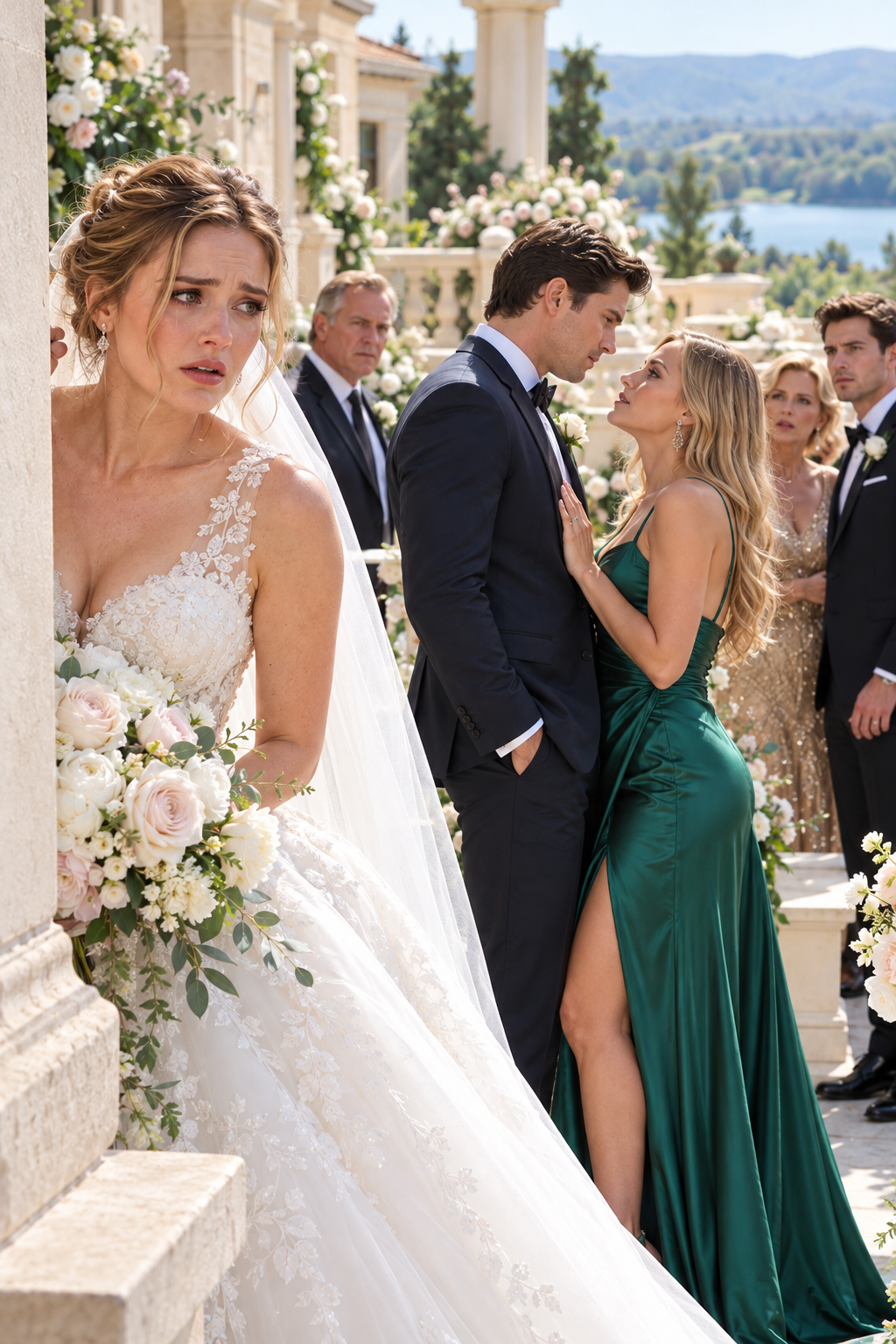
Minutes Before Her Wedding, She Heard His Cruel Confession—Then the Quiet Bride Asked One Question That Destroyed Everything
Seven minutes before Evelyn Harper was supposed to walk down the aisle, she heard her future husband laughing about how quickly he planned to get rid of her.
Not divorce her.
Not leave her.
Get rid of her.
“She’ll sign whatever I put in front of her,” Grant Whitmore said from the room beyond the narrow service hallway. “Evelyn’s spent her whole life apologizing for existing. Give me six months, and Harper Ridge will be ours.”
A second voice laughed.
Evelyn recognized it immediately.
Her younger sister, Mallory.
“Six months?” Mallory said. “You’re giving her too much credit.”
Evelyn stopped moving.
Her wedding gown whispered against the hardwood floor behind her.
She had been searching for her grandmother’s pearl pin.
Instead, she had found the truth.
Through the half-open door, Grant continued talking.
The man who had kissed Evelyn’s forehead that morning.
The man who had promised her father’s grave that he would protect her.
The man waiting beneath an arch of white roses in front of two hundred guests.
“She doesn’t understand what she owns,” Grant said.
Mallory answered, “Neither did Dad.”
“That’s why Howard has been useful.”
Uncle Howard.
Another blade.
Evelyn’s fingers tightened around the little black velvet pouch hidden in her palm.
Inside it was an old brass key.
A key nobody in that room knew existed.
Grant lowered his voice.
“After today, she becomes a Whitmore. We combine the properties, Reid moves the debt, Mom gets the resort expansion approved, and Howard signs off on the eastern acreage.”
“And Evelyn?”
Grant laughed.
A soft, casual laugh.
“She’ll do what she always does.”
“What’s that?”
“Leave quietly.”
Evelyn stared at the wall.
Her reflection trembled faintly in the polished brass frame of an antique mirror.
But she did not.
No hand over her mouth.
Behind the door, Mallory said, “You really never loved her?”
There was a pause.
Evelyn could almost imagine Grant smiling.
“I loved what she made possible.”
That should have broken her.
Maybe once, it would have.
But humiliation has a strange way of changing when you have already swallowed enough of it in your lifetime.
At first it burns.
Then it scars.
Eventually, if you survive long enough, it becomes armor.
Evelyn had been wearing armor for years.
She had paid Mallory’s tuition when their father’s business collapsed.
She had paid their mother’s medical bills until the cancer took her anyway.
She had paid Uncle Howard’s property taxes when he claimed he was “between investments.”
She had paid Grant’s first company payroll when three investors walked out.
She had paid with money, with sleep, with years, with dignity.
And somehow everyone had remembered only that she had paid.
Nobody remembered what it had cost her.
Grant spoke again.
“Once the documents are signed, she’ll have nowhere to go anyway. Howard already agreed that if she causes trouble, he’ll take back the house.”
Mallory snorted.
“Our grandfather’s house?”
“Legally Howard manages it.”
Evelyn looked down at the velvet pouch.
Three nights earlier, she had found it inside an old cedar sewing box belonging to her grandmother.
The box had been stored beneath loose floorboards in the attic of Harper House.
Inside the pouch had been the brass key.
And beneath it, folded four times, a note in her grandfather’s handwriting.
Only one sentence had been underlined.
If they ever make you believe you have nowhere left to stand, use the key before you sign anything.
Her grandfather, Silas Harper, had been dead for eleven months.
At the time, Evelyn had thought the message was simply one more eccentric instruction from a difficult old man.
Now she understood.
Someone touched her elbow.
Evelyn turned.
Her maid of honor, Caroline, stood behind her.
“Evie? They’re ready.”
Evelyn looked at her oldest friend.
Caroline’s smile disappeared.
“What happened?”
“I said nothing happened.”
It was the calmness that frightened Caroline.
Evelyn closed her fingers around the brass key.
Then she smiled.
“Tell them I’ll be there in five minutes.”
Caroline stared at her.
“Are you sure?”
Evelyn looked toward the room where Grant was still discussing how efficiently he intended to dismantle her life.
Then she said something Caroline would remember for years.
“I think everybody should get exactly what they came here for.”
The wedding was being held at Whitmore Hall, a limestone mansion outside Lexington, Kentucky, owned by Grant’s family for three generations.
Or so the Whitmores liked to tell people.
There were twelve-foot windows, imported marble floors, a ballroom built to resemble a French château, and enough white roses to cover a funeral.
Grant’s mother, Celeste Whitmore, had insisted on everything.
The flowers.
The guest list.
The orchestra.
Even Evelyn’s dress.
“Something softer,” Celeste had said during the fitting. “Grant needs a wife who doesn’t look like she’s trying to run the room.”
Evelyn had smiled then too.
For five years, she had smiled whenever Grant’s family corrected her.
When Celeste mocked the way she spoke to waiters.
When Grant’s cousin Reid explained investment structures Evelyn had quietly helped create.
When Mallory called Evelyn “Grandpa’s favorite little martyr.”
When Uncle Howard reminded everyone that practical men, not sentimental women, should control land.
Evelyn had mistaken endurance for grace.
That morning, the mistake ended.
The ballroom doors opened.
Two hundred people rose.
Grant turned.
For one second, his face changed.
Because Evelyn was not carrying flowers.
She was carrying the black velvet pouch.
It rested in her left hand.
Almost ridiculous.
Nobody else would have noticed.
His smile flickered.
Then Evelyn began walking.
Not toward a husband.
Toward a witness stand.
The string quartet played.
Phones rose.
Celeste dabbed at dry eyes.
Mallory stood near the front wearing pale gold silk and the diamond earrings Evelyn had given her for her thirtieth birthday.
Uncle Howard smiled proudly.
Grant waited beneath the roses.
He looked handsome.
Men like Grant often did.
That was part of the danger.
He had built a career on people mistaking polish for character.
When Evelyn reached him, he took her hand.
His thumb brushed her knuckles.
“You okay?” he whispered.
For the first time all day, Evelyn almost laughed.
“I’m perfect.”
The minister began.
Words about devotion.
Words about partnership.
Words about truth.
Grant repeated each vow beautifully.
Evelyn watched his mouth.
When her turn came, the minister smiled.
“Evelyn, do you take Grant—”
“Before I answer,” Evelyn said, “I’d like to ask my fiancé one question.”
The room changed.
Not loudly.
Just enough.
Grant’s smile tightened.
Celeste’s chin lifted.
Mallory stopped breathing.
The minister hesitated.
“Of course.”
Evelyn looked at Grant.
“Did you mean it?”
Grant blinked.
“Mean what?”
“The part about six months.”
Real silence.
The kind that swallows entire rooms.
Grant’s face lost color.
Mallory took one step backward.
Evelyn continued.
“You said I would sign whatever you put in front of me. You said Harper Ridge would be yours within six months.”
A woman in the third row gasped.
Grant recovered quickly.
“Evelyn, whatever you think you heard—”
“I heard you.”
“Then you heard something out of context.”
“Which part?”
“The part where you said you loved what I made possible?”
A hundred heads turned toward Grant.
Celeste stood.
“This is not the place.”
Evelyn looked at her.
“No. I think this is exactly the place.”
Celeste’s face sharpened.
“You’re humiliating yourself.”
Evelyn tilted her head.
“No, Mrs. Whitmore.”
Then she looked around the ballroom.
“I spent years doing that privately.”
Grant reached for her arm.
Evelyn stepped away.
It was a tiny movement.
But everyone saw it.
Grant whispered through his teeth.
“You’re making a mistake.”
“Probably.”
That surprised him.
Evelyn smiled faintly.
“I’ve made several.”
Then she turned to the minister.
“I’m sorry.”
She removed the engagement ring.
Grant looked down as she placed it gently on the small table beside the unity candle.
No dramatic throw.
No screaming.
That somehow made it worse.
Mallory finally spoke.
“Evelyn, don’t do this.”
Evelyn looked at her sister.
The person whose braces she had paid for at sixteen.
Whose first apartment deposit she had covered.
Whose hand she had held outside their mother’s hospice room.
“You were in the room too.”
Mallory’s mouth opened.
Nothing came out.
Evelyn nodded once.
“That’s what I thought.”
She turned.
And walked back down the aisle alone.
Grant called after her.
She kept walking.
Celeste shouted something.
Uncle Howard hurried after her.
Still, Evelyn did not run.
Did not cry.
Did not explain.
At the ballroom doors, she stopped.
Then she looked over her shoulder.
Grant stood beneath the wedding arch surrounded by flowers he had chosen to celebrate an acquisition.
Evelyn lifted the velvet pouch.
Her voice was soft.
Almost apologetic.
“Do you know what this key opens?”
Grant stared at it.
Evelyn nodded.
“Neither do I.”
Then she walked out.
It was the first lie she told that day.
By midnight, the story had spread through half of Lexington.
By morning, Grant’s version had spread through the other half.
According to the Whitmores, Evelyn had suffered an emotional breakdown.
According to Celeste, wedding stress had triggered “old family instability.”
According to Reid, Evelyn had misunderstood a legitimate conversation about estate planning.
According to Mallory, her sister had always been “sensitive.”
And according to Uncle Howard, the entire disaster proved exactly why Evelyn should never have been trusted with serious family decisions.
The system moved quickly.
It always does when it has practiced.
Grant called three times.
Evelyn ignored him.
Celeste sent a message demanding the return of several wedding gifts.
Reid contacted the Harper family accountant.
Howard called an emergency meeting regarding the family property.
Mallory did nothing.
That hurt most.
Evelyn spent the next two nights at Harper House.
The home had belonged to her grandparents.
Thirty-four rooms.
Four stone chimneys.
Three hundred and twelve acres surrounding it.
A horse barn.
An old apple orchard.
Eight cottages where retired Harper employees still lived for nominal rent.
And a ridge overlooking the Kentucky River that developers had been trying to buy for almost twenty years.
Evelyn had grown up there after her mother became ill.
Her grandfather had taught her to drive on the gravel road.
Her grandmother had taught her to bake in the old kitchen.
Evelyn had cared for both of them through their final years.
Mallory visited on holidays.
Howard visited when signatures were required.
Evelyn stayed.
She changed dressings.
Managed medications.
Prepared meals.
Handled payroll.
Negotiated debts.
Sat beside her grandfather through nights when dementia made him forget what year it was.
And listened whenever he became lucid enough to repeat one strange sentence.
“Never confuse who sits at the head of the table with who built the table.”
Evelyn had never understood.
On the third morning after the canceled wedding, Uncle Howard arrived with two attorneys and a locksmith.
Evelyn met them on the porch.
Howard wore a navy suit.
He looked uncomfortable.
That meant he was about to do something cruel while pretending it was necessary.
He glanced at the suitcase beside her.
“You knew we were coming?”
“I assumed.”
One lawyer cleared his throat.
“Ms. Harper, due to recent concerns regarding your judgment and your disruption of pending family transactions, Mr. Harper, in his capacity as managing executor—”
“Trustee,” Evelyn corrected.
The attorney paused.
“Excuse me?”
“My uncle has been calling himself executor for eleven months. Grandfather’s estate closed preliminary probate seven months ago. Howard’s temporary authority comes from a management trust.”
Howard’s expression changed.
But Evelyn saw it.
The lawyer recovered.
“Regardless, the residence is presently under his management.”
“For how long?”
Howard sighed.
“Don’t make this uglier.”
“You brought a locksmith.”
“This house isn’t healthy for you right now.”
There it was.
Cruelty dressed as concern.
Howard stepped closer.
“Go stay with Mallory.”
Evelyn almost smiled.
“You mean the sister who helped my fiancé plan to take my property?”
Howard looked irritated.
“She made a mistake.”
“She made several.”
“You embarrassed this family.”
Evelyn stared at him.
“I embarrassed the family?”
“You turned a private misunderstanding into a spectacle.”
“He planned to marry me for my assets.”
Howard lowered his voice.
“Then you should have handled it privately.”
“Because adults protect family interests.”
Evelyn looked at the lawyers.
Then the locksmith.
Then at the house behind her.
All her childhood.
All her sacrifices.
All the rooms where she had nursed people who had trusted her.
Howard extended a hand.
“The keys.”
Evelyn could have fought.
Could have shouted.
Could have called police.
Instead, she reached into her coat pocket.
Howard relaxed.
He thought she had surrendered.
She placed the house key into his palm.
Then she picked up her suitcase.
Howard frowned.
“That’s it?”
Evelyn looked at him.
“What were you expecting?”
“I don’t know.”
He said nothing.
Evelyn descended one step.
Howard called after her.
“You’ll thank me after you calm down.”
She stopped.
“Uncle Howard?”
“Did Grandfather ever ask you about a brass key?”
His face changed.
Only for half a second.
But there it was.
Evelyn nodded.
Then walked away.
Howard watched her until she reached her car.
He thought he had just evicted a defeated woman.
He had actually given her confirmation.
The key opened a box at Commonwealth Heritage Bank.
Not a safe-deposit box.
A private archival vault.
Evelyn discovered that the following morning.
The bank’s senior trust officer, Margaret Shaw, was seventy-one, silver-haired, perfectly dressed, and entirely unsurprised to see Evelyn.
“You took longer than Silas expected.”
Evelyn stared.
“You knew my grandfather?”
Margaret smiled.
“I survived your grandfather.”
For the first time in days, Evelyn laughed.
Margaret led her through two security doors and into a private conference room.
On the table rested a dark green leather portfolio.
Margaret sat across from her.
“Before I open that, I need you to answer a question.”
“All right.”
“Did anyone pressure you to sign documents involving Harper Ridge, Harper House, the employee cottages, or Whitmore Development?”
“Did you sign?”
Margaret exhaled.
Evelyn’s skin prickled.
Margaret opened the portfolio.
Inside were deeds.
Trust instruments.
Corporate records.
Voting certificates.
And one sealed envelope.
Evelyn recognized her grandfather’s handwriting immediately.
Margaret pushed it toward her.
“He wrote that three years ago.”
Evelyn opened it.
The first line nearly stopped her heart.
Evie, if you are reading this, somebody finally mistook your kindness for stupidity.
She covered her mouth.
Margaret looked away, giving her privacy.
Evelyn continued.
Her grandfather explained everything.
Years earlier, Silas Harper had discovered that Howard was secretly negotiating with Whitmore Development to convert Harper Ridge into a luxury golf resort.
The project would destroy the employee cottages.
Remove the old orchard.
Sell river access.
And displace eight retired workers who had served the Harper family for decades.
Silas had refused.
Howard had continued negotiating behind his back.
So Silas changed the structure of everything.
Harper House and the surrounding 312 acres had been transferred into the Harper Stewardship Trust.
The eastern ridge—another 486 acres—was held through a separate conservation company.
The voting shares of Harper Agricultural Holdings had been reorganized.
And the controlling interest had been assigned to one person.
Not because she was the oldest.
Not because she was the favorite.
Because she had stayed.
Because she had cared for the workers.
Because she had fought to keep health insurance for employees when Howard wanted cuts.
Because when a tornado damaged three rental cottages, Evelyn had emptied her savings to repair them before filing insurance claims.
Because when Silas began forgetting names, Evelyn still listened to every story as if it were the first time.
The fortune was enormous.
Mineral rights.
Commercial leases.
A private water easement.
A regional logistics company.
Estimated combined value: $186 million.
But the number barely registered.
Because beneath the valuation was the clause that mattered.
The trust did not exist to make Evelyn rich.
It existed to stop the family from selling the lives of people who could not fight back.
The cottages could not be demolished while any current resident remained.
The orchard could not be developed for twenty-five years.
The river road had to remain accessible to local rescue services.
Ten percent of annual distributions funded scholarships for employees’ children.
And no controlling beneficiary could transfer the trust’s core property to a spouse within five years of marriage.
Evelyn read that sentence twice.
Then a third time.
Margaret smiled.
“Silas was suspicious by nature.”
“He knew about Grant?”
“He knew about Whitmore.”
Margaret slid another document forward.
A recorded legal memorandum.
Silas’s warning.
If Howard or any Whitmore representative attempted to merge, encumber, pledge, or transfer Harper land without the controlling beneficiary’s informed consent, Howard’s management authority terminated automatically.
Evelyn looked up.
“Automatically?”
“The moment he attempted it.”
“When did he attempt it?”
Margaret turned another page.
“Yesterday morning.”
Evelyn stared.
Margaret continued.
“Howard submitted preliminary authorization for a bridge loan using Harper Ridge as collateral.”
“He can’t.”
“He couldn’t.”
“Past tense?”
Margaret smiled.
“The filing triggered the clause.”
Evelyn leaned back.
“Howard no longer controls the trust?”
“Who does?”
Margaret folded her hands.
Evelyn looked down at her grandfather’s letter.
At the last paragraph.
They will tell you family means forgiveness. Sometimes it does. But family without accountability is only a word people use when they want access to what you have.
Evelyn’s eyes filled.
She did not cry at the altar.
She did not cry when Howard threw her out.
She cried there.
For a stubborn old man who had known she would forgive everyone before she ever learned to defend herself.
Margaret waited.
Then Evelyn asked, “What happens to Howard’s proposed loan?”
“And Whitmore Development?”
“They lose the collateral package they were relying on.”
“How much exposure?”
Margaret studied her.
“You really want to know?”
“Approximately forty-two million dollars.”
Evelyn slowly wiped her eyes.
Grant had believed he was marrying a doorway into Harper wealth.
Instead, he had canceled his own financing by trying to steal it.
But Evelyn was not smiling.
“How many people know?”
Margaret understood immediately.
“About your controlling position?”
“Your grandfather, me, two trust attorneys, and now you.”
“Keep it that way.”
Margaret raised an eyebrow.
“For how long?”
Evelyn looked at the documents.
“Until they finish telling everybody they’ve already won.”
For nine days.
Celeste Whitmore told friends Grant had escaped an unstable marriage.
Reid told investors Whitmore Development remained fully positioned to acquire the Harper parcels.
Howard scheduled contractors to evaluate the employee cottages.
Mallory moved into Harper House.
That one almost made Evelyn lose control.
Mallory sent a photograph to Caroline.
Wine glass in hand.
Sitting beside the fireplace Evelyn had restored with their grandfather.
Sometimes life rearranges itself for the better.
Caroline wanted to respond.
Evelyn stopped her.
“Evie, she’s living in your house.”
“She betrayed you.”
“She deserves to know what’s coming.”
Caroline stared at her.
“Why are you so calm?”
Evelyn looked out the window of the modest rental apartment where she had been staying.
“Because when somebody is digging a hole, interrupting them is rude.”
Caroline burst out laughing.
It was the first time Evelyn had smiled since the bank.
On the tenth day, Grant finally came to see her.
He arrived alone.
No Celeste.
No lawyers.
That told Evelyn the pressure had begun.
She opened the apartment door but did not invite him in.
Grant looked exhausted.
“Can we talk?”
“We’re talking.”
“Privately.”
“This is private.”
He glanced down the hallway.
There was something almost familiar in his voice.
For one dangerous second, she remembered loving him.
Not the man standing there.
The man she thought existed.
That was grief’s cruelest trick.
You do not mourn the person who betrayed you.
You mourn the person you invented before you knew better.
Grant rubbed his jaw.
“My family overreacted.”
“The wedding.”
“You mean the wedding where I discovered you were planning to use me?”
“That’s not what happened.”
“You’re still trying that?”
“Everything I said was about restructuring.”
“You said you loved what I made possible.”
He looked away.
“That was anger.”
“Pressure.”
“From whom?”
“My mother. Reid. Howard. Everyone had expectations.”
There it was.
The system.
Grant wanted to be treated as a victim of the machine he had willingly joined.
Evelyn studied him.
“Did Mallory have expectations too?”
Grant’s eyes sharpened.
“Nothing happened between Mallory and me.”
“I didn’t ask that.”
He went silent.
Interesting.
Evelyn filed the reaction away.
Grant stepped closer.
“We can fix this.”
“You don’t mean that.”
“The Whitmore project could still save Harper Ridge.”
“Save it from what?”
“What debt?”
Grant paused.
Evelyn almost admired how quickly fear moved through his face.
He had expected Evelyn to know nothing.
Now he was realizing she knew something.
“How much have you learned?” he asked.
Evelyn smiled.
“About what?”
Grant stared.
She let the silence stretch.
Then he softened his voice.
She hated when he called her that now.
“I loved you.”
“You loved what I made possible.”
“That isn’t fair.”
She nodded.
“It wasn’t.”
He flinched.
For the first time, she understood the power of not raising her voice.
Grant had always known how to defeat anger.
He could call anger irrational.
Hysterical.
But calmness gave him nothing to fight.
He looked around the apartment.
“This isn’t you.”
“This place. Hiding here.”
“I’m not hiding.”
“You were supposed to be at Harper House.”
“Howard disagreed.”
“He shouldn’t have thrown you out.”
“But you knew he would.”
Grant said nothing.
Evelyn nodded.
She began closing the door.
Grant stopped it with his hand.
Evelyn looked at his fingers.
He removed them.
He swallowed.
“The financing meeting is Thursday.”
“I need you there.”
“To confirm support.”
“For the development?”
“Evelyn, if that financing collapses, people get hurt.”
She almost laughed.
Now morality.
When greed becomes frightened, it discovers ethics.
“Which people?”
“Employees.”
“Whose employees?”
“Interesting.”
Grant’s jaw tightened.
“What does that mean?”
“It means when thirty-two retired Harper workers were going to lose their cottages, none of you cared.”
“That was different.”
“Because development requires trade-offs.”
Evelyn looked at him.
“And losing your company?”
His face hardened.
“That isn’t happening.”
The certainty.
The illusion of ownership.
Evelyn stepped back.
“Then you don’t need me.”
She closed the door.
Thursday arrived with rain.
The financing meeting was held at Whitmore Development’s downtown headquarters.
Grant expected twelve people.
Twenty-eight arrived.
Three banks.
Two private-equity representatives.
The Whitmore board.
And at a.m., Evelyn.
She entered wearing a simple navy suit.
No diamonds.
No entourage.
Only Margaret Shaw and a gray-haired attorney named Daniel Mercer.
Grant stood.
Relief flooded his face.
“You came.”
Evelyn smiled politely.
“You asked.”
Celeste approached.
Her warmth returned immediately.
“Evelyn, darling.”
Ten days earlier she had described Evelyn as unstable.
Now she kissed the air beside Evelyn’s cheek.
“We’re so glad everyone can finally behave like adults.”
Margaret looked down, hiding a smile.
Evelyn said, “I agree.”
Mallory hovered near the windows.
She looked nervous.
Howard looked worse.
Grant pulled Evelyn aside.
“Thank you.”
“For what?”
“For not destroying everything over one bad conversation.”
Evelyn looked into his eyes.
“That would be an extreme reaction.”
He thought she had come back.
Men like Grant were excellent at believing whatever protected their ego.
The meeting began.
Reid presented first.
Projected resort revenues.
Luxury residences.
A private golf course.
A riverfront event pavilion.
The eastern cottages were described as “obsolete workforce structures.”
The orchard became “underutilized agricultural acreage.”
The old rescue road became “nonessential access.”
Every human thing had been translated into a financial term so it would be easier to destroy.
Evelyn listened.
Howard spoke next.
“As acting manager for the Harper interests, I can confirm family support.”
Daniel Mercer wrote something on a yellow legal pad.
Margaret did not move.
Grant presented the final slide.
“The combined project creates an estimated $410 million in long-term value.”
Then one banker asked the only question that mattered.
“Before we move to commitment, do we have final beneficiary consent?”
Grant looked at Evelyn.
Everyone did.
Evelyn folded her hands.
Grant smiled.
She looked at the banker.
“I have a question first.”
Howard sighed loudly.
Celeste whispered, “Please.”
Evelyn ignored her.
She looked at Grant.
“Who owns Harper Ridge?”
Grant hesitated.
“Technically, the Harper trust.”
“And who controls that trust?”
Howard answered.
Daniel Mercer finally looked up.
Evelyn turned to her uncle.
“You’re sure?”
Howard’s face tightened.
“I’ve managed the estate for nearly a year.”
“That wasn’t my question.”
“You know what I mean.”
Evelyn reached into her handbag.
And placed the brass key on the table.
Howard froze.
Grant stared at it.
Mallory whispered, “What is that?”
Evelyn looked at her sister.
“The thing Grandfather hoped I’d never need.”
Daniel Mercer stood.
He distributed twelve folders.
Grant did not touch his.
Howard opened his first.
His face drained.
Celeste looked over his shoulder.
“What is this?”
Daniel answered.
“The controlling instruments for the Harper Stewardship Trust, recorded conservation interests, corporate voting assignments, and notice of automatic termination of temporary management authority.”
Reid leaned forward.
“What termination?”
“Mr. Harper’s.”
Howard stood.
“This is ridiculous.”
Daniel continued calmly.
“Mr. Harper’s authority terminated when he attempted to pledge restricted trust property as collateral without beneficiary consent.”
Grant stared at Evelyn.
“Beneficiary?”
Margaret finally spoke.
“Controlling beneficiary.”
Nobody moved.
Grant looked at Evelyn as if seeing a stranger.
“How much do you own?”
Evelyn’s expression did not change.
“That’s your first question?”
“Answer me.”
She nodded toward the folders.
Reid began scanning pages.
His face changed.
Reid leaned toward him.
“The eastern acreage isn’t in Howard’s structure.”
“It never was.”
Grant snatched the folder.
Reid continued.
“The conservation company controls the access easements.”
Celeste frowned.
“What does that mean?”
“It means without Evelyn’s approval, there is no resort.”
The banker interrupted.
“And our collateral?”
Daniel answered.
“Unavailable.”
Another banker closed his folder.
“Then the financing package doesn’t meet conditions.”
Grant shot up.
The banker looked at him.
“You represented that control of the Harper parcels was secured.”
“No,” Evelyn said.
Grant turned toward her.
“You told me yourself.”
“What did I tell you?”
“That the family estate was being consolidated.”
“I said Howard was handling probate.”
“You knew what I meant.”
“You let me believe—”
Evelyn’s eyebrows rose.
“Be careful.”
Grant stopped.
There it was.
The trap opening beneath him.
He could accuse her of misleading him.
But doing so would require admitting he had expected to gain control through marriage.
Celeste stepped in.
“This is absurd. Families restructure assets all the time.”
Evelyn looked at her.
“So what do you want?”
That question exposed everything.
Not What happened?
Not How do we fix what we did?
What do you want?
As though morality were simply another price negotiation.
Evelyn stood.
“I want the employee cottages left untouched.”
Reid scoffed.
“That destroys the southern plan.”
“I want the rescue road permanently protected.”
“That cuts across the golf course.”
“I want the orchard preserved.”
Celeste stared.
“For apples?”
Evelyn looked at her.
“For memory.”
Celeste rolled her eyes.
There it was.
Exactly why Silas had chosen Evelyn.
Evelyn continued.
“I want every Harper employee currently over sixty-five to retain housing protection for life. I want the scholarship fund restored. I want the medical reserve Howard suspended reinstated.”
Howard slammed his palm on the table.
“This isn’t business.”
Evelyn looked at him.
“It’s responsibility.”
Grant’s voice went cold.
“You’re willing to destroy my company for some cottages?”
She met his eyes.
“You were willing to destroy people for your company.”
Mallory began crying.
Evelyn noticed.
She felt almost nothing.
That frightened her more than anger would have.
Mallory stepped forward.
“Evie, please.”
Evelyn looked at her.
Mallory wiped her face.
“I didn’t know all of this.”
“You knew enough.”
“Grant told me the development would save the estate.”
“You heard him say he planned to use me.”
“I thought he was joking.”
“You laughed.”
Mallory’s face collapsed.
Evelyn remembered the hallway.
That laugh.
Sometimes betrayal does not sound like a scream.
Sometimes it sounds like your little sister laughing behind a door.
Mallory whispered, “I’m sorry.”
Evelyn nodded.
“I believe you’re sorry.”
Hope flashed across Mallory’s face.
Then Evelyn finished.
“I don’t believe you were sorry before you got caught.”
The hope disappeared.
Howard pointed at Evelyn.
“Your grandfather poisoned you against this family.”
Evelyn turned.
“My grandfather kept you from selling homes out from under retired people.”
“He manipulated the trust.”
“He owned the assets.”
“He promised me control.”
Evelyn opened Silas’s final letter.
“He gave you a test.”
Howard stared.
She read one line.
“Temporary authority may continue only so long as Howard protects those who cannot protect themselves from the appetite of stronger men.”
Howard went pale.
Evelyn lowered the paper.
“You failed.”
Grant looked around at the bankers.
“This doesn’t have to kill the deal.”
Nobody answered.
He turned to Evelyn.
“We can renegotiate.”
His composure finally broke.
“You think this makes you powerful?”
Evelyn looked at him.
“Then what?”
She glanced at the trust documents.
At her grandfather’s handwriting.
At the names of employees.
At the protections he had built into paper because he knew kind people sometimes needed legal steel around them.
“It makes me responsible.”
Grant laughed bitterly.
“You’re going to walk away from four hundred million dollars in development value?”
Evelyn shook her head.
“You still don’t understand.”
“Not everything valuable is for sale.”
By Friday afternoon, the financing consortium withdrew.
By Monday, two Whitmore board members resigned.
Reid was placed on administrative leave after internal auditors discovered he had used optimistic Harper valuations in unrelated financing presentations.
Howard received formal notice that his management role had ended.
Celeste called Evelyn nine times.
Evelyn answered once.
Celeste screamed for eleven minutes.
Evelyn listened.
Then said, “Are you finished?”
Celeste hung up.
Grant did not call.
Not for three weeks.
Mallory called every day.
Evelyn answered none of those calls either.
Forgiveness, she discovered, did not require immediate access.
That was another lesson nobody had taught her.
A month later, Evelyn returned to Harper House.
Howard had been ordered to vacate.
Mallory had already left.
The locksmith who had changed the doors four weeks earlier returned to change them again.
He looked embarrassed.
“Sorry about before.”
Evelyn smiled.
“You were doing your job.”
Inside, everything looked almost identical.
But it did not feel identical.
The house had once been proof that Evelyn belonged somewhere.
Now she understood belonging differently.
A house could be taken.
A ring could be removed.
A family name could be weaponized.
Belonging had to begin somewhere nobody else could lock.
She walked into her grandfather’s study.
His chair remained beside the window.
For several minutes, she simply stood there.
Then she placed the brass key on his desk.
“You could have told me,” she whispered.
In her imagination, she could hear his answer.
Would you have believed me?
Probably not.
That afternoon, Evelyn drove to the employee cottages.
Mr. Walter Benson, seventy-eight, was fixing a porch rail.
His wife, June, waved from the doorway.
They had lived there forty-one years.
Walter had worked for Silas since he was nineteen.
“Miss Evelyn.”
“Mr. Benson.”
He removed his cap.
“Heard you saved us.”
Evelyn shook her head.
“My grandfather did.”
Walter looked toward Harper House.
Then back at her.
“He left papers.”
Walter tapped his chest.
“You decided they meant something.”
Evelyn swallowed.
For the first time, the inheritance felt real.
Not the $186 million.
Not the land.
Not the shares.
Two elderly people who no longer had to wonder whether a bulldozer would appear outside their bedroom window.
A scholarship recipient who could finish college.
A retired groundskeeper who could keep his medical coverage.
An orchard where her grandmother’s trees would bloom again in spring.
Justice rarely arrived looking like revenge.
Sometimes it looked like a deed nobody could overturn.
Grant appeared six weeks later.
Evelyn was in the orchard when she saw him walking toward her.
No tailored suit.
No Whitmore confidence.
Just Grant.
He stopped several feet away.
“I heard you’d be here.”
“Who told you?”
Evelyn sighed.
Grant looked toward the trees.
“They’re smaller than I remembered.”
“They were bigger when we were younger.”
For a moment, neither spoke.
Then Grant said, “The board removed me.”
Evelyn looked at him.
“My mother thinks we can sue Howard.”
“Reid thinks we can restructure.”
“I don’t care anymore.”
That surprised her.
Grant shoved his hands into his pockets.
“I’ve been trying to figure out when I became that person.”
Evelyn said nothing.
“I keep replaying the wedding.”
Still nothing.
“You could’ve destroyed me publicly.”
“I canceled a wedding in front of two hundred people.”
“You know what I mean.”
She had recordings.
Caroline’s phone had captured part of the hallway conversation accidentally while recording bridal preparations.
Daniel had advised Evelyn that she could use it if Grant challenged the trust or accused her of fraud.
She had never released it.
Grant looked at her.
“Why didn’t you?”
“Because I didn’t need everyone to hate you.”
“I needed you to stop hurting people.”
Grant stared.
“That’s worse.”
“You not hating me.”
Evelyn considered that.
“I did hate you.”
“For a while.”
She looked past him toward the orchard.
“Now I think you’re a man who kept choosing whatever version of himself made the next room applaud.”
Grant closed his eyes.
That landed harder than an insult.
“You loved me.”
“I loved you too.”
Evelyn looked at him.
He opened his mouth.
She stopped him gently.
“You may have felt something for me. But love that disappears whenever money enters the room isn’t love.”
He looked away.
The wind moved through the trees.
Finally he asked, “Is there any version of this where you forgive me?”
Grant looked back quickly.
Evelyn continued.
“There’s probably a version where I forgive everyone eventually.”
Hope appeared in his face.
She hated how familiar that hope looked.
Then she said, “But forgiveness isn’t the same as returning.”
His shoulders dropped.
Grant nodded.
He stood there another moment.
Then turned to leave.
Evelyn watched him walk away.
Ten steps later, he stopped.
“Did you know at the wedding?”
“Know what?”
“Everything. About the trust. The money.”
Evelyn looked at the brass key hanging now from a small chain inside her coat.
Grant frowned.
“Then why were you so calm?”
Evelyn smiled sadly.
“Because I finally understood that losing you wasn’t the worst thing happening to me.”
“What was?”
“Realizing how long I’d been losing myself.”
Grant had no answer.
This time, when he left, she did not watch until he disappeared.
Winter passed.
Then spring.
Harper Ridge changed.
Not dramatically.
That was the point.
The cottages received new roofs.
The orchard was restored.
A small medical fund reopened.
The scholarship program doubled.
Evelyn hired professional managers for the commercial holdings and created an independent board so no future Harper could control everything through entitlement alone.
Even herself.
Margaret approved.
“You’re voluntarily limiting your authority?”
“Silas would complain.”
“Then secretly approve.”
Margaret smiled.
Howard challenged the trust.
Then appealed.
He lost again.
Eventually, he sent Evelyn a handwritten letter.
She did not answer.
Not because she planned to hate him forever.
Because some apologies need time to prove they are not merely requests for restored privileges.
Mallory was different.
She came to the house in April.
No expensive clothes.
No performance.
Evelyn met her on the porch.
Mallory did not ask to come inside.
That mattered.
“I got a job,” she said.
Evelyn raised an eyebrow.
Mallory laughed nervously.
“A real one.”
“Congratulations.”
“I’m renting an apartment.”
“I sold the earrings.”
Evelyn knew which earrings.
Mallory looked ashamed.
“I used the money to repay part of what you spent on my tuition.”
“You don’t owe me tuition.”
“Yes, I do.”
Mallory’s eyes filled.
“I owe you more than money.”
Evelyn waited.
Mallory breathed deeply.
“I was jealous of you.”
That surprised her.
“Everybody thought you were the good one.”
“Everybody thought I was boring.”
“Dad trusted you. Grandpa trusted you. Mom called you when she was scared.”
“Because I answered.”
Mallory looked down.
“That’s what I hated.”
Evelyn said nothing.
“You always showed up. And instead of becoming like you, I decided it was easier to make you look pathetic for doing it.”
The honesty hurt.
But clean pain was different from betrayal.
Clean pain could heal.
Mallory continued.
“When Grant started talking about the development, he made me feel important. Like I finally understood something you didn’t.”
Evelyn’s voice softened.
“And when he said he didn’t love me?”
Mallory cried then.
Not dramatically.
Just tears.
“I should’ve walked into that hallway and told you.”
“I should’ve ruined the wedding before he could.”
“I should’ve chosen you.”
Evelyn looked at her sister.
Mallory nodded.
For several seconds, neither spoke.
Then Mallory turned.
“I won’t bother you again.”
She descended the porch steps.
Evelyn watched.
Her sister stopped.
Evelyn’s voice was quiet.
Mallory turned.
“Next Thursday.”
Mallory stared.
“At the house?”
Evelyn smiled faintly.
“You haven’t earned the house yet.”
Mallory laughed through tears.
“There’s a diner on Route 27.”
“I know it.”
“Ten o’clock.”
Mallory nodded.
“I’ll be there.”
Evelyn did not call that forgiveness.
It was a door unlocked one inch.
Sometimes that is enough.
One year after the canceled wedding, Harper House hosted another ceremony.
Not a wedding.
A dedication.
The old eastern barn had been converted into a community scholarship center named after Silas and Ruth Harper.
Former employees came.
Children came.
Families came.
Walter Benson sat in the front row beside June.
Margaret attended in a red coat.
Caroline cried before anything even started.
Mallory stood near the back.
She and Evelyn were still rebuilding.
Without pretending scars were erased just because apologies existed.
After the ceremony, Daniel Mercer approached Evelyn.
“There’s one last document.”
She laughed.
“Please tell me my grandfather didn’t hide another corporation.”
Daniel handed her a thin envelope.
“This was sealed with instructions that it be delivered exactly one year after you activated the trust.”
Evelyn stared at it.
“Of course it was.”
She opened the envelope.
Inside was one page.
Silas’s handwriting.
If you are reading this, then the worst probably happened. Someone chose your inheritance over you. Someone called your patience weakness. Someone tried to make you feel homeless in a place your hands helped hold together.
Evelyn’s throat tightened.
I am sorry I cannot be there to see what you do next.
She stopped reading for a moment.
Caroline touched her shoulder.
Evelyn continued.
The land was never the inheritance.
She frowned.
The money was never the inheritance.
Her eyes blurred.
The inheritance was the right to say no without becoming cruel.
Evelyn pressed her lips together.
Howard believes power is controlling the table. The Whitmores believe power is owning the building around it. I hope you learn something neither of them did.
Real power is knowing what you refuse to sell.
Below that was one final sentence.
And when someone asks what all of it is worth, ask them what they think dignity costs.
Evelyn lowered the letter.
Caroline was crying openly now.
Margaret pretended not to be.
Mallory stood several feet away with tears on her face.
Outside, children ran between the orchard rows.
The cottages were safe.
The rescue road was safe.
The scholarships were funded.
The ridge remained untouched.
Harper House still stood.
But Evelyn no longer needed it to prove she did.
That evening, after everyone had left, she walked alone through the ballroom-sized front hall.
Sunlight stretched across the floorboards.
A year earlier, she had believed she was minutes away from becoming Mrs. Grant Whitmore.
She had believed marriage would finally make her life feel settled.
Instead, one overheard confession destroyed the future she thought she wanted.
And exposed the life she had been quietly surrendering.
Evelyn entered her grandfather’s study.
The brass key still rested on his desk.
She picked it up.
Such a tiny thing.
Small enough to disappear inside a bride’s palm.
Large enough to unlock the truth about an entire family.
Her phone buzzed.
A message from Mallory.
Coffee tomorrow? My turn to pay.
Evelyn smiled.
Another message appeared.
Unknown number.
She opened it.
I heard about the scholarship center. Your grandfather would be proud. I’m sorry for everything. I don’t expect an answer.
Evelyn read it once.
Then locked her phone.
No satisfaction.
No temptation.
Just quiet.
She walked onto the porch.
The sun was sinking behind Harper Ridge.
For years, people had told Evelyn that strength meant holding families together.
Holding relationships together.
Holding businesses together.
Holding everyone’s secrets.
Holding everyone’s mistakes.
Nobody had told her strength could also mean opening her hands.
Letting the wrong people fall away.
And keeping only what deserved to remain.
Evelyn stood there until the sky turned gold.
Then Daniel came outside carrying his briefcase.
“One more thing.”
She laughed.
“You said the letter was the last document.”
“Then what?”
Daniel smiled.
“Howard’s attorneys sent a settlement proposal.”
Evelyn groaned.
“What does he want?”
“Access to a portion of the family investment income in exchange for dropping all remaining claims.”
“And what do you recommend?”
“I’m your attorney. I’m supposed to ask what you want.”
Evelyn looked toward the cottages.
At the lights coming on behind small windows.
At homes men like Howard and Grant had once discussed as obstacles on a spreadsheet.
“What happens if I refuse?”
“He probably walks away with nothing.”
“And if I accept?”
“He receives enough to live comfortably, but never controls Harper property again.”
Evelyn considered it.
Daniel waited.
A year earlier, she might have given Howard everything to avoid conflict.
Six months earlier, she might have refused everything to prove she could.
Now she understood there was another choice.
“Give him enough to live.”
Daniel raised an eyebrow.
“Generous.”
Evelyn looked at him.
Daniel smiled.
“I’ll prepare it.”
He turned toward the steps.
“Add one condition.”
“Howard has to sign permanent waivers protecting every employee covenant in the trust.”
Daniel’s smile widened.
“Your grandfather would enjoy that.”
He started down the steps.
Then Evelyn called him again.
“One more question.”
Daniel turned.
Evelyn held the brass key between two fingers.
Her expression looked almost uncertain.
Almost weak.
Almost like the woman everyone had once believed would sign whatever was placed in front of her.
Her voice was soft.
“Before Howard signs…”
“Could you ask him something for me?”
Evelyn looked across the ridge that an entire family had once believed they already owned.
Then she smiled.
“Ask him if he’s absolutely sure he understands what he’s signing this time.”
Daniel stared at her.
Then laughed.
And somewhere beyond the orchard, the last light disappeared behind land that had never needed saving from poverty.
Only from people who believed everything—and everyone—had a price.
✓ Lynn R. Adams
Minutes Before Her Wedding, She Heard His Cruel Confession—Then the Quiet Bride Asked One Question That Destroyed Everything Seven minutes before Evelyn Harper was supposed to walk down the aisle, sh…