Minutes after my divorce became final, my mother-in-law told my parents to “come get their burden” while my ex-husband worried only about the neighbors hearing her
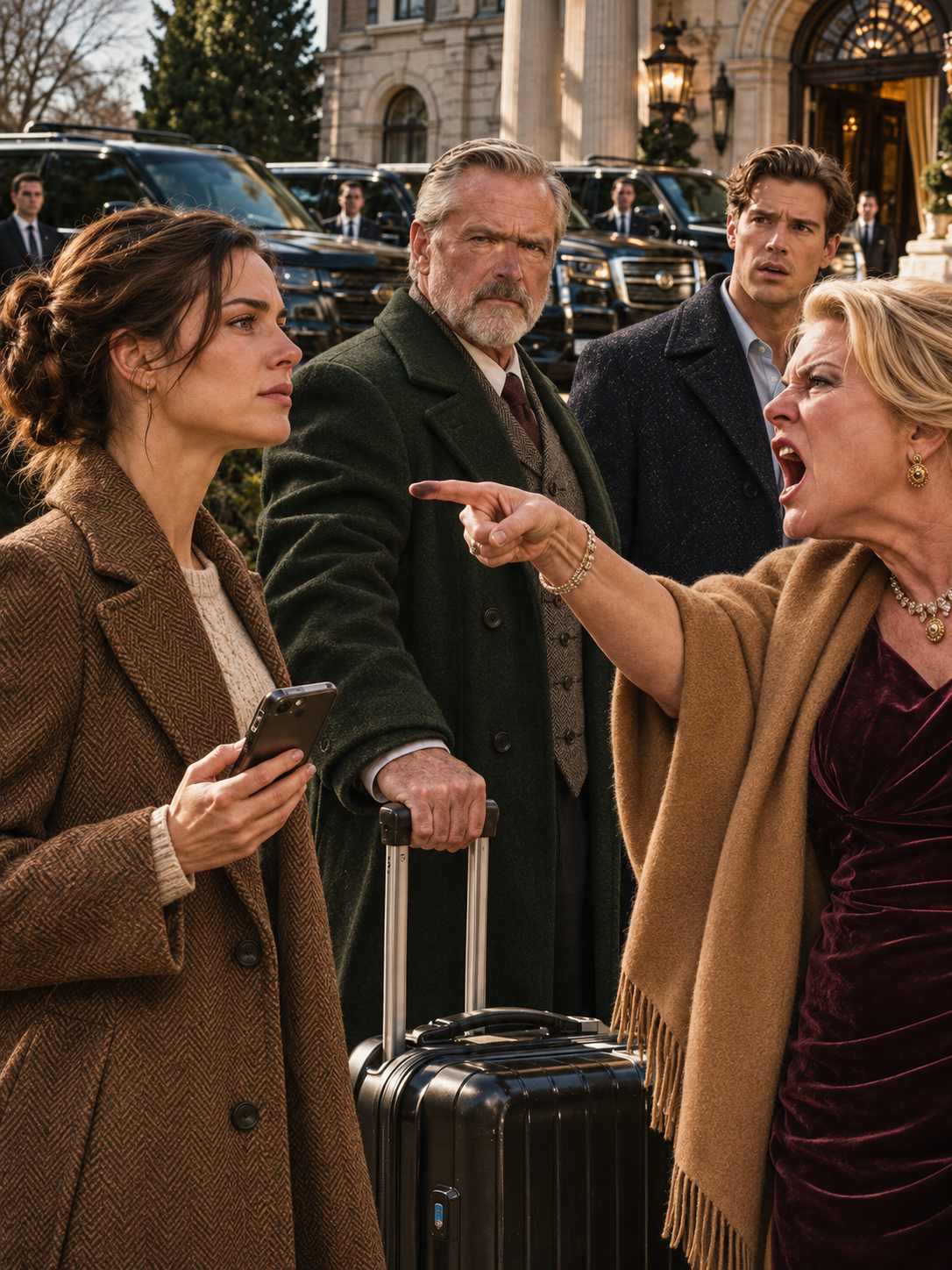
Minutes after my divorce became final, my mother-in-law told my parents to “come get their burden” while my ex-husband worried only about the neighbors hearing her. Then eight black SUVs arrived at the house, my father stepped out, and I noticed Judith was still using the card tied to my $600,000 account before we even left…
“Come get your daughter! She’s nothing but dead weight, and we don’t want her in this house anymore!” my mother-in-law shouted into her phone less than an hour after my divorce became official.
I stood in the marble foyer of the Richmond, Virginia, home I’d shared with Grant Bellamy for eleven years. One hand held a suitcase; the other held the finalized divorce papers. Two more suitcases sat near the stairs beside a cardboard box of books, the small collection of belongings that was supposed to represent the end of a life I’d spent more than a decade building.
Grant was barely three feet away. He had heard every word, but when I looked at him, he said, “Mom, lower your voice. The neighbors can hear you.” He didn’t ask her to stop, remind her I had been his wife, or even look embarrassed for me. He was worried about what people outside might hear.
Judith Bellamy folded her arms, pleased with herself. “Well, Tessa? You heard me. Your parents can come collect you. You’re not our responsibility anymore.” The way she said it made me feel less like a person leaving a marriage and more like an unwanted delivery she wanted removed from her doorstep.
For a moment, I looked at the bags and tried to understand how eleven years could be reduced to a suitcase, a few personal things, and a woman who seemed relieved to see me go. Then I took a breath, picked up my phone, and smiled. “You’re absolutely right, Judith. My parents can come get me.”
I called my father. “Dad? Are you busy?” He answered in the same steady voice he’d used when I was a child and needed him after a bad day. “Not too busy for you, sweetheart. What’s wrong?” I asked if he could pick me up.
He didn’t demand an explanation or ask what had happened. He only asked where I was. “At Grant’s house,” I told him. After a short pause, he asked, “Inside or outside?” When I said I was inside, he replied, “Finish packing. I’ll be there shortly.”
Judith watched me put the phone away. “Good. At least your family understands whose responsibility you are.” Grant shifted his weight and offered, “Tessa, I can drive you to your apartment.” I declined. He said we didn’t have to make it awkward, as if the awkwardness had come from my refusal rather than his mother’s cruelty.
I almost laughed at that word. Awkward. Judith had just told my parents to collect me as though I were an old chair she no longer wanted, and Grant’s concern was that the ride might be uncomfortable.
For most of our marriage, I had made myself useful to the Bellamys in ways that rarely showed up in family photographs. I coordinated Judith’s doctor visits, kept track of her medications, arranged rides, handled medical expenses, planned birthdays and holiday dinners, and dealt with the small emergencies that interrupted their routines. I did those things because I cared about the family I thought I belonged to, not because I expected a reward.
That afternoon, none of it seemed to matter. I picked up my smaller bag and headed toward the rest of my things. Judith pointed at the cardboard box. “Take those books too. I don’t want you showing up again next week claiming you forgot something.” I nodded and asked if there was anything else.
She opened her mouth, but a low engine rumble came through the front windows. Another engine followed, then another. Grant turned toward the driveway. “What the hell?”
A black Cadillac Escalade passed through the gates, followed by another and then another. In a few moments, eight immaculate black SUVs had pulled into the circular drive. Their dark windows and polished chrome stood out against the familiar house, and each vehicle carried the discreet silver emblem of my father’s transportation company.
Judith hurried to the window. “Grant! What’s happening? Who are all these people?” He stared at the driveway and said he had no idea. I did. Dad had been inspecting a new corporate fleet nearby with several drivers when I called.
The first driver’s door opened. My father, Everett Keene, stepped out in a charcoal-gray coat. His silver hair was slightly mussed, his shoes were worn from work, and a folded vehicle inspection sheet stuck out of his pocket. He looked like himself: a man who had been working since morning and had come because his daughter needed him.
Dad had started Keene Executive Transportation as a modest airport shuttle service with two vehicles. Over the years, he’d built it into one of Virginia’s most successful private transportation companies and, two years earlier, expanded into luxury corporate travel. Grant had always described it as a small car service. He had never shown much interest in learning more.
Dad crossed the foyer without looking around to see who was watching. “Everything packed, Tess?” he asked. I lifted the suitcase handle. “Just these.” He reached for the larger one and said, “Then let’s get you home.”
Grant followed us onto the porch, still watching the line of vehicles. “Mr. Keene, are those yours?” Dad glanced back. “Company vehicles. We were inspecting a new corporate fleet nearby when Tessa called.” Grant asked if all eight belonged to the company. Dad told him there were another twelve at the main facility.
I saw Grant trying to fit that answer into the version of my family he had carried around for years. He had never asked about Dad’s contracts or the people who worked for him. He had simply decided that a man in ordinary work shoes who ran an airport shuttle service couldn’t have built much.
Judith came outside, her voice suddenly lighter. “Everett! You didn’t have to bring an entire parade!” Dad looked at her calmly. “I didn’t. I brought my daughter a ride. The drivers are on their way to another appointment.” Her smile tightened. “You know how emotional divorces can be. We were just trying to get everything sorted out.” He didn’t argue with her or give her the reaction she seemed to want.
Instead, Dad turned back to me. Grant picked up my box of books and offered to carry it. Dad took it from him with a quiet, “Thank you, son.” The word seemed to leave Grant with nothing to say. I stepped toward the open passenger door, grateful that my father had come without making me explain myself in front of them.
My phone buzzed as I was getting into the Escalade. A banking alert showed an approved $137.42 purchase at an upscale home furnishings shop, charged by Judith Bellamy. I stared at the notification. Less than an hour after telling me I was no longer part of her family, she was still using the additional credit card attached to my account.
The account held more than $600,000 in assets that belonged exclusively to me. Judith’s supplementary card did not give her access to that balance; it had a relatively modest spending allowance. But after years of using it, she had begun treating the privilege as something permanent, as though my money and my permission were both hers by default.
I opened my bank’s app, found the additional card under Judith’s name, and selected CARD FROZEN. A moment later, another alert appeared: Transaction Declined — Judith Bellamy. Grant was still standing outside, watching us. I looked at the house one last time, turned my phone facedown, and said, “Drive, Dad.”
As we pulled away, I saw Grant standing motionless on the porch. I thought the confrontation was over. Five days later, Judith would appear at my workplace holding that same card, and something she’d found inside her own house would force all of us to look at those eleven years differently. Part 2…..
IF FACEBOOK BROUGHT YOU HERE, HERE’S THE CONTINUATION YOU’VE BEEN WAITING FOR. ENJOY! 👇 Five days later, I was at work when the receptionist called to say Judith Bellamy was waiting to see me. Before I could ask what she wanted, Judith appeared in the doorway with her handbag tucked under one arm and the frozen card pinched between two fingers.
She didn’t sit down. “You need to fix this,” she said, holding the card toward me. “It was declined at the pharmacy, and then again when I tried to pay for lunch. Do you have any idea how embarrassing that was?”
I looked at the card, then at her. “I froze it after I left Grant’s house. You were an authorized user, Judith. You weren’t the owner of the account, and the card was never yours to use without my permission.” She drew herself up as if I had corrected her in front of a room full of people.
“You gave it to me,” she said. “For years.” I nodded. “I did. And I was glad to help while we were family. The divorce is final, and I am no longer authorizing purchases on my account.” I kept my voice level, partly for her sake and partly because I didn’t want to become the person she had already decided I was.
Judith’s fingers tightened around the card. “I came here because I found something at home.” She opened her handbag and took out a thin folder with a worn tab. I recognized it immediately: the folder I had used to keep copies of her appointment dates, prescription receipts, transportation arrangements, and medical bills.
“I was looking for my insurance papers,” she said. “This was in the cabinet by the kitchen. I started going through it because I thought there might be something I needed.” She opened it on the corner of my desk. Inside were the careful notes I had made over the years, along with receipts and copies of bills I had helped pay.
She touched one of the pages. “These payments came from you?” I told her that some of the expenses had, yes. I had kept the paperwork because I was coordinating the appointments and wanted to make sure nothing was missed or paid twice. I had never thought of it as something to hold over her.
“Why didn’t you tell me?” she asked. I almost said that I had, more than once, but the words seemed too small for the moment. “I thought you knew I was helping,” I said. “I did it because I cared about you. I wasn’t keeping a tally.”
For the first time since I had known her, Judith seemed unable to find a quick answer. Her eyes moved over the dates and handwritten reminders. The folder was not a dramatic secret; it was the ordinary record of years of showing up, making calls, arranging rides, and taking care of things that had to be done.
She looked down at the card in her hand. “I shouldn’t have spoken to your parents that way.” It wasn’t a full apology, and she didn’t try to make it one. I told her, “No, you shouldn’t have.” Then I let the silence stay between us instead of rushing to make her comfortable.
Part 3 Judith closed the folder carefully. “I didn’t realize how much you had done,” she said. “I thought those were just things you handled because you were better at organizing.” I told her that being organized didn’t mean the work had been effortless, and loving someone didn’t mean I could be expected to do it forever.
She asked whether I wanted her to pay me back. I shook my head. “This isn’t about a bill, Judith. I don’t need you to reimburse me. I needed you to understand that I was a person in this family, not a service you could dismiss when the marriage ended.” She looked at me, then down at the folder again.
“I was angry,” she said quietly. “I thought Grant was being hurt, and I took it out on you.” I answered honestly: “You were angry, but you chose what to say. And Grant was standing right there.” She didn’t defend herself this time.
After a moment, she slid the folder across my desk. She kept the card in her hand for another second, then placed it beside the folder. “I suppose you should have this back.” I told her I would have the bank close the additional card rather than simply leave it frozen. She nodded, picked up her handbag, and left without asking me to change my mind.
I waited until she was gone before calling the bank. The representative confirmed that Judith’s additional card was frozen and helped me close it. The account and its assets remained mine; closing one authorized card did not change ownership of anything else. I thanked the representative, put the folder in my desk drawer, and went back to work.
Grant called that evening. I let it ring once before answering. He said his mother had told him about the folder and the bills, and that he hadn’t known I had paid some of them. I told him I wasn’t surprised. He had rarely asked how I managed all the things he took for granted.
“I should have known,” he said. “And I should have said something when Mom spoke to you.” His voice sounded tired rather than defensive. Then he admitted, “I was worried about the neighbors hearing her. I wasn’t thinking about what it was doing to you.”
I sat at my kitchen counter and looked at the two mugs I’d left beside the sink that morning. “You were standing three feet away, Grant,” I said. “You heard her call me dead weight. You asked her to lower her voice, not to stop.” He didn’t interrupt or offer an excuse.
He apologized. Not with a long speech or a request to reconsider the divorce, but with a plain acknowledgment that he had failed me in a moment when I needed him to stand beside me. I told him I appreciated hearing him say it, but an apology couldn’t undo eleven years of feeling alone in a marriage or make the divorce less final.
There was a pause before he asked if I was doing all right. I said I was getting there. He told me he hoped I would be happy, and I believed he meant it. We ended the call without making plans to meet, and for once I didn’t feel responsible for making the silence easier for him.
Final The next Sunday, Dad came by my apartment with groceries and a container of the soup he knew I liked. He didn’t ask whether I had forgiven Grant or whether Judith had called again. He put the groceries on the counter, looked at the folder beside my keys, and asked if I wanted to talk about it.
I told him what Judith had found and what she had said. Dad listened without interrupting. When I finished, he said, “You can care about people and still decide they don’t get to keep taking from you.” It was simple, but I needed to hear it from someone who had never confused my kindness with an obligation.
I kept the folder for a while, then returned it to Judith with a short note explaining that the appointment records and receipts might be useful if she needed to follow up on anything. I didn’t include a lecture or ask her to remember what I had done. The records could help her, and that was reason enough to send them back.
A few weeks later, she called. Her apology was more direct this time. She said she had treated me badly, that the words she used in the foyer were cruel, and that she had no right to expect me to keep paying for things or arranging her life after the marriage ended. I thanked her for saying it, but I didn’t offer to restore the old arrangement.
I also didn’t reopen the card. I had closed it, and that decision stayed closed. Judith would have to make her own arrangements for purchases and appointments, just as I was learning to make mine without automatically checking whether everyone else was taken care of first.
Grant and I did not become friends, and Judith and I did not return to the relationship we’d had before. There were too many years of unspoken expectations to repair with one apology. Still, I no longer needed either of them to agree with my version of what happened in order to trust what I had lived.
The divorce had ended my marriage, but it had also ended a role I had quietly accepted: the person who kept everything running and was expected not to notice when nobody made room for her. I had left with two suitcases, a box of books, and my father’s hand on the other suitcase handle. I had not left empty-handed. I had left with the right to decide where my care went next.
THE END. I’ve shared the complete story, and I truly hope it touched your heart. If this story moved you, please , like, and share the post. Thank you for reading! ❤️
✓ Lynn R. Adams
Minutes after my divorce became final, my mother-in-law told my parents to “come get their burden” while my ex-husband worried only about the neighbors hearing her. Then eight black SUVs arrived at th…