Left With Only Her Son, She Bought an Abandoned Sawmill—Then the Dead Owner’s Warning Changed Everything
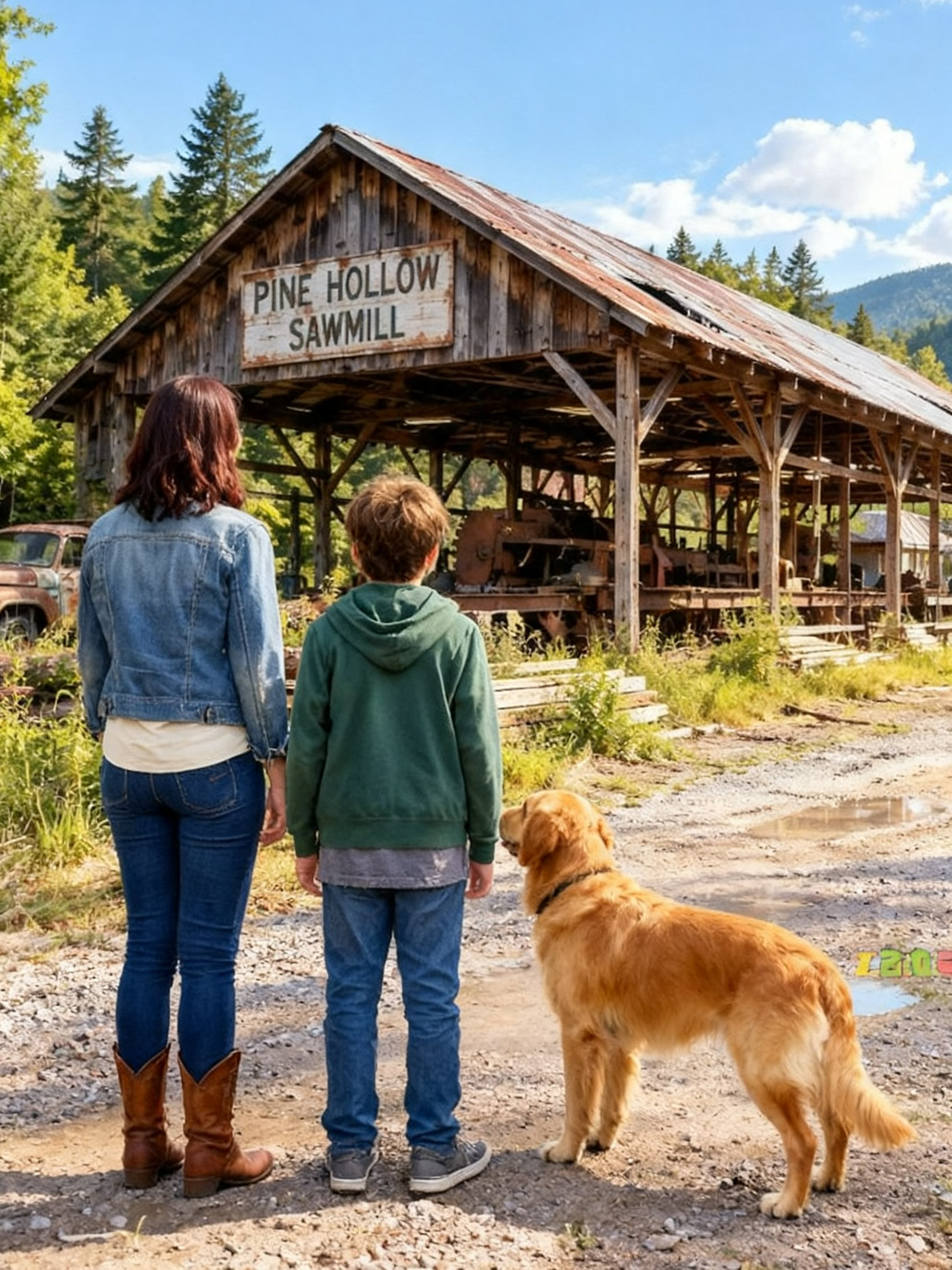
Left With Only Her Son, She Bought an Abandoned Sawmill—Then the Dead Owner’s Warning Changed Everything
“You have three days to get out of my house.”
Those were the first words my younger brother said after our mother’s funeral.
Not I’m sorry.
Not Where will you and your son go?
Not even Thank you for spending the last seven years taking care of Mom while the rest of us lived our lives.
Three days.
My brother, Dean, stood in the kitchen of the farmhouse where I had grown up, one hand resting on the granite counter I had paid to replace after Mom fell against the old one and fractured her wrist.
His wife, Melissa, stood beside him holding a folder.
My older sister, Cynthia, sat at the breakfast table with her arms crossed.
And my fifteen-year-old son, Noah, was upstairs packing the framed photograph of his grandmother because he had already heard enough through the heating vent to understand that nobody intended to let us stay.
Dean slid the folder toward me.
“Mom left the house to the three of us,” he said. “Cynthia and I want to sell.”
I looked at him.
He kept talking.
“You can’t afford to buy us out.”
I said nothing.
Melissa smiled.
Not kindly.
The smile was small, satisfied, almost relieved.
“You haven’t had a real job in years, Lauren.”
That one was hers.
A real job.
For seven years, I had cooked every meal our mother could keep down during chemotherapy.
I had changed dressings.
Managed medication schedules.
Argued with insurance companies.
Driven three hours each way to specialists in Pittsburgh.
Taken freelance bookkeeping jobs at midnight after Mom fell asleep so the electric bill would get paid.
I had cleaned vomit from carpet.
Lifted a woman who had once carried three children on her hip when her legs could no longer support her.
I had sat beside her bed during the last four nights of her life, wetting her lips with a sponge while Dean was in Arizona golfing with a client and Cynthia was posting photographs from a wine festival in Virginia.
But apparently none of that was a real job.
Melissa tapped the folder.
“We’ve already talked to a Realtor.”
That was when I understood.
They had not started after Mom died.
They had been planning while she was dying.
Maybe before.
Dean finally looked uncomfortable.
“Don’t make this ugly.”
I almost laughed.
Instead, I folded my hands in front of me.
That was the moment they began to misunderstand my silence.
They thought silence meant defeat.
They thought silence meant I was ashamed.
They thought silence meant I was calculating how many nights Noah and I could afford in a motel.
What I was actually thinking about was the small brass key in the pocket of my black funeral dress.
The key my mother had pressed into my palm twelve hours before she died.
She had been barely conscious.
Her breathing was shallow.
Her fingers were cold.
But when I leaned close, she opened her eyes with sudden clarity.
“Your father was wrong about one thing,” she whispered.
My father had been dead thirteen years.
I thought the morphine was confusing her.
Then she tightened her fingers around mine with surprising strength.
“Latham Mill.”
I stared at her.
I knew the name.
Everyone in Mercer County knew it.
The abandoned sawmill north of Briar Glen.
Thirty-two acres of weeds, rusted machinery, collapsed sheds and a main cutting building that looked one snowfall away from folding into the earth.
The county had tried twice to auction it for back taxes.
Nobody wanted it.
Mom pushed the key against my palm.
“Don’t let Dean see.”
I had leaned closer.
“What is it?”
She looked toward the bedroom door.
Then she whispered six words that made no sense at the time.
“Walter hid what your father couldn’t.”
Walter Latham had owned the mill.
He had also been my father’s closest friend.
Both men were dead.
Before I could ask anything else, Mom closed her eyes.
She never opened them again.
Now, standing in the kitchen three days later, Dean believed he had cornered me.
Maybe he had.
Just not in the way he thought.
“When do you need me gone?” I asked.
Cynthia blinked.
She had clearly been expecting tears.
Maybe shouting.
Maybe an accusation about the seven years they had abandoned Mom to me.
Dean cleared his throat.
“Friday morning?”
Melissa leaned against the counter.
“That’s it?”
I looked at her.
“What were you hoping for?”
Her smile vanished.
I took the folder, carried it upstairs and closed the bedroom door behind me.
Noah was sitting on the floor beside two cardboard boxes.
His eyes were red.
He had inherited my habit of becoming very still when he was furious.
“Are we homeless?”
“Where are we going?”
I pulled the brass key from my pocket.
“I’m not sure yet.”
He looked at it.
“That’s not reassuring.”
Despite everything, I smiled.
My son had always been able to do that.
Then I sat beside him.
“Do you remember Latham Mill?”
He frowned.
“The creepy place near Blackwater Creek?”
“The one people say is haunted?”
“That’s the one.”
He looked at the key again.
Then at me.
“Please tell me we’re not moving into the haunted sawmill.”
“I’m not promising anything.”
He groaned and dropped his head against the wall.
Three days later, Dean stood in the driveway watching us leave with everything we owned packed into my eleven-year-old Subaru and a borrowed utility trailer.
The house behind him had belonged to my parents for forty-one years.
My father had built the back porch.
Mom had planted the maple beside the mailbox.
My height marks were still penciled inside the pantry door.
Noah’s first steps had happened in the living room.
Dean had already removed the wooden porch swing because Melissa said it looked “dated.”
I stopped before getting into the car.
Dean put his hands in his pockets.
“You know this isn’t personal.”
I looked at him for a long moment.
“Of course it is.”
His face tightened.
“You’ll get your third when the house sells.”
“Minus Realtor fees.”
“That’s how sales work.”
“And funeral expenses?”
“We’re dividing them.”
I almost admired the nerve.
I had already paid most of Mom’s final expenses.
But I didn’t argue.
I opened my car door.
Dean called after me.
“Where are you even going?”
I looked back.
“Somewhere cheap.”
That was the truth.
It just wasn’t the whole truth.
Latham Mill had been listed by the county for $28,700.
Nobody had made an offer in eleven months.
The property taxes were delinquent.
Environmental questions scared developers away.
The access road washed out every spring.
Half the roofs leaked.
Blackwater Creek flooded during heavy storms.
And according to the county records, the main structure had no functioning electrical service.
I had $31,940 in savings.
That was everything.
Seven years of midnight bookkeeping.
A tiny life insurance payment from an old policy Dad had forgotten he owned.
Cash from selling my engagement ring after my husband disappeared when Noah was six.
Emergency money.
College money.
Survival money.
I spent almost all of it on an abandoned sawmill.
People later called that decision brave.
It was desperation wearing work boots.
At the county office, the clerk stared at me when I submitted the offer.
“You understand this property is sold as-is?”
“There may be environmental remediation issues.”
“I understand.”
“The eastern building was condemned.”
“I saw that.”
“There’s no guarantee the old well is potable.”
“And there have been trespassing complaints.”
That caught my attention.
“What kind?”
“Kids. Hunters. Scrappers.”
She hesitated.
“Some people claim they hear equipment at night.”
I stared at her.
“Equipment?”
She gave an embarrassed shrug.
“It’s local nonsense.”
I signed the paper.
By sunset, Noah and I owned Latham Mill.
The first night, we slept in the old foreman’s office because it was the only building with four solid walls and a roof that did not leak.
I ran extension cords from a portable generator.
Noah slept on an air mattress.
I slept on an army cot.
Rain tapped against the windows.
Mice moved inside the walls.
The smell of old pine and machine grease seemed permanently soaked into the floorboards.
At in the morning, I woke to a sound that did not belong in an abandoned mill.
Not a hand saw.
Not branches rubbing together.
A powered circular saw.
It came from somewhere across the property.
A long rising scream.
Then silence.
Noah remained asleep.
I reached for the flashlight beside my cot.
Then the sound came again.
The unmistakable shriek of steel teeth cutting through hardwood.
Every sensible part of me said stay inside.
But fear and poverty have something in common.
After enough exposure, both make you practical.
If someone was stealing material from my property, I needed to know.
I put on my boots, grabbed Dad’s old tire iron from the car and stepped into the rain.
The beam of my flashlight swept over wet grass and collapsed lumber racks.
The mill’s main building stood seventy yards away.
Its windows were black.
The cutting shed leaned toward the creek like a drunk.
Then the saw stopped.
The night became so quiet I could hear rain dripping from rusted gutters.
I walked farther.
Mud swallowed my boots.
My flashlight passed over an old conveyor.
A broken forklift.
A stack of silvered logs half consumed by moss.
Then I saw light.
A thin golden line beneath the door of a building I had assumed was empty.
The old drying shed.
I moved closer.
The light disappeared.
My heart hammered.
“This is private property.”
Still nothing.
I raised the tire iron.
Then something scraped behind the wall.
I almost ran.
Instead, I pulled the door open.
I swept the flashlight across the room.
Broken pallets.
An old workbench.
Rust stains on concrete.
But on the floor beneath the workbench lay fresh sawdust.
I crouched.
The smell hit me immediately.
Fresh-cut cedar.
Someone had been there minutes earlier.
The next morning, I found boot prints behind the shed.
Deep tread.
They led toward the creek.
Then disappeared at a stone retaining wall.
Noah watched me study them.
“So the ghost wears size eleven work boots?”
“Apparently.”
“Comforting.”
We spent the next week making the foreman’s office livable.
I repaired two windows.
Noah patched holes with expanding foam.
We cleaned thirty years of grime from an old bathroom and discovered, by some miracle, that the plumbing still worked after I replaced the well pump.
Every dollar mattered.
Every board mattered.
Every meal mattered.
And every night, sometime between midnight and three, the saw returned.
Sometimes once.
Sometimes three times.
Never long enough for me to find whoever was using it.
Then I noticed something stranger.
The fresh sawdust was always cedar.
But there were no cedar logs on the property.
The mill had processed oak, maple and pine.
I searched old records online.
Latham Mill had closed seventeen years earlier after Walter Latham’s death.
My father, Samuel Bennett, had worked there for twenty-six years.
He had started as a loader operator and eventually managed purchasing.
I remembered him coming home smelling like sawdust.
I remembered cedar splinters in his jackets.
But I did not remember him talking about Walter much.
That changed on the ninth night.
The saw screamed again at a.m.
I was already dressed.
This time, I did not go toward the drying shed.
I stayed hidden behind the old planer building.
Five minutes passed.
Then a figure emerged from the darkness.
Gray jacket.
Work boots.
He moved toward the creek carrying something long beneath one arm.
I followed.
He crossed behind the retaining wall and disappeared.
I hurried after him.
There was nowhere to go.
Just stone.
Then I saw it.
A narrow gap between two slabs of retaining wall.
I pushed through.
Behind it was an old service path descending beneath the main mill.
The man was twenty yards ahead.
I followed until he reached a steel door almost entirely hidden by vines.
He unlocked it.
Before it closed behind him, I shouted.
The man froze.
Slowly, he turned.
He was older than I expected.
Maybe seventy.
White beard.
Sunken cheeks.
His eyes narrowed at the tire iron in my hand.
“You Lauren Bennett?”
“How do you know my name?”
He looked toward the steel door.
Then back at me.
“You took your time.”
His name was Raymond Pike.
He had worked at Latham Mill with my father.
I vaguely remembered him from childhood picnics.
He had once carved me a wooden horse.
Now he lived eleven miles away in a trailer surrounded by beehives.
The saw was his.
The cedar was his.
The strange nightly cutting had been deliberate.
“You were trying to get my attention?”
“I was trying to see if you’d come looking.”
“That is a deeply unsettling way to introduce yourself.”
He almost smiled.
“Walter’s idea.”
“Walter’s dead.”
“So’s your father.”
The words landed hard.
Raymond unlocked the steel door.
Behind it was a narrow concrete corridor.
Old electrical conduit ran along the ceiling.
“Storm storage,” he explained. “Built in the fifties.”
At the end of the corridor stood a cedar wall.
New compared with everything around it.
That explained the sawdust.
Raymond had been replacing sections.
“Because Walter made me promise.”
He reached into his jacket and removed a folded envelope sealed inside plastic.
My name was written across the front.
Not in Raymond’s handwriting.
My father’s.
My knees nearly gave out.
I had not seen his handwriting in thirteen years.
Raymond handed me the envelope.
Inside was a single sheet.
If you are reading this, then either I failed to tell you myself, or I ran out of time.
There is something about Latham Mill that your mother does not know in full.
I made Walter promise not to act unless you ever truly needed it.
Not Cynthia.
The distinction matters.
Whatever they tell you later, do not sign away any claim connected to the Bennett timber parcels, the creek corridor, or the Latham operating company until an attorney has examined the 1989 covenant and Walter’s private ledger.
Your brother will believe family ownership means equal ownership.
It does not.
Please remember that sentence.
I read it twice.
Then three times.
“What does this mean?”
Raymond leaned against the wall.
“It means your father spent twenty years getting cheated.”
The story took nearly two hours.
In 1989, Latham Mill was close to bankruptcy.
Walter needed timber supply.
My grandfather owned 640 acres of forest east of Blackwater Creek.
Rather than sell it, he entered a long-term timber agreement with Walter.
When my grandfather died, Dad inherited most of the land.
Then Dean’s birth came with medical complications.
The bills were enormous.
Dad mortgaged acreage.
Later he sold parcels.
At least that was the story I had always heard.
It was not quite true.
Dad had transferred timber rights into Latham Operating Company in exchange for a 34 percent ownership interest.
Walter held 51 percent.
Several employees collectively held the rest.
The arrangement saved the mill.
For years, Dad received small distributions.
Then, in the late 1990s, Walter’s nephew, Everett Latham, joined the company.
He convinced Walter to restructure.
Documents were changed.
Ownership diluted.
Royalties disappeared.
Dad suspected fraud.
He started collecting evidence.
Before he could sue, I got married.
Then my husband’s business failed.
Dad helped us.
Then Mom became sick the first time.
He postponed everything.
“He always postponed himself,” Raymond said.
That sentence broke something inside me.
Because it was true.
Dad fixed everyone else’s crisis first.
Then he died of a heart attack at fifty-nine.
Walter discovered the fraud afterward.
He fired Everett.
But before he could unwind everything, Walter was diagnosed with pancreatic cancer.
So he created a legal mechanism.
A covenant.
A trust trigger.
And something Raymond called a reversion clause.
“If Latham Mill ever ceased commercial operation for more than ten years,” Raymond explained, “certain land, water and timber interests reverted to the surviving Bennett beneficiary named in the covenant.”
“Which beneficiary?”
Raymond looked at me.
Not because it was funny.
Because the alternative was collapsing.
“That makes no sense.”
He removed three cedar boards from the wall.
Behind them sat a steel safe.
The brass key Mom had given me fit the lock.
Inside were ledgers.
Share certificates.
Survey maps.
And one sealed envelope from Walter Latham.
The first line read:
Lauren, if you are opening this, someone in your family has probably already told you the mill is worthless.
I sat down on the concrete floor.
Raymond watched me quietly.
Walter’s letter was eleven pages.
He admitted failing my father.
He described how Everett had diverted revenue through shell companies.
How several local officials had benefited.
How timber assessments had been manipulated.
How land once owned by my father had been transferred into development entities controlled by people who later became some of Mercer County’s most prominent business leaders.
And then came the part that changed everything.
Latham Mill was not merely thirty-two worthless acres.
Its ownership controlled an access corridor connecting 4,300 acres of commercially valuable timberland to the nearest state highway.
Without the mill property, heavy logging equipment had no legal access.
For seventeen years, developers had used an unofficial road across the abandoned mill.
No one had challenged it because nobody thought ownership mattered.
But it did.
Buried in the documents was an easement agreement.
The access was conditional.
Commercial use required payment to the controlling Bennett beneficiary once the reversion clause activated.
No payment had ever been made.
According to Walter’s calculations, even using conservative rates, the unpaid access fees and timber royalties could exceed eight million dollars.
Possibly much more.
I felt sick.
Because I knew exactly who was using that road.
Harper Land & Timber.
Dean’s employer.
My brother had worked there for eleven years.
Two days later, Dean called me.
His voice was cheerful.
Suspiciously cheerful.
“Settled in?”
“At the mill.”
Then laughter.
Real laughter.
He shouted to someone nearby.
“She bought Latham Mill.”
More laughter in the background.
“Lauren, you bought that dump?”
“With what?”
“My money.”
“You spent Mom’s estate money?”
“I haven’t received Mom’s estate money.”
“Well, that was stupid.”
“You know Harper uses part of that property for equipment access, right?”
“I noticed.”
His tone changed.
“Don’t cause trouble.”
There it was.
Not concern.
Not curiosity.
“I haven’t caused anything.”
“Good. Because Harper’s had that access forever.”
“How long is forever?”
“Never mind.”
“Look, I’m trying to help you. They might buy the property.”
“For how much?”
“Probably more than you paid.”
I looked at Walter’s documents spread across the desk.
“How generous.”
“Seriously, Lauren. Don’t get emotional about some old building because Dad worked there.”
I closed my eyes.
That sentence hurt more than I expected.
Not because Dean meant it cruelly.
Because he meant it casually.
Our father’s life was clutter to him.
Mom’s sacrifices were clutter.
Mine were clutter.
Anything that did not produce immediate money had no value.
“I’ll think about it,” I said.
He relaxed.
Before hanging up, I asked one question.
“Did Dad ever talk to you about timber rights?”
There was a pause.
Barely two seconds.
But it was enough.
He lied badly.
That evening, three trucks arrived.
Harper Land & Timber.
The supervisor introduced himself as Colton Reeves.
He wore expensive boots, a clean vest and the confidence of a man who had never been told no by someone driving an old Subaru.
“We’ve got a standing access arrangement.”
“Can I see it?”
“It’s been this way twenty years.”
“That isn’t paperwork.”
His smile faded.
“We’re moving equipment Monday.”
“Not through my property until I see the agreement.”
He stared at me.
“Your brother said you’d cooperate.”
I stared back.
“My brother doesn’t own this property.”
The trucks left.
The following morning, I received a call from Dean.
“What are you doing?”
“Drinking coffee.”
“With Harper.”
“I asked for paperwork.”
“You’re embarrassing me.”
That sentence almost impressed me.
After everything, he had found a way to make my property about his dignity.
“They’ve used that road for years.”
“So they should have an agreement.”
“Then send it.”
He became quiet.
I heard a door close on his end.
“Lauren, sell them the mill.”
“You paid less than thirty grand. They’ll give you eighty.”
“One hundred.”
His voice hardened.
“You think you’re suddenly some businesswoman because you own a pile of rotten lumber?”
I watched Noah through the window repairing a section of fence.
He had been up since seven.
He never complained about sleeping in an office.
Never complained about losing his bedroom.
Never complained about leaving his school district.
He simply worked beside me.
I thought about the seven years I had given Mom.
The nights Dad gave everyone else.
The lives people call worthless when those lives are spent serving instead of acquiring.
“I think I own the road,” I said.
Dean stopped breathing for a moment.
That told me more than any confession could have.
“Who have you talked to?”
There was fear in his voice now.
I smiled for the first time in days.
“Just answer me.”
“Goodbye, Dean.”
The next attack came from the county.
A building inspector arrived unannounced.
Then environmental services.
Then fire code enforcement.
Then zoning.
Four agencies in six days.
All suddenly fascinated by a property ignored for seventeen years.
Each found violations.
Some legitimate.
Some absurd.
A missing handrail.
Improper storage.
An unregistered generator.
A drainage trench three inches deeper than current guidelines allowed.
Then I received a notice stating the access road might be considered a historic public-use corridor.
Raymond read it and laughed.
“They’re scared.”
I was beginning to understand the system Walter described.
Harper Land & Timber was not just a company.
Its board included Everett Latham.
A county commissioner’s brother.
A bank director.
The husband of the zoning administrator.
And Melissa’s father.
Dean had not simply married into money.
He had married into the network that had spent decades using my father’s land.
Melissa called two nights later.
“I think this has gone far enough.”
“Then sell.”
Her voice sharpened.
“You don’t understand what you’re dealing with.”
“I’m learning.”
“You have a child.”
I went still.
“What did you mean by that?”
“Oh, don’t be dramatic.”
“You mentioned my son.”
“I’m saying responsible mothers don’t drag their children into legal battles they can’t afford.”
I wrote down every word.
“Anything else?”
“You always were stubborn.”
“Interesting.”
“That everyone called Dad stubborn right before admitting he was right.”
She hung up.
The next morning, I hired an attorney.
Her name was Rebecca Sloan.
She was fifty-eight, wore no-nonsense black suits and had spent fourteen years litigating land disputes for the state before opening a private practice in Pittsburgh.
She read the covenant once.
Then again.
Then she removed her glasses.
“Where did you get this?”
“Inside a wall.”
She stared at me.
“I’m serious.”
She spent four days verifying signatures, filings and corporate records.
Then she called me.
“Lauren, don’t speak to your family about this anymore.”
“Because the covenant is valid.”
My hand tightened around the phone.
“And the reversion clause?”
“Also valid.”
“What does that mean?”
“It means when Latham Mill ceased operations for ten consecutive years, the dormant Bennett rights reverted to the beneficiary named in Samuel Bennett’s supplemental interest agreement.”
I sat down.
Rebecca continued.
“But that’s not the biggest problem for Harper.”
“There’s a bigger one?”
“They’ve been using a conditional commercial easement without paying the fee schedule.”
“For seventeen years.”
“How much?”
“We don’t know yet.”
“Walter estimated eight million.”
Rebecca paused.
“Walter was being conservative.”
My stomach turned.
Then she said the sentence that transformed this from inheritance into justice.
“Lauren, your father appears to have been owed profit distributions before he died.”
I closed my eyes.
“How much?”
“We’re still reconstructing the accounting.”
“Potentially millions.”
Dad had died driving a twelve-year-old pickup.
Mom had worried about heating bills.
I had delayed dental work because we needed money for her prescriptions.
Noah wore secondhand baseball cleats for three seasons.
Dean had called the mill worthless.
But this was never about discovering money in a wall.
It was about discovering proof that my father had not failed.
He had been cheated.
And then forgotten.
Rebecca filed three actions.
One to quiet title.
One seeking unpaid easement fees.
One demanding a forensic accounting of the old Latham Operating Company interests.
Harper responded immediately.
Their attorneys called the claims frivolous.
The county suddenly threatened to condemn the foreman’s office where Noah and I lived.
A local newspaper ran a story describing me as an “out-of-work caregiver pursuing a questionable inheritance theory.”
That phrase came directly from someone who knew my history.
Out-of-work caregiver.
As though caring for a dying woman was evidence of incompetence.
Then Cynthia called.
For the first time since I had left the farmhouse.
“You need to stop.”
“Dean could lose his job.”
“Did Dean tell you why?”
“He says you’re trying to take money that doesn’t belong to you.”
I almost laughed.
“Did you read Dad’s documents?”
“What documents?”
There it was.
Dean had not told her.
I sent them.
All of them.
Cynthia called back three hours later.
Her voice was different.
“Did Dean know?”
“I think so.”
“How long?”
“I don’t know.”
She began crying.
Maybe I was empty.
Maybe I had spent all my tears years earlier.
“I signed something after Dad died,” Cynthia whispered.
My blood went cold.
“Dean said it was routine estate paperwork.”
“What did you sign?”
“I don’t know.”
I called Rebecca.
By midnight, we knew.
Six months after Dad died, Dean had presented Cynthia with a disclaimer of residual business interests.
She signed.
My signature was also on the document.
Except I had never seen it.
It was forged.
That changed the case.
Forgery has a way of making polite civil disputes impolite.
Rebecca referred the document to the district attorney.
The district attorney happened to play golf with Harper’s CEO.
He declined to investigate immediately.
Rebecca sent it to the state attorney general.
That office did investigate.
Meanwhile, Harper made its boldest move.
They offered me $750,000 for Latham Mill.
Dean delivered the offer personally.
He arrived in a new black pickup.
I met him outside the main cutting building.
He looked older.
“Three quarters of a million dollars.”
“I heard you.”
“You live in an abandoned office.”
“We’re renovating.”
“You’re ruining everyone over something Dad never cared enough to finish.”
I stepped toward him.
He stopped.
I had never spoken to him that way.
Not loudly.
That was why it worked.
“Don’t tell me what Dad cared about.”
He looked away.
I lowered my voice.
“Did you forge my signature?”
His face changed.
“You don’t know what you’re talking about.”
“Yes, I do.”
“You were gone.”
“You had your own life.”
“I lived twelve minutes away.”
“You were married.”
“Dad wanted things settled.”
“Did Dad ask you to forge my signature?”
He snapped.
“I did what I had to do.”
There it was.
Not an admission.
Almost worse.
“What did you have to do, Dean?”
“Harper was offering me a job. Melissa and I were getting married. Dad’s old claims were going nowhere. Everett said the interests were worthless.”
“So you signed them away.”
“They were nothing.”
“And forged my name.”
“To close the estate.”
“And now they’re worth millions.”
His jaw tightened.
“That’s not the point.”
It was exactly the point.
He stepped closer.
“You think you’re better than us because you stayed with Mom?”
“She chose you.”
“No. You chose not to come.”
That stopped him.
For seven years I had protected them from that sentence.
Protected Dean.
Protected Cynthia.
Protected Mom from admitting her children avoided her because sickness made them uncomfortable.
I had told everyone Dean was busy.
Cynthia lived far away.
Flights were expensive.
Children had schedules.
Work mattered.
I had built excuses for them like walls.
Now I let one collapse.
Dean looked at me.
I continued.
“You visited Mom eleven times in the last four years of her life.”
“Don’t do this.”
“Cynthia came fourteen.”
“I was there every day.”
“You think that makes you a saint?”
I shook my head.
“It made me tired.”
That was the truth.
It disarmed him more than anger would have.
“I didn’t want the house,” I said. “I wanted someone to ask whether Noah and I had somewhere to sleep.”
His face flickered.
Then hardened again.
“You had money.”
“You bought this place.”
“So stop acting like a victim.”
I looked around.
At the broken windows.
My father’s mill.
“No,” I said softly. “That’s the mistake all of you keep making. I stopped being your victim the moment I stopped asking you to understand what you did.”
Dean left without another word.
Two weeks later, a survey team hired by Rebecca found the first physical evidence supporting Walter’s ledger.
Old boundary pins.
Concrete markers.
A buried steel plate stamped with the original Bennett timber company name.
Then came the second discovery.
Behind the cedar wall was another compartment Raymond had never opened.
The brass key did not fit.
But tucked inside Walter’s letter was a combination.
Inside the compartment were reel-to-reel tapes.
Recorded conversations.
Walter had recorded company meetings after he began suspecting Everett.
The recordings were old.
But clear enough.
One voice belonged to Everett Latham.
Another belonged to a young executive named Peter Harper.
Melissa’s father.
On one tape, Walter accused them of diverting timber revenue.
Peter laughed.
Then he said:
“Sam Bennett will never sue. The man would mortgage his own blood before he embarrassed his family.”
I listened to that line three times.
Then I vomited outside the building.
Because they had understood my father perfectly.
Not his weakness.
His decency.
And they had used it against him.
Rebecca wanted the recordings professionally authenticated.
The process took weeks.
During that time, the pressure intensified.
Someone cut the generator fuel line.
Someone broke a window.
Someone loosened lug nuts on my trailer.
Then one morning Noah found a dead fox nailed to the mill gate.
That was when I nearly quit.
Not because I feared for myself.
Because Noah stood beside me staring at it, fifteen years old, trying to pretend his hands were not shaking.
I called Rebecca.
“I’m done.”
She was silent.
“I’ll sell.”
“I can’t risk him.”
“No property is worth your child.”
“But before you decide, I need to tell you something.”
“The state investigators executed a warrant this morning.”
I stopped breathing.
“Harper Land & Timber.”
By evening, three company offices had been searched.
Records seized.
Computers copied.
Everett Latham’s home office searched.
Peter Harper’s financial files taken.
The next morning Dean did not go to work.
By Friday, Harper’s board announced that Peter was taking a “temporary leave.”
The local newspaper stopped calling my case questionable.
Instead, it printed the headline:
STATE INVESTIGATORS EXAMINE DECADES-OLD TIMBER RECORDS.
Funny how quickly words change when powerful people lose control of them.
Then came the probate hearing.
Dean and Melissa arrived with two attorneys.
Cynthia sat beside me.
It was the first time she had taken my side publicly.
She looked terrified.
Dean looked furious.
The issue that day was simple.
Had Dad’s business interests legally passed as Dean claimed?
Rebecca introduced the forged disclaimer.
Dean’s attorneys argued I had probably forgotten signing it.
Rebecca produced bank records showing I was in North Carolina the day the document was supposedly notarized in Pennsylvania.
Then she produced the notary’s journal.
My signature was absent.
Then Cynthia testified.
She described Dean bringing papers to her kitchen.
Telling her they were routine.
Telling her Lauren had already signed.
Dean stared at her as though betrayal belonged only to him.
The judge ruled the disclaimer invalid.
That meant the original inheritance chain reopened.
Outside the courthouse, reporters crowded around us.
Dean pushed through them.
“Happy now?”
Cameras turned.
He had made the mistake of asking the question publicly.
I could have destroyed him in that moment.
I could have described Mom’s final years.
The forged signature.
The eviction.
The threats.
Instead, I said:
Then I walked away.
That answer played on local television all weekend.
People interpreted it as sadness.
I simply wasn’t finished.
Harper Land & Timber collapsed gradually.
Not financially.
Structurally.
First the state suspended several logging permits.
Then lenders demanded disclosures.
Then minority shareholders sued.
Then former employees began talking.
Once people realize a powerful institution can bleed, everyone remembers where the knives are buried.
A retired accountant produced old royalty schedules.
A forester admitted maps had been altered.
A former county assessor testified that he had been pressured to reduce timber valuations.
A truck contractor provided invoices proving commercial use of the Latham access road for fourteen consecutive years.
Thousands of loads.
Millions in timber.
All passing over land everyone called worthless.
Then Rebecca completed the accounting.
The number made no emotional sense to me.
$14.8 million.
That was the preliminary estimate of unpaid distributions, royalties and access charges attributable to the Bennett interests.
Before penalties.
Before interest.
Before damages related to fraud.
Before settlement.
I stared at the spreadsheet.
Rebecca waited.
Finally I asked:
“How much of that would Dad have gotten?”
“Most of the early distributions.”
“And after he died?”
“That becomes complicated.”
“Because of us?”
I looked out her office window.
People moved on the sidewalk twelve floors below.
Fourteen point eight million dollars.
My parents had clipped coupons.
Dad repaired his own boots with epoxy.
Mom once cried because a prescription cost $417.
“How could this happen?”
Rebecca leaned back.
“Because theft committed with paperwork often looks respectable until someone reads the paperwork.”
The final settlement took eight months.
Harper did not survive intact.
The company sold assets.
Several executives resigned.
Peter Harper was charged with conspiracy, fraud and evidence tampering related to records destroyed after the state investigation began.
Everett Latham pleaded guilty to two financial charges and cooperated.
Dean was never charged with the original corporate fraud.
But the forged signature was another matter.
He accepted a plea agreement for falsifying an estate document.
Restitution.
Some people told me he got off easy.
Maybe he did.
But prison was never what I wanted.
I wanted truth entered into a record nobody could rewrite later.
That mattered more.
Cynthia returned her share of several estate distributions tied to the forged paperwork.
I did not ask her to.
She also began visiting the mill every Sunday.
At first we barely spoke.
Then we did.
Some things can be repaired.
Not restored.
There is a difference.
Melissa filed for divorce from Dean seven months after her father was indicted.
I heard she blamed Dean for “dragging their family into his mess.”
Life has a strange sense of humor.
Dean lost his job.
He sold the new truck.
Then the farmhouse sale collapsed because the reopened estate placed a temporary cloud on title.
The house sat empty for months.
One afternoon, he came to Latham Mill.
By then the place looked different.
Noah and I had repaired the foreman’s office.
The main building had a new roof.
Local volunteers helped stabilize the cutting shed.
We had electricity.
Real electricity.
The old mill wheel had been restored.
Not for production.
For history.
Because I had decided not to reopen Latham as a commercial sawmill.
I did something else.
Something Walter would have understood.
I created the Samuel and Margaret Bennett Trades Foundation.
Part of the settlement funded scholarships for students entering carpentry, forestry, welding, heavy-equipment repair and nursing.
Another portion established respite grants for unpaid family caregivers.
People like me.
People who disappear inside someone else’s illness and emerge years later to discover the world considers that absence laziness.
The old drying shed became classrooms.
The foreman’s office became a small museum.
Raymond taught traditional joinery twice a month.
Noah designed the foundation’s website.
And the eastern acreage along Blackwater Creek was placed in a conservation trust.
No subdivision.
No clear-cutting.
The land my father had once protected would remain forest.
That was the first time the inheritance felt like wealth.
Not when I saw the settlement amount.
When I signed the conservation papers.
Dean stood outside the restored main building.
He looked around.
“You did all this?”
“A lot of people did.”
He had lost weight.
His expensive haircut was gone.
For the first time in years, he looked like the boy who used to follow me through Dad’s workshop asking me to tie his shoes.
“I heard you bought the farmhouse.”
After the estate cleared, I purchased Dean and Cynthia’s interests.
Not because I wanted to live there.
Because I wanted Mom’s garden protected.
A young family rented the house now.
Their children played beneath the maple.
“You could’ve let the bank take it,” Dean said.
“Why didn’t you?”
“Mom loved that house.”
He looked toward the creek.
“I messed up.”
I said nothing.
He laughed bitterly.
“There’s that silence.”
“What silence?”
“The one you do.”
“I don’t do anything.”
“Yes, you do.”
He shoved his hands into his pockets.
“When you’re angry, you go quiet. Dad did it too. Makes everybody else start hearing themselves.”
For some reason, that almost made me smile.
Dean’s eyes filled.
He looked away quickly.
“I thought you were weak.”
“I thought because you kept taking care of everybody, you didn’t know how to take care of yourself.”
He swallowed.
“I thought Mom left you that key because she felt sorry for you.”
“She might have.”
He shook his head.
“She knew.”
“Knew what?”
“That if she gave it to me, I would’ve sold it.”
That was probably true.
He looked toward the restored mill.
I considered that.
He frowned.
“What do you mean?”
“Dad was cheated. Mom died thinking we might turn on each other. You forged my name. Cynthia lost years with Mom she can’t get back. Peter destroyed his company. Families lost jobs. That’s not winning.”
“Then what was the point?”
“The truth.”
He looked unconvinced.
So I added:
“And stopping it.”
That he understood.
Before leaving, Dean asked if there was any work at the foundation.
I almost said no.
Every scar in me wanted to.
Then I remembered something Dad once told me when I was sixteen.
You can refuse to carry someone without hoping they drown.
So I told Dean there was a maintenance opening.
Hourly wage.
No special treatment.
He stared at me.
“You’re serious?”
He laughed once.
Not happily.
“You really want me cleaning gutters after I tried to throw you out?”
“Then why offer?”
“Because what I want and what is right don’t always have to be the same thing.”
He started work the following Monday.
That surprised everyone.
Including me.
Years passed.
Noah graduated high school.
Then college.
Civil engineering.
He claimed living inside a collapsing sawmill made structural safety “feel personal.”
Raymond died at seventy-eight.
At his memorial, half the county showed up.
We buried a small cedar box beneath an oak near the creek.
Inside were his carving tools.
The brass key Mom gave me now hangs in a glass case inside the museum.
Beside it is Dad’s letter.
Not the original.
That stays in a safe.
The display copy includes one sentence in larger type:
Your brother will believe family ownership means equal ownership.
It does not.
Visitors usually assume Dad meant money.
At least not entirely.
Some inherit money.
Some inherit property.
Some inherit names.
Some inherit debts.
Some inherit silence.
I inherited the truth about what my parents had given away to keep everyone else standing.
And once I understood that, I stopped measuring inheritance by dollars.
The largest thing Dad left me was proof that a quiet life was not an insignificant one.
The largest thing Mom left me was permission to stop protecting people from the consequences of how they treated me.
The largest thing Walter left me was a chance to put a wrong back where it belonged.
And the largest thing that abandoned sawmill gave my son was a front-row seat to a lesson I hoped he would never forget:
Kindness is not surrender.
Patience is not permission.
Sacrifice is not stupidity.
Silence is not weakness.
And when someone has spent years carrying everybody else, you should be very careful before assuming she has forgotten how much weight she can move.
On the tenth anniversary of the foundation, we held a dinner inside the restored mill.
Former scholarship students came back with families.
Carpenters.
Electricians.
One young woman approached me with tears in her eyes.
Her mother had developed early-onset Alzheimer’s when she was nineteen.
The foundation’s caregiver grant had allowed her to stay in school.
She was now a registered nurse.
She hugged me and said, “You saved my life.”
I told her the truth.
“No. Someone saved mine first.”
That night, after everyone left, I walked alone toward Blackwater Creek.
The mill lights glowed behind me.
Water moved quietly between the rocks.
For a moment, I could almost smell Dad’s work jacket.
Machine oil.
Dean came down the path a few minutes later.
He had gray in his beard now.
We stood beside the creek without speaking.
Eventually he said, “You know what still bothers me?”
“That first day.”
“What first day?”
“At Mom’s house. When I told you to leave.”
I looked at him.
“You didn’t argue.”
“You didn’t beg.”
“You barely reacted.”
“I remember.”
He kicked a stone into the creek.
“For years I thought you already knew about the money.”
I shook my head.
“I didn’t.”
“Then why were you so calm?”
That question took me back instantly.
The kitchen.
Melissa’s folder.
Cynthia’s crossed arms.
Noah upstairs packing.
Three days to disappear from the home where I had spent seven years caring for our mother.
I remembered the brass key pressing into my palm.
The only thing I possessed that none of them understood.
But that wasn’t why I had stayed calm.
Not really.
I looked across the water.
“Because Mom taught me something during the last week of her life.”
Dean waited.
“She couldn’t control anything anymore. Not her body. Not the pain. Not whether she lived another hour. But she could still choose where she spent her strength.”
He lowered his eyes.
“So could I.”
We stood there while the creek moved beneath the old bridge.
Then Dean asked the question I think he had been carrying for ten years.
“Did you ever forgive me?”
I could have said yes.
It would have been beautiful.
Comforting.
It also would not have been true.
So I told him the truth.
“I stopped needing to hate you.”
He nodded slowly.
Maybe that was enough.
Maybe forgiveness is not always a door swinging open.
Sometimes it is simply deciding you no longer need to stand guard outside it.
Dean walked back toward the mill.
I stayed beside the creek.
Somewhere behind me, one of the workshop instructors switched on a table saw to finish a piece before locking up.
The sound rose through the night.
Steel through cedar.
For one second, I was back on my first night at Latham Mill.
Humiliated.
Standing in the rain with a tire iron while a mysterious saw screamed through the darkness.
I had believed someone was hiding inside my property.
I had been wrong.
Something had been hiding there.
My father’s dignity.
My mother’s final act of protection.
And the beginning of a life I had never imagined I was allowed to build.
People sometimes ask what I would have done if I had never discovered the documents.
Would I still have restored the mill?
Would I still have fought?
Would I still have forgiven anything?
I don’t know.
There are questions life never requires us to answer.
But there is one answer I know with absolute certainty.
If Dean had given me another month in Mom’s house, I might never have gone to Latham Mill.
If Melissa had been kinder, I might never have opened the wall.
If Harper had offered fair money before threatening me, I might have sold.
If powerful people had left me alone, I might never have learned how frightened they were of what I owned.
They believed cruelty pushed me out.
Instead, it pushed me exactly where the truth had been waiting.
That is the part nobody in my family likes admitting.
Their worst decision became my doorway.
Their certainty became my advantage.
Their contempt became the reason I looked closer.
Years earlier, in that kitchen, Dean had given me three days.
Three days to leave.
Three days to become someone else’s problem.
Three days before the people who believed they understood my value could turn the page and divide what remained.
I had asked no questions then.
I bought the place everyone called worthless.
And when the saw started screaming in the middle of the night, I followed the sound.
Maybe that was the difference between the woman they believed they had thrown away and the woman I finally became.
I stopped asking why people refused to see my worth.
I started opening the doors they were hoping I would never find.
And even now, after everything, when someone asks me what I would say if I could stand again in that kitchen on the morning Dean ordered me out, I think my answer would be very simple.
I would look at my brother, pick up the old brass key my dying mother had hidden in my hand, and quietly ask:
“Are you absolutely sure three days is all you want to give me?”
✓ Lynn R. Adams
Left With Only Her Son, She Bought an Abandoned Sawmill—Then the Dead Owner’s Warning Changed Everything “You have three days to get out of my house.” Those were the first words my younger brother s…