Kicked Out by Her Parents, She Bought a $30 Farmhouse—Then Found a Hidden Vault!
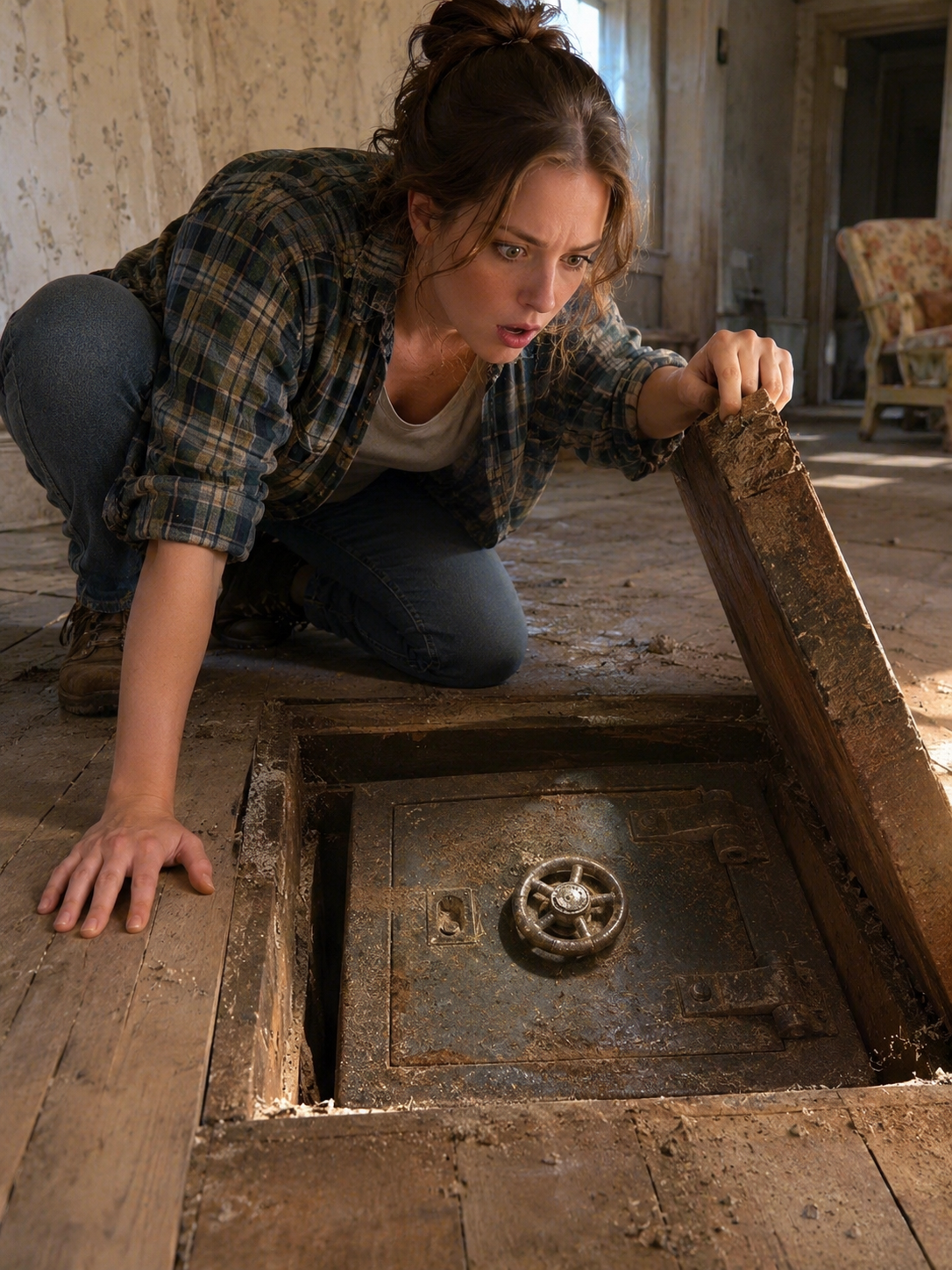
My parents gave me until morning to leave after I defended my aunt in a fight over Grandma’s savings, and I wound up sleeping in my Honda with $41 left. I bought a collapsing farmhouse for a $30 opening bid because I needed somewhere safe to sleep, but a brass key hidden behind a kitchen brick eventually led me to a letter containing a name I knew…
My father didn’t raise his voice when he told me to leave. That was what made it so hard to answer him. Paul stood by the living room doorway and said, “You have until morning to find somewhere else to sleep,” while my mother, Janet, looked down at her hands.
I was 31 years old, and I’d grown up in that house in Fargo, North Dakota. I had come over hoping we could settle a family argument, not expecting to pack a duffel bag in less than ten minutes. When I carried it outside, the living room light went out behind me.
The argument had been building for weeks. Two years earlier, my parents had lent me money toward a medical bill, and I was still grateful for that help. But when a disagreement broke out over my grandmother’s old savings, I sided with my aunt, and Mom and Dad took it as a betrayal.
I tried explaining that disagreeing with them about the inheritance didn’t mean I didn’t love them. Dad brought up the loan, then said he was finished supporting me in any way. Mom didn’t contradict him when he said I was out of family gatherings and the group chat, too.
For six years I’d worked at a local accounting office, where I could make a spreadsheet balance down to the penny. I’d rented a little apartment two towns over during my ordinary, uneventful life. Yet that night, with $41 in my checking account and my phone at 14%, I was staring at a problem I couldn’t work out on paper: where to sleep.
I sat in my Honda Civic in their driveway with the engine running for heat. I watched the dark windows for nearly an hour, thinking one of them might open the front door and ask me back in. Neither did, and eventually I drove away.
A coworker let me sleep on her couch for eleven days. She was kind about it, but I could tell when the arrangement was becoming too much, so I thanked her and left before either of us had to say it. For three nights I slept curled across my back seat in a Walmart parking lot.
I learned which gas station had a sink where I could wash my face before work. I made a sandwich last most of a day and bought as little as I could. Every morning I combed my hair, put on makeup, and arrived at the office on time because I couldn’t bear for anyone there to know.
At two in the morning, instead of sleeping, I started scrolling through property listings. I wasn’t dreaming of a nice house or even a pleasant neighborhood. I wanted four walls, a door I could lock, and somewhere to put my bag without worrying someone would tell me to move along.
One listing had sat untouched for 118 days. The photographs showed a sagging farmhouse, boarded windows, knee-high weeds, and a porch roof that had partly collapsed. It came with 92 acres outside a nearly abandoned North Dakota township, roughly an hour and a half to two hours from Fargo.
The opening bid was $30. I laughed there in the driver’s seat because it had to be a mistake, but the county information showed a tax-forfeiture auction. Back taxes and years of neglect had left a house with no working plumbing, a failing roof, and land nobody wanted to farm.
The farmhouse had passed through two owners after the original family, and neither had kept up the taxes. I knew an opening bid wasn’t the whole cost; the county had administrative fees, and the property would need more repairs than I could count. Still, for the first time in weeks, I had found a possible answer instead of another closed door.
The following morning I scraped together what I could and borrowed a little from the coworker who’d already helped me. The $30 bid and the county fees came to just under $200 in all. No one else bid, and when the clerk handed over the paperwork, my hands shook so much I had trouble getting it into my bag.
I owned a farmhouse and 92 acres. That sounds grand until you see a house whose roof might come down and whose wiring an electrician warns you not to touch. When I first stepped inside, it smelled of damp timber, dust, and rain that had found its way indoors.
“It’s not much,” I said out loud, standing inside the doorway. “But it’s mine.” I didn’t know how I’d fix it, only that nobody could turn me out of that particular house because they were angry with me.
The first month was rougher than I’d admitted it could be. I carried water in jugs from a gas station eleven miles away and slept on a camping mat upstairs, wrapped in blankets. At night I heard raccoons moving inside the walls and wondered whether the roof would hold through the next hard rain.
An electrician friend of a friend took one look at the old wiring and said it needed to be replaced before I tried using it. So I worked by daylight and a camping lantern, watched roof-repair videos when my phone had enough charge, and learned to test every floorboard before putting my weight on it.
There were rusted tools, decades of newspapers chewed by mice, and a wasp’s nest as big as a basketball. Every clear patch of floor made the place feel a little less abandoned. I still went to the accounting office, then spent my available hours hauling junk out and doing what repairs I safely could.
One afternoon I was pulling rotten insulation from a section of the kitchen wall when a loose brick shifted near the floor. Behind it was a small brass key, heavier than the keys I carried, with an ornate, flower-shaped top. It looked deliberately hidden, not dropped there by accident.
I tried it in the front door, the cellar door, and an old writing desk I’d found upstairs. It fit none of them. I nearly tossed it into the scrap pile, but instead I set it on the kitchen windowsill and caught myself looking at it every time I passed.
A few days later I stopped at the local hardware store for supplies. The owner, Earl, was in his seventies and had lived around there all his life. When I mentioned the rundown farmhouse off Route 9, he stopped sorting what was on the counter and said, “The Hale place? You bought the Hale place?”
He told me about Thomas Hale, whose family had owned the farm long ago. According to what Earl had heard from his father, the last Hale to live there had saved money after the war and grown suspicious that people, even relatives, wanted to take it. He died alone; the family scattered, and later owners let the place go.
I drove home thinking about the way Earl’s expression had changed. I wrote his words on a legal pad beside my lantern: a family split apart, an old man afraid of losing what he had, and a key someone had sealed into a wall. Two nights later, while lifting warped boards in what had once been a pantry, I found a metal box rusted nearly shut.
Inside were old photographs and a folded letter whose ink had faded badly. It ended with a single initial, T., and as I carefully worked through the remaining lines, I saw a name that made me sit back on the bare floor. It was my father’s middle name, the one our family had passed down for generations without anyone telling me where it came from. Part 2…..
IF FACEBOOK BROUGHT YOU HERE, HERE’S THE CONTINUATION YOU’VE BEEN WAITING FOR. ENJOY! 👇 I didn’t sleep much that night. I laid the letter and photographs on a clean board, then went back to my legal pad and wrote down every name and date I could make out. I couldn’t tell whether the match meant something or whether I was letting a strange house and an old story get into my head.
The next Saturday I drove to Fargo and spent hours at the North Dakota State Archives. I followed old property records, census entries, birth certificates, marriage records, and county newspapers, checking each connection rather than trusting a familiar-looking name. The farmhouse had been built in the early 1900s by Thomas Hale.
The records traced his family through a son and the generations that followed. One branch led to a young man who left the area in the 1970s, and his name was Paul. My father. I sat with one hand covering my mouth, staring at the page until the words began to blur.
Dad had never mentioned a farm, and I’d never heard him speak about Thomas Hale. The connection didn’t excuse what my parents had done, but it meant I was living inside a piece of our family history without knowing it. Even that little letter, with its fading ink, suddenly felt less like somebody else’s belongings.
Back at the farmhouse, I looked again at the brass key on the windowsill. I’d been trying to find its lock inside the house because that’s where I’d discovered it. But if Thomas had been worried about the farm and his money, there was no reason his hiding place had to be indoors.
Behind the remains of an old equipment shed, weeds covered a low mound with a root-cellar door built into it. I’d passed it plenty of times, assuming it held ruined jars or old vegetables. I cleared the brush, brushed dirt from the padlock, and slid the brass key inside.
It turned on the first try. For a moment I just stood there with the unlocked padlock in my hand, listening to the wind moving through the grass. I had spent weeks wondering what the key opened, and now I wasn’t sure I wanted to go in alone.
I lifted the door and made my way into the dim, earthy space. Beyond cobwebs and empty shelves was another door, smaller and made of steel, set straight into the cellar wall. Its hinges were rusted, and it took me nearly forty minutes with a crowbar to work it open.
Behind that was a compartment about the size of a closet. Inside sat a squat olive-green steel fireproof box, heavy and locked, the sort of thing somebody might have bought in the 1950s. The brass key wouldn’t open this lock, and I wasn’t going to smash a box that could hold the answers I’d come so far to find.
I arranged for a locksmith, who couldn’t come for three days. While I waited, I went back through the archives and contacted a distant cousin still in the area, trying to understand what had happened between Thomas and his family. What I found was sadder and more ordinary than the rumors of a hidden fortune.
Thomas had built a successful but modest farming operation during the 1940s and 1950s. After living through the Depression, he distrusted banks and saved part of his earnings in gold coins and silver certificates. The records and an old family letter also pointed to a bitter argument over who should have a share of the farm.
Thomas had cut off his own son, my great-grandfather, and that son left the area without making peace. The distance carried forward into the next generations until people stopped passing down even the story of the quarrel. I kept thinking about Dad standing in his doorway, telling me I had until morning to leave.
Part 3 On a gray Thursday, the locksmith came out to the property. He studied the old fireproof box, worked on the lock, and had it open in less than fifteen minutes. After spending three days imagining what was inside, I was almost embarrassed by how quickly the lid gave way.
There were bundles wrapped in brittle cloth and old newspaper. I unfolded one and saw silver coins, then another that held thin, carefully stacked gold bars. More coins lay underneath, many dated before 1965, and I understood without knowing their exact value that I was looking at more money than I’d ever held in my life.
I sat on the cellar floor with the box beside me and cried. I was exhausted, cold, and still carrying weeks of hurt from my parents, and I didn’t know whether I was relieved or frightened. I made myself stop handling things until I could find someone qualified to tell me what they were and how to document them.
At the bottom, beneath the metal and cloth, was a bundle of letters tied with old string. They were written by Thomas to the son he’d driven away. None had been mailed, and the words inside were halting in a way the tidy stacks of valuables weren’t.
He wrote about work on the farm and little things he wished he could tell his son. He wrote around the argument at first, then admitted he’d let pride keep him from speaking. Over several letters, it became clear he’d intended the hidden savings for his son if he ever came home.
What he couldn’t bring himself to do was send an apology while there was still time for it to be heard. He died alone, and those letters remained locked away. I had discovered something valuable, but sitting there with the pages on my knees, I could think only of the conversations that never happened.
My great-grandfather had spent the rest of his life without hearing those words. My father had grown up without knowing the story at all. And here I was, another generation of the family, living in a broken house because my own parents had decided silence was easier than disagreement.
I waited nearly a day before I called Dad. I didn’t want money to be part of the conversation, and I didn’t want him mistaking my call for a request to come home. When he answered, I told him I’d bought a place outside Fargo and had found records connecting it to a man named Thomas Hale.
There was a long pause. Then Dad asked me to explain how I knew. I told him about the old photographs, the family records, and letters Thomas had written to a son he’d sent away. His voice got quiet when I said our family had been living with that quarrel for generations without remembering where it began.
Dad said he hadn’t known his own grandfather’s name, much less the history of the farm. For the first time since the argument over Grandma’s savings, he let me finish a sentence without turning it into another accusation. We didn’t make up on that call, but neither of us hung up in anger.
Afterward I put the phone down and went back to the letters. I could see how easily a family might convince itself that being right mattered more than staying connected. I still believed I had been treated unfairly, and I wasn’t ready to pretend otherwise, but I didn’t want to leave another set of unanswered letters behind me.
Final I also needed practical help. I met with a probate attorney, Mr. Whitfield, and brought him the auction paperwork, photographs, the records I’d collected, and an account of where the box had been found. He was careful not to promise anything simply because I owned the land. We needed to establish what the items were, document the discovery, and check whether anyone else had a valid claim.
A certified numismatist examined the coins and the gold, and the legal and tax questions took time to sort through. Mr. Whitfield checked the title and possible claims from surviving relatives. After nearly four months of paperwork, appraisals, and waiting, I was finally able to sell the valuables through a reputable dealer with the ownership questions resolved.
The gold and silver brought in a life-changing amount, especially because some of the coins had dates collectors prized. I paid off my debts, set money aside, and put what I needed into making the farmhouse safe and livable. It still took work, and it didn’t happen all at once, but there was finally money for proper repairs instead of another patch to get me through the week.
The roof was fixed, the unsafe wiring replaced, and running water brought into the house. I restored the kitchen wall where the little brass key had been hidden. Later I built a swing for the freshly painted porch, started a vegetable garden on a small piece of the land, and got a few chickens that turned out to have much stronger opinions than I expected.
Dad and I began talking most weeks. Some calls were awkward, and we didn’t always agree, but he listened when I told him how it had felt to sleep in my car after being told I no longer belonged at home. Mom has needed more time, and I’ve learned that rebuilding a relationship isn’t the same as pretending the damage never happened.
I kept an old photograph of Thomas on my mantel, and the letters stayed carefully preserved. I framed the brass key on the kitchen wall, close to the spot where I’d pulled it from the brick. One of the silver coins stayed with me as a reminder, not of wealth, but of a night when I couldn’t imagine ever feeling secure again.
I still live in that farmhouse outside Fargo. I work part-time at the accounting office because I enjoy having work to do, and I spend the rest of my days tending the place and finding out more about the people who lived here before me. I never set out to recover a fortune or uncover a family secret. I was simply desperate for somewhere I couldn’t be told to leave.
Sometimes I think of Thomas putting those letters away, perhaps meaning to send them tomorrow. I don’t know whether Dad and Mom and I will ever agree about what happened over Grandma’s savings. But I know I don’t want another lifetime to pass before any of us says what needs saying, and I know what it feels like to turn a place nobody wanted into a home.
THE END. I’ve shared the complete story, and I truly hope it touched your heart. If this story moved you, please , like, and share the post. Thank you for reading! ❤️
✓ Lynn R. Adams
My parents gave me until morning to leave after I defended my aunt in a fight over Grandma’s savings, and I wound up sleeping in my Honda with $41 left. I bought a collapsing farmhouse for a $30 openi…