Kicked Out by Her Daughter, She Bought a Forgotten Cabin—Then a Sound Beneath the Floor Exposed a Forty-Year Betrayal
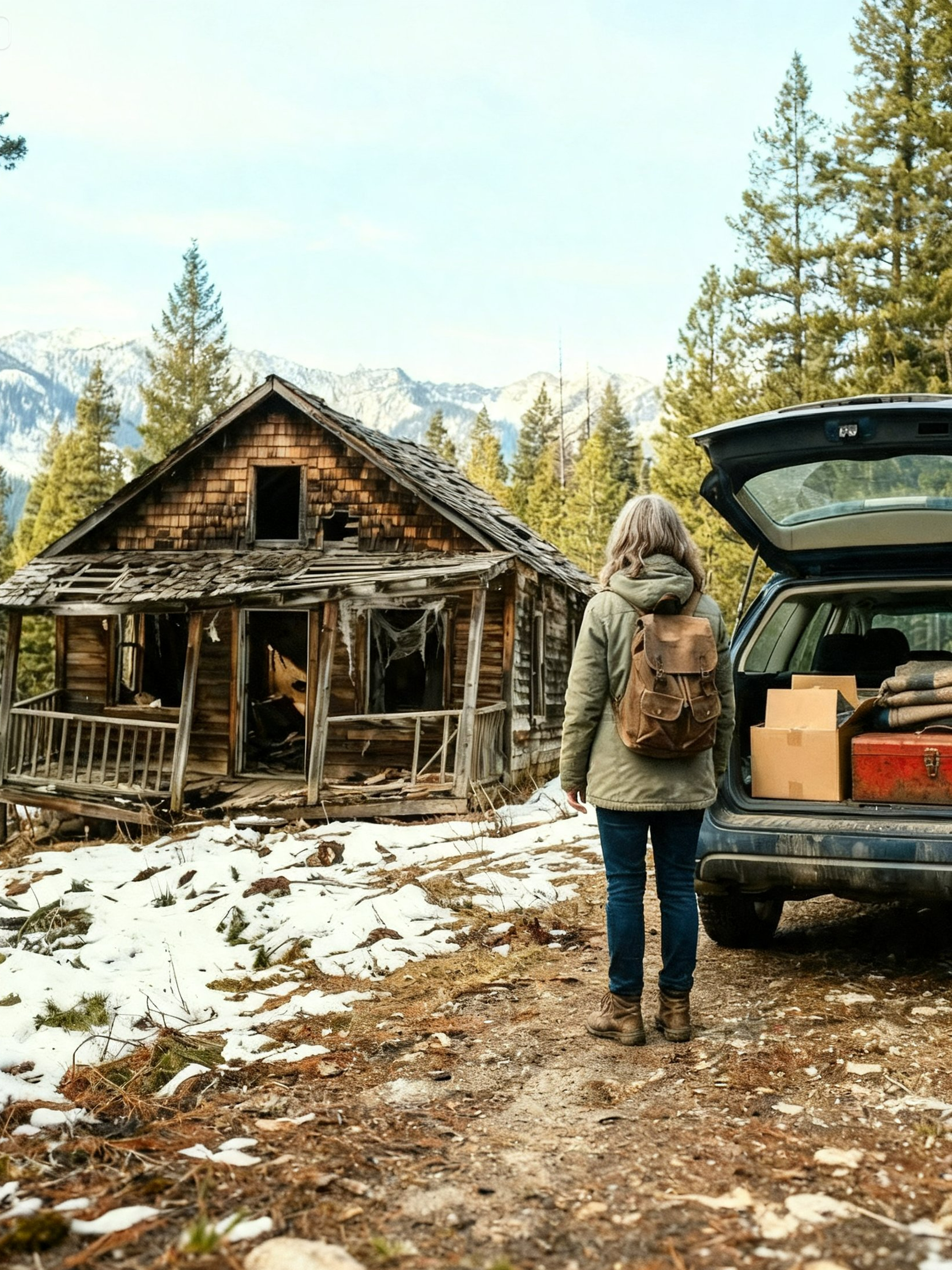
Kicked Out by Her Daughter, She Bought a Forgotten Cabin—Then a Sound Beneath the Floor Exposed a Forty-Year Betrayal
“You have until Sunday morning to get your things out.”
That was how fifty-nine-year-old Margaret Hale learned that thirty-eight years of motherhood could be reduced to three cardboard boxes beside a kitchen island.
Her daughter, Lauren, did not whisper it.
She said it in front of her husband, his brother, their real-estate agent, and two strangers carrying laser measuring tools through the house Margaret had helped pay for.
Then Lauren pushed Margaret’s coffee mug toward her and added, “And please don’t make this dramatic. We’ve already done enough for you.”
Margaret looked at the mug.
It was chipped along the rim.
A cheap white thing with WORLD’S BEST MOM fading across one side.
Lauren had given it to her when she was eight.
Margaret wrapped both hands around it.
She did not cry.
She did not ask where she was supposed to go.
She did not remind Lauren about the sixteen-hour shifts at St. Matthew’s Hospital.
She did not mention the college tuition.
She did not mention the mortgage payment Margaret had secretly covered during Lauren and Eric’s first year of marriage when Eric’s contracting company nearly collapsed.
She simply asked, “Sunday morning?”
Lauren folded her arms.
Margaret nodded once.
That frightened Lauren more than tears would have.
For the previous eleven months, Margaret had been living in the finished basement of Lauren and Eric Dawson’s oversized home outside Asheville, North Carolina. It was supposed to be temporary. Six weeks, Lauren had said. Maybe eight.
Margaret’s husband, Thomas Hale, had died after thirty-seven years of marriage, leaving behind grief, a modest life-insurance policy, and a house with a leaking roof that Margaret could no longer manage alone.
Lauren had insisted she sell.
“You shouldn’t be alone in that old place.”
“You deserve something easier.”
“Stay with us until you figure out your next chapter.”
Margaret had believed her.
The old house sold for $312,000.
After paying the remaining mortgage, medical debts from Thomas’s final year, and taxes, Margaret had a little more than $181,000 left.
She deposited $130,000 into a conservative retirement account.
The rest she kept liquid.
Then Lauren came to her with a problem.
Eric’s company had been sued by a subcontractor.
Their adjustable mortgage had reset.
Their youngest son needed braces.
The upstairs HVAC system had failed.
“We’re drowning,” Lauren said one night.
Margaret transferred $46,000.
No contract.
No promissory note.
No interest.
Lauren had cried when she hugged her.
“You saved us.”
Eight months later, the house was remodeled.
New quartz counters.
New flooring.
New light fixtures.
New landscaping.
And now, apparently, Margaret had become the only feature lowering the property value.
The real-estate agent was a sharp-faced woman named Vanessa Cole, who had spent most of Thursday morning explaining how much more the Dawson house could sell for if the basement were staged as an entertainment suite rather than “occupied family space.”
Margaret had been standing at the bottom of the stairs when she heard Lauren laugh.
“That’s exactly why we need Mom moved.”
Not helped.
By lunchtime, Eric’s older brother, Brett, was there measuring the basement for a wet bar.
At two, Lauren delivered the eviction.
At three, Margaret went downstairs and closed the door.
She sat on the edge of the bed beside Thomas’s old canvas suitcase.
For almost ten minutes, she stared at nothing.
Then she reached beneath the bed and pulled out a small metal cashbox.
Inside were birth certificates, insurance documents, Thomas’s military discharge papers, an old photograph from their wedding, and a sealed envelope he had given her six days before he died.
She had never opened it.
Not because Thomas had forbidden her.
Because of what he had written on the front.
Open this only if somebody you love makes you feel like you have nowhere left to stand.
Margaret ran her thumb along his handwriting.
For eleven months, she had carried that envelope from her old house to Lauren’s basement.
She had almost opened it the night Lauren complained that Margaret used too much hot water.
She had almost opened it when Eric suggested she start paying “a little something toward groceries” despite the $46,000 loan.
She had almost opened it when Lauren asked whether Margaret really needed both shelves in the basement refrigerator.
But she had always stopped.
Those things hurt.
They did not make her homeless.
Now she slid one finger beneath the flap.
Inside was a single sheet of yellow legal paper.
Thomas’s handwriting was weaker than usual.
If you’re reading this, somebody has mistaken your kindness for dependence.
Do not argue with them.
Do not tell them what I’m telling you.
Go to Black Hollow.
Find Cabin 9.
The deed is in my gray lockbox at First Carolina Trust under the name Margaret Anne Hale.
Under the kitchen floor, near the iron stove, there is something my father told me never to move.
Listen before you look.
And Maggie—if anyone named Rourke, Dawson, Mercer, or Bell tells you the property belongs to them, say nothing and call Miriam Shaw.
Her number is on the back.
Whatever happens, do not sign anything involving Black Hollow.
Not even for family.
Especially not for family.
I should have told you sooner.
I was trying to protect you from a fight I hoped would die before I did.
I was wrong.
Forgive me.
Margaret read it twice.
Then she turned the page over.
A phone number was written there.
Below it were four words.
She already knows everything.
Margaret sat very still.
Upstairs, someone laughed.
Brett, probably.
A power drill whined against the wall.
They were already dismantling the life around her.
Margaret folded the letter.
Then she whispered to the empty room, “Black Hollow?”
She had heard Thomas mention it perhaps three times in nearly four decades.
A mountain place.
His grandfather’s land, maybe.
Something abandoned after a fire.
Thomas never went there.
At least Margaret did not think he did.
She opened her laptop.
Black Hollow appeared on a county map nearly seventy miles northwest of Asheville, beyond a narrow state highway that wound toward the Tennessee line.
Population: effectively none.
There was a defunct mining settlement there in the 1940s.
A scattering of old hunting cabins.
Hundreds of acres of forest.
One listing caught her eye.
ABANDONED CABIN — CASH ONLY — AS-IS — $18,500.
The photographs showed a collapsing porch, rusted metal roof, leaning chimney, and enough kudzu to swallow a truck.
Margaret stopped breathing.
The listing agent was Vanessa Cole.
Lauren’s real-estate agent.
For the first time that afternoon, Margaret smiled.
Not because anything was funny.
Because suddenly Lauren’s urgency had a shape.
Margaret clicked through the photographs again.
Vanessa’s listing claimed the structure was being sold by Bell Ridge Holdings following “tax foreclosure and title consolidation.”
The listing had been active for eleven days.
Margaret checked the county parcel number.
Then she looked at Thomas’s letter.
Do not sign anything involving Black Hollow.
Margaret closed the laptop.
At dinner, Lauren behaved as if nothing had happened.
The grandchildren ate chicken nuggets.
Eric discussed interest rates.
Brett complained about building permits.
Vanessa had left, but her glossy property brochure remained on the counter.
Margaret noticed something she had missed earlier.
On the back was a rendering.
It showed a luxury mountain development called BLACK HOLLOW RESERVE.
Forty-two estate lots.
Private clubhouse.
Wellness lodge.
Equestrian trails.
Starting prices: $1.2 million.
Margaret quietly picked up the brochure.
Lauren noticed.
“Oh, that.”
Margaret looked at her.
Lauren cut a piece of chicken.
“Eric and Brett are doing some site work up there.”
“Black Hollow?”
Eric’s fork paused.
Only for half a second.
But Margaret saw it.
Brett looked at Lauren.
Lauren looked at Margaret.
And in that tiny circle of glances, Margaret understood that everybody at the table knew more than she did.
Eric wiped his mouth.
“It’s just a development.”
“North of town.”
“Near Cabin 9?”
Nobody spoke.
Margaret placed the brochure back on the counter.
Lauren gave a short laugh.
“Mom, why are you asking about Cabin 9?”
Margaret shrugged.
“Saw the listing.”
“You’re not thinking of buying some condemned shack, are you?”
Lauren stared at her.
Then laughed again.
This time Eric joined her.
Brett did too.
“You can’t live in that place,” Lauren said. “It probably doesn’t even have plumbing.”
“Then I’ll use a bucket.”
The grandchildren giggled.
Lauren’s face tightened.
“I’m serious.”
“Mom, you’re almost sixty.”
“Still younger than the cabin.”
Eric leaned back in his chair.
“You wouldn’t last a week up there.”
Margaret looked at him.
Then at Lauren.
“Would that be a problem?”
Lauren’s expression changed.
It was small.
A tightening around the mouth.
A flicker of alarm.
“No,” she said quickly. “Obviously not.”
Margaret nodded.
Then she ate her dinner.
That night, she called Miriam Shaw.
The woman answered on the fourth ring.
“My name is Margaret Hale.”
Margaret heard breathing.
Then the woman said, “Thomas?”
“He died eleven months ago.”
“You know?”
“I attended the burial.”
Margaret frowned.
She had no memory of Miriam Shaw.
There had been more than a hundred people at the church.
“I found his letter.”
Another silence.
“Where are you?”
“My daughter’s house.”
“Are you alone?”
“Did anybody see the letter?”
“Have you signed anything involving property since Thomas died?”
“Did you sign a general power of attorney?”
“Any estate-waiver documents?”
“Any quitclaim deed?”
Margaret’s pulse quickened.
Miriam exhaled slowly.
“Then Thomas did one thing right.”
“Who are you?”
“His attorney.”
“Thomas didn’t have an attorney.”
“He had two.”
Margaret stood from the bed.
“What does that mean?”
“It means your husband spent thirty-one years quietly preparing for a lawsuit he prayed would never happen.”
Margaret moved to the basement window.
Outside, the yard lights illuminated Lauren’s new patio.
“Against whom?”
Miriam’s answer came without hesitation.
“Your daughter’s husband’s family.”
Margaret closed her eyes.
“The Dawsons.”
“Eric. Brett. Their father, Leonard. Bell Ridge Holdings. Mercer Development. And possibly your daughter, depending on what she signed.”
Margaret leaned against the wall.
“What does any of this have to do with a cabin?”
“The cabin is the door.”
“Everything beneath it.”
Margaret waited.
Miriam did not continue.
Finally Margaret said, “Thomas told me to listen before I look.”
“What am I listening for?”
“You’ll know.”
“That’s not an answer.”
“It’s the only answer Thomas authorized me to give over the phone.”
Margaret almost laughed.
“Authorized?”
“He expected you might call me someday.”
“He’s dead.”
“And you’re still following instructions?”
Margaret looked at the suitcases.
“What should I do?”
“Buy the cabin.”
“It’s already mine.”
“Then why is it listed for sale?”
“Because somebody believes paperwork can become reality if nobody alive challenges it.”
Margaret thought of Lauren standing beside the kitchen island.
You have until Sunday morning.
“Could they sell it?”
“They’re trying.”
“Can they?”
“Do they know that?”
Miriam paused.
“They think you don’t.”
That night Margaret slept better than she had in months.
Friday morning she drove to First Carolina Trust.
Thomas’s gray lockbox contained an original deed dated 1987.
The property description was more complicated than a cabin.
Cabin 9 sat on 6.4 acres.
But attached to the deed were easements, mineral-rights schedules, timber-rights schedules, water-rights documents, and references to something called the Hale Preservation Trust.
The trust documentation was not in the box.
Neither was an explanation.
Margaret photocopied everything.
Then she drove directly to the county clerk’s office.
She did not ask whether she owned Cabin 9.
She asked for a certified copy of the recorded deed tied to the parcel.
The clerk frowned at the computer.
Then frowned harder.
“There are competing filings on this one.”
“Competing?”
“Your deed is here. Then there’s a tax-lien transfer from 2022. Then a corrective deed. Then a consolidation filing by Bell Ridge Holdings.”
“Was I notified?”
“It says notice sent.”
“To what address?”
The clerk turned the monitor slightly.
Margaret stared.
The notice address was Lauren’s house.
But it had supposedly been mailed thirteen months before Margaret moved there.
“How could that happen?”
The clerk gave her the careful expression government employees use when they know they have found something ugly.
“I can only tell you what the file says.”
Margaret ordered every page.
Then she drove to a bank.
At p.m., she made an offer of $18,500 on Cabin 9 through Vanessa’s online listing.
No inspection.
Closing immediately.
At , Vanessa called.
“Margaret?”
“Is this some kind of joke?”
“You put an offer on Black Hollow?”
“Well, technically that parcel is tied up in—”
“You listed it.”
“Yes, but—”
“I offered full price.”
Vanessa hesitated.
“Let me speak with the seller.”
“All right.”
“Margaret?”
“Did Lauren tell you about this?”
Another hesitation.
“I’ll call you back.”
Margaret knew Vanessa would not call the seller first.
She would call Lauren.
Margaret drove home.
Lauren was waiting in the kitchen.
Her phone lay face down on the counter.
“You made an offer on that cabin.”
Margaret hung her purse on a chair.
“I need somewhere to live.”
“That place is uninhabitable.”
“Then it suits my current social status.”
“Don’t do this.”
Margaret looked at her daughter.
“Turn this into some kind of martyr performance because we asked you to move.”
“You asked me to move.”
“You know what I mean.”
“Yes. I usually do.”
Lauren lowered her voice.
“Withdraw the offer.”
“Because it’s a terrible investment.”
“Since when do you care about my investments?”
“You’re my mother.”
Margaret almost admired the speed with which Lauren could choose whichever role benefited her.
She opened the refrigerator and took out a bottle of water.
Lauren followed.
“Mom, there are liens.”
“The title is messy.”
“The whole area is being redeveloped.”
Lauren stared.
“What exactly do you know?”
Margaret opened the bottle.
“Enough to buy a cheap cabin.”
Eric entered from the garage ten minutes later.
Then Brett arrived.
Then Leonard Dawson, Eric’s seventy-year-old father, pulled up in a black Mercedes.
Within an hour, the kitchen contained almost the entire system.
Margaret sat at the table.
Leonard stood near the island.
For years, Leonard had treated Margaret as harmless.
A grandmother.
A woman who brought deviled eggs to Christmas dinner and remembered everybody’s birthdays.
He smiled now.
“Margaret, this sounds like a misunderstanding.”
“Probably.”
“That land isn’t really something you want.”
“It has a roof.”
“Part of one.”
“I’m not picky.”
Brett laughed uneasily.
Leonard did not.
“There are liability issues.”
“I’ll be careful.”
“Environmental issues.”
“I won’t eat the dirt.”
Eric rubbed his forehead.
“Margaret.”
She turned.
“Can you please stop being difficult?”
Margaret considered that.
Then she smiled.
“I haven’t started.”
Lauren’s eyes narrowed.
Margaret had raised that child.
She knew every version of Lauren’s face.
The stubborn eight-year-old.
The furious teenager.
The exhausted new mother.
The terrified young wife asking for money.
This expression was different.
It was the face of someone guarding information.
Leonard finally sat across from Margaret.
“Tell me what you want.”
“A place to live.”
“We’ll find you something else.”
“I found something.”
“We’ll buy you a condo.”
Lauren turned toward him.
Margaret noticed.
That offer had not been discussed.
“How generous,” Margaret said.
Leonard leaned forward.
“A nice one. Two bedrooms. Asheville. Close to the grandchildren.”
“In exchange for what?”
Margaret waited.
Leonard sighed.
“Withdraw the cabin offer.”
There it was.
Margaret took a sip of water.
Lauren slammed her palm onto the counter.
“Why are you doing this?”
Margaret looked at her.
“You threw me out Thursday.”
“That has nothing to do with Black Hollow.”
“Then why are four people trying to stop me from buying a shack with no plumbing?”
Nobody answered.
Margaret stood.
“Vanessa has until five.”
She walked downstairs.
Saturday afternoon, Vanessa accepted the offer.
Not because Bell Ridge Holdings wanted to.
Because someone had made a serious mistake.
The listing agreement obligated the company to respond to full-price cash offers, and its own internal documents classified Cabin 9 as “surplus structure inventory” separate from the surrounding development until a planned title-consolidation hearing.
Refusing the offer might have invited questions.
Accepting it, apparently, seemed safer.
Bell Ridge expected to clear the title later.
They thought they were selling Margaret a worthless building.
They had no idea she possessed the original deed.
Or perhaps they believed the original deed no longer mattered.
On Sunday at a.m., Margaret carried the last suitcase upstairs.
Lauren stood beside the front door.
For three days, her daughter had behaved as if the eviction were merely an awkward logistical adjustment.
No apology.
No reconsideration.
Margaret placed Thomas’s canvas suitcase in the trunk of her fifteen-year-old Toyota Camry.
Then she returned for the three cardboard boxes.
Her grandson Caleb, twelve, hugged her.
“Where are you going, Grandma?”
“Up the mountain.”
“Can I visit?”
Lauren answered before Margaret could.
“We’ll see.”
Margaret looked at her daughter.
Lauren avoided her eyes.
Margaret kissed Caleb’s hair.
“You can always visit me.”
Eric stood near the staircase.
Brett had already begun moving bar equipment into the basement.
Margaret saw a new mini-fridge against the wall.
Three days.
That was all it had taken for them to erase her.
She picked up the last box.
Lauren finally said, “Mom.”
Margaret stopped.
“I hope you understand this wasn’t personal.”
Margaret looked at the kitchen, the new countertops, the expensive refrigerator, the pendant lights purchased with money that had once represented Thomas’s last year of overtime and Margaret’s unused vacation days.
Then she looked at Lauren.
“No,” Margaret said. “That’s exactly what it was.”
The drive to Black Hollow took almost two hours because the final fifteen miles followed a narrow road through increasingly dense forest.
October had begun painting the Blue Ridge Mountains gold and rust.
The road climbed.
Cell service disappeared.
The houses thinned.
Finally Margaret reached a gravel turnoff marked by a weathered sign.
BLACK HOLLOW RD.
She drove another three miles.
Cabin 9 stood alone at the edge of a clearing.
It looked worse than the photographs.
The porch sagged.
Two windows were boarded.
The chimney leaned slightly east.
Moss covered the roof.
A massive oak had grown so close to the cabin that one branch touched the upper wall like an arm protecting it.
Margaret shut off the engine.
For a while she remained inside the car.
This was it.
Her new life.
A condemned cabin she technically owned twice.
Once through a thirty-nine-year-old deed.
Once through an $18,500 purchase from people who apparently had no right to sell it.
She laughed.
Thomas would have appreciated the absurdity.
Margaret unlocked the front door.
Dust filled the air.
Mouse droppings covered one counter.
The kitchen sink was orange with rust.
A stone fireplace dominated the main room.
Beside it stood the black iron stove Thomas had described.
Margaret set down her bag.
Listen before you look.
She listened.
Wind moved through the trees.
The refrigerator, unplugged for years, offered no hum.
A branch scraped against the roof.
Margaret walked slowly across the kitchen.
The floorboards creaked.
Near the stove, she stopped.
Margaret froze.
Not beneath the stove.
Beneath her feet.
She crouched.
Then a faint metallic vibration traveled through one plank.
Margaret stepped back.
Her heart began pounding.
For one irrational second, she imagined an animal trapped under the cabin.
Then she remembered Thomas’s wording.
Listen before you look.
The tapping came again.
Three taps.
Three taps.
Not random.
Mechanical.
Margaret knelt.
One floorboard near the stove had a narrow circular mark at its end.
She found a screwdriver in Thomas’s toolbox.
The first screw came out.
Then another.
Beneath the board was a shallow cavity.
Inside sat a brass mechanism no larger than a cigar box.
A thin metal rod extended downward.
The rod moved whenever wind pushed a small vent flap outside the foundation.
Each movement struck the box.
Margaret lifted the brass box.
Underneath it was a steel ring.
She pulled.
A section of floor rose on hidden hinges.
Cold air rolled upward.
Stone steps descended beneath the cabin.
Margaret stared into darkness.
Then she laughed softly.
“Thomas, what did you do?”
She found a flashlight.
The underground room was not a basement.
It was a vault.
Concrete walls.
Steel shelves.
A locked cabinet.
A worktable.
Metal filing boxes.
Survey maps.
Dozens of brown document tubes.
And a framed photograph of Thomas’s father, Henry Hale, standing beside three other men in front of the cabin in 1968.
Margaret recognized Leonard Dawson’s father immediately.
Walter Dawson.
Thomas had shown her old family photographs.
The third man was Samuel Bell.
The fourth was unknown.
On the back of the photograph someone had written:
THE FOUR FAMILIES — BEFORE THE THEFT.
Margaret sat down.
The documents required hours.
Some required days.
But the first metal box explained enough.
Black Hollow had once been 2,840 acres jointly held through a complicated family trust created by four men after a mining company abandoned operations there in 1963.
Henry Hale owned forty percent.
Walter Dawson owned twenty.
Samuel Bell owned twenty.
A surveyor named Robert Mercer owned twenty.
The families planned to restore the forest, lease selective timber rights, and preserve the watershed.
Then, in 1979, Henry Hale discovered that Dawson, Bell, and Mercer had quietly transferred hundreds of acres using forged boundary descriptions.
The dispute never reached public trial.
Because Henry’s wife became sick.
Then Henry suffered a stroke.
Then Henry died.
Thomas inherited the unresolved claim.
For decades, Thomas had lacked the money to fight three wealthy families whose companies had multiplied through construction, banking, and real estate.
But he did something else.
He preserved evidence.
Every survey.
Every original deed.
Every tax receipt.
Every letter.
Every fraudulent transfer he could identify.
And eventually, with Miriam Shaw’s help, he created the Hale Preservation Trust.
Margaret opened another file.
Her name appeared on the first page.
SOLE SURVIVING BENEFICIARY: MARGARET ANNE HALE.
She covered her mouth.
Thomas had hidden nothing because he distrusted her.
He had hidden it because Black Hollow had been a sleeping war.
The assets were staggering.
Something more dangerous.
According to an independent survey commissioned six years earlier, 1,126 acres of the Black Hollow Reserve development overlapped land still legally controlled by the Hale trust if the original descriptions were upheld.
The proposed luxury development included thirty-two of its forty-two estate lots on disputed land.
The planned clubhouse sat directly on Hale land.
The new access road crossed Hale land.
The water intake for the entire project crossed Hale land.
And the most valuable item was buried halfway through a stack of engineering reports.
A regional utility consortium had identified Black Hollow as the preferred route for a future underground transmission corridor linking two substations.
Projected easement value: between $18 million and $26 million.
But Thomas had refused it.
Not because he wanted more money.
A handwritten note explained why.
No corridor unless the creek is protected.
No development unless they restore what they poisoned.
Henry wanted this mountain healed.
If Maggie ever gets control, tell her she owes nobody wealth.
She owes herself a choice.
Margaret read those words three times.
Then she began to cry.
Not loudly.
Not desperately.
She sat alone underground, holding a piece of paper written by her dead husband, and allowed tears to fall because for thirty-seven years Thomas had understood something even Margaret had failed to understand about herself.
She had spent her life giving people pieces of what belonged to her.
Career opportunities.
Retirement.
And everyone had slowly come to believe giving was her natural condition.
Lauren believed it.
Eric believed it.
The Dawsons believed it.
Maybe Margaret had believed it too.
She remembered turning down a nursing-management position because Lauren was fourteen and struggling after changing schools.
She remembered withdrawing $18,000 from retirement to help Lauren finish college without loans.
She remembered driving six hours every weekend after Caleb was born because Lauren had postpartum complications.
She remembered using vacation days to care for Eric after his construction accident.
She remembered Thomas asking one night, “Maggie, when do you think you’ll start saving something for yourself?”
She had laughed.
“This is what family does.”
But family had turned generosity into precedent.
Sacrifice into obligation.
Patience into permission.
And kindness into proof that Margaret did not need anything of her own.
She had paid with years nobody could refund.
She had paid with sleep.
She had paid with chances.
She had paid with money.
She had paid with silence.
And when there was finally nothing convenient left to take from her, they had taken the room where she slept.
Margaret wiped her face.
Then she opened the locked steel cabinet.
Inside was a recorder.
A note taped to it said:
She pressed the button.
Thomas’s voice filled the room.
“Maggie, if you’re hearing this, then I lost the argument with death.”
Margaret laughed through her tears.
Thomas continued.
“And if you found this room, somebody probably pushed you here. I’m sorry for that. But maybe being pushed is what finally brought you to the one place I should’ve shown you years ago.”
He coughed.
“I need you to understand something. The Dawsons aren’t evil because they want land. People want things. That’s ordinary. What they did wrong was decide that ordinary people were easier to erase than paperwork.”
Margaret looked at the shelves.
“My father fought them. Then he got sick. I tried. Then life happened. You happened. Lauren happened. Bills happened. And I kept telling myself I would deal with Black Hollow next year.”
His voice softened.
“But there’s another reason I waited.”
Margaret closed her eyes.
“I knew what kind of woman you were. If I told you this land might someday be worth millions, you would’ve sold it to pay Lauren’s tuition. Or our mortgage. Or somebody’s hospital bill. You would’ve turned the mountain into groceries for everybody you loved.”
Margaret laughed.
He was right.
“So I protected it from them,” Thomas said. “And maybe from you.”
The recording clicked softly.
“If Lauren is involved with the Dawsons by the time you hear this, don’t punish her because she’s our daughter. But don’t rescue her from consequences either. There’s a difference between cruelty and allowing gravity to work.”
Margaret stared at the recorder.
“And listen carefully. The 1987 deed is not the most important document. The preservation trust is. The trust contains a reversion clause. Any party acquiring disputed Hale land through a company tied to Dawson, Bell, or Mercer triggers automatic consolidation of the surviving Hale interests under the trust.”
Margaret frowned.
Thomas laughed weakly on the recording.
“Yes. Legal gibberish. Miriam will explain it.”
He coughed again.
“But the simple version is this: if they leave the land alone, the claim stays fragmented and difficult. If they get greedy enough to consolidate it into one big project…”
Another pause.
“They consolidate your claim too.”
Margaret’s skin prickled.
The developers had not stolen the land despite Thomas’s preparations.
They had activated them.
The recording continued.
“One more thing. The cabin itself matters because it is the trust’s anchor parcel. Whoever legally possesses Cabin 9 and holds my beneficiary interest has standing to enforce the whole claim.”
Margaret looked up at the ceiling.
Bell Ridge had sold her the anchor parcel.
For $18,500.
Thomas’s voice became quieter.
“I hope you never need this. I hope Lauren takes care of you. I hope Eric turns out better than Leonard. I hope Black Hollow becomes nothing more than a strange story we never tell.”
The recording paused so long Margaret thought it was over.
Then Thomas said, “But if they come after you, Maggie… don’t fight like them. Make them explain themselves in daylight.”
The recording ended.
Margaret sat alone until sunset.
Then she called Miriam.
“I found the room.”
“I assumed you would.”
“They sold me the cabin.”
Miriam was silent.
Then she said, “They did what?”
“They accepted my offer.”
“How much?”
“Eighteen thousand five hundred.”
Miriam began laughing.
Not politely.
Not briefly.
She laughed for nearly thirty seconds.
Margaret finally said, “I assume that’s good?”
“You have no idea.”
“Thomas mentioned a reversion clause.”
Miriam stopped laughing.
“You played the recording.”
“Then tomorrow morning, bring everything you can carry to my office.”
“What about the cabin?”
“Change the locks.”
“Because once they discover what they sold you, somebody is going to panic.”
Miriam was right.
The first person arrived Monday at a.m.
Leonard Dawson.
Margaret was drinking coffee on the porch.
He stepped out of his Mercedes wearing polished loafers completely unsuited to the mud.
“Margaret.”
“We need to talk.”
He looked at the porch chair as if tetanus might be waiting there.
He remained standing.
“I heard the sale closed electronically last night.”
“There was an error.”
“What kind?”
“The parcel should not have been listed independently.”
“Vanessa listed it.”
“She misunderstood instructions.”
“Then you should train her better.”
Leonard’s jaw tightened.
“We’ll refund your purchase price.”
“Double it.”
“Fifty thousand.”
Margaret sipped her coffee.
“A hundred.”
“Two hundred.”
Margaret placed the mug on the porch rail.
“Yesterday this was an uninhabitable shack. Today you’re offering me two hundred thousand dollars. Should I be insulted or curious?”
Leonard stepped closer.
“You don’t understand what you bought.”
Margaret looked at him.
“That seems to be a common problem in your family.”
His expression hardened.
“Thomas filled your head with nonsense.”
“Thomas is dead.”
The word came out cold.
Margaret felt something change inside her.
Leonard saw it too.
He softened his tone.
“I’m sorry. That sounded wrong.”
“It sounded accurate.”
He looked toward the cabin.
“There are old claims attached to this area. Dead claims. Thomas spent years obsessed with them.”
“You knew?”
“Of course.”
“Did Lauren?”
Leonard hesitated.
Margaret got her answer.
“How long?”
“Margaret—”
“How long did my daughter know?”
Leonard looked away.
“She became aware of certain title issues this summer.”
This summer.
Before Margaret was evicted.
Before the Black Hollow listing.
Before Lauren suddenly needed the basement empty.
Margaret remembered Lauren asking strange questions two months earlier.
Did Dad ever own mountain property?
Did he leave paperwork anywhere?
Was there another safe-deposit box?
Margaret had thought Lauren was helping settle the estate.
Now she understood.
Lauren had been searching.
“Did she know the cabin was mine?”
“Ownership is complicated.”
“That wasn’t my question.”
Leonard sighed.
“She knew Thomas may have had an old claim.”
“Did she know I was his beneficiary?”
“I don’t know.”
“Did you send tax notices to her address before I lived there?”
Leonard said nothing.
Margaret stood.
“Get off my property.”
“Margaret, listen to me.”
“This can become expensive.”
“For whom?”
His face tightened.
“You’re alone up here.”
There are sentences that sound harmless when printed and threatening when spoken.
Margaret heard the threat.
So did the small camera Miriam had instructed her to mount under the porch roof at five that morning.
Margaret looked at Leonard.
“I’m not as alone as you think.”
He glanced toward the cabin.
Then his eyes lifted toward the camera.
He went pale.
Margaret smiled.
“Good morning, Leonard.”
At noon, Lauren called.
Margaret let it ring.
Finally she answered.
“Mom, what are you doing?”
“Cleaning.”
“Dad’s old lawyer contacted Eric.”
“Why didn’t you tell me?”
“You didn’t ask.”
“Don’t play games with me.”
Margaret looked across the clearing.
“What would you like to know?”
“What did Dad leave you?”
Margaret almost laughed.
Not How are you?
Not Are you safe in that cabin?
Not I’m sorry.
What did Dad leave you?
“His wedding ring.”
“You know what I mean.”
“Leonard says you’re making some claim against the development.”
“Leonard says many things.”
“Eric has millions tied up in this project.”
“That sounds risky.”
Margaret held the phone away from her ear.
Lauren lowered her voice.
“You don’t understand. If you challenge those deeds, Eric could lose everything.”
Margaret looked at the cracked porch boards.
“Everything?”
“The company. Our house. Investments. Everything.”
“The basement too?”
“Is that what this is about?” Lauren asked.
Margaret felt something colder than anger.
“You really believe I’m doing this because of a basement?”
“You’re angry.”
“So now you’re trying to punish us.”
Margaret closed her eyes.
“Lauren, did you know Cabin 9 belonged to your father?”
Margaret said nothing.
Lauren continued.
“I knew there were some old documents, but Leonard said they were invalid.”
“Did you know they mailed notices to your address?”
“I didn’t handle that.”
“Did you see them?”
Margaret waited.
Lauren had always been a poor liar.
As a teenager, she filled silence with details.
As an adult, she did the same.
“I mean, Eric gets a lot of business mail, and sometimes things come here for other people, so I may have seen something, but I didn’t understand it.”
Margaret stared into the trees.
“Did you throw away a notice addressed to me?”
“Mom, stop interrogating me.”
There it was.
Margaret’s throat tightened.
“Was that why you wanted me living with you?”
Lauren did not answer.
Margaret felt as if the mountain itself had become silent.
“Of course not.”
“Was that why you insisted I sell my house?”
“Was that why you asked where Thomas kept his documents?”
“I was helping.”
“Was that why Leonard suddenly offered to buy me a condo yesterday?”
“Was that why you threw me out after you thought the title consolidation was finished?”
Lauren began crying.
Margaret did not.
“I didn’t know it was this serious,” Lauren whispered.
Margaret’s voice became almost gentle.
“What did you know?”
“Eric said Dad had some ancient claim everybody knew was worthless.”
“What else?”
“That the cabin parcel was important.”
Margaret gripped the phone.
“What else?”
Lauren cried harder.
“That once Bell Ridge owned it, everything would be cleaner.”
Margaret stared at the old oak tree.
“Did you know it belonged to me?”
A long silence.
The word was barely audible.
Margaret closed her eyes.
For three seconds she was no longer fifty-nine.
She was twenty-seven, carrying a feverish toddler through an emergency room.
She was thirty-one, sewing a Halloween costume at midnight.
She was forty-three, waiting outside Lauren’s college dorm because Lauren had broken up with a boyfriend and said she couldn’t breathe.
She was fifty-one, holding Lauren’s hand during a difficult delivery.
She was every age at which she had chosen her daughter first.
Lauren continued talking.
“Mom, you have to understand. Eric said the title wasn’t real anymore. Leonard said you’d never even know. And they were going to give us a percentage of the development. It was supposed to secure the boys’ future.”
Margaret opened her eyes.
“With my land.”
“It wasn’t like that.”
“What was it like?”
“They said the claim was obsolete.”
“Then why did they need Cabin 9?”
Lauren said nothing.
Margaret’s voice remained calm.
“You knew they needed something that belonged to me. You knew your father had protected it. You knew they were taking it. And instead of telling me, you helped them.”
“I thought it was over.”
“So did they.”
“Please don’t do this.”
“Destroy our family.”
Margaret looked at Thomas’s letter lying on the table.
There was the final trick.
The person who drew the knife always feared the person who pulled it out would make a mess.
“You should come see the cabin,” Margaret said.
“You heard me.”
“Because you wanted it badly enough to lose your mother over it.”
Then Margaret hung up.
Miriam filed suit Wednesday morning.
Not one lawsuit.
The first sought declaratory judgment validating the Hale Preservation Trust’s title interests.
The second alleged fraudulent conveyance, forged notice, conspiracy, and interference with inheritance rights.
The third requested an emergency injunction freezing construction across disputed Black Hollow parcels.
Miriam also sent evidence to the state attorney general’s real-estate fraud unit.
By Friday afternoon, construction stopped.
Forty-seven machines went silent.
More than one hundred workers were sent home.
Investors panicked.
Two banks froze additional draws.
Bell Ridge Holdings issued a statement calling Margaret’s claims “baseless historical allegations.”
Leonard went on local television.
He described Margaret as a “grieving widow being manipulated by opportunistic counsel.”
Margaret watched from the cabin.
Miriam called immediately.
“Do not respond.”
“I wasn’t going to.”
“They want you emotional.”
“I’m tired.”
“Even better.”
Margaret smiled.
By the second week, the entire system had assembled.
Bell Ridge hired a Raleigh litigation firm.
Mercer Development hired another.
The Dawson family brought in public-relations consultants.
Vanessa deleted the Cabin 9 listing.
Brett claimed he had never seen the disputed surveys.
Eric insisted he knew nothing about tax notices.
Lauren stopped calling.
Then came the first real blow.
Bell Ridge produced a quitclaim deed allegedly signed by Thomas nine years earlier.
If valid, it destroyed much of Margaret’s case.
Miriam studied it.
“Signature looks good.”
Margaret stared.
“Thomas signed away the land?”
“What does maybe mean?”
“The signature appears real.”
Margaret sat down.
For the first time since leaving Lauren’s house, she felt afraid.
The deed was notarized.
It transferred “all Hale interests presently known or later discovered” to Bell Ridge’s predecessor for $75,000.
Margaret had no memory of Thomas ever receiving that money.
Miriam ordered bank records.
A $75,000 payment had indeed been made.
To a joint account Margaret and Thomas once held.
Margaret remembered it now.
An insurance settlement after a delivery truck struck Thomas’s parked work van.
Almost same amount.
Different source.
Miriam smiled when she saw the bank statement.
“They layered a transaction.”
“They used a legitimate payment to create the appearance of consideration.”
“But Thomas’s signature?”
“Maybe he signed something else.”
A forensic examiner enlarged the document.
The signature was genuine.
The body was not.
Paper analysis showed the first page and signature page came from different batches.
Printer toner differed.
Margin alignment differed by three millimeters.
Then Miriam found the land mine Thomas had planted.
Deep in the vault was a letter written nine years earlier.
Certified mail.
Addressed to Leonard Dawson, Samuel Bell Jr., and Charles Mercer.
If any document bearing my signature is later presented as a conveyance of Hale trust property without Margaret Anne Hale’s independent witnessed signature, that document is fraudulent or altered.
Margaret read it slowly.
Miriam nodded.
“He knew they were trying.”
Attached was a copy of the actual document Thomas had signed.
A settlement acknowledgment concerning road access.
The signature page matched perfectly.
Bell Ridge had attached it to a fabricated deed.
Miriam leaned back.
“Thomas didn’t build a case.”
Margaret looked at her.
“He built a trap.”
At the emergency hearing two weeks later, Leonard Dawson entered federal court wearing a dark navy suit and the expression of a man accustomed to being believed.
Margaret wore a gray dress she had owned for twelve years.
Lauren sat three rows behind Eric.
She looked exhausted.
For the first hour, lawyers argued about chains of title, limitation periods, equitable tolling, trust law, survey discrepancies, and fraudulent concealment.
Then Miriam introduced Thomas’s warning letter.
The courtroom changed.
Bell Ridge’s attorney objected.
The judge overruled.
Then came the forged deed analysis.
Then the false-notice address.
Then the listing of Cabin 9.
Then Vanessa’s email to Leonard, discovered through subpoena.
Full-price offer received from Margaret Hale. This is obviously a problem. Lauren said her mother doesn’t know about the trust. Can we close and clean title afterward?
Another email.
Leonard to Vanessa:
Close it. She’s harmless. Once consolidation is recorded, she’ll have no leverage.
Margaret did not look at Leonard.
She looked at Lauren.
Her daughter had covered her mouth with one hand.
Miriam introduced a third email.
Lauren to Eric.
I hate lying to her, but if your dad is right, Dad’s old claim dies once the cabin transfers. After that we can finally move forward.
Date: six days before Margaret was evicted.
Margaret had thought she was prepared.
She was not.
The pain came quietly.
Not like a knife.
Like cold water rising.
Lauren had not merely known.
She had participated.
Her own daughter had waited for what she believed was the legal extinction of Thomas’s inheritance.
Then she had given Margaret three days to leave.
Miriam touched Margaret’s arm under the table.
Margaret remained still.
The judge read the email twice.
Then he removed his glasses.
“I am extending the injunction.”
Bell Ridge’s lawyer stood.
“Your Honor—”
“I’m not finished.”
The lawyer sat.
“I am also referring the disputed deed and notice records to the U.S. Attorney’s Office for review.”
Leonard’s face changed.
For the first time, he looked old.
Outside the courthouse, reporters waited.
Margaret ignored them.
Lauren caught up near the parking lot.
Margaret kept walking.
“Mom, please.”
She stopped.
Lauren stood ten feet away.
Eric remained near the courthouse doors.
“I’m sorry,” Lauren said.
Margaret waited.
“I was scared.”
Margaret said nothing.
“Eric said we could lose the house if the project failed.”
“You could.”
“I thought Dad’s claim was fake.”
“No, you thought it was valuable enough to hide from me.”
Lauren flinched.
“I made a mistake.”
Margaret looked at her daughter for a long time.
“A mistake is using salt instead of sugar.”
Lauren began crying.
“I don’t know what you want me to say.”
“That’s the first honest thing you’ve said.”
“I’m your daughter.”
“Doesn’t that matter?”
Margaret felt the old reflex rise.
Comfort her.
Reduce the pain.
Say everything will be fine.
Say family is family.
She heard Thomas’s recorded voice.
Don’t punish her because she’s our daughter. But don’t rescue her from consequences either.
Margaret stepped closer.
“It mattered every time I chose you over myself.”
Lauren lowered her head.
“It mattered when I worked Christmas so you could have tuition money.”
Tears fell onto Lauren’s coat.
“It mattered when your father and I canceled vacations to help with your first house.”
“It mattered when you called at two in the morning and I came.”
Lauren covered her face.
“It mattered when you needed forty-six thousand dollars and I never asked for paperwork because I believed your word was safer than a contract.”
Lauren looked up.
Margaret’s voice remained calm.
“What I’m learning is that family mattered most when you needed something from me.”
“That’s not fair.”
Margaret almost smiled.
“Fair is exactly what we’re discussing.”
She walked away.
The case exploded after that.
Investigators discovered that the forged Hale deed was not unique.
Seven small landowners around Black Hollow had suffered similar title “corrections.”
Two were elderly.
One had died believing he lost forty acres for unpaid taxes.
Records showed the taxes had been paid.
A county title clerk had accepted consulting payments from a company owned by Samuel Bell’s nephew.
A survey firm had shifted boundary markers digitally without completing new field surveys.
A bank vice president had approved loans despite internal concerns.
What began as Margaret Hale versus Bell Ridge became an investigation into a twenty-year property scheme.
Leonard’s system was larger than Margaret.
That was exactly why her victory began to matter beyond her.
Miriam introduced her to eighty-one-year-old Dorothy Wynn, whose family had lost sixty-three acres.
To Marcus Bellamy, a disabled veteran fighting over access to twelve acres inherited from his mother.
To the grandchildren of Joseph Harper, who had been told their grandfather’s farm had vanished through tax foreclosure.
Margaret understood then what Thomas had meant.
Make them explain themselves in daylight.
The mountain was full of people who had been treated as paperwork.
Old people.
Poor people.
Families who could not afford lawyers.
People who had been told resistance was too expensive.
Margaret had been one of them until Thomas left behind enough evidence to force the door open.
Six months after Margaret moved into Cabin 9, Bell Ridge entered settlement negotiations.
The numbers were enormous.
The developers initially offered Margaret $9 million for a full release.
She rejected it.
They offered $14 million.
She rejected it.
Leonard’s attorneys finally proposed $22 million plus ownership of Cabin 9.
Miriam waited for Margaret to celebrate.
Instead Margaret said, “What happens to Dorothy Wynn?”
Miriam smiled.
“They’re not offering her anything.”
“The Harper family?”
Margaret closed the proposal.
The lead mediator stared at her.
“Mrs. Hale, twenty-two million dollars is an extraordinary resolution.”
“So is stealing land from dead people.”
“Your individual claim is different.”
“That’s convenient.”
The attorney representing Mercer Development leaned forward.
“Mrs. Hale, you cannot negotiate claims you don’t own.”
Margaret nodded.
“You’re right.”
The man relaxed.
Then Margaret opened another folder.
“So I bought them.”
Miriam had spent the previous two months quietly structuring assignments.
Not ownership of the families’ land.
Their litigation interests.
Margaret had created the Black Hollow Restitution Fund using a line of credit secured against the uncontested portion of her trust assets.
She financed surveys.
Title research.
Legal representation.
Fifteen families joined.
Then twenty-three.
Then thirty-one.
Margaret did not own them.
She gave them what she herself had lacked for decades.
The financial ability to refuse a bad deal.
Settlement negotiations collapsed.
The case moved toward trial.
Investors fled.
Mercer Development withdrew.
Bell Ridge’s lenders foreclosed on several unrelated assets.
Eric Dawson’s contracting company, which had guaranteed part of the development infrastructure, became insolvent.
Lauren’s house was listed for sale.
The same Vanessa Cole placed it on the market.
Margaret saw the listing online.
The finished basement was described as an “elegant entertainment level with custom wet bar.”
Margaret laughed for a very long time.
She did not bid.
One rainy afternoon almost a year after her eviction, Lauren drove to Cabin 9.
The cabin no longer looked abandoned.
Margaret had repaired the roof.
Restored the porch.
Rebuilt the chimney.
The old oak remained.
Inside, she kept the original floors whenever possible.
Including the hidden door near the stove.
Lauren stood on the porch holding an umbrella.
Margaret opened the door.
Lauren looked thinner.
“Can I come in?”
Margaret stepped aside.
Lauren walked through the kitchen.
Her eyes stopped at the iron stove.
“So this is where Dad hid everything?”
“Some of it.”
Lauren touched the back of a chair.
“I never knew.”
“You knew enough.”
Lauren nodded.
Rain tapped against the windows.
For several minutes neither spoke.
Then Lauren said, “Eric and I separated.”
Margaret waited.
“He blames me.”
“For what?”
“Everything.”
“That sounds familiar.”
Lauren managed a sad smile.
Margaret poured coffee.
Lauren wrapped her hands around the cup.
“I’m not asking you for money.”
“I didn’t think you were.”
“That’s why I came.”
Margaret sat opposite her.
“I’ve spent the last year trying to figure out when I became the kind of person who could do that to you.”
Margaret did not rescue her from the question.
Lauren continued.
“I kept telling myself it wasn’t stealing because Dad’s claim was old. Then I told myself you didn’t care about the land because you didn’t know about it. Then I told myself we needed the project for the boys. Every time something felt wrong, I found a reason why it was necessary.”
Margaret nodded.
“That’s how most people cross lines.”
Lauren’s eyes filled with tears.
“Do you hate me?”
Lauren looked surprised.
“I wish I did sometimes. It would be simpler.”
“Can you forgive me?”
Margaret looked out the window.
A year earlier, she might have answered immediately.
Because that was what mothers did.
But forgiveness given out of reflex could become another form of self-erasure.
“I don’t know yet.”
Lauren began crying quietly.
Margaret did not tell her to stop.
She did not say everything was fine.
She let her daughter experience the full weight of what she had broken.
After a while, Lauren wiped her face.
“Can I still see you?”
“Can the boys?”
Lauren nodded.
Then she looked toward the floor.
“What did Dad actually leave you?”
Margaret smiled faintly.
“A problem.”
Lauren laughed through her tears.
“A valuable problem.”
“How valuable?”
Margaret considered.
The eventual settlement came fourteen months later.
No confidentiality clause.
Margaret insisted.
Bell Ridge transferred 1,041 acres into a public conservation trust.
Another 312 acres were returned to twenty-eight families.
The remaining disputed development parcels were sold under court supervision.
The restitution fund recovered its costs.
Affected landowners received combined settlements exceeding $31 million.
Margaret personally received $11.6 million in compensation, clear title to 417 acres surrounding Cabin 9, timber royalties, and control of the transmission easement negotiations.
She accepted the utility corridor under strict environmental conditions.
The company agreed to bury the line along an existing disturbed route, restore seventeen acres of damaged creek habitat, and fund a permanent watershed-monitoring program.
Margaret used part of her settlement to create the Henry and Thomas Hale Land Justice Clinic in Asheville.
Its purpose was simple.
Help ordinary property owners before “complicated paperwork” became theft.
Dorothy Wynn became the clinic’s first honorary board member.
Marcus Bellamy regained legal access to his land.
The Harper grandchildren recovered their grandfather’s farm.
Leonard Dawson pleaded guilty to conspiracy to commit wire fraud and filing false land records.
Samuel Bell Jr. entered a separate plea.
Two attorneys lost their licenses.
A surveyor went to prison.
Vanessa avoided criminal charges but surrendered her real-estate license after admitting she had knowingly marketed disputed parcels.
Eric was never charged with the original forged deeds, but civil findings destroyed his company.
Brett filed bankruptcy.
Lauren cooperated with investigators.
Her cooperation helped establish the timeline of the Cabin 9 scheme.
Margaret never paid Lauren’s debts.
She never bought her another house.
She did, however, continue seeing her.
With boundaries Lauren initially found painful.
Sunday dinner twice a month.
No surprise visits.
No money requests.
No financial emergencies.
No using the grandchildren as leverage.
Their relationship did not return to what it had been.
Margaret eventually realized that was not a tragedy.
What they had before had looked like closeness because Margaret had no edges.
The new relationship was smaller.
Two years after the eviction, Caleb asked Margaret if he could spend part of summer at Black Hollow.
Lauren drove him up.
This time she did not enter without asking.
Margaret noticed.
So did Lauren.
“I brought something,” Lauren said.
From her car she carried the chipped WORLD’S BEST MOM mug.
Margaret stared.
“I found it in a kitchen box when I moved.”
“You kept it?”
“I almost threw it away.”
Lauren handed it to her.
“I thought maybe it belonged here.”
Margaret turned the mug slowly.
The faded letters were barely visible.
“Thank you.”
Lauren looked toward the cabin.
“You know, I used to think this place ruined my life.”
Margaret raised an eyebrow.
Lauren looked at her sons carrying fishing rods toward the creek.
“I think it showed me what I’d done with it.”
Margaret said nothing.
Lauren smiled sadly.
“You always do that now.”
“Make people finish their own thoughts.”
“It saves time.”
Lauren laughed.
Then she became serious.
“Dad really knew all of this might happen?”
“Some of it.”
“He knew I might choose Eric?”
“Then why warn you about family?”
Margaret looked toward the oak tree.
“Because your father knew me.”
Lauren frowned.
“What does that mean?”
“He knew the greatest threat to me wasn’t people taking things.”
Margaret looked at her daughter.
“It was me giving things away after they’d already shown me they didn’t deserve them.”
Lauren lowered her eyes.
Margaret touched her shoulder once.
Not absolution.
Not punishment.
Just truth.
Years passed.
Black Hollow changed.
Not into a luxury resort.
Not into forty-two gated estates.
The conservation trust built three hiking trails.
The old mining road became a public greenway.
A restored schoolhouse became the land-justice clinic’s mountain office.
Cabin 9 remained Margaret’s home.
She could have built something larger.
She could have moved to Asheville.
She could have bought a mansion.
She never did.
She added a bedroom.
A proper kitchen.
A screened porch.
And a hidden climate-control system in the underground vault.
Thomas’s documents stayed there, preserved behind glass.
Not as relics of wealth.
As evidence of what happened when powerful people believed quiet people would remain quiet forever.
On the fifth anniversary of Margaret’s eviction, a law-school class visited Black Hollow.
Miriam, now semi-retired, gave the students a lecture inside the restored cabin.
She described adverse possession.
Fraudulent conveyance.
Equitable tolling.
Trust reversion.
Clouded title.
Then one student raised his hand.
“What was the most important evidence in the case?”
Miriam looked at Margaret.
“The plaintiff.”
Students laughed.
Miriam did not.
“I’m serious. Documents don’t walk into court by themselves. Evidence does nothing if the person holding it can be frightened into signing it away.”
Margaret stood near the stove.
Another student asked, “Mrs. Hale, when did you know you were going to win?”
Margaret thought about it.
Not when she found the vault.
Not when Miriam filed suit.
Not when the forged deed fell apart.
Not even when the judge extended the injunction.
“I didn’t.”
The student looked disappointed.
Margaret smiled.
“I only knew I was finally willing to lose something without losing myself.”
The room went quiet.
After the students left, Miriam stayed behind.
“You know Leonard gets parole review next month.”
“He may request permission to return to the county.”
“That’s his business.”
Miriam leaned against the counter.
“He still technically owns one parcel near the south ridge.”
Margaret looked at her.
“I thought everything was settled.”
“Almost everything.”
Miriam placed a thin folder on the table.
“One parcel was excluded because of an old family-life-estate issue. Eleven acres.”
“Why are you telling me now?”
“Because Leonard transferred it to Lauren three months before the fraud investigation.”
Margaret stared at the folder.
“Lauren owns land here?”
“Possibly.”
“Does she know?”
“Apparently not.”
Margaret opened the file.
The deed named Lauren Dawson.
The parcel touched the old access road.
More importantly, it overlapped a spring feeding Black Hollow Creek.
Miriam tapped the final page.
“There’s a condition.”
Margaret read it.
The deed transfer was only valid if Lauren had no prior knowledge of fraudulent title activity at the time of conveyance.
If she did, the parcel reverted.
Miriam smiled.
“The Hale Preservation Trust.”
Margaret closed the folder.
“Does Leonard know?”
“He wrote the condition.”
“Why would he do that?”
“Probably to protect himself. If everything collapsed, he could claim Lauren was an innocent recipient. If she wasn’t innocent, the transfer failed and the property stayed tangled.”
Margaret shook her head.
“Even his gifts had traps.”
Miriam nodded.
“The question is whether you want to enforce it.”
Margaret looked out the window.
Lauren was due in twenty minutes with Caleb and his younger brother.
Their relationship had taken five years to rebuild.
Not completely.
Maybe never completely.
But honestly.
Lauren had spent two years working at a hospice center.
She rented a modest townhouse.
She repaid $19,000 of the old $46,000 loan even though Margaret had told her the court settlement made repayment unnecessary.
Lauren insisted.
Not because Margaret needed the money.
Because Lauren needed to become a person who returned what she took.
Margaret slid the folder back.
“What happens if I don’t enforce it?”
“The title remains clouded.”
“What happens if I do?”
“We depose Lauren. Establish whether she knew about the fraud before the transfer date.”
Margaret already knew the answer.
Lauren had admitted knowledge.
The land would revert to Margaret’s trust.
“Maybe nine hundred thousand today. More if the county approves limited eco-lodging.”
Margaret almost laughed.
Another test disguised as property.
Twenty minutes later, Lauren arrived.
Caleb was seventeen now.
His brother, Noah, ran toward the creek.
Lauren entered carrying groceries.
She kissed Margaret’s cheek.
“Need help with dinner?”
They worked side by side.
For an hour Margaret said nothing about the folder.
They chopped vegetables.
Boiled corn.
Grilled chicken.
The boys argued over fishing bait.
The sun lowered behind the ridge.
Finally, after dinner, Margaret asked Lauren to stay at the table.
Lauren noticed the folder.
Her face changed.
“What’s that?”
“Something Miriam found.”
Lauren sat.
Margaret slid the deed across.
Lauren read.
Confusion became disbelief.
Then anger.
“Dad gave me land?”
“I mean Leonard.”
“He tried.”
Lauren reached the condition.
Her eyes stopped.
Margaret watched.
“So because I knew about Bell Ridge…”
“The transfer probably fails.”
Lauren put the paper down.
“How much is it worth?”
Lauren laughed bitterly.
“Of course.”
Margaret waited.
“What are you going to do?”
“I haven’t decided.”
Lauren stared at her.
“You could take it.”
“And legally, you probably should.”
“Probably.”
Lauren looked toward the porch where her sons were talking.
“If you want me to sign something, I will.”
Margaret studied her daughter.
Five years earlier, Lauren had hidden documents for a piece of Black Hollow.
Now she was offering one without bargaining.
“Because it isn’t mine.”
Margaret said nothing.
Lauren shrugged.
“I’d like to say I learned that quickly. I didn’t.”
Margaret felt warmth behind her eyes.
Lauren continued.
“If Leonard transferred it because he thought he could use me as a shield, I don’t want it.”
“What if I offered to let you keep it?”
Lauren shook her head.
“Because I spent too much of my life thinking ownership was the same thing as security.”
Margaret leaned back.
Lauren smiled.
“Besides, I finally have a decent job.”
“You complain about it every week.”
“That’s how you know it’s real.”
Margaret laughed.
Then she took out another document.
Lauren frowned.
“What’s that?”
“A proposal.”
“For what?”
“The eleven acres.”
Lauren hesitated.
Margaret had spent the afternoon thinking.
Thomas had been right.
She owed nobody wealth.
She owed herself a choice.
And choice meant she did not have to repeat either extreme.
She did not have to surrender.
She did not have to punish.
She could build something better.
“I want the trust to enforce reversion,” Margaret said.
Lauren nodded.
“All right.”
“Then I want the trust to lease the eleven acres to a nonprofit for one dollar a year.”
“What nonprofit?”
“A transitional housing project for women over fifty-five.”
Lauren stared.
Margaret continued.
“Women who lose housing after divorce, widowhood, medical debt, family conflict. People who don’t fit the usual shelter system but suddenly have nowhere to go.”
Lauren’s eyes filled.
“The first building would have twelve small apartments. Private. Temporary. Legal counseling downstairs. Financial planning. Job support.”
Lauren looked down.
Margaret smiled.
“And no finished basement.”
Lauren laughed and cried at the same time.
“I’m sorry.”
“No. I know I’ve said it before.”
“You have.”
“But I’m sorry you had to become homeless for me to understand what home meant to you.”
Margaret reached across the table.
Lauren took her hand.
For once, neither tried to erase what had happened.
Neither pretended love had prevented betrayal.
Neither pretended betrayal had erased love.
Outside, the boys shouted at something near the creek.
The mountain grew dark.
Margaret looked around the cabin.
Five years earlier, she had arrived with three cardboard boxes because the person she trusted most had decided she was inconvenient.
She had thought she was buying ruins.
Instead she bought the doorway into a history people had spent forty years trying to bury.
Beneath the floor had been deeds.
A recording.
Millions of dollars in legal rights.
But those were not the real inheritance.
The real inheritance was a boundary.
Thomas had left Margaret proof that love did not require surrender.
Henry Hale had left proof that ordinary people could be cheated without being wrong.
Black Hollow had left proof that ownership meant nothing if fear controlled the owner.
And Lauren, painfully, had given Margaret the final lesson.
Being needed was not the same as being valued.
The transitional housing project opened eighteen months later.
They named it Hollow House.
Margaret objected when the board wanted her name on the building.
“Put Thomas’s name somewhere.”
A small brass plaque near the entrance read:
THOMAS HALE RESOURCE ROOM
Beneath it:
KINDNESS WITHOUT BOUNDARIES BECOMES PERMISSION.
Margaret pretended the line was too dramatic.
She secretly loved it.
On opening day, dozens of people gathered beneath the autumn trees.
Miriam attended.
Dorothy Wynn attended in a wheelchair.
Marcus Bellamy brought his daughter.
Reporters came.
Former clients of the land-justice clinic came.
Lauren stood near the entrance greeting residents.
Nobody would have recognized the woman who once told her mother she had until Sunday to leave.
After the ceremony, Margaret wandered back toward Cabin 9 alone.
The afternoon light passed through red leaves.
Wind moved against the foundation.
Inside the cabin, near the old iron stove, she heard it.
The mechanism was still there.
Margaret had refused to remove it.
She lifted the hidden floor door and descended into the vault.
Thomas’s recorder sat behind glass now.
She opened the case.
For the first time in years, she played the final minute.
His voice filled the room.
“If they come after you, Maggie… don’t fight like them. Make them explain themselves in daylight.”
Margaret smiled.
“You were a pain in the ass, Thomas.”
The recording continued toward its end.
But this time Margaret noticed something.
A faint click after his final sentence.
Then several seconds of silence.
She had always stopped the recorder there.
She waited.
Thomas’s voice returned.
One last sentence.
Almost a whisper.
“And if Leonard ever claims Cabin 9 was his, ask him about October seventeenth, 1987.”
Margaret froze.
She rewound it.
Played it again.
October seventeenth, 1987.
She climbed upstairs and called Miriam.
“Tell me you’re not retired yet.”
Miriam groaned.
“What did you find?”
“Thomas left one more message.”
There was a pause.
“What does it say?”
Margaret repeated it.
Miriam went silent.
Then, slowly, she said, “I know that date.”
“What happened?”
“That was the day Leonard signed the original settlement acknowledgment.”
“The one tied to the forged deed?”
Margaret waited.
Miriam continued.
“And I think I know why Thomas mentioned it.”
“Because Leonard testified under oath that he never personally saw the 1987 Hale deed.”
Margaret’s pulse quickened.
“He witnessed it.”
Margaret stared at the floor.
The case had been settled.
Leonard had served his sentence.
Most claims were done.
But perjury connected to ownership filings could affect the one remaining parcel and several unresolved restitution petitions.
Margaret looked toward the window.
Lauren and the boys were walking up from Hollow House.
She thought of Leonard arriving on her porch years earlier.
You don’t understand what you bought.
Maybe none of them had.
Margaret pulled the original deed from the vault.
There, beside Thomas’s signature, was the witness line.
The name had faded.
But it was still readable.
Leonard Dawson.
Miriam whispered through the phone, “Margaret, if that document is authenticated, there’s one question I need you to ask him before anybody tells him why.”
Margaret smiled.
It was the same kind of question Thomas had taught her to appreciate.
A question that sounded small.
Almost confused.
Almost harmless.
The sort of question an arrogant man might answer before realizing the ground beneath him had moved.
Three weeks later, Leonard Dawson sat across from Margaret in a conference room during a court-ordered title review.
His attorney sat beside him.
Miriam sat beside Margaret.
A court reporter waited.
Leonard looked older than Margaret remembered.
But the old confidence was still there.
He glanced at the folder in front of her.
“This again?”
Margaret smiled politely.
“Just one clarification.”
His attorney leaned forward.
“What clarification?”
Margaret ignored him.
She looked directly at Leonard.
Her voice was gentle.
Almost apologetic.
“Leonard, back in 1987… are you still certain you never saw Thomas Hale’s original deed?”
Leonard smiled.
And answered before his attorney could stop him.
✓ Lynn R. Adams
Kicked Out by Her Daughter, She Bought a Forgotten Cabin—Then a Sound Beneath the Floor Exposed a Forty-Year Betrayal “You have until Sunday morning to get your things out.” That was how fifty-nine-…