Kicked Out at 18 With Nothing, She Bought a $9 Farmhouse — and the Attic Held the Truth About Her Mother
Kicked Out at 18 With Nothing, She Bought a $9 Farmhouse — and the Attic Held the Truth About Her Mother
What would you do when the only home you could afford leads you straight to the secret everyone swore never to speak?
They left me on the sidewalk with one garbage bag and a final, cold warning: Don’t ever come back. I was eighteen. No money. No family. No idea where my mother had gone when I was small. They’d always said she walked away. They’d always said she didn’t care. And I’d believed them—until I found her name carved into an old beam in the attic of a falling‑down farmhouse I bought for nine dollars.
I did not stand there screaming and begging them to change their minds. I did not spend my nights crying over what they took. I did not let anyone tell me I was worth nothing. I did not wander lost and helpless for long. I did not accept their version of my mother as the truth. I did not stop until I found every piece of the story they buried.
I walked three miles to the bus station with everything I owned. I worked double shifts scrubbing floors and bagging groceries. I saved every dollar, counted every cent, until I had enough to claim the only place that would have me. I did not buy it for beauty. I bought it because it was mine. And I did not know then it would hold the key to who I really am.
I stepped through the broken front door and made a promise to myself: I will fix this house. I will build a life here. And I will find out what really happened to her.
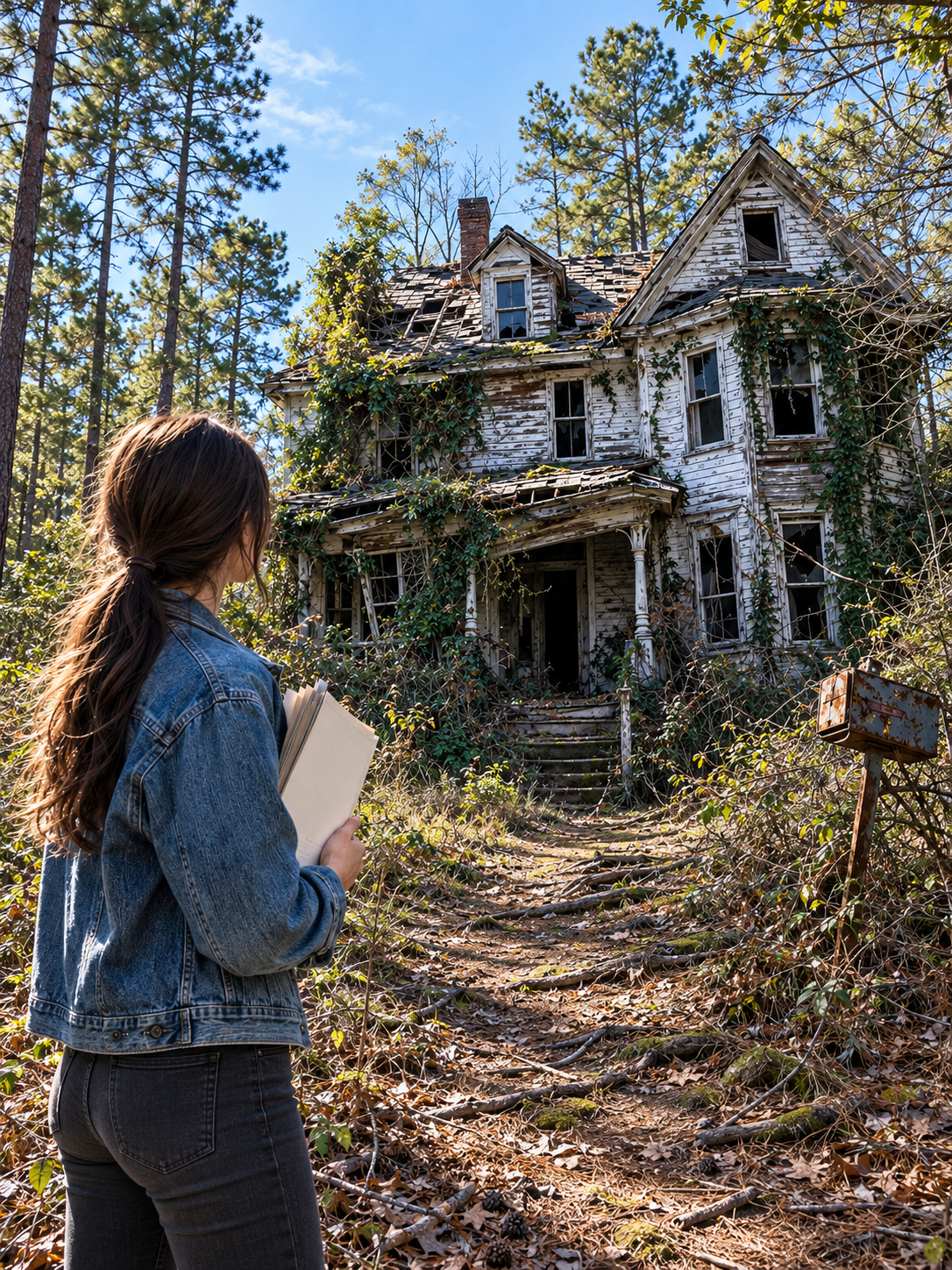
My name is Lila Marlow. The farmhouse sat at the end of a rutted dirt road, deep in the hills of western Pennsylvania. The roof sagged. The windows were cracked. The porch slanted like a tired smile. But the deed was mine—paid in full, nine dollars cash, handed over at the county courthouse with a signature that shook only a little. It was the only thing in the world that belonged to me.
I spent my first weeks patching walls, hauling trash, scrubbing decades of dust from floorboards. I slept on a pile of blankets. I ate soup on a folding chair. I was happy. For the first time, I felt safe.
Then I climbed the attic stairs.
Sunlight slanted through a single dirty window, catching motes of dust that swirled like forgotten memories. Rafters stretched overhead, rough and dark. And there, carved deep into the main beam, were three words: Eleanor Marlow — Stay.
Eleanor Marlow. That was my mother’s name.
I stood frozen, hand pressed to the wood, breath caught in my throat. How? Why here? She had never spoken of this place. My grandparents had said she left the state. Said she vanished. Said she never looked back. But her name was here. Carved by her own hand. As if she’d been told to leave—and had refused.
I searched the attic from end to end. Under loose floorboards, tucked into a crack in the stone chimney, wrapped in oilcloth and tied with frayed ribbon, I found it: a leather‑bound journal. Her handwriting. Loopy, familiar, exactly like the few notes she’d left me before she disappeared.
I sat on the floor and read.
She’d lived here. She’d grown up here. This was her family’s home—not the grand house my grandparents had always called “the only place we ever lived.” This cabin. This land. They’d sold it out from under her when she was seventeen. They’d told her to leave and never mention it again. She’d come back in secret. Carved her name. Written down everything—how they’d pressured her, how they’d lied, how they’d threatened to cut her off if she told anyone where she’d been or what she’d seen.
They said I was unstable, she’d written. They said I made things up. But I saw what they did. I know who they hurt. And I will not be silent.
Pages followed—dates, names, places. A business deal that wasn’t legal. A parcel of land sold twice. Money that vanished. A witness who changed his story and then vanished too. She’d been gathering proof. She’d been planning to speak up. And then, shortly after I was born, she was gone.
I closed the journal slowly. The truth settled soft and heavy in my chest. She didn’t leave me. She didn’t walk away. She was silenced.
I went downstairs, sat at my kitchen table, and made a plan. I would not storm over to their house shouting. I would not send angry texts or make wild accusations. I would gather every piece of the truth first. I would be steady. I would be thorough. And I would be ready when they lied to my face.
I started at the county records office. I cross‑referenced names and dates. I traced property transfers. I found the sale of this very farmhouse—signed over to my grandfather by someone who was not related, under suspicious circumstances, the year before my mother disappeared. The money went nowhere. The trail ended abruptly.
I spoke to old neighbors. People who’d lived here fifty years. “Eleanor was a good girl,” one woman said, lowering her voice. “She found something she wasn’t supposed to. Tried to tell folks. Then she was gone. Her family said she ran off. But she didn’t run far enough.”
Another man hesitated, then said, “They told us not to ask. Said it was family business. But folks around here know—when you see something you shouldn’t, you keep quiet. Or you vanish too.”
Every step confirmed what I already feared. This wasn’t about a mother abandoning her child. It was about covering up a crime. And my grandparents—my own blood—had been at the center of it.
I found more hidden in the farmhouse: a metal box buried beneath the back porch, rusted but sealed. Inside were bank records, letters, a photograph of my mother standing right where I stood now, smiling, holding a baby—me. And a note, dated the week she vanished: If you are reading this, they have kept me from you. Do not trust them. Do not believe their lies. Follow the names. Follow the money. Follow the trail to the ridge.
The ridge. An old, overgrown property line that ran behind the farmhouse—land that had never been sold, never transferred, never accounted for. Land that held the final piece of the puzzle.
I went there at dawn. The path was choked with brambles. Trees grew thick and dark. I pushed through, following the faint markers she’d left—carved initials, broken branches, a stone cairn half‑hidden in fern. At the top, where the trees thinned, I found it: a crumbling stone foundation. The remains of a second structure. And beneath a flat rock, a small, sealed metal canister.
Inside was the truth in black and white: documents proving my grandparents had been diverting funds, falsifying deeds, and selling protected land for decades. My mother had discovered it all. She’d threatened to go public. And they’d made sure she never could.
They hadn’t just taken her home. They’d taken her life.
I stood there in the quiet wind, holding the evidence in my hands, and felt no rage—only a deep, aching sadness. She’d fought so hard. She’d hidden the truth so carefully. She’d left it all for me. And I had spent my whole life believing she didn’t love me.
I returned to the farmhouse to find a car parked in my drive. My grandfather. He stood on my porch, face tight, eyes hard. “I heard you’re asking questions,” he said. “I heard you found things. Give them to me. Walk away. This isn’t your business.”
“It is my business,” I said, stepping out. “It’s her business. And it’s the truth.”
He stepped closer, voice dropping. “You don’t know what you’re dealing with. This goes deeper than you think. People have been hurt for less. Give me what you found, and I’ll make sure you’re taken care of. Keep it, and you’ll regret it.”
I didn’t flinch. “Is that a threat?”
“It’s a warning,” he said. “Walk away, Lila. Just like she should have.”
He drove off. I stood on the porch, the evidence safe in my bag, and realized: he wasn’t just protecting himself. He was terrified. Because he knew I had found what she left. And he knew there was more she hadn’t written down—something she’d kept for last, something she’d hidden where only I would find it.
That night, I went back to the journal. To the last page, written in shaky, hurried handwriting: They think they buried everything. But there is one witness left. He knows everything. His name is Silas Voss. He was there. And he has been waiting for someone to ask.
I knew the name. Silas Voss—her father’s oldest friend. The man who’d been at every family gathering, who’d always looked at me with sorrow in his eyes, who’d never said a word against them. I’d thought he was just loyal. I hadn’t known he was the only one who knew the whole truth.
I found his number at dawn. He answered on the second ring. “Eleanor?” he whispered, and his voice broke.
“It’s Lila,” I said. “Her daughter.”
Silence stretched, long and trembling. “You found her things.”
“I did,” I said. “And I need to know what happened.”
He was quiet a long time. Then he said, “Meet me at the old mill at dusk. Come alone. Don’t tell anyone where you’re going. They’re watching. They’ve been watching since the day she disappeared.”
I packed the journal, the documents, the photo. I locked the doors. I checked the drive—empty, but not quiet. Something felt wrong. The air hummed with tension. A car passed slowly down the road, turned at the gate, and didn’t drive away.
I slipped out the back. Through the orchard. Down the wooded path my mother must have walked. I kept to the shadows. I reached the mill just as the sun dipped below the trees. Silas was there—old, hunched, leaning on a cane, waiting in the fading light.
“I kept my promise,” he said, his voice rough. “I waited. I didn’t tell. I was afraid they’d do the same to me.”
“Tell me now,” I said.
He took a breath. “They didn’t just threaten her. They offered her money. A new life far away. Silence. When she refused—when she said she’d go to the press—they took her. To the ridge. To the place where they buried the evidence. And they made sure she never came back.”
My blood ran cold. “Where is she?”
He looked at me, eyes glistening. “That’s the part they don’t know I know. Before they took her, she gave me something. Something she said would bring them all down. Not just your grandparents. The others too. The ones with money. The ones with power. The ones who still call the shots.”
He reached into his coat and pulled out a small, sealed envelope. “She said to give it only to you. Only when you were old enough to understand. Only when you were strong enough to finish what she started.”
I took it. My hands trembled. “What is it?”
“The names,” he said. “All of them. Every person involved. Every deal. Every cover‑up. And proof that they’re still doing it—right now, on the same land, with the same lies. She didn’t just want justice for herself. She wanted to stop them from hurting anyone else.”
I broke the seal. I unfolded the paper. The names were there—familiar, powerful, dangerous. And at the bottom, in her handwriting, a final line: They won’t stop at threats. Be careful who you trust. The one who told you to leave is the one who never wanted you to find me.
I looked up. Silas was staring past me, face pale. A car engine rumbled in the distance. Headlights cut through the dark.
“Lila,” he whispered. “They followed you.”
The car skidded to a halt at the mill entrance. Doors opened. Footsteps. Heavy. Fast. Coming toward us.
I folded the paper. Tucked it into my pocket. “Run,” I said.
Silas shook his head. “I can’t. Go. Hide. Tell the world what happened here.”
I hesitated. Then I turned and vanished into the trees, the truth burning in my pocket, my mother’s voice in my heart, and the sound of voices calling my name growing closer behind me.
They didn’t just want the papers. They wanted me silenced—permanently. And I knew then: the fight wasn’t over. It had only just begun.
✓ Lynn R. Adams
Kicked Out at 18 With Nothing, She Bought a $9 Farmhouse — and the Attic Held the Truth About Her Mother What would you do when the only home you could afford leads you straight to the secret everyon…