Kicked Out at 17, She Built a $27 Home in a Montana Hillside—Then Winter Exposed Her Stepmother’s Billion-Dollar Lie
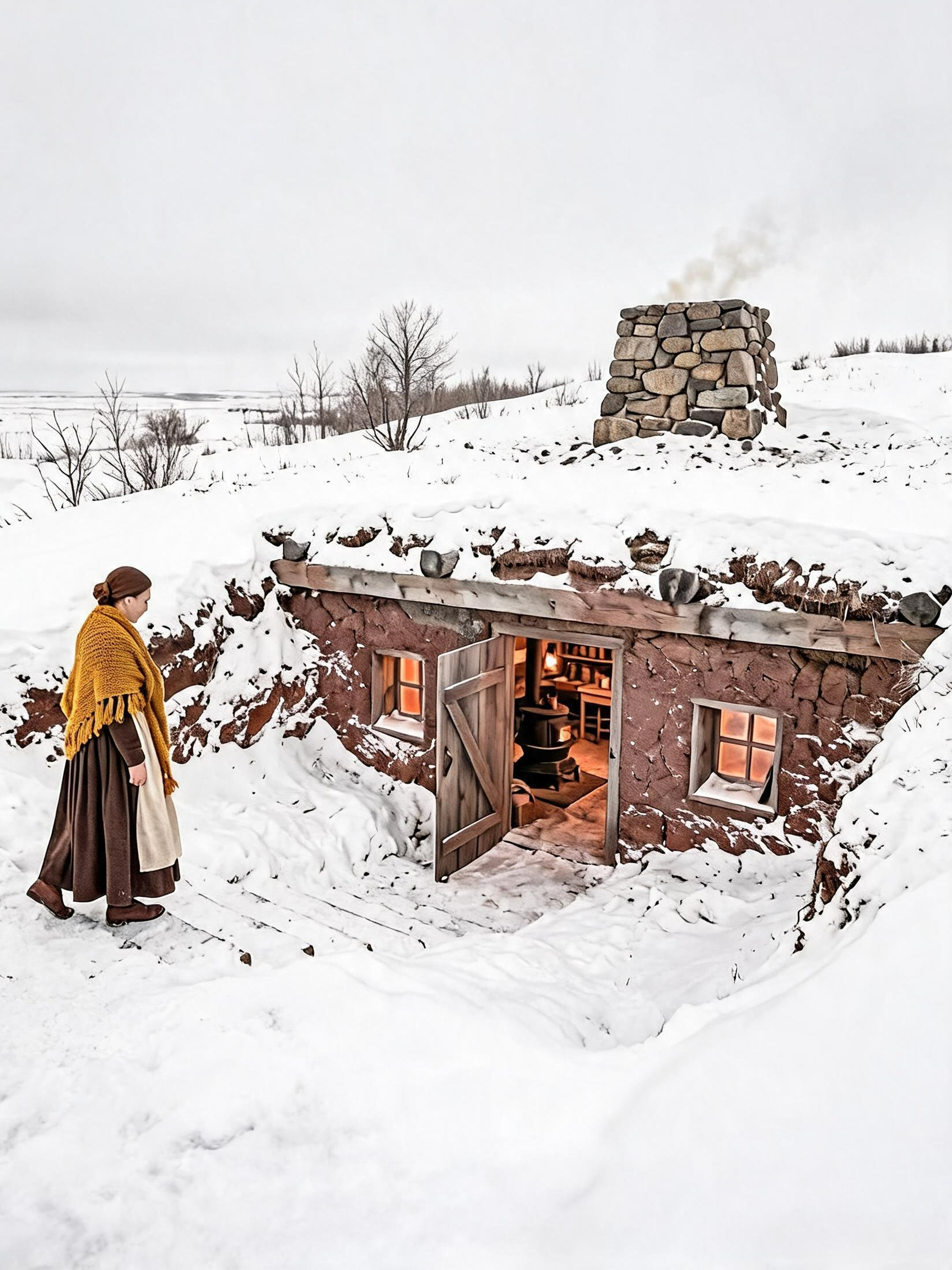
🔥HERE’S THE NEXT PART OF THE STORY, ENJOY !! The explosive twist and the final ending of this story ! ⬇️💬 Thank you ❤
And eighteen cents in the bottom of her backpack.
She loaded three garbage bags onto an ancient bicycle.
She left the other three behind.
Darlene watched through the window.
Mara pushed the bike down the road.
She never looked back.
That night she slept in the laundry room behind Sadie Walsh’s diner.
Sadie was sixty-three, five-foot-two, and incapable of pretending not to notice suffering.
She found Mara at eleven-thirty, sitting in booth six after closing.
“You running away?”
“Then where’s home?”
Mara looked at her hands.
“Don’t have one right now.”
Sadie stared at her.
Then she locked the front door.
“There’s a cot in back.”
“I can work.”
“I didn’t ask.”
“I can wash dishes.”
“I don’t want charity.”
Sadie’s expression softened.
That almost made Mara cry.
Instead, she washed every dish in the kitchen.
At five the next morning, she swept the floor.
At six, she made coffee.
At seven, she went to school.
By noon, everyone knew.
By three, everyone had a version of the story.
Eli Bennett’s spoiled daughter had fought with her stepmother.
Mara had refused to respect the will.
Mara had stolen from the estate.
Mara had been unstable since her mother died when she was a baby.
By Friday, the county had transformed a homeless seventeen-year-old into the villain of her own eviction.
Darlene did not do it alone.
That was the part Mara began understanding.
Darlene had an attorney.
A man named Vernon Pike.
She had a banker.
She had a real-estate broker.
She had Mara’s uncle Clay.
She had two members of the county planning board who played poker with Vernon every Thursday.
And she had Logan Voss, owner of Voss Meridian Development, the richest man within seventy miles.
Voss had wanted Hollow Ridge for years.
Everybody knew that.
The ridge rose behind the Bennett ranch like the spine of some buried animal, twelve hundred acres of pine, stone, meadow, and steep northern slope.
Most people considered it useless.
Too rocky for cattle.
Too steep for crops.
Too remote for subdivisions.
But Voss had made repeated offers.
Eli Bennett had refused every one.
Now Eli was dead.
And according to Darlene, everything was finally hers.
The farmhouse.
The lower pasture.
The timber acreage.
Voss Meridian filed preliminary development plans eleven days after Eli’s funeral.
A luxury ski resort.
Private chalets.
A golf course on the lower meadow.
Projected investment: $218 million.
The local paper printed a smiling photograph of Darlene shaking Logan Voss’s hand.
Underneath it:
BENNETT LAND TO BRING NEW ERA OF PROSPERITY TO COUNTY
Mara read the article while eating toast at Sadie’s counter.
Sadie watched her.
“You gonna say anything?”
“They threw you out.”
“They’re selling your daddy’s land.”
“You’re allowed to be angry.”
Mara folded the newspaper.
“You don’t look angry.”
Mara stood.
“That’s because I don’t want them to know where I’m aiming.”
Sadie stared after her.
It was the first time Mara had frightened her.
That afternoon, Mara rode her bicycle six miles to the Bennett property.
She did not approach the farmhouse.
She went around the southern fence, crossed Miller Creek, climbed through pine scrub, and reached the barn from behind.
The brass key hung beneath her shirt.
The barn door was chained.
New padlock.
Darlene had not trusted her warning.
Mara circled to the old hay door.
The lower hinge had been broken since she was fourteen.
She squeezed through.
Inside, everything smelled like her father.
Cedar shavings.
For one terrible second Mara had to grip the wall.
Then she kept moving.
Her father’s workbench stood beneath the western window.
Someone had searched it.
Drawers open.
Tools scattered.
Coffee cans overturned.
Vernon Pike or Darlene, Mara guessed.
Maybe both.
They had been looking for something.
Mara touched the brass key beneath her shirt.
Her father had said it opened something nobody would value until they understood it.
She searched for forty minutes.
Then she remembered a game.
When Mara was eight, her father had hidden her Christmas present in the barn.
He gave her one clue.
People search where things open. Smart people search where things don’t.
She had found the present taped beneath the bottom of a drawer.
Mara crouched.
Under the workbench was a horizontal support beam.
Fixed to the back was a small black metal box.
No bigger than a Bible.
There was a keyhole.
Her hands began shaking.
The brass key fit.
Inside were four things.
A photograph.
A sealed envelope.
A small silver flash drive.
And an old surveyor’s field notebook wrapped in waxed cloth.
The photograph showed Mara’s father when he was perhaps twenty-five.
Beside him stood Mara’s grandfather, Walter Bennett.
They were standing on Hollow Ridge.
Behind them was a stone marker.
On its face had been carved:
B-17 / TRUST
Mara opened the envelope.
Inside was one sheet of paper in her father’s handwriting.
If you’re reading this, they moved faster than I hoped.
Do not confront Darlene.
Do not confront Vernon.
Do not sign anything.
Most importantly, do not let anyone convince you Hollow Ridge passed through my estate.
Mara stopped breathing.
She read the sentence again.
Hollow Ridge passed through my estate.
Your grandfather protected it in 1989. I strengthened that protection in 2007. Vernon knows enough law to know what that means, which is why he will try to make you disappear before you learn it.
Find Ruth Calder.
Show her the notebook.
Tell her I remembered the winter of ’96.
And Mara—if the house is gone, use the hill.
The earth kept our family alive before walls did.
Love you beyond the fence line.
Mara sat on the dirt floor.
She did not cry loudly.
She pressed her fist against her mouth and let tears fall onto the note.
Then she heard a truck outside.
Doors slammed.
And Vernon Pike.
Mara shoved everything into her backpack.
“There,” Vernon said from outside. “Hay door.”
Mara looked toward the loft.
The main door rattled.
She climbed.
At the back of the loft was a narrow opening beneath the roofline.
She crawled through just as the barn door opened below.
Darlene’s voice echoed.
“I told her not to come here.”
Vernon answered.
“She’s seventeen, not stupid.”
“She has no money.”
“Money isn’t what worries me.”
Mara froze above them.
Darlene lowered her voice.
“What does?”
“The fact that Eli raised her.”
Mara slipped out through the opening and dropped into a snowbank behind the barn.
Ruth Calder lived in a blue trailer twenty-three miles north of town.
She was seventy-eight years old and had once been the county surveyor.
When Mara knocked, Ruth opened the door holding a revolver.
“I’m Mara Bennett.”
The gun lowered.
Ruth stared at her face.
Then at the backpack.
“Eli dead?”
“Two weeks ago.”
Ruth closed her eyes.
Mara nodded.
Ruth stepped aside.
“I wondered why he stopped calling.”
Inside, maps covered almost every wall.
Mara placed the notebook on the kitchen table.
Ruth did not touch it immediately.
She sat down.
“Tell me exactly who knows you have this.”
Ruth opened the book.
Ten minutes passed.
Then twenty.
She turned pages slowly.
Finally she laughed.
Not because anything was funny.
Because something impossible had survived.
“That stubborn son of a gun.”
“What is it?”
Ruth looked at Mara.
“Your grandfather hated developers.”
“I know that.”
“No. You know the family-story version. Walter Bennett hated one developer specifically.”
“Logan Voss’s father.”
Ruth explained.
In 1988, Voss Meridian’s predecessor had tried to acquire several ranches around Hollow Ridge.
The land looked worthless.
But geological surveys had identified something beneath the eastern slope.
An enormous protected aquifer.
And more importantly, the only practical gravity-fed access to several valleys projected to face severe future water shortages.
Walter Bennett discovered the plan.
Rather than sell, he created the Hollow Ridge Stewardship Trust.
The ridge did not legally belong to Walter after that.
Nor later to Eli.
They were trustees.
Caretakers.
The beneficial ownership was structured to pass to Walter’s direct descendants meeting certain conditions.
Mara stared at Ruth.
“So my dad didn’t own it?”
“Not personally.”
“Then Darlene can’t inherit it.”
Ruth’s eyes sharpened.
“She never could.”
Mara thought of the newspaper photograph.
The handshake.
The development announcement.
“She thinks she did.”
“Oh, sweetheart.”
Ruth leaned back.
“I suspect she knows she didn’t.”
That was worse.
Ruth turned to a page near the center.
There were signatures.
Walter Bennett.
Eli Bennett.
Ruth Calder.
And another name.
Vernon Pike.
Mara felt cold despite the heater.
“Junior associate back then.”
“He signed this?”
“As witness.”
“Then he knows.”
Mara whispered, “Why would he help Darlene?”
Ruth gave a humorless smile.
“Two hundred million dollars makes people forget all kinds of things.”
The original trust documents should have been filed in county archives.
But Ruth warned that portions of the records had disappeared years earlier.
The notebook alone would not be enough.
The flash drive might help.
Ruth plugged it into an old laptop.
A password screen appeared.
WINTER OF 96
Ruth looked at Mara.
“I know what he means.”
The winter of 1996 had nearly destroyed the Bennett ranch.
Forty below.
Roads buried.
Power out for nine days.
Eli had been twenty-eight.
A school bus carrying fourteen children became stranded six miles from town.
Eli Bennett found them.
He brought the children to Hollow Ridge.
There had once been an emergency shepherd shelter built into the southern hillside.
Earth on three sides.
Stone chimney.
Timber roof.
Eli kept fourteen children alive there for two nights until rescuers arrived.
Ruth typed:
Mara looked at the password hint.
Then remembered something her father always said during storms.
The cold doesn’t kill you first. Pride does.
The drive opened.
Inside were scanned deeds, tax maps, correspondence, recordings, bank statements, photographs, and one video file.
Eli Bennett appeared on screen.
Clearly sick.
“If you’re watching this,” he said, “I probably ran out of time.”
Mara covered her mouth.
Eli continued.
“Hollow Ridge is not a fortune in the ordinary sense. Anybody who sees it that way is exactly the person the trust was designed to stop.”
He explained that the trust held approximately 1,247 acres.
It also held water rights later valued, under conservation and municipal agreements, somewhere between $74 million and $110 million.
But none of those rights could be sold outright to a private luxury development.
They could be leased for public water use, conservation, agriculture, emergency infrastructure, and certain community purposes.
Income from those leases would benefit Walter Bennett’s descendants and a local public trust.
Voss Meridian could not build its resort without controlling those water rights.
Darlene could sell the farmhouse.
She could sell the lower ranch acreage Eli personally owned.
She could sell the cattle.
But Hollow Ridge?
And neither could Mara.
That was the beauty of it.
Her father had not left her a mountain to liquidate.
He had left her a mountain she was obligated to defend.
Then Eli leaned toward the camera.
“There’s something else.”
His face hardened.
“Vernon Pike came to me six months ago with papers transferring supposed ownership of the ridge into a holding company connected to Voss Meridian. He said Darlene believed I was too sick to understand.”
Mara felt Ruth go still beside her.
“I understood.”
Eli held up copies.
“I refused.”
He looked directly into the camera.
“If those papers appear after my death bearing my signature, the signature is false.”
Silence filled Ruth’s trailer.
Then Eli said:
“I’ve deposited verification materials outside Montana.”
Ruth whispered, “Smart.”
Eli continued.
“Mara, they may tell you that fighting makes you greedy. Remember this: defending what was entrusted to you is not greed.”
His eyes softened.
“You were never raised to own Hollow Ridge.”
“You were raised to deserve the responsibility.”
The video ended.
Mara sat in silence.
Ruth waited.
Finally Mara asked, “Can we stop them?”
Ruth studied her.
“You’re seventeen.”
“I noticed.”
“You have a lawyer?”
“Twenty-seven dollars.”
Ruth raised an eyebrow.
“Exactly twenty-seven?”
“Twenty-seven eighteen.”
“That eighteen cents could turn this whole thing around.”
Mara laughed.
It was the first time since her father died.
Then Ruth became serious again.
“You need somewhere safe.”
“I’m staying behind a diner.”
Mara thought of her father’s note.
If the house is gone, use the hill.
She looked at the topographic map on Ruth’s wall.
“What happened to the old 1996 shelter?”
Ruth slowly smiled.
Technically, the shepherd shelter stood on trust land.
Technically, Mara was one of the named contingent beneficiaries.
Technically, no habitable structure remained.
The roof had collapsed fourteen years earlier.
One stone wall had fallen.
The chimney leaned east.
The floor was dirt.
Winter was less than six weeks away.
Mara moved in anyway.
She spent $8 on a used handsaw.
$4 on nails.
$6 on a roll of heavy plastic from a farm auction.
$3 on stove pipe fittings.
$2 on lamp oil.
The remaining four dollars bought a bowl of chili and two pieces of cornbread at Sadie’s diner.
Sadie refused the money.
Mara left it under the plate.
So the amount she actually spent building her home was twenty-three dollars.
But four days later, a farmer named Hank Dreyer offered her a stack of salvaged boards if she helped unload his feed truck.
Mara insisted on paying him something.
He charged four dollars.
Twenty-seven dollars total.
That became the number everyone laughed about.
The girl with the twenty-seven-dollar house.
She rebuilt the hillside shelter using discarded barn boards, river stone, old insulation, salvaged windows, and timber cut from fallen trees.
Ruth taught her how to read the original shelter diagrams.
Sadie brought food.
Hank loaned tools.
Two ranch hands who had worked for Eli appeared one Saturday morning without explanation.
They repaired the chimney.
At sunset they left.
No money changed hands.
Word spread.
So did mockery.
Darlene told people Mara was “living in a hole.”
Vernon called it evidence of instability.
The local paper photographed the crude doorway beneath the hillside.
Online comments were worse.
Princess Cave.
Wait until January.
Daddy’s money ran out fast.
Someone call social services.
Mara read none of them.
She worked.
The hillside itself became insulation.
Mara sealed the northern wall.
She built a tiny sleeping platform.
She dug drainage channels.
She installed a used woodstove.
She stacked enough firewood for four months.
She hung her father’s photograph beside the door.
Above it she hung the brass key.
Every evening, she opened the survey notebook.
Every evening, she learned more.
And while Mara built something everyone could see, Ruth quietly worked on something nobody could.
Darlene believed she had already won.
By November, she was driving a new pearl-white Range Rover leased through a Voss Meridian affiliate.
She hosted a “future of Hollow Ridge” reception at the farmhouse.
Logan Voss attended.
So did county commissioners.
Vernon Pike drank twelve-year Scotch beneath Eli Bennett’s elk mount.
Mara’s uncle Clay stood near the fireplace.
Darlene raised a glass.
“To new beginnings.”
They toasted.
Outside, contractors had already marked access roads with orange flags.
Voss Meridian had placed a temporary sales office in town.
Renderings showed glass chalets overlooking pristine snow.
The development had a name.
HOLLOW RIDGE RESERVE.
Homes starting at $4.8 million.
Mara saw the billboard while biking home.
Her father’s mountain had been transformed into luxury branding before the first shovel touched soil.
At school, a boy named Trevor asked, “You gonna get a free condo?”
Mara kept walking.
“What’s wrong, Cave Girl?”
She stopped.
Trevor grinned.
Everyone expected a fight.
Mara simply asked, “You ever seen a man build a house on land he doesn’t own?”
Trevor laughed.
“You might.”
Then she walked away.
The first major snowstorm arrived November 19.
Twenty inches overnight.
The hillside house stayed warm.
The farmhouse lost power.
Darlene spent one night at a hotel.
The second storm arrived December 3.
Thirty-one inches.
The temperature fell to twenty below.
Mara’s buried walls held heat beautifully.
The third storm became history.
Meteorologists later called it the worst early-season Montana blizzard in nearly a century.
The temperature dropped to forty-one below zero.
Wind exceeded sixty miles per hour.
Snowdrifts swallowed fences.
Power lines snapped.
Interstate sections closed.
The county emergency system failed in two districts.
And Hollow Ridge became invisible beneath white.
Mara woke at a.m. to pounding on her door.
She grabbed a flashlight.
Outside stood Uncle Clay.
His beard was frozen.
Blood covered one side of his face.
Mara stared.
The man who had watched her get thrown into the snow was standing outside the home everyone mocked.
“Truck went off the road,” he gasped.
“Who’s with you?”
Clay hesitated.
Mara’s face changed.
“Half mile down.”
For one heartbeat, she could have closed the door.
No one would have blamed her.
Maybe not even her father.
Then Mara grabbed a rope.
They found Darlene trapped inside the Range Rover.
A fallen pine had crushed the rear passenger side.
The engine was dead.
Darlene’s expensive coat was useless against the temperature.
When she saw Mara, shame passed across her face.
Mara broke the driver’s window.
Clay helped pull her out.
They brought Darlene to the hillside shelter.
The twenty-seven-dollar house.
Inside, the fire was burning.
The buried room was fifty-eight degrees.
Warm enough to live.
Warm enough to save a life.
Darlene sat wrapped in Mara’s blankets, shaking violently.
Her eyes moved around the tiny room.
The crude shelves.
The salvaged boards.
Eli’s photograph.
“You built this?”
Mara added wood to the fire.
“For twenty-seven dollars?”
Darlene looked at her.
“Why did you come get me?”
Mara did not answer immediately.
“Because Dad would have.”
Darlene looked down.
No accusation could have hurt more.
They remained snowbound for thirty-six hours.
During that time, Clay began talking.
At first about nothing.
Then about everything.
He had debts.
Vernon knew.
Voss Meridian had paid them.
In exchange, Clay signed an affidavit claiming Eli intended Darlene to control Hollow Ridge.
“Did Dad ever say that?”
“Then why sign it?”
Clay’s face crumpled.
“Because I thought it didn’t matter.”
Mara stared at him.
“You thought lying about Dad didn’t matter?”
“I thought the ridge was just rocks.”
Mara looked toward the sleeping Darlene.
“What else?”
Clay swallowed.
“Vernon had papers.”
“What papers?”
“Transfer documents.”
Mara’s voice became quiet.
“Dated before Eli died.”
Clay looked sick.
Clay said nothing.
Mara understood.
The legal mine her father had planted had just found its first foot.
“Uncle Clay?”
“Did you witness the signature?”
Clay began crying.
Mara did not comfort him.
“But Dad never signed it.”
Outside, the blizzard screamed against the hill.
Inside, Mara picked up her father’s old field notebook.
“Then when the roads open, you’re going to tell someone besides me.”
Clay tried to take it back the next morning.
Fear returned with daylight.
“Vernon will destroy me.”
Mara poured coffee.
“You signed a false witness statement.”
“You helped them steal a trust.”
“I didn’t know what it was.”
“You knew it wasn’t Dad’s signature.”
Clay covered his face.
Mara sat across from him.
“You told me Bennetts don’t abandon Bennetts.”
He flinched.
“I failed you.”
The answer stunned him.
She did not soften it.
“But you can decide whether failing me becomes the worst thing you ever did.”
Clay looked up.
Mara slid a piece of paper across the table.
On it was a phone number.
Ruth had given it to her.
Assistant U.S. Attorney Naomi Kerr.
Financial crimes division.
Clay stared at the number.
Darlene was awake now.
Her voice came from the sleeping platform.
“You called federal prosecutors?”
Mara turned.
Darlene relaxed slightly.
Mara continued.
Darlene went pale.
When rescue crews finally reached Hollow Ridge, they discovered three people alive inside the primitive hillside home newspapers had ridiculed for weeks.
One of them was the wealthy widow who had evicted its builder.
The story spread across Montana within twenty-four hours.
Then nationally.
But the bigger story came six days later.
Voss Meridian held a press conference at the county courthouse to announce that construction would resume after the storm.
Logan Voss stood beside Darlene.
Vernon Pike stood behind them.
Reporters filled the steps.
Mara appeared at the edge of the crowd wearing her father’s old coat.
Ruth Calder walked beside her.
So did Uncle Clay.
Darlene saw them.
Her smile disappeared.
Vernon whispered something to Voss.
Mara did nothing.
She did not approach the microphones.
She simply entered the courthouse.
At 10:07 a.m., Ruth filed a petition seeking emergency enforcement of the Hollow Ridge Stewardship Trust.
At 10:11, a federal investigator filed a companion notice concerning suspected forged interstate financial instruments.
At 10:16, the county recorder accepted a certified copy of a 1989 trust instrument recovered from archived microfilm in Helena.
At 10:22, the first construction permit was suspended.
By lunch, Hollow Ridge Reserve no longer had a legally established development site.
By three o’clock, Voss Meridian’s lenders had frozen two credit facilities pending title review.
By sunset, Vernon Pike had stopped answering Darlene’s phone calls.
The system that had made Mara look powerless began turning on itself.
The hearing took place twelve days before Christmas.
The courtroom was packed.
Darlene wore black.
Vernon Pike had hired his own attorney.
Logan Voss sat with four lawyers.
Mara sat beside Ruth and court-appointed counsel, Rebecca Hale, a land-trust attorney from Missoula who had volunteered after seeing the case reported statewide.
The issue appeared simple.
Who owned Hollow Ridge?
But simple questions become complicated when millions of dollars depend upon the answer.
Voss Meridian argued that the 1989 trust had been terminated.
Darlene’s attorneys produced a termination instrument supposedly signed by Eli.
Rebecca Hale produced Eli’s video.
They challenged it.
She produced medical records proving Eli was hospitalized in Billings on the date the document claimed he had signed it in Hollow Ridge County.
They suggested he could have signed remotely.
Rebecca produced handwriting experts.
They disputed them.
Then Ruth opened the field notebook.
“Page eighty-seven,” she said.
The original trust contained a clause nobody involved in the fraudulent transfer appeared to have noticed.
Walter Bennett had anticipated pressure from developers.
Any termination required three independent confirmations.
The trustee’s notarized signature.
Approval of the adult direct descendant beneficiaries.
And certification from the original surveyor or designated successor that the trust’s public water protections had been legally transferred.
The supposed termination had only Eli’s forged signature.
No descendant approval.
No survey certification.
No legal transfer of water protection.
It was worthless.
But Rebecca Hale was not finished.
“Your Honor, we would like to address why the defendants were so willing to rely upon an obviously defective instrument.”
Bank records appeared.
Payments from Voss Meridian subsidiaries.
To Vernon Pike.
To Clay Bennett.
To a consulting company registered to Darlene’s cousin.
Then correspondence.
Vernon had written:
Once the girl is removed from the residence, practical resistance should be negligible.
Another message from Darlene:
She has no resources and turns eighteen in the spring. By then this will already be closed.
Another from Voss:
Need clean possession before lender inspection. Handle family issue.
Mara read those words without expression.
Family issue.
That was what she had been.
Not Eli Bennett’s daughter.
Not a grieving child.
A family issue.
Something to handle.
Rebecca introduced the final piece.
A sealed affidavit Eli had deposited with an attorney in Wyoming months before his death.
It contained one sentence Mara would remember for the rest of her life.
If my daughter is treated as an obstacle to this land, then those responsible have proven precisely why she must be the one entrusted to protect it.
The judge removed his glasses.
The room went completely quiet.
Darlene began whispering urgently to her attorney.
Vernon stared at the table.
Logan Voss looked toward the exit.
And Mara understood what her father had done.
The secret was never merely that she would inherit valuable land.
It was better.
He had created a system in which the greed of the wrong people activated the protection of the right person.
If Darlene had treated Mara kindly, the trust still would have survived.
If Vernon had obeyed the law, the trust still would have survived.
If Voss had negotiated honestly for lawful water access, perhaps a deal benefiting the community might even have been possible.
Instead, they had tried to erase a seventeen-year-old girl.
And by doing so, they had created the evidence proving exactly why Walter and Eli Bennett’s restrictions were necessary.
The trap was not revenge.
The trap was character.
They had walked into it willingly.
The judge issued a preliminary ruling restoring the Hollow Ridge Stewardship Trust and naming Mara its protected successor beneficiary upon adulthood.
Until then, an independent fiduciary would administer it.
All Voss Meridian development activity stopped.
The fraudulent transfer was referred for criminal prosecution.
Darlene retained the farmhouse temporarily, but an audit revealed that she had used estate accounts to finance personal expenses and illegal transactions connected to the attempted land transfer.
The Range Rover disappeared first.
Then the jewelry.
Then the farmhouse itself went into receivership pending claims by Eli’s estate and creditors.
Vernon Pike surrendered his law license before disciplinary proceedings concluded.
Months later, he pleaded guilty to fraud-related charges.
Logan Voss was indicted on conspiracy and financial fraud counts.
Clay cooperated with investigators.
He avoided prison but lost almost everything.
Mara never celebrated that.
Some victories are too expensive for cheering.
On Christmas Eve, Mara returned to the hillside house.
Snow covered the valley.
The storm had left drifts taller than fences.
Inside, the stove glowed.
Ruth arrived carrying pie.
Sadie brought roast beef.
Hank brought a door.
A real one.
“Found it behind my machine shed,” he said.
Mara examined the oak.
“That’s worth more than my whole house.”
“Then I’ll sell it to you cheap.”
“How much?”
“One cent.”
Mara handed him a penny.
By evening, twelve people had crowded inside.
Two former employees of her father.
A volunteer firefighter.
A mother who had been one of the fourteen children Eli saved in 1996.
Her name was Laura Dean.
She stood beside the stove and told Mara something she had never known.
“Your dad gave me his coat that night.”
Mara smiled.
“That sounds like him.”
“No. Listen.”
Laura’s eyes filled.
“He didn’t have another one.”
The room fell quiet.
“He walked outside for firewood all night in two shirts because I was nine years old and scared.”
Mara looked at her father’s photograph.
For weeks, everyone had talked about Eli’s land.
His documents.
His estate.
His water rights.
His planning.
But that coat explained the whole man better than any deed.
He had never believed wealth was what you kept.
Wealth was what you could give away without losing yourself.
Mara finally understood why he had refused to sell Hollow Ridge even when the numbers became enormous.
The mountain was never his prize.
It was his promise.
Mara turned eighteen in May.
By then the snow had melted from the lower valley.
Wildflowers covered the slope above her little home.
The independent trust administrator formally recognized Mara as successor steward.
The valuation report stunned the county.
Between land, restricted water rights, conservation payments, future municipal agreements, and environmental credits, the trust controlled assets potentially worth more than $90 million.
Headlines called Mara a teenage millionaire.
She hated that description.
She could not sell Hollow Ridge for ninety million dollars.
She could not mortgage it for yachts.
She could not carve it into luxury chalets.
That was precisely the point.
She received enough annual trust income to live comfortably and attend college.
The rest went where Walter and Eli intended.
Watershed protection.
Fire prevention.
Ranch conservation.
Emergency shelters.
Low-cost water access for nearby communities.
Mara created one additional program.
The Eli Bennett Winter Fund.
Its first project constructed six earth-sheltered emergency cabins along remote county roads.
Each one used the same basic principle as Mara’s twenty-seven-dollar home.
Insulation.
Enough to survive when electricity and roads failed.
Above every door was a small metal plate.
PRIDE DOESN’T KEEP YOU WARM. PEOPLE DO.
Darlene’s criminal case ended the following autumn.
She pleaded guilty to conspiracy and estate fraud in exchange for reduced charges.
Before sentencing, she requested permission to speak privately with Mara.
Mara almost refused.
Then she remembered her father.
If people get strange after I’m gone, don’t get strange with them.
So she went.
They met in a courthouse conference room.
No fireplace.
No farmhouse.
No expensive coat.
Darlene looked ten years older.
For a long time neither spoke.
Finally Darlene said, “I did love your father.”
Mara looked at her.
“I believe you.”
Darlene seemed surprised.
“I thought you’d say I didn’t.”
“People can love someone and still betray them.”
Darlene looked away.
“I was scared.”
“Being left with nothing.”
Mara almost laughed.
“You had a house. Money. Land. Dad made sure you were provided for.”
“I wanted security.”
Mara’s voice remained quiet.
“You wanted certainty.”
Darlene frowned.
“What’s the difference?”
“Security is having enough.”
Mara leaned back.
“Certainty is making sure nobody else can ever threaten what you have.”
Darlene’s eyes hardened slightly.
“You think you’re better than me?”
Mara considered the question.
That answer seemed to disarm her.
Mara continued.
“I think I had a better teacher.”
Darlene’s eyes moved toward the window.
After a moment she said, “You could ask the court for leniency.”
“Will you?”
Mara looked at the woman who had thrown her out three days after her father’s funeral.
The woman who had placed her clothes into garbage bags.
The woman who had allowed an entire town to believe she was unstable.
The woman whose greed had almost stolen something generations had protected.
Mara felt no hatred.
That surprised her.
Hatred required carrying someone.
She had carried enough.
“I told the prosecutor the truth,” Mara said. “You also told rescuers where two stranded motorists were during the storm. That probably saved their lives. I told them that too.”
Darlene’s eyes filled with tears.
“Because justice isn’t me getting to lie about you just because you lied about me.”
Darlene began crying.
Mara stood.
At the door, Darlene spoke.
She turned.
“Your father would be proud of you.”
For the first time, Mara’s composure cracked.
Only slightly.
“You don’t get to give me that.”
Darlene lowered her eyes.
“You’re right.”
Two years later, Hollow Ridge looked almost exactly as it always had.
That became Mara’s proudest accomplishment.
There was no giant resort.
No glass hotel.
No private ski village.
Eagles still nested above the eastern cliffs.
Elk crossed the meadow in October.
Ranchers downstream received water during drought years.
The county emergency service maintained shelters through the mountains.
Mara attended Montana State University and studied environmental engineering and land-use law.
She still returned to the hillside house.
She could have built something enormous.
Instead, she improved what she had.
A better roof.
A solar panel.
A small kitchen.
A proper bedroom.
The four-dollar boards remained on one wall.
She refused to replace them.
Visitors often asked why.
Mara would touch the scarred wood and say:
“Because expensive things can tell you what you have.”
“Cheap things can remind you who you were when you had nothing.”
The farmhouse eventually sold.
Mara did not buy it.
That surprised everyone.
Sadie asked her why.
Mara stood outside the hillside home, looking down across the valley where she had once pushed a bicycle through snow with garbage bags tied to the back.
“That house stopped being home before Darlene locked the door.”
“Still your daddy’s place.”
Mara smiled.
“Dad’s place is everywhere he kept a promise.”
Sadie wiped her eyes angrily.
“I hate when you talk like him.”
“No, you don’t.”
“No, I don’t.”
Years later, when journalists wrote about the Hollow Ridge case, they usually focused on the numbers.
Twenty-seven dollars.
Ninety million in protected assets.
Two hundred eighteen million in canceled development.
Millions in water rights.
Millions in conservation value.
Those numbers made good headlines.
But they missed the real inheritance.
Mara had inherited proof.
Proof that her father had known exactly who she was.
Proof that her grandfather had thought far enough ahead to protect people he would never meet.
Proof that being cast aside did not make someone worthless.
Proof that sometimes the person everyone calls powerless is simply the only person in the room who has not revealed her hand.
And proof that justice does not always arrive wearing a robe.
Sometimes it arrives on a bicycle with garbage bags tied to the back.
Sometimes it sleeps behind a diner.
Sometimes it buys four dollars of lumber.
Sometimes it digs itself into a frozen Montana hillside.
Sometimes it stays quiet while greedy people celebrate too early.
And sometimes it waits until everyone who betrayed it has confidently signed their own names to the evidence.
On the fifth anniversary of Eli Bennett’s death, Mara climbed Hollow Ridge alone.
She reached the old stone marker from the photograph.
B-17 / TRUST.
The carving had faded.
She knelt and brushed moss from the letters.
Then she placed her father’s brass key beside the stone.
She no longer needed it.
The box it had opened was empty now.
Its documents were safely archived.
Its secrets belonged to courts, trusts, historians, and the communities whose water the ridge protected.
But the key had done its job.
Mara looked down toward the valley.
She could see the little earth-sheltered house below.
Twenty-seven dollars.
People had laughed at it.
They had called it pathetic.
Proof that Eli Bennett’s daughter had lost everything.
Yet during Montana’s worst winter, that little house had sheltered the very people who had abandoned her.
And in the months afterward, it became something greater than shelter.
It became evidence.
Of ingenuity.
Of dignity.
Of restraint.
Of a girl who could have been made cruel and chose instead to become difficult to corrupt.
The wind moved through the pines.
For a moment, Mara could almost hear her father.
Don’t get strange with them.
She smiled.
Then she heard footsteps.
Uncle Clay approached from below.
His hair had gone gray.
He stopped several feet away.
“Mind if I stand here?”
“Free country.”
He came closer.
They had not become what they once were.
Some fractures never disappear.
But Mara had learned that forgiveness did not require pretending something had never broken.
Clay looked at the stone marker.
“I think about that porch every day.”
Mara knew which porch.
The garbage bags.
The locked door.
“You should.”
Clay nodded.
“I keep wishing I’d said something different.”
“I don’t know.”
“That you were sorry?”
“That I could stay with you?”
“That Dad would’ve hated what you were doing?”
Clay closed his eyes.
Mara looked across the ridge.
“You can’t change the sentence.”
“You can change what comes after it.”
Clay nodded.
They stood together in silence.
Far below, children were touring one of the new emergency shelters with their teacher.
Mara could hear their laughter rising faintly through the cold air.
Clay looked toward them.
“Your dad would’ve liked that.”
Mara smiled.
Then Clay asked, “You ever wonder what would’ve happened if Darlene hadn’t kicked you out?”
Mara thought about it.
Perhaps she would never have entered the barn.
Perhaps she would not have opened the box.
Perhaps Voss Meridian would have moved more carefully.
Perhaps the forged paperwork would have survived longer.
Perhaps greed had accidentally accelerated its own destruction.
“I used to.”
“Now I think doors work both ways.”
Clay looked confused.
Mara touched the old stone marker.
“When someone closes one behind you, sometimes they’re locking themselves on the wrong side.”
That evening Mara walked down the mountain.
Snow had begun falling.
Softly this time.
She entered the hillside home and lit the stove.
On one wall hung a framed copy of her father’s handwritten warning.
Not the legal documents.
Not the valuations.
Just the words:
If the house is gone, use the hill.
Beneath it sat the photograph of Eli and Walter Bennett beside the stone marker.
Mara made coffee.
Then headlights appeared outside.
A car stopped.
A young woman stepped out.
She could not have been more than eighteen.
She wore a thin jacket.
A backpack hung from one shoulder.
Mara opened the door.
The girl looked embarrassed.
“Are you Mara Bennett?”
“They said you might know where I could stay.”
Mara looked at the backpack.
Then at the girl’s shaking hands.
“Who’s ‘they’?”
“Sadie Walsh.”
Mara smiled.
“What happened?”
“My mom’s boyfriend told me to leave.”
“How long ago?”
“Three days.”
There it was again.
Three days.
Some cycles repeat because nobody has learned anything.
Others repeat because someone finally has.
The girl quickly added, “I can work. I don’t want charity.”
Mara almost heard her own seventeen-year-old voice.
Behind her, the stove crackled.
Outside, Montana darkened beneath snow.
Mara opened the door wider.
“There’s a cot in back.”
The girl hesitated.
“I can pay you when I get a job.”
“I didn’t ask.”
The girl’s eyes filled.
Mara stepped aside.
“Come in before you freeze.”
The girl entered.
Mara closed the door against the winter.
Only then did she understand the final thing her father had left her.
Not even justice.
A place where the next person did not have to stand outside with garbage bags while someone warm watched through a window.
That was the inheritance.
That was how a family name became worth keeping.
And somewhere beyond the glass, Hollow Ridge rose black and immense beneath the snow, protected not because one family possessed it, but because one family had finally learned what possession was supposed to mean.
Years earlier, Darlene had stood in a warm doorway and told a seventeen-year-old girl that the world did not care.
Mara had answered, I know.
She had been wrong.
The world did care.
Not automatically.
Not fairly.
Not soon enough.
It cared only when someone chose to care first.
Mara looked at the frightened girl warming her hands by the stove.
Then she remembered the Range Rover buried in snow, the forged deeds, the courthouse, the millions, the headlines, the people who had once laughed at her twenty-seven-dollar house.
And she remembered Darlene standing on that porch, certain she had won.
If Darlene had inherited everything she claimed…
If Vernon’s documents were really legitimate…
If Hollow Ridge truly belonged to them…
If Mara had really been nothing but a penniless seventeen-year-old standing in the snow…
Then there was one question none of them had ever been able to answer.
A question so small it almost sounded weak.
A question her father had quietly built an entire trap around.
If they were so certain the land was theirs… why had they been so afraid of a girl with only twenty-seven dollars?
✓ Lynn R. Adams
🔥HERE’S THE NEXT PART OF THE STORY, ENJOY !! The explosive twist and the final ending of this story ! ⬇️💬 Thank you ❤ And eighteen cents in the bottom of her backpack. She loaded three garbage bag…