Karen Parked in My Garage for a Year—So I Put Her SUV on the Mayor’s Lawn and Exposed Why She Never Got Towed
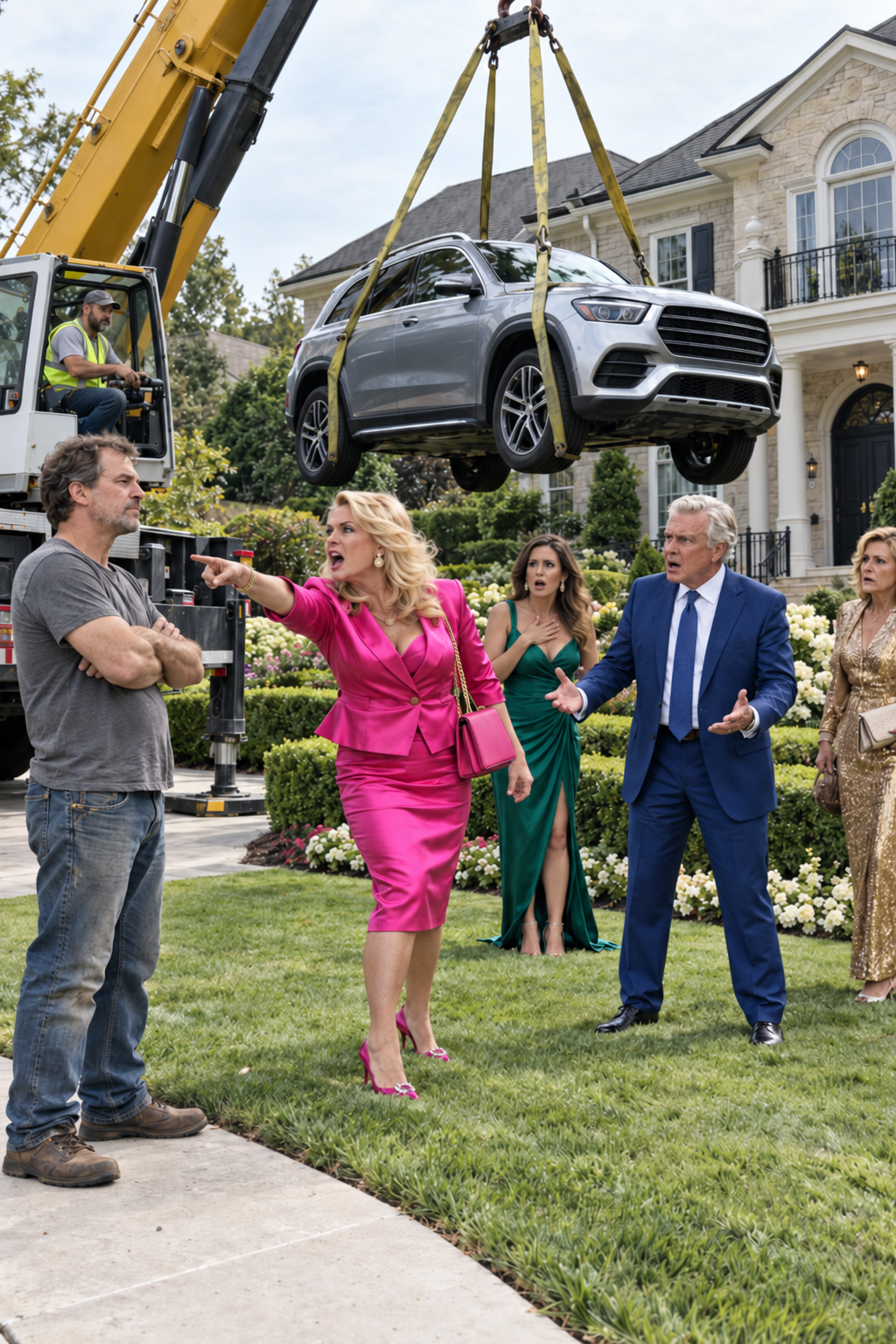
Karen Parked in My Garage for a Year—So I Put Her SUV on the Mayor’s Lawn and Exposed Why She Never Got Towed
The first time I called the police about the strange SUV parked inside my garage, the officer looked at my deed, looked at the vehicle, and told me I was the one who needed to leave.
The second time, my garage door code stopped working.
The third time, I found a typed notice taped to my kitchen window.
UNAUTHORIZED INTERFERENCE WITH COMMUNITY PROPERTY MAY RESULT IN FINES OR ARREST.
There was only one problem.
The garage was mine.
Not shared.
Not leased.
Not community property.
And the woman parking her pearl-white Lexus inside it every morning was Karen Whitmore, president of the Cedar Grove Homeowners Association.
She did it for 364 days.
On day 365, I hired a crane.
By sunset, Karen’s Lexus was hanging twelve feet over Mayor Richard Bell’s front lawn while half the neighborhood watched from the sidewalk.
But that wasn’t the moment things got interesting.
Things got interesting when the mayor saw the SUV and whispered, “Oh, God.”
Then he turned to Karen.
And instead of asking why her car was on his property, he asked her one question.
“Did you leave the folder inside?”
My name is Daniel Mercer.
I’m forty-three years old, divorced, an electrical contractor, and not the kind of man people notice until they need something fixed.
I don’t wear expensive suits.
I don’t post arguments online.
I don’t raise my voice at city meetings.
I keep receipts.
That last habit turned out to matter.
I bought my house in Cedar Grove, Ohio, after my divorce because I wanted quiet.
The place wasn’t glamorous.
Three bedrooms.
Brick exterior.
Old maple tree in front.
A detached two-car garage sitting twenty feet behind the house.
The previous owner, Earl Donnelly, had been eighty-two and moving to Arizona to live near his daughter.
During the inspection, Earl tapped the garage wall with his cane.
“Don’t let those HOA people tell you this building is theirs.”
I laughed because I assumed he was joking.
Earl didn’t.
He stared at me with watery blue eyes.
“Promise me.”
I glanced toward my realtor.
She gave me the polite smile realtors use when old homeowners start telling stories.
“What happened?” I asked.
Earl looked through the garage window toward the row of cedar hedges separating his lot from the HOA clubhouse parking lot.
“They’ve wanted a shortcut through here for years.”
The Cedar Grove clubhouse sat directly behind my property.
Its official parking lot had forty-two spaces, but during summer events, board meetings, pool parties, and weddings, people parked everywhere.
The easiest path between the clubhouse and the main road ran beside my detached garage.
According to Earl, the HOA had spent years trying to convince him to grant them an easement.
He refused.
“They’ll tell you everybody uses it,” he said.
“That’s why they’re mad.”
At closing, my attorney confirmed the parcel boundaries.
Detached garage.
Twelve-foot strip behind it.
There were no HOA easements across the property.
No shared parking agreements.
No access rights.
Nothing unusual except one handwritten note in an old title file stating that a proposed pedestrian easement from 1998 had been “rejected by owner.”
I kept a copy.
For almost three months, Cedar Grove was exactly what I wanted.
I left for work around six-thirty every morning and came home around five.
My twelve-year-old daughter, Lily, stayed with me every other week.
We grilled burgers.
We worked on the battered 1967 Mustang I’d bought as a father-daughter project.
We argued about music.
I drank coffee on the back steps.
Then one Monday in April, I came home and couldn’t open my garage.
The remote clicked.
The motor hummed.
The door rose six inches.
Then stopped.
I ducked down and looked underneath.
There was a tire where my Mustang’s front bumper should have been.
A large tire.
I raised the door manually.
Inside my garage sat a pearl-white Lexus GX.
My Mustang had been shoved toward the far wall so tightly that the rear bumper nearly touched my workbench.
There was a scrape along the driver’s-side quarter panel.
A yellow sticky note was attached to the windshield.
THANK YOU FOR YOUR COOPERATION.
No signature.
I stood there holding the note while my daughter came up behind me.
“Stay outside.”
“Whose car is that?”
“I don’t know.”
I photographed everything.
Then I called the non-emergency police number.
Officer Bradley arrived twenty minutes later.
He was young, maybe twenty-seven.
He walked into the garage, stared at the Lexus, then asked me whether I had spoken to “Mrs. Whitmore.”
I hadn’t mentioned Karen’s name.
That was the first thing that bothered me.
“Who’s Mrs. Whitmore?”
He shifted his weight.
“HOA president.”
“Why would the HOA president’s car be in my garage?”
“She probably has authorization.”
“From whom?”
He glanced toward the clubhouse.
“I don’t know, sir.”
I handed him my deed.
He barely looked at it.
“I’d suggest you contact the HOA before escalating anything.”
“There’s a vehicle inside my locked garage.”
“I understand.”
“No, Officer Bradley. I’m not sure you do.”
His face tightened.
“Mr. Mercer, I’m trying to keep this from turning into a civil dispute.”
“It became a dispute when somebody entered my garage without permission.”
He handed the deed back.
“Call the HOA.”
Then he left.
At that evening, the Lexus disappeared.
At , my doorbell rang.
Karen Whitmore stood on my porch.
She was about fifty-five, silver-blonde hair cut perfectly at the jaw, cream slacks, emerald blouse, gold watch.
She looked like a woman arriving for a fundraiser.
Not a woman who had just trespassed inside someone else’s garage.
“You must be Daniel.”
“You’re Karen.”
Her smile widened slightly.
“So you’ve heard.”
“I’ve seen your car.”
That erased the smile.
Only for a second.
Then it came back.
“I wanted to explain that.”
“Please do.”
She folded her hands in front of her.
“Parking at the clubhouse is extremely limited.”
“And your garage has historically been used for overflow administrative parking.”
“No, it hasn’t.”
She blinked.
“Earl allowed it.”
“No, he didn’t.”
“Perhaps he didn’t explain everything.”
“He explained enough.”
Karen tilted her head.
“I’m sure this feels abrupt, but community arrangements often predate individual homeowners.”
“This isn’t an arrangement.”
She hesitated.
“Show you what?”
“The easement. Lease. Agreement. Something with Earl’s signature allowing the HOA to use my garage.”
Her smile finally disappeared.
“Daniel, most people here understand that being a good neighbor occasionally requires flexibility.”
“Most people probably don’t find your Lexus inside their garage.”
Her jaw tightened.
“I’ll ask the board secretary to locate the paperwork.”
“And until then, we’ll continue operating under the existing arrangement.”
She looked at me.
I looked back.
That was our first real conversation.
It lasted four minutes.
The next morning, Karen’s Lexus was back.
I left at .
My driveway camera showed her arriving at .
She entered a code into my garage keypad.
The door opened.
She parked.
Closed the door.
Walked through the narrow strip behind my property toward the clubhouse.
She had my garage code.
I changed it that evening.
The next morning she opened the garage anyway.
I changed the remote frequency.
The next morning she opened it again.
I unplugged the opener.
The following morning she used a physical key.
That was when I stopped treating it as a parking dispute.
Somebody had given her access to my garage.
Not accidentally.
Systematically.
I changed the lock.
Two days later, I came home and found a new lock installed.
My lock was sitting neatly on the concrete floor.
Beside it was a laminated HOA notice.
ACCESS DEVICE UPDATED FOR COMMUNITY SAFETY.
I called the police again.
This time Officer Bradley arrived with Sergeant Tom Grady.
Grady was older.
Gray mustache.
Heavy shoulders.
The kind of officer who already looked annoyed before leaving his cruiser.
Karen arrived three minutes later.
Not coincidence.
Three minutes.
She stepped through the hedge carrying a blue binder.
“Sergeant.”
They knew each other well enough to skip last names.
Karen opened the binder.
“This structure has been part of Cedar Grove’s administrative parking plan since 2003.”
“That’s false,” I said.
She ignored me.
Grady looked at one page.
Not all of it.
Then he turned toward me.
“Looks like there’s an agreement.”
“Let me see it.”
Karen closed the binder.
“It’s HOA property.”
“Then don’t use it to justify entering my property.”
Grady exhaled.
“Mr. Mercer, I’m not getting in the middle of a document fight.”
“Someone removed a lock I installed on a building I own.”
“And she says she has access rights.”
“She says.”
Karen gave me a small, almost sympathetic smile.
“You’ve been here four months, Daniel. Some of us have been maintaining this community for decades.”
There it was.
Not evidence.
I looked at Sergeant Grady.
“Are you documenting the removed lock?”
“If you want a report.”
He looked irritated.
“Include the Lexus.”
“Include the fact that she possesses a key I didn’t give her.”
Karen interrupted.
“I think we’re becoming unnecessarily dramatic.”
I finally smiled.
That bothered her more than anger would have.
“Good,” I said.
“Now we agree on something.”
I bought three cameras that afternoon.
One facing the driveway.
One inside the garage.
One hidden above the side entrance.
Then I started a spreadsheet.
Arrival time.
Departure time.
License plate.
Who entered.
Who exited.
Whether Karen parked.
Whether another HOA official accessed the building.
Whether police were called.
Whether notices appeared.
I didn’t yell.
I documented.
I didn’t threaten.
I documented.
I didn’t block her car.
I documented.
I didn’t touch her property.
I documented.
I didn’t give Karen the fight she expected.
I gave her a calendar.
Thirty days became sixty.
Sixty became ninety.
Every weekday, Karen parked inside my garage.
Sometimes Saturdays.
Once on Easter Sunday.
She acted as if the space belonged to her.
The strangest part wasn’t that she kept doing it.
It was how normal everyone else acted about it.
Neighbors saw her.
HOA board members saw her.
City workers saw her.
Nobody questioned it.
My next-door neighbor, a retired schoolteacher named Joan Phillips, finally explained why.
We were talking beside my mailbox when Karen drove past.
Joan waited until the Lexus disappeared.
“She’s done this before.”
“Used someone’s garage?”
“Used whatever she wanted.”
“What does that mean?”
Joan lowered her voice.
“Before you bought the house, Earl fought with them for years.”
“About the garage?”
“About everything behind your garage.”
I looked toward the cedar hedge.
“What exactly is behind my garage?”
“The clubhouse.”
“Besides that.”
Joan stared at me.
“City land.”
That got my attention.
The clubhouse, as I understood it, belonged to Cedar Grove HOA.
Joan shook her head.
“The building does. Half the parking lot doesn’t.”
I asked how she knew.
Her late husband had served on the planning commission.
According to Joan, when Cedar Grove was built in the 1980s, the developer dedicated a narrow service lane behind my property to the city.
The lane connected an old stormwater pumping station with the main road.
Over time, the pumping equipment was relocated.
The lane stopped being used.
The HOA paved over part of it.
Then expanded its clubhouse parking lot across it.
“Nobody cared?” I asked.
“People cared.”
“What happened?”
“Richard Bell became mayor.”
That was my introduction to Mayor Bell.
Officially, Richard Bell was the kind of small-town mayor people loved.
Fourth-generation local.
Former high school quarterback.
Owned three car dealerships.
Showed up at pancake breakfasts.
Shook every hand.
Remembered children’s names.
His campaign signs appeared in yards every election season even though nobody could remember the last serious opponent he had.
Karen Whitmore chaired his neighborhood fundraising committee.
That was public knowledge.
What wasn’t public knowledge was that Karen’s younger sister, Elaine, was married to Bell’s business partner.
Suddenly Officer Bradley knowing Karen’s name didn’t seem quite as random.
Neither did Sergeant Grady arriving three minutes before she did.
I went to city hall.
The planning department receptionist sent me to records.
Records sent me to engineering.
Engineering sent me back to planning.
Planning told me the file was archived.
Archives told me the parcel map wasn’t digitized.
I asked for the paper copy.
They said retrieval could take thirty business days.
I filed a written public records request.
Two weeks later I received six pages.
Page one was the modern parcel map.
Pages two through six were zoning notes.
The map showed my property.
The clubhouse.
The parking lot.
No service lane.
I knew enough about electrical plans to understand something important.
Maps don’t simply lose roads.
I requested the original subdivision plat.
The clerk stared at her computer.
“We already provided the current map.”
“I asked for the original plat.”
“Because they’re different things.”
She stopped typing.
“Who told you to ask for that?”
That was an interesting question.
“Nineteen eighty-three subdivision plat. Cedar Grove. Phase One.”
Her expression changed.
“I’m not sure we still have that.”
“You have to.”
“Older records can be incomplete.”
“I’ll wait.”
She disappeared for eleven minutes.
Then a man came out.
Mid-sixties.
American flag pin.
Mayor Richard Bell.
He smiled before reaching me.
“Mr. Mercer.”
We had never met.
He knew my name.
“I hear you’re having a little trouble with the HOA.”
“Do you normally handle records requests personally?”
He laughed.
“Small city.”
“Apparently.”
He lowered his voice, friendly and confidential.
“Karen can be persistent.”
“She parks in my garage every day.”
“For months.”
“Unfortunate.”
“She has a key.”
His smile stayed in place.
“That’s something you should resolve privately.”
“The police told me the same thing.”
“Probably good advice.”
“I’ll keep that in mind.”
I started to leave.
Bell touched my elbow.
“Some battles cost more than they’re worth.”
I looked at his hand until he removed it.
“Good thing I’m not fighting yet.”
For the first time, his smile changed.
Only slightly.
But I saw it.
I left without the plat.
Three days later, my daughter found a boot on my Mustang.
Not outside.
Inside my garage.
An orange wheel clamp had been attached to the front tire.
There was a violation notice under the windshield wiper.
IMPROPER STORAGE OF UNREGISTERED VEHICLE IN COMMUNITY ADMINISTRATIVE AREA.
Fine: $500.
Daily assessment after seventy-two hours: $100.
Lily read it twice.
“Dad, it’s our garage.”
“Can they do this?”
“Then why are they?”
That was harder to answer.
I crouched beside her.
“Because some people get away with something for so long that eventually they mistake nobody stopping them for permission.”
Lily looked at the Lexus beside our Mustang.
“What are you going to do?”
“Make sure they don’t get confused again.”
I cut the boot off.
Photographed each step.
Stored it on a shelf.
Then I called an attorney.
Rachel Hayes had been recommended by the title company.
She was forty-eight, sharp-eyed, red-haired, and unimpressed by everyone.
She spent two hours reviewing my documents.
When she finished, she leaned back.
“Your deed is clean.”
“No HOA garage rights.”
“No access easement.”
“No parking agreement.”
She tapped the HOA notice.
“And this is nonsense.”
“I suspected that.”
Rachel didn’t smile.
“The nonsense isn’t what bothers me.”
“What does?”
“The confidence.”
She had spent seventeen years litigating property disputes.
She said most people trespassing on questionable land behaved cautiously.
They hedged.
They avoided paperwork.
They retreated when challenged.
Karen did the opposite.
She issued fines.
Changed locks.
Called police.
Produced binders.
“People behave that confidently for two reasons,” Rachel said.
“They’re right, or they think nobody can prove they’re wrong.”
“You’re paying me to find out which.”
Rachel sent formal letters.
To the HOA.
To the city.
To the police department.
She demanded copies of every agreement granting access to my garage.
The city responded first.
No responsive records.
The HOA responded five days later.
They produced a one-page document dated July 17, 2003.
“Parking and Access Understanding.”
Owner: Earl Donnelly.
Property: 1847 Walnut Creek Drive.
The agreement supposedly granted Cedar Grove HOA permanent use of the detached garage for “administrative vehicle storage.”
It had Earl’s signature.
I stared at it.
“That’s their proof?”
Rachel nodded.
“Looks like it.”
Something bothered me immediately.
I drove home and pulled Earl’s closing papers from my filing cabinet.
Then I found the handwritten inspection note he’d signed.
Different signature.
Not dramatically different.
Just different enough.
The 2003 document showed “Earl R. Donnelly” in smooth looping cursive.
The closing documents showed “Earl Donnelly” in cramped block letters.
Rachel hired a handwriting examiner.
The preliminary opinion came back a week later.
Likely not the same signer.
That could have been our first twist.
Rachel found something better.
The supposed agreement had been notarized by Patricia Lane.
We checked state records.
Patricia Lane didn’t become a notary until 2006.
The document was dated 2003.
Rachel called me.
Her voice was almost cheerful.
“I think somebody forged it.”
I looked through my kitchen window.
Karen’s Lexus was inside my garage.
Rachel paused.
“Now we know what game we’re playing.”
We could have sued immediately.
Rachel wanted to.
But I asked her to wait.
Not because I was afraid.
Because the forged agreement answered one question and created another.
Why risk forgery for a garage?
Karen had a driveway.
The clubhouse had parking.
There were spaces along the street.
Nobody needed one particular two-car garage badly enough to falsify a document, involve police, change locks, and threaten a homeowner.
Unless the garage wasn’t the real objective.
So I watched.
That Friday, Karen parked at a.m.
At 10:17, a city engineering truck arrived.
Two men walked behind my garage.
At 10:26, Karen joined them.
At 10:41, they opened the side door of my garage.
They weren’t looking at her Lexus.
They were looking at the rear wall.
One man took measurements.
Another photographed the concrete floor.
Karen pointed toward the northwest corner.
They left at 11:03.
That night, after Lily went to bed, I emptied the garage.
Everything.
The northwest corner looked ordinary.
Concrete floor.
Painted cinderblock wall.
Work bench.
I took a flashlight and inspected the foundation.
Then I noticed one section of concrete was a slightly different color.
Four feet by six feet.
Rectangular.
I tapped it with a hammer.
Near the edge, the sound changed.
I called a friend named Miguel Santos who did commercial concrete work.
He arrived Saturday morning with a scanner.
We rolled ground-penetrating radar across the floor.
Miguel stopped.
Ran it again.
“What?” I asked.
He pointed at the screen.
“There’s something under here.”
“Too large.”
We scanned perpendicular.
The object continued underneath the back wall.
Into the land behind my garage.
Miguel frowned.
“Looks like a concrete structure.”
“Older than your garage floor.”
I remembered Joan.
The service lane.
The old pumping station.
I requested underground utility maps from the county instead of the city.
The county clerk emailed them the next afternoon.
There it was.
A stormwater service tunnel built in 1981.
It ran from the old pumping station.
Under the rear corner of my garage.
Under the clubhouse parking lot.
Then toward the drainage basin west of Cedar Grove.
The tunnel had officially been “decommissioned.”
Except an engineering note from 2011 labeled it:
EMERGENCY OVERFLOW CONDUIT — MAINTAIN ACCESS.
Maintain access.
Through my garage.
Suddenly Karen’s behavior made more sense.
The garage wasn’t parking.
The garage was a lid.
And somebody needed control over it.
Rachel dug deeper.
Then she called me to her office on a Thursday evening.
She had three folders on the conference table.
“The city has been receiving federal stormwater compliance money for maintaining an emergency overflow system that includes the conduit under your property.”
“How much?”
“Over twelve years? About 2.4 million dollars.”
I sat down.
“To maintain an abandoned tunnel?”
“Officially, it’s not abandoned.”
“But they told the public it was.”
Rachel slid a satellite image toward me.
The clubhouse parking lot had expanded three times.
Each expansion covered more of the old service lane.
Each expansion had apparently required certification that emergency access to the conduit remained available.
My garage was listed in an engineering diagram as “Access Structure 4.”
Not private garage.
Access Structure 4.
I stared at the page.
“Did Earl know?”
“Did he agree?”
“No proof.”
“Then how did my garage become an access structure?”
Rachel tapped the forged 2003 document.
“I think this was created later to make it look like he did.”
That was twist number one.
Karen wasn’t stealing my garage because she wanted convenient parking.
She was occupying it to establish continuous HOA control over the city’s hidden access point.
The Lexus was a flag.
A daily visible claim.
A way to create witnesses who could later say the HOA had openly used the garage for years.
And if I eventually challenged the arrangement, they could point to months of uncontested possession.
Except I had contested it.
From day one.
In writing.
With police reports.
With photographs.
With certified letters.
Karen didn’t know about my spreadsheet.
She didn’t know about the hidden garage camera.
And she definitely didn’t know I had located Earl.
Still alive.
Eighty-three now.
Rachel arranged a video call.
Earl appeared wearing a Cincinnati Reds cap.
I showed him the 2003 agreement.
He stared at it for a long time.
Then laughed.
Not amused laughter.
Disgusted laughter.
“I never signed that.”
“Did you ever give Cedar Grove access to the garage?”
“Did the city?”
“Did Karen ever ask?”
“After the flood.”
“What flood?”
His face changed.
“Nobody told you?”
Nobody had.
In 2002, a heavy summer storm overwhelmed part of Cedar Grove.
The old emergency conduit should have carried runoff toward the western basin.
But the system had been partially blocked during clubhouse construction.
Seven basements flooded.
Earl’s didn’t.
According to him, city crews opened the access hatch beneath his garage floor and manually cleared a gate.
Afterward, the city wanted permanent access.
Earl agreed to allow emergency entry if needed.
Emergency entry.
Not HOA parking.
Not daily access.
Not ownership.
Not permanent control.
“Was anything written?” Rachel asked.
“I signed something saying firefighters or city workers could enter during emergencies.”
“Do you have a copy?”
Earl leaned back.
“My daughter might.”
We waited twelve days.
Then an overnight envelope arrived.
Inside was the real 2002 agreement.
Three pages.
Signed by Earl.
Signed by the city engineer.
No parking.
The agreement clearly stated that ownership remained with Earl and that access was limited to declared infrastructure emergencies.
Better yet, it expired automatically if the city permanently relocated the pumping equipment.
According to public records, that relocation happened in 2008.
The access agreement had expired eighteen years earlier.
Rachel looked at me across her desk.
“We can destroy them with this.”
She frowned.
“They forged a document.”
“They manipulated city records.”
“Possibly.”
“They sent police.”
“They changed locks.”
“So why do they keep risking more?”
Rachel understood immediately.
“Because there’s something we’re still missing.”
I went back to watching Karen.
Summer turned into fall.
Her Lexus kept arriving.
September 3.
September 4.
September 5.
By then I had 147 recorded unauthorized parking events.
October brought 169.
November, 190.
Every few weeks Karen escalated.
A violation notice for obstructing “community access.”
A $750 fine.
Then $1,100.
Then a threat to place a lien on my house.
Rachel responded to each one.
I never confronted Karen again.
That drove her crazy.
She began manufacturing opportunities.
One Saturday she stood in my driveway while I raked leaves.
“You know, Daniel, none of this has to be unpleasant.”
I kept raking.
“You could sign a revised access agreement.”
I kept raking.
“We could waive every fine.”
I kept raking.
“We might even compensate you.”
That was new.
“How much?”
Karen smiled.
“$500 a month.”
“For what?”
“Use of the garage.”
“What kind of use?”
“Administrative.”
“Primarily.”
“Primarily.”
Her smile tightened.
“It’s a generous offer.”
“Put it in writing.”
She blinked.
“Excuse me?”
“Send me the offer.”
“You’d consider it?”
“I consider everything.”
Karen left smiling.
No written offer ever came.
But two days later, someone entered my garage at a.m.
The hidden camera captured him.
Baseball cap.
Dark jacket.
Flashlight.
He moved Karen’s Lexus slightly forward.
Kneeling at the northwest corner, he lifted a rubber floor mat I had deliberately placed over the discolored concrete.
Then he used a metal tool to pry at the seam.
He couldn’t open anything because I’d bolted a steel workbench over the section after discovering the conduit.
The man photographed the bolts.
I sent the footage to Rachel.
She froze one frame.
“Recognize him?”
“That’s Mark Ellison.”
“Deputy director of public works.”
Now we had city involvement on video.
Rachel wanted an injunction.
I wanted one more thing.
A pattern nobody could explain away.
So I let Karen keep parking.
Winter came.
She parked through snowstorms.
Christmas Eve.
New Year’s Day.
A February ice storm.
By March, we reached 300 days.
Lily asked why I hadn’t simply blocked the garage.
“Because then they’ll claim the parking stopped when I prevented it.”
“I need to prove they chose to do it every single day.”
She thought about that.
“You’re letting them build the case against themselves.”
“You’re getting scary.”
“I’ll put that on my résumé.”
On day 329, Karen made her first serious mistake.
She forgot to close the Lexus hatch completely.
I noticed on the garage camera.
I didn’t enter the vehicle.
I didn’t touch anything.
I simply zoomed the camera footage.
Inside the cargo area was a cardboard file box.
Black lettering on the side.
CG REDEVELOPMENT — PHASE IV.
I searched city planning agendas.
Nothing called Phase IV existed publicly.
I searched HOA meeting minutes.
County development filings.
Then Rachel searched corporate registrations.
Three months earlier, a company called Cedar Grove Redevelopment Partners LLC had been formed.
Registered agent:
Elaine Bell.
Mayor Richard Bell’s sister-in-law.
Now we had a second mystery.
What was Phase IV?
Joan gave us the answer accidentally.
She came over carrying banana bread one Sunday.
I showed her an aerial map.
“Do you remember anything about development plans behind the clubhouse?”
She studied it.
“The senior villas?”
“What senior villas?”
Her eyebrows rose.
“That’s old. Twenty years old.”
She explained that developers had once proposed building luxury senior housing west of Cedar Grove.
The plan failed because there was no road access wide enough for fire code.
Unless they could connect through the old service lane.
The lane behind my garage.
The one the HOA had paved over.
The one Karen had spent nearly a year pretending she controlled.
I checked county parcel records.
The land west of Cedar Grove had sold six weeks earlier.
Cedar Grove Redevelopment Partners LLC.
Purchase price:
$3.8 million.
Rachel sat silently when I showed her.
Then she said, “There it is.”
The garage wasn’t about the tunnel anymore.
It was about the road.
If Cedar Grove could claim permanent control of access across my parcel, the redevelopment company could connect the future project to Walnut Creek Drive.
Without my twelve-foot strip, they’d need to build a new road over wetlands.
Estimated cost according to a county engineering proposal:
$6.2 million.
Karen wasn’t saving a parking space.
She was trying to manufacture history.
One year of continuous HOA use.
One year of city acquiescence.
One year of police reports describing the dispute as “longstanding community access.”
One forged agreement.
Then Phase IV would be announced.
And they would argue the access existed before I bought the property.
I finally understood why Mayor Bell had told me some battles cost more than they were worth.
Mine was worth approximately six million dollars.
Day 350 arrived.
I planned carefully.
Not revenge.
Not vandalism.
Not anything Rachel could point at and call stupid.
I hired Franklin Heavy Recovery, a licensed towing and rigging company from two counties away.
The owner, Wes Franklin, read my paperwork twice.
“You want us to remove a vehicle from inside your detached garage.”
“And transport it.”
I slid a document across the desk.
Wes read it.
Then looked at me.
“You own that land too?”
“Not the lawn.”
“Then we’re not putting a vehicle there.”
“I don’t want you to.”
I showed him the permit.
Every year, Cedar Grove held Founders Day.
The city temporarily closed one block of Hawthorne Avenue in front of Mayor Bell’s house for a charity breakfast.
A strip of municipal right-of-way ran between the sidewalk and Bell’s private lawn.
The decorative lawn looked continuous, but the first eleven feet belonged to the city.
I’d confirmed it with a surveyor.
I’d also secured a temporary equipment permit for the closed roadway because I told public works—truthfully—that a crane would be used to move disabled private property from a nearby residential structure.
Nobody asked where it was going.
The Lexus would never touch Mayor Bell’s private property.
It would be suspended momentarily over the municipal strip during transfer to the flatbed.
Long enough to make a point.
Rachel hated the idea.
Legally, though, she couldn’t find a reason it wouldn’t work.
“You’re turning a lawsuit into theater.”
“Karen has been doing theater for a year.”
“Everything will be permitted.”
“Nobody touches the vehicle except licensed operators.”
Rachel stared at me.
“Make sure somebody films everything.”
Day 364 fell on a Friday.
Karen arrived at a.m.
White Lexus.
Same routine.
She walked toward the clubhouse wearing a crimson jacket.
At noon, a flyer appeared on my door announcing a special HOA meeting scheduled for Monday.
INFRASTRUCTURE ACCESS CERTIFICATION.
There it was.
They were preparing to formalize the lie.
I called Wes.
“Tomorrow.”
Founders Day.
At a.m., Karen arrived.
She parked inside my garage.
Then walked toward the clubhouse where volunteers were preparing breakfast tables.
At , Franklin Heavy Recovery arrived.
One rotator tow truck.
One flatbed.
One compact crane truck.
Four operators.
Rachel arrived at .
A professional process server arrived at .
At , I opened my garage.
The neighborhood noticed immediately.
People came outside holding coffee.
Phones appeared.
Wes documented the Lexus from every angle.
License plate.
Body condition.
Interior visible through windows.
Mileage wasn’t accessible.
Doors remained locked.
At , soft wheel straps went around all four tires.
At , the Lexus rolled backward on dollies.
At , it crossed my property line for the first time in nearly twenty-four hours.
Karen appeared at .
I will remember her face for the rest of my life.
She didn’t scream immediately.
First came confusion.
Then recognition.
Then panic.
Then anger.
“What are you doing?”
I held up the removal notice.
“Recovering my garage.”
“Put my vehicle down.”
“It’s being professionally relocated.”
“You cannot touch my car.”
She pushed toward the operators.
Wes raised one hand.
“Ma’am, stay outside the work zone.”
“I’m the HOA president.”
Wes looked at me.
Then back at Karen.
“Congratulations.”
Somebody laughed.
Karen’s face turned red.
She grabbed her phone.
“Call the police,” I said.
She stopped.
I could see the calculation.
Calling police had always been her weapon.
Now I wanted her to.
That scared her.
She called anyway.
Sergeant Grady arrived first.
Of course he did.
He stepped out of his cruiser.
Saw Rachel.
Saw the tow company.
Saw the cameras.
Saw my stack of paperwork.
His entire posture changed.
“What’s happening?”
Rachel answered.
“Removal of a vehicle after documented unauthorized storage on private property.”
Karen marched toward him.
“Tom, stop this.”
Not Sergeant.
Rachel noticed.
So did half the neighborhood.
Grady looked at the paperwork.
“Where are you taking it?”
“Temporary staging point,” Wes said.
“Founders Day.”
Ten minutes later, we moved.
The flatbed couldn’t maneuver directly through the crowded Founders Day street closure, so the crane truck went ahead.
The Lexus followed.
So did Karen.
So did Sergeant Grady.
So did approximately forty neighbors.
By the time we reached Hawthorne Avenue, the number was closer to seventy.
Mayor Bell was standing under a white event tent shaking hands.
He saw the convoy.
Stopped mid-handshake.
Wes positioned the crane in the permitted closure zone.
Outriggers down.
Boom extended.
The Lexus rose.
People began recording.
Karen shoved through the crowd.
“Put it down!”
Nobody listened.
The crane rotated.
The pearl-white Lexus moved across the bright October sky.
For perhaps twelve seconds, it hovered directly above the municipal right-of-way bordering Mayor Bell’s immaculate front lawn.
Richard Bell walked out from beneath the tent.
His face went white.
And that’s when he said it.
Then he looked at Karen.
“Did you leave the folder inside?”
Karen’s eyes widened.
Bell realized what he’d said.
Rachel was standing six feet away.
Her phone was recording.
So was mine.
So were twenty others.
Karen recovered first.
“What folder?”
Bell stared at her.
She stared back.
Nobody moved.
Then a sound came from the Lexus.
The alarm had activated.
The rear hatch, which apparently hadn’t latched completely, popped upward two inches.
The cardboard file box inside shifted.
One corner rose into view.
CG REDEVELOPMENT — PHASE IV.
Rachel inhaled sharply.
Mayor Bell stepped toward the crane.
“That vehicle needs to be lowered immediately.”
Wes nodded.
“That’s the plan.”
“Onto my property?”
“Then where?”
Bell looked at me.
For the first time since I’d met him, there was no smile.
“You think this is funny?”
“You’ve created a public safety problem.”
“The crane is permitted.”
“This isn’t a game.”
Karen stepped closer.
Her voice dropped.
“You have no idea what you’re interfering with.”
That was the closest she ever came to admitting anything.
I handed her an envelope.
She looked down.
“What is this?”
“Revocation of any claimed access.”
Her hand shook.
“Effective when?”
“Eleven months ago.”
Rachel stepped beside me.
“We served notice by certified mail, personal service, email, and registered agent. Today’s copy is ceremonial.”
Karen looked around.
Her Lexus hanging beside his lawn.
A year’s worth of confidence collapsed in her eyes.
The car was lowered onto the flatbed.
Wes secured it.
Then I gave Karen the address of the licensed storage facility where she could retrieve it after presenting registration and paying the lawful tow charges.
She stared at the paper.
“You’ll regret this.”
Maybe she expected fear.
I felt relief.
“Get in line.”
That evening, the video was everywhere locally.
Not because anyone understood the property case.
Because the image was irresistible.
HOA PRESIDENT’S SUV CRANED OUT OF HOMEOWNER’S GARAGE.
MAYOR CONFRONTS HOMEOWNER DURING FOUNDERS DAY.
CROWD CHEERS AS SUV REMOVED AFTER YEAR-LONG DISPUTE.
People argued online.
Some called me petty.
Some called me a hero.
One man wrote that I deserved to be sued.
Another asked why police hadn’t removed Karen’s vehicle months ago.
That question spread.
Then people started asking others.
Why did the HOA have keys to a private garage?
Why had city engineering staff entered it?
Why did police repeatedly refuse to act?
Why was the mayor personally involved?
What was Phase IV?
By Sunday afternoon, city hall posted a statement saying Mayor Bell had “no financial involvement in any Cedar Grove redevelopment project.”
That statement lasted three hours before someone posted state business records showing Bell’s sister-in-law as registered agent.
By Monday morning, the special HOA meeting had been canceled.
Karen didn’t answer her phone.
Sergeant Grady was placed on administrative leave pending “internal review of complaint-handling procedures.”
Deputy Public Works Director Mark Ellison took vacation.
Mayor Bell called a press conference.
He described the entire situation as a “private property disagreement being exploited for political attention.”
Then a reporter asked whether he knew about the forged 2003 agreement.
Bell’s expression changed.
Just for a moment.
But cameras caught it.
He said he had never seen the document.
That was useful.
Because Rachel had something I hadn’t known about.
She called me during the press conference.
“Check your email.”
I opened the attachment.
An email chain.
Obtained from a retired city engineer who had seen the news and contacted her.
Dated 2019.
Karen to Richard Bell.
Subject: ACCESS STRUCTURE.
We need the Donnelly paperwork cleaned up before Phase IV moves forward.
Bell’s reply:
Mark can handle mapping. Get me something documenting HOA control.
Not necessarily something real.
Just something documenting control.
We had them.
Not all the way.
But enough.
Rachel filed suit Tuesday morning.
Conversion.
Declaratory judgment.
Injunctive relief.
The county prosecutor announced that documents related to the forged agreement would be reviewed.
By Wednesday, three television vans were parked outside city hall.
The Cedar Grove board removed Karen as president in an emergency vote.
Not because they suddenly developed morals.
Because homeowners were terrified the HOA insurance wouldn’t cover intentional fraud.
Karen didn’t attend.
For the first time in 365 days, my garage was empty.
Lily and I rolled the Mustang back into the center bay.
The scrape Karen’s SUV had caused months earlier was still visible.
Lily touched it.
“Are you fixing that?”
“Eventually.”
“You should leave it.”
She shrugged.
“You’re definitely my kid.”
That night we ordered pizza.
For the first time in a year, I closed the garage door without wondering who had a key.
At p.m., my phone rang.
Unknown number.
I almost ignored it.
Then answered.
“Daniel Mercer?”
A man’s voice.
“My name is Samuel Price. I used to work for the city engineering department.”
“What can I do for you?”
“I think I can do something for you.”
I grabbed a pen.
“Go ahead.”
“I saw the story about Whitmore.”
“And the garage.”
Another pause.
“You found the conduit, didn’t you?”
That made me stop writing.
“How do you know about the conduit?”
“Because I inspected it.”
Earl’s flood.
“What do you want, Mr. Price?”
“I want you to understand something before you get yourself hurt.”
The room suddenly felt quieter.
“I’m listening.”
“The redevelopment project isn’t the reason they needed your garage.”
I looked toward the dark kitchen window.
“Then what is?”
“You’ve been assuming the conduit is empty.”
My hand tightened around the pen.
“Isn’t it?”
“What is it carrying?”
“Then what’s inside it?”
Samuel didn’t answer.
Instead he asked, “Did Whitmore ever leave anything in her SUV overnight?”
“Sometimes.”
“Blue binders?”
“Possibly.”
He breathed out.
“Listen carefully. Do not open anything you removed from that vehicle.”
“I didn’t remove anything.”
“You really don’t know?”
A long silence followed.
Then Samuel said something that made every argument, every forged form, every police visit, every changed lock feel suddenly small.
“Daniel, twenty-four years ago, that tunnel was sealed after an investigation.”
“What investigation?”
“Three city employees disappeared.”
“Disappeared?”
“One was my brother.”
The call crackled.
“Someone has been using that tunnel again.”
“I don’t know.”
“How do you know?”
“Because six months ago I received photographs.”
My mouth went dry.
“The inside.”
“There were new electrical cables.”
That got me.
I’m an electrical contractor.
“What kind?”
“Heavy service.”
“I don’t know.”
“Conduit type?”
“Orange jacket. Thick.”
“Communications?”
“Where did they run?”
“Under the clubhouse.”
I thought about the engineering crew measuring my garage.
The late-night visit.
Karen parking there every day.
“What else was in the photographs?”
Samuel went silent.
“Mr. Price?”
“What door?”
“In the tunnel.”
“Where does it go?”
“That’s what my brother was trying to find out when he disappeared.”
My pulse kicked harder.
“Why haven’t you gone to police?”
Samuel laughed once.
No humor in it.
“Which police?”
That shut me up.
Then he said, “Check underneath the driver’s side of Whitmore’s Lexus.”
“The Lexus is at a tow yard.”
“Get there before she does.”
“What am I looking for?”
“A black magnetic case.”
I stood completely still.
“How do you know it’s there?”
“Because Karen doesn’t know I put it there.”
The line disconnected.
I called back.
Number unavailable.
I called Rachel.
The storage yard had closed at nine.
Wes agreed to meet us there.
We arrived at 10:31.
Rachel came directly from home wearing jeans under a long coat.
Wes unlocked the security gate.
Karen’s Lexus sat beneath a floodlight near the rear fence.
We didn’t enter it.
Didn’t unlock it.
Didn’t open anything.
Wes crouched beside the driver’s side with a flashlight.
Thirty seconds passed.
Then he stopped.
“There’s something here.”
He reached beneath the rocker panel.
A rectangular black case snapped loose from the undercarriage.
About ten inches long.
Rachel immediately said, “Nobody opens that.”
We photographed it in place.
Photographed the removal.
Photographed the seal.
Then Rachel called the county sheriff, not Cedar Grove police.
Two deputies arrived.
One wore body camera number 2147.
Rachel explained everything.
The deputy opened the case while all of us stood back.
Inside was no weapon.
Just a flash drive.
And a brass key.
The key had a stamped number.
Access Structure 4.
The deputy bagged both.
Rachel demanded an evidence receipt.
We got one.
By midnight, I was home.
I didn’t sleep.
At Thursday morning, someone knocked on my front door.
Three slow hits.
I checked the camera.
Joan Phillips stood outside.
Nightgown under a winter coat.
She looked terrified.
I opened the door.
She pushed a folded piece of paper into my hand.
“You need to go.”
“What happened?”
“Someone was behind your garage.”
“Twenty minutes ago.”
“I couldn’t see.”
“Did you call police?”
She grabbed my wrist.
“Daniel. Go.”
I unfolded the paper.
It was a photocopy of an old newspaper clipping.
August 19, 2002.
CITY ENGINEER MISSING AFTER STORM INFRASTRUCTURE INSPECTION.
Three names were listed.
One was Samuel Price’s brother.
Another was familiar.
I had seen it hundreds of times over the past year.
Patricia Lane.
The woman whose notary stamp appeared on Karen’s forged 2003 garage agreement.
According to the clipping, Patricia Lane had disappeared in 2002.
Four years before state records said she ever became a notary.
I looked at Joan.
“Where did you get this?”
She was crying now.
Not loudly.
Just tears running down her face.
“My husband kept it.”
“He knew them.”
“All three.”
A metallic sound came from behind my house.
Not above ground.
Joan turned white.
The sound came again.
From beneath the garage.
I ran through the kitchen.
Out the back door.
Across the cold grass.
The garage door was closed.
No vehicle outside.
Then I saw it.
The steel workbench I’d bolted over the discolored concrete section was tilted.
One anchor had been ripped completely from the floor.
From below.
Another clang shook the concrete.
Dust jumped along the seam.
My phone rang.
I answered without taking my eyes off the floor.
“Daniel, don’t go into the garage.”
“Little late.”
“They checked the flash drive.”
My throat tightened.
“What was on it?”
She breathed hard into the phone.
“Your garage.”
“Last week.”
“That’s impossible. I have cameras.”
“Not from above.”
I stared at the concrete.
“What do you mean?”
“The video was recorded from underneath your floor.”
Another bolt lifted.
Not loosened.
The heavy workbench shifted half an inch.
Joan screamed my name from outside.
Rachel kept talking.
“Daniel, there’s more.”
The concrete panel moved.
Just slightly.
A black line appeared along one edge.
Cold air rose through it.
“What?” I whispered.
“The video shows Karen standing in the tunnel with Mayor Bell.”
The gap widened.
“And they’re talking to someone.”
Rachel didn’t answer immediately.
I backed toward the garage door.
“Rachel. Who?”
“I don’t know.”
The concrete slab rose another inch.
Something underneath scraped against stone.
“But Daniel…”
Her voice dropped.
“The timestamp is from three nights ago.”
My hand froze on the garage handle.
Three nights ago.
Karen’s Lexus had already been removed.
The lawsuit had already been filed.
The city was already under investigation.
Someone had still been beneath my house.
Rachel said one final thing.
“The person standing with them is wearing your jacket.”
I looked down.
My brown work jacket was hanging on a hook beside the garage door.
Or at least I thought it was.
The hook was empty.
Behind me, the slab stopped moving.
For one second, everything became perfectly still.
Then a man’s voice came from beneath the floor.
Almost conversational.
I didn’t answer.
The voice continued.
“We need to talk about what Earl buried down here.”
And from somewhere deep beneath my garage, another voice whispered something I could barely hear.
A woman’s voice.
But unmistakably alive.
“Don’t believe him.”
✓ Lynn R. Adams
Karen Parked in My Garage for a Year—So I Put Her SUV on the Mayor’s Lawn and Exposed Why She Never Got Towed The first time I called the police about the strange SUV parked inside my garage, the off…