Karen Called My Ranch Worthless and Ordered Me to Sell—Then Oil Was Found Beneath It, and Her Real Plan Began to Unravel
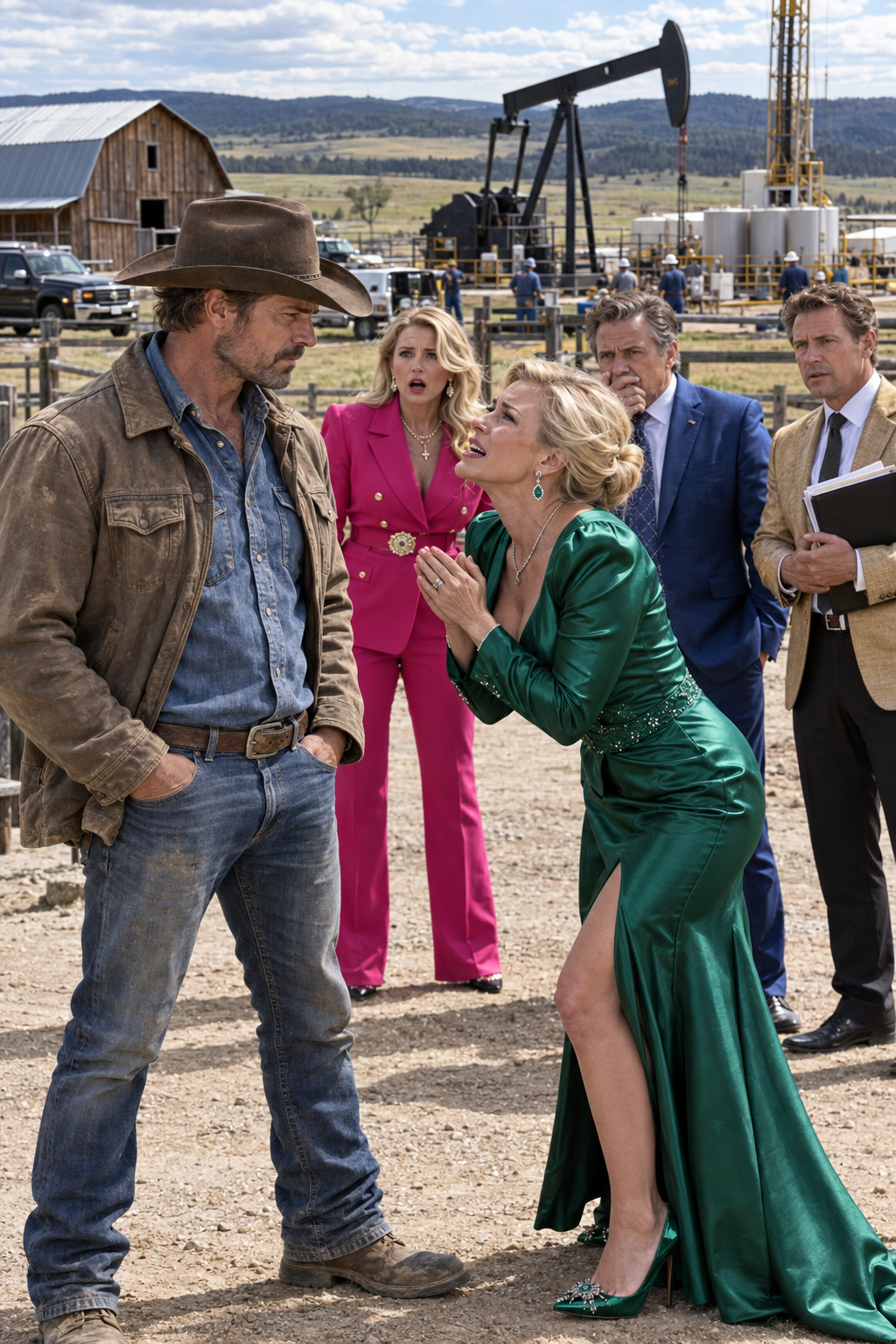
Karen Called My Ranch Worthless and Ordered Me to Sell—Then Oil Was Found Beneath It, and Her Real Plan Began to Unravel
“Your father left you nine hundred and eighty acres of absolutely worthless dirt,” Karen Bellamy announced into the microphone. “Sell it before the county takes it away from you.”
Sixty-three homeowners laughed.
My seventeen-year-old daughter was sitting beside me when Karen leaned forward, smiled like a woman delivering a charitable favor, and added, “Some families just don’t know when to stop pretending they’re important.”
I didn’t raise my voice.
I didn’t slam my hands against the table.
I didn’t tell Karen what I’d discovered three days earlier, or why a petroleum geologist from Houston had called me twice that morning.
I simply turned the manila envelope in my lap so the label faced down.
Inside was a preliminary geological report.
Under my supposedly worthless ranch was a potentially valuable oil formation.
And Karen Bellamy was about to discover that she’d spent eighteen months trying to steal the cheapest piece of land in West Texas from the one woman who could afford to let her make every mistake first.
But that’s not where the trouble started.
It started with a white envelope taped to my front gate.
And a sentence that made my blood go cold.
She said my fences were an eyesore.
She said my cattle lowered neighborhood property values.
She said my father’s land belonged to a better class of people.
She said my daughter deserved a real home instead of an aging ranch house.
She said I should be grateful someone was willing to take the property off my hands.
Five insults.
Five carefully chosen ways to make me feel small.
And one enormous mistake.
Because Karen thought I was a desperate woman trying to hold on to the past.
She had no idea I was already planning for the future.
My name is Harper Quinn.
I’m forty-two years old, and I own Red Mesa Ranch, nine hundred and eighty acres of caliche roads, mesquite, scrub grass, cattle pasture, and stubborn West Texas dirt about twenty minutes west of Midland.
My family had worked that property for three generations.
My grandfather bought the first section after coming home from Korea. My father gradually acquired the surrounding acreage, one difficult mortgage payment at a time.
We weren’t rich.
We weren’t famous.
And despite living in a part of Texas where oil money had built entire neighborhoods, my father never struck it lucky.
He raised cattle, repaired fences, sold hay when the weather cooperated, and kept a little black notebook where he recorded every dollar the ranch brought in.
By the time I inherited the property, the house needed new plumbing, the west pasture needed fencing, and the barn roof had more patches than original metal.
But everything was paid for.
Including the land.
And, as my father had made me promise never to forget, the mineral rights beneath it.
I was thirty-eight when he died.
My daughter, Sophie, was thirteen.
The night before his funeral, I sat at the kitchen table reading his handwritten instructions.
Most of them were ordinary.
Keep the north stock tank repaired.
Don’t trust contractors who quote prices without looking at the job.
Replace the barn’s electrical panel before winter.
Then, on the final page, he’d written something different.
“Harper, don’t ever sell what you don’t understand. The surface feeds us. What lies underneath belongs to the future.”
I’d assumed he was repeating the same advice he’d given me since childhood.
Land was valuable because it couldn’t be manufactured.
A ranch wasn’t just an address.
It was freedom.
That was what I believed.
Until Karen Bellamy moved into the neighborhood beside us.
Coyote Ridge Estates had been built on land that once belonged to a struggling cotton farmer.
At first, it was advertised as a peaceful country development for families who wanted acreage without the responsibility of running a ranch.
The lots were large.
The houses were expensive.
And the entrance had two fake stone towers decorated with wrought-iron coyotes.
Within six years, sixty-three custom homes stood where cotton rows had once stretched toward the highway.
Some had swimming pools.
Some had elaborate outdoor kitchens.
Three had artificial waterfalls, which always struck me as an interesting use of water in West Texas.
I didn’t mind the development.
People had a right to enjoy their property.
I only expected them to respect mine.
Then Karen became president of the homeowners association.
She was fifty-six, always perfectly dressed, and drove a pearl-white Mercedes SUV that looked as though it had never encountered an unpaved road.
She wore expensive sunglasses, large diamond earrings, and a smile that never reached her eyes.
Her husband, Grant, owned a regional construction company.
They lived in the largest house in Coyote Ridge, a limestone mansion with a circular driveway and landscaping that required two maintenance crews.
Karen liked to introduce herself as someone who “protected community standards.”
What she actually protected was her authority.
Within her first year as HOA president, she fined a retired teacher for planting the wrong variety of tree.
She ordered another family to remove a basketball hoop because it was visible from the street.
She spent eleven thousand dollars of association money replacing a perfectly good entrance sign because she disliked the lettering.
And then she turned her attention to my ranch.
Our properties shared nearly a mile of boundary.
Her neighborhood ended at a decorative stone wall.
My pasture began on the other side.
For years, cattle grazed there without anybody paying much attention.
Then one afternoon, I found Karen standing by my gate, photographing my barn.
“Can I help you?” I asked.
She lowered her phone.
“Harper, isn’t it?”
“That’s right.”
“I’m Karen Bellamy. President of Coyote Ridge.”
“I know who you are.”
Her smile tightened.
“Well, I hope you understand that we’re trying to maintain a certain aesthetic here.”
I glanced at my barn.
It had stood there since 1972.
“What aesthetic would that be?”
“Clean. Modern. Prosperous.”
She emphasized the last word.
I looked at her Mercedes.
Then at the cattle.
Then back at her.
“My cows haven’t complained.”
She didn’t laugh.
Instead, she informed me that several homeowners had expressed concerns about the appearance of my property.
There were rusted fence posts.
An aging water tank.
Equipment visible from the road.
And, apparently, the smell of cattle offended people who had deliberately purchased homes beside a working ranch.
“Perhaps,” Karen suggested, “you should consider selling.”
I folded my arms.
“Perhaps your homeowners should consider curtains.”
That was our first conversation.
It was also the last peaceful one.
Two weeks later, Karen sent me a formal-looking letter demanding that I remove the livestock from my eastern pasture.
The document cited three HOA regulations.
None applied to my property.
I knew because I’d checked the recorded subdivision boundaries when Coyote Ridge was originally developed.
My ranch was never part of their association.
No deed restriction connected us.
No annexation agreement existed.
Karen had no authority over a single blade of grass on my side of the fence.
I sent the letter to my attorney, Tessa Moreno.
Tessa had been my closest friend since high school.
She’d become a real estate attorney in Midland, built a successful practice, and developed a habit of smiling whenever somebody handed her a legally ridiculous document.
She read Karen’s letter.
Then she laughed.
“Harper, she might as well demand that you repaint the moon.”
“Can you make her stop?”
“I can tell her to stop.”
“Is that different?”
“Unfortunately.”
Tessa sent a response explaining that Coyote Ridge had no jurisdiction over Red Mesa Ranch.
She included the county property records, the subdivision plat, and a polite warning that further interference could create legal liability.
Karen didn’t respond.
For almost a month, everything was quiet.
Then the offers began.
The first came from a company called Mesa Vista Holdings.
Six hundred thousand dollars.
For all nine hundred and eighty acres.
Including mineral rights.
I read the offer twice.
Land prices in our area varied widely, but that number was insultingly low even before accounting for the house, equipment, improvements, and whatever minerals might be beneath us.
The letter claimed the ranch had “significant environmental and infrastructure disadvantages.”
It said the offer would expire in ten days.
I threw it into the kitchen drawer.
Three days later, someone called from the same company.
“Miss Quinn, we understand you’re facing financial pressure.”
“Who told you that?”
“We’re simply familiar with the challenges of agricultural property.”
“I’m not selling.”
“We could increase our offer slightly.”
“Then increase it on somebody else’s land.”
A week later, a second letter arrived.
Seven hundred thousand.
Still including all mineral rights.
I rejected that one too.
Then came an offer of seven hundred and fifty thousand, provided I signed a confidentiality agreement and closed within thirty days.
That was when I started paying attention.
Not because the money tempted me.
Because desperate buyers rarely admitted how desperate they were.
Something about the offers felt wrong.
And the more I thought about it, the more peculiar Karen’s behavior became.
She was no longer complaining about my barn.
She was trying to convince the entire neighborhood that my ranch was a public nuisance.
She raised concerns about dust.
Then drainage.
Then fire access.
One homeowner told me Karen had circulated a petition describing my eastern pasture as an “undeveloped hazard corridor.”
I asked Tessa what that meant.
“Nothing official,” she said. “But it sounds impressive if you say it fast.”
Then came the HOA meeting.
The one where Karen publicly called my father’s ranch worthless.
I’d only attended because three homeowners had asked me to explain the boundary issue directly.
Sophie insisted on coming.
“I want to see what she says when you show everybody the property map,” my daughter told me.
I almost refused.
Sophie already had enough on her mind.
She was applying to colleges, working weekends at a veterinary clinic, and trying to decide whether she wanted to study agricultural science or engineering.
But she’d grown up on Red Mesa.
She deserved to understand what was happening to her home.
So we went.
Karen opened the meeting with a presentation.
She’d prepared slides showing photographs of our barn, cattle pens, equipment shed, and the old windmill near the county road.
Under each photograph was a phrase.
DECLINING LAND QUALITY.
SAFETY CONCERN.
COMMUNITY EXPOSURE.
POTENTIAL LIABILITY.
I watched Sophie grip her chair.
“Mom,” she whispered, “she took those pictures from inside our fence.”
I looked more closely.
She was right.
One photograph showed the rear of the equipment shed.
The only way to take it was from my property.
I quietly photographed the screen.
Karen continued.
“Unfortunately, certain neighboring owners refuse to recognize how their decisions affect everyone else.”
A few residents nodded.
Then she looked directly at me.
“And while we sympathize with sentimental attachments, sentiment doesn’t increase real estate value.”
That was when she made the comment about my father.
The room laughed.
Sophie looked at me.
I put a hand over hers.
“Let her finish,” I whispered.
Karen mistook my silence for surrender.
She announced that Mesa Vista Holdings had approached the association about coordinating a land improvement project.
If my ranch were sold, she said, the property could potentially become an upscale equestrian development, with access roads and recreational facilities benefiting Coyote Ridge.
“Everyone wins,” Karen declared.
I raised my hand.
She looked annoyed.
“Yes, Harper?”
“Who’s the owner of Mesa Vista Holdings?”
Her smile flickered.
“An independent investment group.”
“Which investors?”
“I don’t believe that’s relevant.”
“You’re recommending that I sell my property to them in a public meeting. Seems relevant to me.”
The room became quieter.
Karen adjusted the microphone.
“The details are confidential.”
“Then why are we discussing my land?”
A man in the third row coughed.
Karen’s cheeks reddened.
She said the discussion concerned the association’s long-term planning.
I asked whether the association had voted to acquire property outside its boundaries.
She said no.
I asked whether the county had declared my ranch a nuisance.
She said no.
I asked whether anybody present had seen an actual government condemnation order.
Then I stood.
“For the record, Red Mesa Ranch is not for sale. Your association has no authority over my property. And anybody entering my land without permission will be treated as a trespasser.”
Karen laughed into the microphone.
“Well, I suppose stubbornness runs in the family.”
Sophie stood beside me.
Her voice was steady.
“So does ownership.”
That got a much bigger reaction than Karen expected.
Someone in the back clapped.
A woman near the aisle whispered, “Good for her.”
And for the first time that evening, Karen lost control of the room.
Only for a few seconds.
But I noticed.
So did she.
On our way out, she followed us into the parking lot.
She approached with Grant beside her.
Up close, her husband looked less polished than his wife. His jaw was square, his hands rough, and there was something watchful about his expression.
“Don’t take the meeting personally,” Karen said.
“You discussed my property in front of sixty-three households. I think personally is the appropriate way to take it.”
Grant stepped closer.
“Look, we can make a deal that benefits everybody.”
“I’ve already given my answer.”
He glanced toward Sophie.
“College is expensive. So is keeping an old ranch running.”
Something cold settled in my stomach.
He’d been asking questions about my daughter.
Karen smiled.
“Your father might have enjoyed playing cowboy, Harper, but the world’s moved on.”
I looked directly at her.
“Then you shouldn’t have any trouble moving on without my land.”
We walked to my truck.
Sophie didn’t speak until I’d started the engine.
“Are we in trouble?”
I glanced at her.
“Then why do they keep acting like they’re going to take the ranch?”
I watched Karen and Grant cross the parking lot together.
“Because,” I said, “they think we have something they can get cheaply.”
Sophie looked back at the building.
“What do we have?”
At that exact moment, my phone vibrated.
A message from Julian Price.
The petroleum landman who’d been trying to reach me for two weeks.
His message contained only eleven words.
“Harper, please don’t sign anything until we’ve spoken. This is important.”
I didn’t know it yet.
But the answer to Sophie’s question was buried more than two miles beneath our boots.
And someone besides Julian already knew it was there.
I waited until we were home before returning Julian’s call.
Not because I wasn’t curious.
Because I wanted to hear what he had to say while sitting at my father’s kitchen table, with the property files spread out in front of me.
Julian answered on the second ring.
“Miss Quinn?”
“Harper is fine.”
“Thank you for calling. I’ve been hoping we’d connect.”
His voice was polite, but there was a strain underneath it.
He worked for Morrow Creek Energy, a privately held exploration company based in Houston.
Three weeks earlier, he’d requested permission to review some historical geological information related to Red Mesa Ranch.
At first, I’d assumed he was just another landman trying to buy mineral rights.
But then an independent geologist I’d hired to review my father’s old records had delivered a preliminary report that made me reconsider.
Julian cleared his throat.
“I understand you’ve received an independent assessment.”
“Then you know why we’re interested.”
“I know somebody thinks there may be oil beneath my land.”
“That’s a reasonable summary.”
“How much oil?”
“We don’t know yet.”
I appreciated that answer more than he realized.
People trying to sell dreams usually start with enormous numbers.
People with something real tend to be careful.
Julian explained that newer drilling activity in the surrounding area had revealed commercially promising formations at depths that made my ranch particularly interesting.
Seismic interpretations suggested that one productive trend might extend beneath my property.
The company wanted to negotiate an oil and gas lease.
A real one.
Not a purchase of the ranch.
Not a vague development proposal.
A lease covering the mineral interest I owned.
He also wanted to discuss surface access, but only after we established who owned what and agreed on protective terms.
“What are you offering?” I asked.
He gave me a range.
I took out a pen.
“Send it in writing.”
“I’ll do that.”
“And I want a full title examination before we discuss the bonus.”
“Absolutely.”
“Environmental protections. Water testing. Surface damage compensation. Reclamation requirements. Separate access agreements.”
There was a small pause.
Then Julian chuckled.
“You’ve done your homework.”
“My father taught me not to sign what I didn’t understand.”
“Sounds like a smart man.”
Julian hesitated.
“Harper, there’s one other thing.”
“Have you recently received offers to buy your property?”
I looked toward the kitchen drawer.
“Would you mind telling me from whom?”
“Mesa Vista Holdings.”
It lasted just long enough for me to notice.
“I’m not familiar with that entity,” he said carefully.
“Should you be?”
“I can’t speak to another company’s intentions. But please don’t agree to transfer any mineral interest until your attorney has reviewed it.”
That caught my attention.
“Because a buyer may be willing to pay you the value of bare surface land while acquiring minerals that could be worth substantially more.”
I looked at my father’s notebook.
Then at the envelope containing the geological assessment.
“How much more?”
“We need data before putting a number on that.”
“Give me an honest guess.”
“I’d rather give you an honest contract.”
I liked Julian more with every answer.
We arranged a meeting for the following Tuesday.
After hanging up, I stood in the kitchen for a long time.
The house was quiet.
Sophie had gone upstairs.
Through the window above the sink, I could see the barn light glowing across the yard.
My father had installed that light himself.
He’d climbed a ladder with a bad knee, ignored my mother’s protests, and spent half a Saturday trying to make the wiring cooperate.
I remembered holding the ladder while he worked.
“Every place needs somebody willing to see its possibilities,” he’d told me.
At the time, he was talking about a barn.
Now I wondered whether he’d known something about the ground beneath it.
The next morning, I called Tessa.
“How would you feel about learning oil and gas law?”
She went quiet.
Then she said, “Harper, what have you done?”
“That sounds suspiciously like the beginning of something expensive.”
“I think we need a mineral title specialist.”
Another pause.
Then a single word.
“Possibly.”
Tessa exhaled.
“Do not tell Karen.”
“Wasn’t planning to.”
“And don’t tell anyone else until we’ve established exactly what you own.”
We hired a mineral title attorney in Midland named Robert Keene.
Robert was sixty-one, wore cowboy boots with every suit, and had spent thirty-five years untangling oilfield ownership records.
He arrived at my house carrying two briefcases and a thick folder.
He’d already spent several days tracing the title.
My grandfather had bought the original acreage in 1959.
Over the following decades, he’d added adjacent parcels.
Some had complicated histories.
One had an old easement.
Another had once been subject to a mineral lease that expired before my father inherited it.
But Robert’s conclusion was clear.
The family had preserved ownership of the minerals under the entire ranch.
There were no active leases burdening my mineral interest.
No known outstanding mineral reservations.
No recorded transfer to a third party.
And nothing in the Coyote Ridge development documents gave its HOA any interest in my property.
Robert placed a marked copy of the title report on the table.
“Your father was careful.”
“Careful was his favorite way to be.”
Robert turned another page.
“Most landowners sell off portions of their mineral estate over generations. Your family didn’t.”
“Does that make a difference?”
“A very significant difference if this prospect turns into production.”
Sophie, who’d been pretending to do homework at the other end of the table, looked up.
“Does this mean we’re rich?”
Robert smiled.
“It means your mother owns something worth investigating. There’s a difference.”
I was grateful he said it.
Oil prospects fail.
Wells produce less than expected.
Prices change.
Drilling costs can swallow fortunes.
I wasn’t about to spend money I hadn’t earned.
But I was finally beginning to understand why Mesa Vista Holdings had been so determined to buy my ranch outright.
The real question was how they’d learned about its potential.
Two days later, I found another envelope at the front gate.
This one carried the Coyote Ridge HOA seal.
Inside was a “Notice of Required Landowner Cooperation.”
Karen demanded that I grant the association permission to enter my eastern pasture to conduct a drainage assessment.
She claimed the assessment was necessary to protect neighboring homes.
The letter gave me forty-eight hours to comply.
Failure, it said, could result in “administrative enforcement and recovery of associated costs.”
I forwarded it to Tessa.
Her response arrived nine minutes later.
“She’s getting creative.”
Tessa sent Karen another formal letter.
No entry without consent.
No HOA jurisdiction.
No authority to assess fines.
And no right to conduct surveys or inspections on Red Mesa Ranch.
That should have been enough.
The following Saturday, I drove toward the north pasture and found three men standing beside my fence.
One held surveying equipment.
Another was placing a wooden stake into the ground.
The third was photographing the boundary.
A silver pickup with the words BELLAMY CONSTRUCTION sat on the county road.
I stopped my truck.
“What are you doing?”
A young man wearing a safety vest looked startled.
“We’re establishing reference points.”
“On whose authority?”
He checked a clipboard.
“Mesa Vista development planning.”
I stepped out.
“You’re on private property.”
The older man looked toward the road.
“We were told this was part of the proposed development site.”
“Proposed by whom?”
“That’s above my pay grade, ma’am.”
I took photographs of the truck, equipment, and survey stakes.
Then I pointed to the fence line.
“This is Red Mesa Ranch. Nobody has permission to be here. Pack up and leave.”
The men exchanged glances.
The older one apologized.
Five minutes later, they were gone.
I called Tessa from the truck.
Then I called the county sheriff’s office to document the trespass.
Deputy Miguel Santos arrived later that afternoon.
He walked the fence with me, examined the photographs, and listened without interrupting.
“Did you give Bellamy Construction permission to survey?” he asked.
“Did you give Mesa Vista permission?”
He wrote in his notebook.
“Do you want them warned?”
“I want a record that they were here.”
He looked at me.
“That’s usually a good place to start.”
The next day, Karen called.
I let it go to voicemail.
“Harper, this is Karen. I understand you were unnecessarily rude to some professionals doing preliminary work for the neighborhood. Really, there’s no reason to create hostility. We’re all trying to improve the community.”
I saved the recording.
Then I forwarded it to Tessa.
A few minutes later, Tessa called.
“Please tell me you haven’t deleted that voicemail.”
“Good. Because she just acknowledged knowing why those men were there.”
A small victory.
But victories mattered.
Especially when someone expected you to be too intimidated to collect them.
Over the next three weeks, Karen’s campaign grew uglier.
Someone submitted an anonymous complaint to the county about my cattle pens.
An inspector visited.
He checked the drainage, looked at the livestock areas, and found no violation.
Someone reported abandoned equipment on my property.
Another inspector came.
The equipment was operational, registered where required, and stored legally.
Someone complained about a possible health hazard from my stock tank.
The county environmental office requested information.
I provided recent water test results.
Nothing came of it.
Each complaint cost me time.
Each inspection disrupted work.
But each one also produced another official record.
I kept them all.
Photographs.
The black notebook my father had used for cattle expenses became the model for a new binder.
Only this one had a different title.
Sophie printed the label herself.
“That’s kind of ominous, Mom.”
“Documentation usually is.”
She grinned.
Then she went back to feeding her dog.
I thought we were managing the situation.
Until the morning Karen’s people blocked our driveway.
I was taking Sophie to school.
A large construction truck sat across the entrance to Red Mesa Ranch, its tires planted in the shallow ditch on either side of the gate.
Two orange cones stood beside it.
A contractor was unloading metal barricades.
My daughter stared through the windshield.
“Are you kidding me?”
I stopped fifty feet away.
The truck was positioned on the county-maintained road, directly across our driveway.
The contractor approached.
“Morning, ma’am. We’re closing this access temporarily.”
“Under whose permit?”
“Road safety improvements.”
“May I see it?”
He looked toward a clipboard.
Then toward a man in a white pickup parked farther down the road.
I recognized that pickup.
Grant Bellamy.
He climbed out and walked toward me.
“Harper, we’re going to need a little cooperation.”
“Move your truck.”
“Crews are evaluating road conditions.”
“Then evaluate them without blocking my driveway.”
Grant smiled.
“Look, this would all be easier if you’d stop fighting progress.”
I held out my hand.
He stared at me.
“The county authorization to close access to my property.”
He said he didn’t have it with him.
I asked for the contractor’s company name.
Then I called county road maintenance on speakerphone.
The woman who answered checked the address.
“No authorized closure scheduled there,” she said.
I asked whether a private developer could block access without county approval.
“No, ma’am.”
I thanked her.
Then I called Deputy Santos.
Grant’s smile disappeared.
“You really want to turn this into a police matter?”
“No,” I said. “I want to take my daughter to school.”
The contractor began moving the barricades before the deputy arrived.
Grant shouted something at him.
The man ignored it.
I stood beside my truck, phone still recording.
When Deputy Santos pulled up, he found the construction truck halfway through clearing the road.
Grant tried to explain that there’d been a misunderstanding.
The deputy asked who’d authorized the closure.
Nobody answered.
Then the deputy looked at Grant.
“Sir, you cannot obstruct a property owner’s access on a county road because you’re negotiating a land purchase.”
Grant’s neck turned red.
“We’re not negotiating anything.”
“Then there’s even less reason for this truck to be here.”
Sophie turned away so Grant wouldn’t see her smile.
We reached school twenty-three minutes late.
I walked my daughter to the entrance.
Before she went inside, she hugged me.
“Grandpa would’ve loved that.”
I kissed the top of her head.
“He would’ve told me I should’ve brought coffee.”
She laughed.
But as I drove back toward the ranch, my phone rang.
Julian Price.
“We’ve completed another round of technical review,” he said.
“I’d like to bring our geologist and reservoir engineer out next week.”
His voice changed.
“Because the numbers are beginning to look better than our original estimates.”
I pulled onto the shoulder.
“What does that mean?”
“It means we’re ready to discuss a substantial lease offer.”
“How substantial?”
He gave me a figure.
I looked out across the flat West Texas landscape.
The cotton fields.
The mesquite.
The oil pumpjacks moving on the horizon.
Then I asked him to repeat it.
Two million, three hundred and fifty-two thousand dollars.
A proposed signing bonus for leasing the mineral interests beneath my ranch.
Plus a negotiated royalty on qualifying future production.
Subject to final title, contract terms, and closing.
I gripped the steering wheel.
For a moment, I couldn’t speak.
My father had spent his whole life worrying about drought, diesel prices, and whether another broken pump would put us behind on bills.
Now a company was discussing more money than he’d ever seen at once.
But there was still no producing well on my ranch.
No guarantee of oil sales.
And no reason to rush.
I took a slow breath.
“Send the proposal to my attorney.”
“Of course.”
“And tell your people we need to talk about the water table before we talk about drilling.”
He laughed softly.
“Harper, I think we’re going to get along.”
Then I sat alone in my truck.
Not crying.
Not cheering.
Just staring at the pasture my father had once described as the hardest piece of ground he’d ever loved.
I finally understood why Karen Bellamy wanted me to believe it was worthless.
And I was beginning to suspect her interest had never been about neighborhood standards at all.
The first serious meeting took place in my kitchen.
Julian arrived with a geologist named Dr. Laura Chen, a reservoir engineer, and two representatives from Morrow Creek Energy.
Robert Keene joined us.
So did Tessa.
My table had never held so many expensive briefcases.
Laura spread several maps across the wood.
One showed the surface of my ranch.
Another showed subsurface structures thousands of feet below it.
The third contained colored geological interpretations that looked like something from a weather forecast.
She pointed to a broad formation running beneath Red Mesa.
“The nearby drilling results suggest potentially productive intervals in this area,” she explained. “Your property sits in a position we’re especially interested in testing.”
“How certain are you?”
“Certain enough to recommend additional investment. Not certain enough to promise production.”
“Good. Keep talking.”
She described the proposed development.
One initial horizontal well, contingent on permitting, financing, and final engineering.
If successful, the company might consider additional wells over time.
I asked about noise.
Truck traffic.
Emergency response.
Groundwater protection.
Surface restoration.
I asked what happened if they drilled and found nothing.
I asked who would remove the equipment.
I asked how long it would take to reclaim the land.
I asked about financial assurance and who would be responsible if the operator sold its interests to another company.
Nobody laughed.
Nobody told me I was asking too many questions.
Laura answered what she could.
When she couldn’t, she wrote the question down.
And for the first time in months, I sat across from people who treated me as the owner of my property instead of an obstacle standing in the way of theirs.
The negotiations took six weeks.
I rejected their first lease form.
Not because the bonus was too low.
Because one clause gave the operator overly broad discretion to use my surface.
Robert identified language that could have permitted facilities far beyond what I’d expected.
We narrowed it.
I demanded a designated access route that avoided the main cattle pasture.
I insisted on baseline water testing.
I required compensation for documented surface damages and restoration obligations tailored to the actual drilling site.
We negotiated a meaningful royalty rate, limitations on certain deductions, and provisions addressing how long unused acreage could remain tied up.
Morrow Creek pushed back.
There were late-night phone calls.
Revised documents.
Redlines covering entire pages.
Once, Julian said we’d reached the company’s limit.
I thanked him for his time.
The following morning, he called back.
There was another compromise available.
I accepted it only after Robert and Tessa approved.
The final bonus remained $2,352,000.
The royalty provision was twenty-four percent under the negotiated lease terms.
Production would determine whether those royalties ever became meaningful.
And nothing in the agreement required me to sell the ranch.
I signed at Tessa’s office on a Thursday afternoon.
Sophie sat beside me.
When the papers were finished, Julian shook my hand.
“Congratulations, Harper.”
I looked down at my father’s name in the old title documents.
For decades, he’d refused offers from people who wanted the mineral rights for almost nothing.
People had called him stubborn.
People had called him unrealistic.
People had told him the land would never amount to anything.
I wished he could have seen that moment.
Instead, I quietly folded a copy of the closing statement and slipped it into my purse.
I wasn’t planning to buy a new house.
Or a sports car.
Or anything with marble floors.
I paid the remaining balance on a ranch equipment note.
I set aside money for taxes.
I established college funds and emergency reserves with professional advice.
Then I approved repairs to the cattle water system.
The first purchase I made for myself was a new coffee maker.
My old one had been leaking for four years.
Sophie stared at the box when I brought it home.
“Seriously, Mom?”
“You just signed a multimillion-dollar lease.”
“And now we can make coffee without putting a towel under the counter.”
She shook her head.
“You’re impossible.”
“Runs in the family.”
For eleven beautiful days, Karen didn’t contact me.
Then a local business website published a short article about Morrow Creek Energy expanding its exploration position west of Midland.
Red Mesa wasn’t mentioned.
Neither was I.
But drilling permit activity and land records were becoming visible to people who knew where to look.
And Karen knew where to look.
The following morning, she appeared at my gate.
No appointment.
Just her pearl-white Mercedes idling beside my cattle guard.
She was wearing a bright cream-colored pantsuit and the expression of a woman who’d spent the drive rehearsing a pleasant conversation.
I walked toward her from the barn.
“Harper. You look well.”
“Thank you.”
“I thought we should talk.”
“We’ve done a lot of that.”
She laughed too loudly.
“Oh, don’t be difficult. I think we’ve both allowed a few misunderstandings to get out of hand.”
I watched her remove her sunglasses.
“I heard you’ve been speaking with some energy companies.”
“Have you?”
“Grant has contacts in that industry.”
“I’m sure he does.”
“Apparently there’s been some interest in your property.”
“Apparently.”
She studied my face.
I could almost hear the calculations.
Then she changed her voice.
Softened it.
“We’ve always wanted what’s best for this community, Harper. And if there’s a genuine business opportunity here, I think we should explore it together.”
I rested one hand on the gate.
“Together how?”
“A partnership.”
“What would your contribution be?”
She blinked.
“Well, connections. Development expertise. Community relations.”
“Which company?”
“Would the partnership be with you personally? Bellamy Construction? Mesa Vista Holdings?”
The color drained from her face so quickly I almost felt sorry for her.
“I don’t know what you mean.”
“Then there’s probably nothing to discuss.”
She stepped closer.
“Harper, don’t let past disagreements cloud your judgment.”
“You may be sitting on something valuable, but people like you need people like us to manage opportunities of this size.”
There it was again.
People like you.
I looked at her immaculate cream-colored suit.
Then at the sunburn on my forearms.
“Karen, I’ve been managing this property since before your subdivision existed.”
“Managing cattle isn’t the same as managing oil.”
“Fortunately, oil companies employ people who understand oil.”
Her mouth tightened.
“You’re making a mistake.”
“That seems to be a popular prediction.”
I opened the gate.
“Have a good afternoon.”
She didn’t leave immediately.
Instead, she watched me walk away.
And I could feel the hostility returning.
Three days later, Grant Bellamy appeared at a public county meeting and objected to a proposed drilling-related access arrangement.
He claimed increased traffic would endanger residents of Coyote Ridge.
That might have been a legitimate concern if the proposed access route had gone through his neighborhood.
Morrow Creek had selected an approach from a different county road on the western side of my ranch.
No oilfield traffic needed to pass through Coyote Ridge.
No homeowners needed to open their gates.
Their streets weren’t part of the proposal.
Grant knew that.
But he stood in front of the county officials and spoke for almost eight minutes about the danger to neighborhood children.
When he finished, I raised my hand.
The official conducting the meeting recognized me.
“Miss Quinn?”
“Could the applicant display the proposed access map?”
Laura Chen, who was sitting with the Morrow Creek representatives, provided it.
The map appeared on the screen.
The proposed entrance was nearly two miles from the nearest Coyote Ridge residence.
I pointed to it.
“That’s the only access route being requested for the initial well site.”
The official nodded.
“That appears consistent with the submitted materials.”
I turned toward Grant.
“Can you identify which HOA street you believe the drilling traffic will use?”
Grant stared at the map.
He opened his mouth.
Then said he was concerned about “broader future impacts.”
“Those concerns can be addressed if future proposals are made,” the official replied.
Someone in the audience snickered.
Grant sat down.
Another small victory.
But this one had witnesses.
A week later, a woman named Denise Porter called me.
She was sixty-nine and lived in Coyote Ridge with her husband, a retired firefighter.
We’d spoken a few times when she’d stopped along the road to admire my horses.
“I hope I’m not bothering you,” she said.
“Not at all.”
“Harper, I think you should know something.”
Her voice was uncharacteristically nervous.
“Karen’s been telling homeowners that you’re planning to put drilling equipment next to the subdivision.”
“That isn’t true.”
“I suspected as much.”
She hesitated.
“She’s also asking the board to approve emergency legal spending.”
“For what?”
“She says the HOA has to protect itself from your development.”
I nearly laughed.
My development.
As though keeping my ranch while leasing underground minerals were an attack against sixty-three homeowners.
“How much is she asking for?”
“Fifty thousand dollars.”
My expression changed.
“Fifty thousand?”
“From our reserve account.”
“Has the board approved it?”
“Not yet. There’s a special meeting next Monday.”
I thanked her.
Then I called Tessa.
By Monday evening, thirty-four homeowners had received copies of the publicly available access proposal.
Several were angry.
Denise later told me the meeting became the first open challenge to Karen’s presidency.
One resident asked why association funds were needed to litigate a dispute over land outside the neighborhood.
Another asked whether the board had consulted independent counsel.
A third wanted to know whether Grant’s construction business had any financial interest in the proposed development beside the subdivision.
Karen called the questions inappropriate.
That made everything worse.
The board postponed the legal spending vote.
The following morning, I received a text from Denise.
“She lost. 4-3. No HOA money for lawyers.”
I smiled so widely that Sophie noticed from across the breakfast table.
“What happened?”
“Karen just found out a homeowners association has actual homeowners.”
Sophie grinned.
“Grandpa would’ve called that a learning opportunity.”
“He would’ve used stronger language.”
We laughed.
For a moment, the pressure of the past several months lifted.
But Karen wasn’t finished.
And beneath the humor, I was starting to understand something important.
Karen hadn’t merely assumed I was poor.
She’d built an entire strategy around that assumption.
She believed I would panic under public criticism.
She believed I would sell under financial pressure.
She believed repeated complaints would wear me down.
She believed I’d never spend the money necessary to defend myself.
What she hadn’t counted on was that my father had taught me to keep records.
And that I had inherited his patience along with his land.
The drilling permit was approved after the required reviews and procedures.
Morrow Creek began preparing the initial well site.
The first morning the equipment arrived, I stood beside the west pasture with Sophie and watched trucks roll through the designated entrance.
They moved slowly.
There were no crowds.
No television cameras.
No dramatic eruption of oil from the ground.
Just workers in hard hats, heavy equipment, and the steady business of preparing to drill thousands of feet beneath the surface.
Sophie leaned against the truck.
“Does it feel different?”
“Owning the ranch now.”
I thought about it.
The same wind moved across the grass.
The same fence posts leaned near the stock tank.
The same red dust covered my boots.
“No,” I said. “That’s the strange part.”
“It’s still home.”
She smiled.
Then her phone vibrated.
A message from a classmate.
Sophie read it.
Her expression changed.
“What is it?” I asked.
She turned the screen toward me.
It was a post shared in a Coyote Ridge neighborhood group.
Karen had written that Red Mesa Ranch was under investigation for “potentially hazardous industrial activity.”
She warned families to be alert for environmental risks.
The post didn’t claim a specific violation.
It didn’t have to.
The implication was enough.
Beneath it, several people were asking whether their water would be contaminated.
Whether their homes would become unsafe.
Whether property values would collapse.
I read the comments.
Then I took out my phone.
I wrote a short factual statement.
The drilling project was subject to applicable state rules and permits.
The planned access did not use the subdivision roads.
Baseline water testing had been performed, and additional monitoring requirements were included in my private agreements.
Any resident with concerns could review public permit information or contact the appropriate regulator.
I attached the publicly available site map.
Nothing more.
No insults.
No accusations.
No reference to Karen.
Within an hour, Denise shared it.
By dinner, several residents had thanked me.
By the next morning, people were asking why Karen hadn’t provided the same information.
She deleted her original post.
But Sophie had already saved screenshots.
Of course she had.
She was my daughter.
Three months later, Morrow Creek completed the initial drilling and testing program.
The project had encountered delays.
There’d been mechanical problems.
An equipment replacement.
Two weather interruptions.
At one point, Laura told me the results were still uncertain.
I prepared myself for disappointment.
If the well failed, the ranch would remain ours.
We could still raise cattle.
Sophie could still go to college.
And the bonus money, invested carefully, would give our family security my father had never enjoyed.
That was enough.
Then, on a Tuesday morning, Julian called.
His voice was different.
Not excited exactly.
More like a man trying very hard to remain professional.
“Harper, are you sitting down?”
I was standing beside the kitchen sink.
“Should I be?”
“We’ve completed the initial production testing.”
I gripped the counter.
“The well is producing oil.”
For several seconds, I heard nothing but the refrigerator humming behind me.
“Commercially?”
“The initial results are encouraging enough that we’re preparing for ongoing production, subject to the remaining work. Early test rates have been strong, though they aren’t a guarantee of sustained output.”
“How strong?”
He gave me the preliminary rate.
Over seven hundred barrels of oil per day during a twenty-four-hour test interval, with the usual qualifications about early well performance.
I didn’t understand every technical detail.
But I understood what he said next.
“We think this could be a very successful well, Harper.”
I lowered myself into my father’s old wooden chair.
For the first time since the lease negotiations began, I allowed myself to imagine the possibility.
Not just a signing bonus.
Not just financial stability.
Actual production from the mineral estate my family had protected for decades.
“Are you sure?”
“We’re sure there’s oil. What we don’t know yet is how much the well will ultimately recover.”
I pressed my free hand against the table.
My father’s notebook was still in the drawer beneath it.
“Thank you for calling.”
After we hung up, I sat quietly.
Then I walked outside.
The sky was pale blue.
A tractor rattled near the barn.
Our oldest mare, Ruby, lifted her head when she saw me.
I leaned against the fence.
“Dad,” I whispered, “you were right.”
The wind carried the words away.
I stayed there until Sophie came looking for me.
When I told her, she stared at me.
Then she started laughing.
Not because it was funny.
Because the news was too enormous to fit into ordinary words.
She threw her arms around my neck.
“Mom! There’s actually oil?”
“There’s actually oil.”
“Under our ranch?”
“Under our ranch.”
She pulled back.
“Does Karen know?”
I looked toward the eastern boundary.
Sophie smiled.
“Can I please be there when she finds out?”
“No, sweetheart.”
“Because some things are more satisfying when you let the truth arrive without an invitation.”
I was wrong about one thing.
Karen didn’t need an invitation.
She found out on her own.
And forty-eight hours later, she came begging.
Karen arrived at the ranch on Thursday afternoon carrying a bottle of champagne.
Not the cheap kind.
A large bottle wrapped in gold foil, tucked into a designer gift bag.
She stood outside my gate with a smile so wide it looked painful.
I’d been expecting her.
News traveled quickly in the oil business, especially when drilling results attracted attention from neighboring mineral owners.
Morrow Creek hadn’t promised me secrecy about information that would eventually appear in regulatory filings.
And I hadn’t tried to hide the fact that drilling had succeeded.
I simply hadn’t called Karen.
She waved when I approached.
“Harper! Congratulations!”
I stopped on my side of the gate.
“Oh, don’t be modest! Everyone’s talking about your little oil discovery.”
There was that word again.
She held up the champagne.
“I thought we should celebrate.”
“That’s thoughtful.”
Her smile grew brighter.
“Well, despite our occasional disagreements, we’ve always been neighbors.”
“And I think this is an opportunity to put the past behind us.”
I looked at the bottle.
“Does the association have a rule about bringing alcohol onto private ranch property?”
She didn’t appreciate that.
Her smile slipped.
Then returned.
“Harper, seriously. There’s no reason for us to be adversaries. Grant and I have been discussing the possibilities, and we believe we could build something extraordinary together.”
“What kind of something?”
“A regional development partnership.”
“Doing what?”
She gestured toward the pasture.
“Supporting your energy operations. Managing future infrastructure. Bringing in investors. Creating a coordinated commercial vision for the surrounding area.”
I tilted my head.
“What exactly would I need investors for?”
Karen hesitated.
“Expansion. Opportunities. Professional management.”
“Professional management of an oil lease that’s already been negotiated by professionals?”
She shifted the champagne bag from one hand to the other.
“You’re looking at this too narrowly.”
“Then explain it to me.”
Her expression tightened.
“We could form a partnership. Grant’s company could provide construction services, and the association could facilitate community cooperation.”
“You’re offering me cooperation from an HOA that has spent eighteen months trying to force me off my land?”
“That’s unfair.”
She took a breath.
“Harper, we’re talking about serious money.”
“Then surely you understand the value of working with established people.”
I almost smiled.
There it was.
The same assumption.
The same condescension.
The same belief that money was something other people should control on my behalf.
“What percentage would you want?” I asked.
Karen’s eyes brightened.
“Well, naturally, we’d need to discuss the structure.”
“Give me a number.”
She paused.
“Twenty percent would be a reasonable starting point.”
I stared at her.
Twenty percent.
Of a business opportunity she hadn’t created.
On land she didn’t own.
For a company she hadn’t helped negotiate with.
I slowly folded my arms.
“And what would you contribute worth twenty percent?”
She looked offended.
“Harper, I just told you. Our relationships, our expertise, our resources.”
“Karen, you couldn’t even get a road closure approved.”
Her cheeks flushed.
“There’s no need to be insulting.”
We looked at each other.
She understood the point.
I let the silence stretch.
Then I said, “No.”
Her smile disappeared.
“Excuse me?”
“No partnership.”
“Don’t be foolish.”
“I’ve thought about it.”
“You can’t possibly know how complicated this industry is.”
“That’s why I hired qualified people.”
“Grant has connections.”
She gripped the champagne bottle.
“Harper, you’re letting your pride get in the way of a tremendous opportunity.”
I leaned against the gate.
“Karen, you called my ranch worthless in front of my daughter.”
She looked away.
“You sent inspectors after me.”
“Those were legitimate concerns.”
“You arranged for surveyors to enter my property.”
“I had nothing to do with—”
“You left a voicemail acknowledging their work.”
She stopped.
“You tried to block my driveway.”
“Grant handled that.”
“You repeatedly claimed your HOA could control land outside its boundaries.”
She said nothing.
“And now you’re standing at my gate, asking for twenty percent of something you insisted had no value.”
Her face hardened.
“Business is business, Harper.”
I pointed toward the county road.
“And my answer is no.”
Karen stared at me for another few seconds.
Then her voice dropped.
“You may regret this.”
“That’s possible.”
“You think a single successful well makes you untouchable?”
“You think these companies are your friends?”
“Then what exactly do you think?”
I looked past her toward the old windmill.
“I think I own my ranch.”
She stepped backward.
For the first time since I’d met her, Karen seemed to have run out of things to say.
Then she returned to her Mercedes.
She put the champagne in the back seat.
And she drove away.
I thought that would be the end of her attempt to become my partner.
That evening, Grant Bellamy called my attorney.
He wanted a confidential meeting.
Tessa refused to discuss anything without knowing the subject.
Grant said it concerned “a mutually beneficial resolution of outstanding property issues.”
Tessa asked him to identify those issues in writing.
He never did.
The next morning, a different lawyer called Robert Keene.
This one represented Mesa Vista Holdings.
He wanted to discuss a joint venture involving Red Mesa’s mineral estate.
Robert asked whether his client had any legal interest in the property.
The lawyer admitted it did not.
Robert asked what Mesa Vista intended to contribute.
The lawyer wouldn’t say.
Robert declined the proposal.
By Monday, another offer arrived.
This one wasn’t for the ranch.
It was for a non-operating economic interest in future royalty revenue.
Mesa Vista proposed paying me a lump sum in exchange for a significant share of the income from my mineral estate.
The offer was complicated.
It used phrases like projected cash flow and risk-adjusted valuation.
But beneath the professional language was a familiar idea.
Give us control of what you own.
We’ll pay you less than it might be worth.
And we’ll make you believe we’re doing you a favor.
I forwarded the document to Robert.
He called me ten minutes later.
“Harper, do you want to sell any of your royalty interest?”
“Good. Because you have no reason to make a rushed decision.”
“Did you notice the company name?”
“Something about Mesa Vista bothers me.”
“Then perhaps we should find out who’s behind it.”
Two days later, Tessa called me into her office.
She had printed documents from the Texas Secretary of State, county records, and several public business filings.
She spread them across her desk.
“Harper, remember when you asked Karen who owned Mesa Vista Holdings?”
“She said it was an independent investment group.”
Tessa tapped the first page.
“Mesa Vista Holdings was organized shortly before it made its first offer on your ranch.”
“The public filings list Grant Bellamy as one of its managing persons.”
I stared at the document.
His name was there.
Plain as day.
GRANT A. BELLAMY.
His business address matched the office used by Bellamy Construction.
Tessa turned another page.
“A related company purchased an option on a neighboring parcel last year. Grant signed the paperwork.”
I felt something settle into place.
The complaints.
The false warnings.
The humiliating meetings.
The constant pressure to sell.
It hadn’t been an overly aggressive HOA president trying to improve her neighborhood.
At least, not entirely.
Karen and Grant had been trying to obtain control of Red Mesa Ranch through a company connected to their own business interests.
And they’d wanted the mineral rights included in every offer.
“They knew,” I whispered.
Tessa looked at me.
“We don’t have proof of exactly what they knew or when. But they certainly had a financial interest they weren’t disclosing when they publicly pushed you to sell.”
I sat back.
Something about that distinction mattered.
Karen hadn’t merely underestimated the value of my ranch.
There was a real possibility she’d known it could be valuable before I did.
And the entire campaign to convince me otherwise might have been intentional.
“Can we prove she concealed the connection?” I asked.
“We can prove the public corporate relationship. We have her statements from the HOA meeting. And we have the purchase offers.”
“Is that enough?”
“Enough to raise serious questions. More evidence would help.”
I thought about the binder at home.
Eighteen months of complaints.
Voicemails.
Survey photographs.
Road access incidents.
Screenshots.
“I think we have more evidence,” I said.
Tessa smiled.
“I was hoping you’d say that.”
We spent the next several days organizing everything.
Not to punish Karen for being rude.
Not to humiliate her.
But to determine whether her actions had crossed legal lines, and to make certain she couldn’t repeat them.
Tessa prepared a demand for records related to the HOA’s spending and decisions, to be pursued through the appropriate legal channels.
Denise Porter and two other homeowners separately requested financial disclosures from the association.
An independent accountant was retained by a group of residents to review information they were entitled to inspect.
Karen objected.
She called it harassment.
She accused residents of disloyalty.
She claimed outsiders were trying to destroy the neighborhood.
But people were no longer accepting her explanations at face value.
Especially after Grant’s connection to Mesa Vista became public.
The neighborhood message group exploded.
Residents asked why their HOA president had pressured a neighboring landowner to sell to a company connected to her husband.
They asked whether association resources had been used to advance private interests.
They asked why Karen had proposed spending fifty thousand dollars fighting my drilling access when the operation didn’t require their roads.
And they asked why she’d repeatedly implied the HOA could punish me when its governing documents plainly said otherwise.
Karen responded with a lengthy statement.
She insisted her husband’s business activities were separate from HOA affairs.
She said she had acted only to protect property values.
She accused me of creating a hostile environment through industrial development.
Then she made one more mistake.
She wrote that she had “never encouraged the sale of Red Mesa Ranch for personal financial gain.”
Denise posted a photograph of the meeting presentation where Karen had promoted Mesa Vista’s proposal.
Another homeowner posted screenshots of Karen’s earlier messages urging residents to support the acquisition.
And Sophie found the original neighborhood announcement describing the proposed redevelopment as a benefit to the community.
People started putting the pieces together.
One homeowner wrote:
“Why were we being used to pressure Harper into selling her property?”
Another asked:
“Who benefits if Mesa Vista gets the ranch?”
The questions multiplied.
Karen stopped responding.
A special meeting was scheduled.
This time, I didn’t attend.
It wasn’t my association.
And I didn’t need to stand in a room watching Karen defend herself.
The homeowners deserved to decide what kind of leadership they wanted.
Denise called me afterward.
Her voice was trembling with excitement.
“Harper, she resigned.”
I was standing in the barn, checking a feed invoice.
“Karen. She resigned as president.”
“Just like that?”
“Not exactly. There was a motion to remove her from the board, and they were preparing a formal vote. She resigned before it happened.”
I sat down on a bale of hay.
Denise laughed.
“You should’ve heard the room.”
“Did Grant attend?”
“How’d he take it?”
“Like a man whose wife had promised him an easy evening.”
I laughed so hard I had to put down my pen.
Denise continued.
“The board has appointed an interim president. They’re hiring independent counsel to review everything. And they voted to send you a written apology.”
“That’s not necessary.”
“Maybe not for you. But it’s necessary for us.”
I was quiet.
Then I thanked her.
Before hanging up, Denise said something I’ll never forget.
“Harper, most of us moved out here because we wanted space and freedom. Somewhere along the way, we let one woman convince us that freedom meant telling everybody else how to live.”
I looked toward the pasture.
“Maybe that’s changing.”
“It already has.”
The written apology arrived five days later.
It acknowledged that the association had no authority over Red Mesa Ranch.
It withdrew its previous demands.
It confirmed that the association would not interfere with my lawful use of the property.
And it expressed regret for the conduct of its former leadership.
I framed it.
Not because I needed the apology on my wall.
Because I wanted Sophie to remember that standing your ground didn’t require becoming cruel.
Sometimes it required nothing more dramatic than knowing your rights and refusing to surrender them.
For the first time in nearly two years, the ranch was quiet.
No threatening letters.
No unauthorized surveys.
No unexpected inspectors.
The cattle grazed.
The drilling operation continued.
The west fence was repaired.
And Sophie received an acceptance letter from the engineering program at a university she’d been dreaming about since freshman year.
We celebrated with pizza on the back porch.
She wanted to know if the oil would change everything.
I told her some things would change.
We could repair the ranch properly.
Build financial security.
Take care of people who’d helped us.
Maybe establish scholarships for local students who wanted to study agriculture, geology, or engineering.
But I also told her that money didn’t excuse us from working hard or treating people decently.
She nodded.
Then she asked whether we could finally replace the old living room couch.
I considered the cushions, which had been flattened by sixteen years of family movie nights and one extremely large dog.
“That,” I said, “may be our next major investment.”
We laughed until Ruby whinnied from the nearby paddock.
For a little while, life felt simple.
Then Karen called again.
It was a Sunday evening.
Her number appeared on my phone while I was washing dishes.
I almost ignored it.
But something made me answer.
Her voice sounded different.
Less polished.
“Please don’t hang up.”
“I’m listening.”
She took a shaky breath.
“I need to speak with you.”
“About what?”
“Business.”
“Harper, please.”
There was something in her voice I’d never heard before.
Not the theatrical outrage she used during HOA meetings.
Not the offended superiority she’d displayed at my gate.
She sounded like someone watching a door close and realizing there was no other exit.
“What’s happened?” I asked.
A long silence.
Then she said, “Grant made some financial commitments.”
“What kind?”
“Investors.”
“Investors in what?”
“Mesa Vista.”
She swallowed.
“We thought the ranch acquisition would go through.”
I stared at the dark window above the sink.
“Who thought that?”
“Grant had people interested in the redevelopment. The land. The potential future income.”
“Did he tell them the ranch was his?”
“No. Not exactly.”
“Harper, I’m trying to explain.”
“Then explain.”
She took another breath.
“Some of the investors believed we had a realistic path to acquiring the property. Grant spent money arranging financing, negotiating other purchases, and preparing plans.”
“Without owning my land?”
“He expected you to accept.”
I said nothing.
She rushed to fill the silence.
“The project has become very complicated. With your energy agreement, the original development plans no longer make sense.”
“I imagine not.”
“We need another arrangement.”
“You’ve already asked.”
“I’m not talking about twenty percent anymore.”
“What are you talking about?”
“Five percent. Or even less. Some consulting arrangement. Something we can show our investors.”
The desperation in her voice was unmistakable.
“Because Grant has obligations.”
“That sounds like a problem for Grant.”
“Harper, if we can’t demonstrate a viable business relationship, we could lose everything.”
I looked at my father’s worn kitchen cabinets.
For years, Karen had treated my family like we were something beneath her.
Now she was asking me to rescue hers.
I didn’t enjoy hearing her frightened.
But I wasn’t going to let sympathy become permission for someone else to control my property.
“Karen, I’m not entering a fake partnership to solve your husband’s financial problems.”
“It wouldn’t be fake.”
“Then tell me what services you’d actually provide.”
She couldn’t answer.
Instead, she began crying.
Quietly at first.
Then harder.
“Please,” she said. “You don’t understand what this could do to us.”
I thought about the night she’d humiliated Sophie in front of the neighborhood.
About the false complaints.
About the construction truck blocking my driveway.
About the champagne she’d brought when she thought she could still get a piece of my future.
“Karen,” I said gently, “when you thought I was going to lose my home, you told me to accept it as progress.”
She didn’t speak.
“I hope you find a lawful way to resolve your financial problems. But it won’t involve my ranch.”
I ended the call.
Then I set my phone on the counter and finished washing the dishes.
I thought that was the last time Karen Bellamy would ever ask me for a partnership.
I was wrong.
Because the following morning, she didn’t call me.
She called my lawyer.
And what happened next made every argument about fences, fines, and HOA authority look like child’s play.
Tessa contacted me at a.m.
“Harper, are you alone?”
I was in the equipment shed.
“Can you come to my office?”
“What’s wrong?”
“I don’t want to discuss this over the phone.”
My stomach tightened.
She hesitated.
“Robert was doing a routine follow-up on the county records. Something new was filed against your mineral estate.”
I stopped walking.
“What kind of filing?”
“A document claiming someone else has a contractual right to acquire an interest in your minerals.”
“Mesa Vista Holdings.”
I stared at the wall.
For a moment, the words made no sense.
“They don’t own anything.”
“I never signed anything with them.”
“I know that too.”
“Then how can they file a claim?”
“Anybody can submit a document for recording if it meets the recording office’s formal requirements. Recording doesn’t make a false claim true.”
I gripped the phone.
“What does it say?”
Tessa went quiet.
Then she said, “Harper, you need to see it.”
Forty minutes later, I was sitting in her office.
Robert Keene was there.
So was another attorney from Tessa’s firm.
Nobody offered coffee.
That frightened me more than anything.
Tessa slid a document across the desk.
Across the top were the words:
MEMORANDUM OF OPTION TO PURCHASE MINERAL INTERESTS.
The filing described Red Mesa Ranch.
All nine hundred and eighty acres.
It claimed that an earlier agreement gave Mesa Vista Holdings the right to acquire a substantial portion of the mineral estate under certain conditions.
The document was recent.
Recorded that very morning.
Attached was a copy of what purported to be the original agreement.
I turned the page.
My hands went cold.
The original agreement supposedly had been executed years before Karen’s first offer.
Before the HOA complaints.
Before the drilling.
Before anyone had publicly announced that Red Mesa might contain commercially valuable oil.
I looked at the signature.
Then at the date.
Then back at the signature.
“Robert,” I whispered, “this can’t be real.”
He nodded slowly.
“We have serious concerns about its authenticity.”
Tessa leaned forward.
“Harper, the document doesn’t automatically give them anything. We can challenge it. But a recorded claim like this can create a title dispute, and we need to act immediately.”
I barely heard her.
Because my eyes were fixed on the final page.
The purported agreement said that Mesa Vista had secured an option over part of my mineral estate in exchange for an advance payment made years earlier.
The payment amount was listed.
One dollar.
One single dollar.
I looked at Tessa.
“Who supposedly signed this?”
She didn’t answer right away.
Then Robert turned the page toward me.
And I saw it.
A familiar name written in slanted blue ink.
Raymond E. Quinn.
For a moment, I couldn’t breathe.
The signature resembled his.
The shape of the R.
The narrow loop in the Q.
The short, decisive line he always used beneath the final letter.
I had seen that signature thousands of times.
On cattle bills.
Tax returns.
Birthday cards.
The deed he’d given me when I inherited the ranch.
“Harper,” Tessa said carefully, “do you recognize the handwriting?”
I swallowed.
“It looks like his.”
Robert nodded.
“That’s what concerns us.”
I turned back to the date.
March 14, 2024.
I stared at it.
Then I looked at the name again.
My father’s name.
My father’s signature.
On a document supposedly granting Karen Bellamy’s company rights to the minerals beneath our family ranch.
I looked up.
She was watching me.
“My father died on September 8, 2022.”
The office went completely silent.
I pushed the document across the desk.
“This was supposedly signed eighteen months after we buried him.”
Robert closed his eyes for a moment.
Tessa reached for her phone.
Then something else caught my attention.
At the bottom of the attached agreement was a notary acknowledgment.
A signature.
And a small, printed line identifying the person who had supposedly witnessed the transaction.
I leaned closer.
The notary’s commission information appeared genuine at first glance.
But the name underneath it wasn’t familiar.
I read it twice.
Then a third time.
“Tessa, who is Evelyn Shaw?”
Robert looked at her.
Tessa’s face changed.
“Evelyn Shaw?”
She pulled the document toward her.
“Yes,” I said. “It says she notarized my father’s signature.”
Tessa stopped moving.
“Evelyn Shaw worked for Bellamy Construction.”
I stared at her.
“She died last year.”
I felt the room tilt.
Tessa was already searching her phone.
Her expression grew more serious.
Then she looked at Robert.
“We need the original notary records.”
Robert nodded.
“And a certified copy of this entire filing.”
My phone vibrated.
An unknown number.
A text message.
I almost ignored it.
Then I saw the photograph attached.
It showed a stack of old survey maps spread across a desk.
On top was a geological report bearing my father’s name.
The document was dated eleven years earlier.
Long before Morrow Creek had contacted me.
Long before Karen became president of Coyote Ridge.
Across the top, someone had written:
CONFIDENTIAL MINERAL PROSPECT — RED MESA RANCH.
The next photograph showed a different page.
It contained my father’s handwriting.
And beside it was another signature.
Grant Bellamy.
I stared at the screen.
Tessa noticed.
Another message appeared.
“Your father knew about the oil. So did Grant Bellamy. Ask Karen what happened the night Raymond refused to sign.”
I couldn’t move.
A third message arrived.
This one contained only six words.
“Check the north pasture before Friday.”
Then a photograph loaded.
It showed my father’s old windmill.
The one beside the abandoned cattle tank.
Except the photograph had been taken at night.
And beside the windmill were three men standing near an open excavation.
One was Grant Bellamy.
Another wore a jacket bearing the logo of a drilling contractor that had gone out of business years earlier.
The third man was holding what looked like a metal storage case.
The timestamp in the corner was from the summer before my father died.
Tessa leaned toward me.
“What is that?”
I enlarged the photograph.
Something white was visible inside the excavation.
A section of pipe.
Not the kind used for cattle water.
Much larger.
Capped with a steel plate.
I remembered my father warning me, not long before his final illness, to leave the old north pasture alone.
He’d said the ground near the abandoned tank wasn’t safe for heavy equipment.
I’d assumed there was an old buried water line or a collapsed maintenance pit.
But now I was looking at a photograph of Grant Bellamy standing beside something my father had never told me about.
Something hidden.
Something that had been opened after dark.
My phone rang.
The same unknown number.
I answered.
For two seconds, there was only breathing.
Then a man’s voice.
“Miss Quinn?”
“Who is this?”
“Someone who worked for Grant Bellamy.”
I looked at Tessa.
She was already reaching for a pen.
“What do you want?”
The man whispered something I couldn’t understand.
Then he spoke clearly.
“Whatever you do, don’t let Morrow Creek drill another well on the north side of your ranch.”
My mouth went dry.
A long silence.
Then he said, “Because your father didn’t refuse to sell the land because he was stubborn.”
“He refused because he knew what Bellamy buried out there.”
A sound came through the phone.
A car door slamming.
The man gasped.
Then he whispered the words that made me forget all about the oil money.
“Harper, listen carefully. If Grant gets back into that excavation before you do, the only evidence of what happened to your father will disappear.”
The call ended.
I stared at the screen.
Across the desk, Tessa had gone pale.
Robert was already dialing someone.
And then my daughter sent me a message.
“Mom, I’m at the north windmill. Somebody has cut the lock on the old gate. There’s a truck here, and I think I just heard someone calling for help underground.”
I grabbed my keys.
But before I reached the office door, Sophie sent one last text.
“Mom, there’s a man down there. He says Grandpa didn’t die the way we were told.”
And then her phone went silent.
✓ Lynn R. Adams
Karen Called My Ranch Worthless and Ordered Me to Sell—Then Oil Was Found Beneath It, and Her Real Plan Began to Unravel “Your father left you nine hundred and eighty acres of absolutely worthless di…