Karen Called Her Break-Ins Routine HOA Inspections — Until My Marine Son Opened the Door and Found What She Was Really Hunting
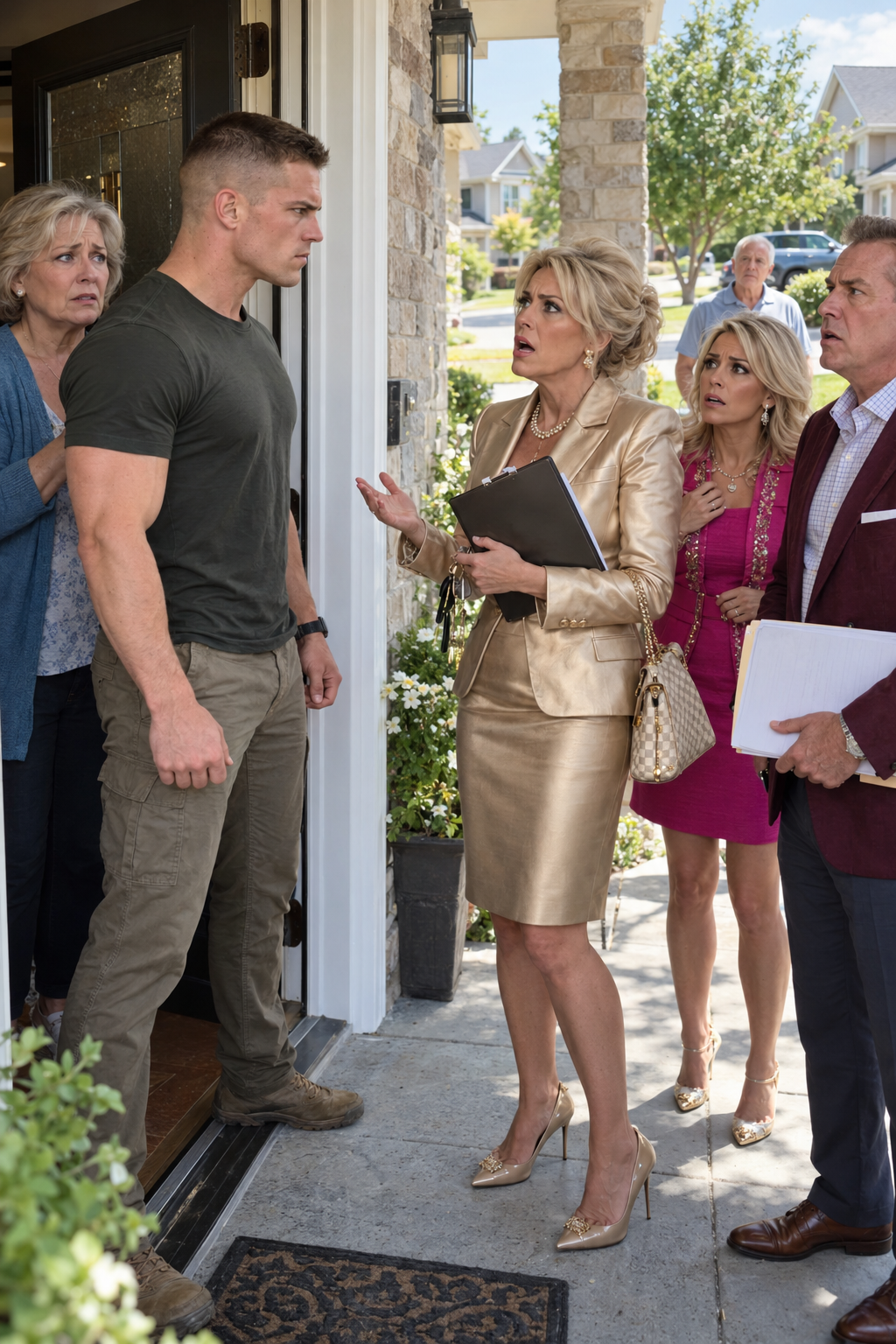
Karen Called Her Break-Ins Routine HOA Inspections — Until My Marine Son Opened the Door and Found What She Was Really Hunting
The first time I caught Karen Whitfield inside my house, she was standing in my dead husband’s office with one hand inside his locked desk.
The second time, she smiled at my security camera and called it a “routine HOA inspection.”
The third time, my son came home from the Marines three days early.
Karen didn’t know that.
And when she used her copied key at on a Tuesday morning, she finally opened the wrong door.
My name is Laura Bennett.
I was fifty-eight years old, widowed, and living alone in Cedar Ridge Estates outside Fredericksburg, Virginia.
At least that was what everyone in the neighborhood believed.
Cedar Ridge looked like the kind of place real-estate agents described with words like prestigious, peaceful, and exclusive.
Stone entrance.
Maple-lined streets.
Two small ponds.
A clubhouse with fake white columns.
Mailboxes that all had to be the exact same shade of black because apparently civilization would collapse if one homeowner used bronze.
Most of the houses were built after 2008.
Mine wasn’t.
My house had been there since 1973, long before anyone invented Cedar Ridge Estates or its homeowners association.
My husband, David, inherited the property from his father.
When developers bought the farmland around us, David allowed one concession.
Our driveway would connect to the subdivision’s main road.
That was it.
We never signed our house into the HOA.
Our deed said so.
Our survey said so.
The county tax map said so.
David used to joke that Cedar Ridge had built itself around us like an expensive pearl necklace around a stubborn old rock.
For thirteen years, nobody cared.
Then Karen Whitfield became HOA president.
Karen was fifty-four, always perfectly dressed, always perfectly highlighted, always wearing sunglasses too expensive for whatever boring Tuesday morning she happened to be ruining.
She drove a white Mercedes SUV.
She chaired every meeting as if Congress had temporarily relocated to the Cedar Ridge clubhouse.
And she had one belief stronger than gravity.
If she could see something from an HOA street, she believed the HOA controlled it.
My garbage cans.
My porch furniture.
My garden fence.
The American flag David had hung beside the garage after our son enlisted.
Even my mailbox.
The first letter arrived six weeks after David died.
NOTICE OF EXTERIOR NONCOMPLIANCE.
I was still sleeping on my side of the bed because I could not bring myself to move his pillow.
And Karen was threatening me with a $150 fine because two hydrangeas were “inconsistent with the approved landscaping palette.”
I put the letter in a kitchen drawer.
The second notice concerned my garage door.
The third concerned my roof.
The fourth informed me that my flag was six inches larger than Cedar Ridge standards permitted.
That one made me laugh.
Not because it was funny.
Because David had served twenty-two years in the Army.
Our son Luke was an active-duty Marine.
And Karen Whitfield had just informed me that my American flag was too American for her subdivision.
I mailed every notice back with the same four words written across the front.
NOT AN HOA PROPERTY.
Karen responded with certified mail.
I responded with a copy of my deed.
That should have ended it.
Instead, it began something worse.
One Thursday afternoon in October, I came home from the grocery store and noticed my front door wasn’t closed all the way.
It rested against the frame with a thin black gap.
I stopped on the walkway.
Two grocery bags were cutting into my fingers.
Nothing outside looked disturbed.
No broken window.
No damaged lock.
No strange vehicle.
I set the groceries down beside my car and called the sheriff’s non-emergency number.
Then I waited.
Deputy Aaron Miller arrived nine minutes later.
He cleared the house before allowing me inside.
Nothing seemed stolen.
Television still there.
Laptop on the kitchen counter.
Jewelry upstairs.
Cash in a ceramic jar.
David’s old service pistol untouched in the gun safe.
But his office door was open.
That door mattered.
After David died, I kept it closed because opening it still felt like walking into a conversation that had stopped in the middle.
His reading glasses were beside the keyboard.
His old legal pads were stacked near the window.
His coffee mug still held three pens.
A yellow sticky note on the lamp had his handwriting on it.
Call Luke Sunday.
I had never removed it.
The bottom drawer of his desk was open.
I knew I had locked it.
Deputy Miller crouched beside the drawer.
“No damage.”
“Who has keys?”
“Anybody else?”
I hesitated.
“My son. But he’s stationed in North Carolina.”
“Cleaning service?”
“Neighbors?”
He checked the doors.
No forced entry.
Then he walked to the back porch.
The lock there showed faint scratches around the cylinder.
Not pry marks.
Something subtler.
“Could be somebody had a key,” he said.
That sentence stayed with me.
Somebody had a key.
The next afternoon Karen knocked on my front door.
She was carrying a blue binder.
I did not invite her in.
“Laura,” she said brightly. “I understand there was some excitement yesterday.”
I looked at her.
“What excitement?”
“Police cars.”
“One deputy.”
“Still concerning.”
“How did you know?”
Her smile never changed.
“People notice things.”
That was Karen’s favorite phrase.
People notice things.
People notice weeds.
People notice paint colors.
People notice cars parked overnight.
People notice when homeowners do not comply.
She opened her binder.
“While I’m here, I wanted to discuss your continued refusal to schedule your annual interior safety inspection.”
I stared at her.
“Interior safety inspection.”
“My home is not in your association.”
“The board’s counsel has a different interpretation.”
“Then your board’s counsel should reread my deed.”
“This isn’t about membership, Laura. It’s about community safety.”
“You have no right to enter my house.”
She sighed as though I were a difficult child.
“We inspect smoke detectors, water shutoffs, electrical modifications, prohibited rentals—”
“The covenants allow emergency access.”
“I am not subject to your covenants.”
“Our master declaration includes all parcels within the development boundary.”
“My property predates the development.”
“We can argue technicalities all day.”
“No. You can argue them from my driveway.”
I closed the door.
The next morning, a violation notice was taped to it.
FAILURE TO PROVIDE ACCESS.
I photographed the notice.
I photographed the tape.
I emailed both to my attorney.
His name was Daniel Ross.
He had handled David’s estate, and he had a talent for becoming very quiet when someone was doing something extremely stupid.
Daniel called me eleven minutes later.
“Laura, don’t pay anything.”
“I wasn’t planning to.”
“Do not let them inside.”
“I wasn’t planning that either.”
“I’m sending Whitfield and their management company a letter today. Certified mail and email.”
“Do you have cameras?”
“Doorbell camera.”
“Add more.”
That afternoon, I bought six.
Front porch.
Back porch.
And one inside David’s office.
Karen came back four days later.
At 10:43 in the morning.
I was at the dentist.
The front camera showed her Mercedes stopping beside my mailbox.
Karen stepped out with the HOA property manager, a nervous man named Scott Reeves.
She carried a clipboard.
Scott carried a ring of keys.
They walked to my porch.
Karen knocked.
Waited twenty seconds.
Knocked again.
Then Scott removed a key from the ring.
He put it in my lock.
The door opened.
I watched the recording in Daniel’s office that afternoon.
Neither of us spoke for several seconds.
On the video, Karen stepped into my house as casually as someone entering a conference room.
Scott followed her.
My indoor camera caught everything.
Karen walked through my living room.
She opened the hall closet.
She entered the kitchen.
She photographed the breaker panel.
Then she went straight to David’s office.
Not the smoke detectors.
Not the water shutoff.
Not anything Karen had claimed the inspection was about.
David’s office.
She pulled open two drawers.
She opened the file cabinet.
She lifted folders.
She read labels.
Scott stood in the doorway shifting his weight.
At one point he said something the camera microphone picked up.
“Karen, I thought we were checking the panel.”
Karen did not look up.
“You’re going through personal files.”
“We need documentation.”
“For what?”
Karen shut one drawer.
“Scott, if this property is legally inside our boundary, we need to know what Bennett had.”
My skin went cold.
Daniel replayed it.
If this property is legally inside our boundary, we need to know what Bennett had.
“What did David have?” Daniel asked quietly.
“Nothing that would matter to her.”
I looked at the paused image of Karen standing beside my husband’s desk.
David had been a civil engineer.
He worked on transportation and land-development projects all over northern Virginia.
He saved everything.
Property records.
Notes from county meetings.
He was the kind of man who could locate a drainage easement from 1987 faster than most people could locate their car keys.
But Cedar Ridge?
He hated the place’s bureaucracy.
He avoided HOA meetings.
He referred to Karen’s predecessor as “Napoleon with a landscaping budget.”
Then I remembered something.
About two months before his heart attack, David had spent three evenings at the dining-room table with old plats spread everywhere.
I had asked what he was doing.
He said, “Trying to figure out why they’re suddenly so interested in our north boundary.”
I hadn’t asked more.
We were leaving for Charleston that weekend.
Life was busy.
Then David died.
And the question vanished beneath funeral flowers, insurance forms, casserole dishes, and that terrible silence that arrives when everyone stops checking on the widow.
Daniel turned back to the screen.
“This isn’t an inspection.”
“This is a search.”
I felt anger rise in me, but it wasn’t hot anger.
It was colder.
The kind David used to get when a contractor lied to him during a site meeting.
I watched Karen open my husband’s files.
I watched her touch his things.
I watched her invade the room where I still could not move his coffee mug.
And I made myself a promise.
I would not scream.
I would not threaten.
I would not give Karen the emotional explosion she probably expected from a grieving widow living alone.
I would document.
I would preserve.
I would wait.
Because I had learned something from twenty-nine years of marriage to a man who spent his career around contracts.
Paper beats outrage.
Evidence beats accusations.
And arrogant people become careless when they believe you are weaker than you are.
The sheriff’s office took a report.
Karen’s attorney responded within forty-eight hours.
According to him, no burglary had occurred because the HOA possessed an “access right for inspection and emergency maintenance.”
Daniel answered with six pages explaining why that was nonsense.
The HOA answered again.
Then came the first twist.
Scott Reeves, the property manager, called me privately.
It was almost nine at night.
His voice was low.
“Mrs. Bennett?”
“This is Scott.”
I looked at my phone.
“I probably shouldn’t be calling.”
“Then I assume it’s important.”
“I didn’t know she had a key to your house.”
“You used it.”
“She told me it was a master access key.”
“There are no master access keys to privately owned houses.”
“I understand that now.”
“Where did she get it?”
Another silence.
“I don’t know.”
That was a lie.
Not a good lie.
“Did Karen copy my key?”
“I genuinely don’t know how it was obtained.”
Different sentence.
“Why was she looking through David’s files?”
“She didn’t tell me.”
“What is she looking for?”
“I don’t know.”
He exhaled.
“She’s been asking about an easement.”
“What easement?”
“The old service road.”
I sat up straighter.
There was an abandoned gravel lane along the north edge of my property.
It disappeared into woods behind Cedar Ridge’s newest section.
David’s father once used it to reach an equipment shed that had burned down in the 1980s.
Now deer used it more often than people.
“Why does the HOA care about my old service road?”
“I shouldn’t have said anything.”
“I have to go.”
He hung up.
The following morning, Karen sent an email accusing me of “harassing association vendors.”
I almost admired the speed.
The subject line read FINAL ACCESS NOTICE.
She demanded an inspection on November 14.
I forwarded it to Daniel.
He replied to Karen with one sentence.
Any entry onto Mrs. Bennett’s property without express written consent will be treated as trespass and referred to law enforcement.
Karen scheduled the inspection anyway.
That was when my life became a test of patience.
Because over the next three weeks, someone entered my house two more times.
Each time, I was away.
Each time, the cameras caught enough to make my stomach knot.
The first was Karen and another board member, Patricia Cole.
They spent eleven minutes inside.
Karen checked David’s file cabinet again.
The second time, Karen came alone.
She wore gloves.
Not winter gloves.
Thin blue disposable gloves.
And that was the moment I stopped believing this was simply an HOA president overstepping her authority.
People do not wear nitrile gloves to check smoke detectors.
People do not photograph the inside of desk drawers to enforce landscaping rules.
People do not enter a widow’s home repeatedly because they care about property values.
People do not keep coming back unless they failed to find something.
People do not risk criminal charges for paperwork unless the paperwork matters.
I installed a safe.
I moved David’s financial documents.
I changed every exterior lock.
Then I did something Karen did not know.
I told Luke.
My son was thirty-one.
Staff Sergeant Luke Bennett, United States Marine Corps.
He was stationed at Camp Lejeune.
Luke had David’s shoulders and my tendency to go quiet when angry.
He had been deployed twice.
He hated HOA stories because David used to send him screenshots of neighborhood arguments for entertainment.
When I sent him the camera footage, he called within three minutes.
“I’m fine.”
“Why is that woman inside Dad’s office?”
“She claims she’s inspecting the house.”
“She’s opening his desk.”
“I’m aware.”
“Did you call the sheriff?”
“Attorney?”
“Changed yesterday.”
I smiled despite myself.
“You sound like your father.”
“No, Dad would have installed a moat.”
“That is true.”
“Mom, do you want me to come up?”
“Are you sure?”
Luke’s unit had just finished a brutal training cycle.
He was supposed to have leave near Thanksgiving.
I did not want him burning days because Karen Whitfield had developed a fixation on my paperwork.
“I can be there Friday.”
“You’re coming in two weeks anyway.”
“If she goes inside again—”
“She can’t. Locks are changed.”
Luke was silent.
Then he asked, “Does she know?”
“Know what?”
“That you changed them.”
I heard something in his voice.
“Do not do anything stupid.”
“I’m a Marine, Mom.”
“That is not the reassurance you think it is.”
He laughed.
For the first time in weeks, so did I.
Then Karen escalated.
She posted a notice on the Cedar Ridge resident portal.
PROPERTY SAFETY ENFORCEMENT UPDATE.
She did not name me.
She didn’t need to.
The post warned residents about “a noncompliant legacy parcel refusing mandatory safety access.”
Comments appeared within minutes.
Is this the old house on Hawthorne?
Why should one homeowner get special treatment?
If there’s a fire hazard it affects everyone.
Fine them until they comply.
A woman named Denise Harper wrote, Maybe we should know what they’re hiding.
That one made me stare at the screen.
What they’re hiding.
By sunset, a photograph of my house had been posted in a private neighborhood Facebook group.
Someone had circled my detached garage in red.
One man suggested the HOA place a lien on the property.
Another suggested condemnation.
Most were merely nosy.
But Karen had done what people like Karen do best.
She turned a legal dispute into a moral one.
Now I wasn’t a widow protecting her home.
I was dangerous.
Uncooperative.
A threat to the community.
Daniel wanted to sue immediately.
I told him to wait.
“Why?” he asked.
“Because Karen still wants something.”
“All the more reason.”
I looked toward David’s office.
“She thinks it’s here.”
“I don’t know yet.”
“And you intend to find out.”
Daniel sighed.
“You and David were annoyingly well matched.”
“Thank you.”
“That wasn’t entirely a compliment.”
I started going through David’s papers.
Every night after dinner, I sat at his desk.
At first, it hurt.
His notes were everywhere.
His handwriting leaned slightly right.
He underlined measurements twice.
He drew boxes around parcel numbers.
He wrote sarcastic comments in margins where nobody else would see them.
One engineering review from 2016 had a sticky note that read:
Drainage designed by raccoons.
I laughed so hard I cried.
Not the dramatic kind.
Just quiet tears that appeared before I noticed them.
Then I found the first clue.
A yellow folder marked CEDAR RIDGE—NORTH PHASE.
Inside were copies of subdivision plats.
The newest plat showed twenty-seven homes in Phase Four.
Their only paved access came through Cedar Ridge Parkway.
But behind those homes was a dashed line.
PROPOSED SECONDARY EMERGENCY ACCESS.
The line crossed my property.
Specifically, my old service road.
I pulled out another page.
County planning comments.
A red note said:
SECONDARY ACCESS REQUIRED BEFORE OCCUPANCY OF LOTS 208–234.
I read it twice.
Then a third time.
Twenty-seven houses.
Already occupied.
I called Daniel.
He came over at nine the next morning.
He studied the plat at my dining-room table.
“This road was never built.”
“And they have twenty-seven occupied houses.”
“How did they get certificates of occupancy?”
“That,” I said, “is probably what David was trying to understand.”
Daniel’s face changed.
“If the county required a second emergency access and someone certified that one existed—”
He flipped through more documents.
Then we found David’s handwritten note.
Four words.
NO EASEMENT EVER GRANTED.
Underneath it was a date.
Three weeks before he died.
Karen had become HOA president on March 2.
I sat very still.
Daniel looked at me.
“This may be what she’s after.”
“No. If she just needed an easement, she could ask.”
“Maybe she knows you’d refuse.”
“Then she’d offer money.”
“Unless she believes paperwork already exists.”
I looked toward the hallway.
David’s office was visible from where we sat.
“She’s not looking for an easement.”
Daniel waited.
“She’s looking for proof that there isn’t one.”
That afternoon, we drove to the county records office.
What we found made everything worse.
A document had been recorded eighteen months earlier.
EMERGENCY ACCESS EASEMENT.
Grantor: David Bennett and Laura Bennett.
Beneficiary: Cedar Ridge Development Association.
Thirty-foot right-of-way.
Permanent access.
My signature was at the bottom.
So was David’s.
Neither signature was ours.
I felt my fingertips go numb.
Daniel whispered one word.
A notary stamp appeared beneath the signatures.
Patricia Cole.
The same HOA board member who had entered my house with Karen.
I did not scream.
I did not call Karen.
I did not post anything online.
I took out my phone and photographed every page.
Then Daniel requested a certified copy.
The clerk disappeared into the back.
I studied the forged signature bearing my name.
Whoever had done it knew my signature reasonably well.
That bothered me almost as much as the forgery itself.
My real signature has a strange loop in the B.
The forged version copied it.
Not perfectly.
But closely.
Close enough that someone had seen examples.
Bank paperwork.
Old HOA correspondence?
Or documents inside my house.
Suddenly Karen’s repeated searches made a different kind of sense.
Maybe she wasn’t only looking for David’s evidence.
Maybe she was checking whether we had discovered hers.
Daniel wanted law enforcement immediately.
This time I agreed.
The sheriff’s investigator assigned to the case was Detective Michelle Alvarez.
She wore plain clothes, spoke quietly, and asked questions in a way that made you realize halfway through your answer that you had just told her more than you intended.
She studied the forged easement.
“Did either of you sign this?”
“Did your husband ever discuss granting access?”
“Absolutely not.”
“Could he have signed without telling you?”
“The document says I signed too.”
“I’m asking separately.”
“No. David wouldn’t have.”
“Who benefits financially?”
“The subdivision.”
“How much?”
Daniel answered.
“Potentially millions.”
Detective Alvarez looked up.
“If secondary emergency access was required as a condition of development, and that access didn’t legally exist, those lots may not have been approved properly.”
“How many?”
“Twenty-seven occupied homes.”
“What are they worth?”
“Average maybe seven hundred thousand.”
Alvarez leaned back.
“So roughly nineteen million dollars in developed property depends, at least partly, on a road crossing Mrs. Bennett’s land.”
She tapped the forged document once.
“That’s motive.”
Karen’s next mistake came three days later.
She sent a locksmith.
I was home.
At p.m., a red van pulled into my driveway.
A man in work clothes walked toward my front door carrying a small tool bag.
I opened the door before he reached it.
“Can I help you?”
“Locksmith.”
“I can see that.”
“I’m here for the association.”
“No, you’re not.”
He checked his phone.
“Cedar Ridge HOA. Work order says inspect and restore master-key access.”
I almost laughed.
“Did they tell you this house belongs to the HOA?”
He hesitated.
“Ma’am, I just have the work order.”
“Would you mind showing me?”
He turned his screen.
There it was.
AUTHORIZED BY: KAREN WHITFIELD.
REASON: OWNER ALTERED ASSOCIATION-MANDATED ACCESS LOCK WITHOUT APPROVAL.
I photographed the screen.
Then I gave the locksmith Detective Alvarez’s business card.
His face changed instantly.
“I’m not touching that door.”
“Excellent decision.”
Karen emailed thirty-six minutes later.
Your continued obstruction of authorized inspections creates substantial liability for the entire community. The Board will take all necessary corrective action.
Karen Whitfield President Cedar Ridge Estates HOA
I forwarded it to Alvarez.
Her reply came back.
Please do not respond.
So I didn’t.
That silence drove Karen crazy.
She issued more fines.
She threatened legal action.
She sent a process server with an HOA hearing notice.
She mailed me a demand for keys.
She even called my insurance company and reported “unapproved structural alterations.”
Every move became another page in Alvarez’s file.
But publicly, nothing happened.
And Karen mistook that for safety.
Then Luke called.
“Change of plans.”
“What happened?”
“Leave got moved.”
“Tomorrow.”
“You’re coming home?”
“Three days.”
“Karen has an HOA meeting tomorrow night.”
“Nothing dramatic.”
“I promise to be incredibly boring.”
That promise lasted less than twelve hours.
Luke arrived after midnight.
He parked his dark blue pickup inside my garage so nobody on the street would see it.
That was his idea.
I raised an eyebrow.
“I thought you planned to be boring.”
“I am being boring quietly.”
He hugged me so hard my feet almost left the floor.
For all the uniforms and deployments and rank, part of me still saw the eleven-year-old boy who once tried to rescue a snapping turtle with a laundry basket.
He walked through the house.
Then he entered David’s office.
He stopped.
For several seconds, he said nothing.
“Feels weird,” he finally said.
He touched the back of David’s chair.
Then his eyes shifted to the small camera near the bookshelf.
“That where you caught her?”
He looked at the desk.
“Which drawer?”
Luke opened it.
“I moved everything important.”
I told him about the easement.
The forged signatures.
The twenty-seven houses.
The emergency access requirement.
Luke sat on the edge of the desk.
“So somebody faked Dad’s signature to build houses.”
“That’s one possibility.”
“And Karen keeps coming inside looking for whatever Dad found.”
“That’s our working theory.”
Luke’s jaw tightened.
“Do the homeowners know?”
“Because Detective Alvarez asked us to keep it quiet.”
He nodded immediately.
That was one thing about Luke.
He might dislike orders.
But he understood operational discipline.
“What does Alvarez want us to do?”
“Exactly nothing.”
“That is a deeply unsatisfying mission.”
We went to sleep around one.
At the next morning, I left for an appointment.
At least, that was what Karen was supposed to believe.
My appointment was actually breakfast at a diner two miles away with Daniel and Detective Alvarez.
Luke stayed home.
His truck remained hidden in the garage.
At , my phone buzzed.
Motion detected: FRONT DOOR.
I looked at Alvarez.
She looked at me.
We opened the live feed.
Karen Whitfield walked onto my porch.
She wore beige slacks, a navy blazer, and those ridiculous oversized sunglasses.
A leather tote hung from one shoulder.
She knocked.
Then she looked toward my driveway.
My car was gone.
Karen reached into her tote.
She pulled out a key.
Not a locksmith tool.
Not a lockpick.
Daniel whispered, “How the hell—”
Karen slid it into my new lock.
My blood went cold.
I had changed that lock less than three weeks earlier.
Only four copies of the new key existed.
One in my purse.
One with Luke.
One in a small safe.
One with Daniel.
Yet Karen had a fifth.
Alvarez was already standing.
“Stay here.”
The camera showed Karen stepping inside.
She closed the door carefully behind her.
Then she walked straight toward David’s office.
No inspection.
No smoke detectors.
No clipboard.
No pretense.
She entered the office and began opening drawers.
At the diner, my phone displayed every movement.
She searched the file cabinet.
Then she crouched beside the bookshelf.
Luke had placed one of his duffel bags there the night before.
Karen touched it.
She looked toward the doorway.
Something had changed.
Maybe she heard the shower upstairs shut off.
Maybe a floorboard creaked.
Maybe thirty years of bullying homeowners had finally failed to prepare her for the possibility that houses contain people.
She stepped into the hallway.
And Luke appeared at the top of the stairs.
He wore jeans and a gray Marine Corps T-shirt.
No dramatic pose.
Just six-foot-two inches of completely unexpected homeowner’s son.
Karen froze.
Luke froze too.
Then he said the four words that ended her “routine inspections.”
“Who are you, ma’am?”
Karen recovered fast.
I’ll give her that.
She straightened her shoulders.
“I’m Karen Whitfield, HOA president.”
Luke came down two steps.
“You live here?”
“Family friend?”
“Then why are you inside my mother’s house?”
“I’m conducting an authorized inspection.”
“At seven in the morning?”
“We have access rights.”
Luke reached the bottom of the stairs.
Karen raised a hand.
“You need to step aside.”
He didn’t move.
His voice stayed calm.
“Did my mother invite you?”
“I don’t require individual invitation.”
“That wasn’t my question.”
“I’m not discussing association policy with you.”
“Did my mother invite you?”
Karen’s cheeks darkened.
“She has been repeatedly informed of our inspection authority.”
Karen reached for her phone.
“You are obstructing an HOA officer.”
Luke actually blinked.
“An HOA officer?”
“That’s not a thing.”
“I’ll have you removed.”
“From my mother’s house?”
“You’re being hostile.”
“I’m standing in socks.”
At the diner, Daniel made a noise that sounded suspiciously like a laugh.
Alvarez had already called units toward my house.
Luke pointed at the front door.
“Please leave.”
Karen didn’t.
Instead, she stepped backward toward David’s office.
“This property is under enforcement review.”
“You don’t understand the legal situation.”
“I understand a stranger unlocked my mother’s front door and entered without permission.”
“I am not a stranger.”
“To me you are.”
“My authority comes from the association.”
Luke pointed again.
Karen’s expression changed.
The smile disappeared.
Something hard surfaced underneath.
“Your mother is making a very serious mistake.”
“Then communicate with her attorney.”
“She could jeopardize this entire neighborhood.”
“There are families here whose homes depend on compliance.”
That sentence mattered.
Alvarez heard it.
So did Daniel.
Luke didn’t know exactly why.
But he knew enough to stay quiet.
Karen realized she had said too much.
She picked up her tote.
Then the front door opened.
Deputy Aaron Miller entered first.
Detective Alvarez followed.
Karen went white.
Alvarez held up her badge.
“Karen Whitfield?”
Karen stared at me through the open doorway because I had followed them from the diner.
For one second, our eyes met.
She understood.
The cameras.
The silence.
The changed locks.
The forged easement.
The timing.
And for the first time since this started, Karen looked at me without contempt.
She looked afraid.
Alvarez said, “Mrs. Whitfield, step away from that desk.”
Karen’s hand was still resting on David’s chair.
She removed it.
“This is a misunderstanding.”
“I’m sure we’ll discuss that.”
“I’m here on HOA business.”
“At a.m.?”
“We have inspection authority.”
Karen reached into her tote.
Alvarez stopped her.
“Keep your hands where I can see them.”
“I’m retrieving documents.”
“We’ll retrieve them.”
Deputy Miller took the bag.
Inside were three things that had nothing to do with smoke detectors.
A small flashlight.
A stack of photocopied property records.
And a handwritten list.
Miller handed it to Alvarez.
I saw her eyebrows lift.
“What?” I asked.
She turned the page slightly.
Six addresses.
Mine was first.
Five other homes followed.
All were older parcels along the edges of Cedar Ridge.
Beside my address, someone had written:
ORIGINAL PLAT / BENNETT FILES / 1998 AGREEMENT?
Beside another address:
WELL EASEMENT DOCUMENT.
UTILITY MAP.
OLD COUNTY CORRESPONDENCE.
This was bigger than my service road.
Karen saw me reading.
“Those are association records.”
“In my house?” I asked.
“You don’t understand.”
“Then explain.”
Alvarez looked at me.
Karen looked relieved.
She shouldn’t have.
Alvarez removed a clear evidence bag from her coat pocket.
Then she held out her hand.
“Mrs. Whitfield, the key.”
Karen stared.
“The key you used to enter.”
“It belongs to the association.”
“No,” I said quietly. “It doesn’t.”
Karen ignored me.
“There is a master-key policy.”
“No,” Alvarez said. “There isn’t.”
“I can have counsel provide—”
Karen slowly reached into her blazer pocket.
She placed it in Alvarez’s hand.
Alvarez examined it.
Then looked at me.
“How long ago did you change your locks?”
“Nineteen days.”
“Who had copies?”
I told her.
Karen interrupted.
“This is absurd.”
Alvarez looked toward Deputy Miller.
That was when Karen made her first real mistake in front of police.
She stepped forward.
“You have no authority to seize association property.”
Alvarez’s eyes settled on her.
“Association property?”
Karen stopped.
Everyone heard it.
That tiny slip.
That accidental admission that the unauthorized copy of my newly cut house key belonged, in Karen’s mind, to the HOA.
Alvarez smiled slightly.
“Thank you.”
Karen’s lawyer arrived forty minutes later.
By then, Karen was sitting at my dining-room table while Miller documented the scene.
She was not handcuffed.
That almost made it worse for her.
Arrogant people understand dramatic opposition.
What they cannot tolerate is uncertainty.
Karen kept demanding to know whether she was being arrested.
Alvarez kept saying, “We’re investigating.”
Karen asked to leave.
Her lawyer told her to stay quiet.
She didn’t.
“This woman has intentionally interfered with association operations for months.”
Her lawyer closed his eyes.
“She removed approved access hardware.”
“She knows twenty-seven families could lose—”
Her lawyer’s head snapped toward her.
Karen stopped.
Alvarez’s pen stopped too.
Twenty-seven.
Exactly the number of houses in Phase Four.
Daniel looked at me.
There it was.
But close enough to smell smoke.
Karen’s lawyer stood.
“My client is done answering questions.”
Alvarez nodded.
“That’s her right.”
“I assume she’s free to leave.”
Karen rose.
At the door, she turned toward me.
Her face had changed again.
No fake smile.
No HOA-president performance.
“You have no idea what David did.”
Luke moved slightly.
I touched his arm before he could speak.
“What did my husband do, Karen?”
Her lawyer said, “Do not answer that.”
Karen’s eyes stayed on mine.
“He should have left it alone.”
Then her lawyer pulled her outside.
Nobody spoke until the Mercedes disappeared.
Luke broke the silence.
Daniel looked at him.
“Well what?”
“I officially dislike the HOA.”
That afternoon, Cedar Ridge exploded.
People had seen sheriff’s vehicles outside my house.
Karen posted a statement saying the HOA president had been “briefly questioned following a hostile resident complaint.”
Hostile resident.
That was me now.
Someone posted that I had tried to have Karen arrested.
Someone else claimed Luke threatened her.
A third person wrote that an “armed military man” had trapped the HOA president inside my house.
Luke read that one from my kitchen.
“I was armed with coffee.”
“Dangerous.”
“It was dark roast.”
“Very dangerous.”
Then something unexpected happened.
A woman named Rebecca Sloan knocked on my door.
Rebecca lived four streets away.
Forty-something.
Two teenage daughters.
I knew her only enough to wave at the mailbox.
She looked nervous.
“Can I come in?”
I hesitated.
“Because Karen has a key to my house too.”
That was the beginning.
Rebecca said the HOA required owners to provide emergency-access keys after a gas leak three years earlier.
Residents were told the keys would be stored in sealed boxes at the management office.
Rebecca had complied.
Last summer, she came home early from a trip and found Karen in her basement.
Karen claimed she was checking for an illegal rental unit.
Rebecca believed her because Karen had a key.
Another homeowner, Mark Ellis, called that evening.
Karen had entered his garage while he was at work.
Routine inspection.
Another, Ellen Price, said Karen once appeared inside her screened porch without warning.
Routine inspection.
By eight that night, eleven homeowners had contacted me.
By the next morning, nineteen.
Different houses.
Different dates.
Same phrase.
Routine HOA inspection.
Most assumed it was legal because Karen said it was.
Some were embarrassed they had never challenged her.
Others were furious.
One man told me Karen had photographed his gun safe.
A woman said Karen entered her bedroom while checking window replacements.
Another said cash disappeared from a kitchen drawer after an inspection, though she could never prove who took it.
That did not mean Karen stole anything.
But it meant Detective Alvarez suddenly had a lot more interviews.
At noon, Scott Reeves called again.
This time I put him on speaker with Daniel present.
“I want to talk,” he said.
“Then talk.”
“Not on the phone.”
“Because Karen is destroying files.”
Daniel and I looked at each other.
“What files?”
“HOA records.”
“The management office.”
“How do you know?”
“She called me last night and ordered me to delete archived access logs.”
Daniel grabbed a notepad.
“What access logs?”
“The key cabinet.”
I felt cold.
“The what?”
Scott’s breathing was audible.
“We log every emergency key removed from storage.”
“You told me you didn’t know where Karen got my key.”
“I was scared.”
“That is not an excuse.”
“Was my old key in that cabinet?”
“Then where did she get it?”
Scott hesitated.
“When David was alive, Karen asked me for the key-code record from your previous locksmith.”
“We never used an HOA locksmith.”
“I know that now.”
“She got something from Patricia.”
Patricia Cole.
The notary on the forged easement.
“I don’t know.”
“Where is Karen now?”
“At the management office.”
Daniel mouthed, Call Alvarez.
The sheriff’s office arrived at Cedar Ridge Management sixteen minutes later.
Karen was gone.
But the office smelled like burned paper.
A metal trash can behind the building contained blackened documents.
A shredder was jammed.
Two desktop computers had missing hard drives.
And the surveillance system had been unplugged.
Karen later claimed she was conducting routine record disposal.
That word was becoming expensive.
The sheriff’s department executed a search warrant the following morning.
By then, Cedar Ridge’s board called an emergency meeting.
Karen did not attend.
Patricia Cole resigned by email.
Nobody could reach her.
Residents packed the clubhouse.
I went because Daniel said I should observe.
Luke came too.
The room went silent when we entered.
I could feel people looking at him.
The armed military man.
He wore jeans and a navy polo.
No uniform.
Nothing dramatic.
Rebecca Sloan waved us over.
We sat near the back.
The vice president, Robert Lang, tried to call the meeting to order.
It lasted approximately twenty seconds.
“Did Karen have keys to our houses?”
“Were inspections legal?”
“Why is the sheriff investigating?”
“Did the HOA forge documents?”
“Where is Patricia?”
“Why did Karen enter Bennett’s house?”
Robert kept hitting the gavel.
Nobody cared.
Then an older man stood near the front.
His name was George Wilkins.
He had lived in Cedar Ridge since Phase One.
“My wife died in that house,” he said.
The room quieted.
George pointed toward the board table.
“Two days after her funeral, Karen came inside while I was at the cemetery.”
Nobody moved.
“She said she had to inspect the upstairs bathroom because a neighbor reported water damage.”
His voice cracked once.
He swallowed.
“When I came home, my wife’s jewelry box was open.”
A murmur moved across the room.
“I didn’t accuse anybody. Nothing seemed missing. I told myself maybe I left it that way.”
He looked toward me.
“Now I’m wondering if I was stupid.”
“No,” I said.
I hadn’t planned to speak.
The word simply came out.
George looked at me.
“You weren’t stupid.”
The room stayed quiet.
“You were told someone had authority they may not have had. There’s a difference.”
Rebecca nodded.
Then another homeowner stood.
Then another.
Stories accumulated.
Home offices.
Medicine cabinets.
Filing cabinets.
Insurance papers.
Always justified after the fact.
Always called routine.
The board meeting dissolved into chaos.
But beneath the shouting, something had shifted.
Karen had spent years convincing residents that privacy was suspicious and compliance was virtuous.
Now homeowners were asking the opposite question.
Why had they trusted her?
Two days later, the HOA board voted to suspend Karen pending investigation.
She responded by suing the board.
But my problem wasn’t finished.
Because Detective Alvarez found something during the search.
She came to my house on Friday afternoon.
Luke had returned to base that morning.
The house felt too quiet again.
Alvarez placed a folder on my kitchen table.
“We recovered fragments from the burn bin.”
“Anything useful?”
“Potentially.”
She opened the folder.
Inside was a photograph of a partially burned ledger page.
Some entries marked ENTRY.
Some marked DOCS.
Some marked COPY.
My name appeared six times.
David’s appeared twice.
Then Alvarez pointed to a line dated four days before David died.
BENNETT—CONTACT MADE. REFUSED SIGNATURE.
Another line two days later.
DB HAS ORIGINAL COUNTY LETTER.
I looked up.
“DB is David Bennett.”
“That’s our assumption.”
“What county letter?”
“We don’t know.”
“Karen was looking for it.”
I stared at the page.
“What happened four days before David died?”
“You tell me.”
That week was ordinary.
Painfully ordinary.
David went to work Monday.
Tuesday we ate tacos.
Wednesday he complained about heartburn.
Thursday he took the truck for an oil change.
Friday morning he collapsed in the kitchen.
Massive cardiac event.
He was sixty-one.
I had spent months torturing myself with meaningless questions.
Why didn’t I recognize the symptoms?
Why didn’t I insist on the ER?
Why did I believe him when he said it was indigestion?
Now Alvarez’s question dragged that week into a different light.
“He never told me Karen contacted him.”
“Could she have?”
“Could they have met?”
“What does ‘refused signature’ mean?”
“I don’t know.”
Alvarez closed the folder.
“There’s something else.”
She placed a second photograph in front of me.
A handwritten note.
Only part survived the fire.
…SECONDARY ACCESS…
…DAVID WILL NOT COOPERATE…
…COUNTY LETTER DESTROYS APPROVAL…
…IF LAURA FINDS…
The rest was burned away.
I stopped breathing for a second.
Alvarez watched me.
“I’m fine.”
“You don’t look fine.”
“I’m thinking.”
“About what?”
“Where David would keep something he didn’t want found.”
“We’ve searched the office.”
“Bank box?”
“We checked estate records. Nothing.”
David never trusted obvious hiding places.
When Luke was fifteen, he found his Christmas gift because David hid it in the attic.
After that, David became competitive.
One year he hid Luke’s new laptop inside the box for our vacuum cleaner.
Another year he put my anniversary gift inside a bag of potting soil in the garage.
Think like David.
Not important.
Uninteresting.
Something Karen would overlook while searching files.
I walked toward the garage.
Alvarez followed.
The detached garage held shelves of tools, paint cans, lawn equipment, camping gear, and decades of objects David intended to repair “one day.”
I looked around.
Then I saw his old survey tripod.
Leaning behind a stack of plastic bins.
David had not used it professionally for years.
I pulled it forward.
One leg rattled.
Alvarez heard it too.
We looked at each other.
The aluminum tube had a rubber cap at the bottom.
I removed it.
A rolled plastic sleeve slid into my palm.
Inside was an envelope.
Across the front, in David’s handwriting, were three words.
LAURA—IF NECESSARY.
My knees almost gave way.
I sat on the workbench stool.
For a few seconds, I simply held the envelope.
David had written my name.
Not a legal label.
Not a parcel number.
My husband had hidden something before he died.
Something he expected I might need.
Alvarez stood beside me.
“You want privacy?”
I shook my head.
My fingers broke the seal.
Inside were photocopies.
County correspondence.
And a handwritten letter from David.
If you’re reading this, Karen or somebody from Cedar Ridge pushed this further than I expected.
My vision blurred.
I kept reading.
They want the north road.
Do not sign anything.
The Phase Four approval required secondary emergency access across our land. We never granted it.
Someone submitted a preliminary access certification using an old conceptual easement that was never executed.
I told Karen this on March 16.
She asked me to sign a replacement agreement “confirming” the easement retroactively.
Patricia Cole was present.
Karen said the alternative could create “serious consequences for everyone.”
I have sent copies to—
The next line stopped.
The paper had been torn.
Not recently.
David had torn off the bottom section himself.
Another sheet continued.
A county planning letter from nine years earlier.
Phase Four occupancy approvals were conditional on proof of secondary fire access.
Stamped across it:
CONDITION NOT SATISFIED.
Alvarez whispered, “There it is.”
But something still bothered me.
“If the condition wasn’t satisfied, how were the houses occupied?”
“We’ll find out.”
I turned to the next document.
An email chain.
A developer.
A county consultant.
And another name.
One I recognized.
Thomas Whitfield.
Karen’s husband.
He was a real-estate attorney.
I read faster.
Thomas had represented Cedar Ridge Development during Phase Four.
He knew about the missing easement.
He knew the county condition.
And according to David’s notes, he had personally contacted David twice seeking a retroactive signature.
The HOA wasn’t merely protecting homeowners.
Karen was protecting her husband.
Potentially herself.
Potentially whoever allowed twenty-seven houses to be occupied despite an unmet condition.
That was twist number one.
The break-ins had never really been about HOA power.
They were about evidence.
Evidence that could expose years of fraud.
Alvarez took photographs before allowing me to replace the documents in their sleeve.
“I’ll need these officially.”
“Of course.”
She paused.
“Laura, I need to ask something uncomfortable.”
“Go ahead.”
“David’s death. Was there anything unusual?”
My entire body tightened.
“Any threats?”
“Arguments?”
“Visitors that week?”
“I don’t know.”
“Medications missing?”
“Anything?”
“My husband had a heart attack.”
“He had high blood pressure.”
“The hospital said natural causes.”
“Then why are you asking?”
Alvarez did not answer immediately.
Instead, she pulled out her phone.
“We recovered another camera from the management office.”
I stared at her.
“What camera?”
“Old parking-lot unit. It wasn’t connected to their main system.”
She opened a still image.
Black-and-white.
Timestamped March 16.
David stood beside his truck outside the Cedar Ridge management office.
Karen faced him.
Patricia stood nearby.
And Thomas Whitfield was there too.
That was not shocking by itself.
David’s letter said they met.
Then Alvarez swiped to the next photograph.
Timestamp: forty-three minutes later.
David was walking toward his truck.
Thomas stood several feet behind him.
Karen was pointing at David.
Patricia was holding a folder.
Then the third frame.
A man I had never seen before stood beside Karen.
Baseball cap.
Dark jacket.
His face partly turned away.
“Who is that?” I asked.
“We don’t know.”
“What does this have to do with David’s death?”
“Maybe nothing.”
“Michelle.”
It was the first time I had used her first name.
She looked at me.
“The same man appears on a traffic camera near your road two days later.”
“The evening before David died.”
The garage suddenly felt colder.
“What car?”
“Gray Ford Explorer.”
I grabbed the workbench.
Not because I was going to faint.
Because I remembered.
David mentioned an Explorer.
At the funeral, Luke had said something strange.
Dad kept complaining about some gray SUV following him.
I dismissed it.
David was an engineer who drove to job sites.
Vehicles followed vehicles.
It meant nothing.
At least then.
“Do you think someone hurt my husband?”
“I am not saying that.”
“Do you think his death wasn’t natural?”
“I am not saying that either.”
“Then what are you saying?”
“I’m saying I don’t like coincidences until I understand them.”
I sat again.
For months, grief had been a closed room.
Now someone had opened a window inside it, and cold air was rushing in.
I wanted to slam it shut.
I wanted David’s death to remain horrible but simple.
Heart attack.
A husband gone too soon.
Not a meeting.
Not a forged easement.
Not a gray SUV.
Not Karen Whitfield’s hands inside his desk after he was dead.
Alvarez took the documents and left.
I called Luke.
He answered on the second ring.
“Hey, Mom.”
“Do you remember telling me Dad thought someone was following him?”
Then his voice changed.
“What exactly did he say?”
“Before he died.”
Luke was quiet.
“Mom, what happened?”
“Tell me first.”
“He called me about a week before.”
“He asked whether I remembered the license plate on a gray Explorer we’d seen near the house at Christmas.”
“What Explorer?”
“You don’t remember?”
Luke exhaled.
“We were unloading my truck. Gray Explorer drove by twice. Dad joked that HOA intelligence services were watching us.”
My stomach turned.
“Did he say anything else?”
“He said the same SUV had been behind him two or three times.”
“Did he sound scared?”
“No. Annoyed.”
“Why didn’t you tell me?”
“I did. After the funeral.”
I closed my eyes.
He was right.
I had forgotten.
Grief deletes strange things.
It preserves the sound of shoes in a hospital hallway but erases whole conversations.
“I found something David hid.”
I told him.
Not everything.
Luke was silent for so long I checked the screen.
“I’m here.”
“Say something.”
“Dad knew.”
“And Karen knew Dad knew.”
“And now there’s some guy following him before he dies?”
“We don’t know what that means.”
“I’m coming back.”
“No. Detective Alvarez is handling it.”
“You have responsibilities.”
“You’re my responsibility too.”
The sentence almost broke me.
I stared at David’s empty workbench.
“I’m okay.”
“That doesn’t answer anything.”
“I have cameras. The locks are changed. Karen is suspended.”
“And somehow she copied the changed key.”
He had me there.
“How did she do that?” he asked.
“We’re trying to find out.”
He was quiet again.
Then he said, “Check the lock.”
“Take a picture of the keyway.”
Luke called back.
“Mom, look closely at the bottom edge.”
I crouched.
There was a small scratch.
Almost invisible.
“If somebody impressioned the lock, they might have made a key without having yours.”
“Is that easy?”
“Not easy. Possible.”
I remembered the first burglary.
Scratches around the old cylinder.
Then I remembered something worse.
The locksmith Karen sent.
He never touched my door.
I had watched him.
But had someone else?
The next morning I checked all six cameras.
Then I remembered the camera outage.
Five days after changing the locks, my internet router had restarted overnight.
All my cameras went offline for nineteen minutes.
I had assumed it was an update.
The router log showed a manual reset.
At a.m.
I called Alvarez.
She arrived with a technician.
They examined the outside cable box.
The latch had been opened.
Whoever did it knew exactly where to look.
This wasn’t Karen walking around with a clipboard anymore.
Someone skilled had helped her.
The gray Explorer suddenly mattered more.
By Monday, Karen had disappeared.
Her lawyer said she was “taking personal time.”
Her Mercedes remained at her house.
Thomas Whitfield was supposedly on a business trip.
Patricia’s phone was disconnected.
Scott Reeves entered into a cooperation agreement with investigators.
And Cedar Ridge’s board hired independent counsel.
Then the county stepped in.
Building officials inspected Phase Four.
Fire officials inspected the access plan.
Twenty-seven homeowners learned their million-dollar corner of suburbia rested on paperwork that might have been fraudulent.
Panic spread faster than gossip.
People blamed Karen.
Then the developer.
Then the county.
That part was predictable.
A man named Eric Dalton confronted me at the mailbox.
His house was in Phase Four.
“You’re really going to destroy twenty-seven families over a gravel road?”
I looked at him.
“I didn’t forge an easement.”
“My mortgage is on that house.”
“I understand.”
“No, you don’t.”
“I understand better than you think.”
“If you’d just sign the easement now, this could go away.”
There it was.
The solution everyone would eventually want.
Laura signs.
Problem disappears.
No investigation.
No lawsuits.
No threatened occupancy.
No questions about who forged what.
Just sacrifice the widow’s property rights and call it community.
“I’m not signing anything while there’s an active criminal investigation.”
“You’re proving everything Karen said about you.”
I almost smiled.
“What did she say?”
“That you hate the neighborhood.”
“I barely think about the neighborhood.”
“She said David hated us too.”
That got my attention.
“What else did Karen tell you about David?”
Eric hesitated.
“She said he was trying to extort the developer.”
I stepped closer.
“That’s what she said. He wanted money for the easement.”
“How much?”
“I don’t know.”
“When did she say this?”
“Months ago.”
“Before or after he died?”
Eric’s expression shifted.
“How long before?”
“I don’t know. A few weeks?”
I took out my phone.
“Would you repeat that for Detective Alvarez?”
“I’m not getting involved.”
“You already are.”
He walked away.
But the rumor gave us another thread.
Daniel searched David’s emails.
Nothing about extortion.
Nothing about demanding money.
Then he found a draft letter David never sent.
Stop characterizing this as a negotiation.
There is no valid easement.
I will not execute a backdated agreement.
Your suggestion that the county need not be informed if I am “compensated appropriately” is unacceptable.
Do not contact Laura directly.
All future communications must be in writing.
David Bennett
I read the last line three times.
Do not contact Laura directly.
David had been protecting me.
He knew something was wrong.
He simply believed he had time.
That thought hurt more than anything else.
Not because he kept a secret.
Because he expected to come home and explain it later.
People always assume death announces itself.
It doesn’t.
Sometimes your husband leaves a coffee cup in the sink because he expects to wash it after work.
Sometimes he writes half a letter because he expects to finish it tomorrow.
Sometimes tomorrow never comes.
Three nights later, someone tried to enter my house again.
My alarm screamed.
I sat upright in bed.
The front camera showed nothing.
Driveway clear.
Back porch clear.
Then side-yard motion triggered.
A figure stood near the basement door.
Dark clothing.
Baseball cap.
My heart hammered, but my hands were steady.
I called 911.
Then I called Luke.
It was instinct.
He answered instantly.
“Someone’s outside.”
“Basement.”
“Do not go downstairs.”
“Lock your bedroom door.”
The basement camera lost signal.
Then the main router died.
Every camera went black.
My alarm panel remained active because it had cellular backup.
A downstairs sensor chimed.
Basement door.
My entire body went cold.
Someone was inside.
Luke was still on the phone.
“Do you have Dad’s pistol?”
“In the bedroom safe.”
I opened the safe.
I had shot with David for years.
I knew the weapon.
I knew the law.
I also knew I did not want to use it.
I sat behind the locked bedroom door with the phone in one hand and the pistol pointed safely toward the floor in the other.
Downstairs, something moved.
Then another.
The intruder was searching.
Not attacking.
Just like Karen.
Blue lights appeared through my bedroom curtains.
Luke heard me breathe.
“Police are here.”
“Stay upstairs until they call you.”
Seconds later came shouting downstairs.
“SHERIFF’S OFFICE!”
Then the back door alarm.
Someone ran.
Deputies chased him through the woods.
They lost him near the old service road.
But he left something behind.
A backpack.
Inside were lock tools.
A flashlight.
Disposable gloves.
A portable Wi-Fi jammer.
Photographs of my house.
Photographs of David.
And a folded sheet listing places to search.
OFFICE DESK—CLEARED.
GARAGE—CHECK TRIPOD? UNKNOWN.
COUNTY LETTER.
The words CHECK TRIPOD made my blood freeze.
Whoever entered my house knew the document had been hidden in the survey tripod.
Only a handful of people knew that.
Detective Alvarez.
Unless someone had seen us retrieve it.
Or unless David told someone before he died.
The backpack also contained a prepaid phone.
One recent text remained visible on the lock screen.
FIND THE ORIGINAL BEFORE SHE TALKS TO THE COUNTY.
The sender was saved under one letter.
Then Deputy Miller found one more thing.
A photograph tucked inside the backpack’s front pocket.
David leaving the county administration building.
Taken six days before he died.
On the back, someone had written:
HE MADE A COPY.
That ended any hope I had that the burglaries were simply an HOA dispute gone insane.
Someone had been watching my husband before his death.
Someone continued searching after it.
Someone believed David possessed more than the documents we found.
And they believed the missing piece was still somewhere in my house.
The sheriff placed a patrol car outside overnight.
Luke ignored me and drove home anyway.
He arrived shortly after sunrise.
He entered the kitchen, dropped his duffel bag, and hugged me without a word.
Then he looked at the basement door.
“You okay?”
“That answer getting old.”
Detective Alvarez arrived at eight.
She looked exhausted.
“Bad news first.”
“Go ahead.”
“The phone’s wiped beyond what we can recover locally. It’s going to the lab.”
“And the good news?”
“We got DNA from the backpack.”
Luke folded his arms.
“How long?”
“No guarantees.”
“Do you recognize the man from the camera?”
Alvarez placed a still image on the table.
The intruder had passed beneath a neighbor’s infrared wildlife camera while fleeing.
His face was clearer than before.
Same man from the management-office footage.
Same man near David.
I shook my head.
Luke didn’t.
He leaned closer.
His expression changed.
“You know him?” Alvarez asked.
Luke stared at the image.
“You reacted.”
“I’ve seen him.”
Luke looked at me.
“Dad’s funeral.”
Everything inside me stopped.
“He was there.”
“You’re sure?”
Luke pointed at the man’s left ear.
“He has a notch. I remember because I thought he was somebody from Dad’s Army days.”
I tried to picture the funeral.
Black suits.
Former coworkers.
People I barely saw through grief.
“Did you talk to him?”
“Did he talk to me?”
“I don’t know.”
Alvarez was already making calls.
Within three hours, investigators recovered photographs from the church.
Luke was right.
The man stood near the rear doors during David’s funeral.
He never signed the guest book.
Nobody recognized him.
Except one person.
Scott Reeves.
Scott identified him as Raymond Pike.
A private security contractor.
Former police officer.
And, according to Scott, someone Thomas Whitfield occasionally hired for “sensitive property matters.”
Police went to Pike’s apartment.
His truck was gone.
His phone was off.
But inside the apartment they found a storage-unit receipt.
A warrant followed.
What investigators found in that storage unit turned the case upside down.
Copies of homeowner records.
Property photographs.
License plate numbers.
County employee schedules.
Blank notary forms.
Old HOA letterhead.
And a locked fireproof box.
Inside that box were seventeen envelopes.
Each labeled with an address.
Mine was one.
Detective Alvarez brought the contents to my house the next evening.
She placed one page in front of me.
A photocopy of my driver’s license.
A bank form with my signature.
A photocopy of David’s signature from a refinance document.
The source material for the forged easement.
I looked at Alvarez.
“Where did he get these?”
“We’re investigating.”
Luke pointed to the bank document.
“That’s private.”
“So either somebody at the bank gave it to him or—”
“Or he accessed it elsewhere.”
Then Alvarez pulled out an HOA document.
An old architectural request.
David had signed it years earlier when Cedar Ridge’s previous board asked permission to install temporary construction fencing near our property.
My signature was on the second page.
So Karen had several models to copy.
That explained the forgery.
But not the copied new key.
Not the intrusion after the documents were removed.
Not David’s death.
Then Alvarez showed us a financial record.
Raymond Pike had received nine payments over fourteen months.
They came from a consulting company.
WFC Community Solutions LLC.
The registered agent?
Thomas Whitfield.
Karen’s husband.
Luke leaned back.
“So Karen’s husband paid the guy who followed Dad.”
Alvarez chose her words carefully.
“A company controlled by Thomas Whitfield paid Mr. Pike.”
“For what?”
“We don’t know yet.”
“Where are Karen and Thomas?”
“We’re looking for both.”
That answer chilled the room.
They were no longer simply avoiding meetings.
They had disappeared.
The next morning, federal agents arrived.
Not because of the HOA.
Because some of the alleged fraud involved federally backed mortgages.
That was the point Cedar Ridge stopped feeling like a neighborhood dispute and started feeling like the opening scene of something much larger.
County officials were interviewed.
The original Phase Four developer’s records were subpoenaed.
Patricia Cole surrendered through an attorney.
Her lawyer announced she intended to cooperate.
And at that afternoon, Detective Alvarez called me.
“Laura, Patricia says the forged easement wasn’t created eighteen months ago.”
“But that’s when it was recorded.”
“She says it was created years earlier.”
“How many?”
My stomach dropped.
“Phase Four was built eight years ago.”
“Then why record it eighteen months ago?”
“That’s what we’re trying to understand.”
“What does Patricia say?”
“She says there were two documents.”
“One used internally during development approval.”
“And the second?”
“The recorded version.”
“She hasn’t fully explained yet.”
“Michelle.”
“She says David discovered the original version.”
My hand tightened around the phone.
“A few months before he died.”
I closed my eyes.
There was the larger secret.
The forged easement we found wasn’t the beginning.
It was a cleanup operation.
Someone had relied on a fake document years ago.
Then, when David discovered it, someone tried to create a cleaner version for the public record.
David refused to help.
Karen searched our home.
Pike followed him.
Then David died.
I did not want to connect those dots.
But they were sitting in front of me.
A straight line.
That night, Luke and I sat on the porch.
No conversation for a long time.
Finally he said, “Dad would hate this.”
“He’d say everybody’s being dramatic.”
“He’d say it was a paperwork problem.”
“Then spend fourteen hours solving it.”
“Without eating.”
“Then complain nobody brought him a sandwich.”
Luke looked toward the road.
A sheriff’s cruiser was parked near the mailbox.
“If this gets worse, you’re leaving.”
“Not permanently.”
“Stay with Aunt Melissa.”
“Absolutely not.”
“Her guest bed is terrible.”
He gave me a look.
“I’m serious.”
“Somebody broke into your house at two in the morning.”
“And failed.”
“They could come back.”
“I have law enforcement outside.”
“That isn’t the same.”
I put my hand over his.
“You cannot stand guard over me forever.”
“You have a life.”
“I’m not letting Karen Whitfield take that too.”
Luke looked away.
His jaw tightened exactly like David’s used to.
Then he nodded.
“Thank you.”
“I’m installing better locks.”
“And hardwired cameras.”
“And a dog.”
“Large dog.”
“Two dogs.”
I laughed again.
For about ten seconds, we were normal.
Then my phone rang.
Unknown number.
I almost ignored it.
Something made me answer.
Then a woman’s voice.
“Laura Bennett?”
“My name is Patricia Cole.”
Luke turned toward me.
I put the phone on speaker.
Patricia whispered, “I need to talk to you.”
“My attorney can arrange—”
“Then talk to Detective Alvarez.”
“I already did.”
“Then why are you calling me?”
“Patricia?”
“Because I didn’t tell them everything.”
Luke’s expression sharpened.
“What didn’t you tell them?”
“You need to stop looking for Raymond Pike.”
“We’re not looking for him. Police are.”
“You don’t understand.”
“Then help me understand.”
Patricia started crying.
Not loudly.
Terrified, breathless crying.
“I notarized the papers.”
“Karen said they were replacements. She said David had already agreed years ago and the original file was lost.”
“Did you believe her?”
“At first.”
“And later?”
The word barely came out.
“You knew the signatures were forged?”
Luke closed his eyes.
“Because Thomas said if Phase Four failed, everyone on the board could be sued. He said homeowners would lose everything. He said fixing the paperwork would protect families.”
“How much did they pay you?”
“I don’t believe you.”
“They didn’t pay me.”
“Then why risk prison?”
Patricia was silent.
Finally she whispered, “Because Thomas had something on my husband.”
That sounded possible.
“It doesn’t matter.”
“It matters to you.”
She breathed slowly.
“Laura, the easement isn’t the worst thing.”
I looked at Luke.
“David found another file.”
“What file?”
“I don’t know exactly. Karen called it the county book.”
“What did it show?”
“That Phase Four wasn’t the only project.”
The porch seemed to go silent.
“How many?”
“I don’t know.”
“Patricia.”
“Cedar Ridge isn’t the only subdivision.”
My stomach tightened.
“What are you saying?”
“Thomas used the same process somewhere else.”
“What process?”
“Temporary approvals. Missing conditions. Recreated documents. People who didn’t notice until years later.”
“How many developments?”
“I heard six names.”
Luke mouthed, Six?
“Where is the file?”
“David had part of it.”
“We found what David hid.”
The certainty in her voice frightened me.
“No, Laura. Not that.”
“How do you know?”
“Because Karen found what was in the tripod months before David died.”
I stood so quickly the porch chair scraped backward.
“What did you say?”
Luke grabbed the phone.
“Patricia, repeat that.”
“Karen already knew about the tripod.”
“That’s impossible,” I said.
“She saw David hide something in it at the management office.”
“No. We found his letter there.”
“Then he switched it.”
My pulse pounded in my ears.
“Switched what?”
“The real file.”
“Where is it?”
“I don’t know.”
“Then why has Karen been searching my house?”
“Because she doesn’t know either.”
There it was.
The second twist.
Karen wasn’t searching for the documents we found.
Those were bait.
David had deliberately hidden enough evidence to expose the easement scheme.
But somewhere else, he had hidden something bigger.
Evidence tied to multiple developments.
Maybe multiple forged approvals.
Maybe millions of dollars.
Maybe people beyond Karen and Thomas.
And everyone had been hunting for it.
“Patricia,” I said, “why did David hide the real file?”
“He thought someone inside the county was helping Thomas.”
My mouth went dry.
“I don’t know.”
“You said you didn’t tell Alvarez everything.”
“I’m telling her tomorrow.”
“Why tomorrow?”
“Because my lawyer wants a formal agreement first.”
“Then why call me tonight?”
Another long silence.
When she answered, her voice was barely audible.
“Because Karen called me.”
Luke sat forward.
“Twenty minutes ago.”
“From where?”
“I don’t know. Blocked number.”
“What did she say?”
Patricia started crying again.
“She said Raymond failed.”
My eyes went to the dark woods beyond the driveway.
“Failed at what?”
“She didn’t say.”
Luke took the phone.
“Did she threaten you?”
“She said I had until midnight to remember where David put the second copy.”
“What second copy?”
“I don’t know.”
“Patricia, where are you right now?”
“At my sister’s.”
“I’m not telling you.”
“Call the police.”
“Then stay there.”
Patricia suddenly stopped speaking.
We heard movement through the phone.
Maybe far away.
Maybe close.
“Patricia?”
“Patricia?”
Her breathing became fast.
Then she whispered something.
“Oh my God.”
The line went dead.
I called Alvarez immediately.
She already had deputies heading to Patricia’s sister’s home.
Luke stood at the porch rail, scanning the dark road.
Ten minutes passed.
Then fifteen.
At twenty-three minutes, Alvarez called.
“They’re safe.”
I closed my eyes.
“Thank God.”
“But Laura…”
Her tone changed everything.
“Patricia gave deputies something.”
“A package.”
“What kind of package?”
“She says David mailed it to her three days before he died.”
Luke and I stared at each other.
“Why would David mail Patricia anything?”
“She says he didn’t trust her. That’s why he sent it.”
“That makes no sense.”
“It was addressed to her with instructions that it be opened only if anyone tried to record an easement after his death.”
My legs felt weak.
“And she kept it?”
“She was scared.”
“What’s inside?”
“They haven’t opened it yet.”
“Why are you calling me?”
“Because your name is written across the inner envelope.”
I gripped the phone.
Alvarez continued.
“And Luke’s.”
Luke stepped closer.
“What does it say?” he asked.
Alvarez was silent for a beat.
Then she read the handwriting exactly.
LAURA AND LUKE—IF THEY ENTER THE HOUSE, IT MEANS I WAS RIGHT.
Neither of us spoke.
My eyes moved toward the front door.
The door Karen had unlocked again and again.
The door Pike had tried to reach in the dark.
The door David apparently knew someone would someday cross.
Alvarez’s voice came through the phone.
“There’s one more line.”
I could barely breathe.
“What line?”
She read it.
DO NOT TRUST THE COUNTY INVESTIGATOR. HE IS PART OF IT.
At that exact moment, headlights appeared beyond our gate.
Not the sheriff’s cruiser.
A black SUV.
It stopped in the road.
Luke moved in front of me.
The driver’s door opened.
A man stepped out wearing a county identification badge around his neck.
He lifted both hands where we could see them.
Then he shouted toward the porch.
“Mrs. Bennett? I’m Investigator Daniel Mercer with County Compliance.”
My phone was still against my ear.
Detective Alvarez went completely silent.
The man took one step toward the house.
And from the darkness behind him, a second figure emerged.
Blonde hair.
Even from fifty yards away, I recognized the way she walked.
Karen Whitfield had come back.
✓ Lynn R. Adams
Karen Called Her Break-Ins Routine HOA Inspections — Until My Marine Son Opened the Door and Found What She Was Really Hunting The first time I caught Karen Whitfield inside my house, she was standin…