Karen Bulldozed My Licensed Airstrip for Her Luxury Homes—Then One FAA Call Turned Her Million-Dollar Project Into a Federal Problem
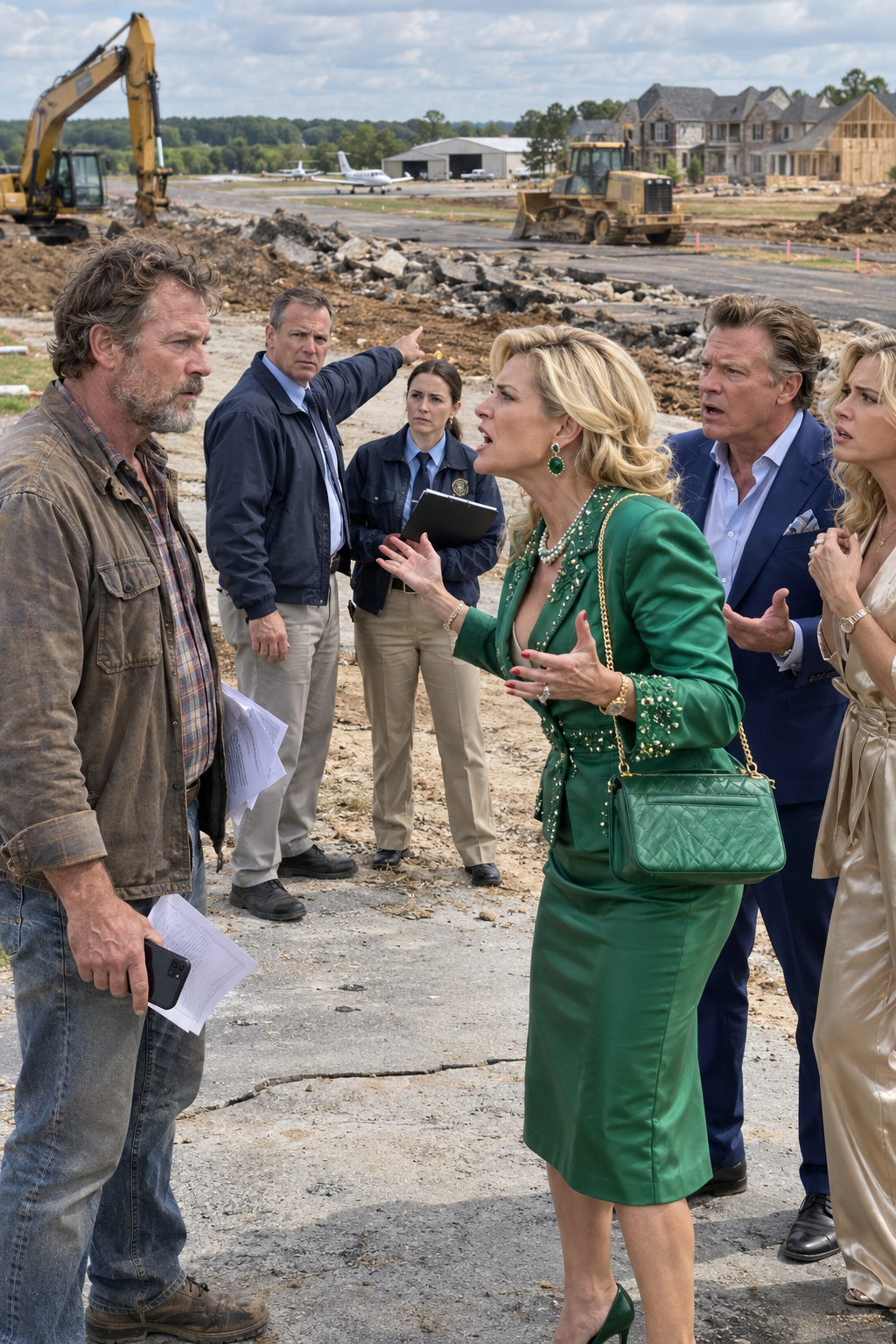
Karen Bulldozed My Licensed Airstrip for Her Luxury Homes—Then One FAA Call Turned Her Million-Dollar Project Into a Federal Problem
The first thing Karen Whitfield said after I caught her bulldozers tearing apart my licensed airstrip was, “You should be thanking me.”
The second thing she did was hand me an $18,400 bill for destroying it.
The third thing was worse.
She told me I had forty-eight hours to remove my airplane from my own property or her construction crew would “dispose of the remaining obstruction.”
I stood at the edge of what had been Runway 17 for twenty-six years and looked past her shoulder.
Three yellow excavators were chewing through the compacted gravel surface.
A bulldozer was pushing my runway lights into a pile of broken plastic and twisted aluminum.
Two workers were sawing through the posts that held the orange-and-white windsock.
Beyond them, fresh wooden stakes marched across the south end of the strip.
Someone had spray-painted the numbers in fluorescent pink.
Karen had already divided my runway into houses.
She stood ten feet from me in white designer boots, tailored cream pants, an emerald-green blouse, and a spotless white hard hat carrying the gold logo of Whitfield Residential Group.
She looked dressed for a ribbon cutting.
I looked down at the invoice in my hand.
“Hazard remediation,” I read.
Karen smiled.
“You entered my property.”
“We corrected an abandoned aviation hazard.”
“This is an active private airport.”
“Not anymore.”
Behind her, the bulldozer blade dropped.
It bit into another fifty feet of runway.
Gravel rolled like gray water.
Karen glanced back, then returned her attention to me with the relaxed expression of someone watching landscapers replace an ugly hedge.
She expected screaming.
She expected threats.
She expected me to charge toward the machines and give her something useful for the police report she had probably already drafted in her head.
Instead, I took out my phone.
Karen’s smile widened.
“Oh, good. Record all you want.”
I recorded the machines.
I recorded the property stakes.
I recorded the excavator sitting directly on the painted threshold marker.
I recorded Karen.
Then I slowly turned until the camera caught the registration sign beside the hangar.
FALCON RIDGE AIRFIELD.
PRIVATE USE.
STATE LICENSE NO. 4CO7.
Karen’s smile slipped for half a second.
That was all I needed.
I saw the crushed runway lights my father installed by hand.
I saw the windsock my daughter helped me replace the summer before college.
I saw the white threshold blocks disappearing beneath a bulldozer track.
I saw thirty years of permits, inspections, flight logs, surveys, and emergency agreements being treated like scrap.
I saw Karen watching me, waiting for anger.
And I knew anger was the one thing I could not afford to give her.
So I asked one question.
“Who told you this airport was abandoned?”
Her expression became careful.
“The county has documentation.”
“Whose documentation?”
“You’ll need to speak to Planning.”
I folded the invoice.
Karen gave a tiny laugh.
“You’re taking this surprisingly well, Caleb.”
My name is Caleb Mercer.
I was forty-four years old that morning.
I owned 312 acres outside Cedar Falls, Colorado, on land my grandfather bought when Eisenhower was president.
The airport occupied a narrow strip through the eastern meadow.
Four thousand one hundred feet long.
Seventy-five feet wide.
Compacted aggregate surface.
Clear approaches on both ends.
No terminal.
No commercial airline service.
Just one hangar, one maintenance shed, a fuel tank that met state requirements, and a runway that had been legally operating since 1998.
My father, Daniel Mercer, built it after retiring from crop aviation.
He had flown firefighting support, agricultural routes, search operations, and medical transports back when half the mountain counties around us still depended on pilots willing to land wherever they could.
By the time I inherited the property, Falcon Ridge had become quieter.
But quiet did not mean abandoned.
I kept the state airport license current.
I maintained the FAA airport record.
I filed required updates.
I hosted emergency training twice a year.
A sheriff’s aviation unit used the runway occasionally.
A medical flight contractor had a standing agreement allowing diversion landings during mountain weather.
And three weeks before Karen’s bulldozers arrived, I had landed my own Cessna there after a flight from Grand Junction.
There was no honest definition of “abandoned” that included an airplane touching down twenty-one days earlier.
Karen knew I loved that strip.
More importantly, Karen knew exactly where the property line was.
We had argued about it eighteen months earlier.
That was when Whitfield Residential Group bought 146 acres along my eastern boundary.
Karen had been developing Ridgeview Heights, a gated community of oversized houses with stone facades, black-framed windows, and enough fake rustic beams to rebuild a railroad.
The first phase sat on the ridge above my property.
The second phase extended toward the creek.
Her third phase was supposed to contain thirty-eight homes, a pool, a clubhouse, and a landscaped entrance road.
There was one problem.
My runway sat precisely where her engineers wanted to connect the southern section of the project to County Road 14.
Not physically across her land.
Across mine.
Her original engineer had shown up at my kitchen table with a proposed purchase.
Twelve acres.
Two million dollars.
I declined.
Karen raised it to three.
I declined again.
She sent a lawyer.
Then a broker.
Then two county commissioners came by separately to tell me how much “economic benefit” Ridgeview would bring to the tax base.
I told all of them the same thing.
The airport wasn’t for sale.
Karen eventually stopped asking.
That should have worried me more than it did.
Now I looked down the destroyed south end of the strip and understood why she had gone quiet.
She hadn’t changed her plan.
She had changed her method.
“How much did you destroy?” I asked.
Karen crossed her arms.
“Enough to make redevelopment practical.”
“That wasn’t my question.”
“About nine hundred feet.”
I checked my watch.
“Was that everything you intended to remove today?”
She looked amused.
“No. By Friday, the entire strip will be graded.”
“We’ve lost enough time already.”
Then I walked toward my truck.
Karen called after me.
“If you interfere with the contractors, they’ve been instructed to call the sheriff.”
She smiled again.
“And before you start making legal threats, you should know the county signed off on this.”
That sentence interested me far more than the bulldozers.
“Did they?”
Her eyebrows lifted.
She hadn’t expected that answer.
I got into my truck.
I did not drive to the courthouse.
I did not call my attorney.
I drove two hundred yards west to the hangar.
My Cessna 182 sat inside.
The airplane was fine.
Karen’s crews hadn’t reached the apron yet.
I unlocked the office and pulled a blue binder from the fireproof cabinet.
My father had labeled it in black marker.
AIRFIELD — LICENSE / FAA / COUNTY.
Dad believed digital records were useful but paper survived bad software, dead batteries, and government databases.
Inside were twenty-eight years of inspections, renewals, correspondence, plats, approach surveys, insurance certificates, emergency-use agreements, and certified letters.
I opened the most recent state inspection.
I opened the FAA airport record printout.
Active private-use facility.
I opened the county zoning map.
The runway was marked.
So was the airport influence area.
Then I reached the folder containing the 2024 correspondence from Ridgeview’s engineering consultant.
There it was.
A letter asking whether I would support a modification to the southern approach zone.
My written response was clipped behind it.
Certified mail receipt attached.
Karen hadn’t discovered an abandoned airport.
She had tried to negotiate around an active one.
There is a difference between arrogance and fraud.
I didn’t yet know which side of that line she had crossed.
I intended to find out before sunset.
My first call went to the Colorado Division of Aeronautics.
My second went to the FAA office that handled airport data and regional safety coordination.
My third went to my attorney, Sarah Bell.
Sarah answered on the second ring.
“You sound calm,” she said after I explained what was happening.
“I am calm.”
“That usually means somebody else is about to have a very bad afternoon.”
I looked through the office window.
Another excavator swung its bucket.
“Possibly.”
“Do not confront the workers.”
“I haven’t.”
“Photograph everything.”
“Already done.”
“Property corners?”
“Security cameras?”
“Recording.”
There was a pause.
“You still have the email where Karen offered to buy the runway parcel?”
“All of it.”
“Good. Send me copies.”
“I’m calling the county next.”
That stopped me.
“Because Karen said the county approved it.”
“If that’s true, I want to know what they approved before anyone gets a chance to clean up their paperwork.”
Sarah understood the same thing I did.
If this was merely trespass, it was ugly.
If a county official had approved destruction of a licensed airport using false documentation, it was something else.
Twenty minutes later, a woman named Laura Mendoza from the state aeronautics office returned my call.
I gave her the license number.
Computer keys clicked.
Then she went quiet.
“Mr. Mercer, Falcon Ridge is showing active.”
“Our last inspection was eleven months ago.”
“Did you request closure?”
“Temporary closure?”
“Runway shortening?”
“Change of use?”
More typing.
“What exactly happened?”
“Nine hundred feet of Runway 17 has been bulldozed. Construction stakes for a residential subdivision are inside the runway footprint.”
Then Laura said, “Do not attempt to use the runway.”
“I wasn’t planning to.”
“Can you send photographs?”
“I’m emailing you now.”
Her message arrived before we hung up.
I attached twenty-three images.
Three videos.
The invoice Karen gave me.
The 2024 Ridgeview letter.
My rejection.
The current survey.
Then I waited.
At 11:07, a black sheriff’s SUV came through my gate.
Deputy Aaron Pike stepped out.
I had known Aaron since high school.
He looked at the construction site, then at me.
“Karen called.”
“I figured.”
“She says you’re interfering with permitted development.”
“I haven’t spoken to a worker.”
“She says this runway was legally abandoned.”
“It wasn’t.”
Aaron rubbed his jaw.
“Do you have documents?”
“Come inside.”
Ten minutes later, he stood over the office desk looking at the active airport license.
“Karen showed our dispatcher something from Planning.”
“An abandonment determination.”
“Signed by whom?”
“I didn’t see it.”
“Did it have my signature?”
His eyes moved toward mine.
“That I don’t know.”
I handed him copies of the current paperwork.
Aaron walked outside and called someone.
Karen came down the runway in a white Range Rover while he was still talking.
She parked beside his cruiser.
“What is he doing?” she asked me.
She ignored me and walked straight to Aaron.
“Deputy, the contractors are on schedule. Mr. Mercer is trying to delay a permitted project because he doesn’t like residential development.”
Aaron held up a hand.
“I’m verifying property access.”
“It’s been verified.”
“With Planning?”
“With everyone.”
“Do your crews have written authorization to enter Mercer’s parcel?”
Karen didn’t answer immediately.
“The development plan includes that area.”
“That isn’t what I asked.”
Her jaw tightened.
“Our title package establishes control.”
“Ownership?”
I almost smiled.
Lawyers use words carefully.
Developers who spend a lot of time around lawyers learn to do the same.
Aaron asked, “Do you own the land under the runway?”
Karen looked at me.
“The relevant rights have been released.”
“What rights?”
“Aviation restrictions.”
“That still doesn’t answer whether you own the dirt.”
Karen turned toward me.
“Caleb, this theater is unnecessary.”
I said nothing.
That irritated her more than any argument could have.
She stepped closer.
“You refused every reasonable proposal. The county is growing. Families need homes. One man should not be able to freeze a hundred-million-dollar project because he wants to play pilot on a gravel strip.”
There it was.
Her motive.
Not madness.
Not random cruelty.
Thirty-eight luxury houses averaging $1.6 million each.
Future phases beyond them.
A new road connection.
Higher-density approval if she removed the aviation conflict.
Karen believed my runway was an inefficient use of land standing between her and tens of millions of dollars.
She hadn’t bulldozed it because she hated airplanes.
She bulldozed it because a spreadsheet told her I was cheaper to defeat than to buy.
Aaron repeated, “Do you own this parcel?”
Karen stared at him.
“Our attorneys can answer technical title questions.”
“Until they do, nobody crosses farther onto Mercer property.”
Her face changed.
Just enough.
“Excuse me?”
“I’m not making a zoning decision. I’m preventing escalation while ownership is disputed.”
“You don’t have authority to stop permitted construction.”
“I have authority to deal with potential trespass.”
Karen reached for her phone.
She walked away dialing.
Aaron looked at me.
“That bought you a few hours.”
“A few hours may be enough.”
At 12:19, my phone rang.
The number showed a Denver area code.
“Mr. Mercer?”
“This is Michael Reeves with the FAA.”
His voice was ordinary.
Almost disappointingly calm.
I had expected the government equivalent of a fire alarm.
Instead, Michael asked precise questions.
Was the runway currently listed active?
Had I issued permission for construction?
Had I submitted notice of closure?
Had I authorized anyone else to submit one?
Was there vertical construction proposed within the airport environment?
Had the developer submitted the required aeronautical notice?
I didn’t know.
“No record appears under the project name you provided.”
I watched Karen stand beside her Range Rover fifty yards away, speaking sharply into her phone.
Michael continued.
“We’re also seeing something unusual.”
“A status update was entered approximately four months ago indicating anticipated permanent closure.”
I gripped the phone tighter.
“Entered by whom?”
“The supporting documentation references the property owner.”
“I’m the property owner.”
“I understand.”
“I never submitted anything.”
“That’s why I’m calling.”
The wind moved through the broken windsock fabric lying beside the construction pile.
“Can you send me the document?”
“Because I’m trying to determine whether we’re dealing with an incorrect filing, a third-party submission, or something more serious.”
“Does it have my name on it?”
That was the moment my day changed.
Until then, Karen might have been an aggressive developer who believed a county process gave her rights she didn’t actually possess.
Now somebody had used my name.
“Does it have my signature?”
Another pause.
“It appears to.”
I looked across the runway.
Karen was watching me.
She couldn’t hear the call.
But she saw my face.
For the first time that morning, she stopped smiling completely.
Michael said an FAA representative and a state aeronautics inspector could be on site that afternoon.
“Don’t alter the area any further,” he said.
“And if the contractor resumes?”
“I have a deputy here.”
Karen immediately started walking toward me.
“What was that?”
I slipped the phone into my pocket.
“With whom?”
“You told me to speak to the proper agencies.”
Her face hardened.
“What did you do?”
“I verified my runway status.”
“You’re wasting everyone’s time.”
“Caleb, listen carefully. You’re not stopping this project.”
“I haven’t tried to stop your project.”
She laughed once.
“You just called someone.”
“That is trying to stop my project.”
“No, Karen.”
I looked at the shredded runway behind her.
“I called someone to ask why my name appears on paperwork I never filed.”
It lasted perhaps one second.
Maybe less.
But people reveal themselves in small delays.
Her eyes flicked toward the project trailer.
Not toward the county.
Not toward her lawyer.
Toward the trailer.
Then she recovered.
“I have no idea what you’re talking about.”
“If you have nothing to do with it, you should be very interested in finding out who does.”
She stared at me.
I walked back toward the hangar.
At , every construction machine shut down.
Not because Karen ordered it.
Because Aaron walked from operator to operator and told them their access across my boundary was disputed.
The sudden silence was astonishing.
For hours, the property had been filled with diesel engines, backup alarms, steel tracks, and hydraulic pumps.
Then nothing.
Karen stood alone beside the excavators.
She looked smaller without the machines moving behind her.
At , three black SUVs arrived from Whitfield Residential.
Two men in business clothes and one woman carrying rolled plans stepped out.
Karen met them at the trailer.
Voices rose.
I couldn’t hear everything.
I heard my name.
I heard “FAA.”
I heard “closure letter.”
Then one of the men said something loud enough to cross the field.
“You told us that was resolved.”
Karen pulled him inside the trailer.
That was my first real payoff.
Not revenge.
Information.
Somebody on her own team believed the airport issue had been “resolved.”
At , a state vehicle came through my gate.
Laura Mendoza stepped out wearing jeans, boots, a navy jacket, and the expression of someone who had spent a career inspecting places where people insisted everything was fine.
Behind her came Michael Reeves from the FAA.
Karen intercepted them before they reached me.
Of course she did.
“Can I help you?” she asked.
Michael showed identification.
“We’re here regarding Falcon Ridge Airfield.”
“The airport is closed.”
Laura looked down the runway.
“Who closed it?”
Karen gestured vaguely toward the development.
“The closure was processed months ago.”
“By the owner?”
I was standing thirty feet away.
Laura looked at me.
“Mr. Mercer, did you close this airport?”
Karen’s shoulders stiffened.
Michael asked her, “Are you representing the developer?”
“I’m Karen Whitfield, president of Whitfield Residential Group.”
“Do you have copies of the closure authorization?”
“Our legal team does.”
“Do you have them here?”
“They can provide whatever is necessary.”
Michael nodded.
“Please ask them to do that.”
Karen crossed her arms.
“Are you issuing some kind of federal stop order?”
Michael didn’t take the bait.
“We’re determining the status of the airport and whether required aviation reviews were completed.”
“The county approved this subdivision.”
“County approval and federal aviation review are different processes.”
“You can’t regulate private land development.”
“There are notification requirements associated with construction affecting navigable airspace and existing airport environments.”
Karen glanced toward me.
I stayed silent.
Michael continued.
“For now, I would strongly advise against further alteration of the runway until ownership authorization and facility status are clarified.”
Karen gave a tight smile.
“Advice is not an order.”
She relaxed slightly.
Then Laura spoke.
“But the state airport license is active.”
Karen looked at her.
“And intentionally destroying an active licensed runway without owner authorization creates a separate state issue.”
The smile disappeared again.
Before Karen could answer, a white county pickup entered the gate.
Then another.
Mark Dorsey, Cedar County’s planning director, climbed out of the first truck.
I knew Mark.
He had reviewed an agricultural building permit for me years earlier.
He looked like he would rather be undergoing dental surgery.
Karen marched toward him.
“Mark, please explain to these people that the airport was removed from county planning.”
Mark didn’t answer.
He carried a folder under one arm.
Behind him came the county engineer.
Mark stopped beside Michael and Laura.
“Are you Mr. Reeves?”
They shook hands.
Karen stared.
He finally looked at her.
“We’ve suspended the grading permit.”
The color drained from her face.
“For what?”
“Pending verification.”
“Verification of what?”
“The airfield closure.”
Karen laughed sharply.
“You already verified it. You approved the plat.”
“Based on submitted documentation.”
“My attorneys submitted valid documentation.”
Mark opened the folder.
“That’s what we’re checking.”
“Mark, you cannot shut down a fifty-eight-million-dollar phase because one property owner is unhappy.”
“The grading permit is suspended.”
“Effective when?”
“Immediately.”
Behind us, one of the contractor supervisors swore under his breath.
Karen stepped closer to Mark.
“You know how much this costs per day?”
“Yes, Karen.”
“Then fix it.”
Mark’s face reddened.
“I’m trying to determine why Planning received an airport abandonment affidavit carrying Caleb Mercer’s signature when Caleb Mercer says he never signed it.”
Nobody moved.
Nobody spoke.
Karen turned toward me slowly.
I could hear the wind clicking a loose piece of runway light against a metal post.
Finally she said, “That’s between Caleb and whoever filed it.”
Mark shook his head.
“No. It was submitted with your Phase Three application.”
“By counsel.”
“On behalf of Whitfield Residential.”
Karen’s mouth opened.
Michael asked, “May I see the affidavit?”
Mark handed him the folder.
I stepped closer.
For the first time, I saw the page that had turned my airport into Karen’s housing development.
It looked professional.
County recording stamp.
Parcel number.
Legal description.
My full name.
CALEB J. MERCER.
The document declared that Falcon Ridge Airfield had ceased aviation operations and that I voluntarily released objections to non-aviation development in the former runway influence area.
At the bottom was a signature.
Whoever created it had done a good job.
The C leaned exactly the way mine did.
The M had the same long first stroke.
Even the little upward hook at the end of Mercer looked familiar.
Then I saw the date.
I knew immediately I could prove it was fake.
Sarah arrived ten minutes later.
She walked from her car carrying a leather bag, took one look at the affidavit, and asked me, “Where were you April seventeenth?”
“Hotel invoice. Fuel receipt. Flight tracking. I gave a safety seminar at the Idaho Backcountry Pilots Association dinner.”
“Witnesses?”
“About eighty.”
She nodded.
Karen heard us.
“That proves nothing,” she said.
Sarah turned.
“I’m sorry?”
“A signature can be completed electronically.”
Sarah smiled.
It was not a friendly smile.
“Interesting.”
Karen realized what she had done.
Sarah asked, “Why would you assume it was electronic?”
“I didn’t assume anything.”
“You just volunteered a method.”
“I said it could have been.”
“Of course.”
Karen turned away.
At , the contractors began loading equipment.
Not because they were finished.
Because their insurance carrier had been called.
I learned that when the superintendent approached me near the hangar.
His name was Wes Dalton.
He was a broad man with sunburned forearms and dusty boots.
“I owe you an apology,” he said.
“For what?”
“We were told the runway was decommissioned and the developer controlled access.”
“Did you see property authorization?”
“I saw the construction packet.”
“Did it include my signature?”
He hesitated.
“Same affidavit?”
“I think so.”
“Who gave it to you?”
“Whitfield’s project manager.”
“No. Blake Turner.”
I remembered the name.
Blake had been one of the men arguing outside the trailer earlier.
“Is Blake still here?”
Wes looked toward the SUVs.
“About twenty minutes ago.”
Interesting.
“Did he say where he was going?”
Wes glanced at the damaged runway.
“We never would’ve touched an active strip knowingly.”
“I believe you.”
He seemed surprised.
“You stopped when the deputy told you there was a dispute.”
“We should’ve confirmed it ourselves.”
“Probably.”
He looked miserable.
“My guys crushed your lights.”
“We’ll cooperate.”
He walked away.
Sarah came beside me.
“You’re being nicer than I would be.”
“Wes isn’t the person I’m interested in.”
We both looked toward Karen.
She was inside the project trailer with the blinds closed.
By four o’clock, Ridgeview Phase Three was officially frozen.
The county posted the notice electronically.
Whitfield Residential’s lenders received it.
The contractor received it.
The title company received it.
And, because wealthy homebuyers have an astonishing ability to discover bad news involving their deposits, two future residents arrived at my gate before five.
One of them was a cardiologist from Denver who had already put $190,000 down on a house that existed only as a foundation.
He wanted answers.
I gave him none.
“Talk to Whitfield,” I said.
“Whitfield says you’re trying to extort them.”
Sarah nearly laughed.
“How much am I asking for?”
The doctor blinked.
“I don’t know.”
“Neither do I.”
His wife looked past me at the ruined runway.
“Did they really bulldoze your airport?”
“Nine hundred feet of it.”
“That’s what everyone is trying to determine.”
The doctor lowered his voice.
“They told us the neighboring property used to have a hobby airstrip but it had been closed for years.”
I felt something cold move through my chest.
“When did they tell you that?”
Three months before the false affidavit was dated.
I asked, “Was it written anywhere?”
His wife took out her phone.
She opened an email.
The message came from a Whitfield sales representative.
Ridgeview Phase Three offers peaceful estate living adjacent to preserved open meadowland. The former private landing strip has been permanently retired, allowing expanded trails, landscaping, and enhanced residential privacy.
January 22.
Karen’s company had marketed the airport as closed before the document supposedly closing it existed.
Sarah read the message twice.
Then she asked the couple to forward it.
Mini-payoff number two.
The forged affidavit was no longer an isolated document that might have appeared through some innocent administrative mistake.
Whitfield had been telling buyers the runway was gone months before my supposed consent.
That meant somebody planned around my signature before they had it.
The doctor looked sick.
“Are we going to lose our house?”
“I don’t know.”
“Can the project continue?”
“I don’t know.”
“Would you sell them the land?”
Sarah looked at me.
So did his wife.
I answered honestly.
The doctor exhaled.
Just defeated.
His wife touched his arm.
As they walked away, Karen came out of the trailer.
She waited until they were gone.
Then she approached us.
Her hard hat was missing now.
Her blonde hair, perfect that morning, had started blowing loose around her face.
“Caleb, we need to talk privately.”
Sarah answered before I could.
Karen looked at her.
“This is a business matter.”
“I’m his attorney.”
“It predates your involvement.”
Sarah smiled.
“Everything today predates my involvement. I’m still staying.”
Karen looked at me.
“Five minutes.”
I shrugged.
She took a breath.
“The project can be redesigned.”
“Then redesign it.”
“It would require relocating the southern entrance.”
“That costs approximately six million dollars.”
“That sounds like a Whitfield problem.”
Her eyes narrowed.
“I’m trying to avoid unnecessary escalation.”
I looked at the ruined strip.
“I can restore the runway.”
“We can compensate you.”
“For the damage?”
“And we can resolve the paperwork issue without turning this into some spectacle.”
Sarah said, “There it is.”
Karen snapped, “I’m speaking to Caleb.”
Sarah’s tone stayed mild.
“And I’m listening.”
Karen looked back at me.
“Name a number.”
“Four million.”
“You rejected three million for the corridor. I’m offering five.”
“You’re not buying the corridor.”
“Everything has a price.”
“Not this.”
Her composure cracked.
“Do you understand what happens if you insist on making this personal?”
I almost laughed.
“You bulldozed my runway.”
“That was done under a valid county permit.”
“Based on a document with my forged signature.”
“Allegedly forged.”
“Would you like me to sign my name right now?”
She stared.
“I can write it ten times. We can compare them. Then we can call the notary listed on your affidavit and ask when she watched me sign it.”
Karen’s eyes flicked away.
Sarah noticed.
I took the affidavit copy from Sarah.
The notary block showed the name:
DENISE R. CALDWELL.
Commission number.
Expiration date.
I had never heard of her.
“Do you know Denise Caldwell?” I asked.
Sarah said, “You didn’t even ask who she is.”
Karen’s face went blank.
I felt the day shift again.
“I said I don’t know her.”
“You recognized the name.”
She stepped backward.
“This conversation is over.”
Sarah said, “Finally something we agree on.”
Karen walked quickly toward her Range Rover.
Before she reached it, Michael Reeves came out of the hangar carrying another folder.
“Ms. Whitfield?”
She stopped.
He approached.
“We found an additional issue.”
She gave a tired laugh.
“Of course you did.”
Michael’s expression didn’t change.
“Your Phase Three plan shows structures reaching forty-seven feet above grade along the northern ridge.”
“Where is your aeronautical notice submission?”
“My engineers handle filings.”
“We have no matching submission.”
“That can be corrected.”
“Possibly.”
“What does that mean?”
“It means the proposed structures may require review due to their location relative to the airport environment.”
“The airport is private.”
“Then why does the FAA care?”
Michael answered patiently.
“Private airports still interact with navigable airspace.”
Karen rubbed both temples.
“You people are acting like I built a skyscraper in front of Denver International.”
“No one said that.”
“Then what are you saying?”
“I’m saying that your permitting package appears to assume an airport closure that the actual airport owner denies requesting.”
Her voice rose.
“And if Caleb agrees now?”
Sarah looked at me.
Karen noticed.
“If Caleb signs a closure today, what happens?”
Michael said, “That would not retroactively validate earlier filings.”
There are sentences that remove oxygen from a person’s body.
That was one.
Karen looked at me.
For the first time all day, I saw fear.
Not frustration.
The problem was no longer whether she could persuade me.
The problem was the past.
At , everyone left except Sarah, me, and two county employees photographing the site.
Sunlight stretched across the torn gravel.
My runway looked wounded.
That may sound sentimental.
It was dirt and stone.
I understood that.
But certain places hold the shape of people after they’re gone.
My father had taught my daughter Emma to steer a golf cart down that runway when she was eight.
He had painted the threshold numbers with her when she was twelve.
The summer before he died, he sat outside the hangar watching me land and said, “Keep the approaches clear. Land is cheap until you need somewhere safe to come down.”
Dad had a way of saying practical things that sounded philosophical only later.
Sarah sat on the tailgate of my truck.
“You okay?”
“That was not convincing.”
“I’m angry.”
“I’m also thinking.”
“That’s more dangerous.”
I handed her the sales email.
“January twenty-second.”
“The affidavit is dated April seventeenth.”
“They marketed the closure before they had the closure.”
“So the forgery wasn’t created to reflect something they thought had already happened.”
“It was created because something they had already promised required it to happen.”
Sarah nodded.
“That’s how I see it.”
I looked toward Ridgeview’s ridge.
Large homes caught the orange evening light.
“Why take that risk?”
“Karen had other route options.”
“More expensive ones.”
“Six million expensive, according to her.”
“That’s motive.”
Sarah frowned.
“It’s motive for bullying me. Not for forging a legal document tied to an airport.”
“Developers have committed fraud for less.”
“Karen’s arrogant. She’s not stupid.”
Sarah studied me.
“You think there’s more.”
“I think she believed she couldn’t afford for this runway to remain legally active.”
“That could still be the road.”
At , a gray pickup stopped outside my gate.
The driver didn’t enter.
I watched from the hangar.
“Expecting anyone?” Sarah asked.
The driver flashed his headlights twice.
Then my phone rang from an unknown number.
I answered.
“Caleb Mercer?”
“It’s Blake Turner.”
Whitfield’s project manager.
I looked at the gray pickup.
“Are you outside my gate?”
His voice sounded strained.
“Because Karen has cameras on every project vehicle.”
“That your personal truck?”
“My wife’s.”
Sarah was watching me.
I put the call on speaker.
Blake continued.
“I need you to understand something. I didn’t know your signature was fake.”
“I was told you signed.”
“Who told you?”
“I’m not saying that on the phone.”
“Then come inside.”
Sarah said, “Mr. Turner, I’m Caleb’s attorney. If you possess information concerning a falsified land-use filing, you should preserve it and speak with counsel.”
Blake was silent.
Then he said, “Karen fired me today.”
That explained his disappearance.
“For what?” I asked.
“For asking why the FAA was here.”
“I doubt that was the exact reason.”
His voice dropped.
“She said I had failed to control document distribution.”
“What document?”
“The closure package.”
Sarah stood.
“What does that mean?”
Blake ignored her question.
“Caleb, you need to check the Phase Two plat.”
“Just check it.”
“What am I looking for?”
Another silence.
Then he said five words.
“Your runway is the problem.”
“I’m aware.”
His voice cracked.
“You’re not.”
Headlights appeared on the county road behind him.
Blake abruptly said, “I have to go.”
The call ended.
His truck pulled away.
“Get the plate,” Sarah said.
I had already zoomed my camera.
The second vehicle passed without stopping.
Tinted windows.
I didn’t recognize it.
Sarah looked at me.
“Phase Two.”
We went inside.
I opened the county GIS portal.
Ridgeview Phase Two contained sixty-two completed houses.
Most had sold within the previous two years.
I pulled up the recorded subdivision plat.
Nothing obvious.
Drainage easements.
Common space.
Then I opened my own airport map.
Sarah stood over my shoulder.
“Overlay them.”
The runway itself did not reach Phase Two.
But the extended approach protection area did.
A triangular zone projected from the north end of Falcon Ridge toward the ridge.
Straight into Phase Two.
Sarah whispered, “Oh.”
Twelve homes sat inside it.
Not on my property.
Not necessarily illegal.
But potentially affected by aviation disclosure rules, local airport zoning restrictions, height limitations, avigation easements, noise acknowledgments, and development review depending on the county requirements.
I opened the Phase Two recorded disclosures.
No airport reference.
I searched.
Sarah pulled out her phone.
“Call Blake back.”
Straight to voicemail.
Then she said, “Check Phase One.”
The older section sat farther north.
Outside the immediate triangle.
But a portion still touched the broader airport influence boundary shown on the county’s older planning map.
Twenty-three additional houses.
Thirty-five total properties potentially affected.
Sarah sat down.
“This isn’t about thirty-eight future houses.”
“If the airport remained active, existing owners may have been entitled to disclosures.”
“Maybe more than disclosures.”
I found an old county ordinance.
Airport influence overlay.
Adopted 2003.
Amended 2011.
Developments within designated zones required planning review and aviation compatibility findings.
I pulled the approval minutes for Ridgeview Phase Two.
One sentence appeared in the staff report.
No active aviation facilities are located within the project impact area.
I read it twice.
Sarah read it over my shoulder.
“That’s false.”
“Was Falcon Ridge on the county map then?”
“Can you prove it?”
I pulled Dad’s 2018 county aviation map from the binder.
Falcon Ridge was clearly marked.
Sarah whispered, “Why would county staff write that there was no active airport?”
I didn’t answer.
Because I finally understood why Karen had looked afraid when Michael said a closure today would not fix earlier filings.
The bulldozers weren’t just creating land for Phase Three.
They were destroying evidence that Falcon Ridge was still physically operational.
If the runway looked abandoned today, Karen could argue the maps were outdated.
If the lights were gone…
If the threshold markings were gone…
If the windsock was gone…
If the gravel surface became a street…
Then buyers, lenders, insurers, and county reviewers seeing the property months later might believe the same story.
Old hobby strip.
Closed years ago.
Irrelevant.
Except Karen’s crews had moved too soon.
I had returned while the evidence was still warm.
At , Sarah called Mark Dorsey.
He answered.
We asked one question.
“Who wrote the Phase Two staff finding that no active aviation facility was in the impact area?”
There was a long silence.
“I don’t know,” Mark said.
“Can you find out?”
Another pause.
He called back twenty-three minutes later.
His voice had changed.
“That staff report was revised.”
“Three days before the Planning Commission hearing.”
“The system shows my login.”
Sarah asked, “Did you revise it?”
“Who had access to your account?”
“Specifically?”
“Caleb, Sarah, I need to contact county counsel.”
“Mark,” I said. “Was Falcon Ridge mentioned in the earlier draft?”
He said nothing.
That was answer enough.
“What did the earlier draft say?”
Paper moved on his end.
Finally he read it.
“Existing private-use airport approximately zero-point-six miles southwest. Applicant must demonstrate compatibility with airport overlay provisions and obtain required owner acknowledgments prior to final plat.”
Sarah closed her eyes.
“What replaced it?”
We already knew.
Mark read anyway.
“No active aviation facilities are located within the project impact area.”
The phone went silent.
Then Mark whispered, “I did not make this change.”
He hung up.
For a while Sarah and I said nothing.
Outside, twilight settled across the damaged runway.
Somewhere beyond the ridge, a dog barked.
My phone buzzed.
My daughter lived in Fort Collins and had seen something online.
DAD ARE YOU REALLY FIGHTING THE HOA WITH THE FAA???
I stared at the message.
Then another appeared.
PLEASE TELL ME YOU DIDN’T GET ARRESTED.
I finally laughed.
It was the first time all day.
I wrote back.
NOT ARRESTED.
AIRPLANE SAFE.
CALL YOU LATER.
Three dots appeared.
GRANDPA WOULD BE LOSING HIS MIND.
That stopped the laugh.
Dad would have been furious.
But he would have done exactly what I was doing.
Documents first.
Anger later.
At , a tow company arrived to remove the last Whitfield equipment from my parcel.
Karen returned with them.
She stayed near her SUV while the machines were loaded.
No hard hat now.
No polished smile.
Before leaving, she walked toward me one final time.
Sarah was on a call inside the hangar.
Karen stopped six feet away.
“You think you won.”
“I think your bulldozers left.”
“You know what I mean.”
“Don’t pretend.”
She looked exhausted.
“You’ve embarrassed me in front of the county, my contractors, federal officials, and buyers.”
“I didn’t invite any of those people to bulldoze my runway.”
“You called them.”
“You could have called me first.”
“I was standing in front of you.”
“That isn’t what I mean.”
Her mouth tightened.
“Tomorrow, my lawyers will seek an emergency order confirming our development rights.”
“We will show that Falcon Ridge ceased meaningful aviation operations years ago.”
“My flight logs disagree.”
“Occasional personal flights don’t make you indispensable.”
“I never said they did.”
She stepped closer.
“You’re risking other people’s homes because you’re sentimental about a strip of gravel.”
“No, Karen.”
I pointed toward the excavator tracks.
“You risked their homes when you sold them something based on facts you apparently couldn’t support.”
Her face went still.
“You don’t know anything about those sales.”
“I know January comes before April.”
She knew exactly what I meant.
The sales email.
For the first time, hatred entered her eyes.
Not irritation.
Not disdain.
“Be very careful, Caleb.”
“Is that a threat?”
“It’s advice.”
“From a developer?”
“From someone who understands what happens when banks get nervous.”
She turned to leave.
Then stopped.
Without looking back, she said, “Your father should have sold that place when he had the chance.”
I felt every muscle in my body tighten.
“My father?”
Karen walked away.
I called after her.
She didn’t stop.
Sarah came outside.
“What happened?”
“She mentioned Dad.”
Sarah frowned.
“Did they ever negotiate with him?”
“Not that I know.”
“When did Whitfield first buy land here?”
“Karen’s company? About six years ago.”
“When did your father die?”
“Eight years ago.”
Sarah stared at me.
“That’s interesting.”
At , I pulled Dad’s oldest property files from the cabinet.
Nothing involving Whitfield.
No sales proposal.
No developer correspondence.
Then I found something else.
A certified letter from 2017.
RIDGEVIEW LAND HOLDINGS LLC.
I didn’t recognize the company.
The letter proposed purchasing an avigation easement release affecting Falcon Ridge’s northern approach.
Dad had written one word across the top in red ink.
I checked the state corporate registry.
Ridgeview Land Holdings had been dissolved.
Its registered manager at formation was a real estate attorney named Thomas Whitfield.
Karen’s husband.
Sarah leaned against the desk.
“They approached your father.”
“Two years before Whitfield Residential publicly acquired the ridge.”
“They wanted the aviation rights before they bought the development land.”
“And your father refused.”
Suddenly Karen’s comment made sense.
She didn’t know about my father’s refusal because of family gossip.
She knew because her family had been trying to neutralize Falcon Ridge before I even inherited it.
This plan was older than I realized.
My phone rang again.
Michael Reeves.
I answered.
“Sorry for the late call,” he said.
“No problem.”
“I’ve been reviewing archived airport records.”
“Find something?”
“Another fake closure?”
He sounded puzzled.
“Something older.”
I glanced at Sarah.
“What happened in 2006?”
“There was a county request for technical guidance concerning proposed development near Falcon Ridge.”
“I don’t remember that.”
“You may not. Your father was listed as owner.”
“What did the FAA say?”
“That maintaining the northern approach and ensuring compatible land use would be advisable.”
“There’s also correspondence from your father.”
I smiled slightly.
“That sounds like him.”
“He objected to anticipated residential encroachment.”
“Still sounds like him.”
Michael paused.
“But that isn’t the unusual part.”
“In 2019, three years after his death, we received documentation indicating that the avigation concerns had been privately resolved with the Mercer property owner.”
I stopped breathing for a second.
“My father died in 2016.”
“I became owner after probate.”
“Who signed in 2019?”
The office seemed to shrink around me.
“I didn’t.”
“I suspected you’d say that.”
“I’ll have to clear release of the full file. But I can describe it.”
“Go ahead.”
“It appears to be an avigation easement release and compatibility acknowledgment.”
“In favor of whom?”
“Ridgeview Land Holdings.”
Sarah stepped closer to the phone.
I asked, “Does it have my signature?”
“What date?”
“September ninth, 2019.”
I knew exactly where I had been.
Not another state.
Not even in the country.
In September 2019, I spent five weeks in Alaska helping a friend ferry aircraft between Bethel and Anchorage.
I had flight records.
Credit card records.
Dozens of witnesses.
“What notary?”
Michael shuffled paper.
“Denise R. Caldwell.”
The same name.
Sarah mouthed, There it is.
The first real twist had just become undeniable.
Someone had been forging my consent for years.
Karen hadn’t invented the method this spring.
She had used it before.
“Michael,” I said carefully, “do you know who submitted the 2019 document?”
“Can you find out?”
“I’m working on it.”
He hesitated.
“There’s one other reason I called.”
“When I searched that parcel reference, I found the same release recorded in another file.”
“Which file?”
He didn’t answer immediately.
Then he said, “A federal land-use coordination file.”
Sarah and I looked at each other.
“Why would my private airport have a federal land-use file?”
“That’s what I’m trying to understand.”
“Is that normal?”
“Not in this form.”
“What does it say?”
“I don’t have the complete record yet.”
“I don’t want to speculate.”
“Give me what you can.”
Another pause.
“Your runway may have had a status your current county records no longer show.”
“What status?”
“I need the archived documents before I say more.”
The call ended five minutes later.
I should have gone home.
Instead, Sarah and I stayed in the hangar.
At , headlights appeared outside.
This time the vehicle came through the gate.
A sheriff’s cruiser.
Aaron Pike stepped out carrying a large brown evidence envelope.
“What now?” Sarah asked.
Aaron didn’t smile.
“Mark Dorsey called the sheriff.”
“He found something in the county archives.”
He handed me a photocopy.
It was a scanned internal memo from 2019.
The subject line read:
FALCON RIDGE AIRPORT CONFLICT — RIDGEVIEW COMPATIBILITY RESOLUTION.
Below that were four names.
Planning Director Mark Dorsey.
County Counsel Robert Ames.
Developer representative Thomas Whitfield.
Property Owner Caleb Mercer.
My name had a check mark beside it.
Meeting completed.
September 12, 2019.
I looked at Aaron.
“I was in Alaska.”
“Sarah sent us your flight records.”
I scanned the page.
There was a handwritten note at the bottom.
Owner agrees airport no longer required for emergency coordination. Easement release received. Remove airport overlay conflict before final plat.
I read it again.
“Emergency coordination?”
Sarah took the page.
Aaron pulled a second document from the envelope.
This one was older.
Much older.
County Emergency Management.
Falcon Ridge Airfield.
Designated auxiliary emergency landing site.
Agreement originally executed 1999.
Updated 2008.
Wildfire evacuation.
Medical diversion.
Search-and-rescue staging.
Disaster access.
My father’s signature was on the 2008 update.
A real signature.
I recognized every stroke.
Aaron said, “Mark had never seen this.”
“Neither have I.”
“It was archived under old emergency management records, not planning.”
Sarah asked, “Was it still active in 2019?”
“Apparently.”
I looked at her.
“Apparently?”
Aaron handed me a third page.
Termination required written notice by property owner plus review by county emergency management and state aviation officials.
There was a termination notice.
Dated August 2019.
Signed by me.
Notarized by Denise Caldwell.
My skin went cold.
Three forged documents.
One pattern.
One notary.
One development.
Sarah spoke slowly.
“They didn’t just fake the airport closure.”
“They faked your withdrawal from an emergency-use agreement.”
Aaron nodded.
“And that may be why Planning stopped treating the airport as a development conflict.”
I sat down.
Not because I was overwhelmed.
Because my mind was moving too quickly.
They approached Dad through Ridgeview Land Holdings.
He refused.
After Dad was dead, someone forged my signature releasing aviation protections.
Someone forged my signature terminating the emergency agreement.
Phase Two advanced.
Homes sold.
Phase Three required the physical runway itself.
Another forged affidavit appeared.
Then Karen sent bulldozers.
It wasn’t a sudden act of arrogance.
It was the last step of a long process.
“Where is Denise Caldwell?” I asked.
Aaron looked at me.
“That’s another problem.”
“We can’t find her.”
“The notary commission number belongs to a real person.”
“But the Denise Caldwell attached to that number died in 2018.”
Nobody spoke.
The fluorescent light above the desk hummed.
Sarah finally said, “The 2019 documents were notarized a year after the notary died.”
Aaron nodded.
“And the 2026 affidavit uses the same dead woman’s commission information.”
I looked toward the dark runway.
Nine hundred feet gone.
Suddenly that seemed like the smallest problem on my property.
At 10:03, Aaron left.
Sarah wanted me to lock everything and sleep somewhere else.
I told her I would.
She knew I was lying.
“I have cameras.”
“That didn’t stop bulldozers.”
“They entered in daylight with a permit.”
“Someone forged your identity for seven years.”
“That person now knows the documents are being examined.”
She stared at me.
“Please try behaving like a normal client for six hours.”
“I’ll consider it.”
“That means no.”
“Probably.”
She left at 10:21.
I locked the gate behind her.
Then I walked the ruined runway alone.
Moonlight was starting to brighten the mountains.
The bulldozed section was rough under my boots.
Pieces of my threshold lights lay half-buried in gravel.
I picked one up.
The lens was cracked.
Dad had installed that system in 2003 after saving for two years.
He hated debt.
Paid cash for everything.
Aircraft parts.
Fence posts.
Fuel tanks.
He would spend fifty dollars in gasoline driving to another county to save thirty dollars on hardware and then defend the logic for an hour.
I could almost hear him complaining about the lights.
Keep the approaches clear.
The phrase came back again.
I walked north.
At the undamaged portion, I turned and looked toward Ridgeview.
Thirty-five homes glowed along the ridge.
Kitchen windows.
Porch lights.
Televisions.
Families living normal lives in houses that might have been sold after an airport conflict was erased from county records using my forged name.
Those people weren’t my enemies.
They were evidence.
That mattered.
I reached the windsock pole.
The crew had cut it near the base.
Fresh steel shone silver.
I touched the edge.
Then headlights appeared near the south gate.
I checked the security camera app.
A vehicle was parked outside.
Not trying to enter.
Just sitting there.
Possibly the same one that had passed Blake.
I zoomed the camera.
No front plate visible from the angle.
The SUV stayed for six minutes.
At 10:56, Blake Turner called again.
His voice was barely above a whisper.
“Are you alone?”
“That’s not smart.”
“Who was following you?”
“I don’t know.”
“Why did you tell me to check Phase Two?”
“Because I found an old project folder.”
“What was in it?”
“Between whom?”
“Karen. Her husband. County people. Lawyers.”
“Do you have copies?”
“Send them.”
“Because the company monitors my cloud access.”
“You said you were fired.”
“They locked me out, but I downloaded files before I left.”
“Where are they?”
Another pause.
“Bring it to the sheriff.”
“Because one of the emails is from someone in county government.”
“I’m not saying on the phone.”
“Then call Aaron Pike.”
“I don’t know who’s clean.”
That sentence landed harder than I expected.
“Blake, listen to me. If you have evidence of forged documents, hiding it puts you in more danger, not less.”
“Then where are you?”
“I’m moving.”
“Moving where?”
“I’ll contact you tomorrow.”
“I need more than that.”
“You want more?”
His voice became sharp.
“Fine. Karen did not start Ridgeview.”
“I know her husband had Ridgeview Land Holdings.”
“No. You don’t understand.”
“What don’t I understand?”
“The development company came later.”
He breathed hard.
“The airport issue came first.”
I stopped walking.
“I found emails from 2017. Before they had financing. Before they controlled most of the ridge property. Before there were house plans.”
“What do the emails say?”
“They were trying to terminate your airport protections before they even bought the land.”
“I don’t know.”
“You read the emails.”
“I read enough.”
“Then guess.”
“I’m not guessing.”
He went silent.
Then he said something I still hear in my head.
“One email says, ‘The runway must be legally neutralized before Parcel 8 records are reviewed.’”
“What is Parcel 8?”
“I don’t know.”
“Is it part of Ridgeview?”
“I couldn’t find it on the current plat.”
“Who wrote the email?”
Blake breathed once.
Then the call dropped.
I called back.
Phone unavailable.
I stood in the dark, staring toward the ridge.
I went inside.
County GIS showed Ridgeview parcels 1 through 7.
Then 9 through 14.
Old assessor maps were harder to search.
I found a 2004 plat.
Parcel 8 existed.
It sat directly beneath the northern approach to my runway.
Not where the houses were.
Not where Karen’s planned road was.
A long narrow tract ran from the ridge down toward my property.
Current maps showed it divided among several parcels with no Parcel 8 label.
I searched ownership history.
The database stalled.
Then loaded.
2004 owner: Cedar County Holdings Authority.
2009 transfer: restricted.
2017 transfer: Ridgeview Land Holdings LLC.
I leaned toward the screen.
Ten dollars.
A twenty-six-acre tract near luxury development land had transferred for ten dollars.
I opened the scanned deed.
The legal description was ordinary.
Then I saw a restriction.
Subject to reversion if property is not used in accordance with original public-purpose conveyance.
Public purpose?
I downloaded the deed.
The original transfer document referenced a federal program.
That was when my email chimed.
Michael Reeves.
ARCHIVED FALCON RIDGE MATERIAL — URGENT.
There was no attachment.
Only a message.
I located the historic coordination file. Do not sign any airport closure, easement release, settlement, or land transfer document until we speak in person.
I have also asked our legal office to preserve all records associated with Falcon Ridge and the adjoining ridge parcels.
There is a 1998 federal instrument affecting the northern approach area that does not appear on the current county planning map.
Call me immediately.
He answered on the first ring.
“You saw the email?”
“What federal instrument?”
“I’m still reading it.”
“I found Parcel 8.”
Then, “How?”
“Old county GIS.”
“Who owns it?”
“Ridgeview Land Holdings bought it for ten dollars in 2017.”
Michael swore softly.
It was the first unprofessional thing I had heard him do.
“Caleb, I need you to listen carefully.”
“I’m listening.”
“The 1998 file suggests Parcel 8 was transferred to the county under a federal surplus-property arrangement connected to emergency aviation access.”
I looked at the deed on my screen.
“Meaning the parcel may have carried permanent or long-duration restrictions.”
“What kind?”
“Aviation access. Compatible use. Possibly reversionary rights.”
“That’s what legal is checking.”
“Why would Karen care?”
“If the land was later conveyed improperly, development title could be affected.”
“How much development?”
“I don’t know yet.”
“Phase Three?”
“I don’t know.”
“Phase Two?”
“I don’t know.”
“I genuinely don’t know.”
I stared through the hangar window at the lights of Ridgeview.
“What happens if Parcel 8 still has federal restrictions?”
“That depends on the exact instrument.”
“And if somebody forged my airport closure documents to make those restrictions disappear?”
His voice became very quiet.
“Then your bulldozed runway is no longer the biggest issue.”
A sound came from outside.
Another sound.
Near the office door.
I opened the security feed.
Camera One showed the hangar apron.
Camera Two showed the gate.
Camera Three—
Black screen.
“Michael, one of my cameras just went down.”
“Call the sheriff.”
Then Camera Four went black.
The runway camera.
My pulse finally accelerated.
I dialed Aaron on my second phone.
Before he answered, something slid under the hangar office door.
A white envelope.
I stared at it.
Michael was still talking.
I didn’t answer.
The envelope sat on the concrete floor.
No footsteps.
Aaron picked up.
“Someone is outside the hangar.”
“I’m coming.”
“Two cameras are down.”
“Do not go outside.”
I walked toward the envelope.
“Caleb,” Michael said through my other phone, “wait for law enforcement.”
I crouched.
No writing on the front.
I used a shop rag to pick it up by the edge.
Inside was a photocopy.
Aerial photograph.
Falcon Ridge.
Parcel 8 outlined in red.
My runway outlined in blue.
Thirty-five existing houses circled.
At the bottom, someone had typed:
THE RUNWAY WAS NEVER THE TARGET.
Underneath:
IT WAS THE PROOF.
I turned the page over.
There was handwriting on the back.
Three lines.
Your father found out in 2016.
Ask why his airplane’s fuel sample disappeared.
Then the hangar lights went out.
Complete darkness.
I heard an engine start outside.
Tires hit gravel.
Aaron’s siren sounded somewhere beyond the gate.
I stood absolutely still, holding the page.
My father had died in 2016 after what everyone—including me—had accepted as an aviation accident.
Engine failure shortly after takeoff.
Forced landing in a mountain field.
He survived the impact.
Died in the hospital two days later from internal injuries.
The investigation had blamed contaminated fuel.
The final sample had supposedly been misplaced during transfer between agencies.
For ten years, I had considered that bureaucratic incompetence.
Now somebody had just connected Dad’s crash to Parcel 8.
The emergency lights flickered on.
My phone rang.
Not Michael.
Unknown number.
I answered.
Nobody spoke.
Then a woman whispered:
“Caleb, don’t give the FAA the original 1998 file.”
I gripped the phone.
“Who is this?”
“You don’t know me.”
“How did you get this number?”
“Your father did.”
My heart stopped.
“He gave it to me before the crash.”
“Who are you?”
The woman began crying quietly.
Not dramatically.
Like she was trying not to be heard.
Then she said:
“Daniel Mercer didn’t refuse to sell the runway because he loved flying.”
I looked at the aerial map in my hand.
“What did he find?”
A car door slammed outside.
Aaron shouted my name.
The woman whispered one final sentence.
“He found out Ridgeview was built on land the county was never allowed to sell.”
The call disconnected.
Aaron entered the hangar with his weapon drawn.
I handed him the page.
He read the message about my father.
Then he looked at me.
My email chimed again.
This time there was an attachment.
A scanned federal deed from 1998.
I opened page four.
There, beneath six paragraphs of restrictions, was a clause highlighted by Michael.
If aviation emergency access ceased or the property was transferred for incompatible private development, title to the affected tract could revert.
Not to the county.
Not to the developer.
To the United States government.
Below that clause was a hand-drawn exhibit.
The runway approach.
And an area extending beneath Ridgeview Phase Two.
Aaron stared at the screen.
“How many houses are inside that?”
I counted the marked parcels.
Then counted again.
“Thirty-five.”
A new message from Michael appeared.
PLEASE CALL. FOUND A SECOND EXHIBIT.
I opened it.
The second map extended farther north.
Phase Three.
The clubhouse.
The entrance road.
Nearly the entire Ridgeview development was shaded.
Aaron whispered, “Jesus.”
At the bottom of the federal exhibit was another signature.
My father’s.
Daniel Mercer had signed as an adjoining aviation operator and emergency-access coordinator.
Beside his signature was a handwritten note dated twelve days before his fatal crash.
Developer inquiry received. No release authorized. Possible improper conveyance. Request investigation.
My hands went cold.
For ten years, I thought Dad’s last fight had been with bad fuel.
For seven years, someone had been signing my name to erase the airport protections he refused to surrender.
And that morning, Karen Whitfield had bulldozed nine hundred feet of runway while smiling at me and saying I should thank her.
Aaron’s radio crackled.
A deputy at the gate reported finding an abandoned black SUV half a mile down County Road 14.
Driver gone.
Inside the vehicle was a laptop.
A county employee access badge.
And a metal notary stamp.
Aaron looked at me.
“What name is on the stamp?”
The radio answered before he could ask.
“Denise R. Caldwell.”
Then came another transmission.
The deputy had found something else in the SUV.
A photograph.
Printed on glossy paper.
My father standing beside Falcon Ridge’s windsock in 2016.
Karen Whitfield was standing next to him.
And between them was the county official whose login had been used to erase Falcon Ridge from the Phase Two planning report.
On the back, someone had written a date.
The night before my father’s final flight.
✓ Lynn R. Adams
Karen Bulldozed My Licensed Airstrip for Her Luxury Homes—Then One FAA Call Turned Her Million-Dollar Project Into a Federal Problem The first thing Karen Whitfield said after I caught her bulldozers…