Karen Built a Festival Stage on My Farm Without Permission—Then My Sprinklers Exposed What She Was Really Doing
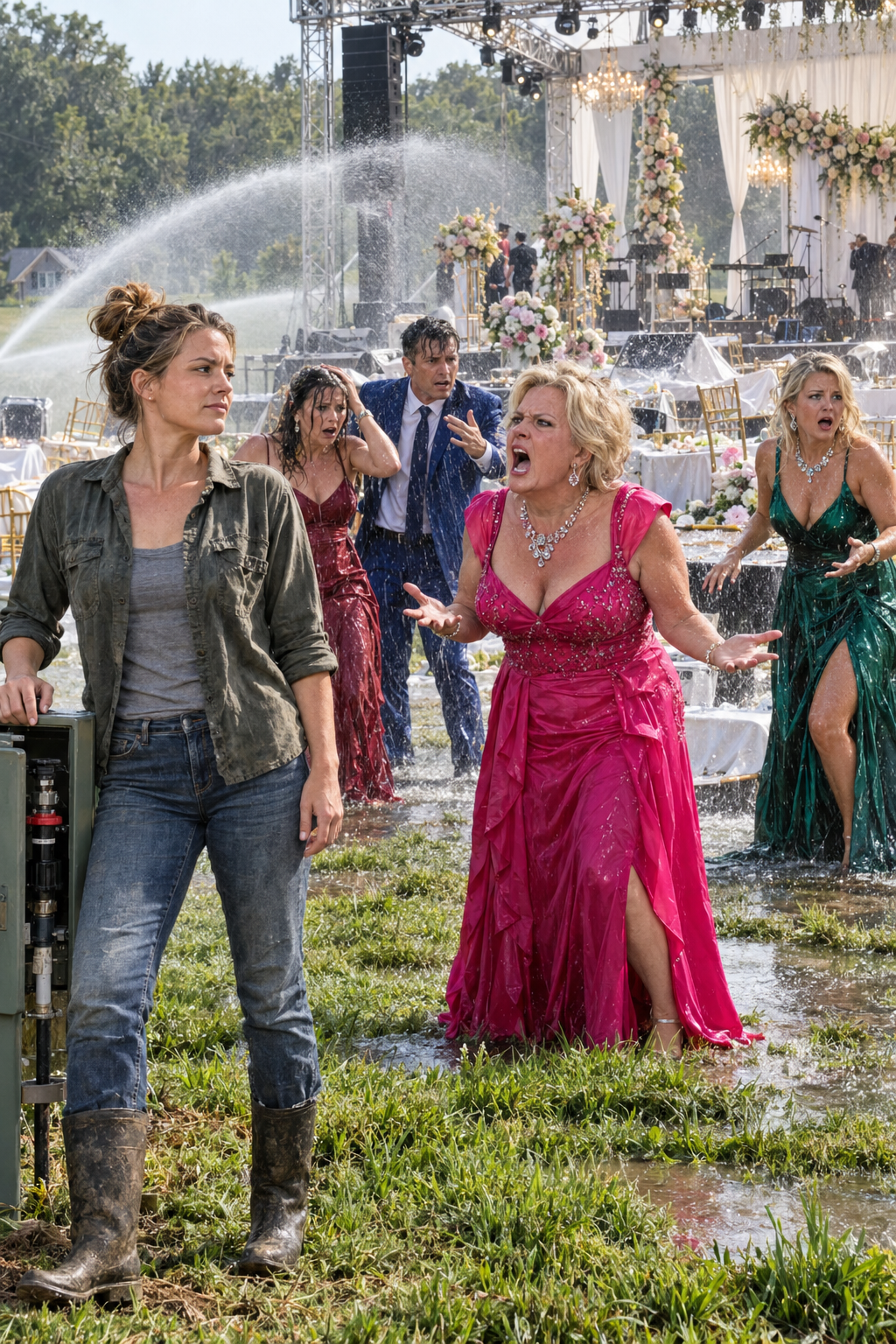
Karen Built a Festival Stage on My Farm Without Permission—Then My Sprinklers Exposed What She Was Really Doing
The first thing Karen Whitfield said when I found forty-seven strangers building a concert stage in my hay field was, “You should be grateful. Your land finally has a purpose.”
The second thing she said was worse.
“If you interfere, Daniel, I’ll have the sheriff remove you.”
From my own property.
I stood beside my pickup with one hand resting on the warm hood and looked past her at the circus unfolding across twelve acres my grandfather had bought in 1968.
Forklifts crawled over the grass.
Men in orange vests were unloading steel barricades.
A white event tent the size of a basketball court had already gone up near the south fence.
Portable toilets stood in two neat blue rows beside my irrigation shed.
And directly over the spot where my father had taught me to throw a baseball, six workers were bolting together a black steel stage twenty feet high.
A banner stretched across the front.
CEDAR RIDGE SUMMER CELEBRATION.
Presented by the Cedar Ridge Homeowners Association.
There was even a gold VIP section.
On my field.
Karen stood in front of me wearing white slacks, a coral blouse, oversized sunglasses, and the expression of a woman explaining parking rules to someone she considered intellectually defective.
She was fifty-eight and had been president of Cedar Ridge HOA for six years.
Cedar Ridge was a subdivision of eighty-four expensive houses built along the eastern edge of my property outside Lexington, Kentucky.
I wasn’t part of it.
Never had been.
My farm predated Cedar Ridge by almost forty years.
That distinction had annoyed Karen from the moment she became HOA president.
She liked straight curbs.
I had gravel roads.
She liked approved paint colors.
I had a red equipment barn that had faded to something closer to rust.
She liked committees.
I liked gates.
Most important, she controlled Cedar Ridge.
She did not control me.
Apparently, she’d decided the solution was to pretend otherwise.
I looked at the stage again.
“When did you decide you owned my field?”
Karen gave a little laugh.
“Oh, Daniel.”
That laugh told me almost everything I needed to know.
Not because it was loud.
Because it was practiced.
The laugh of someone who believed embarrassment could substitute for authority.
She lowered her sunglasses just enough to look at me over the frames.
“We sent notice.”
“No, you didn’t.”
“We absolutely did.”
“To the property owner.”
“You’re looking at him.”
Her smile tightened.
Behind her, a forklift beeped as it reversed across my grass.
I could smell diesel.
Fresh-cut hay.
Something else too.
The sharp chemical smell of marking paint.
Blue lines had been sprayed through my field, outlining temporary roads and parking lanes.
They hadn’t just wandered onto my property.
They had planned this.
Measured it.
Scheduled contractors.
Sold tickets.
Karen tilted her head toward the stage.
“We’re expecting nearly nine hundred people Saturday. Vendors, families, sponsors, local press. The mayor is giving remarks at six. It would be extremely embarrassing if you caused a scene now.”
I checked my watch.
Three days away.
“You sold nine hundred tickets to an event on land you don’t own?”
Her mouth shifted.
Just slightly.
There it was.
Calculation.
“We have authorization.”
“The paperwork isn’t here.”
“Of course it isn’t.”
“Daniel, don’t make this difficult.”
I looked around my field again.
Don’t make this difficult.
They had broken my gate lock.
Don’t make this difficult.
They had driven trucks over my hay.
Don’t make this difficult.
They had planted steel supports in my soil.
Don’t make this difficult.
They had sold access to my property.
Don’t make this difficult.
They had built an entire public event around the assumption that I would be too shocked, too polite, or too afraid to stop them.
I looked back at Karen.
“You have twenty minutes.”
She blinked.
“For what?”
“To get everybody off my land.”
The smile disappeared.
Her sunglasses went back up.
“You don’t have authority to shut down an HOA-sponsored civic event.”
“I have a deed.”
“You also have obligations as an adjacent landowner.”
I didn’t raise my voice.
That bothered her more.
People like Karen expected resistance to arrive screaming.
Screaming could be called irrational.
Screaming could be filmed.
Screaming could be edited into a thirty-second neighborhood Facebook video titled UNHINGED FARMER THREATENS FAMILIES.
I wasn’t going to give her that.
I pulled out my phone.
Karen immediately held up one palm.
“If you’re calling the police, I’ve already spoken with Sheriff Bell’s office.”
“I’m not calling the police.”
That made her hesitate.
I opened the camera instead.
I slowly filmed the stage.
The forklifts.
The vendor tents.
License plates.
Company logos.
Temporary power cables.
Every face I could capture.
Then I turned the camera toward the nearest construction supervisor.
A broad man with a sunburned neck saw me recording and walked over.
“Can I help you?”
He frowned.
“Excuse me?”
“Your name.”
“Last name?”
He looked at Karen.
Karen said, “You do not have to answer him.”
I kept my eyes on Mark.
“You’re standing on private property without the owner’s permission. I’m the owner. I’d like the name of the person supervising the work.”
His face changed.
Not dramatically.
But enough.
“Private property?”
Karen stepped between us.
“Mark, ignore him. We have a use agreement.”
I looked at him.
“Have you seen it?”
Mark looked at her.
Then at me.
Then back at her.
Karen’s jaw flexed.
“Because that’s not your department.”
I asked, “Who hired you?”
“The HOA hired the event company. Event company hired us.”
“Who’s the event company?”
He pointed toward the white tent.
“Bluegrass Event Group.”
“Thank you.”
Karen snapped, “Mark.”
He stopped.
“You continue working. We have a contract.”
Mark’s expression said he suddenly wished he had picked a different job site.
I walked past them toward the white tent.
Karen followed me.
I kept walking.
Still walking.
“You are trespassing in an active construction zone.”
That almost made me smile.
I turned around.
We were standing thirty yards inside my property.
“Say that again.”
Her face reddened.
Two workers nearby stopped carrying barricades.
Karen noticed.
“There’s no need to perform.”
“You just accused me of trespassing on my own farm.”
“During permitted event setup.”
“Show me the permit.”
“It isn’t my responsibility to carry municipal documents around for your personal inspection.”
“Then we’re done.”
I reached the white tent.
Inside were folding tables, radios, cases of bottled water, printed maps and stacks of laminated passes.
A young woman with a headset looked up from a laptop.
“Can I help you?”
“Yes. Who’s in charge?”
A man in a navy polo came from behind a table.
“I’m Ethan Cole, site director.”
I introduced myself.
Then I asked him a simple question.
“Mr. Cole, who told you Bluegrass Event Group had permission to use this property?”
Karen answered before he could.
Ethan looked from her to me.
I said, “Do you have a signed land-use agreement?”
Karen said, “Ethan, we covered this.”
“I’m asking him.”
“And I’m telling you this has already been handled.”
Ethan slowly closed the binder he’d been holding.
“Mr. Mercer, I was provided a site authorization packet.”
“Can I see it?”
Karen snapped, “No.”
Ethan didn’t move.
That told me something.
He wasn’t stupid.
Whatever Karen had given him suddenly mattered more than keeping her happy.
He opened the binder again.
Karen reached toward it.
He stepped back.
Her hand froze.
His voice was calm.
“If he’s claiming ownership, I need to verify.”
“I have verified.”
“I need to verify.”
For the first time that morning, Karen looked uncertain.
Ethan pulled several stapled pages from the binder.
He turned them around.
There it was.
A one-page authorization form.
PROPERTY USE CONSENT.
Address: 1740 Mercer Farm Road.
Parcel number: mine.
Event dates: July 16 through July 19.
Authorized by: Daniel Mercer.
My property.
My supposed signature.
I stared at it.
Someone had signed my name.
Very badly.
They had even misspelled my middle initial.
I was Daniel R. Mercer.
The form said Daniel P. Mercer.
I took a photograph.
Karen said, “That document is confidential.”
I took another.
“Stop photographing it.”
Ethan wasn’t stopping me.
Karen stepped forward.
“Give me the packet.”
He ignored her.
I asked, “Where did this come from?”
Ethan rubbed his mouth.
“It was included in the approval file.”
“Who sent it?”
He looked at Karen.
That was enough.
Karen crossed her arms.
“You’re being dramatic over a clerical issue.”
“A forged signature isn’t clerical.”
“No one forged anything.”
“My name is signed.”
“It may have been your farm manager.”
“I don’t have a farm manager.”
“Your attorney.”
“My attorney doesn’t sign my name.”
“A relative?”
“My parents are dead. I’m divorced. My daughter lives in Nashville.”
Karen sighed loudly.
“Then perhaps you’ve forgotten signing it.”
That was impressive.
Not convincing.
Impressive.
I leaned closer.
“You think I forgot giving nine hundred strangers permission to hold a festival in my hay field?”
“I think you’ve been under stress.”
There it was.
I wasn’t the owner whose signature had been forged.
I was confused.
Karen had used the same tactic on three homeowners in Cedar Ridge who challenged special assessments.
Everyone knew the pattern.
Question her numbers, and you were “angry.”
Ask for records, and you were “obsessed.”
Disagree publicly, and you were “creating a hostile environment.”
Now I was “under stress.”
Ethan cleared his throat.
“I’m going to pause setup.”
Karen spun toward him.
“You will not.”
“Until ownership is confirmed.”
“We paid your company twenty-eight thousand dollars.”
“And my insurance carrier would love to know whether we’re erecting a public structure on private land using fraudulent authorization.”
Her face went still.
A forklift stopped moving.
Then another.
Workers began looking toward us.
Karen stepped closer to Ethan.
“If you shut this down, Bluegrass Event Group will never work another Cedar Ridge event.”
Ethan’s eyebrows rose.
“Karen, I’ve been running events for twenty-two years. That’s not the threat you think it is.”
I liked Ethan.
Karen did not.
She pulled out her phone and walked away fast.
I heard her say, “Call Leonard. Now.”
That name mattered.
Leonard Pike.
Vice president of the HOA.
Real estate broker.
Professional smile.
He’d spent two years trying to buy the southern half of my farm for a proposed expansion.
I’d rejected every offer.
The last one had been $1.7 million.
It sounded like a lot until you understood what they wanted.
My south field was the only large flat tract between Cedar Ridge and County Route 18.
Without it, the subdivision had one narrow entrance.
With it, a developer could add another hundred homes and build a second access road.
I had no interest in selling.
Leonard had never seemed offended.
He’d just kept increasing the offer.
Maybe I had mistaken patience for acceptance.
I called my attorney.
Rachel Monroe answered on the second ring.
“I need you at the farm.”
“What happened?”
“Someone forged my signature on a property-use consent and built half a concert venue in my field.”
There was a pause.
“How half?”
“Twenty-foot stage. VIP tents. Toilets. Barricades.”
Another pause.
“You’re serious.”
“I wish I weren’t.”
“Don’t touch anything.”
“I wasn’t planning to.”
“Don’t threaten anyone.”
“I haven’t.”
“Don’t shut off power.”
“Wasn’t planning to.”
“Don’t move their equipment.”
“They broke my gate.”
This time the pause was shorter.
“I’ll be there in forty minutes.”
She arrived in thirty-two.
By then, setup had stopped.
Most workers were sitting under tents drinking water.
Two Cedar Ridge board members had arrived.
So had Leonard Pike.
He stepped out of a black Mercedes wearing tan trousers and a pale-blue shirt with the sleeves rolled to his elbows.
He smiled when he saw me.
Not a worried smile.
A salesman smile.
He looked over my shoulder at the frozen work site.
“Seems we’ve got a misunderstanding.”
Rachel parked beside my truck and got out carrying a leather folder.
Leonard’s smile weakened.
She knew him.
Of course she did.
Lexington wasn’t that big.
Karen came marching over behind him.
“Daniel has shut down the event based on an obvious paperwork discrepancy.”
Rachel looked at me.
“Did you shut it down?”
Ethan raised his hand from ten feet away.
Rachel nodded.
Karen looked irritated.
Leonard slipped his hands into his pockets.
“Can we have a reasonable conversation?”
Rachel said, “Absolutely. Start by explaining the signature.”
Leonard glanced at Karen.
Karen glanced at Leonard.
Less than a second.
But I saw it.
Rachel saw it too.
Leonard shrugged.
“I haven’t inspected the form.”
I held up my phone.
“You’ve seen this authorization before?”
Karen said quickly, “The administrative office handled it.”
Rachel asked, “Which administrative office?”
“Our management company.”
“Hawthorne Community Services.”
“And who at Hawthorne prepared the document?”
“I don’t know.”
Rachel smiled without warmth.
“Excellent. Then we’ll ask them.”
Karen frowned.
“There is no reason to turn this into litigation.”
Rachel said, “Nobody mentioned litigation.”
Karen’s eyes flicked toward me.
That was interesting.
Without meaning to.
Leonard moved closer.
“Daniel, the community has already committed almost ninety thousand dollars to this event. Food vendors. Music. Children’s activities. Local charities. You’ve seen the posters.”
“I haven’t.”
“It’s for the whole area.”
“Not my area.”
He gestured toward the stage.
“Look around. The infrastructure is already here. Give us three days. We’ll compensate you.”
“How much?”
Karen looked relieved.
Leonard looked confident.
“Five thousand.”
Not because the amount was insulting.
Because it confirmed something.
They still believed this was about money.
“Twenty-seven trucks drove onto my land. You cut my gate. You damaged a hay field worth more than five thousand. Someone forged my signature. And your answer is five grand?”
“Name a number.”
“No number.”
Karen’s voice hardened.
“Then you’re deliberately sabotaging a community event.”
Rachel turned toward her.
“Karen, I recommend you stop speaking.”
“Excuse me?”
“You’re standing on my client’s property beside a document bearing what appears to be his forged signature. Every additional sentence is becoming increasingly useful.”
Karen stared at her.
Rachel was five-foot-four, maybe one hundred twenty pounds, and had the calmest courtroom voice I’d ever heard.
It was the kind of voice that made loud people suddenly notice how loud they were being.
Leonard stepped between them.
“Let’s reset.”
“No,” I said.
He looked at me.
“The answer is no.”
His smile finally vanished.
I pointed toward the road.
“You have until six tonight to remove everything that can safely be removed.”
Karen said, “We cannot dismantle this stage in five hours.”
“Then start.”
“You don’t understand the contractual obligations here.”
“I understand ownership.”
“The county approved this event.”
“Not on my property.”
Leonard studied me.
His eyes moved toward the irrigation shed.
Then toward the far end of the field.
“Six o’clock?”
He nodded slowly.
Karen turned on him.
He touched her elbow.
“Let’s talk.”
They walked toward his Mercedes.
Rachel waited until they were fifty yards away.
Then she said quietly, “They’re not leaving.”
“Because that’s when my irrigation cycle starts.”
She turned her head toward me.
“You said you weren’t going to touch anything.”
She followed my gaze.
The south field had an underground irrigation system my father and I installed fifteen years earlier when we experimented with alfalfa.
Six industrial impact sprinklers sat on risers throughout the field.
They weren’t delicate lawn sprinklers.
Each one could throw water nearly a hundred feet.
Running together, they covered almost the entire open area around the stage.
Rachel stared at them.
Then at me.
“You are not going to turn sprinklers on while electrical equipment is connected.”
“The automatic system will.”
She closed her eyes.
“It’s scheduled.”
“Can you turn it off?”
“Of course.”
“So legally, don’t pretend you can’t.”
“I wasn’t going to.”
She looked toward the stage.
Then toward Ethan.
“Tell the event company about the irrigation.”
Ethan listened.
Then he looked at the sprinkler heads.
“What pressure?”
“About eighty PSI.”
He whistled softly.
“You serious?”
He checked his watch.
It was .
He turned toward the stage crew and shouted, “Guys, we’re breaking this down now.”
That changed the mood.
Before, the workers had been waiting for a paperwork dispute to resolve.
Now they moved.
Speakers were disconnected.
Lighting rigs came down.
Electrical cables were coiled.
Tent walls disappeared.
Cases rolled toward trucks.
Karen noticed within minutes.
She stormed out from beside Leonard’s Mercedes.
“What are you doing?”
Ethan didn’t stop.
“Protecting my equipment.”
“I told you the event is proceeding.”
“The property owner says irrigation comes on at six.”
She looked at me.
“You wouldn’t.”
I said nothing.
“Daniel, there are tens of thousands of dollars in electronics here.”
“Then I’d move them.”
“You would intentionally destroy contracted equipment?”
“That is exactly what you’re threatening.”
“No. I’m informing you that an agricultural irrigation system operates on agricultural property.”
She stared at me.
Rachel said, “He has also provided more than four hours’ notice.”
Karen turned to her.
“You think that’s clever?”
“I think it’s documented.”
The next four hours were the most productive four hours Cedar Ridge HOA had ever managed.
By three, the expensive speakers were gone.
By four, the VIP tent had been dismantled.
By five, half the stage decking had been loaded onto a flatbed.
But Karen had apparently drawn a line.
The main steel stage frame remained.
So did the decorative arch.
So did several sponsor signs.
So did the portable toilets.
And more strangely, so did dozens of wooden stakes hammered into the ground across the western half of the field.
I hadn’t noticed them at first because of the vehicles.
Now that the field was clearing, I did.
Orange survey ribbons.
They were arranged in rows.
Not parking rows.
I walked toward one.
Leonard saw me.
He immediately started walking too.
That was the first moment all day when I saw genuine urgency in him.
I crouched beside a stake.
A small aluminum tag had been stapled to it.
I looked toward the next.
Rachel joined me.
She didn’t speak.
Leonard arrived several seconds later.
“Those are for vendor placement.”
I looked at him.
“Vendor placement?”
I pointed toward the stakes.
“In quarter-acre rectangles?”
“Temporary layout.”
“Why are they numbered as lots?”
“It’s how the planner organizes things.”
Rachel pulled out her phone.
Leonard’s voice sharpened.
“Please don’t photograph internal event markings.”
Rachel took the picture.
“No reason.”
Another picture.
Karen hurried over.
“What now?”
I pointed at the stakes.
“Your vendors apparently need setbacks.”
Karen stared at them.
For half a heartbeat, she looked surprised.
Not fake surprised.
Real surprised.
Then it vanished.
“They’re markers.”
“For what?”
“The festival.”
“Leonard says vendors.”
“What kind?”
“Food. Crafts. Sponsors.”
“Then why are they aligned with Cedar Ridge’s eastern road?”
Neither answered.
Rachel looked toward the subdivision.
My field bordered Hawthorn Lane, a dead-end road inside Cedar Ridge.
It stopped at my fence.
Had always stopped there.
The survey stakes began exactly where Hawthorn Lane ended.
A straight line of them continued across my land toward County Route 18.
A future road.
I could see it without needing a map.
Rachel could too.
“Daniel,” she said quietly.
Leonard shoved his hands into his pockets.
“Coincidence.”
I looked at him.
He held my gaze.
There was something different in his face now.
The salesman had left.
What remained was harder.
“We made you offers,” he said.
Karen turned.
He ignored her.
“Repeatedly.”
“Generous offers.”
“I said no.”
“You own one hundred thirty-seven acres, Daniel.”
“You actively use maybe sixty.”
“That isn’t your concern.”
“Cedar Ridge is boxed in. Everyone knows it.”
“Still not my concern.”
“The county wants another emergency access route.”
“The county has never contacted me.”
“They will.”
Rachel asked, “Is that a threat?”
Leonard smiled again.
Smaller this time.
“No. It’s reality.”
A truck engine started behind us.
He looked back at the half-dismantled stage.
“People get emotional about land.”
I stared at him.
“My grandfather is buried on this farm.”
That answer stuck with me.
Not because it was cruel.
Because it was revealing.
He thought attachment made me irrational.
Predictable.
People like Leonard never understood land unless it had a price per acre.
My grandfather didn’t leave me acreage.
He left me memories with boundary lines.
The walnut tree where my parents got engaged.
The creek where my daughter caught her first fish.
The barn where my father died of a heart attack at sixty-nine while repairing a baler he had no business repairing alone.
The ridge where we scattered my mother’s ashes because she’d said she wanted to “see the sunsets without having to mow anything.”
You could put numbers on the deed.
Not on the place.
At , Ethan approached me.
“Anything left with power is disconnected.”
“People clear?”
He glanced at the stage.
“Frame’s staying overnight.”
“Karen refused the removal charge.”
“Removal charge?”
“Our crew can finish tonight. Overtime. She won’t authorize it.”
Karen was standing twenty yards away.
I called over.
“Six o’clock.”
She checked her phone.
“You seriously intend to flood your own field because you’re having a tantrum?”
“Then shut off the sprinklers.”
“There is no agricultural need to water this field tonight.”
I looked at the cracked July soil beneath her expensive sandals.
“You’re an irrigation specialist now?”
“I have eyes.”
“Good. Use them to find the road.”
Several workers laughed.
Karen heard them.
Her face hardened.
“You’ve wanted to embarrass me for years.”
That caught me off guard.
Not because it was true.
Because I barely thought about her.
“Karen, I don’t care enough about you to spend years planning your embarrassment.”
That landed harder than any insult I could have invented.
At , she called the sheriff.
I know because she put him on speaker.
“Sheriff Bell, I’m standing on Mercer Farm, and the owner is threatening to activate industrial irrigation equipment while contractors are still dismantling an approved public venue.”
A man’s voice responded.
“Is anybody in danger?”
“He is creating the danger.”
“Are electrical systems energized?”
Ethan called out, “No, sir.”
“Who’s that?”
“Ethan Cole, Bluegrass Event Group. Site director. We’ve disconnected power and cleared personnel from the sprinkler coverage area.”
The sheriff paused.
“Then what exactly are you asking me to do?”
“Stop him.”
“From irrigating his property?”
Karen lowered the phone.
Her nostrils flared.
She took the call off speaker.
Rachel turned away to hide a smile.
At , the remaining workers moved to the gravel drive.
At , Karen still stood beside the stage.
“Karen,” Leonard said.
She ignored him.
I looked at my watch.
She folded her arms.
“You want your viral little moment? Go ahead.”
I said, “Move.”
“This is intimidation.”
“Move out of sprinkler range.”
“I am not moving.”
I looked at Ethan.
He shrugged.
Rachel said quietly, “You warned her.”
The irrigation pump started at exactly six.
You could hear it before you saw anything.
A deep mechanical hum from the pump house.
Then a shudder beneath the ground.
Then the first sprinkler rose.
Water exploded from the brass nozzle.
A heavy stream shot across the field, caught the late-afternoon sun, and slammed into the side of the stage.
Karen jumped.
The second sprinkler fired.
Then the third.
Then all six.
Within five seconds, the dry field became a moving cage of water.
Jets swept in wide arcs.
The steel stage rang like a drum.
Sponsor signs folded.
Orange ribbons snapped sideways.
Dust turned to mud.
Her white slacks lasted maybe twelve seconds.
The first stream hit her from behind.
It wasn’t dangerous.
But it was spectacular.
Water flattened her coral blouse against her back and knocked her giant sunglasses into the grass.
She screamed.
Workers erupted.
Some laughed.
Some filmed.
Leonard sprinted toward his Mercedes.
Karen slipped once, caught herself on a barricade, and staggered through knee-high wet grass with both arms extended.
“This is assault!”
Another sprinkler rotated.
She ducked.
“This is criminal assault!”
Rachel called back, “It’s water, Karen.”
“I am calling the police!”
“You already did!”
By then, even I was smiling.
Not because she was soaked.
Because for the first time all day, something on my farm was behaving exactly as it was supposed to.
The sprinkler nearest us clicked rhythmically.
The stream swept away.
Swept away again.
Water darkened the soil.
Mud formed around the survey stakes.
And that’s when the day changed.
One of the stakes tipped over.
Not unusual.
Except something metallic came up with it.
I saw a flash beneath the mud.
At first I thought it was an old pipe.
Then another sprinkler washed more soil aside.
A rectangular steel plate appeared about six inches below the surface.
Rachel saw it too.
“What is that?”
I walked closer.
Ethan followed.
Karen stopped yelling.
That was the detail I remember most.
The moment the metal became visible, she went silent.
I crouched in the mud.
The plate was maybe twelve inches wide.
Four bolts.
A small stamped number.
USGS-74-118.
Rachel took a picture.
Leonard was halfway to his car.
He stopped.
Then slowly turned around.
I brushed mud from the metal.
Beside the plate was an old concrete marker buried nearly flush with the ground.
A survey monument.
I knew we had markers on the farm.
But not this one.
My grandfather’s original survey used iron pins and stone references.
This was newer.
Rachel searched the number on her phone.
“No signal.”
I looked toward Karen.
“What is this?”
She was soaked.
Hair stuck to her cheeks.
Mud on her slacks.
But she wasn’t angry anymore.
She was scared.
“Probably an old utility marker.”
Leonard called from near his car.
“Leave it alone, Daniel.”
I turned toward him.
“Because you don’t know what it is.”
“Neither do you, apparently.”
He didn’t answer.
Rachel looked between us.
“You do know.”
Leonard opened his car door.
“I’m done here.”
“What is it?”
He climbed inside.
Karen hurried after him.
I called, “Your stage is still here.”
He started the engine.
She yanked open the passenger door.
I watched them leave together.
Much too fast.
At , almost everyone was gone.
Ethan left two men to guard the remaining steel structure and promised removal first thing in the morning.
The sprinklers ran until seven.
When they stopped, the field looked battered but peaceful.
A half-naked stage skeleton.
Collapsed sponsor banners.
And that metal plate.
Rachel and I stayed beside it.
I called my neighbor, Frank Dorsey.
Frank was seventy-two, retired from the county road department and knew more about local land history than anyone alive.
He arrived in an old F-250 carrying a flashlight despite the fact that the sun was still up.
He crouched beside the plate.
His expression changed almost immediately.
“Well,” he said.
“Where’d you find this?”
“Under the survey stake.”
He looked toward Cedar Ridge.
Then toward County Route 18.
“Interesting.”
He stood slowly.
“Back in the seventies, before your granddad bought the north tract, state surveyors mapped a transportation corridor through here.”
Rachel asked, “Road?”
“Plans changed.”
“For what?”
Frank rubbed mud from his hand onto his jeans.
“There was talk of a state connector. Never built.”
I looked at the plate.
“So this marks the corridor?”
“Why would the HOA care?”
Frank stared toward Cedar Ridge again.
“Because old transportation corridors sometimes create easements.”
Rachel shook her head.
“Not automatically.”
“No. But developers love old paperwork. Especially paperwork nobody remembers.”
My stomach tightened.
I thought about the stakes.
The straight line from Hawthorn Lane.
Leonard’s offers.
The forged event permission.
The strange insistence on using this exact field when Cedar Ridge had a perfectly good clubhouse lawn.
Maybe the festival wasn’t the objective.
Maybe it was cover.
“What if they were surveying something?” I asked.
Rachel looked at me.
“While pretending to set up an event?”
“They had crews here all day.”
Frank pointed at the numbered stakes.
“That ain’t festival spacing.”
Rachel walked to the nearest one.
She photographed the tag again.
Then another.
And another.
“Don’t touch anything,” she said.
For the second time that day.
At , the last Bluegrass Event truck left.
Rachel went home with copies of the forged authorization.
Frank left ten minutes later.
I locked the replacement chain across my gate.
Then I drove my truck toward the farmhouse.
Halfway there, I stopped.
Something bothered me.
The portable toilets were gone.
The tents were gone.
The equipment was gone.
But near the western fence, one small white utility trailer remained.
No license plate I could see from the house.
I assumed it belonged to the stage crew.
Still, I took a photograph.
Then I went inside.
I didn’t sleep much.
At a.m., motion alerts woke me.
Three cameras.
South gate.
Equipment barn.
I grabbed my phone.
Headlights.
A dark pickup had entered the farm.
Not through the main gate.
Through the old cattle entrance near the creek.
Someone had cut the chain.
I pulled on jeans and boots.
Then I stopped.
I wasn’t twenty-five anymore.
I wasn’t going outside in the dark to confront strangers over land.
I called the sheriff.
Then I opened the camera feed again.
Two people got out.
One was carrying a shovel.
The other had something that looked like a metal detector.
They walked straight toward the buried survey monument.
Not toward the stage.
Not toward the trailers.
The monument.
That answered one question.
They knew it was there.
I zoomed in.
The person with the shovel wore a baseball cap.
The other wore a hood.
They reached the marker.
The hooded figure pointed.
The man with the shovel started digging.
I hit record.
At , headlights appeared on Mercer Farm Road.
Sheriff’s cruiser.
The two figures saw it.
One disappeared toward the creek.
The other sprinted to the pickup.
The truck tore across the field without its passenger and disappeared through the cattle entrance.
Deputy Nolan Price found the abandoned shovel.
No fingerprints we could see.
Cheap hardware-store gloves lay nearby.
And something else.
A folded sheet of waterproof paper half-buried in the mud.
The deputy opened it.
A survey map.
My property.
Cedar Ridge.
County Route 18.
A thick red line crossed my south field.
I recognized the path instantly.
Hawthorn Lane to the highway.
Along the exact line of the numbered stakes.
At the bottom was a project name.
CEDAR RIDGE PHASE IV – EMERGENCY ACCESS CORRIDOR.
Rachel arrived at wearing sweatpants under a trench coat.
She stared at the map under the deputy’s flashlight.
“Phase IV?”
“Never heard of it.”
Deputy Price pointed at a note on the side.
“What’s ‘vesting trigger’?”
Rachel took the map carefully.
Her face went pale.
“What?” I asked.
She didn’t answer.
She looked at the stage.
Then at the field.
Then back at the document.
“A vesting trigger can mean an action that preserves development rights.”
“Depending on the ordinance, demonstrating certain improvements or uses before an approval expires can help a developer argue that a project has legally commenced.”
I stared at her.
“The festival.”
“They weren’t holding an event.”
“Maybe the event was supposed to establish activity on the property.”
“Property they don’t own.”
“Which would explain why they needed your signature.”
That was the first twist.
Karen hadn’t built the stage because she wanted a pretty summer festival.
The stage was evidence.
Or it was supposed to be.
Evidence that something had begun.
And someone had forged my permission to make it look legitimate.
Deputy Price scratched his chin.
“Who’s developing Phase IV?”
We looked at the map.
There was no company name.
Just a project number.
Rachel photographed everything.
The deputy bagged the document.
By dawn, the story had grown much bigger than sprinklers.
At nine, Rachel called the county planning office.
At , she called me back.
“There is no active Phase IV application.”
“No, Daniel. Not good.”
“There was one.”
“Filed seven years ago.”
“Cedar Ridge Development Partners.”
That name was familiar.
They’d built the original subdivision.
“Didn’t they dissolve?”
“Five years ago.”
“So the application is dead.”
“Supposedly.”
“Supposedly?”
“I’m driving to the county clerk.”
At 10:30, the stage crew returned.
Ethan came with them.
Karen didn’t.
Leonard didn’t.
Nobody from the HOA came.
By noon, the steel stage was gone.
Only flattened grass and holes remained.
Ethan handed me his insurance information and a copy of every document Bluegrass Event Group had received.
“Your lawyer asked.”
He hesitated.
“There’s something else.”
He pulled out his phone.
“Karen didn’t originally book this field.”
I looked at him.
“The first site plan was the HOA clubhouse lawn.”
“When did it change?”
“Six weeks ago.”
“Who changed it?”
He opened an email.
SITE LOCATION REVISED.
New location: Mercer South Field.
Reason: improved emergency access and sponsor visibility.
Attached: landowner approval pending final signature.
“Can you send this to Rachel?”
“Already did.”
I looked at him.
“Why are you helping me?”
Ethan glanced across the field.
“Because somebody put my company on private land with a forged document. If you’d been a different kind of owner, my employees could’ve gotten hurt.”
Fair enough.
He pocketed his phone.
“One more thing.”
“Go ahead.”
“The stage orientation.”
“What about it?”
“When we install stages, we anchor based on engineering drawings. Leonard insisted we place it exactly where his markers indicated.”
“The survey stakes?”
“No. There were different markers Monday.”
I stared at him.
“Our layout crew came two days before full setup.”
“I wasn’t here Monday.”
“Nobody was.”
My chest tightened.
I had driven to Nashville Sunday night to visit my daughter and granddaughter.
Returned Wednesday morning.
They knew I was gone.
Ethan continued.
“There were little green flags. Leonard personally moved our stage footprint twelve feet west.”
“He said county compliance.”
“Compliance with what?”
“He didn’t say.”
I thanked him.
Then I walked to where the stage had stood.
Twelve feet west.
I paced it out.
Mud squished beneath my boots.
At the western edge of the old stage footprint, I saw disturbed soil.
Not from support legs.
A narrow rectangular cut.
Freshly filled.
I called Rachel.
She answered immediately.
“Don’t dig.”
I hadn’t even spoken.
“How did you know?”
“Because I know you.”
“There’s disturbed soil under where the stage was.”
“Photograph it. Do not touch it.”
“The planning office found something.”
“A recorded easement.”
My hand tightened around the phone.
“Across my farm?”
“It was recorded in 1974.”
“My grandfather bought this place in 1968.”
“That makes no sense.”
“Who granted it?”
“The document says Robert Mercer.”
I stopped breathing for a second.
Robert Mercer.
My grandfather.
“No. He wouldn’t.”
“I’m looking at the scanned record.”
“For what purpose?”
“Future public roadway and utilities.”
I looked across the wet field.
Cedar Ridge hadn’t existed in 1974.
The land east of us had been cattle pasture.
“Who was the easement granted to?”
“The Commonwealth of Kentucky.”
That was different.
Not a developer.
Not an HOA.
Rachel continued.
“But there’s a handwritten release note dated 1981.”
“So it’s gone.”
“There is that word again.”
“The release references another document that isn’t in the digital archive.”
“What document?”
“Transfer of corridor rights.”
“I don’t know yet.”
I stared toward the buried USGS marker.
Someone had come onto my property at two in the morning to dig it up.
That didn’t happen over dead paperwork.
“When can you know?”
“I’m at records storage now.”
At , two county vehicles arrived.
Not police.
Planning and zoning.
A woman named Melissa Grant introduced herself as a senior compliance officer.
She was polite.
Professional.
And very interested in the survey markers.
“Did you authorize these?”
“Did you authorize the event?”
“Did you sign this?”
She held up a printed copy of the consent form.
Her mouth tightened.
“That’s a problem.”
“I’ve heard.”
She walked the field for nearly an hour.
Measured distances.
Photographed stakes.
Inspected the buried monument.
Then she stood at the end of Hawthorn Lane on the other side of my fence.
Cedar Ridge residents watched from their yards.
By then, news had spread.
A woman I knew slightly, Megan Foster, called across the fence.
“Daniel, is the festival canceled?”
“Karen’s Facebook post says you revoked permission after setup and caused thousands in damages.”
Melissa looked at me.
I said nothing.
Megan added, “She says the HOA is suing you.”
Rachel would love that.
I asked Megan, “Did Karen mention the forged signature?”
Megan frowned.
“What forged signature?”
Three nearby neighbors turned their heads.
And just like that, Karen’s version of events developed a crack.
I didn’t need to give a speech.
Didn’t need to accuse her.
Didn’t need to post angry screenshots.
One question was enough.
By two, someone had uploaded a picture of the consent form to the Cedar Ridge community page.
By two-thirty, homeowners were asking why Daniel P. Mercer had signed a document when my name was Daniel R. Mercer.
By three, Karen disabled comments.
At , she deleted the entire post.
At , Leonard called me.
I let it ring.
He called again.
I answered.
“This is getting out of control.”
“No. It’s getting documented.”
Then, “We need to meet.”
“With Rachel present.”
“This doesn’t need lawyers.”
“It already has lawyers.”
“Some old records have created confusion.”
“Interesting choice of words.”
“Look, Cedar Ridge has a legitimate emergency-access issue.”
“Then ask me.”
“You offered to buy my land. That’s different.”
“You wouldn’t cooperate.”
“So you forged my name?”
“I did not forge anything.”
“I don’t know.”
“Who sent the document to Bluegrass?”
“Our management office.”
“Who told Ethan to move the festival into my field?”
More silence.
“Who placed the survey markers?”
“Who sent two people onto my property at two in the morning?”
His voice changed.
There it was.
Maybe genuine.
“Someone came for the federal marker.”
“I don’t know anything about that.”
“The sheriff has the map they dropped.”
This silence lasted longer.
“What map?”
“Phase IV.”
He exhaled.
“Where are you?”
I almost laughed.
“You already know.”
“Listen carefully. Do not give that map to anyone.”
“The sheriff has it.”
For the first time since I’d known him, Leonard sounded afraid.
Not annoyed.
Not calculating.
“That map isn’t what you think.”
“What do I think?”
That word surprised me more than everything else.
“Meet me tonight,” he said.
“Rachel comes.”
“Then no meeting.”
“Daniel, if Karen knows you have that map—”
I went still.
“If Karen knows?”
He stopped.
I looked toward Cedar Ridge.
Her house sat on the hill.
Large brick colonial.
White columns.
American flag over the porch.
“You and Karen aren’t on the same side.”
He hung up.
I stared at the phone.
That was the second twist.
Or the beginning of it.
At four, Rachel came back.
She had copies.
Lots of copies.
She spread them across my kitchen table.
My grandfather’s easement.
The 1981 release note.
Old parcel maps.
County commission minutes.
A faded engineering plan.
And one document that didn’t belong with the others.
A deed transfer.
She tapped it.
“I found the missing reference.”
“Who got the corridor rights?”
She looked at me.
“Your grandfather did.”
“That makes no sense.”
“The state abandoned the road project in 1981. Instead of simply releasing the easement, they transferred any remaining corridor interest back to Robert Mercer.”
“So nobody has rights across my field.”
I leaned back.
“Then what is everybody chasing?”
Rachel slid another paper toward me.
“Read the legal description.”
The old corridor crossed forty-two acres of my south field.
But then it continued.
Past my current western boundary.
Into land that had been separated from the farm in 1993.
Land now occupied by Cedar Ridge.
I looked up.
“The corridor runs through their subdivision.”
“So Robert Mercer owned the reacquired corridor interest before the eastern acreage was sold.”
I stared at the old deed.
“Was it transferred with the land?”
Rachel shook her head.
A cold feeling moved through me.
“Meaning the strip underlying part of Cedar Ridge may never have been legally conveyed.”
I didn’t speak.
She pointed at the map.
“Your grandfather sold the eastern tract in 1993. The deed excluded ‘all previously reserved roadway and corridor interests.’”
“I don’t know.”
“What’s on that corridor now?”
Rachel unfolded a modern parcel map.
Her finger traced a line.
Hawthorn Lane.
Then Willow Court.
I leaned closer.
The clubhouse.
The HOA office.
The swimming pool.
And fourteen houses.
I stared at her.
“You’re saying my family might own strips of land under fourteen houses?”
“I’m saying there is a title question.”
“That sounds insane.”
“It is insane.”
“Wouldn’t title companies have caught it?”
“They should have.”
“But somebody recorded a quitclaim deed in 2008.”
“To clean it up.”
“Apparently.”
“Apparently again.”
“The deed claims Robert Mercer transferred the corridor interest to Cedar Ridge Development Partners.”
“My grandfather died in 2002.”
Rachel slid the deed across the table.
The signature was dated 2008.
Robert Mercer’s signature.
Six years after he was buried beside my grandmother.
I felt the room become very quiet.
There are moments when anger arrives hot.
This wasn’t one of them.
Mine arrived cold.
I looked at the signature.
Then at Rachel.
“They forged my grandfather’s name.”
“It appears so.”
“And now somebody forged mine.”
“Same land.”
“Same corridor.”
I stood and walked to the sink.
Outside, evening light covered the wet field.
The ground glittered.
For years I had thought Leonard wanted my south field because it was valuable for future development.
Maybe that was only half the truth.
Maybe they needed my field because touching it reopened the corridor.
Maybe the festival wasn’t about establishing a new right.
Maybe it was about hiding an old crime.
At , Rachel left to speak with a title investigator.
I stayed home.
At , someone knocked.
He stood on the porch without his salesman smile.
I didn’t invite him in.
“You said Rachel had to be here,” he said.
“She’ll be back.”
“I can’t wait.”
“Then leave.”
He looked over his shoulder toward the road.
“Karen fired me from the board this afternoon.”
“That sounds difficult.”
“The sarcastic farmer act.”
“This isn’t an act.”
He rubbed both hands over his face.
“She knows the old deed is exposed.”
“Which old deed?”
He stared at me.
So he knew.
“The 2008 quitclaim.”
“Did you forge it?”
“I wasn’t involved then.”
“But you knew.”
He hesitated.
“Three years ago.”
“I was handling a refinancing package for the association.”
“The title company flagged the corridor.”
“What did Karen do?”
“She told me it had been resolved.”
“With a signature from a dead man?”
“I didn’t know that part.”
I didn’t believe him completely.
But I believed he was scared.
“You’ve been trying to buy my field.”
“To fix it.”
“If Cedar Ridge Development Partners acquired your south tract from you, they could merge the corridor interests and record corrective instruments.”
“Cedar Ridge Development Partners doesn’t exist.”
“No. Rachel checked.”
“The old company dissolved.”
He looked toward the road again.
“The name was revived eighteen months ago.”
He swallowed.
Now things fit.
Not completely.
“The Phase IV map?”
“She wants an expansion.”
“So you were helping her.”
“At first.”
“At first?”
“She told the board that buying your land would secure emergency access. That’s true. But six months ago, I saw the financing proposal.”
“What proposal?”
“New development. One hundred twelve homes.”
I laughed once.
“You tried buying my farm for $1.7 million so she could build a subdivision.”
“The land is worth more with approvals.”
“How much more?”
He didn’t answer.
“How much, Leonard?”
“Maybe twelve million.”
There it was.
But his face told me money wasn’t the worst part.
“And if I wouldn’t sell?”
“She needed another way to prove control of the corridor.”
“The festival.”
“You forged my signature?”
“Stop lying.”
“I didn’t!”
His voice cracked across the porch.
He immediately lowered it.
“I changed the venue location. I pushed Ethan to use the field. That part is on me.”
“Karen gave me the consent form.”
“You knew it was fake.”
“I suspected.”
“That means you knew.”
He looked down.
Close enough.
I asked, “Why put the stage over that exact spot?”
His face tightened.
“What spot?”
“The disturbed soil.”
He said nothing.
“What did you bury?”
“I didn’t bury anything.”
“Then who did?”
His gaze moved past me into the house.
“Do you still have the Phase IV map?”
“The sheriff does.”
“What about copies?”
“Because Phase IV isn’t the important page.”
I stared at him.
“What page is?”
He reached into his shirt pocket.
He pulled out a folded photograph.
An actual photo.
He handed it to me.
The image showed my south field.
Taken from the air.
Maybe drone footage.
My barn visible at the top.
Cedar Ridge to the east.
Red lines overlaid across the field.
One line was the corridor.
Another outlined something much smaller.
A rectangle.
Exactly where the stage had stood.
“What is that?”
Leonard whispered.
“I don’t know.”
“Then why show me?”
“Because Karen paid a private excavation crew twelve thousand dollars last month.”
I felt my jaw tighten.
“For what?”
“Night work.”
“I think so.”
“You think?”
“She listed it as drainage remediation.”
“There is no HOA drainage system on my property.”
“June twenty-first.”
I remembered June twenty-first.
My daughter had taken me fishing at Dale Hollow for Father’s Day weekend.
I had been gone three nights.
Karen knew that too.
Or someone did.
“What did they do?”
“I couldn’t find the invoice details.”
“You’re a real estate broker. You’re on the board. You expect me to believe you just happened to stumble into all this?”
His eyes hardened.
“I helped her because I thought this was development politics. Land acquisition. Easements. Aggressive paperwork. Things I could justify to myself.”
“A forged signature?”
“I didn’t sign it.”
“You used it.”
He looked away.
Fair point.
I held up the photo.
“What’s in the rectangle?”
“I don’t know.”
“Then we’re going to find out.”
His head snapped toward me.
“Not tonight.”
“Because Karen knows I came here.”
“She tracks the HOA vehicle.”
“You drove your Mercedes.”
“Not today.”
I looked past him.
Parked near the road was a gray Ford Escape.
HOA property sticker in the corner of the windshield.
“You came in her vehicle?”
“It was the only thing available when she kicked me out of the office.”
“Then leave.”
He stepped closer.
“If you dig before the state investigator gets here, you could destroy evidence.”
“What state investigator?”
There it was again.
A sentence he hadn’t meant to say.
I grabbed his arm.
He pulled away.
“I have to go.”
“Who is investigating?”
“Call your lawyer.”
He walked quickly toward the SUV.
I followed him down the steps.
“Who is investigating Karen?”
He started the engine.
Then lowered the window.
“Not Karen.”
He looked directly at me.
“The land.”
Then he drove away.
Rachel returned at .
I showed her the aerial photo.
I told her everything Leonard said.
She listened without interrupting.
When I finished, she put both hands flat on my kitchen table.
“No digging.”
“That’s what he said.”
“For once, Leonard and I agree.”
“I want to know what’s there.”
“We can rent a mini excavator tomorrow.”
“A shovel.”
“My bare hands?”
She took a photo of Leonard’s photograph.
Then zoomed in.
The rectangle was maybe eight feet by twelve.
Near the old federal marker.
Exactly under the western side of where the stage had been built.
Rachel frowned.
She enlarged the lower corner.
Tiny numbers.
Coordinates.
Latitude and longitude.
“This isn’t an event-planning image.”
“Survey or engineering.”
She typed the coordinates into her phone.
The pin landed in my field.
Then she searched the project number printed beside them.
Nothing public.
She tried another database.
At , she called someone.
I couldn’t hear most of it.
Only pieces.
“Yes, tonight.”
“No, I understand.”
“Because someone entered the property last night.”
“Possibly federal.”
That got my attention.
She hung up.
“Who was that?”
“A former law-school classmate.”
“She works environmental enforcement.”
“Environmental?”
Rachel looked at the photo.
“Daniel, federal survey monuments aren’t usually placed randomly.”
“So what if the transportation corridor isn’t the only historical use of this area?”
I stared at her.
“You’re suggesting contamination?”
“I’m suggesting we know nothing.”
I thought of my grandfather.
He farmed this land.
My father farmed this land.
I had spent fifty-seven years walking it.
“There’s nothing buried out there.”
Rachel met my eyes.
“You didn’t know about the monument.”
At , my daughter called.
“Dad, why is there a video online of you pressure-washing an HOA president?”
I rubbed my forehead.
“Hello to you too, Emily.”
“She looks like she got hit by a fire hose.”
“She was warned.”
“Three times?”
Emily laughed.
Then she became serious.
“Are you okay?”
“Don’t do anything stupid.”
“Your lawyer friend already told me.”
“She has used the phrase ‘do not dig’ at least six times.”
I looked out the kitchen window.
The field was dark.
Stage gone.
Only moonlight.
“I won’t dig.”
“I promise.”
After we hung up, I checked the security cameras.
South gate.
Creek entrance.
Field camera—
I stared at it.
The field feed had gone black.
I refreshed.
The other cameras worked.
Rachel saw my expression.
“Field camera’s down.”
“Maybe water damage.”
“How do you know?”
“It survived a tornado warning last year.”
I switched to the exterior porch camera.
A faint light moved in the distance.
Across the field.
Not headlights.
Flashlights.
More than one.
Rachel whispered, “Call the sheriff.”
Then we killed the kitchen lights.
From the dark window, we watched.
One flashlight.
People moving around the old stage footprint.
No vehicle lights.
They had come in on foot.
Rachel called 911 too, added that we had an active trespass with prior attempted evidence removal.
We stayed inside.
That was the smart move.
Every instinct in me hated it.
My grandfather had kept a twelve-gauge over the back door.
My father believed anybody on the property after midnight should be personally introduced to the concept of leaving.
But this wasn’t a stray thief.
Someone had forged deeds across decades.
Someone had revived a dead corporation.
Someone had cut chains.
Someone had come for a survey marker.
Running into a dark field would help nobody.
At , the flashlights suddenly disappeared.
Seconds later, I heard engines.
Not from my driveway.
From Hawthorn Lane inside Cedar Ridge.
Rachel and I looked at each other.
They had entered through the subdivision.
At , two sheriff’s cruisers reached my farm.
Deputies searched the field.
But they found the camera.
They also found fresh tire tracks beside the fence.
And a section of my wire fence had been temporarily unhooked from the posts.
Someone had created a passage from Cedar Ridge.
At 10:05, Deputy Price knocked on the back door.
“Mr. Mercer, you need to see something.”
Rachel and I followed him out.
We crossed the field carrying flashlights.
The grass still smelled wet from irrigation.
Near the old stage site, three deputies stood around the rectangular disturbed patch.
Except it wasn’t just disturbed anymore.
Someone had started digging.
A hole about three feet wide.
Maybe eighteen inches deep.
They hadn’t finished.
Maybe the arrival of police scared them off.
Deputy Price shined his flashlight down.
At the bottom was wood.
Dark with soil.
Parallel boards.
Rachel whispered, “Oh my God.”
I crouched.
The deputy said, “Could be.”
Nobody touched it.
The hole exposed only one corner.
Whatever was buried there was larger than I expected.
Deputy Price immediately called a supervisor.
Then the sheriff himself.
Within forty minutes, my field looked like a crime scene.
Portable lights.
Four cruisers.
Nobody could tell me what was underground because nobody wanted to disturb it until morning.
At 11:28, an unmarked black SUV arrived.
Two people got out.
A man and a woman.
Not county officers.
The woman showed credentials to Sheriff Bell.
They spoke privately.
Then the sheriff walked over to me.
“Mr. Mercer, this is Special Agent Laura Bennett.”
I looked at Rachel.
She looked just as surprised.
The woman held up a badge.
Environmental Protection Agency.
Criminal Investigation Division.
That didn’t make me feel better.
She said, “Mr. Mercer, have you ever excavated this portion of the property?”
“Has your family?”
“Not that I know of.”
“Did you know materials were buried here?”
“Did anyone contact you during the past year about historical industrial use of the property?”
Rachel stepped beside me.
“I represent Mr. Mercer.”
Agent Bennett nodded.
“Understood.”
Then she turned toward the exposed boards.
A technician took photographs.
I asked, “What do you think is under there?”
Bennett studied me for a moment.
“That’s what we’re going to determine.”
“Leonard Pike mentioned a state investigation.”
Her expression changed slightly.
“Who is Leonard Pike?”
I told her.
She wrote the name down.
Then asked, “Where is he?”
“I don’t know.”
She looked at the sheriff.
Something passed between them.
I didn’t like it.
Sheriff Bell said, “We’ve been trying to reach Mr. Pike.”
“Since when?”
“About thirty minutes.”
His radio crackled before he answered.
A deputy’s voice.
“Sheriff, we located the HOA vehicle.”
Bell grabbed the radio.
“Location?”
“Hawthorn Lane.”
“Occupant?”
“Negative.”
“Where’s Pike?”
Another pause.
“We found blood on the driver’s door.”
Rachel went very still.
Agent Bennett immediately walked away, phone already in her hand.
Sheriff Bell started issuing orders.
I stood in the middle of my field under portable lights, staring at a half-exposed wooden structure nobody wanted to open.
Karen’s ridiculous festival suddenly felt like it had happened months ago.
But it had been yesterday.
Yesterday, my problem was trespassing.
Then forgery.
Then a land corridor.
Then a dead man’s signature.
Now a federal agent was on my farm and a missing real estate broker had left blood on an HOA vehicle.
At 12:16 a.m., Agent Bennett returned.
She asked Rachel and me to step away from everyone else.
“Mr. Mercer, I need to ask you a question.”
“Go ahead.”
“Did your grandfather ever work for a company called Hartwell Agricultural Chemical?”
The name meant nothing.
“Your father?”
“Are you certain?”
She studied my face.
She didn’t answer.
Instead, she showed me a black-and-white photograph on her phone.
Four men standing beside barrels.
A warehouse behind them.
Date stamped: 1976.
One man was circled.
I looked closer.
My stomach dropped.
The face was younger.
Much younger.
But I knew it.
My grandfather.
Robert Mercer.
I stared at the image.
“That doesn’t make sense.”
“What doesn’t?”
“He was a farmer.”
“Was he ever employed elsewhere?”
“Not that I know.”
Agent Bennett swiped to another image.
A scanned shipping record.
Destination:
MERCER TRACT – TEMPORARY STORAGE SITE.
I felt Rachel move closer.
“What was stored?” she asked.
Bennett locked the phone.
“We don’t know yet.”
She did know.
Or suspected.
I could see it.
“Is that why you’re here?”
“We’ve been reviewing records from Hartwell’s successor company.”
“For how long?”
“Several months.”
“Did Karen know?”
Bennett’s eyes narrowed.
“Who exactly is Karen?”
I almost laughed.
Instead, I told her.
HOA president.
Revived development company.
Forged paperwork.
Survey stakes.
The nighttime trespass.
Everything.
She listened.
When I reached the part about the stage, she interrupted.
“Where exactly was it positioned?”
“Over there.”
“Over the disturbed ground?”
“Partially.”
She turned immediately.
Something in her voice made everyone move.
She crossed the field to the exposed boards.
The technician joined her.
They talked quietly.
Then Bennett came back.
“Everyone needs to leave this area.”
Rachel asked, “Why?”
“We’re establishing a larger perimeter.”
“Hazardous material?”
“I can’t confirm that.”
“Can you rule it out?”
Bennett didn’t answer.
That was answer enough.
By a.m., the south field was closed.
Federal tape crossed my own gate.
An officer told me not to enter forty acres of my property.
I stood beside my farmhouse and watched portable lights glow across the grass.
Then my phone rang.
Unknown number.
I answered.
Then a man’s voice.
I straightened.
“Where are you?”
Rachel looked at me.
He whispered, “Don’t tell them I’m calling.”
“Who’s them?”
“The police.”
“You’re bleeding.”
“How do you know?”
“They found the vehicle.”
Another pause.
“Listen to me. Karen didn’t start this.”
“She inherited it.”
“From who?”
“She found records after her husband died.”
I knew Karen had been widowed eight years.
Her husband, Douglas Whitfield, had been an attorney.
Real estate.
Commercial contracts.
I suddenly remembered something my father once said.
Whitfield handled the original Cedar Ridge closing.
“Doug?” I asked.
Leonard breathed heavily.
“Where are you?”
“The box under the stage isn’t chemicals.”
Every hair on my arms rose.
I looked toward the federal lights.
“How do you know?”
“Because I saw it opened.”
“Three weeks ago.”
“What is it?”
“What records?”
“Deeds. Payments. Names.”
“Whose names?”
“Everybody who made Cedar Ridge possible.”
I looked at Rachel.
She was trying to hear.
Leonard continued.
“Daniel, the 2008 deed isn’t the first forgery.”
“How many?”
“What does my grandfather have to do with Hartwell?”
“He found out.”
“Found out what?”
A sharp sound came through the phone.
Leonard gasped.
“Are you hurt?”
“Tell me where you are.”
“Your grandfather didn’t work for Hartwell.”
Agent Bennett was walking toward us now.
Leonard’s voice dropped almost to nothing.
“He was collecting evidence.”
My mouth went dry.
“Evidence of what?”
“They buried more than chemicals.”
The call crackled.
“No one was supposed to find the first box.”
He made a sound like he was trying to breathe through pain.
“There are three.”
“Three boxes?”
The line hissed.
“Three sites.”
Then the call ended.
I called back.
Straight to voicemail.
Agent Bennett reached us.
“Who was that?”
Before I could answer, shouting erupted near the excavation.
A technician backed away from the hole.
Another agent raised one hand.
Everyone froze.
Sheriff Bell hurried over.
“What happened?”
The technician pointed his flashlight into the exposed cavity.
One of the old wooden boards had shifted.
Something beneath it had become visible.
Not a barrel.
Not another wooden crate.
Rachel gripped my sleeve.
I walked one step closer before Agent Bennett blocked me.
“Stay back.”
The technician carefully moved his light.
The beam passed over a rusted steel container.
Then a second object.
For a second, my brain refused to understand what I was looking at.
Then Sheriff Bell whispered one word.
Nobody moved.
The field went silent.
Agent Bennett turned to me.
“Mr. Mercer, go inside.”
I couldn’t.
Because under the place where Karen Whitfield had built her summer festival stage—
under the ground my grandfather had guarded for decades—
beside a federal survey marker someone had tried to remove—
a human skull was staring up through the mud.
And tied around its neck was a rotted plastic evidence tag.
Most of the writing was gone.
But one line was still readable beneath the dirt.
MERCER, ROBERT — WITNESS 04.
✓ Lynn R. Adams
Karen Built a Festival Stage on My Farm Without Permission—Then My Sprinklers Exposed What She Was Really Doing The first thing Karen Whitfield said when I found forty-seven strangers building a conc…